Je schoenen mag je passen. In een orthese moet jij passen.
Daar sta je dan, midden in een schoenwinkel. Rijen vol schoenen strekken zich voor je uit: kleurrijk, stevig, sportief, trendy. Je voeten worden gemeten, je looppatroon geanalyseerd. Wat goed voelt mag mee naar huis. En volgend seizoen? Dan kies je weer wat nieuws.
Beeld je nu in dat je niet mag kiezen wat je draagt, ook al hangt je mobiliteit ervan af. Dit is helaas de realiteit voor veel mensen die aangewezen zijn op een enkel-voet orthese. Hoewel dit hulpmiddel bedoeld is om het stappen te vergemakkelijken, wordt het vaak op één moment ontworpen, zonder mee te groeien met het lichaam of het leven van de gebruiker.
Waar het schoentje wringt
Een enkel-voetorthese, kortweg EVO, is een beugel die de enkel ondersteunt en de voet helpt afrollen tijdens het stappen. Voor mensen met spierzwakte of verlamming, bijvoorbeeld na een beroerte of door een neurologische aandoening, maakt een EVO het verschil tussen een rolstoel en opnieuw zelfstandig kunnen stappen.

Figuur 1: Enkel-voet orthese
Toch zijn er nog heel wat pijnpunten.
Een voorschrift garandeert immers geen goede orthese. Er bestaan nauwelijks richtlijnen over hoe een EVO precies ontworpen moet worden. De uiteindelijke vorm hangt af van de ervaring en voorkeur van de orthopedisch instrumentenmaker. Zelfs de stijfheid, die een invloed heeft op hoeveel energie het stappen kost, wordt vaak puur op gevoel gekozen.
Veel aandoeningen waarvoor een EVO wordt voorgeschreven zijn dan ook dynamisch: mensen herstellen, hervallen, verliezen spiermassa of komen net aan. Alsof dat nog niet genoeg is, verandert het lichaam van de gebruiker vaak sneller dan het hulpmiddel dat moet ondersteunen. Terwijl de noden snel kunnen evolueren, blijft de orthese wat ze was op het moment van aflevering. Door strakke terugbetalingsregels en beperkte aanpasbaarheid zit de gebruiker vaak jarenlang vast aan een hulpmiddel dat al lang niet meer bij zijn lichaam past.
Ontwerpen voor verandering
Die vastgeroeste realiteit vormde het vertrekpunt van mijn masterproef. Wat als een orthese niet ontworpen wordt om te blijven, maar om mee te bewegen? Wat als we vertrekken van verandering in plaats van een momentopname?
Samen met Materialise en orthopedisch experten onderzocht ik hoe een enkel-voetorthese flexibeler ontworpen kan worden, zowel in vorm, werking als gebruik. Niet als één eindproduct, maar als een systeem dat ruimte laat: voor herstel, voor aanpassing, voor verschil.
Met 3D-printing, krachtsimulaties en parametrisch ontwerp verkende ik hoe stijfheid, pasvorm en samenstelling beter kunnen worden afgestemd op de noden van de gebruiker en vooral: hoe dat sneller en eenvoudiger kan worden bijgestuurd wanneer die noden veranderen.
Niet passen, maar aanpassen
Het resultaat is een modulair opgebouwde orthese die bestaat uit drie hoofdelementen: een voetplaat, een verbindende spalk en een bovenstuk rond het onderbeen. Elk onderdeel is ontworpen om apart te kunnen worden aangepast of vervangen, zonder de hele orthese opnieuw te moeten maken. Zo wordt een onveranderlijk product een flexibel product systeem, dat bijgestuurd en afgestemd kan worden op de actuele noden van de gebruiker.
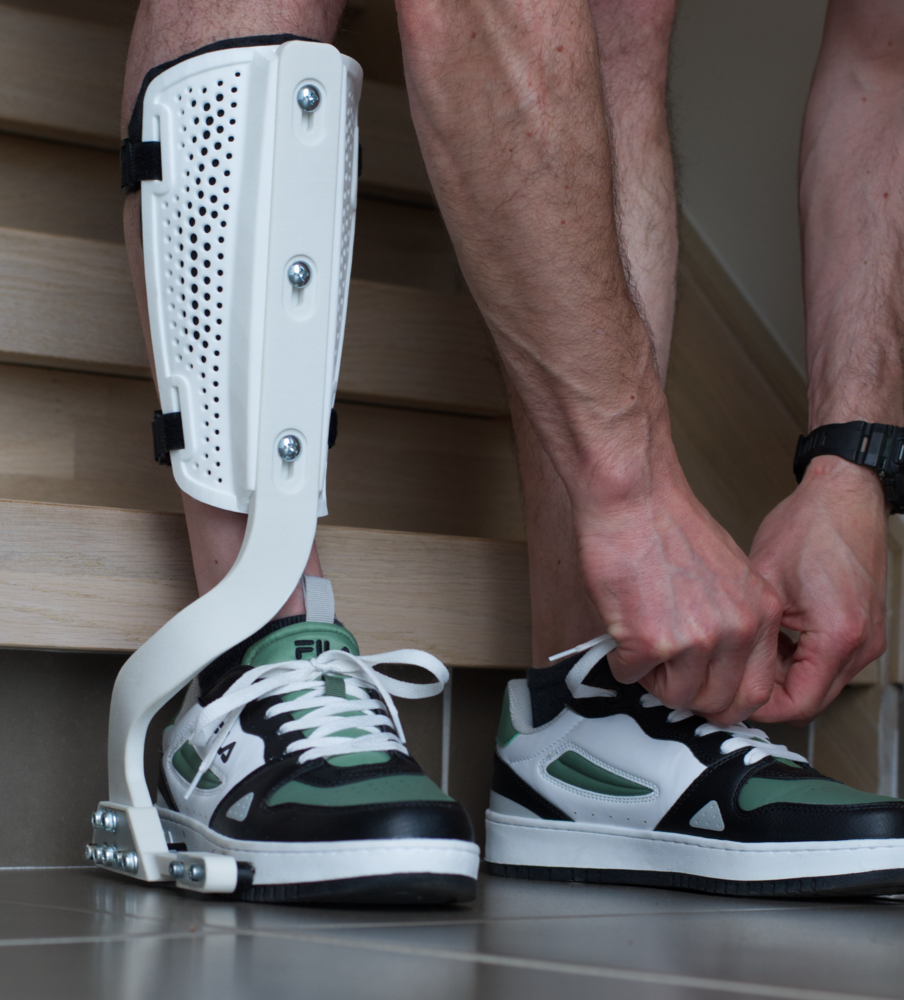
Figuur 2: Finaal prototype
Aan de hand van een aantal digitale en fysieke prototypes onderzocht ik hoe variaties in vorm, stijfheid en materiaalverdeling invloed hebben op de eigenschappen van de orthese. De resultaten tonen aan dat deze manier van werken niet alleen de pasvorm, maar ook het comfort, de bewegingsweerstand en zelfs de esthetiek beter laat aansluiten bij de noden van de patiënt.
Maar daarmee stopt het niet. Deze orthese is niet alleen anders in vorm, ze vraagt ook om een andere manier van werken. In samenwerking met orthopedisch experten onderzocht ik hoe zo’n modulair systeem intuïtief kan worden ingepast in het bestaande zorgproces. Hoe een orthopedisch instrumentenmaker ermee aan de slag kan. Hoe het ontwerp afgestemd kan worden op de gebruiker. En hoe het blijft passen, ook als alles verandert.
De volgende stappen
Deze orthese is maar een begin. De mogelijkheden reiken verder dan het ontwerp alleen. Hoe kunnen orthopedisch instrumentenmakers vlot met dit systeem aan de slag? Hoe brengen we de juiste afstemming tussen vorm, stijfheid en comfort in kaart? En hoe maken we ook het uiterlijk van het hulpmiddel iets waar mensen zich goed in voelen?
Net zoals schoenen meegroeien met je voeten en stijl, moet een orthese kunnen meebewegen met je lichaam en leven. Geen vaste vorm als beperking, maar een flexibel systeem om een dynamisch leven te ondersteunen. Dat is de toekomst van mobiliteit.
Bibliografie
[1] M. Paydar, A. Fard, and M. Khaghani, ‘Pedestrian Walkways for Health in
Shiraz, Iran, the Contribution of Attitudes, and Perceived Environmental
Attributes’, Sustainability, vol. 12, no. 18, p. 7263, Sep. 2020,
doi: 10.3390/su12187263.
[2] World Health Organization, ‘Global recommendations on physical activity
for health’, Recomm. Mond. Sur Act. Phys. Pour Santé, p. 58, 2010.
[3] Y.-T. Park, ‘Emerging New Era of Mobile Health Technologies’, Healthc.
Inform. Res., vol. 22, no. 4, p. 253, 2016, doi: 10.4258/hir.2016.22.4.253.
[4] P. Masrori and P. Van Damme, ‘Amyotrophic lateral sclerosis: a clinical review’,
Eur. J. Neurol., vol. 27, no. 10, pp. 1918–1929, Oct. 2020,
doi: 10.1111/ene.14393.
[5] M. Ma et al., ‘A meta-analysis on the prevalence of Charcot–Marie–Tooth
disease and related inherited peripheral neuropathies’, J. Neurol.,
vol. 270, no. 5, pp. 2468–2482, May 2023, doi: 10.1007/s00415-023-11559-8.
[6] S. Schwab and T. Kesar, ‘Effects of an Articulated Ankle Foot Orthosis on Gait
Biomechanics in Adolescents with Traumatic Brain Injury:
A Case-Series Report’, 2018.
[7] M. W. Whittle, Gait analysis: an introduction, 4th ed., Reprinted. Edinburgh:
Butterworth-Heinemann, Elsevier, 2008.
[8] ISO 8549-1:2020(en) Prosthetics and orthotics — Vocabulary — Part 1:
General terms for external limb prostheses and external orthoses,
ISO 8549-1:2020(en). [Online]. Available:
https://www.iso.org/obp/ui/en/#iso:std:iso:8549:-1:ed-2:v1:en
[9] D. P. Murphy and J. B. Webster, Eds., Atlas of orthoses and assistive devices,
Fifth edition. Philadelphia, PA: Elsevier, 2019.
[10] D. Patrick, ‘Orthotics’, in A Comprehensive Guide to Geriatric Rehabilitation,
Elsevier, 2014, pp. 497–500. doi: 10.1016/B978-0-7020-4588-2.00069-3.
[11] American Board for Certification in Orthotics, Prosthetics & Pedorthics, Inc., ‘
Practice Analysis of Certified Practitioners in the Disciplines of Orthotics and
Prosthetics’, Alexandria, 2022. [Online]. Available: https://www.abcop.org/
individual-certification/get-certified/orthotist-prosthetist/practice-analysisarchive/
[12] Y. J. Choo and M. C. Chang, ‘Commonly Used Types and Recent
Development of Ankle-Foot Orthosis: A Narrative Review’, Healthcare,
vol. 9, no. 8, p. 1046, Aug. 2021, doi: 10.3390/healthcare9081046.
[13] A. Slijper, A. Danielsson, and C. Willén, ‘Ambulatory Function and Perception
of Confidence in Persons with Stroke with a Custom-Made Hinged versus
a Standard Ankle Foot Orthosis’, Rehabil. Res. Pract., vol. 2012,
pp. 1–6, 2012, doi: 10.1155/2012/206495.
[14] D. J. J. Bregman, V. De Groot, P. Van Diggele, H. Meulman, H. Houdijk, and J.
Harlaar, ‘Polypropylene Ankle Foot Orthoses to Overcome Drop-Foot Gait in
Central Neurological Patients: A Mechanical and Functional Evaluation’,
Prosthet. Orthot. Int., vol. 34, no. 3, pp. 293–304, Sep. 2010,
doi: 10.3109/03093646.2010.495969.
[15] D. J. J. Bregman, J. Harlaar, C. G. M. Meskers, and V. De Groot, ‘Spring-like
Ankle Foot Orthoses reduce the energy cost of walking by taking over
ankle work’, Gait Posture, vol. 35, no. 1, pp. 148–153, Jan. 2012,
doi: 10.1016/j.gaitpost.2011.08.026.
[16] Y. Wang, H.-S. Ma, J.-H. Yang, and K.-S. Wang, ‘Industry 4.0: a way from mass
customization to mass personalization production’, Adv. Manuf., vol. 5, no. 4, pp. 311–
320, Dec. 2017, doi: 10.1007/s40436-017-0204-7.
[17] Executive Agency for Small and Medium sized Enterprises. and PwC.,
Curriculum guidelines for Key Enabling Technologies (KETs) and Advanced
Manufacturing Technologies (AMT): interim report. LU: Publications Office,
2019. Accessed: Jan. 23, 2025. [Online]. Available:
https://data.europa.eu/doi/10.2826/356798
[18] J. P. Kruth, ‘Material Incress Manufacturing by Rapid Prototyping Techniques’,
CIRP Ann., vol. 40, no. 2, pp. 603–614, 1991,
doi: 10.1016/S0007-8506(07)61136-6.
[19] I. Gibson, Additive manufacturing technologies, 3rd edition. Cham:
Springer, 2021.
[20] M. Attaran, ‘The rise of 3-D printing: The advantages of additive manufacturing
over traditional manufacturing’, Bus. Horiz., vol. 60, no. 5, pp. 677–688,
Sep. 2017, doi: 10.1016/j.bushor.2017.05.011.
[21] M. K. Thompson et al., ‘Design for Additive Manufacturing: Trends,
opportunities, considerations, and constraints’, CIRP Ann., vol. 65, no. 2,
pp. 737–760, 2016, doi: 10.1016/j.cirp.2016.05.004.
[22] P. Tack, J. Victor, P. Gemmel, and L. Annemans, ‘3D-printing techniques in a
medical setting: a systematic literature review’, Biomed. Eng. OnLine,
vol. 15, no. 1, p. 115, Dec. 2016, doi: 10.1186/s12938-016-0236-4.
[23] S. Hellman, P. Frisch, A. Platzman, and P. Booth, ‘3D Printing in a hospital:
Centralized clinical implementation and applications for comprehensive care’,
Digit. Health, vol. 9, p. 20552076231221899, Jan. 2023,
doi: 10.1177/20552076231221899.
[24] American Hospital Association, ‘3 Ways 3D Printing Is Revolutionizing Health
Care | AHA’. Accessed: May 03, 2025. [Online]. Available: https://www.aha.org/
aha-center-health-innovation-market-scan/2022-06-07-3-ways-3d-printingrevolutionizing-
health-care
[25] V. Papanek, ‘DESIGN FOR THE REAL WORLD’.
[26] L. D. Couvreur, J. Detand, B. Grimonprez, and B. Mistiaen, ‘DESIGN FOR
[EVERY]ONE’.
[27] A. G. Money, J. Barnett, J. Kuljis, M. P. Craven, J. L. Martin, and T. Young,
‘The role of the user within the medical device design and development
process: medical device manufacturers’ perspectives’, BMC Med. Inform.
Decis. Mak., vol. 11, no. 1, p. 15, Dec. 2011, doi: 10.1186/1472-6947-11-15.
[28] M. Schoepen, E. Vansteenkiste, W. De Gersem, and J. Detand, ‘Systems t
hinking and designerly tools for medical device design in engineering
curricula’, Health Syst., vol. 12, no. 4, pp. 461–471, Oct. 2023,
doi: 10.1080/20476965.2022.2072778.
[29] B.-T. Karsh, ‘Beyond usability: designing effective technology implementation
systems to promote patient safety’, Qual. Saf. Health Care, vol. 13, no. 5,
pp. 388–394, Oct. 2004, doi: 10.1136/qshc.2004.010322.
[30] P. Badke-Schaub and E. Voute, ‘DESIGN METHODOLOGY: WHERE DO
YOU GO?’, presented at the 15th International Design Conference, 2018,
pp. 25–32. doi: 10.21278/idc.2018.0550.
[31] ‘Materialise | 3D Printing Innovators’. Accessed: Apr. 25, 2025. [Online].
Available: https://www.materialise.com/en
[32] ‘Dynamic Pressure Measurements and Orthotic Insoles | Materialise’.
Accessed: Apr. 25, 2025. [Online]. Available: https://www.materialise.com/en/
healthcare/hcps/pressure-measurements-orthotics
[33] ‘Materialise Phits Suite | Digital Workflow for Custom Orthotics’. Accessed:
Apr. 25, 2025. [Online]. Available: https://www.materialise.com/en/healthcare/
phits-suite
[34] ‘The Story behind Materialise Motion: When Ideas Come to Life’. Accessed:
Apr. 25, 2025. [Online]. Available: https://www.materialise.com/en/inspiration/
articles/story-behind-materialise-motion
[35] M. Schoepen, J. Detand, L. Veldeman, H. Van Hulle, V. Vakaet, and
W. De Neve, ‘Prone Crawl Breast Couch: analysis of the translational
development of a patient support device for breast cancer radiotherapy’, Des.
Health, vol. 5, no. 2, pp. 197–213, May 2021,
doi: 10.1080/24735132.2021.1980269.
[36] M. D. Tomlinson, ‘The Impact of Design Thinking on Driving Innovation Within
Large Businesses’, 2018, doi: 10.13140/RG.2.2.24520.62726.
[37] K. T. Ulrich, S. D. Eppinger, and M. C. Yang, Product design and development,
Seventh edition, International student edition. New York, NY: McGraw-Hill,
2020.
[38] L. A. Medina, G. E. O. Kremer, and R. A. Wysk, ‘Supporting medical device
development: a standard product design process model’, J. Eng. Des.,
vol. 24, no. 2, pp. 83–119, Feb. 2013, doi: 10.1080/09544828.2012.676635.
[39] P. G. Yock, Ed., Biodesign: the process of innovating medical technologies,
Second edition. Cambridge: Cambridge University Press, 2015.
doi: 10.1017/CBO9781316095843.
[40] G. Pahl and W. Beitz, Engineering design: a systematic approach,
Third edition. Berlin: Springer, 2007.
[41] Cambridge University Press, ‘gait’, Cambridge Dictionary. Accessed:
Feb. 01, 2025. [Online]. Available: https://dictionary.cambridge.org/dictionary/
english/gait
[42] J. Rose and J. G. Gamble, Eds., Human walking, 3rd ed. Philadelphia:
Lippincott Williams & Wilkins, 2006.
[43] M. P. Murray, ‘Gait as a total pattern of movement’, Am. J. Phys. Med., vol. 46,
no. 1, pp. 290–333, Feb. 1967.
[44] Z. O. Abu-Faraj, G. F. Harris, P. A. Smith, and S. Hassani, ‘Human gait and
Clinical Movement Analysis’, in Wiley Encyclopedia of Electrical and
Electronics Engineering, 1st ed., J. G. Webster, Ed., Wiley, 2015, pp. 1–34.
doi: 10.1002/047134608X.W6606.pub2.
[45] C. Kirtley, Clinical gait analysis. Edinburgh New York: Elsevier, 2006.
[46] P. K. Levangie, C. C. Norkin, and P. K. Levangie, Eds., Joint structure and
function: a comprehensive analysis, 5th ed. Philadelphia: F.A. Davis Co, 2011.
[47] L. M. Silva and N. Stergiou, ‘The basics of gait analysis’, in Biomechanics and
Gait Analysis, Elsevier, 2020, pp. 225–250.
doi: 10.1016/B978-0-12-813372-9.00007-5.
[48] H. M. Nazha, S. Szávai, M. A. Darwich, and D. Juhre, ‘Passive Articulated and
Non-Articulated Ankle–Foot Orthoses for Gait Rehabilitation: A Narrative
Review’, Healthcare, vol. 11, no. 7, p. 947, Mar. 2023,
doi: 10.3390/healthcare11070947.
[49] N. L. Bragazzi et al., ‘Global, regional, and national burden of Guillain–Barré
syndrome and its underlying causes from 1990 to 2019’,
J. Neuroinflammation, vol. 18, no. 1, p. 264, Dec. 2021,
doi: 10.1186/s12974-021-02319-4.
[50] A. J. Copp, N. S. Adzick, L. S. Chitty, J. M. Fletcher, G. N. Holmbeck, and
G. M. Shaw, ‘Spina bifida’, Nat. Rev. Dis. Primer, vol. 1, p. 15007, Apr. 2015,
doi: 10.1038/nrdp.2015.7.
[51] M. P. McGinley, C. H. Goldschmidt, and A. D. Rae-Grant, ‘Diagnosis and
Treatment of Multiple Sclerosis: A Review’, JAMA, vol. 325, no. 8, p. 765,
Feb. 2021, doi: 10.1001/jama.2020.26858.
[52] N. Salari et al., ‘Global prevalence of Duchenne and Becker muscular
dystrophy: a systematic review and meta-analysis’, J. Orthop. Surg., vol. 17,
no. 1, p. 96, Feb. 2022, doi: 10.1186/s13018-022-02996-8.
[53] S. McIntyre et al., ‘Global prevalence of cerebral palsy: A systematic analysis’,
Dev. Med. Child Neurol., vol. 64, no. 12, pp. 1494–1506, Dec. 2022,
doi: 10.1111/dmcn.15346.
[54] A. McGrogan, G. C. Madle, H. E. Seaman, and C. S. De Vries,
‘The Epidemiology of Guillain-Barré Syndrome Worldwide’,
Neuroepidemiology, vol. 32, no. 2, pp. 150–163, 2009, doi: 10.1159/000184748.
[55] D. K. Simon, C. M. Tanner, and P. Brundin, ‘Parkinson Disease Epidemiology,
Pathology, Genetics, and Pathophysiology’, Clin. Geriatr. Med., vol. 36, no. 1,
pp. 1–12, Feb. 2020, doi: 10.1016/j.cger.2019.08.002.
[56] H. Blencowe, V. Kancherla, S. Moorthie, M. W. Darlison, and B. Modell,
‘Estimates of global and regional prevalence of neural tube defects for 2015: a
systematic analysis’, Ann. N. Y. Acad. Sci., vol. 1414, no. 1, pp. 31–46,
Feb. 2018, doi: 10.1111/nyas.13548.
[57] ‘Prosthetics And Orthotics Market Size | Industry Report, 2030’. Accessed:
Feb. 02, 2025. [Online]. Available: https://www.grandviewresearch.com/
industry-analysis/prosthetics-orthotics-market
[58] Market Data Forecast, ‘Global Foot and Ankle Devices Market - Segmented by
Product, Injury Type and Region - Market Size, Growth Trends and Y-o-Y
Forecasts 2023 - 2028’, Market data research report July 2023.
[59] S. L. Nori and M. F. Stretanski, ‘Foot Drop’, in StatPearls, Treasure Island (FL):
StatPearls Publishing, 2025. Accessed: Feb. 02, 2025. [Online]. Available:
http://www.ncbi.nlm.nih.gov/books/NBK554393/
[60] ‘Paralysis of the plantar flexors’. Accessed: Feb. 02, 2025. [Online]. Available:
https://www.fior-gentz.de/en/orthotics/paralyses-and-orthoses/weakness-…-
plantar-flexors.html
[61] C. Zhou, Z. Yang, K. Li, and X. Ye, ‘Research and Development of Ankle–Foot
Orthoses: A Review’, Sensors, vol. 22, no. 17, p. 6596, Sep. 2022,
doi: 10.3390/s22176596.
[62] S. J. Kim, J. Park, W. Shin, D. Y. Lee, and J. Kim, ‘Proof-of-concept of a
Pneumatic Ankle Foot Orthosis Powered by a Custom Compressor for Drop
Foot Correction’, in 2020 IEEE International Conference on Robotics and
Automation (ICRA), Paris, France: IEEE, May 2020, pp. 747–753.
doi: 10.1109/ICRA40945.2020.9196817.
[63] E. Pasbanian, H. Khashabi, F. Hadjibabaie, and M. Zareinejad, ‘Design and
Fabrication of an Ankle Rehabilitation Robot with Active Dorsiflexion-
Plantarflexion Control and Free Eversion-Inversion Motion’, in 2023 11th RSI
International Conference on Robotics and Mechatronics (ICRoM), Tehran,
Iran, Islamic Republic of: IEEE, Dec. 2023, pp. 128–133.
doi: 10.1109/ICRoM60803.2023.10412532.
[64] J. Kim, S. Hwang, R. Sohn, Y. Lee, and Y. Kim, ‘Development of an Active
Ankle Foot Orthosis to Prevent Foot Drop and Toe Drag in Hemiplegic
Patients: A Preliminary Study’, Appl. Bionics Biomech., vol. 8, no. 3–4,
pp. 377–384, 2011, doi: 10.1155/2011/530375.
[65] W. Svensson and U. Holmberg, ‘Ankle-Foot-Orthosis Control in Inclinations
and Stairs’, in 2008 IEEE Conference on Robotics, Automation
and Mechatronics, Chengdu, China: IEEE, Sep. 2008, pp. 301–306.
doi: 10.1109/RAMECH.2008.4681479.
[66] C. A. Lara-Velazquez et al., ‘Design and Simulation of an Active Ankle-Foot
Orthosis with Parameter Optimization’, in 2022 International Conference on
Mechatronics, Electronics and Automotive Engineering (ICMEAE),
Cuernavaca, Mexico: IEEE, Dec. 2022, pp. 7–12.
doi: 10.1109/ICMEAE58636.2022.00009.
[67] S. H. Collins, M. B. Wiggin, and G. S. Sawicki, ‘Reducing the energy cost of
human walking using an unpowered exoskeleton’, Nature, vol. 522, no. 7555,
pp. 212–215, Jun. 2015, doi: 10.1038/nature14288.
[68] N. F. J. Waterval, F. Nollet, J. Harlaar, and M.-A. Brehm, ‘Precision orthotics:
optimising ankle foot orthoses to improve gait in patients with neuromuscular
diseases; protocol of the PROOF-AFO study, a prospective intervention study’,
BMJ Open, vol. 7, no. 2, p. e013342, Feb. 2017,
doi: 10.1136/bmjopen-2016-013342.
[69] Basko Healthcare, ‘Voorvoetamputatie - Een illustratieve gids’.
[70] Ottobock SE & Co. KGaA, ‘WalkOn Catalogue’.
[71] M. Farhan, J. Z. Wang, P. Bray, J. Burns, and T. L. Cheng, ‘Comparison of 3D
scanning versus traditional methods of capturing foot and ankle morphology
for the fabrication of orthoses: a systematic review’, J. Foot Ankle Res.,
vol. 14, no. 1, p. 2, Dec. 2021, doi: 10.1186/s13047-020-00442-8.
[72] J. Barrios-Muriel, F. Romero-Sánchez, F. J. Alonso-Sánchez, and
D. Rodríguez Salgado, ‘Advances in Orthotic and Prosthetic Manufacturing: A
Technology Review’, Materials, vol. 13, no. 2, p. 295, Jan. 2020,
doi: 10.3390/ma13020295.
[73] M. Alam, I. A. Choudhury, and A. B. Mamat, ‘Mechanism and Design Analysis
of Articulated Ankle Foot Orthoses for Drop-Foot’, Sci. World J., vol. 2014,
pp. 1–14, 2014, doi: 10.1155/2014/867869.
[74] N. F. J. Waterval, M.-A. Brehm, H. E. Ploeger, F. Nollet, and J. Harlaar,
‘Compensations in lower limb joint work during walking in response to
unilateral calf muscle weakness’, Gait Posture, vol. 66, pp. 38–44, Oct. 2018,
doi: 10.1016/j.gaitpost.2018.08.016.
[75] D. L. N. Mobiliteit, ‘Orthesen’, DLN Mobiliteit. Accessed: Feb. 02, 2025.
[Online]. Available: https://www.dlnmobiliteit.be/orthesen-info/
[76] ‘Orthesen – NK Orthopedics’. Accessed: Feb. 02, 2025. [Online]. Available:
http://nkorthopedics.eu/nl/orthesen/
[77] niels waterval, ‘Onderzoeks-wensen in de EVO-zorg’, Mijnsite. Accessed:
May 13, 2025. [Online]. Available: https://nielswaterval.wixsite.com/
nielswaterval/post/onderzoeks-wensen-in-de-evo-zorg
[78] N. F. J. Waterval et al., ‘Stiffness-Optimized Ankle-Foot Orthoses Improve
Walking Energy Cost Compared to Conventional Orthoses in Neuromuscular
Disorders: A Prospective Uncontrolled Intervention Study’, IEEE Trans.
Neural Syst. Rehabil. Eng., vol. 28, no. 10, pp. 2296–2304, Oct. 2020,
doi: 10.1109/TNSRE.2020.3018786.
[79] N. F. J. Waterval et al., ‘Interacting effects of AFO stiffness, neutral angle and
footplate stiffness on gait in case of plantarflexor weakness: A predictive
simulation study’, J. Biomech., vol. 157, p. 111730, Aug. 2023,
doi: 10.1016/j.jbiomech.2023.111730.
[80] Koninklijk Besluit van 29 januari 1993 betreffende de nomenclatuur van
verstrekkingen door orthopedisten, vol. 13 oktober 1993.
[81] Niels Waterval, ‘Vragenlijst onderzoek orthese-gebruikers’, Niels Waterval,
PhD. Accessed: Feb. 08, 2025. [Online]. Available: https://nielswaterval.
wixsite.com/nielswaterval/post/vragenlijst-onderzoek-orthese-gebruikers
[82] I. Swinkels-Meewisse and M. Bokhorst, ‘Dutch version of the Quebec User
Evaluation of Satisfaction with assistive technology (D-QUEST)’.
[83] RStudio Team, Rstudio. (Apr. 26, 2025). Posit Software, PBC, Boston, MA.
[84] D. J. Haight, E. Russell Esposito, and J. M. Wilken, ‘Biomechanics of uphill
walking using custom ankle-foot orthoses of three different stiffnesses’,
Gait Posture, vol. 41, no. 3, pp. 750–756, Mar. 2015,
doi: 10.1016/j.gaitpost.2015.01.001.
[85] N. F. J. Waterval et al., ‘The interaction between muscle pathophysiology, body
mass, walking speed and ankle foot orthosis stiffness on walking energy cost:
a predictive simulation study’, J. NeuroEngineering Rehabil., vol. 20, no. 1,
p. 117, Sep. 2023, doi: 10.1186/s12984-023-01239-z.
[86] A. Z. Bashir, D. M. Dinkel, I. I. Pipinos, J. M. Johanning, and S. A. Myers,
‘Patient Compliance With Wearing Lower Limb Assistive Devices: A Scoping
Review’, J. Manipulative Physiol. Ther., vol. 45, no. 2, pp. 114–126,
Feb. 2022, doi: 10.1016/j.jmpt.2022.04.003.
[87] ‘Semi-orthopedische schoenen’, Vigo. Accessed: May 14, 2025. [Online].
Available: https://www.vigogroup.eu/orthopedische-schoenen/semiorthopedische-
schoenen
[88] ‘How to Save Your Shoes from AFO Damage’, Nicole O’Meara. Accessed:
May 14, 2025. [Online]. Available: https://nicoleomeara.blog/the-blog/how-tosave-
your-shoes-from-afo-damage
[89] R. Silva, A. Veloso, N. Alves, C. Fernandes, and P. Morouço, ‘A Review of
Additive Manufacturing Studies for Producing Customized Ankle-Foot
Orthoses’, Bioengineering, vol. 9, no. 6, p. 249, Jun. 2022,
doi: 10.3390/bioengineering9060249.
[90] G. Rogati, P. Caravaggi, and A. Leardini, ‘Design principles, manufacturing
and evaluation techniques of custom dynamic ankle-foot orthoses: a review
study’, J. Foot Ankle Res., vol. 15, no. 1, p. 38, Jan. 2022,
doi: 10.1186/s13047-022-00547-2.
[91] J. H. P. Pallari, K. W. Dalgarno, J. Munguia, L. Muraru, L. Peeraer, and
S. Telfer, ‘DESIGN AND ADDITIVE FABRICATION OF FOOT AND ANKLEFOOT
ORTHOSES’.
[92] Thomas More Mobilab, ‘Efforth van scan tot print’, Jul. 2018.
[93] E. S. Schrank, L. Hitch, K. Wallace, R. Moore, and S. J. Stanhope,
‘Assessment of a Virtual Functional Prototyping Process for the Rapid
Manufacture of Passive-Dynamic Ankle-Foot Orthoses’, J. Biomech. Eng.,
vol. 135, no. 10, p. 101011, Oct. 2013, doi: 10.1115/1.4024825.
[94] A. Dal Maso and F. Cosmi, ‘3D-printed ankle-foot orthosis: a design method’,
Mater. Today Proc., vol. 12, pp. 252–261, 2019,
doi: 10.1016/j.matpr.2019.03.122.
[95] J. H. P. Pallari, K. W. Dalgarno, and J. Woodburn, ‘Mass Customization of
Foot Orthoses for Rheumatoid Arthritis Using Selective Laser Sintering’, IEEE
Trans. Biomed. Eng., vol. 57, no. 7, pp. 1750–1756, Jul. 2010,
doi: 10.1109/TBME.2010.2044178.
[96] A. Roberts, J. Wales, H. Smith, C. J. Sampson, P. Jones, and M. James, ‘A
randomised controlled trial of laser scanning and casting for the construction
of ankle–foot orthoses’, Prosthet. Orthot. Int., vol. 40, no. 2, pp. 253–261,
Apr. 2016, doi: 10.1177/0309364614550263.
[97] V. Creylman, L. Muraru, J. Pallari, H. Vertommen, and L. Peeraer, ‘Gait
assessment during the initial fitting of customized selective laser sintering
ankle foot orthoses in subjects with drop foot’, Prosthet. Orthot. Int., vol. 37,
no. 2, pp. 132–138, Apr. 2013, doi: 10.1177/0309364612451269.
[98] M. Thalmeier, K. Lam, M. Schnaubelt, and F. Gundlack, ‘Processing 3D Scans
Using Statistical Shape Analysis and Automatic Pose Correction for
Subsequent Orthosis Fitting’, in Proceedings of 3DBODY.TECH 2018 - 9th
International Conference and Exhibition on 3D Body Scanning and Processing
Technologies, Lugano, Switzerland, 16-17 Oct. 2018, Lugano, Switzerland:
Hometrica Consulting - Dr. Nicola D’Apuzzo, Oct. 2018, pp. 10–18.
doi: 10.15221/18.010.
[99] Y. H. Cha et al., ‘Ankle-Foot Orthosis Made by 3D Printing Technique and
Automated Design Software’, Appl. Bionics Biomech., vol. 2017,
pp. 1–6, 2017, doi: 10.1155/2017/9610468.
[100] J. P. Deckers, M. Vermandel, J. Geldhof, E. Vasiliauskaite, M. Forward, and
F. Plasschaert, ‘Development and clinical evaluation of laser-sintered ankle
foot orthoses’, Plast. Rubber Compos., vol. 47, no. 1, pp. 42–46, Jan. 2018,
doi: 10.1080/14658011.2017.1413760.
[101] N. F. J. Waterval, M.-A. Brehm, J. Harlaar, and F. Nollet, ‘Individual stiffness
optimization of dorsal leaf spring ankle–foot orthoses in people with calf
muscle weakness is superior to standard bodyweight-based
recommendations’, J. NeuroEngineering Rehabil., vol. 18, no. 1, p. 97,
Dec. 2021, doi: 10.1186/s12984-021-00890-8.
[102] ‘ResearchRabbit’, ResearchRabbit. Accessed: Apr. 26, 2025. [Online].
Available: https://www.researchrabbit.ai
[103] E. Vasiliauskaite, W. Van Paepegem, J. P. Deckers, M. Vermandel,
M. Forward, and F. Plasschaert, ‘Additive Manufacturing of Ankle-Foot
Orthosis with Predefined Ankle Stiffness—A Case Report’, JPO J. Prosthet.
Orthot., vol. 32, no. 4, pp. 310–318, Oct. 2020,
doi: 10.1097/JPO.0000000000000336.
[104] D. Totah, M. Menon, C. Jones-Hershinow, K. Barton, and D. H. Gates, ‘The
impact of ankle-foot orthosis stiffness on gait: A systematic literature review’,
Gait Posture, vol. 69, pp. 101–111, Mar. 2019,
doi: 10.1016/j.gaitpost.2019.01.020.
[105] N. G. Harper, E. R. Esposito, J. M. Wilken, and R. R. Neptune, ‘The influence
of ankle-foot orthosis stiffness on walking performance in individuals with
lower-limb impairments’, Clin. Biomech., vol. 29, no. 8, pp. 877–884,
Sep. 2014, doi: 10.1016/j.clinbiomech.2014.07.005.
[106] N. Waterval, M. Brehm, J. Harlaar, and F. Nollet, ‘DESCRIPTION OF
ORTHOTIC PROPERTIES AND EFFECT EVALUATION OF ANKLE FOOT
ORTHOSES IN NON-SPASTIC CALF MUSCLE WEAKNESS’.
[107] B. R. Shuman, D. Totah, D. H. Gates, F. Gao, A. J. Ries, and E. Russell
Esposito, ‘Comparison of five different methodologies for evaluating ankle–foot
orthosis stiffness’, J. NeuroEngineering Rehabil., vol. 20, no. 1, p. 11,
Jan. 2023, doi: 10.1186/s12984-023-01126-7.
[108] A. Nor Azhar, S. M. Bergin, S. E. Munteanu, and H. B. Menz, ‘Footwear,
Orthoses, and Insoles and Their Effects on Balance in Older Adults: A Scoping
Review’, Gerontology, vol. 70, no. 8, pp. 801–811, 2024,
doi: 10.1159/000539591.
[109] K. Z. Lynn, M. Samala, G. Guerra, and P. Kerdsomnuek, ‘The Effects of Rigid
Ankle-Foot Orthosis with Lateral Flare and Shoe Modification on Stability of
Stroke Patients: A Pilot Study’, in 2021 13th Biomedical Engineering
International Conference (BMEiCON), Ayutthaya, Thailand: IEEE, Nov. 2021,
pp. 1–5. doi: 10.1109/BMEiCON53485.2021.9745230.
[110] Inventors: • Kusvidas, Valentinas, Areskevicius, Linas, and Abakevicius, Gytis,
‘ANKLE-FOOT ORTHOPAEDIC ORTHOSIS’, Jun. 28, 2023
[111] Willner, Stig, ‘ankle-foot orthosis’, 5.897.515, Apr. 27, 1999
[112] Shlomovitz, Tal, ‘ankle foot orthosis device’, US 2008/0300525 A1,
Dec. 04, 2008
[113] Medical Device Coordination Group, ‘Guidance on classification of medical
devices - MDCG 2021-24’. Oct. 2021.
[114] Rijksinstituut voor Ziekte- en Invaliditeitsverzekering, ‘Omzendbrief VI
nr 2024/359’, Jan. 01, 2025.
[115] ‘Prosthetics & Orthotics’, Hanger Clinic. Accessed: Feb. 21, 2025. [Online].
Available: https://hangerclinic.com/
[116] ‘Locations - Comprehensive Prosthetics & Orthotics’. Accessed:
Feb. 21, 2025. [Online]. Available: https://www.cpousa.com/locations/
[117] ‘VA.gov | Veterans Affairs’. Accessed: Feb. 21, 2025. [Online]. Available:
https://www.rehab.va.gov/psas/index.asp
[118] Robert McNeel, Rhino 8. (24 2025). [Online]. Available: https://www.rhino3d.
com
[119] M. L. Akerman, ‘Ankle-foot orthosis’, EP1005297B1
[120] D. Bregman, A. Rozumalski, D. Koops, V. De Groot, M. S. Schwartz, and
J. Harlaar, ‘O065 A new method for evaluating ankle foot orthosis stiffness:
BRUCE’, Gait Posture, vol. 28, p. S45, Sep. 2008,
doi: 10.1016/S0966-6362(08)70065-1.
[121] Siemens Digital Industries Software, Siemens NX. (Apr. 28, 2025).
[122] ‘Additive Manufacturing Materials at Materialise’. Accessed: Apr. 28, 2025.
[Online]. Available: https://www.materialise.com/en/industrial/3d-printingmaterials
[123] R. M. White, ‘Comparative Anthropometry of the Foot’:, Defense Technical
Information Center, Fort Belvoir, VA, Dec. 1982. doi: 10.21236/ADA126189.
[124] S. A. Aitken, ‘Normative Values for Femoral Length, Tibial Length, and the
Femorotibial Ratio in Adults Using Standing Full-Length Radiography’,
Osteology, vol. 1, no. 2, pp. 86–91, May 2021, doi: 10.3390/osteology1020009.
[125] H. J. Choi, G. F. Zehner, J. A. Hudson, and S. M. Fleming, ‘Trends in
Anthropometric Measures in U.S. Air Force Aircrew Survey Data’, Proc. Hum.
Factors Ergon. Soc. Annu. Meet., vol. 53, no. 10, pp. 620–624, Oct. 2009,
doi: 10.1177/154193120905301008.
[126] M. Walbran, K. Turner, and A. J. McDaid, ‘Customized 3D printed ankle-foot
orthosis with adaptable carbon fibre composite spring joint’, Cogent Eng.,
vol. 3, no. 1, p. 1227022, Dec. 2016, doi: 10.1080/23311916.2016.1227022.
[127] Z. Liu et al., ‘Additive manufacturing of specific ankle-foot orthoses for persons
after stroke: A preliminary study based on gait analysis data’, Math. Biosci.
Eng., vol. 16, no. 6, pp. 8134–8143, 2019, doi: 10.3934/mbe.2019410.
[128] Occipital Inc., Structure SDK Scanner. (Apr. 28, 2025).
[129] D. Dinkel et al., ‘Assessing wear time and perceptions of wearing an ankle foot
orthosis in patients with peripheral artery disease’, PM&R, vol. 15, no. 4,
pp. 493–500, Apr. 2023, doi: 10.1002/pmrj.12829.
[130] J. B. Pietzsch, L. A. Shluzas, M. E. Paté-Cornell, P. G. Yock, and
J. H. Linehan, ‘Stage-Gate Process for the Development of Medical Devices’,
J. Med. Devices, vol. 3, no. 2, p. 021004, Jun. 2009, doi: 10.1115/1.3148836.
[131] P. J. Ogrodnik, Medical device design: innovation from concept to market,
1st ed. Amsterdam ; Boston: Elsevier/Academic Press, 2013.
[132] ‘Borg Rating of Perceived Exertion Scale’, Meetinstrumenten in de zorg.
Accessed: May 09, 2025. [Online]. Available: https://meetinstrumentenzorg.nl/
instrumenten/borg-rating-of-perceived-exertion-scale/
[133] ‘Spentys Interface - User-Friendly 3D Design Automation for O&P’. Accessed:
May 16, 2025. [Online]. Available: https://www.spentys.com/interface
[134] ‘MediACE3D Platform’. Accessed: May 16, 2025. [Online]. Available: https://
mediace3d.net/
[135] F. Ceschin and İ. Gaziulusoy, Design for Sustainability: A Multi-level
Framework from Products to Socio-technical Systems, 1st ed.
London: Routledge, 2019. doi: 10.4324/9780429456510.
[136] ‘phits Custom 3D-Printed Orthotic Insoles | Materialise Healthcare’. Accessed:
Dec. 17, 2024. [Online]. Available: https://www.materialise.com/en/healthcare/
phits-suite/phits-3d-printed-orthotics
[137] National Institute of Neurological Disorders and Stroke, ‘Amyotrophic Lateral
Sclerosis (ALS) | National Institute of Neurological Disorders and Stroke’,
NINDS. Accessed: May 10, 2025. [Online]. Available: https://www.ninds.nih.
gov/health-information/disorders/amyotrophic-lateral-sclerosis-als
[138] E. Schönfelder, A. Osmanovic, L. H. Müschen, S. Petri, and O. Schreiber-Katz,
‘Costs of illness in amyotrophic lateral sclerosis (ALS): a cross-sectional
survey in Germany’, Orphanet J. Rare Dis., vol. 15, no. 1, p. 149, Dec. 2020,
doi: 10.1186/s13023-020-01413-9.
[139] E. Landfeldt et al., ‘The burden of Duchenne muscular dystrophy: An
international, cross-sectional study’, Neurology, vol. 83, no. 6, pp. 529–536,
Aug. 2014, doi: 10.1212/WNL.0000000000000669.
[140] M. Nagappa, S. Sharma, and A. B. Taly, ‘Charcot-Marie-Tooth Disease’, in
StatPearls, Treasure Island (FL): StatPearls Publishing, 2025. Accessed:
May 10, 2025. [Online]. Available: http://www.ncbi.nlm.nih.gov/books/
NBK562163/
[141] E. Schorling et al., ‘Cost of illness in Charcot-Marie-Tooth neuropathy: Results
from Germany’, Neurology, vol. 92, no. 17, Apr. 2019, doi: 10.1212/
WNL.0000000000007376.
[142] UZ leuven, ‘Ziekte van Charcot-Marie-Tooth (CMT)’. Accessed: May 10, 2025.
[Online]. Available: https://www.uzleuven.be/nl/ziekte-van-charcot-marietooth-
cmt
[143] National Institute of Neurological Disorders and Stroke, ‘Cerebral Palsy |
National Institute of Neurological Disorders and Stroke’. Accessed:
May 10, 2025. [Online]. Available: https://www.ninds.nih.gov/healthinformation/
disorders/cerebral-palsy
[144] H. A. Wafa, C. D. A. Wolfe, E. Emmett, G. A. Roth, C. O. Johnson, and
Y. Wang, ‘Burden of Stroke in Europe: Thirty-Year Projections of Incidence,
Prevalence, Deaths, and Disability-Adjusted Life Years’, Stroke, vol. 51,
no. 8, pp. 2418–2427, Aug. 2020, doi: 10.1161/STROKEAHA.120.029606.
[145] Cleveland clinic, ‘Hemiparesis: A One-sided Symptom That Needs Your Whole
Attention’, Cleveland Clinic. Accessed: May 10, 2025. [Online]. Available:
https://my.clevelandclinic.org/health/symptoms/24952-hemiparesis
[146] N. Shahrizaila, H. C. Lehmann, and S. Kuwabara, ‘Guillain-Barré syndrome’,
The Lancet, vol. 397, no. 10280, pp. 1214–1228, Mar. 2021, doi: 10.1016/
S0140-6736(21)00517-1.
[147] National Institute of Neurological Disorders and Stroke, ‘Guillain-Barré
Syndrome | National Institute of Neurological Disorders and Stroke’. Accessed:
May 10, 2025. [Online]. Available: https://www.ninds.nih.gov/healthinformation/
disorders/guillain-barre-syndrome
[148] National Institute of Neurological Disorders and Stroke, ‘Muscular Dystrophy |
National Institute of Neurological Disorders and Stroke’. Accessed:
May 10, 2025. [Online]. Available: https://www.ninds.nih.gov/healthinformation/
disorders/muscular-dystrophy
[149] D. Tafti, M. Ehsan, and K. L. Xixis, ‘Multiple Sclerosis’, in StatPearls, Treasure
Island (FL): StatPearls Publishing, 2025. Accessed: May 10, 2025. [Online].
Available: http://www.ncbi.nlm.nih.gov/books/NBK499849/
[150] B. Bebo et al., ‘The Economic Burden of Multiple Sclerosis in the United
States: Estimate of Direct and Indirect Costs’, Neurology, vol. 98, no. 18,
May 2022, doi: 10.1212/WNL.0000000000200150.
[151] B. Svendsen, N. Grytten, L. Bø, H. Aarseth, T. Smedal, and K.-M. Myhr,
‘The economic impact of multiple sclerosis to the patients and their families in
Norway’, Eur. J. Health Econ., vol. 19, no. 9, pp. 1243–1257, Dec. 2018,
doi: 10.1007/s10198-018-0971-5.
[152] National Institute of Neurological Disorders and Stroke, ‘Parkinson’s Disease |
National Institute of Neurological Disorders and Stroke’. Accessed:
May 10, 2025. [Online]. Available: https://www.ninds.nih.gov/healthinformation/
disorders/parkinsons-disease
[153] National Institute of Neurological Disorders and Stroke, ‘Spinal Cord Injury |
National Institute of Neurological Disorders and Stroke’. Accessed:
May 10, 2025. [Online]. Available: https://www.ninds.nih.gov/healthinformation/
disorders/spinal-cord-injury
[154] G. Deuschl et al., ‘The burden of neurological diseases in Europe: an analysis
for the Global Burden of Disease Study 2017’, Lancet Public Health, vol. 5,
no. 10, pp. e551–e567, Oct. 2020, doi: 10.1016/S2468-2667(20)30190-0.
[155] Y. Rau, A.-P. Schulz, R. Thietje, L. Matrisch, J. Frese, and S. Hirschfeld,
‘Incidence of spinal cord injuries in Germany’, Eur. Spine J., vol. 32, no. 2,
pp. 601–607, Feb. 2023, doi: 10.1007/s00586-022-07451-0.
[156] T. Karsonovich, A. A. Alruwaili, and J. M. Das, ‘Myelomeningocele’, in
StatPearls, Treasure Island (FL): StatPearls Publishing, 2025. Accessed:
May 10, 2025. [Online]. Available: http://www.ncbi.nlm.nih.gov/books/
NBK546696/
[157] J. S. Dufek, E. S. Neumann, M. C. Hawkins, and B. O’Toole, ‘Functional and
dynamic response characteristics of a custom composite ankle foot orthosis
for Charcot–Marie–Tooth patients’, Gait Posture, vol. 39, no. 1, pp. 308–313,
Jan. 2014, doi: 10.1016/j.gaitpost.2013.07.121.
[158] F. De Fazio, C. Bakker, B. Flipsen, and R. Balkenende, ‘The Disassembly
Map: A new method to enhance design for product repairability’,
J. Clean. Prod., vol. 320, p. 128552, Oct. 2021,
doi: 10.1016/j.jclepro.2021.128552.
[159] B. B. V. Acker, D. D. Parmentier, P. Vlerick, and J. Saldien, ‘Understanding
Mental Workload: From a Clarifying Concept Analysis Towards an
Implementable Framework’.
[160] ‘Ansys Granta EduPack | Software for Materials Education’. Accessed:
May 10, 2025. [Online]. Available: https://www.ansys.com/products/materials/
granta-edupack