Tussen wet en werkelijkheid: de beperkte impact van de EU-Blokkeringsverordening
Oorlog voeren gebeurt niet altijd met tanks en geweren: vandaag gebruiken grootmachten steeds vaker economische sancties als hun voornaamste wapen. Daardoor worden Europese bedrijven ongewild het doelwit van buitenlandse druk. Om hen te beschermen, heeft de Europese Unie (EU) een juridisch schild gecreëerd: de EU-Blokkeringsverordening. Op papier klinkt het sterk, maar in de praktijk vertoont dit schild barsten. Mijn onderzoek toont namelijk aan dat de Verordening haar doelstellingen nauwelijks waarmaakt.
De lange arm van Washington
Het verhaal begint niet in Brussel, maar in Washington. Al decennialang gebruiken de Verenigde Staten (VS) economische sancties als politiek drukmiddel. Soms richten deze sancties zich enkel tegen Amerikaanse bedrijven of personen; dat noemen we primaire sancties. Maar de VS gaat een stap verder: ook bedrijven uit andere landen die zakendoen met het “foute” land kunnen worden getroffen. Dit zijn de beruchte secundaire sancties.
Een voorbeeld maakt dit duidelijk. Stel dat een Belgisch bedrijf aan Iran machines levert die de petrochemische industrie ondersteunen. Volgens de VS kan dit bedrijf gestraft worden voor deze handelstransactie, ook al heeft het geen enkele band met de VS. Het kan bijvoorbeeld de toegang tot de Amerikaanse market verliezen, uitgesloten worden van bankentransacties of zware boetes krijgen. Via zulke maatregelen probeert de VS namelijk bedrijven van andere landen te dwingen haar buitenlands beleid te volgen.
Van president Bill Clinton tot Donald Trump
Toen president Clinton in 1996 secundaire sancties invoerde betreffende Cuba, Iran en Libië, reageerde de EU met een tegenzet: de EU-Blokkeringsverordening. Die verbood Europese bedrijven de Amerikaanse wetten met “extraterritoriale” werking (dus wetten die gelden buiten het grondgebied van de VS) na te leven. Uiteindelijk besloot de VS zijn sanctiewetgeving terug te trekken.
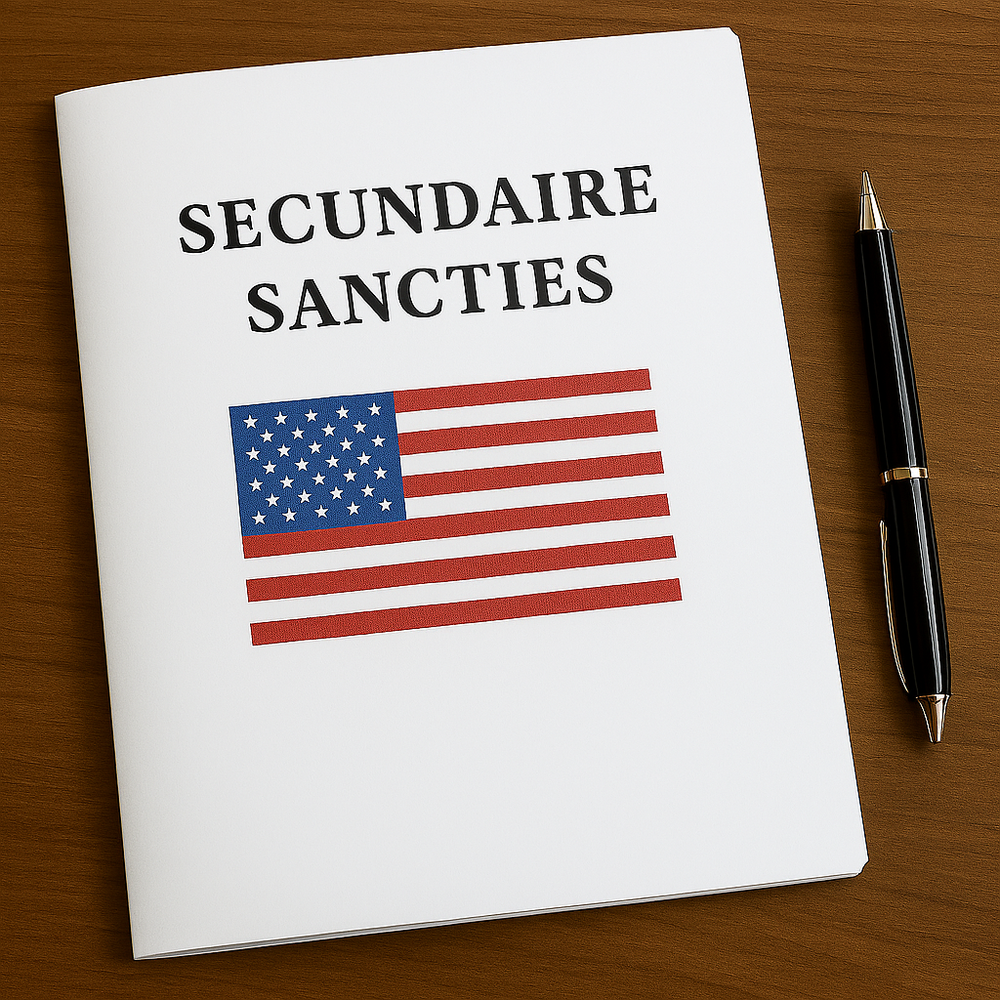
Jaren bleef de EU-Blokkeringsverordening op de achtergrond. Tot president Trump in 2018 opnieuw secundaire sanctiewetgeving instelde met betrekking tot Iran, nadat de VS zich terugtrok uit de internationale nucleaire deal met Iran (het Joint Comprehensive Plan of Action). Als reactie voegde de EU Trumps sancties toe aan het toepassingsgebied van de EU-Blokkeringsverordening. Het idee was simpel: Europese bedrijven beschermen en de Amerikaanse druk neutraliseren. Maar dat bleek makkelijker gezegd dan gedaan. Europese bedrijven zaten opnieuw klem: zakendoen met Iran betekende sancties van de VS riskeren, terwijl het naleven van de Amerikaanse regels in strijd was met EU-recht.
Twee heroïsche doelen …
De EU-Blokkeringsverordening heeft twee doelstellingen: (1) het neutraliseren van de effecten van buitenlandse sancties binnen de EU en (2) het beschermen van belangen van de Europese bedrijven én van de EU zelf. De effectiviteit van de Verordening werd daarom in het onderzoek beoordeeld aan de hand van de mate waarin deze doelstellingen worden bereikt. Om dat te toetsen voerde ik een juridische analyse uit van de kernartikelen van de Verordening, de rechtspraak van het Hof van Justitie van de Europese Unie en relevante juridische literatuur. Bij elk kernartikel stelde ik steeds de twee zelfde vragen. Neutraliseert dit artikel Amerikaanse sancties? Beschermt het effectief de Europese bedrijven?
… met bitter weinig resultaat
De resultaten leggen enkele tekortkomingen van de EU-Blokkeringsverordening bloot.
Ten eerste heeft de EU-Blokkeringsverordeningen een beperkt toepassingsgebied (art. 1). Ze geldt enkel voor een beperkte lijst van Amerikaanse sanctiewetten. Andere wetgevingen die eveneens secundaire sancties opleggen, zoals Chinese regelgeving, vallen buiten de boot. Daardoor neutraliseert de Verordening lang niet alle buitenlandse sancties waarmee Europese bedrijven worstelen.
Ten tweede bepaalt art. 5, lid 1 dat Europese bedrijven niet mogen gehoorzamen aan de Amerikaanse sanctiewetgeving. Dit verbod plaatst hen echter voor een moeilijke keuze. Wie de VS gehoorzaamt, schendt het EU-recht en wie de EU gehoorzaamt, riskeert Amerikaanse straffen. In beide gevallen dreigt bestraffing. Veel bedrijven kiezen er dan ook voor om de Amerikaanse  regels te volgen en hun handelsrelaties met landen zoals Iran stop te zetten, omdat de Amerikaanse sancties zeer verregaand zijn. Zo tonen handelsstatistieken dat tussen 2017 en 2019 het totale handelsvolume (import én export) tussen EU en Iran met ongeveer 76% is gedaald. Dit artikel werkt dus noch neutraliserend, noch beschermend.
Ten derde zijn regels slechts zo sterk als hun handhaving. Daar knelt het schoentje: art. 9 laat de strafmaatregelen over aan de EU-lidstaten zelf. Dat leidt tot grote verschillen tussen de lidstaten wat betreft de aard, zwaarte en handhaving van de sancties. Daarnaast blijkt dat in de praktijk bedrijven die de Verordening schenden zelden bestraft worden. Enerzijds sanctioneren lidstaten niet graag bedrijven die bijdragen aan hun economie, en anderzijds is het voor de bevoegde autoriteiten moeilijk om sluitend bewijs te leveren van een doelbewuste schending. Ook onder dit artikel blijkt dus dat noch neutralisatie, noch bescherming effectief worden bereikt.
Tussen symbool en realiteit
Wat duidelijk wordt, is dat de EU-Blokkeringsverordening goede intenties heeft, maar tekortschiet in de realiteit zodra geopolitieke en economische belangen doorwegen. Het is een papieren tijger. De EU kan bedrijven wel verbieden de sanctiewetten te volgen, maar dit neemt de impact van de Amerikaanse sancties niet weg.
Ondanks dat de EU-Blokkeringsverordening op papier veelbelovend lijkt, bereikt ze haar doestellingen in de praktijk amper tot niet. Ze neutraliseert buitenlandse sancties niet en beschermt de Europese bedrijven gedeeltelijk, slechts wanneer dit samenvalt met de politieke agenda van de EU.
Nochtans is dit gegeven een issue dat niet van tafel mag worden geveegd. Europese bedrijven staan nog al te vaak tussen twee vuren. Dit leidt tot onzekerheid, economische schade en een aantasting van de strategische autonomie van de EU.

In een wereld waarin economische wapens steeds vaker worden ingezet – denk maar aan Rusland, China, en de VS – is een krachtig en geloofwaardig antwoord van de EU nodig. De EU-Blokkeringsverordening werd ooit gecreëerd als schild tegen buitenlandse dwang, maar vandaag is dat schild gebarsten. Als de EU haar bedrijven écht wil beschermen, moet ze meer doen dan symbolisch blokkeren. De EU moet investeren in sterke handhaving, bredere bescherming en vooral een duidelijk signaal geven dat de Europese autonomie geen lege doos is. Zolang dat niet gebeurt, blijven Europese bedrijven tussen hamer en aambeeld.
Bibliografie
Legislation
European Legislation – primary law
- Consolidated version of the Treaty on European Union (2012) OJ C326, 13-390.
- Consolidated version of the Treaty on the Functioning of the European Union (2012) OJ C326, 47-390.
- Charter of Fundamental Rights of the European Union (2016) OJ C202, 389-405.
European legislation – secondary law
- Council Regulation (EC) No 2271/96 of 22 November 1996 protecting against the effects of the extra-territorial application of legislation adopted by a third country, and actions based thereon or resulting therefrom (1996) OJ L309, 1-6.
- Regulation (EU) No 1215/2012 of the European Parliament and of the Council of 12 December 2012 on jurisdiction and the recognition and enforcement of judgments in civil and commercial matters (recast) (2012) OJ L351, 1-32.
- Commission Delegated Regulation (EU) 2018/1100 of 6 June 2018 amending the Annex to Council Regulation (EC) No 2271/96 protecting against the effects of extra-territorial application of legislation adopted by a third country, and actions based thereon or resulting therefrom (2018) OJ L199I, 1-6.
- Commission Implementing Regulation (EU) 2018/1101 of 3 August 2018 laying down the criteria for the application of the second paragraph of Article 5 of Council Regulation (EC) No 2271/96 protecting against the effects of the extra-territorial application of legislation adopted by a third country, and actions based thereon or resulting therefrom (2018) OJ L199I, 7-10.
National legislation – United States of America
- Cuban Liberty and Democratic Solidarity (LIBERTAD) Act of 1996, Pub L No 104-114 (1996) 110 Stat 785.
- Iran and Libya Sanctions Act of 1996, Pub L No 104-172 (1996) 110 Stat 1541.
- United and Strengthening America by Providing Appropriate Tools Required to Intercept and Obstruct Terrorism (USA PATRIOT) Act of 2001, Pub L No 107–56 (2001) 115 Stat 272, 311.
- Executive Order 13846 of 6 August 2018, Reimposing Certain Sanctions With Respect to Iran (2018) 83(152) Fed Reg 38939.
- Protecting Europe’s Energy Security Act, Title LXXV, National Defense Authorization Act for Fiscal Year 2020, Pub L No 116-92 (2019) 133 Stat 2300.
Case law
CJEU case law
- Judgment of 10 April 1984, von Colson and Kamann, C-14/83, EU:C:1984:153.
- Judgment of 13 November 1990, The Queen v Ministry of Agriculture, Fisheries and Food, ex parte FEDESA and Others, C-331/88, EU:C:1990:391.
- Judgement of 18 October 1989, Orkem v. Commission, C-374/87, EU:C:1989:387.
- Judgement of 18 October 1989, Solvay v Commission, C-27/88, EU:C:1989:388.
- Judgment of 19 November 1998, Nilsson and Others, C-162/97, EU:C:1998:554.
- Judgment of 19 December 2019, Puppinck and Others v Commission, C‑418/18 P, EU:C:2019:1113.
- Judgment of 5 March 2020, OPR-Finance, C-679/18, EU:C:2020:167.
- Judgment of 11 February 2021, K.M., C-77/20, EU:C:2021:112.
- Judgement of 21 December 2021, Bank Melli Iran v Telekom Deutschland GmbH, C-124/20, EU:C:2021:1035.
- Judgment of 12 July 2023, IFIC Holding AG v European Commission, Case T-8/21, EU:T:2023:387.
- Action brought on 21 August 2023, Middle East Bank, Munich Branch v Commission, T-518/23.
Opinions of Advocate Generals
- Opinion of Advocate General Hogan of 12 May 2021, Bank Melli Iran v Telekom Deutschland GmbH, C-124/20, EU:C:2021:386.
National case law
- Belgium
- Commercial Court Antwerp 23 May 2023 BFR/DBF 2023/4 279.
- Germany
- Landgericht Hamburg 15 October 2018, 318 O 330/18.
- Hanseatische Oberlandesgericht Hamburg 14 October 2022, 11 U 116/19.
- Switzerland
- Tribunal fédéral Suisse 6 August 2021, 4A_659/2020.
- The Netherlands
- Court of The Hague 25 June 2019, ECLI:NL:RBDHA:2019:6301.
- Court of Amsterdam 6 February 2020, ECLI:NL:RBAMS:2020:893.
- Court of Cassation 7 April 2020, ECLI:NL:HR:2020:623.
- Dutch Supreme Court 7 April 2020, ECLI:NL:PHR:2020:156.
- United Kingdom
- Mamancochet Mining v Aegis Managing Agency and Others [2018] EWHC 2643 (Comm).
- Lamesa Investments Ltd v. Cynergy Bank Ltd [2019] EWHC 1877 (Comm).
Documents of the European Union Institutions
European Commission
- European Commission, ‘Questions and Answers: adoption of update of the Blocking Statute’ (Guidance Note) [2018] OJ C277, 4-10.
- European Commission, ‘Combined evaluation roadmap/inception impact assessment’ Ref. Ares(2021)4911405 (2021).
- European Commission, ‘Commission Staff Working Document Impact Assessment Report Accompanying the document Proposal for a Regulation of the European Parliament and of the Council on the protection of the Union and its Member States from economic coercion by third countries’ SWD (2021) 371 final.
- European Commission, ‘Communication from the Commission on the European economic and financial system: fostering openness, strength and resilience’ COM (2021) 32 final.
- European Commission, ‘Report from the Commission to the European Parliament and the Council relating to Article 7(a) of Council Regulation (EC) No 2271/96 (‘Blocking Statute’)’ COM (2021) 535 final.
- European Commission, ‘Summary of Results of the Open Public Consultation on the Review of the Blocking Statute (Council Regulation (EC) 2271/96)’ Ref. Ares(2021)7829130 (2021).
- European Commission, ‘European Union, Trade in goods with Iran’ (DG Trade and Economic Security, updated 2024) <https://webgate.ec.europa.eu/isdb_results/factsheets/country/details_ir…; accessed 16 April 2025.
Council of the European Union
- Council of the European Union, ‘Council Conclusions on the EU’s economic and financial strategic autonomy: one year after the Commission’s Communication’ (2022) 6301/22.
International documents
- World Trade Organization, ‘United States – The Cuban Liberty and Democratic Solidarity Act: Request for the Establishment of a Panel by the European Communities’ (8 October 1996) WT/DS38/2.
- World Trade Organization, ‘United States – The Cuban Liberty and Democratic Solidarity Act: Lapse of the Authority for Establishment of the Panel’ (24 April 1998) WT/DS38/6.
- Joint Comprehensive Plan of Action (Vienna, 14 July 2015).
Government statements and documents
Austria
- Austrian Federal Ministry for European and International Affairs, ‘Foreign Ministry Ceases Investigations against BAWAG Bank’ (23 April 2007) <https://www.bmeia.gv.at/en/the-ministry/press/news/2007/foreign-ministr… 1 May 2025.
Gibraltar
- HM Government of Gibraltar, ‘Further Mutual Legal Assistance Requests from the United States of America – 604/2019’ (18 August 2019) <https://www.gibraltar.gov.gi/press-releases/further-mutual-legal-assist…; accessed 25 March 2025.
United States
- US Department of State, ‘Fact Sheet: Iran Freedom and Counter-Proliferation Act of 2012’, 3-4 <https://2009-2017.state.gov/documents/organization/208111.pdf> accessed 16 April 2025.
- Trump D.J., ‘Ceasing US Participation in the JCPOA and Taking Additional Action to Counter Iran’s Malign Influence and Deny Iran All Paths to a Nuclear Weapon’ (Presidential Memorandum, Trump White House Archives, 8 May 2018) <https://trumpwhitehouse.archives.gov/presidential-actions/ceasing-u-s-p…; accessed 4 March 2024.
- Trump D.J., ‘Statement from the President on the Reimposition of United States Sanctions with Respect to Iran’ (Statements and Releases, Trump White House Archives, 6 August 2018) <https://trumpwhitehouse.archives.gov/briefings-statements/statement-pre…; accessed 4 March 2024.
- Michael R. Pompeo, ‘Remarks to the press’ (17 April 2019) <https://cl.usembassy.gov/secretary-of-state-michael-r-pompeos-remarks/&…; accessed 16 January 2025.
Legal doctrine
Books
- Beaucillon C. (ed.), Research Handbook on Unilateral and Extraterritorial Sanctions (Edward Elgar 2021).
- Fahey E. (ed.), The Routledge Handbook of Transatlantic Relations (Routledge 2023).
- Hardyns W. and Peeraer F., ‘Onderzoeksmethoden’ (Ghent University 2022).
- Parrish A. and Ryngaert C. (eds.), Research Handbook on Extraterritoriality in International Law, (Edward Elgar 2023).
- Ruys T., Ryngaert C. and Silvestre F.R. (eds.), The Cambridge Handbook of Secondary Sanctions and International Law(Cambridge University Press 2024).
Journal articles
- Clarke R., ‘Derogation decisions and encouragement for the EUBR: IFIC Holding v. Commission’ (2024) 61 CML Rev. 805
- De Vries A., 'Council Regulation (EC) No 2271/96 (the EU Blocking Regulation)' (1998) 26 International Business Lawyer 345.
- Fabre C., ‘Secondary Economic Sanctions’ (2016) 69 Current Legal Problems 259.
- Goldman Z., Horn D.M., Kessler J.I., Kamann H-G., Louis F., Meltzer R.I. and Tzifa G., ‘Top EU Court Rules on the EU Blocking Regulation Against U.S. Sanctions for the First Time’ (2022) 39 Computer and Internet Lawyer 3.
- Huber J., ‘The Helms-Burton Blocking Statute of the European Union’ (1997) 20 Fordham Int'l LJ 699.
- Hufbauer G.C. and Jung E., ‘What’s new in economic sanctions?’ (2020) 130 European Economic Review 1.
- Kamminga M.T., ‘Extraterritoriality’ (2020) MPEPIL <https://opil.ouplaw.com/display/10.1093/law:epil/9780199231690/law-9780…; accessed 12 May 2025.
- Latapí Agudelo M.A., Jóhannsdóttir L. and Davídsdóttir B., 'A Literature Review of the History and Evolution of Corporate Social Responsibility' (2019) 4 International Journal of Corporate Social Responsibility 1.
- Lohmann S., 'European Strategic Autonomy: The Test Case of Iran' (2021) 8 European Review of International Studies 443.
- Mignon E., 'The CLOUD Act: Unveiling European Powerlessness' (2021) 1 Revue Européenne du Droit 108 <https://geopolitique.eu/articles/the-cloud-act-unveiling-european-power…; accessed 2 February 2025.
- Rovetta D., Pandey G. and Smiatacz A., ‘Don’t Wake up the (EU) Bear! The Scope of the EU Blocking Regulation 2271/96 in Light of the Recent Preliminary Ruling Reference in Bank Melli V. Telekom Deutschland Case, C-124/20’ (2021) 16 Global Trade and Customs Journal 44.
- Ruys T. and Ryngaert C., ‘Secondary Sanctions: A Weapon out of Control? The International Legality of, and European Responses to, US Secondary Sanctions’ (2020) 0 BYBIL 1.
- Ryngaert C., ‘De Europese ‘Blocking Statute’: Een probaat middel om het Europese bedrijfsleven te beschermen tegen de Amerikaanse secundaire sancties tegen Iran?’ (2019) 4 SEW 157.
- Ryngaert C., ‘Interpreting an Unsatisfactory EU Blocking Statute: Bank Melli Iran’ (2023) 60 CML Rev. 517.
- Ryngaert C., Ruys T. and Silvestre F.R., ‘De EU en secundaire economische sancties’ (2024) 1 SEW.
- Smis S. and van der Borght K., ‘The EU–US Compromise on the Helms–Burton and D’Amato Acts’ (1999) 93 AJIL 227.
- Stalls J.D., ‘Economic Sanctions’ (2003) 11 University of Miami International & Comparative Law Review 115.
- Szabados T., ‘Building Castles in the Air? The EU Blocking Regulation and the Protection of the Interests of Private Parties’ (2023) CYELS 1.
- Terry P.C.R., ‘Secondary Sanctions: Why the US Approach Is Unlawful and the EU’s Response Is Ineffective’ (2022) 17 Global Trade and Customs Journal 370.
- Tilahun N., ‘Resisting (US) Sanctions: A Comparison of Special Purpose Vehicles, Blocking Statutes and Countermeasures’ (2022) 17 Global Trade and Customs Journal.
- Van der Aa N.M.D. and Stax S.H., ‘Amerikaanse sancties op Iran en de Europese blokkeringsverordening: Europese ondernemingen in een lastige spagaat’ (2019) Nederlands tijdschrift voor Europees recht 71.
- Van Haute C., Nordin S. and Forwood G., ‘The Reincarnation of the EU Blocking Regulation: Putting European Companies Between a Rock and a Hard Place’ (2018) 13 Global Trade and Customs Journal 496.
- Van Dam C., ‘Guidance documents of the European Commission: a typology to trace the effects in the national legal order’ (2017) 10 Review of European Administrative Law 75.
Think Tanks
- Blockmans S., ‘Extraterritorial sanctions with a Chinese trademark: European responses to long-arm legal tactics’ (CEPS 2021).
- Damen M., ‘EU strategic autonomy 2013-2023: From concept to capacity’ (EPRS 2022).
- Financial Market Law Committee, ‘U.S. Sanctions and the E.U. Blocking Regulation: Issues of Legal Uncertainty’ (FMLC 2019).
- Geranmayeh E. and Rapnouil M., ‘Meeting the challenge of secondary sanctions’ (ECFR 2019).
- Hackenbroich J., ‘Defending Europe’s economic sovereignty: new ways to resist economic coercion’ (ECFR 2020).
- Russell M., ‘The Nord Stream 2 Pipeline: Economic, Environmental and Geopolitical Issues’ (EPRS 2021).
Blogposts
- Challet C., ‘Op-Ed: Judgment in Bank Melli Iran: The Court of Justice, Too, is Between a Rock and a Hard Place’ (EU Law Live, 14 January 2022) <https://eulawlive.com/op-ed-judgment-in-bank-melli-iran-the-court-of-ju…; accessed 16 February 2024.
- Kneller E. and Matthaiou A., ‘General Court clarifies the application of the EU Blocking Statute (Case T-8/21)’ (EU Law Live, 11 September 2023) <https://eulawlive.com/analysis-eu-law-live-analysis-general-court-clari…; accessed 16 February 2024.
- Jones M. and Bailes E., ‘US Iran Sanctions and the EU Blocking Regulation – private law claims for damages’ (Lexology, 31 July 2018) <https://www.lexology.com/library/detail.aspx?g=972bcc34-c050-4982-bd66-…; accessed 2 April 2025.
- Joustra J., ‘Kan een bank een zakelijke bankrekening opzeggen vanwege handelen met een UHRC-land? Rechtbank Amsterdam doet uitspraak’ (RWV Advocaten, 17 April 2020) <https://rwv.nl/kennis/kan-een-bank-een-zakelijke-bankrekening-opzeggen-…; accessed 12 April 2025.
- Kneller E. and Matthaiou A., ‘General Court clarifies the application of the EU Blocking Statute (Case T-8/21)’ (EU Law Live, 11 September 2023) <https://eulawlive.com/analysis-eu-law-live-analysis-general-court-clari…; accessed 16 February 2024.
Other doctrine
- Stoll T., Blockmans S., Hagemejer J., Hartwell A., Gött H., Karunska K. and Maurer A., ‘Extraterritorial Sanctions on trade and investments and European responses’ (European Parliament DG for external policies 2020).
- Barnes R., Bradshaw A., Feldberg P., Mortlock D., Thoms A. and Wysong W. (eds.), ‘The Guide to Sanctions fifth edition’ (Global Investigations Review, 5 September 2024). <https://globalinvestigationsreview.com/guide/the-guide-sanctions-archiv…; 16 March 2025 accessed.
Other
Contributions submitted to the Commission Public Consultation on the Review of the Blocking Statute
- AFEP, ‘Public consultation on the review of the EU blocking Statute (Regulation (EC) n°2271/96) – comments by AFEP (French association of large companies)’ Ref. Ares(2021)6840659 (2021).
- De Vries A.W., ‘A citizens view on the Commission Initiative to amend Council Regulation (EC) 2271/96 (the EU Blocking Statute) as laid down in its document Combined Evaluation Roadmap/Inception Impact Assessment and the Questionnaire it launched on the Commission site Have your Say’ Ref. Ares(2021)7605798 (2021).
- Fondation pour le Droit Continental, ‘Synthese: consultation sur la revision de la loi de blocage [Reglement (CE) N° 2271/96]’ Ref. Ares(2021)6840648 (2021).
- France Industrie, ‘France Industrie’s contribution for the review of the Blocking Statute’ Ref. Ares(2021)6840640 (2021).
- Lohmann S., ‘Response to Public Consultation Unlawful extra-territorial sanctions – a stronger EU response (amendment of the Blocking Statute)’ Ref. Ares(2021)6840647 (2021).
- VDMA, ‘Non-exhaustive contribution of VDMA to the public consultation of the European Commission on the review of the Blocking Statute’ Ref. Ares(2021)6840645 (2021).
- X, ‘Helms-Burton Act identification of needs and proposed improvements’ Ref. Ares(2021)6840644 (2021).
Websites – news
- Emmott R. and De Carbonnel A., ‘European Investment Bank casts doubt on EU plan to salvage nuclear deal’ Reuters (18 July 2018) <https://www.reuters.com/article/us-iran-nuclear-eu/european-investment-…; accessed on 8 May 2025.
- Petroff A., ‘Siemens CEO: We can't do new deals with Iran’ CNN (14 May 2018) <https://money.cnn.com/2018/05/14/investing/iran-sanctions-siemens-europ…; accessed 16 April 2025.
- Svirnovskiy G., ‘Trump threatens ‘secondary sanctions’ on importers of Iranian oil’ Politico (1 May 2025) <https://www.politico.com/news/2025/05/01/trump-iran-oil-sanctions-china… 5 May 2025.
- Wald E.R., ‘10 Companies Leaving Iran As Trump's Sanctions Close In’ Forbes (6 June 2018) <https://www.forbes.com/sites/ellenrwald/2018/06/06/10-companies-leaving…; accessed 16 April 2025.
- X, ‘Austria charges bank after Cuban accounts cancelled’ Reuters (9 August 2007) <https://www.reuters.com/article/legal/government/austria-charges-bank-a…; accessed 1 May 2025.
- X, ‘French energy giant Total officially pulls out of Iran’ Die Welle (21 August 2018) <https://www.dw.com/en/french-energy-giant-total-officially-pulls-out-of…; accessed 16 April 2025.
Website – others
- BNP Paribas, ‘BNP Paribas Group Financial Security and Anti Bribery & Corruption Program’ (BNP Paribas, 6 November 2023) <https://cdn-group.bnpparibas.com/uploads/file/bnpp_group_financial_secu…; accessed 12 April 2025.
- Fi-compass, ‘Sanctions clause’ (European Investment Bank) <https://www.fi-compass.eu/sanctions-clause> accessed 13 April 2024.
- Ghent University, ‘Guidelines on the use of AI tools for (writing) assignments’ (Ghent University) <https://www.ugent.be/re/en/guidelines_ai.htm> accessed 7 May 2025.
- ING, ‘ING Financial Economic Crime Statement’ (ING, 1 October 2024) <https://www.ing.com/About-us/Compliance/Financial-Economic-Crime-Statem…; accessed 12 April 2025.
- Office of Foreign Assets Control, ‘Basic Information on OFAC and Sanctions’ (US department of treasury, 21 August 2024) <https://ofac.treasury.gov/faqs/topic/1501#:~:text=The%20U.S.%20Departme… of%20the,international%20narcotics%20traffickers%2C%20weapons%20of> accessed 3 April 2025.
- Trump D.J., ‘ALERT: All purchases of Iranian Oil, or Petrochemical products, must stop, NOW!’ (Truth Social, 1 May 2025) <https://truthsocial.com/@realDonaldTrump/posts/114433959082847679> accessed 5 May 2025.
Webinars/conferences
- T.M.C. Asser Institute, ‘[Panel Discussion] Secondary Sanctions and the international legal order’ (YouTube, 7 November 2024) <https://www.youtube.com/watch?v=SLDd0MBTlPE> accessed 26 December 2024.
- K. Lenaerts, ‘Proportionality as a matrix principle promoting the effectiveness of EU law and the legitimacy of EU action’ (ECB Legal Conference, November 2021) <https://www.ecb.europa.eu/press/conferences/shared/pdf/20211125_legal/E…; accessed 27 February 2025.