Cloeck of neuswijs?
Het zijn maar enkele van de termen die op vroedvrouwen geplakt worden in het zestiende-eeuwse t’ Boeck vande Vroet-Wijfs. Dat werd als één van de eerste handboeken voor vroedvrouwen geschreven door Jakob Ruf in de late zestiende eeuw en vertaald naar het Middelnederlands door Maarten Everaert. Een tijd waarin veel meer controle kwam te liggen op het vrouwelijk lichaam en dus ook op wie het verzorgde. Een handboek leent zich perfect tot het analyseren van het discours, de taal die Everaert gebruikte in zijn boek, over vroedvrouwen.

Beschermend of controlerend?
Al geruime tijd bestuderen historici de groeiende mannelijke inmenging bij vroedvrouwen. De beslissings- en handelingsruimte van die vroedvrouwen werd grondig ingeperkt. Ze hadden immers veel macht doordat ze bijvoorbeeld de enige vrouwen waren die als expert in de rechtbank mochten getuigen. De vroedvrouwen moesten bijvoorbeeld steeds vaker een eed afleggen of werden gecontroleerd op hun geloof. Dit omdat ze in noodgevallen dopen mochten uitvoeren en ook daarom een heel bijzondere en machtige positie kenden. Veel historici stellen dan ook dat vanaf de late middeleeuwen de vroedvrouw steeds minder mag doen en dat ze, in geval van een moeilijke geboorte, steeds de hulp van een mannelijke hulpverlener moet inroepen. Daar kunnen we wel wat nuance bij plaatsen. Uit t’ Boeck vande Vroet-Wijfs blijkt dat vroedvrouwen wel nog operaties mochten uitvoeren en geheel instonden voor de gezondheid van zowel moeder als kind. Er is dus niet zo’n duidelijke scheiding te maken tussen de verschillende beroepsgroepen.
Hoe er naar die zwangere vrouwen gekeken wordt, is andere koek. Zij worden volledig gecontroleerd in t’ Boeck vande Vroet-Wijfs. Op een andere manier gebeurt dit nog steeds, denk maar aan de verschillende (dwingende) adviezen die toekomstige moeders voortdurend aangereikt krijgen via allerlei boekjes, maar zeker ook op sociale media. Verschillende onderzoekers stellen dat dit een bron van angst is voor de moeder. Dat was dus vroeger niet anders. Een stijgende focus op het kind ligt hier aan de start van de verklaring. Doe daar nog een goede portie bijgeloof bij en je komt uit bij een zwangerschap waarbij niets mag.
Menstruatie opwekken of abortus uitvoeren?
Toch beschrijft Everaert in t’ Boeck vande Vroet-Wijfs ook vroedvrouwen niet altijd op dezelfde manier. Soms worden ze bevestigd in hun kunnen, terwijl ze op andere momenten over dezelfde kam geschoren worden als andere vrouwen die slechte praktijken in stand zouden houden. Dat is heel duidelijk zichtbaar in het onderdeel over abortus.
Want ja, abortus vond wel degelijk plaats in het verleden, zij het niet met dezelfde woorden en termen. Over die bewoordingen was lang discussie onder historici. Zo zou het ‘opwekken van de menstruatie’ aan de hand van kruiden kunnen wijzen op het stopzetten van een zwangerschap, maar ook letterlijk de menstruatie laten terugkeren, kunnen betekenen. Dat laatste is niet geheel onlogisch in een tijd waarin om heel veel verschillende redenen de menstruatiecyclus onderbroken werd. In de zestiende eeuw werd ook benadrukt dat de menstruatie essentieel was om de conceptie te doen plaatsvinden. Veel remedies zullen dus ook effectief daarop gewezen hebben. Al kan de andere verklaring, die van de abortus, zeker niet gewoon aan de kant geschoven worden.
“Sy begeert ende vraecht haer raet met hoflicke woorden, om haer Maentstonden te voorderen, efnde te mogen doen hebben.”
Dit is bijvoorbeeld van wat in t’ Boeck vande Vroet-Wijfs staat wanneer het gaat over abortus. Hier legt Everaert dus het eufemisme bloot dat volgens hem veel gebruikt werd. Later in dat hoofdstuk gaat hij verder door personen die een abortus mogelijk maken in de meest negatieve bewoordingen te beschrijven. Wat daarbij opvalt, is dat de persoon die de abortus verzoekt, veel minder negatief afgebeeld wordt dan de persoon die de abortus mogelijk maakt door kennis van kruiden.
Praktisch of theoretisch of toch eens een eenduidig antwoord?
Abortus is slechts één van de vele aspecten die aan bod omen in t’ Boeck vande Vroet-Wijfs. Dat boek is an sich ook uniek omdat het een handboek is voor vrouwelijke zorgverleners. Die combinatie van woorden is opvallend, aangezien vrouwen uitgesloten werden van universiteiten en dus van officiële medische opleidingen. Toch is het blijkbaar nodig om ze grondige richtlijnen te geven en werd er dus veel belang aan gehecht. Het is dan ook wel een heel praktisch boek, met een register en samenvattingen per hoofdstuk. Dat maakt het ook makkelijker om specifieke gevallen op te zoeken. Om dat praktische karakter nog meer in de verf te zetten, kunnen we verwijzen naar de afbeeldingen die heel vaak aan bod komen in t’ Boeck vande Vroet-Wijfs. Die worden gebruikt om bepaalde concepten te duiden, zoals de afbeelding aantoont, waarop instrumenten worden afgebeeld die de vroedvrouw moet hanteren om de vrucht uit de baarmoeder te verwijderen. Everaert vermeldt er wel steeds bij hoe voorzichtig ze ermee moeten zijn.
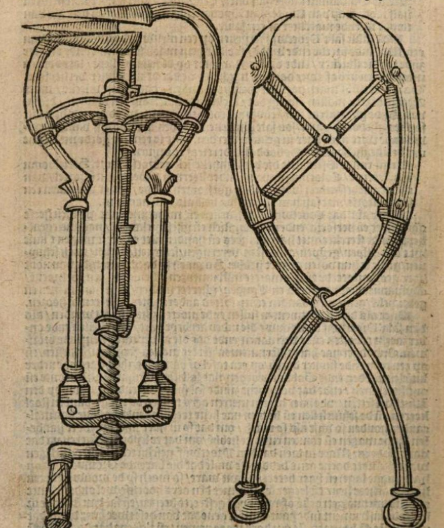

t’ Boeck vande Vroet-Wijfs specifieert zijn doelpubliek heel duidelijk: vroedvrouwen en zwangere vrouwen. Wanneer we zelf het boek induiken, merken we nog een bijkomende doelgroep op. De auteur wil zich namelijk plaatsen in een veld van geleerden die schrijven over de medische achtergrond van vrouwen. Daarom zijn sommige hoofdstukken opvallend hard ingebed in theoretische concepten, zoals de humorenleer, uit de vroegmoderne periode. Andere hoofdstukken geven dan weer meer een ware concrete houvast voor vroedvrouwen. Die spreidstand tussen theoretische en praktische kennis komt doorheen het hele boek naar voren.
Op verschillende manieren blijkt uit t’ Boeck vande Vroet-Wijfs dat we nuances kunnen plaatsen bij verschillende concepten waarvan gedacht werd dat ze vaststonden. Allereerst is het ontzettend belangrijk om het discours over vrouwen te ontleden en het onderscheid te durven maken tussen verschillende vrouwen. Wat ook heel duidelijk is, is dat praktische en theoretische kennis niet losstaan van elkaar, maar elkaar aanvullen. Vroedvrouwen krijgen in t’ Boeck vande Vroet-Wijfs ‘universitaire’ kennis aangereikt en het mannelijk doelpubliek leest ook de meer theoretische kennis. Desondanks konden ze wel degelijk nog operaties uitvoeren. De verdeling van de zorgende en medische taken was dus niet zo zwart-wit zoals eerst werd gedacht.
Bibliografie
Bibliografie
1. Onuitgegeven bronnen
BELGIË
Antwerpen
Museum Plantin-Moretus: Index archives Plantiniennes, Officina Plantiniana
Grootboek kostenberekening edities 1563-1567
Kasboek 1563-1567
Brugge
Rijksarchief Brugge: Parochieregisters - Huwelijksakten - Provincie West-Vlaanderen, PARHUWVL_00243673 Parochieregisters huwelijken, 22/02/1585, Sint-Gillis.
NEDERLAND
Leiden
Stadsarchief
0506 Notarissen ter standplaats Leiden (oud notarieel archief): Minuutakten van notaris Willem (Claesz. van) Oudevliet, 1588. Minuutakten van notaris Willem (Claesz. van) Oudevliet, 1587.
1004 Doop-, trouw-, begraaf- en geboorteboeken Leiden: 197 Ondertrouwboek en trouwboek voor schepenen van Leiden, 1592 - juni 1611.
2. Uitgegeven bronnen
Album studiosorum Academiae Lugduno Batavae MDLXXV-MDCCCLXXV. Uitgegeven door Willem Nicolaas Du Rieu. Hagae Comitum: Apud Martinum Nijhoff, 1875.
del Rio, Martin. Investigations into magic, an edition and translation of Martín Del Río’s ‘Disquisitionum magicarum libri sex.’ Uitgegeven en vertaald door Peter Maxwell-Stuart en José Manuel García Valverde. Leiden: Brill, 2022.
Everaert, Maarten. t’ Boeck van de Vroet-Wijfs. Amsterdam: Cornelis Claesz, 1591. Uitgegeven door Linda Brakenhoff in samenwerking met Willem van Bentum, Edith Claessens en Hans Rijns. Transcriptie T’boeck vande vroet-wijfs van Jacob Rueff vertaald uit het Hoogduits in het Nederlands door Martinus
Everaerts Amsterdam 1591. Utrecht: Universiteitsbibliotheek Utrecht, 2018.
Sharp, Jane. The midwives book. Or the whole art of midwifry discovered. Uitgegeven door Elaine Hobby. Oxford: Oxford University Press, 1999.
Savonarola, Michele. A mother’s manual for the women of Ferrara. A fifteenth-century guide to pregnancy and pediatrics, written by Michele Savonarola. Uitgegeven door Gabriella Zuccolin en vertaald door Martin Marafioti. New York: Iter Press, 2022.
Siegemund, Justine. The court midwife. Vertaald en uitgegeven door Lynne Tatlock. Chicago: University of Chicago Press, 2007.
Miracula ex variis collecta. In Acta Sanctorum: volume 28: Jul. II. Antwerpen: Société des Bollandistes, 1721.
3. Gedrukte bronnen
Everaert, Maarten. t’ Boeck van de Vroet-Wijfs. Amsterdam: Cornelis Claesz, 1591
Kiliaan, Cornelis. Etymologicum teutonicae linguae. Antwerpen: Jan Moretus, 1599.
Het Antwerps Liedboek. Antwerpen: Jan Frans Roelants, 1544.
Melchior Schaerer. Prognosticon oder Practica ... auff das Jahr 1621. Nürnberg: Johan Friderich Sartorio, 1621.
4. Online informatie
“Mola zwangerschap.” KULeuven. Geraadpleegd 06.02.2025. https://www.uzleuven.be/nl/molazwangerschap.
“Perinatal conditions.” World Health Organisation. Geraadpleegd 29.04.2025. https://platform.who.int/.
“Officiële regelingen bij verlies van een kind.” Kind en Gezin. Geraadpleegd 28.04.2025, https://www.kindengezin.be/.
“Omdat goed doorverwijzen zo belangrijk is.” KdG Perinataal Verlies. Geraadpleegd 28.04.2025. https://perinataalverlies.be/.
“Rouwverlof.” Kind en Gezin. Geraadpleegd 28.04.2025. https://www.kindengezin.be/.
“Vroedvrouw.” FOD Volksgezondheid, Veiligheid van de Voedselketen en Leefmilieu, 12.01.2016. Geraadpleegd 09.03.2025. https://www.health.belgium.be/nl/vroedvrouw.
Green, Monica H. “‘Cliff notes’ on the circulation of the gynecological texts of Soranus and Muscio in the Middle Ages.” Online: academia.edu, laatste update 23.02.2023. Geraadpleegd 15.03.2025.
5. Databanken
Algemeen Letterkundig Lexicon, https://www.dbnl.org/.
Database of Latin Dictionaries, https://clt.brepolis.net/.
Middelnederlandsch Woordenboek, http://gtb.ivdnt.org/.
Nederlandse Liederenbank, https://www.liederenbank.nl/.
WorldCat, https://search.worldcat.org/.
6. Literatuur
Ames, Melissa en Sarah Burcon. “Nine months of fear and a lifetime of paranoia. The hidden effects of pregnancy manuals, child rearing products, and more.” In How pop culture shapes the stages of a woman’s life: from toddlers-in-tiaras to cougars-on-the-prowl, uitgegeven door Melissa Ames en Sarah
Burcon, 123-40. Londen: Palgrave Macmillan UK, 2016.
Arnade, Peter J. en Walter Prevenier. Honor, vengeance, and social trouble: pardon letters in the Burgundian Low Countries. Ithaca: Cornell University Press, 2015.
Bates, Alan W. H. “Monstrous exegesis: opening up double monsters in early modern Europe.” In The body of evidence. Corpses and proofs in early modern European medicine, uitgegeven door Francesco Paolo de Ceglia, 119-48. Leiden: Brill, 2020.
Benton, John F. “Trotula, women’s problems, and the professionalization of medicine in the Middle Ages.” Bulletin of the History of Medicine 59, nr. 1 (1985): 30-53.
Blom, Johan Cornelis Hendrik, E. Lambrechts en James C Kennedy. History of the Low Countries. New York: Berghahn Books, 2006.
Blumenfeld-Kosinski, Renate. Not of woman born. Representations of Caesarean birth in medieval and Renaissance culture. Ithaca: Cornell University Press, 2019.
Bleyl, Steven B., Philip R. Brauer, Philippa H. Francis-West en Gary C. Schoenwolf. Larsen’s human embryology. Philadelphia: Elsevier, 2021.
Borrelli, Sarah. “What is a good midwife? Some historical considerations.” Evidence Based Midwifery 11, nr. 2 (2013): 51-9.
Bourdieu, Pierre. Le sens pratique. Parijs: Ed de Minuit, 1984.
Brandão, Sónia en Bárbara Figueiredo. “Fathers’ emotional involvement with the neonate: impact of the umbilical cord cutting experience.” JAN: Learning Global Nursing Research 68, nr. 12 (2012): 2730-39.
Brinton, Laurel J. “Historical discourse analysis.” In The handbook of discourse analysis, uitgegeven door Deborah Tannen, Heidi E. Hamilton en Deborah Schiffrin, 222-43. New York: Wiley, 2015.
Butler, Judith. Bodies that matter. On the discursive limits of ‘sex’. New York: Routledge, 1993.
Maeve B., Callan. “Of vanishing fetuses and maidens made-again. Abortion, restored virginity, and similar scenarios in medieval Irish hagiography and penitentials.” Journal of the History of Sexuality 21 nr. 2 (2012): 282-96.
Campbell Hurd-Mead, Kate. Women in medicine. From the earliest times to the beginning of the nineteenth century. Haddam: The Haddam Press, 1938.
Ciganda, Carmen en Amalia Laborde. “Herbal infusions used for induced abortion.” Journal of Toxicology: Clinical Toxicology 41, nr. 3 (2003): 235-39.
Coates, Jennifer. “Gender and discourse analysis.” In The Routledge handbook of discourse analysis, uitgegeven door James Paul Gee en Michael Handford, 90-103. Londen: Taylor & Francis Group, 2012.
Corretti, Carolyn en Sukumar P. Desai. “The legacy of Eve’s curse. Religion, childbirth pain, and the rise of anesthesia in Europe: c. 1200-1800s.” Journal of Anesthesia History 4 (2018): 182-90.
Côté-Arsenault, Denise, Davya Brody en Mary-Therese Dombeck. “Pregnancy as a rite of passage: Liminality, rituals and communitas.” Journal of Prenatal & Perinatal Psychology & Health 24, nr. 2 (2009): 69-87.
Cowan, Heather. “Surviving a public obsession. Reading the female body in post-Reformation legislation and medicine.” In Reading the Reformations. Theologies, cultures and beliefs in an age of change, uitgegeven door Anna French, 233-52. Leiden: Brill, 2023.
Davy, Amber. “An evolving conception of sexual difference. Evaluating Thomas Laqueur’s theory on the emergence of a ‘Two-Sex Model’ in the eighteenth century.” Trinity Women & Gender Minorities Review 3, nr. 1 (2019): 57–71.
de Blécourt, Willem. “The making of the female witch. Reflections on witchcraft and gender in the early modern period.” Gender & History 12, nr. 12 (2000): 287-309.
Delany, Paul. “Constantinus Africanus’ ‘De Coitu’. A translation.” The Chaucer Review 4, nr. 1 (1969): 55-65.
Delva, Anna. Vrouwengeneeskunde in Vlaanderen tijdens de late middeleeuwen. Brugge: Genootschap voor geschiedenis, 1983.
De Meyer, Isaac Joseph. Recherches historiques sur la pratique de l’art des accouchements, à Bruges, depuis le XIVme siècle jusqu’à nos jours. Brugge: De Pachtere, 1843.
de Moor, Tine en Jan Luiten van Zanden. “Mensen en economie in de Gouden Eeuw.” Leidschrift 23 nr. 2 (2008): 1-12.
Devos, Isabelle en Tina Van Rossem. “Oud, ouder, oudst. Regionale en lokale verschillen in sterfte in het graafschap Vlaanderen tijdens de zeventiende en achttiende eeuw.” De zeventiende eeuw (2019): 39-53.
DeVun, Leah. The shape of sex. Nonbinary gender from Genesis to the Renaissance. New York: Columbia University Press, 2021.
de Waardt, Hans. “Witchcraft and wealth. The case of the Netherlands.” In The Oxford handbook of witchcraft in early modern Europe and colonial America, uitgegeven door Brian P. Levack, 232-49. Oxford: Oxford University Press, 2013.
Drapkin Lyerly, Anne. “Shame, Gender, Birth.” Hypatia 21, nr. 1 (2006): 101–18.
Ehrenreich, Barbara en Deirdre English. Witches, midwives and nurses. A history of women healers. Old Westbury New York: The Feminist Press, 1973.
Evans, Jennifer. “‘They are called imperfect men.’ Male infertility and sexual health in early modern England.” Social History of Medicine 29, nr. 2 (2016): 311-32.
Evenden, Doreen. “Mothers and their midwives in 17th century Londen.” In The Art of Midwifery. Early modern midwives in Europe, uitgegeven door Hilary Marland, 9-27. Londen en New York: Routledge, 1993.
Fildes, Valerie. Wet nursing. A history from Antiquity to the present. Oxford: Basil Blackwell, 1988.
Filippini, Nadia. Pregnancy, delivery, childbirth. A gender and cultural history from Antiquity to the test tube in Europe. London: Routledge, 2020.
Fisher, Will. “The Renaissance beard. Masculinity in early modern England.” Renaissance Quarterly 54 (2001): 155-87.
Fissell, Mary E. “Man-midwifery revisited.” In Reproduction. Antiquity to the present day, uitgegeven door Nick Hopwood, Rebecca Flemming en Lauren Kassell, 319-32. Cambridge: Cambridge University Press, 2018.
Fissell, Mary E. “Introduction. Women, health, and healing in Early Modern Europe.” Bulletin of the History of Medicine 82, nr. 1 (2008): 1-17.
Gee, James Paul en Michael Handford. “Introduction.” In The Routledge handbook of discourse analysis, uitgegeven door James Paul Gee en Michael Handford, 1-8. Londen: Taylor & Francis Group, 2012.
Gradwohl, Alex. “Herbal abortifacients and their classical heritage in Tudor England.” Penn History Review 20, nr. 1 (2013): 45-71.
Green, Monica H. “Eve’s herbs. A history of contraception and abortion in the West.” Bulletin of the History of Medicine 73, nr. 2 (1999): 308-11.
Green, Monica H. “Gendering the history of women’s healthcare.” Gender & History 20, nr. 3 (2008): 487–518.
Green, Monica H. Making women’s medicine masculine. The rise of male authority in pre-modern gynaecology. Oxford: Oxford University Press, 2008.
Green, Monica. “The developement of the Trotula.” Revue d’Histoire des Textes 26 (1996): 119-203.
Green, Monica. “The possibilities of literacy and the limits of reading. Women and the gendering of medical literacy.” In Women’s healthcare in the medieval west, uitgegeven door Monica Green, 1-76. Aldershot: Ashgate, 2000.
Green, Monica H. “The sources of Eucharius Rösslin’s ‘Rosegarden for pregnant women and midwives’ (1513).” Medical History 53 (2009): 167-92.
Greilsammer, Myriam. “The midwife, the priest, and the physician. The subjugation of midwives in the Low Countries at the end of the Middle Ages.” Journal of Medieval and Renaissance Studies 21, nr. 2 (1991): 285-329.
Grijp, Louis Peter en Dieuwke van der Poel. “Introduction.” In Identity, intertextuality, and performance in early modern song culture, uitgegeven door Wim van Anrooij, Louis Peter Grijp en Dieuwke van der Poel, 1-38. Leiden: Brill, 2016.
Haffter, Carl. “The changeling. History and psychodynamics of attitudes to handicapped children in European folklore.” Journal of the History of the Behavioral Sciences 4, nr. 1 (1968): 55–61.
Hailwood, Mark. “Rethinking literacy in rural England, 1550–1700.” Past & Present 260, nr. 1 (2023): 38-70.
Hall, Lesley A. “Review of 'Eve’s herbs. A History of contraception and abortion in the West,” The American Historical Review 103, nr. 4 (1998): 1211-12.
Harley, David. “Historians as demonologists. The myth of the midwife-witch.” Social History of Medicine 3, nr. 1 (1990): 1-26.
Haws, Rachel A., Mohammad Yawar Yakoob, Tanya Soomro, Esme V. Menezes, Gary L. Darmstadt en Zulfiqar A. Bhutta, “Reducing stillbirths: screening and monitoring during pregnancy and labour,” BMC pregnancy and childbirth 9, nr. S5 (2009): 1-48.
Held, Virginia. “Birth and death.” Ethics 99, nr. 2 (1989): 362-88.
Hellman, Alfred M. “A collection of early obstretical books.” Yale journal of biology and medicine 24, nr. 3 (1951): 206-19.
Hill Collins, Patricia en Sirma Bilge. Intersectionality. Cambridge: Polity, 2020.
Hobby, Elaine. “Early-modern midwifery manuals and herbal practice.” In Critical approaches to the history of Western herbal medicine, uitgegeven door Susan Francia en Anne Stobart, 67-87. Londen: Bloomsbury Academic, 2014.
Hopwood, Nick, Rebecca Flemming en Lauren Kassell. “Reproduction in history.” In Reproduction. Antiquity to the present day, uitgegeven door Nick Hopwood, Rebecca Flemming en Lauren Kassell, 3-18. Cambridge: Cambridge University Press, 2018.
Hubbard, Eleanor. “Reading, writing, and initialing. Female literacy in early modern London.” Journal of British Studies 54, nr. 3 (2015): 553-77.
Huizinga, Erwin, Orlanda Lie en Lenny Veltman. “Inleiding. Een wereld van kennis.” In Een wereld van kennis. Bloemlezing uit de Middelnederlandse artesliteratuur, uitgegeven door E. Huizinga, O. S. H. Lie en L. M. Veltman, 11-36. Hilversum: Verloren, 2002.
Hull Geil, Melissa. “The monstrous womb of early modern midwifery manuals.” In Monstrosity, disability, and the posthuman in the medieval and early modern world, uitgegeven door Richard H. Godden en Asa Simon Mittman, 249-66. Londen: Palgrave Macmillan, 2019.
Jansen-Sieben, Ria. Repertorium van de Middelnederlandse Artes-literatuur. Utrecht: HES, 1989.
Kassell, Lauren. “Introduction to part II.” In Reproduction. Antiquity to the present day, uitgegeven door Nick Hopwood, Rebecca Flemming en Lauren Kassell, 123-28. Cambridge: Cambridge University Press, 2018.
Katz Rothman, Barbara. “Pregnancy, birth and risk: an introduction.” Health, Risk & Society 16, nr. 1 (2014): 1-6.
Keller, Hildegard Elisabeth en Hubert Steinke, “Jakob Ruf’s Trostbüchlein and De conceptu (Zurich 1554). A textbook for midwives and physicians.” In Scholarly knowledge. Textbooks in early modern Europe, uitgegeven door Emidio Campi, Simone De Angelis en Anja-Silva Goeing, 307-32. Genève: Droz, 2008.
Kelly, Joan. “Did women have a Renaissance?” In Women, history and theory. The essays of Joan Kelly, uitgegeven door Joan Kelly, 19-51. Chicago en Londen: The University of Chicago Press, 1984.
Kieckhefer, Richard. “Magic and its hazards in the late medieval West.” In The Oxford handbook of witchcraft in early modern Europe and colonial America, uitgegeven door Brian P. Levack, 13-32. Oxford: Oxford University Press, 2013.
King, Angela. “The prisoner of gender: Foucault and the disciplining of the female body.” Journal of International Women’s Studies 5, nr. 2 (2004): 29-39.
King, Helen. Midwifery, obstetrics and the rise of gynaecology. The uses of a sixteenth-century compendium. Aldershot: Ashgate, 2007.
King, Helen. “Reading the female body.” Gender & History 9, nr. 3 (1997): 620-24.
King, Helen. The one-sex body on trial. The classical and early modern evidence. Farnham: Ashgate, 2013.
Klairmont Lingo, Alison en Stephanie O’Hara. Louise Bourgeois. Midwife to the queen of France. Diverse observations. Chicago: Iter Press, 2017.
Koelbing, Huldrych M. “‘De conceptu et generatione hominis’: die lateinische Fassung von Jakob Rueffs ‘Trostbüchle’, Zürich 1554.” Gesnerus: Swiss Journal of the history of medicine and sciences 38 (1981): 51-8.
Kuijpers, Erika. “Lezen en schrijven. Onderzoek naar het alfabetiseringsniveau in de zeventiende eeuws Amsterdam.” Tijdsschrift voor Sociale Geschiedenis 4 (1997): 490-522.
Laqueur, Thomas Walter. Making Sex. Body & gender from the Greeks to Freud. Cambridge, Massachusetts: Harvard University Press, 1990.
Larner, Christina. Enemies of God. The witch-hunt in Scotland. Londen: Chatto en Windus, 1981.
Larner, Christina. “Witchcraft past and present.” In Witchcraft and religion. The politics of popular belief, uitgegeven door Alan Macfarlane, 79-93. Oxford: Basil Blackwell, 1984.
Layne, Linda L. “Motherhood lost. Cultural dimensions of miscarriage.” Women & Health 16, nr. 3–4 (1990): 69-98.
Lerner, Gerda. “Placing women in history. Definitions and challenges.” Feminist Studies 3, nr. 1/2 (1975): 5-14.
Lie, Orlanda S. H. “Women’s medicine in Middle Dutch.” In Science translated. Latin and vernacular translations of scientific treatises in medieval Europe, uitgegeven door Michèle Goyens, Pieter De Leemans en An Smets, 449-66. Leuven: Leuven University Press, 2008.
Lindeboom, Gerrit Arie. Geschiedenis van de medische wetenschap in Nederland. Bussum: Fibula-Van Dishoeck, 1972.
Lipinska, Mélanie. Histoire des femmes médecins. Depuis l’Antiquité jusqu’à nos jours. Parijs: Jacques, 1900.
Long, Mary Beth. “‘Woful womman, confortlees’ : Failed maternity and maternal grief as feminist issues.” Postmedieval: a journal of medieval cultural studies 10 (2019): 326–43.
Maddens, Nikolaas. “Heksen op de brandstapel te Ieper, 1593.” Biekorf 61, nr. 3 (1960): 75-78.
Maréchal, Griet. De sociale en politieke gebondenheid van het Brugse hospitaalwezen in de middeleeuwen. Kortrijk: UGA, 1978.
Marland, Hilary. “The ‘burgerlijke’ midwife: the stadsvroedvrouw of eighteenth-century Holland,” In The Art of Midwifery. Early modern midwives in Europe, uitgegeven door Hilary Marland, 209-30. Londen en New York: Routledge, 1993.
McLaren, Angus. Reproductive rituals. The perception of fertility in England from the sixteenth century to the nineteenth century. Londen: Methuen, 1984.
Mendelson, Sara en Patricia Crawford. Women in early modern England, 1550-1720. Oxford: Clarendon Press, 2003.
Oren-Magidor, Daphna en Catherine Rider. “Introduction: infertility in medieval and early modern medicine.” Social History of Medicine 29, nr. 2 (2016): 1-13.
Ozment, Steven E. When fathers ruled. Family life in reformation Europe. Cambridge, Massachusetts: Harvard University Press, 1983.
Park, Katharina. “Managing childbirth and fertility in medieval Europe.” In Reproduction. Antiquity to the present day, uitgegeven door Nick Hopwood, Rebecca Flemming en Lauren Kassell, 153-67. Cambridge: Cambridge University Press, 2018.
Pelling, Margaret en Charles Webster, “Medical practitioners,” in Health, medicine and mortality in the sixteenth century, uitgegeven door Charles Webster, 165-237. Cambridge: Cambridge University Press, 1979.
Pilorget, Julie. “'Comment meraleresse se doit contenir en ladite science.' Le statut de sage-femme à Amiens à la fin du Moyen Âge.” In Enfanter dans la France d’Ancien Régime, uitgegeven door Laetitia Dion, Adeline Gargam, Marie-Elisabeth Henneau en Nathalie Grande, 19–32. Artois: Artois Presses Université, 2020.
Piper, Leanne. “The professionalization of midwifery in the late Middle Ages.” Canadian Journal of Midwifery Research and Practice 9, nr. 1 (2010): 21-34.
Pollock, Linda A. “Childbearing and female bonding in early modern England.” Social History 22, nr. 3 (1997): 286-306.
Riddle, John M. “Contraception and early abortion in the Middle Ages.” In Handbook of medieval sexuality, uitgegeven door Vern L. Bullough en James A. Brundage, 261–79. New York en Londen: Garland Publishing, 1996.
Riddle, John M. Eve’s herbs. A history of contraception and abortion in the West. Cambridge, Massachusetts: Harvard University Press, 1997.
Rider, Catherine. “Gender, old age, and the infertile body in medieval medicine.” In Gender, health, and healing, 1250–1550, uitgegeven door Sharon Strocchia en Sara Ritchey, 267-90. Amsterdam: Amsterdam University Press, 2021.
Roelens, Jonas. “A woman like any other. Female sodomy, hermaphroditism, and witchcraft in seventeenth-century Bruges.” Journal of Women's History 29, nr. 4 (2017): 11-34.
Roper, Lindal. The holy household. Women and morals in Reformation Augsburg. Oxford: Clarendon Press, 2001.
Rowland, Beryl. “Women’s healthcare and Trotula.” Florilegium 8, nr. 1 (1986): 56-70.
Rowlands, Alison. “Witchcraft and gender in early modern Europe.” In The Oxford handbook of witchcraft in early modern Europe and colonial America, uitgegeven door Brian P. Levack, 449-68. Oxford: Oxford University Press, 2013.
Rublack, Ulinka. “Pregnancy, childbirth and the female body in early modern Germany.” Past and Present. A Journal of Historical Studies 150 (1996): 84-110.
Santow, Gigi. “Review of 'Eve’s herbs'. A history of contraception and abortion in the West.” Population and Development Review 24, nr. 4 (1998): 869-75.
Scott, Joan W. “Gender. A useful category of historical analysis.” The American Historical Review 91, nr. 5 (1986): 1053-75.
Serrure, C.P. “Marten Everaert, van Brugge.” Vaderlandsch museum voor Nederduitsche letterkunde, oudheid en geschiedenis 2 (1858): 453-62.
Sisson Runyan, Anne. “What is intersectionality and why is it important?” Academe 104, nr. 6 (2018): 10-14.
Slack, Paul. “Mirrors of health and treasures of poor men. The uses of the vernacular medical literature of Tudor England.” In Health, medicine, and mortality in the sixteenth century, uitgegeven door Charles Webster, 237–73. Cambridge: Cambridge University Press, 1979.
Small, Chanley M., Amita K. Manatunga, Mitchel Klein, Heather S. Feigelson, Celia E. Dominguez, Ruth McChesney en Michele Marcus. “Menstrual cycle characteristics. Associations with fertility and spontaneous abortion.” Epidemiology 17, nr. 1 (2006): 52-60.
Stelmack, Robert M. en Anastasios Stalikas. “Galen and the humour theory of temperament.” Personality and Individual Differences 12, nr. 3 (1991): 255–63.
Stjerna, Kirsi Irmeli. Women and the Reformation. Malden Mass: Blackwell, 2009.
Stolberg, Michael. “‘You have no good blood in your body’. Oral communication in sixteenth century physicians’ medical practice.” Medical History 59, nr. 1 (2015): 63–82.
Tasioulas, Jacqueline A. “Sex, medicine and disease.” In A cultural history of sexuality in the Middle Ages, uitgegeven door Ruth Evans, 119-39. Oxford: Berg, 2011.
Toepfer, Regina. Infertility in medieval and early modern Europe. Premodern views on childlessness. Cham: Palgrave MacMillan, 2022.
vander Haeghen, Ferdinand en Marie-Thérèse Lenger. Bibliotheca Belgica. Brussel: Editions Culture et civilisation, 1964.
Van de Walle, Etienne. “Flowers and fruits. Two thousand years of menstrual regulation.” The Journal of Interdisciplinary History 28, nr. 2 (1997): 183–203.
Van de Walle, Etienne en Elisha P. Renne. Regulating menstruation. Beliefs, practices, interpretations. Chicago: University of Chicago Press, 2001.
van Gennep, Arnold. The rites of passage. Vertaald door Monika B. Vizedom en Gabrielle L. Caffee. Chicago: The University of Chicago Press, 1960.
Vanhemelryck, Fernand. Heksenprocessen in de Nederlanden. Leuven: Davidsfonds, 1982.
Vanhemelryck, Fernand. Het gevecht met de duivel. Heksen in Vlaanderen. Leuven: Davidsfonds, 2000.
van Leerdam, Andrea. “Popularising and personalising an illustrated herbal in Dutch.” Nuncius 36 nr. 2 (2021): 356-393.
van Lieburg, M. J. “Over de stadsmedicus in de Noord-Nederlandse steden van de 16e eeuw.” In Pieter van Foreest. Een Hollands medicus in de zestiende eeuw. Bundeling van de voordrachten gehouden op het symposium ter gelegenheid van het 25-jarig bestaan van de Pieter van Foreeststichting, uitgegeven door H. L. Houtzager, 41-72. Amsterdam: Atlanta, 1989.
Vaughan, Theresa. Women, food, and diet in the Middle Ages. Balancing the humours. Amsterdam: Amsterdam University Press, 2020.
Whiteley, Rebecca. “Figuring pictures and picturing figures. Images of the pregnant body and the unborn child in England, 1540 ‑ c. 1680.” Social History of Medicine 32, nr. 2 (2019): 241-66.
Wiesner, Merry E. “The midwives of South Germany and the public/private dichotomy.” In The art of midwifery: Early Modern midwives in Europe, uitgegeven door Hilary Marland, 77-95. Londen: Routledge, 1993.
Wiesner-Hanks, Merry E. “Do women need the Renaissance?” Gender & History 20, nr. 3 (2008): 539–57.
Wiesner-Hanks, Merry E. Women and gender in early modern Europe. Cambridge: Cambridge University Press, 2008.
Charles T. Wood. “The doctor's dilemma. Sin, salvation, and the menstrual cycle in medieval thought.” Speculum 56, nr. 4 (1981): 710-27.
Xiang, Jinpo en Santhana Venkatesa. “The role of Vesalius and his contemporaries in the transfiguration of human anatomical science.” Journal of Anatomy 242, nr. 2 (2022): 124-31.
Young, Iris Marion. “The logic of masculinist protection. Reflections on the current security state.” Signs: Journal of Women in Culture and Society 29, nr. 1 (2003): 1–25.
Zemon Davis, Natalie. “‘Women’s history’ in transition. The European case.” Feminist Studies 3, nr. 3/4 (1976): 83-103.
Zubin, Mistry. “The sexual shame of the chaste. 'Abortion miracles' in early medieval saints' lives.” Gender and history 25 (2013): 607-20.