Wat als architecten niet alleen tekenen, maar ook luisteren?
"Die kleine die aan het janken is, links en hoog, vermoedelijk het tweede verdiep."
Sandy is slechtziend en staat in een hal wanneer ze een kind hoort huilen. Zonder te kijken weet ze waar het zit. Voor haar is geluid geen achtergrondlawaai, maar een manier om de ruimte te begrijpen. Geluid is haar plattegrond.
Voor architecten ligt dat anders. Een gebouw wordt vooral ontworpen met wat zichtbaar is: plannen, renders en maquettes. Maar hoe klinkt een ruimte eigenlijk? En kan je dat al ervaren vóór er een muur staat?
Een masterstudente ingenieur-architectuur aan de KU Leuven onderzocht die vraag aan de hand van het Stadhuis van Leuven. Met behulp van auralisatie, een digitale simulatie die laat horen hoe een ruimte klinkt, liet ze drie ervaringsdeskundigen luisteren naar ruimtes die nog niet bestonden.
Het probleem met stille plannen
“We promoten architectuur visueel”, zegt architectuurtheoreticus Van Lengen. “We schrijven er visueel over. We denken en onderwijzen erover met alleen de visuele aspecten in het achterhoofd.”
Geluid komt daardoor vaak pas ter sprake wanneer een gebouw er al staat. Dan blijkt een hal misschien te veel te galmen, een gang elke voetstap te versterken of een klaslokaal de stem van een leerkracht onvoldoende verstaanbaar te maken. Bijsturen wordt dan moeilijker en duurder.
Maar akoestiek gaat niet alleen over technische normen. Hetzelfde geluid kan voor de ene persoon helpen en voor de andere net overprikkelend zijn.
Luisteren naar wat nog niet gebouwd is
Als casestudy koos de onderzoekster het Stadhuis van Leuven, dat momenteel wordt gerestaureerd. Het gebouw combineert een historisch gedeelte met vergaderruimtes en een nieuwbouw met een hoge onthaalruimte.
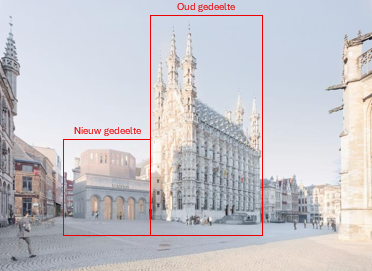
Twee ruimtes werden onderzocht: de antichambre in de nieuwbouw (rechts) en de polyvalente zaal in het historische gedeelte (links).

Het renovatieproject besteedt aandacht aan toegankelijkheid, met onder meer nieuwe liften, trappen en een helling. Dat gaat echter vooral over rolstoeltoegankelijkheid. Akoestische toegankelijkheid kreeg in de gesprekken met de ervaringsdeskundigen opvallend minder aandacht.
Drie oren, drie werelden
Drie ervaringsdeskundigen luisterden mee, en elk van hen ervaart dezelfde akoestiek totaal anders.
Voor Sandy, die slechtziend en vroegblind is, is geluid een manier om haar omgeving in kaart te brengen. Echolocatie en het geluid van haar stok helpen haar om een mentale plattegrond te maken. Tapijt kan dat moeilijker maken. “Want dat maakt geen lawaai meer, en je hoort dat dan echt niet.” Ze verkiest daarom materialen zoals tegels, hout en linoleum. “Waarom esthetiek? Het moet praktisch zijn.”
Stefanie, die autisme en ADHD heeft, ervaart geluid juist als een prikkel. Niet alleen het volume, maar vooral de voorspelbaarheid ervan speelt een rol. “Net zoals als je langs de treinsporen wandelt, is een trein even luid, maar doordat je weet dat hij eraan gaat komen, ga je er beter mee om.” Een huilende baby kan vervelend zijn, maar is voorspelbaar. Een onverwachte schreeuwende vrouw komt volgens haar “de hele tijd vanuit het niks”. Daarom zoekt ze vooraf informatie op, heeft ze vaste plekken en zou ze een druktemeter op een website waarderen.
Ook Wout, die autisme en een mentale beperking heeft, is gevoelig voor complexe geluiden. Een ruimte kan aangenaam zijn, terwijl de route ernaartoe dat niet is. “Deze zaal vond ik wel oké, maar de weg ernaartoe is wel bijzonder overprikkelend.” Op weg naar het stadsbalkon reageerde hij met: “VEEL TE DRUK!” Hij zette zijn hoofdtelefoon gedeeltelijk af om toch ergens rust te vinden.
Eén ruimte, tegengestelde noden
De drie perspectieven leggen samen een spanningsveld bloot. Meer galm helpt Sandy zich te oriënteren, maar diezelfde galm jaagt Stefanie en Wout net in de stress. Eén ontwerp, tegengestelde behoeften.
Toch vond het onderzoek een gedeelde basis: minder complexiteit werkt voor iedereen positief, en minder galm verhoogt het comfort. Om dat te testen vergeleek de onderzoekster de originele ruimtes (links) met aangepaste versies (rechts), waarin tapijt en akoestische panelen werden toegevoegd.


De reacties veranderden merkbaar. Stefanie ging van “ik wil hier weg” naar “best oké om te zijn”. Wout beoordeelde bijna alle posities als “aangenaam”. Sandy vond het geluid “natuurlijker” en “rustgevender”.
De resultaten tonen ook dat niet alleen de bestemming telt. Gangen, trappen en overgangen kunnen minstens even belangrijk zijn als de ruimte waar iemand uiteindelijk terechtkomt.
De conclusie is geen nieuwe akoestische norm die voor iedereen moet gelden. Het gaat eerder om een andere manier van ontwerpen: betrek gebruikers vroeger bij het proces en ontwerp niet voor een gemiddelde gebruiker, maar voor verschillende manieren van ervaren.
Wat werkt, en wat nog niet
Eerlijk is eerlijk: de tool is nog niet perfect. Stefanie bleef zich er voortdurend van bewust dat ze “op die stoel zat, alleen”, wat inleving bemoeilijkte. Wout vond de simulatie “onvoorspelbaar” door een gebrek aan voorkennis. En Sandy waarschuwde dat je niet te veel interactieve geluiden moet toevoegen: “Ik denk dat je dan wel heel lang bezig gaat zijn.”
Ook de technologie zelf vraagt nog werk. Het model moest drastisch vereenvoudigd worden, de simulatie duurde uiteindelijk vier uur en kleine foutjes (een verouderde softwareversie, een verkeerd bestandsformaat) zorgden voor uren extra werk. Toch toont het onderzoek dat auralisatie al kan helpen om een ontwerp niet alleen te bekijken, maar ook te beluisteren.
Van norm naar ervaring
Het onderzoek is duidelijk over zijn eigen grenzen: drie deelnemers, een vereenvoudigd model en geen enkele persoon met een auditieve beperking in de sessies. Het is een verkenning, geen blauwdruk.
Maar de vraag die op tafel wordt gelegd, is groter dan de steekproef doet vermoeden. De traditionele vraag luidt: voldoet de galm aan de norm? Dit onderzoek stelt een andere vraag: hoe ervaart déze persoon déze ruimte?
Akoestiek wordt zo niet alleen een technische kwestie die aan het einde van het ontwerpproces wordt gecontroleerd, maar een onderdeel van het ontwerp zelf. Door gebruikers vroeger te betrekken en plan, beeld en geluid te combineren, kan auralisatie een manier worden om al vóór de bouw te bespreken hoe een ruimte verschillende mensen zal laten voelen.
Een gebouw dat je vooraf hoort, kan je nog bijsturen. Een gebouw dat je pas hoort als de sleutel al is overhandigd, luistert te laat.
Sandy hoort een kind huilen. Links, hoog, vermoedelijk op de tweede verdieping. Ze weet het zonder te kijken. Misschien begint toegankelijke architectuur wel bij de vraag hoe een ruimte klinkt.
Bibliografie
Abraham, A. K., & Manohar, N. (2015). Efficacy of an assistive device for museum visitors with hearing impairment. Journal of All India Institute of Speech & Hearing (JAIISH), 34, 117-127.
Afonso-Jaco, A., & Katz, B. F. G. (2022). Spatial Knowledge via Auditory Information for Blind Individuals: Spatial Cognition Studies and the Use of Audio-VR. Sensors, 22(13), 4794. https://doi.org/10.3390/s22134794
Anderson, S. (2022). Beyond standards: In search of heterogeneous approaches to sound in the design and planning of the public realm. inter-noise and noise-con Congress and Conference Proceedings, 265(5), 2561-2567. https://www.ingentaconnect.com/content/ince/incecp/2023/00000265/000000…
aNNo ARCHITECTEN & FELT architectuur & design. (2023, 14 februari). 1905_DO_230214_00_architectuurplannen_A3 [Architectuurplannen].
Architexture V. (z.d.). Recroding Room Impulse Responses. Architexture V - 2: Room Impulse Responses. Geraadpleegd 27 mei 2026, van https://architexture.york.ac.uk/learning-activities/2-room-impulse-resp…
ARUP & Aural Diversity Network. (2024, februari). Aural Diversity Toolkit. https://www.arup.com/insights/aural-diversity-toolkit/
Aspöck, L. (2020). Validation of room acoustic simulation models. Logos Verlag GmbH.
Aspöck, L., Pelzer, S., Wefers, F., & Vorländer, M. (2014, 3 april). A real-time auralization plugin for architectural design and education. Proceedings of the EAA Joint Symposium on Auralization and Ambisonics.
Axelsson, Ö., Nilsson, M. E., & Berglund, B. (2010). A principal components model of soundscape perception. The Journal of the Acoustical Society of America, 128(5), 2836-2846. https://doi.org/10.1121/1.3493436
Azevedo, M., & Sacks, J. (2014, 3 april). Auralization as an architectural design tool. Proceedings of the EAA Joint Symposium on Auralization and Ambisonics. https://doi.org/10.14279/depositonce-27
Beldam, M.-B. (2018, maart 9). Room acoustic descriptors—RT, C50 and Strength/ Gain. Acoustic Bulletin. https://www.acousticbulletin.com/room-acoustic-descriptors-rt-c50-and-g…
Bettarello, F., Caniato, M., Marzi, A., Scavuzzo, G., & Gasparella, A. (2022). Smart Sensors and Auditory Sensitivity: Acoustic Optimization of Dedicated Spaces for Autistic Individuals. In Building Simulation Applications BSA 2022 (pp. 387-393). Bozen-Bolzano University Press. https://arts.units.it/handle/11368/3041980
Bettarello, F., Caniato, M., Scavuzzo, G., & Gasparella, A. (2021). Indoor Acoustic Requirements for Autism-Friendly Spaces. Applied Sciences, 11(9), 3942. https://doi.org/10.3390/app11093942
Blesser, B., & Salter, L.-R. (2006). Spaces Speak, Are You Listening?: Experiencing Aural Architecture. The MIT Press. https://doi.org/10.7551/mitpress/6384.001.0001
Bradley, J. S., Reich, R., & Norcross, S. G. (1999). A just noticeable difference in C50 for speech. Applied Acoustics, 58(2), 99-108. https://doi.org/10.1016/S0003-682X(98)00075-9
Brown, C. A., & Bacon, S. P. (2010). Fundamental frequency and speech intelligibility in background noise. Hearing Research, 266(1-2), 52-59. https://doi.org/10.1016/j.heares.2009.08.011
Caldas, F., Underwood, S., Masiero, B. S., & Wang, L. M. (2024). Autism and Indoor Sounds. Acoustics Today, 20(2), 21. https://doi.org/10.1121/AT.2024.20.2.21
Campbell, C., Nilsson, E., & Svensson, C. (2015). The Same Reverberation Time in Two Identical Rooms does not Necessarily Mean the Same Levels of Speech Clarity and Sound Levels when We Look at Impact of different Ceiling and Wall Absorbers. Energy Procedia, 78, 1635-1640. https://doi.org/10.1016/j.egypro.2015.11.242
Castronovo, F., Nikolic, D., Liu, Y., & Messner, J. (2013, 30 oktober). An evaluation of immersive virtual reality systems for design reviews. Proceedings of the 13th International Conference on Construction Applications of Virtual Reality. https://www.researchgate.net/publication/286095846_An_evaluation_of_imm…
Caulfield, J. (2021, 6 september). Wat is een thematische analyse (thematic analysis)? Scribbr. https://www.scribbr.nl/onderzoeksmethoden/thematische-analyse/
Dalenbäck, B.-I. L. (1996). Room acoustic prediction based on a unified treatment of diffuse and specular reflection. The Journal of the Acoustical Society of America, 100(2), 899-909. https://doi.org/10.1121/1.416249
Defays, A., Safin, S., Billon, A., Decaestecker, C., Warzée, N., Leclercq, P., & Nyssen, A.-S. (2014). Bimodal Interaction: The Role of Visual Information in Performing Acoustic Assessment in Architecture. Ergonomics Open Journal, 7. https://doi.org/10.2174/1875934301407010013
Ding, N., Gao, J., Wang, J., Sun, W., Fang, M., Liu, X., & Zhao, H. (2023). Speech recognition in echoic environments and the effect of aging and hearing impairment. Hearing Research, 431, 108725. https://doi.org/10.1016/j.heares.2023.108725
Ecophon. (z.d.). Nagalmtijd. Ecophon. Geraadpleegd 2 mei 2026, van https://www.ecophon.com/nl/about-ecophon/acoustic-knowledge/room-acoust…
Eisazadeh, N., Vermeersch, P.-W., Heylighen, A., & Houbart, C. (2025). Informing Heritage Conservation Through Diverse Experiences: The Case of the Leuven Town Hall. Urban Planning, 10. https://doi.org/10.17645/up.9168
Erfanian, M., Mitchell, A. J., Kang, J., & Aletta, F. (2019). The Psychophysiological Implications of Soundscape: A Systematic Review of Empirical Literature and a Research Agenda. International Journal of Environmental Research and Public Health, 16(19), 3533. https://doi.org/10.3390/ijerph16193533
Fay, M. (2013). Acoustics 101 for Architects. GraceNote Design Group, (1).
Goubran, R., Vukovic, B., Laska, B., Ault, L., Hirotani, M., Wallace, B., Gunnell, J., Bergin, C., & Hudak, A. (2023). Informing Standards for Acoustics and the Built Environment: Final Research Report. Carleton University. Faculty of Engineering and Design. https://doi.org/10.22215/rcgl/23jn0251e
Gracey & Associates. (2023, 12 mei). Sound level frequency-weightings terms and definitions. Acoustic glossary. https://www.acoustic-glossary.co.uk/frequency-weighting.htm#a-weighting
Guastamacchia, A., Rosso, R. G., Puglisi, G. E., Riente, F., Shtrepi, L., & Astolfi, A. (2024). Real and Virtual Lecture Rooms: Validation of a Virtual Reality System for the Perceptual Assessment of Room Acoustical Quality. Acoustics, 6(4), 933-965. https://doi.org/10.3390/acoustics6040052
Hamida, A., Eijkelenboom, A., & Bluyssen, P. M. (2024). Profiling university students based on their acoustical and psychosocial preferences and characteristics of their home study places. Building and Environment, 253, 111324. https://doi.org/10.1016/j.buildenv.2024.111324
Hamilton, B., & Bilbao, S. (2017). FDTD Methods for 3-D Room Acoustics Simulation With High-Order Accuracy in Space and Time. IEEE/ACM Transactions on Audio, Speech, and Language Processing, 25(11), 2112-2124. https://doi.org/10.1109/TASLP.2017.2744799
Herssens, J. (2011). Designing Architecture for More: A Framework of Haptic Design Parameters with the Experience of People Born Blind. https://documentserver.uhasselt.be//handle/1942/13903
Heylighen, A., Vermeir, G., & Rychtáriková, M. (2008). The Sound of Inclusion: A Case Study on Acoustic Comfort for All. In P. Langdon, J. Clarkson, & P. Robinson (Red.), Designing Inclusive Futures (pp. 75-84). Springer. https://doi.org/10.1007/978-1-84800-211-1_8
Hong, J. Y., & Jeon, J. Y. (2017). Relationship between spatiotemporal variability of soundscape and urban morphology in a multifunctional urban area: A case study in Seoul, Korea. Building and Environment, 126, 382-395. https://doi.org/10.1016/j.buildenv.2017.10.021
Hoorzorg Specialist Sander. (2025, 7 juli). Horend Goed Audiciens. De Stilste Plek op Aarde: De Dode Kamer. https://www.horendgoed.nl/nieuws-achtergrond/de-stilste-plek-op-aarde-d…
Hugill, A. (2022, 23 oktober). Aural Diversity: Infographic. https://auraldiversity.org/infographic.html
Hull, J. M., & Hayhoe, S. (2019). Touching the Rock: An Experience of Blindness (1990). In G. Thomas Couser & S. B. Mintz (Red.), Disability Experiences (Vol. 2, pp. 759-762). Macmillan. https://www.cengage.com/search/productOverview.do?Ntt=disability+experi…
IKEA. (z.d.). IKEA PS LÖMSK [Screenshot]. Geraadpleegd 16 mei 2026, van https://www.ikea.com/be/nl/p/ikea-ps-loemsk-draaifauteuil-wit-rood-1040…
Institute of Acoustics (IOA) & Association of Noise Consultants (ANC). (2015). Acoustics of Schools: A design guide.
judefelix. (2024, 30 juli). Coffee Shop [3D model]. CGTrader. https://www.cgtrader.com/free-3d-models/exterior/exterior-public/coffee…
Kanakri, S. M., Shepley, M., Varni, J. W., & Tassinary, L. G. (2017). Noise and autism spectrum disorder in children: An exploratory survey. Research in Developmental Disabilities, 63, 85-94. https://doi.org/10.1016/j.ridd.2017.02.004
Kang, J., Aletta, F., Gjestland, T. T., Brown, L. A., Botteldooren, D., Schulte-Fortkamp, B., Lercher, P., Van Kamp, I., Genuit, K., Fiebig, A., Bento Coelho, J. L., Maffei, L., & Lavia, L. (2016). Ten questions on the soundscapes of the built environment. Building and Environment, 108, 284-294. https://doi.org/10.1016/j.buildenv.2016.08.011
Khairul Anuar, F. N., Sulaiman, R., Din, N. C., & Abdul Razak, A. S. (2024). A Conceptual Framework for Immersive Acoustic Auralisation: Investigating the Key Attributes. Journal of Physics: Conference Series, 2721(1), 012015. https://doi.org/10.1088/1742-6596/2721/1/012015
Kinnear, D., Rydzewska, E., Dunn, K., Hughes-McCormack, L., Melville, C., Henderson, A., & Cooper, S.-A. (2020). The relative influence of intellectual disabilities and autism on sensory impairments and physical disability: A whole-country cohort of 5.3 million children and adults. Journal of Applied Research in Intellectual Disabilities, 33(5), 1059-1068. https://doi.org/10.1111/jar.12728
Kleiner, M., Dalenbäck, B.-I. L., & svensson, P. (1993). Auralization—An overview. Journal of the Audio Engineering Society, Vol. 41, No. 11, 861-875.
KU Leuven. (z.d.). 00.32—Academisch Kwartier De Valk—KULag [Afbeelding]. Geraadpleegd 16 mei 2026, van https://www.kuleuven.be/kulag/nl/lokaal/103-03-000032/onderwijs
Kurniawan, S. H., Sporka, A., Nemec, V., & Slavik, P. (2004). Design and user evaluation of a spatial audio system for blind users. Virtual Reality.
Larsen, O. N., Gannon, W. L., Erbe, C., Pavan, G., & Thomas, J. A. (2022). Source-Path-Receiver Model for Airborne Sounds. In C. Erbe & J. A. Thomas (Red.), Exploring Animal Behavior Through Sound: Volume 1: Methods (pp. 153-183). Springer International Publishing. https://doi.org/10.1007/978-3-030-97540-1_5
Larsson, K. (2016). The Importance of Engineering Acoustics. https://www.academia.edu/28159491/The_Importance_of_Engineering_Acousti…
Lavagna, L., Shtrepi, L., Farina, A., Bevilacqua, A., & Astolfi, A. (2022, 6 juli). Acoustic design optimization through the use of auralization: How does it sound like? PROCEEDINGS of the 2nd Symposium: The Acoustics of Ancient Theatres. https://doi.org/10.58874/SAAT.2022.189
Lindebrink, J., & Nätterlund, J. (2015, 15 november). An engine for real-time audiovisual rendering in the building design process. Acoustics 2015 Hunter Valley. https://www.semanticscholar.org/paper/AN-ENGINE-FOR-REAL-TIME-AUDIOVISU…
Massie, C. (2014, 7 maart). Soundscape Architecture Analyzes Aural Characteristics of Iconic Buildings. Architect Magazine. https://www.architectmagazine.com/practice/professional-development/sou…
Milo, A. (2020). The acoustic designer: Joining soundscape and architectural acoustics in architectural design education. Building Acoustics, 27(2), 83-112. https://doi.org/10.1177/1351010X19893593
Minelli, G., Astolfi, A., & Puglisi, G. E. (2020). The effect of classroom acoustics on students? Learning processes: selection of objective parameters and provision of a measurement protocol. 6 pages. https://doi.org/10.48465/FA.2020.0575
Minnaar, P., Favrot, S., & Buchholz, J. M. (2010). Improving hearing aids through listening tests in a virtual sound environment. The Hearing Journal, 63(10), 40. https://doi.org/10.1097/01.HJ.0000389926.64797.3e
Nagib, W., & Williams, A. (2018). Creating “therapeutic landscapes” at home: The experiences of families of children with autism. Health & Place, 52, 46-54. https://doi.org/10.1016/j.healthplace.2018.05.001
Nguyen, P., d’Auria, V., & Heylighen, A. (2020). Detail Matters: Exploring Sensory Preferences in Housing Design for Autistic People. In P. Langdon, J. Lazar, A. Heylighen, & H. Dong (Red.), Designing for Inclusion (pp. 132-139). Springer International Publishing. https://doi.org/10.1007/978-3-030-43865-4_14
Níall McLaughlin Architects. (2025, 26 maart). Bishop Edward King Chapel. https://www.niallmclaughlin.com/projects/bishop-edward-king-chapel/
NOV’82 Architecten. (z.d.). Audiomaquette Tweede Kamer. Geraadpleegd 30 mei 2026, van https://nov82.nl/projecten/audiomaquette-tk/
Nureva support. (2024, 12 april). About background noise levels. https://support.nureva.com/docs/about-background-noise-levels
Odelius, J., Johansson, Ö., & Ågren, A. (2005). Communication quality for students with a hearing impairment: An experiment evaluating speech intelligibility and annoyance. Forum Acusticum 2005. https://www.researchgate.net/publication/229043294_Communication_qualit…
ODEON A/S. (z.d.). Prices and Editions. ODEON Room Acoustics Software. Geraadpleegd 30 december 2025, van https://odeon.dk/buy/prices-and-editions/
ODEON Room Acoustics Software. (2024, 9 oktober). How to produce auralisations of your room model—ODEON tutorial [Video]. https://www.youtube.com/watch?v=NxB6596U5c0
Patel, R. (2020). Architectural Acoustics: A guide to integrated thinking. Routledge.
Pelzer, S., Aspöck, L., Schröder, D., & Vorländer, M. (2014). Integrating Real-Time Room Acoustics Simulation into a CAD Modeling Software to Enhance the Architectural Design Process. Buildings, 4(2), 113-138. https://doi.org/10.3390/buildings4020113
Picinali, L., Afonso, A., Denis, M., & Katz, B. F. G. (2014). Exploration of architectural spaces by blind people using auditory virtual reality for the construction of spatial knowledge. International Journal of Human-Computer Studies, 72(4), 393-407. https://doi.org/10.1016/j.ijhcs.2013.12.008
Poirier-Quinot, D. (2025). Cue-preserving auralisations for blind exploration of virtual indoor environments. Technology and Disability, 0(0), 1-18. https://doi.org/10.1177/10554181251339605
Poirier-Quinot, D., Postma, B. N., & Katz, B. F. (2016). Augmented auralization: Complementing auralizations with immersive virtual reality technologies. 1-10. https://scholar.google.com/citations?view_op=view_citation&hl=fr&user=W…
Probst, W., Böhm, M., & Datakustik GmbH. (2017). The application of the STI in speech communication. https://www.datakustik.com/fileadmin/user_upload/e-Learning-Center/Pape…
Renel, W. (2022). Non-normative sonic space: Exploring the divergent capacities of soundscape design in the built environment. inter-noise and noise-con Congress and Conference Proceedings, 265(6), 1102-1113. https://www.ingentaconnect.com/content/ince/incecp/2023/00000265/000000…
Reverberation Time in Room Acoustics. (2023, 9 maart). Larson Davis. http://www.larsondavis.com/learn/building-acoustics/Reverberation-Time-…
Rychtáriková, M. (2015). How do blind people perceive sound and soundscape? Akustika, 23, 6-9.
Secchi, S., Lauria, A., & Cellai, G. (2017). Acoustic wayfinding: A method to measure the acoustic contrast of different paving materials for blind people. Applied Ergonomics, 58, 435-445. https://doi.org/10.1016/j.apergo.2016.08.004
Shokz oordopjes. (z.d.). [Screenshot]. Coolblue. Geraadpleegd 16 mei 2026, van https://www.coolblue.be/nl/oordopjes/shokz
SonaVyx. (z.d.). Early Reflections. SonaVyx. Geraadpleegd 2 mei 2026, van https://sonavyx.com/en/glossary/early-reflections
Speech clarity | Room acoustic descriptors | Ecophon. (z.d.). Geraadpleegd 2 mei 2026, van https://www.ecophon.com/en/about-ecophon/acoustic-knowledge/room-acoust…
Stad Leuven. (z.d.-a). Ontwerp van het toekomstige stadhuis. Geraadpleegd 17 november 2025, van https://www.leuven.be/ontwerp-van-het-toekomstige-stadhuis
Stad Leuven. (z.d.-b). Verbouwings- en renovatiewerken in het stadhuis. Geraadpleegd 17 november 2025, van https://www.leuven.be/verbouwings-en-renovatiewerken-het-stadhuis
Symposium on Sound Driven Design. (2025, 11 september). Ressources IRCAM. https://ressources.ircam.fr/fr/event/symposium-on-sound-driven-design-2…
Thery, D., Boccara, V., & Katz, B. F. G. (2019). Auralization uses in acoustical design: A survey study of acoustical consultants. The Journal of the Acoustical Society of America, 145(6), 3446-3456. https://doi.org/10.1121/1.5110711
Thery, D., Poirier-Quinot, D., Jouan, S., Katz, B. F., & Boccara, V. (2022). Architectural acoustic design: Observation of use cases including audio-only and multimodal auralizations. Building Acoustics, 29(1), 179-199. https://doi.org/10.1177/1351010X211045518
Treble. (z.d.). Geraadpleegd 30 december 2025, van https://app.treble.tech/subscription?type=singlestandard&period=monthly
Tsimpou, T. (2025, 11 februari). Kengo kuma discusses translating sound into space as “onomatopoeia” show lands in athens. Designboom | Architecture & Design Magazine. https://www.designboom.com/architecture/kengo-kuma-sound-space-onomatop…
Tweede Kamer der staten-generaal. (2022, 4 april). Kamer onthult audiomaquette en blindegeleidelijn. https://www.tweedekamer.nl/nieuws/kamernieuws/kamer-onthult-audiomaquet…
Unity Technologies. (z.d.). Spatial Audio. Unity Glossary. Geraadpleegd 26 mei 2026, van https://unity.com/glossary/spatial-audio
Vermeersch, P.-W. (2013). Less vision, more senses: Towards a more multisensory design approach in architecture. https://www.researchgate.net/publication/275891851_Less_vision_more_sen…
Vermeersch, P.-W., & Heylighen, A. (2021). Involving blind user/experts in architectural design: Conception and use of more-than-visual design artefacts. CoDesign, 17(1), 50-69. https://doi.org/10.1080/15710882.2018.1557696
Visit Leuven. (z.d.). 360° virtuele tour | Discover Leuven town hall [Screenshot]. Bezoek Leuven virtueel. Geraadpleegd 29 mei 2026, van http://townhall.visitleuven.be/
Vorländer, M. (2014). Virtual Acoustics. Archives of Acoustics, 39(3). https://doi.org/10.2478/aoa-2014-0036
Vorländer, M. (2020). Auralization: Fundamentals of Acoustics, Modelling, Simulation, Algorithms and Acoustic Virtual Reality. Springer International Publishing. https://doi.org/10.1007/978-3-030-51202-6
Weber, C., Husung, S., Brix, T., Brix, S., & Sladeczek, C. (2011, 12 september). Auralisation of acoustical product properties for technical systems in virtual environments. 56th international scientific colloquium.
Williams, M. A., Dubin, B., Amaefule, C., Nguyen, L., Abdolrahmani, A., Galbraith, C., Hurst, A., & Kane, S. K. (2016). Better Supporting Blind Pedestrians and Blind Navigation Technologies Through Accessible Architecture. In P. Langdon, J. Lazar, A. Heylighen, & H. Dong (Red.), Designing Around People (pp. 237-246). Springer International Publishing. https://doi.org/10.1007/978-3-319-29498-8_25
Woorden.org. (z.d.-a). Akoestiek. Woorden.org - Nederlands woordenboek. Geraadpleegd 17 december 2025, van https://www.woorden.org/woord/akoestiek
Woorden.org. (z.d.-b). Auditief. Woorden.org - Nederlands woordenboek. Geraadpleegd 17 december 2025, van https://www.woorden.org/woord/auditief
Wyke, S. S., Svidt, K., Christensen, F., Sorensen, J. B., Fadnes, T. M., & Jensen, R. L. (2020). Real-Time Evaluation of Room Acoustics using IFC-Based Virtual Reality and Auralization Engines. 279-290. https://doi.org/10.46421/2706-6568.37.2020.paper020
Zaar, J., & Carney, L. H. (2022). Predicting speech intelligibility in hearing-impaired listeners using a physiologically inspired auditory model. Hearing Research, 426, 108553. https://doi.org/10.1016/j.heares.2022.108553
Zahorik, P., & Brandewie, E. (2011). Perceptual Adaptation to Room Acoustics and Effects on Speech Intelligibility in Hearing-Impaired Populations. Proceedings of Forum Acusticum, 2167-2172.
Zaniboni, L., & Toftum, J. (2023). Indoor environment perception of people with autism spectrum condition: A scoping review. Building and Environment, 243, 110545. https://doi.org/10.1016/j.buildenv.2023.110545