CO₂ vangen met plasticafval?
430,9 miljoen ton. Zoveel plastic werd wereldwijd geproduceerd in 2024. Een materiaal dat we bijna overal gebruiken, zorgt voor een steeds groter afvalprobleem en tegelijk een koolstofprobleem. Wat als we die koolstof niet verbranden als CO₂, maar omvormen tot een materiaal dat zelf CO₂ kan opvangen?
Afval = grondstof
CO₂ is één van de belangrijkste broeikasgassen die bijdragen aan de opwarming van de aarde. Zonder bijkomende maatregelen kunnen de jaarlijkse CO₂-emissies tegen 2050 oplopen tot 48 à 55 gigaton. De omschakeling van fossiele brandstoffen naar duurzamere energiebronnen kan veel uitstoot verminderen, maar sommige sectoren, zoals de staal- en cementindustrie, zijn moeilijk volledig koolstofvrij te maken. Daarom zal naast het verminderen van uitstoot ook het opvangen van CO₂ een belangrijke rol spelen.
Een mogelijkheid om CO₂ op te vangen is adsorptie. Daarbij hechten CO₂-moleculen zich aan het oppervlak van een vast materiaal. Vooral materialen met veel kleine poriën zijn hiervoor interessant, omdat ze binnenin een heel groot oppervlak kunnen hebben waarop CO₂ kan worden vastgehouden. Geactiveerde koolstoffen zijn veelbelovende adsorbenten, omdat ze erg poreus kunnen worden gemaakt, stabiel zijn en na gebruik kunnen worden geregenereerd en hergebruikt. Waarom zouden we daarvoor nieuwe grondstoffen gebruiken als plasticafval zelf al grotendeels uit koolstof bestaat? Door moeilijk recycleerbaar plastic om te zetten in poreuze koolstof ontstaat een dubbel voordeel: afval krijgt opnieuw waarde en het nieuwe materiaal kan worden ingezet om CO₂ op te vangen. Vanuit dit idee onderzocht ik of PET-afval en sigarettenpeuken konden worden omgezet in zulke poreuze koolstofmaterialen.
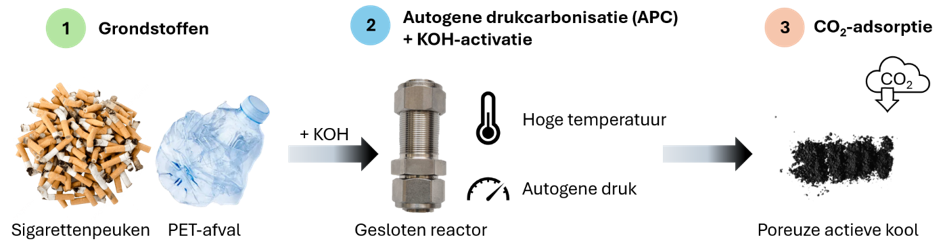
Hiervoor gebruikte ik autogene drukcarbonisatie (APC). Hierbij wordt het afval verhit in een gesloten reactor. In tegenstelling tot klassieke pyrolyse kunnen vluchtige afbraakproducten niet zomaar ontsnappen. De druk in de reactor bouwt vanzelf op en bevordert verdere reacties, waardoor meer koolstof in het vaste product kan worden behouden. Voor de productie van actieve kool werd voor de verhitting kaliumhydroxide (KOH) aan het versneden afval toegevoegd. Zo vonden carbonisatie en activatie in één processtap plaats. Tijdens deze behandeling ontstaan kleine poriën en wordt het interne oppervlak sterk vergroot. Het resultaat is een poreuze actieve kool die als adsorbens voor CO₂ kan worden gebruikt. PET-afval en sigarettenpeuken werden zowel afzonderlijk als in een mengsel van beide verwerkt.
Vijf tennisvelden in één gram
Sigarettenpeuken zijn alomtegenwoordig in het straatbeeld. Hun filters bestaan hoofdzakelijk uit celluloseacetaat, een kunststof die na gebruik langdurig in het straatbeeld en uiteindelijk in het milieu kan blijven. APC bleek in staat om ook deze filters om te zetten in een koolstofrijk materiaal. Deze koolstof had al vóór verdere activatie een intern oppervlak van ongeveer 252 vierkante meter per gram. De hoeveelheid actieve kool was echter te klein om de prestaties ervan volledig te onderzoeken.
PET-afval leverde uiteindelijk de meest veelbelovende resultaten op. Na KOH-activatie steeg het specifieke oppervlak van de actieve kool van 2,7 naar 1205 vierkante meter per gram. Dat betekent dat één gram actieve kool door zijn netwerk van minuscule poriën bijna vijf tennisvelden aan intern oppervlak bevat. Tegelijk ontstond een microporeuze structuur, precies het soort structuur waarin CO₂ goed kan worden vastgehouden. Net dat grote interne oppervlak maakt poreuze koolstof interessant: hoe meer oppervlak en geschikte kleine poriën, hoe meer plaatsen er zijn waar CO₂-moleculen zich kunnen vasthechten. Het onderzoek toont daarmee aan dat moeilijk recycleerbaar PET-afval kan worden omgezet in een poreus koolstofmateriaal met potentieel voor CO₂-afvang. Daarmee kan moeilijk recycleerbaar afval een nieuwe, hoogwaardige functie krijgen.
Een mengsel van PET en sigarettenfilters bleek daarentegen geen extra voordeel op te leveren: het ontwikkelde nauwelijks porositeit en er werd geen positieve synergie gevonden.
Dat potentieel bleek ook uit de CO₂-opnametesten. De actieve kool uit PET nam 8,5 tot 9,8 millimol CO₂ per gram op. Die waarden liggen opvallend hoog: vergelijkbare geactiveerde koolstoffen uit afval behalen in de literatuur doorgaans 2,7 tot 4,8 millimol per gram. Een eerdere studie waarin PET eveneens via APC en KOH-activatie werd verwerkt, rapporteerde bijvoorbeeld ongeveer 4,4 millimol per gram. Toch betekent dit niet dat deze actieve kool plots dubbel zo goed presteert. De metingen waren verkennend en bereikten nog geen evenwicht. Bovendien kunnen naast fysieke adsorptie ook andere interacties hebben bijgedragen aan de gemeten massatoename. De resultaten moeten daarom worden gezien als een veelbelovend principebewijs, niet als een definitieve adsorptiecapaciteit.
Wat betekent dit in de praktijk?
Of zo’n actieve kool uiteindelijk ook buiten het laboratorium kan worden toegepast, hangt echter van meer af dan alleen hoeveel CO₂ het kan opnemen. Het proces moet ook economisch en energetisch zinvol zijn. Het proces vereist hoge temperaturen en, voor de activatie, chemicaliën zoals KOH. Bij verdere ontwikkeling moet daarom worden onderzocht hoeveel energie en chemicaliën nodig zijn. Ook moet worden onderzocht hoeveel materiaal uiteindelijk wordt geproduceerd en hoe vaak het adsorbens opnieuw kan worden gebruikt. Daarnaast zijn productie op grotere schaal en een vergelijking van de totale milieu-impact en kosten noodzakelijk. De economische haalbaarheid van CO₂-adsorbenten wordt immers sterk bepaald door onder meer materiaalprijs, regeneratie en levensduur.
Tegelijk ligt juist daar de maatschappelijke aantrekkingskracht van het concept. In plaats van moeilijk recycleerbare afvalstromen uitsluitend als een probleem te behandelen, kunnen ze grondstoffen worden voor nieuwe toepassingen. Zo wordt niet alleen geprobeerd minder nieuwe grondstoffen te gebruiken, maar krijgt bestaande koolstof een nieuwe functie voordat die als CO₂ in de atmosfeer terechtkomt. Dat past binnen het idee van een circulaire economie, waarin afval niet als het eindpunt van een materiaal wordt gezien, maar als mogelijke grondstof voor iets nieuws. De koolstof die gisteren nog een plasticfles was, kan morgen misschien deel uitmaken van een materiaal dat helpt om CO₂ op te vangen.
Bibliografie
[1] D. Bruneel, Toepassingen in de chemische industrie. Gent: KU Leuven, 2025.
[2] ‘Plastics - the Facts 2009 • Plastics Europe’, Plastics Europe. Accessed: Feb. 22, 2026. [Online]. Available: https://plasticseurope.org/knowledge-hub/plastics-the-facts-2009/
[3] ‘The-New-Plastics-Economy-Rethinking-the-future-of-plastics.pdf’. Accessed: Feb. 12, 2026. [Online]. Available: https://content.ellenmacarthurfoundation.org/m/1775fbba280fa21/original…
[4] ‘Knowledge hub • Plastics Europe’, Plastics Europe. Accessed: Feb. 11, 2026. [Online]. Available: https://plasticseurope.org/knowledge-hub/
[5] T. Chanda, L. Chitondo, and L. Ngulube, ‘Plastic Pollution: Causes, Effects, and Solutions’, International Journal of Research Publication and Reviews, vol. 5, pp. 6570–6581, Mar. 2024.
[6] P. G. C. Nayanathara Thathsarani Pilapitiya and A. S. Ratnayake, ‘The world of plastic waste: A review’, Cleaner Materials, vol. 11, p. 100220, Mar. 2024, doi: 10.1016/j.clema.2024.100220.
[7] S. M. Al-Salem, P. Lettieri, and J. Baeyens, ‘Recycling and recovery routes of plastic solid waste (PSW): A review’, Waste Management, vol. 29, no. 10, pp. 2625–2643, Oct. 2009, doi: 10.1016/j.wasman.2009.06.004.
[8] J. N. Hahladakis, C. A. Velis, R. Weber, E. Iacovidou, and P. Purnell, ‘An overview of chemical additives present in plastics: Migration, release, fate and environmental impact during their use, disposal and recycling’, Journal of Hazardous Materials, vol. 344, pp. 179–199, Feb. 2018, doi: 10.1016/j.jhazmat.2017.10.014.
[9] A. Ebikapade and J. Baird, ‘The Concept of Waste and Waste Management’, Journal of Management and Sustainability, vol. 6, pp. 88–88, Nov. 2016, doi: 10.5539/jms.v6n4p88.
[10] ‘The environmental impacts of plastic pollution’. Accessed: Feb. 22, 2026. [Online]. Available: https://www.researchgate.net/publication/339907673_The_environmental_im…
[11] ‘ISO/DIS 24187(en), Principles for the analysis of plastics and microplastics present in the environment’. Accessed: Jun. 01, 2026. [Online]. Available: https://www.iso.org/obp/ui#iso:std:iso:24187:dis:ed-1:v1:en
[12] A. Adekanmbi, E. Ani, A. Abatan, U. Izuka, N. Ninduwezuor-Ehiobu, and A. Obaigbena, ‘Assessing the environmental and health impacts of plastic production and recycling’, World Journal of Biology Pharmacy and Health Sciences, vol. Vol. 1, pp. 232–241, Feb. 2024, doi: 10.30574/wjbphs.2024.17.2.0081.
[13] S. B. Sheavly, ‘Sheavly, S.B. (2005) Marine Debris—An Overview of a Critical Issue for Our Oceans. 6th Meeting of the UN Open-Ended Informal Consultative Processes on Oceans & the Law of the Sea, New York, 6-10 June 2005, 7 p. - References - Scientific Research Publishing’. Accessed: Feb. 23, 2026. [Online]. Available: https://www.scirp.org/reference/referencespapers?referenceid=1752350
[14] A. Cózar et al., ‘Plastic debris in the open ocean’, Proc Natl Acad Sci U S A, vol. 111, no. 28, pp. 10239–10244, Jul. 2014, doi: 10.1073/pnas.1314705111.
[15] R. W. Furness, ‘Birds as monitors of pollutants’, in Birds as Monitors of Environmental Change, R. W. Furness and J. J. D. Greenwood, Eds, Dordrecht: Springer Netherlands, 1993, pp. 86–143. doi: 10.1007/978-94-015-1322-7_3.
[16] M. Sigler, ‘The Effects of Plastic Pollution on Aquatic Wildlife: Current Situations and Future Solutions’, Water Air Soil Pollut, vol. 225, no. 11, p. 2184, Oct. 2014, doi: 10.1007/s11270-014-2184-6.
[17] J. John, A. R. Nandhini, P. Velayudhaperumal Chellam, and M. Sillanpää, ‘Microplastics in mangroves and coral reef ecosystems: a review’, Environ Chem Lett, vol. 20, no. 1, pp. 397–416, Feb. 2022, doi: 10.1007/s10311-021-01326-4.
[18] J. G. B. Derraik, ‘The pollution of the marine environment by plastic debris: a review’, Mar Pollut Bull, vol. 44, no. 9, pp. 842–852, Sep. 2002, doi: 10.1016/s0025-326x(02)00220-5.
[19] F. Gallo et al., ‘Marine litter plastics and microplastics and their toxic chemicals components: the need for urgent preventive measures’, Environ Sci Eur, vol. 30, no. 1, p. 13, Apr. 2018, doi: 10.1186/s12302-018-0139-z.
[20] P. Li, X. Wang, M. Su, X. Zou, L. Duan, and H. Zhang, ‘Characteristics of Plastic Pollution in the Environment: A Review’, Bull Environ Contam Toxicol, vol. 107, no. 4, pp. 577–584, Oct. 2021, doi: 10.1007/s00128-020-02820-1.
[21] Y. Huang, X. Qing, W. Wang, G. Han, and J. Wang, ‘Mini-review on current studies of airborne microplastics: Analytical methods, occurrence, sources, fate and potential risk to human beings’, TrAC Trends in Analytical Chemistry, vol. 125, p. 115821, Apr. 2020, doi: 10.1016/j.trac.2020.115821.
[22] Y. Wang, J. Huang, F. Zhu, and S. Zhou, ‘Airborne Microplastics: A Review on the Occurrence, Migration and Risks to Humans’, Bull Environ Contam Toxicol, vol. 107, no. 4, pp. 657–664, Oct. 2021, doi: 10.1007/s00128-021-03180-0.
[23] J. Brahney, M. Hallerud, E. Heim, M. Hahnenberger, and S. Sukumaran, ‘Plastic rain in protected areas of the United States’, Science, vol. 368, no. 6496, pp. 1257–1260, Jun. 2020, doi: 10.1126/science.aaz5819.
[24] S. Allen et al., ‘Atmospheric transport and deposition of microplastics in a remote mountain catchment’, Nat. Geosci., vol. 12, no. 5, pp. 339–344, May 2019, doi: 10.1038/s41561-019-0335-5.
[25] J. R. Rochester, ‘Bisphenol A and human health: a review of the literature’, Reprod Toxicol, vol. 42, pp. 132–155, Dec. 2013, doi: 10.1016/j.reprotox.2013.08.008.
[26] R. S. Kaulgud, S. Belur, A. M. Anagharani, S. Veeresh, and A. K. Shettar, ‘Effects of Bisphenol-A on human endocrine function and health outcomes: a review’, Discov Toxicol, vol. 2, no. 1, p. 24, Dec. 2025, doi: 10.1007/s44339-025-00046-6.
[27] Y. Wang and H. Qian, ‘Phthalates and Their Impacts on Human Health’, Healthcare, vol. 9, no. 5, p. 603, May 2021, doi: 10.3390/healthcare9050603.
[28] O. Emoyan, G. Tesi, E. Ohwo, C. Olisah, and U. Oghoje, ‘Polybrominated diphenyl ethers concentrations in metals and plastics scrap impacted soils: Pollution load, sources, ecological, and onsite human health implications’, Environmental Forensics, vol. 24, pp. 1–16, Nov. 2021, doi: 10.1080/15275922.2021.2006367.
[29] M. Shen, W. Huang, M. Chen, B. Song, G. Zeng, and Y. Zhang, ‘(Micro)plastic crisis: Un-ignorable contribution to global greenhouse gas emissions and climate change’, Journal of Cleaner Production, vol. 254, p. 120138, May 2020, doi: 10.1016/j.jclepro.2020.120138.
[30] F. D’Acierno, ‘Circular economy’, in Circulaire processen en materialen, Gent: KU Leuven, 2025.
[31] F. D’Acierno, ‘Recycling Technologies and Systems’, in Circulaire processen en materialen, Gent: KU Leuven, 2025.
[32] X. Chen, N. Kroell, M. Althaus, T. Pretz, R. Pomberger, and K. Greiff, ‘Enabling mechanical recycling of plastic bottles with shrink sleeves through near-infrared spectroscopy and machine learning algorithms’, Resources, Conservation and Recycling, vol. 188, p. 106719, Jan. 2023, doi: 10.1016/j.resconrec.2022.106719.
[33] ‘Recent Advancements in Plastic Packaging Recycling: A Mini-Review’. Accessed: Feb. 16, 2026. [Online]. Available: https://www.mdpi.com/1996-1944/14/17/4782
[34] ‘Plastics - the Facts 2020 • Plastics Europe’, Plastics Europe. Accessed: Feb. 16, 2026. [Online]. Available: https://plasticseurope.org/knowledge-hub/plastics-the-facts-2020/
[35] H. Alrazen et al., ‘A review of the pathways, limitations, and perspectives of plastic waste recycling’, Materials for Renewable and Sustainable Energy, vol. 14, Aug. 2025, doi: 10.1007/s40243-025-00328-4.
[36] ‘Plastic and Climate: The Hidden Costs of a Plastic Planet’, Center for International Environmental Law. Accessed: Feb. 12, 2026. [Online]. Available: https://www.ciel.org/plasticandclimate/
[37] H. Ritchie, ‘How much of global greenhouse gas emissions come from plastics?’, Our World in Data, Oct. 2023, Accessed: Mar. 01, 2026. [Online]. Available: https://ourworldindata.org/ghg-emissions-plastics
[38] H. Ritchie, P. Rosado, and M. Roser, ‘Breakdown of carbon dioxide, methane, and nitrous oxide emissions by sector’, Our World in Data, Jun. 2020, Accessed: Mar. 05, 2026. [Online]. Available: https://ourworldindata.org/emissions-by-sector
[39] ‘Net Zero by 2050 – Analysis’, IEA. Accessed: Mar. 05, 2026. [Online]. Available: https://www.iea.org/reports/net-zero-by-2050
[40] S. Solomon, Intergovernmental Panel on Climate Change, and Intergovernmental Panel on Climate Change, Eds, Climate change 2007: the physical science basis: contribution of Working Group I to the Fourth Assessment Report of the Intergovernmental Panel on Climate Change. Cambridge ; New York: Cambridge University Press, 2007.
[41] S. G. Gizer, O. Polat, M. K. Ram, and N. Sahiner, ‘Recent developments in CO2 capture, utilization, related materials, and challenges’, International Journal of Energy Research, vol. 46, no. 12, pp. 16241–16263, 2022, doi: 10.1002/er.8347.
[42] R. Sharifian, R. M. Wagterveld, I. A. Digdaya, C. Xiang, and D. A. Vermaas, ‘Electrochemical carbon dioxide capture to close the carbon cycle’, Energy Environ. Sci., vol. 14, no. 2, pp. 781–814, Feb. 2021, doi: 10.1039/D0EE03382K.
[43] R. Wennersten, Q. Sun, and H. Li, ‘The future potential for Carbon Capture and Storage in climate change mitigation – an overview from perspectives of technology, economy and risk’, Journal of Cleaner Production, vol. 103, pp. 724–736, Sep. 2015, doi: 10.1016/j.jclepro.2014.09.023.
[44] ‘Mineralization | EMIS’. Accessed: Jun. 01, 2026. [Online]. Available: https://emis.vito.be/nl/tools/mapitccu/technologies/mineralization
[45] ‘Global Status of CCS Report: 2020’, Global CCS Institute. Accessed: Mar. 07, 2026. [Online]. Available: https://www.globalccsinstitute.com/publications/global-status-of-ccs-re…
[46] A. Mukherjee, J. A. Okolie, A. Abdelrasoul, C. Niu, and A. K. Dalai, ‘Review of post-combustion carbon dioxide capture technologies using activated carbon’, Journal of Environmental Sciences, vol. 83, pp. 46–63, Sep. 2019, doi: 10.1016/j.jes.2019.03.014.
[47] C. Chao, Y. Deng, R. Dewil, J. Baeyens, and X. Fan, ‘Post-combustion carbon capture’, Renewable and Sustainable Energy Reviews, vol. 138, p. 110490, Mar. 2021, doi: 10.1016/j.rser.2020.110490.
[48] B. Metz, O. Davidson, H. de Coninck, M. Loos, and L. Meyer, ‘IPCC Special Report on Carbon dioxide Capture and Storage’, Policy Stud., Jan. 2005.
[49] M. Mohammad, R. Isaifan, Y. Weldu, M. Rahman, and S. G. Al-Ghamdi, ‘Progress on carbon dioxide capture, storage and utilisation’, International Journal of Global Warming, vol. 20, p. 124, Jan. 2020, doi: 10.1504/IJGW.2020.105386.
[50] R. Soundararajan, T. Gundersen, and M. Ditaranto, ‘Oxy-Combustion Coal Based Power Plants: Study of Operating Pressure, Oxygen Purity and Downstream Purification Parameters’, Chemical Engineering Transactions, vol. 39, pp. 229–234, Aug. 2014, doi: 10.3303/CET1439039.
[51] C. Gaber, C. Schluckner, P. Wachter, M. Demuth, and C. Hochenauer, ‘Experimental study on the influence of the nitrogen concentration in the oxidizer on NOx<math><mrow is="true"><msub is="true"><mtext is="true">NO</mtext><mtext is="true">x</mtext></msub></mrow></math> and CO emissions during the oxy-fuel combustion of natural gas’, Energy, vol. 214, p. 118905, Jan. 2021, doi: 10.1016/j.energy.2020.118905.
[52] M. B. Toftegaard, J. Brix, P. A. Jensen, P. Glarborg, and A. D. Jensen, ‘Oxy-fuel combustion of solid fuels’, Progress in Energy and Combustion Science, vol. 36, no. 5, pp. 581–625, Oct. 2010, doi: 10.1016/j.pecs.2010.02.001.
[53] W. Gao et al., ‘Industrial carbon dioxide capture and utilization: state of the art and future challenges’, Chem. Soc. Rev., vol. 49, no. 23, pp. 8584–8686, Dec. 2020, doi: 10.1039/D0CS00025F.
[54] F. Ochedi, J. Yu, H. Yu, Y. Liu, and A. Hussain, ‘Carbon dioxide capture using liquid absorption methods: a review’, Environmental Chemistry Letters, Sep. 2020, doi: 10.1007/s10311-020-01093-8.
[55] T. N.Borhani and M. Wang, ‘Role of solvents in CO2 capture processes: The review of selection and design methods’, Renewable and Sustainable Energy Reviews, vol. 114, p. 109299, Oct. 2019, doi: 10.1016/j.rser.2019.109299.
[56] J. H. Kwon and L. D. Wilson, ‘Surface-modified activated carbon with β-cyclodextrin—Part II. Adsorption properties’, Journal of Environmental Science and Health, Part A, vol. 45, no. 13, pp. 1793–1803, Oct. 2010, doi: 10.1080/10934529.2010.513292.
[57] C.-H. Yu, C.-H. Huang, and C.-S. Tan, ‘A Review of CO2 Capture by Absorption and Adsorption’, Aerosol Air Qual. Res., vol. 12, no. 5, pp. 745–769, 2012, doi: 10.4209/aaqr.2012.05.0132.
[58] M. Kafi, H. Sanaeepur, and A. Ebadi Amooghin, ‘Grand Challenges in CO2 Capture and Conversion’, Journal of Resource Recovery, vol. 1, no. January-December, p. e703896, Jan. 2023, doi: 10.52547/jrr.2302-1007.
[59] ‘Methods and Techniques for CO2 Capture: Review of Potential Solutions and Applications in Modern Energy Technologies’. Accessed: Mar. 08, 2026. [Online]. Available: https://www.mdpi.com/1996-1073/15/3/887
[60] M. Gholami, T. R. Van Assche, and J. F. Denayer, ‘Temperature vacuum swing, a combined adsorption cycle for carbon capture’, Current Opinion in Chemical Engineering, vol. 39, p. 100891, Mar. 2023, doi: 10.1016/j.coche.2022.100891.
[61] Y. Ban, M. Zhao, and W. Yang, ‘Metal-organic framework-based CO2 capture: From precise material design to high-efficiency membranes’, Front. Chem. Sci. Eng., vol. 14, no. 2, pp. 188–215, Apr. 2020, doi: 10.1007/s11705-019-1872-6.
[62] N. Norahim, P. Yaisanga, K. Faungnawakij, T. Charinpanitkul, and C. Klaysom, ‘Recent Membrane Developments for CO2 Separation and Capture’, Chemical Engineering & Technology, vol. 41, Jan. 2018, doi: 10.1002/ceat.201700406.
[63] J. Fu et al., ‘Techno-economic and life cycle assessment of membrane separation in post-combustion carbon capture: A review’, Gas Science and Engineering, vol. 129, 2024, doi: 10.1016/j.jgsce.2024.205401.
[64] B. Seoane et al., ‘Metal–organic framework based mixed matrix membranes: a solution for highly efficient CO2 capture?’, Chem. Soc. Rev., vol. 44, no. 8, pp. 2421–2454, Apr. 2015, doi: 10.1039/C4CS00437J.
[65] D. Y. C. Leung, G. Caramanna, and M. M. Maroto-Valer, ‘An overview of current status of carbon dioxide capture and storage technologies’, Renewable and Sustainable Energy Reviews, vol. 39, pp. 426–443, Nov. 2014, doi: 10.1016/j.rser.2014.07.093.
[66] W. R. Alesi, M. Gray, and J. R. Kitchin, ‘CO2 Adsorption on Supported Molecular Amidine Systems on Activated Carbon’, ChemSusChem, vol. 3, no. 8, pp. 948–956, Aug. 2010, doi: 10.1002/cssc.201000056.
[67] X. Gao, S. Yang, L. Hu, S. Cai, L. Wu, and S. Kawi, ‘Carbonaceous materials as adsorbents for CO2 capture: synthesis and modification’, Carbon Capture Science & Technology, vol. 3, p. 100039, Jun. 2022, doi: 10.1016/j.ccst.2022.100039.
[68] M. Sevilla and A. B. Fuertes, ‘Sustainable porous carbons with a superior performance for CO2 capture’, Energy Environ. Sci., vol. 4, no. 5, pp. 1765–1771, Apr. 2011, doi: 10.1039/C0EE00784F.
[69] J. Yang et al., ‘Efficient CO2 Capture by Porous Carbons Derived from Coconut Shell’, Energy Fuels, vol. 31, no. 4, pp. 4287–4293, Apr. 2017, doi: 10.1021/acs.energyfuels.7b00633.
[70] X. Yuan et al., ‘Recent advancements in sustainable upcycling of solid waste into porous carbons for carbon dioxide capture’, Renewable and Sustainable Energy Reviews, vol. 162, p. 112413, Jul. 2022, doi: 10.1016/j.rser.2022.112413.
[71] S. Li, M.-K. Cho, S. Deng, J. Wang, and K. B. Lee, ‘Upcycling of polyethylene terephthalate waste into porous carbon as potential CO2 adsorbents through autogenic pressure carbonization’, Chemical Engineering Journal, vol. 494, p. 152931, Aug. 2024, doi: 10.1016/j.cej.2024.152931.
[72] A. Ligero, M. Calero, A. Pérez, R. R. Solís, M. J. Muñoz-Batista, and M. Martín-Lara, ‘Low-cost activated carbon from the pyrolysis of post-consumer plastic waste and the application in CO2 capture’, Process Safety and Environmental Protection, vol. 173, Mar. 2023, doi: 10.1016/j.psep.2023.03.041.
[73] F. Hussin, M. K. Aroua, M. A. Kassim, and U. F. Md. Ali, ‘Transforming Plastic Waste into Porous Carbon for Capturing Carbon Dioxide: A Review’, Energies, vol. 14, no. 24, p. 8421, Jan. 2021, doi: 10.3390/en14248421.
[74] A. S. Jalilov et al., ‘Asphalt-Derived High Surface Area Activated Porous Carbons for Carbon Dioxide Capture’, ACS Appl. Mater. Interfaces, vol. 7, no. 2, pp. 1376–1382, Jan. 2015, doi: 10.1021/am508858x.
[75] X. Zhou, L. Zhu, W. Dong, and M. Jiang, ‘Solving two environmental problems simultaneously:Microporous carbon derived from mixed plastic waste for CO2 capture’, Chemosphere, vol. 345, p. 140546, Dec. 2023, doi: 10.1016/j.chemosphere.2023.140546.
[76] V. G. Pol, ‘Upcycling: Converting Waste Plastics into Paramagnetic, Conducting, Solid, Pure Carbon Microspheres’, Environ. Sci. Technol., vol. 44, no. 12, pp. 4753–4759, Jun. 2010, doi: 10.1021/es100243u.
[77] J. Serafin and B. Dziejarski, ‘Activated carbons—preparation, characterization and their application in CO2 capture: A review’, Environ Sci Pollut Res, vol. 31, no. 28, pp. 40008–40062, Jun. 2024, doi: 10.1007/s11356-023-28023-9.
[78] P. Klobes and R. G. Munro, ‘Porosity and Specific Surface Area Measurements for Solid Materials’, NIST, Aug. 2006, Accessed: Apr. 11, 2026. [Online]. Available: https://www.nist.gov/publications/porosity-and-specific-surface-area-me…
[79] J. Wilcox, ‘Adsorption’, in Carbon Capture, J. Wilcox, Ed., New York, NY: Springer, 2012, pp. 115–175. doi: 10.1007/978-1-4614-2215-0_4.
[80] B. Petrovic, M. Gorbounov, and S. Soltani, ‘Impact of Surface Functional Groups and Their Introduction Methods on the Mechanisms of CO2 Adsorption on Porous Carbonaceous Adsorbents’, Carbon Capture Science & Technology, vol. 3, p. 100045, Mar. 2022, doi: 10.1016/j.ccst.2022.100045.
[81] A. E. Creamer, B. Gao, and M. Zhang, ‘Carbon dioxide capture using biochar produced from sugarcane bagasse and hickory wood’, Chemical Engineering Journal, vol. 249, pp. 174–179, Aug. 2014, doi: 10.1016/j.cej.2014.03.105.
[82] F. Raganati, M. Alfe, V. Gargiulo, R. Chirone, and P. Ammendola, ‘Kinetic study and breakthrough analysis of the hybrid physical/chemical CO2 adsorption/desorption behavior of a magnetite-based sorbent’, Chemical Engineering Journal, vol. 372, pp. 526–535, Sep. 2019, doi: 10.1016/j.cej.2019.04.165.
[83] N. Álvarez-Gutiérrez, M. V. Gil, F. Rubiera, and C. Pevida, ‘Kinetics of CO2 adsorption on cherry stone-based carbons in CO2/CH4 separations’, Chemical Engineering Journal, vol. 307, pp. 249–257, Jan. 2017, doi: 10.1016/j.cej.2016.08.077.
[84] F. Montagnaro et al., ‘Post-combustion CO2 adsorption on activated carbons with different textural properties’, Microporous and Mesoporous Materials, vol. 209, pp. 157–164, Jun. 2015, doi: 10.1016/j.micromeso.2014.09.037.
[85] J. Manyà, B. Gonzalez, M. Azuara, and G. Arner, ‘Ultra-microporous adsorbents prepared from vine shoots-derived biochar with high CO2 uptake and CO2 /N2 selectivity’, The Chemical Engineering Journal, vol. 345, Aug. 2018, doi: 10.1016/j.cej.2018.01.092.
[86] Z. Wang et al., ‘Pith based spherical activated carbon for CO2 removal from flue gases’, Chemical Engineering Science, vol. 66, no. 22, pp. 5504–5511, Nov. 2011, doi: 10.1016/j.ces.2011.06.070.
[87] V. Presser, J. McDonough, S.-H. Yeon, and Y. Gogotsi, ‘Effect of pore size on carbon dioxide sorption by carbide derived carbon’, Energy Environ. Sci., vol. 4, no. 8, p. 3059, 2011, doi: 10.1039/c1ee01176f.
[88] X.-L. Zhu, P.-Y. Wang, C. Peng, J. Yang, and X.-B. Yan, ‘Activated carbon produced from paulownia sawdust for high-performance CO2 sorbents’, Chinese Chemical Letters, vol. 25, no. 6, pp. 929–932, Jun. 2014, doi: 10.1016/j.cclet.2014.03.039.
[89] X. Yuan et al., ‘Solving two environmental issues simultaneously: Waste polyethylene terephthalate plastic bottle-derived microporous carbons for capturing CO2’, Chemical Engineering Journal, vol. 397, p. 125350, Oct. 2020, doi: 10.1016/j.cej.2020.125350.
[90] Y. Zhao, X. Liu, K. X. Yao, L. Zhao, and Y. Han, ‘Superior Capture of CO2 Achieved by Introducing Extra-framework Cations into N-doped Microporous Carbon’, Chem. Mater., vol. 24, no. 24, pp. 4725–4734, Dec. 2012, doi: 10.1021/cm303072n.
[91] M. Wang et al., ‘Probing the role of O-containing groups in CO2 adsorption of N-doped porous activated carbon’, Nanoscale, vol. 9, no. 44, pp. 17593–17600, 2017, doi: 10.1039/c7nr05977a.
[92] J. C. Moreno-Piraján and L. Giraldo, ‘Heat of Adsorption: A Comparative Study between the Experimental Determination and Theoretical Models Using the System CH4 -MOFs’, J. Chem. Eng. Data, vol. 65, no. 6, pp. 3130–3145, Jun. 2020, doi: 10.1021/acs.jced.0c00159.
[93] C. Feng et al., ‘Key technology and application analysis of zeolite adsorption for energy storage and heat-mass transfer process: A review’, Renewable and Sustainable Energy Reviews, vol. 144, Jun. 2021, doi: 10.1016/j.rser.2021.110954.
[94] F. Rouquerol, J. Rouquerol, K. S. W. Sing, P. Llewellyn, and G. Maurin, Adsorption by Powders and Porous Solids: Principles, Methodology and Applications. Academic Press, 2013. doi: 10.1016/C2010-0-66232-8.
[95] Y.-C. Chiang and R.-S. Juang, ‘Surface modifications of carbonaceous materials for carbon dioxide adsorption: A review’, Journal of the Taiwan Institute of Chemical Engineers, vol. 71, Dec. 2016, doi: 10.1016/j.jtice.2016.12.014.
[96] J. R. Pels, F. Kapteijn, J. A. Moulijn, Q. Zhu, and K. M. Thomas, ‘Evolution of nitrogen functionalities in carbonaceous materials during pyrolysis’, Carbon, vol. 33, no. 11, pp. 1641–1653, Jan. 1995, doi: 10.1016/0008-6223(95)00154-6.
[97] X. Hu, M. Radosz, K. A. Cychosz, and M. Thommes, ‘CO2-Filling Capacity and Selectivity of Carbon Nanopores: Synthesis, Texture, and Pore-Size Distribution from Quenched-Solid Density Functional Theory (QSDFT)’, Environ. Sci. Technol., vol. 45, no. 16, pp. 7068–7074, Aug. 2011, doi: 10.1021/es200782s.
[98] X. Zhang et al., ‘Nitrogen enriched biochar modified by high temperature CO2–ammonia treatment: Characterization and adsorption of CO2’, Chemical Engineering Journal, vol. 257, pp. 20–27, Dec. 2014, doi: 10.1016/j.cej.2014.07.024.
[99] D. Saha and M. J. Kienbaum, ‘Role of oxygen, nitrogen and sulfur functionalities on the surface of nanoporous carbons in CO2 adsorption: A critical review’, Microporous and Mesoporous Materials, vol. 287, pp. 29–55, Oct. 2019, doi: 10.1016/j.micromeso.2019.05.051.
[100] D. J. Babu, M. Bruns, R. Schneider, D. Gerthsen, and J. J. Schneider, ‘Understanding the Influence of N-Doping on the CO2 Adsorption Characteristics in Carbon Nanomaterials’, J. Phys. Chem. C, vol. 121, no. 1, pp. 616–626, Jan. 2017, doi: 10.1021/acs.jpcc.6b11686.
[101] Y. Liu and J. Wilcox, ‘Molecular Simulation Studies of CO2 Adsorption by Carbon Model Compounds for Carbon Capture and Sequestration Applications’, Environ. Sci. Technol., vol. 47, no. 1, pp. 95–101, Jan. 2013, doi: 10.1021/es3012029.
[102] Y. Liu and J. Wilcox, ‘Effects of Surface Heterogeneity on the Adsorption of CO2 in Microporous Carbons’, Environ. Sci. Technol., vol. 46, no. 3, pp. 1940–1947, Feb. 2012, doi: 10.1021/es204071g.
[103] X. Ma, L. Li, C. Ruofei, C. Wang, H. Li, and S. Wang, ‘Heteroatom-doped nanoporous carbon derived from MOF-5 for CO 2 capture’, Applied Surface Science, vol. 435, Nov. 2017, doi: 10.1016/j.apsusc.2017.11.069.
[104] M. Kienbaum, ‘Role of oxygen, nitrogen and sulfur functionalities on the surface of nanoporous carbons in CO2 adsorption: A critical review’, Microporous and Mesoporous Materials, May 2019, doi: 10.1016/j.micromeso.2019.05.051.
[105] Y. Wang et al., ‘Nitrogen and Oxygen Codoped Porous Carbon with Superior CO2 Adsorption Performance: A Combined Experimental and DFT Calculation Study’, Ind. Eng. Chem. Res., vol. 58, no. 29, pp. 13390–13400, Jul. 2019, doi: 10.1021/acs.iecr.9b01454.
[106] X. Ma, L. Li, R. Chen, C. Wang, H. Li, and S. Wang, ‘Heteroatom-doped nanoporous carbon derived from MOF-5 for CO2 capture’, Applied Surface Science, vol. 435, pp. 494–502, Mar. 2018, doi: 10.1016/j.apsusc.2017.11.069.
[107] Y. Guo, C. Tan, J. Sun, W. Li, J. Zhang, and C. Zhao, ‘Porous activated carbons derived from waste sugarcane bagasse for CO2 adsorption’, Chemical Engineering Journal, vol. 381, p. 122736, Feb. 2020, doi: 10.1016/j.cej.2019.122736.
[108] T. Chen, S. Deng, B. Wang, J. Huang, Y. Wang, and G. Yu, ‘CO2 adsorption on crab shell derived activated carbons: Contribution of micropores and nitrogen-containing groups’, RSC Adv., vol. 5, no. 60, pp. 48323–48330, 2015, doi: 10.1039/c5ra04937g.
[109] C. Schlumberger and M. Thommes, ‘Characterization of Hierarchically Ordered Porous Materials by Physisorption and Mercury Porosimetry—A Tutorial Review’, Advanced Materials Interfaces, vol. 8, no. 4, p. 2002181, 2021, doi: 10.1002/admi.202002181.
[110] M. Thommes et al., ‘Physisorption of gases, with special reference to the evaluation of surface area and pore size distribution (IUPAC Technical Report)’, Pure and Applied Chemistry, vol. 87, Jan. 2015, doi: 10.1515/pac-2014-1117.
[111] I. Langmuir, ‘THE ADSORPTION OF GASES ON PLANE SURFACES OF GLASS, MICA AND PLATINUM.’, J. Am. Chem. Soc., vol. 40, no. 9, pp. 1361–1403, Sep. 1918, doi: 10.1021/ja02242a004.
[112] Y. Saghapoor and R. Alizadeh, ‘A description of the proofs of formulas Langmuir, BET and Anderson related to adsorption isotherms-A Review’, Advanced Journal of Chemistry, Section B: Natural Products and Medical Chemistry, vol. 3, no. 1, pp. 62–67, Jan. 2021, doi: 10.22034/ajcb.2021.118945.
[113] S. Brunauer, P. H. Emmett, and E. Teller, ‘Adsorption of Gases in Multimolecular Layers’, J. Am. Chem. Soc., vol. 60, no. 2, pp. 309–319, Feb. 1938, doi: 10.1021/ja01269a023.
[114] ‘De Boer, J.H. (1968) Dynamical Character of Adsorption. Oxford at the Clarendon Press, Oxford. - References - Scientific Research Publishing’. Accessed: May 02, 2026. [Online]. Available: https://www.scirp.org/reference/referencespapers?referenceid=1378662
[115] M. Eddaoudi, ‘Characterization of Porous Solids and Powders: Surface Area, Pore Size and Density By S. Lowell (Quantachrome Instruments, Boynton Beach), J. E. Shields (C. W. Post Campus of Long Island University), M. A. Thomas, and M. Thommes (Quantachrome In-struments). Kluwer Academic Publishers: Dordrecht, The Netherlands. 2004. xiv + 348 pp. $159.00. ISBN 1-4020-2302-2.’, J. Am. Chem. Soc., vol. 127, no. 40, pp. 14117–14117, Oct. 2005, doi: 10.1021/ja041016i.
[116] A. Samanta, A. Zhao, G. K. H. Shimizu, P. Sarkar, and R. Gupta, ‘Post-Combustion CO2 Capture Using Solid Sorbents: A Review’, Ind. Eng. Chem. Res., vol. 51, no. 4, pp. 1438–1463, Feb. 2012, doi: 10.1021/ie200686q.
[117] ‘Reducing the Cost of CO2 Capture from Flue Gases Using Pressure Swing Adsorption | Industrial & Engineering Chemistry Research’. Accessed: May 03, 2026. [Online]. Available: https://pubs-acs-org.kuleuven.e-bronnen.be/doi/full/10.1021/ie070831e
[118] X. Zhou, L.-M. Shao, F. Lü, and P.-J. He, ‘Hierarchical Porous Carbon Spheres from Low-Density Polyethylene for High-Performance Supercapacitors’, ACS Sustainable Chemistry & Engineering, vol. 7, Jan. 2019, doi: 10.1021/acssuschemeng.8b04539.
[119] W. Peng, H. Zhang, F. Lü, L. Shao, and P. He, ‘From food waste and its digestate to nitrogen self-doped char and methane-rich syngas: Evolution of pyrolysis products during autogenic pressure carbonization.’, Journal of hazardous materials, vol. 424 Pt A, p. 127249, Sep. 2021, doi: 10.1016/j.jhazmat.2021.127249.
[120] G. Ripberger, J. Jones, A. Paterson, and C. Kirwan, ‘Effect of autogenous pressure on volatile pyrolysis products’, Fuel, Aug. 2018, doi: 10.1016/j.fuel.2018.03.111.
[121] X. Zhou et al., ‘Preparation of starch-derived porous carbon with improved yield by autogenic pressure carbonization and KOH activation for high-performance supercapacitor’, Biomass Conversion and Biorefinery, pp. 1–12, Feb. 2023, doi: 10.1007/s13399-023-03942-2.
[122] X. Zhou, P. He, W. Peng, F. Lü, L. Shao, and H. Zhang, ‘From plastics to methane and carbon spheres: The evolution of pyrolysis products during pyrolysis under autogenic atmosphere’, Journal of Analytical and Applied Pyrolysis, Dec. 2021, doi: 10.1016/j.jaap.2021.105421.
[123] ‘Liquid Crystals and Carbon Materials’, PHYSICS TODAY. Accessed: May 09, 2026. [Online]. Available: https://physicstoday.aip.org/features/liquid-crystals-and-carbon-materi…
[124] V. G. Pol et al., ‘Probing the evolution and morphology of hard carbon spheres’, Carbon, vol. 68, pp. 104–111, Mar. 2014, doi: 10.1016/j.carbon.2013.10.059.
[125] M. Inagaki, ‘Discussion of the formation of nanometric texture in spherical carbon bodies’, Carbon, vol. 35, no. 5, pp. 711–713, Jan. 1997, doi: 10.1016/S0008-6223(97)86645-6.
[126] M. Inagaki, K. C. Park, and M. Endo, ‘Carbonization under pressure’, New Carbon Materials, vol. 25, no. 6, pp. 409–420, Dec. 2010, doi: 10.1016/S1872-5805(09)60042-1.
[127] ‘What is the calorific value of gas?’, Energuide. Accessed: May 10, 2026. [Online]. Available: https://www.energuide.be/en/questions-answers/what-is-the-calorific-val…
[128] F. D’Acierno, ‘Sustainable Materials’, 2025.
[129] M. Pahnila, A. Koskela, P. Sulasalmi, and T. Fabritius, ‘A Review of Pyrolysis Technologies and the Effect of Process Parameters on Biocarbon Properties’, Energies, Oct. 2023, doi: 10.3390/en16196936.
[130] A. Al-Rumaihi, M. Shahbaz, G. Mckay, H. Mackey, and T. Al-Ansari, ‘A review of pyrolysis technologies and feedstock: A blending approach for plastic and biomass towards optimum biochar yield’, Renewable and Sustainable Energy Reviews, Jun. 2022, doi: 10.1016/j.rser.2022.112715.
[131] X. Zhou, H. Zhang, L. Shao, F. Lü, and P. He, ‘Preparation and Application of Hierarchical Porous Carbon Materials from Waste and Biomass: A Review’, Waste and Biomass Valorization, vol. 12, pp. 1699–1724, Jun. 2020, doi: 10.1007/s12649-020-01109-y.
[132] L. Wei, N. Yan, and Q. Chen, ‘Converting Poly(ethylene terephthalate) Waste into Carbon Microspheres in a Supercritical CO2 System’, Environ. Sci. Technol., vol. 45, no. 2, pp. 534–539, Jan. 2011, doi: 10.1021/es102431e.
[133] J. F. González, S. Román, C. M. González-García, J. M. V. Nabais, and A. L. Ortiz, ‘Porosity Development in Activated Carbons Prepared from Walnut Shells by Carbon Dioxide or Steam Activation’, Ind. Eng. Chem. Res., vol. 48, no. 16, pp. 7474–7481, Aug. 2009, doi: 10.1021/ie801848x.
[134] Ö. Şahin and C. Saka, ‘Preparation and characterization of activated carbon from acorn shell by physical activation with H2O-CO2 in two-step pretreatment’, Bioresource technology, vol. 136C, pp. 163–168, Mar. 2013, doi: 10.1016/j.biortech.2013.02.074.
[135] M. Ahmedna, W. E. Marshall, and R. M. Rao, ‘Surface properties of granular activated carbons from agricultural by-products and their effects on raw sugar decolorization’, Bioresource Technology, vol. 71, no. 2, pp. 103–112, Jan. 2000, doi: 10.1016/S0960-8524(99)90069-X.
[136] A.-N. El-Hendawy, A. Alexander, R. Andrews, and G. Forrest, ‘Effects of activation schemes on porous, surface and thermal properties of activated carbons prepared from cotton stalks’, Journal of Analytical and Applied Pyrolysis, vol. 82, pp. 272–278, Jul. 2008, doi: 10.1016/j.jaap.2008.04.006.
[137] M. Jagtoyen and F. Derbyshire, ‘Activated carbons from yellow poplar and white oak by H3PO4 activation’, Carbon, vol. 36, no. 7, pp. 1085–1097, Jan. 1998, doi: 10.1016/S0008-6223(98)00082-7.
[138] B. Chang et al., ‘Graphitized hierarchical porous carbon nanospheres: simultaneous activation/graphitization and superior supercapacitance performance’, J. Mater. Chem. A, vol. 3, no. 18, pp. 9565–9577, Apr. 2015, doi: 10.1039/C5TA00867K.
[139] M. Kwiatkowski and E. Broniek, ‘An analysis of the porous structure of activated carbons obtained from hazelnut shells by various physical and chemical methods of activation’, Colloids and Surfaces A: Physicochemical and Engineering Aspects, vol. 529, pp. 443–453, Sep. 2017, doi: 10.1016/j.colsurfa.2017.06.028.
[140] S. Kaskel, ‘KOH activation of carbon-based materials for energy storage’, J. Mater. Chem., vol. 22, pp. 23710–23725, Oct. 2012, doi: 10.1039/C2JM34066F.
[141] M. A. Lillo-Ródenas, D. Cazorla-Amorós, and A. Linares-Solano, ‘Understanding chemical reactions between carbons and NaOH and KOH: An insight into the chemical activation mechanism’, Carbon, vol. 41, no. 2, pp. 267–275, Feb. 2003, doi: 10.1016/S0008-6223(02)00279-8.
[142] K. R. Vanapalli et al., ‘Cigarettes butt littering: The story of the world’s most littered item from the perspective of pollution, remedial actions, and policy measures’, J Hazard Mater, vol. 453, p. 131387, Jul. 2023, doi: 10.1016/j.jhazmat.2023.131387.
[143] ‘4.5 trillion cigarette butts are equal to 1.69 billion pounds of toxic trash’. Accessed: May 16, 2026. [Online]. Available: https://fctc.who.int/newsroom/spotlight/environment/4.5-trillion-cigare…
[144] K. Abdul Kadir and N. Sarani, ‘Cigarette Butts Pollution and Environmental Impact – A Review’, Applied Mechanics and Materials, vol. 773–774, pp. 1106–1110, Jul. 2015, doi: 10.4028/www.scientific.net/AMM.773-774.1106.
[145] B. Janković et al., ‘Upcycling of the Used Cigarette Butt Filters through Pyrolysis Process: Detailed Kinetic Mechanism with Bio-Char Characterization’, Polymers, vol. 15, no. 14, p. 3054, Jan. 2023, doi: 10.3390/polym15143054.
[146] E. Wilkinson, M. Stack, E. Hoh, S. Poletti, N. Mladenov, and G. Youssef, ‘Cigarette filters: a benchmarking investigation of thermal and chemical attributes’, Cellulose, vol. 31, no. 17, pp. 10359–10373, Nov. 2024, doi: 10.1007/s10570-024-06202-2.
[147] R. Bi, S.-K. Pang, K.-C. Yung, and L.-K. Yin, ‘Comprehensive study of used cigarette filters-derived porous activated carbon for Supercapacitors: From biomass waste to sustainable energy source’, Journal of Electroanalytical Chemistry, vol. 925, p. 116915, Nov. 2022, doi: 10.1016/j.jelechem.2022.116915.
[148] T. Muringayil Joseph et al., ‘Polyethylene terephthalate (PET) recycling: A review’, Case Studies in Chemical and Environmental Engineering, vol. 9, p. 100673, Jun. 2024, doi: 10.1016/j.cscee.2024.100673.
[149] H. Zhang, X. Zhou, L. Shao, F. Lü, and P. He, ‘Upcycling of PET waste into methane-rich gas and hierarchical porous carbon for high-performance supercapacitor by autogenic pressure pyrolysis and activation.’, The Science of the total environment, vol. 772, p. 145309, Feb. 2021, doi: 10.1016/j.scitotenv.2021.145309.
[150] M. Efimov, A. Shkolin, A. Grinchenko, A. Vasilev, and D. Muratov, ‘Polyethylene terephthalate waste into efficient CO2 adsorbents’, Diamond and Related Materials, vol. 166, p. 113737, Jun. 2026, doi: 10.1016/j.diamond.2026.113737.
[151] X. Cheng, H. Shi, C. D. Adams, and Y. Ma, ‘Assessment of metal contaminations leaching out from recycling plastic bottles upon treatments’, Environ Sci Pollut Res, vol. 17, no. 7, pp. 1323–1330, Aug. 2010, doi: 10.1007/s11356-010-0312-4.
[152] P. Das and P. Tiwari, ‘Thermal degradation study of waste polyethylene terephthalate (PET) under inert and oxidative environments’, Thermochimica Acta, vol. 679, p. 178340, Sep. 2019, doi: 10.1016/j.tca.2019.178340.
[153] ‘Ballot Bin’, Ballot Bin. Accessed: Mar. 16, 2026. [Online]. Available: https://ballotbin.co.uk
[154] A.- Ferrous and N.-F. M. Stockist, ‘Grade 316 Stainless Steel: Properties, Fabrication and Applications’, AZoM. Accessed: Mar. 18, 2026. [Online]. Available: https://www.azom.com/article.aspx?ArticleID=2868
[155] H. Baniasadi et al., ‘Bio-based foams with multifunctional photothermal, fire-resistant, and CO2 capture properties’, Carbon, vol. 247, p. 121027, Feb. 2026, doi: 10.1016/j.carbon.2025.121027.
[156] N. Parveen, H. Singh, K. R. Vanapalli, and S. Goel, ‘Leaching of organic matter from cigarette butt filters as a potential disinfection by-products precursor’, Journal of Hazardous Materials, vol. 476, p. 134976, Sep. 2024, doi: 10.1016/j.jhazmat.2024.134976.
[157] N. Parveen, A. Joseph, and S. Goel, ‘Leaching of organic matter from microplastics and its role in disinfection by-product formation’, Science of The Total Environment, vol. 906, p. 167640, Jan. 2024, doi: 10.1016/j.scitotenv.2023.167640.
[158] ‘Organic elemental microanalysis service’, KU Leuven Kulak. Accessed: Apr. 01, 2026. [Online]. Available: https://kulak.kuleuven.be/nl/onderzoek/Onderzoeksdomeinen/SusMat/servic…
[159] J. Price, ‘CHNS Elemental Analysers’, TB v, 2008.
[160] N. Ivanichok et al., ‘Effect of Thermal Activation on the Structure and Electrochemical Properties of Carbon Material Obtained from Walnut Shells’, Materials (Basel), vol. 17, no. 11, p. 2514, May 2024, doi: 10.3390/ma17112514.
[161] R. Härmas et al., ‘Carbide-Derived Carbons: WAXS and Raman Spectra for Detailed Structural Analysis’, C, vol. 7, p. 29, Mar. 2021, doi: 10.3390/c7010029.
[162] M. Sato, T. Sukegawa, T. Suzuki, and K. Kaneko, ‘Surface Fractal Dimension of Less-Crystalline Carbon Micropore Walls’, J. Phys. Chem. B, vol. 101, no. 10, pp. 1845–1850, Mar. 1997, doi: 10.1021/jp962472z.
[163] D. Saurel et al., ‘A SAXS outlook on disordered carbonaceous materials for electrochemical energy storage’, Energy Storage Materials, vol. 21, May 2019, doi: 10.1016/j.ensm.2019.05.007.
[164] M. Mastalerz, A. Goodman, and D. Chirdon, ‘Coal Lithotypes before, during, and after Exposure to CO2: Insights from Direct Fourier Transform Infrared Investigation’, Energy Fuels, vol. 26, no. 6, pp. 3586–3591, Jun. 2012, doi: 10.1021/ef3003813.
[165] S. L. Goertzen, K. D. Thériault, A. M. Oickle, A. C. Tarasuk, and H. A. Andreas, ‘Standardization of the Boehm titration. Part I. CO2 expulsion and endpoint determination’, Carbon, vol. 48, no. 4, pp. 1252–1261, Apr. 2010, doi: 10.1016/j.carbon.2009.11.050.
[166] A. M. Oickle, S. L. Goertzen, K. R. Hopper, Y. O. Abdalla, and H. A. Andreas, ‘Standardization of the Boehm titration: Part II. Method of agitation, effect of filtering and dilute titrant’, Carbon, vol. 48, no. 12, pp. 3313–3322, Oct. 2010, doi: 10.1016/j.carbon.2010.05.004.
[167] K. Phothong, C. Tangsathitkulchai, and P. Lawtae, ‘The Analysis of Pore Development and Formation of Surface Functional Groups in Bamboo-Based Activated Carbon during CO2 Activation’, Molecules, vol. 26, no. 18, p. 5641, Sep. 2021, doi: 10.3390/molecules26185641.
[168] Q. Luo, Y. Deng, Y. Li, Q. He, H. Wu, and X. Fang, ‘Effects of pyrolysis temperatures on the structural properties of straw biochar and its adsorption of tris-(1-chloro-2-propyl) phosphate’, Sci Rep, vol. 14, no. 1, p. 25711, Oct. 2024, doi: 10.1038/s41598-024-77299-5.
[169] J. P. Chen and Wu, ‘Acid/Base-Treated Activated Carbons: Characterization of Functional Groups and Metal Adsorptive Properties’, Langmuir, vol. 20, no. 6, pp. 2233–2242, Mar. 2004, doi: 10.1021/la0348463.
[170] C. Van Assche, Labo Industriële analysen. Odisee.
[171] ‘Microwave Digestion | Anton Paar Wiki’, Anton Paar. Accessed: Mar. 25, 2026. [Online]. Available: https://wiki.anton-paar.com/en/microwave-digestion/
[172] F. G. Lepri et al., ‘Determination of heavy metals in activated charcoals and carbon black for Lyocell fiber production using direct solid sampling high-resolution continuum source graphite furnace atomic absorption and inductively coupled plasma optical emission spectrometry’, Talanta, vol. 81, no. 3, pp. 980–987, May 2010, doi: 10.1016/j.talanta.2010.01.050.
[173] L. Tsechansky and E. R. Graber, ‘Methodological limitations to determining acidic groups at biochar surfaces via the Boehm titration’, Carbon, vol. 66, pp. 730–733, Jan. 2014, doi: 10.1016/j.carbon.2013.09.044.
[174] J. Biscoe and B. E. Warren, ‘An X-Ray Study of Carbon Black’, Journal of Applied Physics, vol. 13, no. 6, pp. 364–371, Jun. 1942, doi: 10.1063/1.1714879.
[175] K. Yoshizawa, T. Yumura, T. Yamabe, and S. Bandow, ‘The Role of Orbital Interactions in Determining the Interlayer Spacing in Graphite Slabs’, J. Am. Chem. Soc., vol. 122, no. 48, pp. 11871–11875, Dec. 2000, doi: 10.1021/ja994457o.
[176] Mcube, ‘Crystalline Fraction by WAXS’, Xenocs. Accessed: May 31, 2026. [Online]. Available: https://www.xenocs.com/saxs-characterization/crystalline-fraction-by-wa…
[177] ‘The Effect of Potassium Superoxide (KO2) Surface Symmetry on Its Thermal Decomposition: Insights from First-Principles and Experimental Analyses’. Accessed: Jun. 04, 2026. [Online]. Available: https://www.mdpi.com/2073-8994/18/3/504
[178] ‘(1) (PDF) Characterization and Catalytic Performance of Potassium Loaded on Rice Husk Silica and Zeolite NaY for Transesterification of Jatropha Seed Oil’. Accessed: Jun. 04, 2026. [Online]. Available: https://www.researchgate.net/publication/259801330_Characterization_and…
[179] ‘Alloy 600: Corrosion & Heat-Resistant’, Corrosion Materials. Accessed: Jun. 03, 2026. [Online]. Available: https://corrosionmaterials.com/alloys/alloy-600/