Hoe delen we de klimaatrekening?
1,225 miljard euro. Dat is het bedrag dat Belgische huishoudens jaarlijks zullen verliezen door het nieuwe emissiehandelssysteem van de Europese Unie (EU ETS2). Dat komt neer op gemiddeld zo’n 239 euro per huishouden. Maar dat gemiddelde verbergt grote verschillen. Dat blijkt uit mijn masterproef, waarin ik onderzocht welke Belgische huishoudens het meest kwetsbaar zijn voor de nieuwe Europese "koolstofbelasting". Sommige gezinnen voelen nauwelijks iets van de maatregel, terwijl andere bijna 400 euro aan koopkracht verliezen. Waarom zijn die verschillen zo groot?
Een nieuwe koolstofbelasting

De Europese Unie wil tegen 2050 klimaatneutraal zijn. Een cruciale stap richting die doelstelling is EU ETS2: een systeem dat het gebruik van fossiele brandstoffen voor onder meer gebouwen en wegtransport duurder maakt, met als doel het gebruik van die brandstoffen te verminderen. Voor gezinnen vertaalt zich dat concreet in een hogere kost voor bijvoorbeeld het verwarmen van hun huis of het gebruik van hun auto, tenminste als ze daarvoor fossiele brandstoffen gebruiken. Hoewel de maatregel door milieueconomen geprezen wordt om haar efficiëntie, botst ze bij veel burgers op weerstand. Is het leven al niet duur genoeg? Treft deze maatregel niet vooral de meest kwetsbaren, terwijl wie met een elektrische Tesla rondrijdt buiten schot blijft?
Gelukkig brengt EU ETS2 ook geld op. Een deel daarvan vloeit via het Sociaal Klimaatfonds terug naar kwetsbare huishoudens, met als doel de rechtvaardige energietransitie waar te maken. Daaruit volgt natuurlijk de vraag: wie zijn de kwetsbare huishoudens? Om daar zicht op te krijgen, onderzocht ik in mijn masterproef welke kenmerken Belgische huishoudens kwetsbaar maken, en hoe beleid kan ingrijpen om net diegenen te beschermen die dat het hardst nodig hebben.
Kwetsbaarheid voor EU ETS2 draait om meer dan enkel inkomen
Aangezien EU ETS2 pas in 2028 wordt ingevoerd, berustte mijn onderzoek op een simulatiemodel op basis van gegevens over de inkomens en uitgaven van duizenden Belgische gezinnen. Eerst berekende ik hoeveel ton CO₂ elk gezin uitstoot door de consumptie van producten die onder EU ETS2 zullen vallen, zoals aardgas of autobrandstof. Vervolgens vermenigvuldigde ik die uitstoot met de prijs die op één ton CO₂ zal staan: 45 euro; dat is de richtprijs die de Europese Commissie in de eerste jaren van het systeem wil aanhouden. Zo bekwam ik voor elk gezin een concreet bedrag: de "EU ETS2-kostprijs". Door dat bedrag te delen door het inkomen van het gezin, kon ik ook berekenen hoe zwaar die kost weegt in verhouding tot wat het gezin verdient.
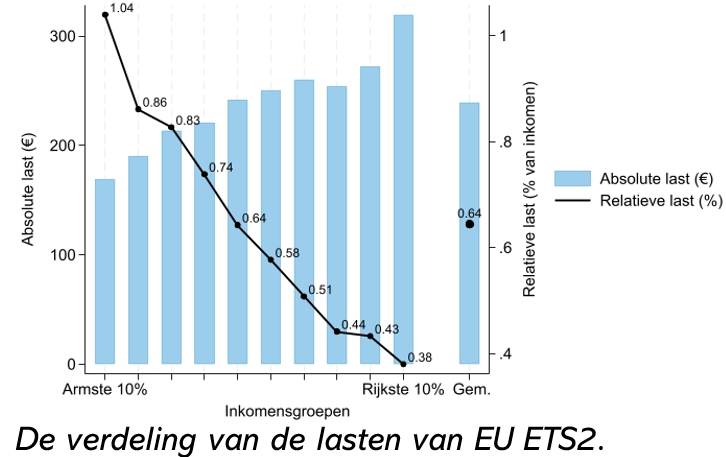
Uit de simulaties blijkt dat de impact van EU ETS2 aanzienlijk zal zijn. Maar niet ieder gezin wordt in dezelfde mate getroffen. De verschillen tussen arme en rijke huishoudens volgen een bekend patroon bij klimaatbeleid: hoewel rijkere huishoudens in absolute bedragen meer verliezen, verliezen armere huishoudens een groter deel van hun inkomen. Dat zit zo: EU ETS2 zal een gezin uit de armste tien procent van de bevolking gemiddeld 169 euro kosten, terwijl een gezin uit de rijkste tien procent van de bevolking gemiddeld 319 euro verliest. Maar wanneer die verliezen relatief worden uitgedrukt ten opzichte van het totale inkomen, blijkt dat het arme gezin zo'n 1,04% verliest, terwijl het rijke gezin slechts 0,38% verliest.
Zulke verschillen doen zich niet enkel voor tussen arme en rijke huishoudens. Ook huishoudens met een vergelijkbaar inkomen kunnen heel verschillend getroffen worden. Woon je alleen? Dan ben je een stuk kwetsbaarder dan iemand die met meerdere personen samenwoont. Woon je in Wallonië? Dan ben je een stuk kwetsbaarder dan iemand die in Vlaanderen of Brussel woont. Verwarm je met stookolie? Dan word je veel sterker getroffen dan iemand die op aardgas verwarmt.
EU ETS2 creëert dus ongelijkheden: tussen rijk en arm, maar ook tussen huishoudens met een vergelijkbaar inkomen. Om te beoordelen of die ongelijkheden gerechtvaardigd kunnen worden, stel ik in mijn masterproef twee eenvoudige vragen. Één: zijn de gezinnen die het hardst getroffen worden verantwoordelijk voor de grootste CO₂-uitstoot? Twee: hebben die gezinnen de mogelijkheid om hun uitstoot te verminderen? Als het antwoord op één van die vragen negatief is, roept dat belangrijke twijfels op over de rechtvaardigheid én effectiviteit van het klimaatbeleid. Want wanneer huishoudens belast worden voor uitstoot die ze niet kunnen verminderen, mist het beleid zijn doel. En worden vooral gezinnen getroffen die niet de grootste vervuilers zijn, dan groeit het maatschappelijk verzet, met het risico dat de maatregel sneuvelt. Op basis van die twee vragen lijkt het moeilijk te verantwoorden dat arme, alleenstaande huishoudens in Wallonië die met stookolie verwarmen de grootste verliezen zullen lijden door EU ETS2. Gelukkig hoeft dat niet zo te zijn.
Gerichte steun

Het Sociaal Klimaatfonds kan een deel van die verschillen opvangen. Hoe de beschikbare middelen (jaarlijks zo'n 368 miljoen euro) ingezet worden, is daarbij cruciaal. Uit mijn simulaties blijkt dat beleid dat alle bevolkingsgroepen ten goede komt (denk aan een betaling aan ieder huishouden of een algemene belastingverlaging) er niet in slaagt om ongelijkheden weg te werken. Daarvoor zijn de beschikbare middelen simpelweg te beperkt. Om effectief te zijn, moet steun gericht worden op nauw afgebakende groepen; beleidsmakers kunnen daarbij zelf kiezen welke groepen ze willen ondersteunen. Om alleenstaanden of huishoudens in Wallonië te beschermen, kan de steun gericht worden op gezinnen in energiearmoede. Ook het investeren van de middelen in sociale woningen levert vergelijkbare resultaten op. Beide investeringen slagen er bovendien in de ongelijkheid tussen rijk en arm te doen afnemen.
De 1,225 miljard euro die EU ETS2 opbrengt, kan twee kanten op: als een instrument dat bestaande ongelijkheid groter maakt, of als een hefboom om net de meest kwetsbare gezinnen te beschermen. Of die middelen ongelijkheid vergroten of verkleinen, hangt niet af van EU ETS2 zelf, maar van hoe gericht het Sociaal Klimaatfonds wordt ingezet. Één simpele maatregel zal daarvoor niet volstaan. Er is doordacht beleid nodig dat rekening houdt met verschillende vormen van kwetsbaarheid. Terwijl de Belgische overheid op dit moment haar Sociaal Klimaatplan ontwikkelt, toont mijn onderzoek wie ze daarbij niet uit het oog mag verliezen.
Bibliografie
Adiyia, B. (2025). Doortastend klimaatbeleid houdt energie betaalbaar: De impact van ETS2 op de energiefactuur van gezinnen en bedrijven. In EnergyVille/VITO. https://energyville.be/wp-content/uploads/2025/04/ETS2-paper_final-1504…
Amores, A. F., Maier, S., & Ricci, M. (2023). Taxing household energy consumption in the EU: The tax burden and its redistributive effect. Energy Policy, 182, 113721. https://doi.org/10.1016/j.enpol.2023.113721
Bachus, K., & Dunne, A. (2024). 4 Principles and 2 Policy packages for a Just Transition in Belgium. Just Transition. https://www.justtransition.be/sites/default/files/2024-12/4Principles-2…
Bachus, K., Van Ootegem, L., & Verhofstadt, E. (2019). ‘No taxation without hypothecation’: Towards an improved understanding of the acceptability of an environmental tax reform. Journal of Environmental Policy & Planning, 21(4), 321-332. https://doi.org/10.1080/1523908X.2019.1623654
Bangalore, M., Hallegatte, S., Bonzanigo, L., Kane, T., Fay, M., Narloch, U., Treguer, D., Rozenberg, J., & Vogt-Schilb, A. (2016). Shock waves: Managing the impacts of climate change on poverty. World Bank. https://doi.org/10.1596/978-1-4648-0673-5
Baranzini, A., Van den Bergh, J. C., Carattini, S., Howarth, R. B., Padilla, E., & Roca, J. (2017). Carbon pricing in climate policy: seven reasons, complementary instruments, and political economy considerations. Wiley Interdisciplinary Reviews: Climate Change, 8(4), e462. https://doi.org/10.1002/wcc.462
Berry, A. (2019). The distributional effects of a carbon tax and its impact on fuel poverty A microsimulation study in the French context. Energy Policy, 124, 81-94. https://doi.org/10.1016/j.enpol.2018.09.021
Bird, S., & Hernández, D. (2012). Policy options for the split incentive: Increasing energy efficiency for low-income renters. Energy policy, 48, 506-514. https://doi.org/10.1016/j.enpol.2012.05.053
Blasco, J., Guillaud, E., & Zemmour, M. (2023). The inequality impact of consumption taxes: An international comparison. Journal of Public Economics, 222, 104897. https://doi.org/10.1016/j.jpubeco.2023.104897
Büchs, M., Bardsley, N., & Duwe, S. (2011). Who bears the brunt? Distributional effects of climate change mitigation policies. Critical Social Policy, 31(2), 285-307. https://doi.org/10.1177/0261018310396036
Büchs, M., & Mattioli, G. (2024). How socially just are taxes on air travel and ‘frequent flyer levies’?. Journal of Sustainable Tourism, 32(1), 62-84. https://doi.org/10.1080/09669582.2022.2115050
Büchs, M., & Schnepf, S. V. (2013). Who emits most? Associations between socio-economic factors and UK households' home energy, transport, indirect and total CO2 emissions. Ecological Economics, 90, 114-123. https://doi.org/10.1016/j.ecolecon.2013.03.007
Bursens, F., De Poli, S., Maier, S., & Verbist, G. (2025). Bridging climate and social equity: Progressive carbon tax simulations for Belgium. Ecological Economics, 240, 108803. https://doi.org/10.1016/j.ecolecon.2025.108803
Cañizares, J. C., Copeland, S., & Doorn, N. (2024). Embedding justice considerations in climate resilience. Ethics, Policy & Environment, 27(1), 63-88. https://doi.org/10.1080/21550085.2023.2197824
Carleton, T., Jina, A., Delgado, M., Greenstone, M., Houser, T., Hsiang, S., Hultgren, A., Kopp, R.E., McCusker, K.E., Nath, I., Rising, J., Rode, A., Seo, H.K., Viaene, A., Yuan, J. & Zhang, A. T. (2022). Valuing the global mortality consequences of climate change accounting for adaptation costs and benefits. The Quarterly Journal of Economics, 137(4), 2037-2105. https://doi.org/10.1093/qje/qjac020
Chancel, L., Bothe, P., & Voituriez, T. (2023). Climate inequality report 2023. World Inequality Lab Study 2023/1. https://wid.world/www-site/uploads/2023/01/CBV2023-ClimateInequalityRep…
Costa, R., & Dobbelaere, L. (2025). Verkenning van de impact van ETS2 op de uitgaven voor verwarming van de gezinnen. Federaal Planbureau. https://www.plan.be/sites/default/files/documents/ART_021_13173_NL.pdf
Cronin, J. A., Fullerton, D., & Sexton, S. (2019). Vertical and horizontal redistributions from a carbon tax and rebate. Journal of the Association of Environmental and Resource Economists, 6(S1), S169-S208. https://doi.org/10.1086/701191
Cui, Y., & Wu, W. (2025). The economic burden of EU ETS2 carbon pricing on single and childless households: focusing on transport and building sectors. Frontiers in Environmental Science, 13, 1572246. https://doi.org/10.3389/fenvs.2025.1572246
Davidson, M. D. (2021). How fairness principles in the climate debate relate to theories of distributive justice. Sustainability, 13(13), 7302. https://doi.org/10.3390/su13137302
de Vries, A., Werner, G., Wijlhuizen, E., Toom, V., Bovens, M., & Hulscher, S. (2024). Justice in Climate Policy: Distributing Climate Costs Fairly. Springer Nature. https://doi.org/10.1007/978-3-031-59427-4
Douenne, T. (2020). The vertical and horizontal distributive effects of energy taxes: A case study of a French policy. The Energy Journal, 41(3), 231-254. https://doi.org/10.5547/01956574.41.3.tdou
Drews, S., & Van den Bergh, J. C. (2016). What explains public support for climate policies? A review of empirical and experimental studies. Climate policy, 16(7), 855-876. https://doi.org/10.1080/14693062.2015.1058240
Eisl, A., & Nguyen, P. V. (2025). Making the ETS2 Socially Acceptable through Carbon Revenue Redistribution and Investments. More with More: Investing in the Energy Transition 2025: European Public Investment Outlook. 205-222. https://doi.org/10.11647/obp.0499.13
Ekins, P., & Barker, T. (2001). Carbon taxes and carbon emissions trading. Journal of economic surveys, 15(3), 325-376. https://doi.org/10.1111/1467-6419.00142
European Commission. (2023). ETS2: Buildings, road transport and additional sectors. https://climate.ec.europa.eu/eu-action/carbon-markets/ets2-buildings-ro…
European Commission. (2025a). Proposal for a DECISION OF THE EUROPEAN PARLIAMENT AND OF THE COUNCIL amending Decision (EU) 2015/1814 as regards the market stability reserve for the buildings,road transport and additional sectors. https://eur-lex.europa.eu/legal-content/EN/TXT/HTML/?uri=CELEX:52025PC0…
European Commission. (2025b). Trends in carbon intensity and the macroeconomic role of the EU Emissions Trading System. https://economy-finance.ec.europa.eu/trends-carbon-intensity-and-macroe…
European Council. (2025). Fit for 55. https://www.consilium.europa.eu/en/policies/fit-for-55/
European Environment Agency. (2025). EU new Emissions Trading System (ETS2) and Social Climate Fund: Mechanisms, challenges and conditions for a fair decarbonisation in road transport. https://doi.org/10.2800/0221527
European Union. (2021). European Climate Law. https://eur-lex.europa.eu/eli/reg/2021/1119/oj
Fabra, N., & Reguant, M. (2014). Pass-through of emissions costs in electricity markets. American Economic Review, 104(9), 2872-2899. https://doi.org/10.1257/aer.104.9.2872
Feindt, S., Kornek, U., Labeaga, J. M., Sterner, T., & Ward, H. (2021). Understanding regressivity: Challenges and opportunities of European carbon pricing. Energy Economics, 103, 105550. https://doi.org/10.1016/j.eneco.2021.105550
Feng, K., Hubacek, K., Guan, D., Contestabile, M., Minx, J., & Barrett, J. (2010). Distributional effects of climate change taxation: The case of the UK. Environmental Science and Technology, 44(10), 3670–3676. https://doi.org/10.1021/es902974g
FOD Economie. (2025). Analyse van het energieverbruikvan huishoudens in België in 2023. https://economie.fgov.be/nl/file/7471929/download?token=an3UoJhZ
FOD Economie. (2026). Maandelijkse consumptie van de voornaamste aardolieproducten. https://economie.fgov.be/nl/themas/energie/energie-cijfers/maandelijkse…
Fragkos, P., Fragkiadakis, K., Sovacool, B., Paroussos, L., Vrontisi, Z., & Charalampidis, I. (2021). Equity implications of climate policy: Assessing the social and distributional impacts of emission reduction targets in the European Union. Energy, 237, 121591. https://doi.org/10.1016/j.energy.2021.121591
Frère, J. M., Vandille, G., & Wolff, S. (2018). The PEACH2AIR database of air pollution associated with household consumption in Belgium in 2014 (No. 3–18). Federal Planning Bureau Working Paper. Brussels. http://refhub.elsevier.com/S0921-8009(21)00123-3/rf0060
Gillingham, K., Harding, M., & Rapson, D. (2012). Split incentives in residential energy consumption. The Energy Journal, 33(2), 37-62. https://doi.org/10.5547/01956574.33.2.3
Goedemé, T. (2022). Een koolstofbelasting als sociaalecologisch beleid? Het kan!. Oikos: Politiek, Milieu, 101, 1-14. https://oikos.be/wp-content/uploads/2022/03/oikos.be_joomlatools-files_…
Goulder, L. H., & Schein, A. R. (2013). Carbon taxes versus cap and trade: a critical review. Climate Change Economics, 4(03), 1350010. https://doi.org/10.1142/S2010007813500103
Gugler, K., Haxhimusa, A., & Liebensteiner, M. (2021). Effectiveness of climate policies: Carbon pricing vs. subsidizing renewables. Journal of Environmental Economics and Management, 106, 102405. https://doi.org/10.1016/j.jeem.2020.102405
Günther, C., Pahle, M., Govorukha, K., Osorio, S., & Fotiou, T. (2024). Carbon prices on the rise? Shedding light on the emerging EU ETS2. SSRN Electronic Journal. http://dx.doi.org/10.2139/ssrn.4808605
Haywood, L., & Jakob, M. (2023). The role of the emissions trading scheme 2 in the policy mix to decarbonize road transport in the European Union. Transport Policy, 139, 99-108. https://doi.org/10.1016/j.tranpol.2023.06.003
Hengalová, R. (2024). Will the Fund fund enough? A conversation with stakeholders on the suitable allocation of the Social Climate Fund and expected impacts of the ETS2 on transport poverty in EU Member States. EUROPEUM. https://www.europeum.org/wp-content/uploads/TV_fund_paper_Rebeka_FINAL…
Heyndrickx, C., Bachus, K., De Bevere, A., Grandjean, G., Schepers, W., van der Loo, S., Vanpée,R., Vanrykel, F., Van Zeebroeck, B., Heyndrickx, C. (Eds.) (2022). Proposal for a green tax reform. Research report, Transport & Mobility Leuven. https://finances.belgium.be/sites/default/files/beoess/20220630%20Final…
Ivanova, D., & Büchs, M. (2020). Household sharing for carbon and energy reductions: the case of EU countries. Energies, 13(8), 1909. https://doi.org/10.3390/en13081909
Ivanova, D., & Wood, R. (2020). The unequal distribution of household carbon footprints in Europe and its link to sustainability. Global Sustainability, 3, e18. https://doi.org/10.1017/sus.2020.12
Jüngling, E., Sgaravatti, G., Tagliapietra, S., & Zachmann, G. (2025). Making the best of the new EU Social Climate Fund. Bruegel. http://www.jstor.org/stable/resrep69145
Kerkhof, A. C., Moll, H. C., Drissen, E., & Wilting, H. C. (2008). Taxation of multiple greenhouse gases and the effects on income distribution: A case study of the Netherlands. Ecological Economics, 67(2), 318-326. https://doi.org/10.1016/j.ecolecon.2007.12.015
Klenert, D., Mattauch, L., Combet, E., Edenhofer, O., Hepburn, C., Rafaty, R., & Stern, N. (2018). Making carbon pricing work for citizens. Nature Climate Change, 8(8), 669-677. https://doi.org/10.1038/s41558-018-0201-2
Klimaat.be (2025). Een rechtvaardige transitie dankzij het Belgisch Sociaal Klimaatplan. https://klimaat.be/klimaatbeleid/belgisch/nationaal/sociaal-klimaatplan
Köppl, A., & Schratzenstaller, M. (2023). Carbon taxation: A review of the empirical literature. Journal of Economic Surveys, 37(4), 1353-1388. https://doi.org/10.1111/joes.12531
Lévay, P. Z., Vanhille, J., Goedemé, T., & Verbist, G. (2021). The association between the carbon footprint and the socio-economic characteristics of Belgian households. Ecological Economics, 186, 107065. https://doi.org/10.1016/j.ecolecon.2021.107065
Lim, H., Kim, J., & Jo, H. H. (2020). Population age structure and greenhouse gas emissions from road transportation: A panel cointegration analysis of 21 OECD countries. International journal of environmental research and public health, 17(21), 7734. https://doi.org/10.3390/ijerph17217734
Linden, J., O'Donoghue, C., & Sologon, D. (2026). Modelling Distributional Impacts of Carbon Taxation: a Systematic Review and Meta-Analysis. arXiv. https://doi.org/10.48550/arXiv.2601.07713
Mandelli, M. (2022). Understanding eco-social policies: a proposed definition and typology. Transfer: European Review of Labour and Research, 28(3), 333-348. https://doi.org/10.1177/10242589221125083
Maier, S., De Poli, S., & Amores, A. F. (2024). Carbon taxes on consumption: Distributional implications for a just transition in the EU (No. 9/2024). JRC Working Papers on Taxation and Structural Reforms. https://www.econstor.eu/bitstream/10419/306595/1/1905322127.pdf
Maier, S., & Dreoni, I. (2026). Who is “energy poor" in the EU?. Energy Policy, 208, 114869. https://doi.org/10.1016/j.enpol.2025.114869
Markkanen, S., & Anger-Kraavi, A. (2019). Social impacts of climate change mitigation policies and their implications for inequality. Climate Policy, 19(7), 827-844. https://doi.org/10.1080/14693062.2019.1596873
McCauley, D., & Heffron, R. (2018). Just transition: Integrating climate, energy and environmental justice. Energy policy, 119, 1-7. https://doi.org/10.1016/j.erss.2022.102764
Melvin, J. (2018). The split incentives energy efficiency problem: Evidence of underinvestment by landlords. Energy Policy, 115, 342-352. https://doi.org/10.1016/j.enpol.2017.11.069
Mintz‐Woo, K. (2024). Carbon tax ethics. Wiley Interdisciplinary Reviews: Climate Change, 15(1), e858. https://doi.org/10.1002/wcc.858
Neugschwender, J. (2020). Top and bottom coding at LIS. LIS Technical Working Paper Series. https://www.lisdatacenter.org/wps/techwps/9.pdf
OECD (2013), OECD Framework for Statistics on the Distribution of Household Income, Consumption and Wealth, OECD Publishing. http://dx.doi.org/10.1787/9789264194830-en
Ohlendorf, N., Jakob, M., Minx, J. C., Schröder, C., & Steckel, J. C. (2021). Distributional impacts of carbon pricing: A meta-analysis. Environmental and Resource Economics, 78(1), 1-42. https://doi.org/10.1007/s10640-020-00521-1
Ottelin, J., Heinonen, J., Nässén, J., & Junnila, S. (2019). Household carbon footprint patterns by the degree of urbanisation in Europe. Environmental Research Letters, 14(11), 114016. https://doi.org/10.1088/1748-9326/ab443d
Paavola, J., & Adger, W. N. (2002). Justice and adaptation to climate change. Tyndall Centre for Climate Change Research. https://www.researchgate.net/publication/228813871_Justice_and_Adaptati…
Paavola, J., & Adger, W. N. (2006). Fair adaptation to climate change. Ecological economics, 56(4), 594-609. https://doi.org/10.1016/j.ecolecon.2005.03.015
Reusens, P., Vastmans, F., & Damen, S. (2022). The impact of changes in dwelling characteristics and housing preferences on Belgian house prices. NBB economic review, 1-39. https://www.nbb.be/doc/ts/publications/economicreview/2022/ecorevi2022_….
Rey, F., & Madiès, T. (2021). Addressing the concerns about carbon leakage in the implementation of carbon pricing policies: A focus on the issue of competitiveness. Journal of Industrial and Business Economics, 48(1), 53-75. https://doi.org/10.1007/s40812-020-00157-8
Saraswat, C., & Kumar, P. (2016). Climate justice in lieu of climate change: a sustainable approach to respond to the climate change injustice and an awakening of the environmental movement. Energy, Ecology and Environment, 1(2), 67-74. https://doi.org/10.1007/s40974-015-0001-8
Sabato, S., Büchs, M., & Vanhille, J. (2023). A just transition towards climate neutrality for the EU: debates, key issues and ways forward. Report. European Social Observatory. https://www.ose.be/publication/just-transition-towards-climate-neutrali…
Schaffer, L. M. (2024). Who’s afraid of more ambitious climate policy? How distributional implications shape policy support and compensatory preferences. Environmental Politics, 33(4), 567-590. https://doi.org/10.1080/09644016.2023.2247818
Schlosberg, D. (2003). The justice of environmental justice: reconciling equity, recognition, and participation in a political movement. Moral and political reasoning in environmental practice, 77(106), 125-156. https://www.nypl.org/sites/default/files/schlosberg_reconceiving_ej_glo…
Sommer, S., Mattauch, L., & Pahle, M. (2022). Supporting carbon taxes: The role of fairness. Ecological Economics, 195, 107359. https://doi.org/10.1016/j.ecolecon.2022.107359
Timilsina, G. R. (2022). Carbon taxes. Journal of Economic Literature, 60(4), 1456-1502. https://doi.org/10.1257/jel.20211560
Trinomics B.V. (2025). Support to the preparation of social climate plans: Deliverable 2 Report on the impacts of ETS2, the identification of vulnerable groups and stakeholder engagement plans. https://klimaat.be/doc/be-dlv2-final-report-clean-1.pdf
United Nations Framework Convention on Climate Change. (1992). United Nations Framework Convention on Climate Change. https://unfccc.int/resource/docs/convkp/conveng.pdf
Vandyck, T., & Van Regemorter, D. (2014). Distributional and regional economic impact of energy taxes in Belgium. Energy Policy, 72, 190-203. https://doi.org/10.1016/j.enpol.2014.04.004
Vanhille, J., Goedemé, T., & Verbist, G. (2019). Sociale ongelijkheid in het klimaatvraagstuk. In Klimaat en sociale rechtvaardigheid/Dierckx, Sacha [edit.] (pp. 61-83).
Vanhille, J., Van Hecken, G., Goedemé, T., & Verbist, G. (2021). Klimaatverandering en sociale ongelijkheid. In Van klimaatverandering naar systeemverandering: een veelzijdige blik op een complexe globale uitdaging/Vicca, S.[edit.]; Crabbé, A.[edit.] (pp. 60-73).
Vella, A., Mayeres, I., Platsakis, O., Acipinar, Acipinar, R.K., Dauwe, T., Sarantaridis, D., Gores, S., Skribbe, R. (2026). EU ETS2 and Social Climate Fund: Enabling decarbonisation in transport and buildings that works for all. https://doi.org/10.5281/zenodo.18242768
Vlaams Energie- & Klimaatagentschap (VEKA). (2026). Standaard CO2-emissiefactoren, calorische onderwaarden en soortelijkegewichten van brandstoffen. https://assets.vlaanderen.be/image/upload/v1770643685/repositories-prd/…
Wier, M., Birr-Pedersen, K., Jacobsen, H. K., & Klok, J. (2005). Are CO2 taxes regressive? Evidence from the Danish experience. Ecological economics, 52(2), 239-251. https://doi.org/10.1016/j.ecolecon.2004.08.005
Wouter, N. (2025). Economische afweging van luchtwater warmtepomp en gasboiler zonder verbouwing. VITO. https://vito.be/sites/vito/files/upload/20250917-economische-afweging-w…
Zachmann, G., Fredriksson, G., & Claeys, G. (2022). The distributional effects of climate policies. Bruegel Blueprints. https://www.bruegel.org/blueprint/distributional-effects-climate-polici…
Zagheni, E. (2011). The leverage of demographic dynamics on carbon dioxide emissions: does age structure matter?. Demography, 48(1), 371-399. https://doi.org/10.1007/s13524-010-0004-1