Dikkedarmkanker screening op maat
Dikkedarmkanker treft steeds vaker mensen jonger dan vijftig, net de groep die geen uitnodiging krijgt voor het bevolkingsonderzoek. Een statistische techniek die vooral gebruikt wordt om overstromingen of hittegolven te voorspellen, toont dat erfelijke aanleg samenhangt met de leeftijd waarop de ziekte opduikt. Dit kan de deur openen naar screening op maat.
Wie in Vlaanderen vijftig wordt, krijgt een envelop in de bus. Daarin zit een stoelgangtest, de uitnodiging voor het Bevolkingsonderzoek Dikkedarmkanker. Tot je 74ste volgt er om de twee jaar een nieuwe. Dat systeem werkt. Dankzij screening worden tumoren vroeger ontdekt en sterven er minder mensen aan de ziekte.
Eén leeftijd voor iedereen
Toch heeft het huidige screeningsysteem een zwakke plek. Iedereen krijgt de envelop op dezelfde leeftijd, alsof iedereen evenveel risico loopt. Dat klopt niet. Wie weinig risico loopt, wordt jarenlang getest zonder dat het veel oplevert, en dat kost geld. Wie veel risico loopt, krijgt de test te laat.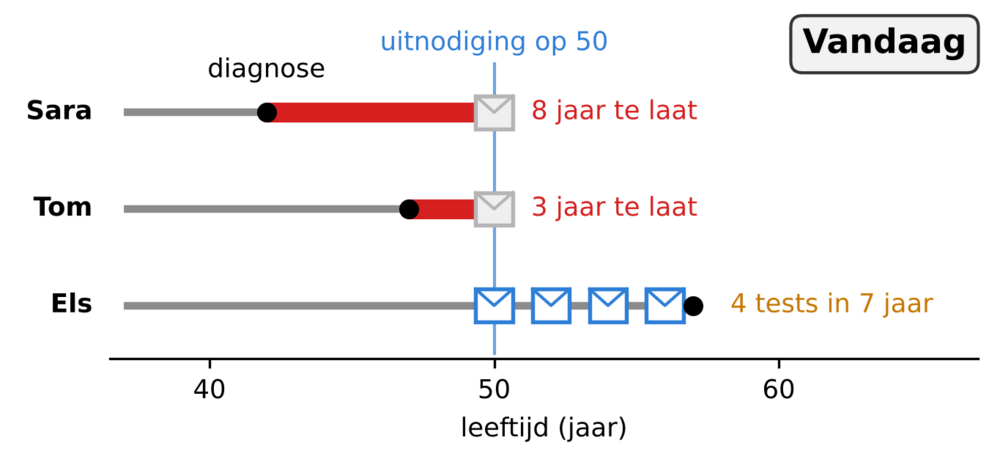
Te laat getest worden komt steeds vaker voor. Terwijl het aantal diagnoses bij ouderen daalt, mede dankzij screening die poliepen opspoort voordat ze kwaadaardig worden, neemt het aantal diagnoses bij mensen jonger dan vijftig al jaren toe. De startleeftijd verlagen lijkt een voor de hand liggende oplossing. De Verenigde Staten deden dit in 2021, van 50 naar 45 jaar. Maar wie vóór hun vijfenveertigste ziek wordt, valt nog steeds buiten het screeningsprogramma.
Het juiste moment van screening
Een betere oplossing is screening op maat: wie meer risico loopt, wordt vroeger uitgenodigd. Maar het risico inschatten is moeilijker dan het klinkt. Dikkedarmkanker ontstaat door een samenspel van verschillende factoren, waaronder onze genen.
DNA is als een receptenboek. Bij ieder mens komen er kleine verschillen voor zonder dat deze de smaak van het gerecht beïnvloeden. Van meer dan tweehonderd van die verschillen (genetische varianten) weten we dat ze samenhangen met een iets hoger of lager risico op dikkedarmkanker.
Onderzoekers gebruiken statistische modellen om dat risico in te schatten. Die modellen proberen vooral te voorspellen óf iemand kanker zal krijgen. Voor screening is een andere vraag minstens even belangrijk: wannéér?
Die vraag stond centraal in mijn masterproef aan de Universiteit Gent. Kunnen genetische varianten voorspellen op welke leeftijd dikkedarmkanker zal worden vastgesteld?
Een statistisch vergrootglas voor jonge patiënten
Dikkedarmkanker is vooral een ziekte van zestigers en zeventigers. Patiënten jonger dan vijftig zijn een minderheid: zij vertegenwoordigen ongeveer 7% van de diagnoses in België. Dat maakt het moeilijk om voor deze groep goede voorspellingen te maken. Klassieke statistische modellen zijn vooral ontworpen om patronen in de grote meerderheid van de data te beschrijven. Over zeldzamere gevallen, zoals kanker op jonge leeftijd, is veel minder informatie beschikbaar. Het model heeft dan weinig houvast en kan er snel naast zitten.
Ingenieurs kennen dat probleem. Wie een dijk bouwt, wil niet weten hoe hoog het water gemiddeld staat. De dijk moet bestand zijn tegen uitzonderlijke waterstanden die zelden voorkomen. Daarom kijken ze naar extreme gebeurtenissen, zoals een uitzonderlijk zware stormvloed.
Hiervoor bestaat een aparte tak van de statistiek: de extremewaardentheorie. Die is ontwikkeld om zeldzame, extreme waarden te bestuderen. Ik paste ze toe op kanker: in plaats van te modelleren wat er bij de gemiddelde patiënt gebeurt, richtte ik me op de uitzonderlijke gevallen, namelijk dikkedarmkanker op jonge leeftijd.
Om te weten of de aanpak met extreme waarden inderdaad betere voorspellingen oplevert gebruikte ik echte patiëntendata: de leeftijd bij hun eerste diagnose. Bij gebrek aan uitgebreide publieke Belgische of Europese gegevens koos ik een Amerikaans kankerregister met ruim 750.000 patiënten.
Hiermee vond ik dat het klassieke model zijn dijk te laag bouwde: bij de jongste patiënten zat het er één tot twee jaar naast. De extremewaardentheorie kwam veel dichter bij de werkelijke leeftijd bij diagnose.
Heeft DNA invloed op de timing?

Het extremewaardemodel werkte dus beter voor de zeldzame, vroege diagnoses. Daarna onderzocht ik of DNA kon helpen om de leeftijd bij diagnose beter te voorspellen. Daarvoor gebruikte ik gegevens van ruim tweeduizend Europese patiënten.
Elf genetische varianten bleken samen te hangen met de leeftijd waarop dikkedarmkanker werd vastgesteld. Ik bracht ze, als een soort optelsom, samen in één score per persoon: hoe hoger de score, hoe groter de genetische aanleg voor een vroege diagnose.
Onder de patiënten die vóór hun vijftigste ziek werden, kreeg iemand met een lage score de diagnose gemiddeld op 46 jaar. Iemand met een hoge score kreeg ze gemiddeld ruim drie jaar vroeger. Het verschil is nog groter voor de vroegste leeftijd waarop de ziekte volgens het model kan opduiken: bijna 9 jaar vroeger bij een hoge score dan bij een lage.
Ik testte de score ook bij een onafhankelijke, kleinere groep patiënten. Ook daar kwamen de leeftijden die de score voorspelde goed overeen met de werkelijke leeftijden bij diagnose. Dat is een eerste bevestiging, maar grotere en meer diverse groepen zijn nodig voor meer zekerheid.
Belangrijk is ook wat de score níét voorspelt. Het onderzoek keek alleen naar mensen die al dikkedarmkanker hadden. De score zegt dus niet wie kanker zal krijgen, maar kan mogelijk helpen voorspellen op welke leeftijd de diagnose wordt gesteld bij iemand die de ziekte krijgt.
De volgende stap is onderzoeken of deze informatie ook bruikbaar is bij mensen zonder kanker. In de toekomst kan dit helpen om beter te bepalen wanneer screening het meest zinvol is, als aanvullen op bestaande methodes. De aanpak is bovendien niet beperkt tot dikkedarmkanker en kan mogelijk ook bij andere kankertypes worden toegepast.
Een envelop op het juiste moment
Een kant-en-klare test is dit dus nog niet. Het is wél een nieuwe manier om naar screening te kijken, die nu getest moet worden bij grotere en meer diverse groepen patiënten.
Lukt dat, dan valt die envelop straks misschien niet meer op je vijftigste in de bus, maar op het moment afgestemd op het individuele risico.

Bibliografie
Akimoto, Naohiko et al. (2021). “Rising incidence of early-onset colorectal cancer a call to
action”. In: Nature Reviews Clinical Oncology 18 (4), pp. 230–243. ISSN: 17594782. DOI:
10.1038/s41571-020-00445-1.
Archambault, Alexi N. et al. (2020). “Cumulative Burden of Colorectal CancerAssociated
Genetic Variants Is More Strongly Associated With Early-Onset vs Late-Onset Cancer”. In:
Gastroenterology 158 (5), 1274–1286.e12. ISSN: 15280012. DOI: 10.1053/j.gastro.
2019.12.012.
Archambault, Alexi N. et al. (2022). “Risk Stratification for Early-Onset Colorectal Cancer
Using a Combination of Genetic and Environmental Risk Scores: An International Multi-
Center Study”. In: Journal of the National Cancer Institute 114 (4), pp. 528–539. ISSN:
14602105. DOI: 10.1093/jnci/djac003.
Armitage, P and R Doll (1954). “The Age Distribution of Cancer and a Multi-Stage Theory of
Carcinogenesis”. In: British Journal of Cancer 8 (1).
Belikov, Aleksey V. (2017). “The number of key carcinogenic events can be predicted from
cancer incidence”. In: Scientific Reports 7 (1). ISSN: 20452322. DOI: 10.1038/s41598-
017-12448-7.
Belikov, Aleksey V., Alexey Vyatkin, and Sergey V. Leonov (2021). “The Erlang distribution
approximates the age distribution of incidence of childhood and young adulthood cancers”.
In: PeerJ 9. ISSN: 21678359. DOI: 10.7717/peerj.11976.
Belzile, Léo R. et al. (2021). “Human mortality at extreme age”. In: Royal Society Open
Science 8 (9). ISSN: 20545703. DOI: 10.1098/rsos.202097.
Belzile, Léo R et al. (2022). “Annual Review of Statistics and Its Application Is There a Cap
on Longevity? A Statistical Review”. In: DOI: 10.1146/annurev- statistics- 040120.
URL: https://doi.org/10.1146/annurev-statistics-040120-.
Briggs, Sarah E.W. et al. (2022). “Integrating genome-wide polygenic risk scores and nongenetic
risk to predict colorectal cancer diagnosis using UK Biobank data: population
based cohort study”. In: BMJ 379. ISSN: 17561833. DOI: 10.1136/bmj-2022-071707.
Casella, George and Roger L Berger (2002). Statistical Inference. Ed. by Carolyn Crockett.
2nd. Duxbury.
Chen, Xuechen et al. (2023). “Personalized Initial Screening Age for Colorectal Cancer in
Individuals at Average Risk”. In: JAMA Network Open 6 (10), E2339670. ISSN: 25743805.
DOI: 10.1001/jamanetworkopen.2023.39670.
Coles, Stuart (2001). An Introduction to Statistical Modeling of Extreme Values. Springer
London. ISBN: 978-1-84996-874-4. DOI: 10.1007/978-1-4471-3675-0.
Davison, A C and R L Smith (1990). Models for Exceedances over High Thresholds. Tech.
rep., pp. 393–442.
dbGaP (2016). GECCO: Genetics and Epidemiology of Colorectal Cancer Consortium. dbGaP
Study Accession: phs001315.v1.p1. Accessed: 10Jul2026. URL: https://dbgap.ncbi.
nlm.nih.gov/beta/study/phs001315.v1.p1/#study.
Fernandez-Rozadilla, Ceres et al. (2023). “Deciphering colorectal cancer genetics through
multi-omic analysis of 100,204 cases and 154,587 controls of European and east Asian ancestries”.
In: Nature Genetics 55 (1), pp. 89–99. ISSN: 15461718. DOI: 10.1038/s41588-
022-01222-9.
Gilleland, Eric and Richard W. Katz (2016). “ExtRemes 2.0: An extreme value analysis package
in R”. In: Journal of Statistical Software 72. ISSN: 15487660. DOI: 10.18637/jss.
v072.i08.
Hamilton, Ashleigh C. et al. (2023). “Distinct Molecular Profiles of Sporadic Early-Onset
Colorectal Cancer: A Population-Based Cohort and Systematic Review”. In: Gastro Hep
Advances 2 (3), pp. 347–359. ISSN: 27725723. DOI: 10.1016/j.gastha.2022.11.005.
Huang, Sida et al. (2025). “Screening History, Stage at Diagnosis, and Mortality in Screen-
Detected Breast Cancer”. In: JAMA Network Open 8 (4). ISSN: 25743805. DOI: 10.1001/
JAMANETWORKOPEN.2025.5322.
Huyghe, Jeroen R. et al. (2019). “Discovery of common and rare genetic risk variants for
colorectal cancer”. In: Nature Genetics 51 (1), pp. 76–87. ISSN: 15461718. DOI: 10.1038/
s41588-018-0286-6.
Jeon, Jihyoun et al. (2018). “Determining Risk of Colorectal Cancer and Starting Age of
Screening Based on Lifestyle, Environmental, and Genetic Factors”. In: Gastroenterology
154 (8), 2152–2164.e19. ISSN: 15280012. DOI: 10.1053/j.gastro.2018.02.021.
Jones, A. M. et al. (2012). “TERC polymorphisms are associated both with susceptibility to
colorectal cancer and with longer telomeres”. In: Gut 61 (2), pp. 248–254. ISSN: 00175749.
DOI: 10.1136/gut.2011.239772.
Kleinbaum, David G and Mitchel Klein (2012). Statistics for Biology and Health Survival
Analysis A Self-Learning Text Third Edition. Tech. rep. URL: http://www.springer.com/
series/2848.
Laskar, R. S. et al. (2024). “Genome-wide association studies and Mendelian randomization
analyses provide insights into the causes of early-onset colorectal cancer”. In: Annals of
Oncology 35 (6), pp. 523–536. ISSN: 15698041. DOI: 10.1016/j.annonc.2024.02.008.
Law, Philip J. et al. (2019). “Association analyses identify 31 new risk loci for colorectal
cancer susceptibility”. In: Nature Communications 10 (1). ISSN: 20411723. DOI: 10.1038/
s41467-019-09775-w.
Lee, Isaac et al. (2026). “The Increase of Early-Onset Colorectal Cancer: New Insights
and Emerging Hypotheses”. In: Cancer Control 33. ISSN: 15262359. DOI: 10 . 1177 /
10732748261432271.
Li, Shuai and John L. Hopper (2021). Age dependency of the polygenic risk score for colorectal
cancer. DOI: 10.1016/j.ajhg.2021.02.002.
Liu, Jimmy Z. et al. (2015). “Association analyses identify 38 susceptibility loci for inflammatory
bowel disease and highlight shared genetic risk across populations”. In: Nature
Genetics 47 (9), pp. 979–986. ISSN: 15461718. DOI: 10.1038/ng.3359.
Lu, Yingchang et al. (2019). “Large-Scale Genome-Wide Association Study of East Asians
Identifies Loci Associated With Risk for Colorectal Cancer”. In: Gastroenterology 156 (5),
pp. 1455–1466. ISSN: 15280012. DOI: 10.1053/j.gastro.2018.11.066.
Maas, Silvana C.E. et al. (2026). “Epigenetic fingerprints link early-onset colon and rectal
cancer to pesticide exposure”. In: Nature Medicine. ISSN: 1546170X. DOI: 10.1038/
s41591-026-04342-5.
Marees, Andries T. et al. (2018). “A tutorial on conducting genome-wide association studies:
Quality control and statistical analysis”. In: International Journal of Methods in Psychiatric
Research 27 (2). ISSN: 15570657. DOI: 10.1002/mpr.1608.
Martin, Eden R., Xiaoyi R. Gao, and Yi Ju Li (2021). “An exploration of genetic association
tests for disease risk and age at onset”. In: Genetic Epidemiology 45 (3), pp. 249–279.
ISSN: 10982272. DOI: 10.1002/gepi.22368.
Mauri, Gianluca et al. (2019). “Early-onset colorectal cancer in young individuals”. In: Molecular
Oncology 13 (2), pp. 109–131. ISSN: 18780261. DOI: 10.1002/1878-0261.12417.
National Cancer Institute (2026). Overview of the SEER Program. URL: https://seer.
cancer.gov/about/overview.html (visited on 07/15/2026).
Ojavee, Sven E. et al. (2022). “Novel discoveries and enhanced genomic prediction from
modelling genetic risk of cancer age-at-onset”. DOI: 10.1101/2022.03.25.22272955.
Patel, Swati G. et al. (2022). “Updates on age to start and stop colorectal cancer screening:
recommendations from the U.S. Multi-Society Task Force on Colorectal Cancer”. In: Gastrointestinal
Endoscopy 95 (1), pp. 1–15. ISSN: 10976779. DOI: 10.1016/j.gie.2021.
06.012.
Peters, Ulrike et al. (2013). “Identification of genetic susceptibility loci for colorectal tumors
in a genome-wide meta-analysis”. In: Gastroenterology 144 (4). ISSN: 15280012. DOI:
10.1053/j.gastro.2012.12.020.
Pickands, James (1975). “Statistical inference using extreme order statistics”. In: The annals
of Statistics 3 (1), pp. 119–131.
Robin, Xavier et al. (2011). “pROC: an open-source package for R and S+ to analyze and
compare ROC curves”. In: BMC Bioinformatics 12, p. 77.
Scarrott, Carl and Anna Macdonald (2012). “A Review of Extreme Value Threshold Estimation
and Uncertainty Quantification”. In: REVSTAT-Statistical Journal 10 (1), pp. 33–60.
Siegel, Rebecca L., Nikita S. Wagle, and Ahmedin Jemal (2026a). “Leading Cancer Deaths in
People Younger Than 50 Years”. In: JAMA 335.7, pp. 632–634. DOI: 10.1001/jama.2025.
25467.
Siegel, Rebecca L et al. (2026b). “Colorectal cancer statistics, 2026.” In: CA: a cancer journal
for clinicians 76 (2), e70067. ISSN: 1542-4863. DOI: 10.3322/caac.70067.
Smith, R and I Weissman (1985). “Maximum likelihood estimation of the lower tail of a
probability distribution”. In: Journal Royal Statistical Society (47), pp. 285–298.
Su, Yu Ru et al. (2023). “Validation of a Genetic-Enhanced Risk Prediction Model for Colorectal
Cancer in a Large Community-Based Cohort”. In: Cancer Epidemiology Biomarkers
and Prevention 32 (3), pp. 353–362. ISSN: 15387755. DOI: 10.1158/1055-9965.EPI-22-
0817.
Syed, Aslam R. et al. (2019). “Old vs new: Risk factors predicting early onset colorectal
cancer”. In: World Journal of Gastrointestinal Oncology 11 (11), pp. 1011–1020. ISSN:
19485204. DOI: 10.4251/wjgo.v11.i11.1011.
Tamlander, Max et al. (2024). “Genome-wide polygenic risk scores for colorectal cancer
have implications for risk-based screening”. In: British Journal of Cancer 130 (4), pp. 651–
659. ISSN: 15321827. DOI: 10.1038/s41416-023-02536-z.
Tang, Junwei et al. (2024). “Molecular characteristics of early-onset compared with lateonset
colorectal cancer: a case controlled study”. In: International journal of surgery (London,
England) 110 (8), pp. 4559–4570. ISSN: 17439159. DOI: 10.1097/JS9.0000000000001584.
Tian, Ruiyi et al. (2026). “Biological aging and generational shifts in early-onset cancer risk”.
In: Nature Medicine. ISSN: 1546170X. DOI: 10.1038/s41591-026-04448-w.
Vratanar, Bor and Maja Pohar Perme (2023). “Evaluating cancer screening programs using
survival analysis”. In: Biometrical Journal 65 (7). ISSN: 15214036. DOI: 10.1002/bimj.
202200344.
Wasserman, Larry (2004). All of Statistics. Springer.
Willauer, Alexandra N. et al. (2019). “Clinical and molecular characterization of early-onset
colorectal cancer”. In: Cancer 125 (12), pp. 2002–2010. ISSN: 10970142. DOI: 10.1002/
cncr.31994.
Zhao, Jianhui et al. (2023). “Global trends in incidence, death, burden and risk factors of
early-onset cancer from 1990 to 2019”. In: BMJ Oncology 2 (1). ISSN: 27527948. DOI:
10.1136/bmjonc-2023-000049.
Zhu, Zhaozhong et al. (2020). “Shared genetic and experimental links between obesityrelated
traits and asthma subtypes in UK Biobank”. In: Journal of Allergy and Clinical
Immunology 145 (2), pp. 537–549. ISSN: 10976825. DOI: 10.1016/j.jaci.2019.09.035.