Dimt CBD een psychedelische trip? Een veelbelovend idee onder de loep
In een laboratorium in Sydney staat een plaatje met 96 minuscule putjes, elk gevuld met menselijke cellen die oplichten zodra ze een signaal krijgen. Met dat plaatje probeerde ik een vraag te beantwoorden die je niet zomaar aan proefpersonen voorlegt: kan CBD, een van de bekendste bestanddelen van cannabis, de effecten van psychedelica zoals LSD afzwakken? Een recente studie suggereerde van wel. Dat is een interessante piste, nu psychedelica steeds vaker onderzocht worden als mogelijke behandeling voor psychische aandoeningen zoals depressie en angst.
Het slot waar elke trip begint
CBD is een bestanddeel van de cannabisplant dat je, in tegenstelling tot THC, niet stoned maakt. Het wordt al gebruikt bij enkele zeldzame vormen van epilepsie en onderzoekers vermoeden dat het ook angst- en psychoseklachten kan verlichten. Hoe CBD precies werkt, blijft echter onduidelijk. De stof grijpt namelijk aan op tientallen verschillende plaatsen in het lichaam.
Een recente studie wees naar een opvallende kandidaat: de serotonine 2A-receptor. Je kan die receptor zien als een slot op hersencellen, waarop serotonine en psychedelica als sleutel passen. Activatie van deze receptor speelt een cruciale rol in de psychedelische effecten van stoffen zoals LSD en psilocybine.
Het interessante aan CBD is dat het dit slot niet rechtstreeks lijkt te blokkeren. Volgens de studie zou het eerder werken als een dimmer: de sleutel past nog steeds, maar het signaal dat volgt wordt minder sterk. Wetenschappers noemen zo'n mechanisme een negatieve allosterische modulatie. Als dat klopt, zou CBD mogelijk de ongewenste effecten van psychedelica kunnen afzwakken zonder hun therapeutisch potentieel volledig weg te nemen.
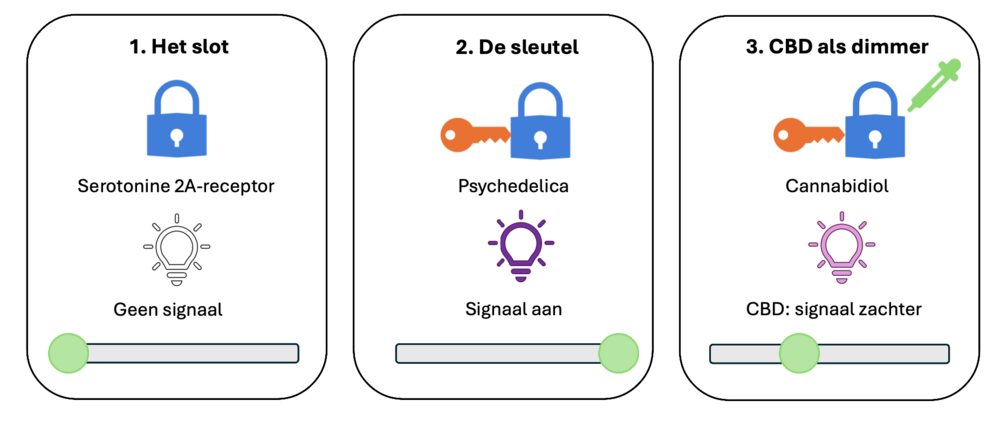
Schematische voorstelling van het onderzochte principe, CBD als mogelijke dimmer van psychedelische effecten.
Een resultaat dat niet wil blijven
Voor mijn masterproef onderzocht ik die hypothese in menselijke cellen. Het bijzondere aan die cellen was dat ik kon bepalen hoeveel serotonine 2A-receptoren ze aanmaakten. Zodra een receptor geactiveerd werd, maakten de cellen calcium vrij en begonnen ze op te lichten. Een lichtmeter registreerde vervolgens putje na putje hoe sterk dat signaal was. Zo kon ik nagaan of een voorbehandeling met CBD het effect verminderde.
De eerste resultaten waren ontnuchterend. Onder de meeste omstandigheden deed CBD vrijwel niets. Toch verscheen er onder twee zeer specifieke omstandigheden een effect dat past bij wat je van een dimmer zou verwachten. Om te begrijpen waarom, helpt een vergelijking. Stel je een kamer voor met twintig lampen. Als elke lamp een klein beetje minder fel brandt, merk je dat nauwelijks op. In een kamer met slechts twee lampen valt dezelfde verandering meteen op.
Zo ging het ook in mijn experimenten. Cellen met veel receptoren beschikken over een soort reserve. Ze kunnen een maximaal signaal produceren, zelfs wanneer een deel van de receptoren minder efficiënt werkt. Farmacologen noemen dat fenomeen receptorreserve of “spare receptors”. Toen ik het aantal receptoren verlaagde, verdween een deel van die reserve en werd een effect zichtbaar. Zelfs dan waren de voorwaarden streng: de cellen moesten een uur lang blootgesteld worden aan een relatief hoge concentratie CBD. Een lagere concentratie of slechts vijf minuten voorbehandeling leverde geen meetbaar effect op.
Echt effect of artefact?
Die strenge voorwaarden maken voorzichtigheid noodzakelijk. CBD is een sterk vetoplosbare stof die zich anders gedraagt dan veel klassieke geneesmiddelen. Ze dringt traag door in de vettige omgeving van een celmembraan en kan in waterige oplossingen bovendien samenklonteren tot minuscule deeltjes, vergelijkbaar met oliedruppeltjes in een glas water. Zulke eigenschappen kunnen een meting beïnvloeden zonder dat de receptor zelf rechtstreeks betrokken is.
Met andere woorden: de daling die ik zag, kan wijzen op een echte interactie met de receptor, maar ook op een experimenteel artefact. Beide verklaringen zijn momenteel nog mogelijk.
Mijn controles bieden wel enkele aanwijzingen. CBD bleek actief in een tweede test op een andere receptor, wat erop wijst dat de gebruikte stof correct functioneerde. Daarnaast verstoorde CBD het calciumsignaal van een andere receptor in dezelfde cellen niet. Dat maakt een algemene verstoring van het meetsysteem minder waarschijnlijk. Toch sluiten deze controles een artefact niet volledig uit.
Waarom dit ertoe doet
Voor mensen die CBD-olie gebruiken, verandert dit onderzoek voorlopig niets. De concentraties die in celproeven worden gebruikt, zeggen weinig over hoeveel CBD uiteindelijk in de menselijke hersenen terechtkomt. CBD bindt sterk aan eiwitten in het bloed en stapelt zich gemakkelijk op in vetweefsel, waardoor de concentratie aan de receptor moeilijk te voorspellen is.
Mijn resultaten bewijzen dus niet dat CBD een psychedelische trip kan afzwakken. Ze bewijzen evenmin dat CBD helemaal geen effect heeft. Wat ze vooral tonen, is hoe moeilijk het kan zijn om een veelbelovende hypothese te bevestigen.
Die les reikt verder dan CBD alleen. Een resultaat dat in één experimentele opstelling verschijnt en in een andere verdwijnt, is nog geen zekerheid. Wetenschap bouwt haar conclusies stap voor stap op. Pas wanneer verschillende onderzoeksgroepen met uiteenlopende technieken tot dezelfde conclusie komen, weten we of CBD werkelijk als een dimmer van psychedelische signalen werkt. Tot dan blijft het een intrigerende hypothese.
Bibliografie
- Rehman S, Rahimi N, Dimri M. Biochemistry, G Protein Coupled Receptors. StatPearls. 2023 Jul 30. PubMed PMID: 30085508.
- Liu S, Anderson PJ, Rajagopal S, Lefkowitz RJ, Rockman HA. G Protein-Coupled Receptors: A Century of Research and Discovery. Circ Res. 2024 Jun 21;135(1):174–97. doi:10.1161/CIRCRESAHA.124.323067 PubMed PMID: 38900852.
- Wisler JW, Xiao K, Thomsen ARB, Lefkowitz RJ. Recent developments in biased agonism. Curr Opin Cell Biol. 2014 Apr 1;27(1):18–24. doi:10.1016/j.ceb.2013.10.008 PubMed PMID: 24680426.
- Shen S, Zhao C, Wu C, Sun S, Li Z, Yan W, et al. Allosteric modulation of G protein-coupled receptor signaling. Front Endocrinol (Lausanne). 2023;14:1137604. doi:10.3389/fendo.2023.1137604 PubMed PMID: 36875468.
- May LT, Christopoulos A. Allosteric modulators of G-protein-coupled receptors. Curr Opin Pharmacol. 2003 Oct 1;3(5):551–6. doi:10.1016/S1471-4892(03)00107-3 PubMed PMID: 14559102.
- Lütjens R, Perry B, Schelshorn D, Rocher JP. New technologies enabling the industrialization of allosteric modulator discovery. Drug Discov Today Technol. 2013 Jun 1;10(2):e253–60. doi:10.1016/j.ddtec.2013.01.001 PubMed PMID: 24050276.
- Christopoulos A, Changeux JP, Catterall WA, Fabbro D, Burris TP, Cidlowski JA, et al. International Union of Basic and Clinical Pharmacology. XC. Multisite Pharmacology: Recommendations for the Nomenclature of Receptor Allosterism and Allosteric Ligands. Pharmacol Rev. 2014;66(4):918. doi:10.1124/PR.114.008862 PubMed PMID: 25026896.
- De Amici M, Dallanoce C, Holzgrabe U, Tränkle C, Mohr K. Allosteric ligands for G protein-coupled receptors: A novel strategy with attractive therapeutic opportunities. Med Res Rev. 2010 May;30(3):463–549. doi:10.1002/med.20166 PubMed PMID: 19557759.
- Jakubík J, Randáková A, Chetverikov N, El-Fakahany EE, Doležal V. The operational model of allosteric modulation of pharmacological agonism. Scientific Reports 2020 10:1. 2020 Sep 2;10(1):14421-. doi:10.1038/s41598-020-71228y PubMed PMID: 32879329.
- Wold EA, Zhou J. GPCR Allosteric Modulators: Mechanistic Advantages and Therapeutic Applications. Curr Top Med Chem. 2018 Jan 1;18(23):2002. doi:10.2174/1568026619999190101151837 PubMed PMID: 30621563.
- Christopoulos A. Allosteric binding sites on cell-surface receptors: novel targets for drug discovery. Nature Reviews Drug Discovery 2002 1:3. 2002;1(3):198–210. doi:10.1038/nrd746 PubMed PMID: 12120504.
- Kenakin T. Allostery: The Good, the Bad, and the Ugly. J Pharmacol Exp Ther. 2024 Jan 1;388(1):110–20. doi:10.1124/JPET.123.001838 PubMed PMID: 37918859.
- Keov P, Sexton PM, Christopoulos A. Allosteric modulation of G protein-coupled receptors: A pharmacological perspective. Neuropharmacology. 2011 Jan 1;60(1):24–35. doi:10.1016/j.neuropharm.2010.07.010 PubMed PMID: 20637785.
- Kenakin T. New Concepts in Drug Discovery: Collateral Efficacy and Permissive Antagonism. Nature Reviews Drug Discovery 2005 4:11. 2005 Nov;4(11):919–27. doi:10.1038/nrd1875 PubMed PMID: 16264435.
- Bdioui S, Verdi J, Pierre N, Trinquet E, Roux T, Kenakin T. Equilibrium Assays Are Required to Accurately Characterize the Activity Profiles of Drugs Modulating Gq-Protein-Coupled Receptors. Mol Pharmacol. 2018 Sep 1;94(3):992– 1006. doi:10.1124/MOL.118.112573 PubMed PMID: 29954837.
- Rock EM, Parker LA. Constituents of Cannabis Sativa. Adv Exp Med Biol. 2021;1264:1–13. doi:10.1007/978-3-03057369-0_1 PubMed PMID: 33332000.
- Marchalant Y, Cooper K. Roles of endocannabinoid in aging. Handb Behav Neurosci. 2025 Jan 1;33:231–46. doi:10.1016/B978-0-443-13908-6.00016-5
- De Meijer EPM, Bagatta M, Carboni A, Crucitti P, Moliterni VMC, Ranalli P, et al. The Inheritance of Chemical Phenotype in Cannabis sativa L. Genetics. 2003 Jan 1;163(1):335–46. doi:10.1093/genetics/163.1.335 PubMed PMID: 12586720.
- Atakan Z. Cannabis, a complex plant: Different compounds and different effects on individuals. Ther Adv Psychopharmacol. 2012;2(6):241–54. doi:10.1177/2045125312457586 PubMed PMID: 23983983.
- Adams R, Hunt M. Structure of Cannabidiol, a Product Isolated from the Marihuana Extract of Minnesota Wild Hemp. I. J Am Chem Soc. 2002 Jan 1;62(1):196–200. doi:10.1021/ja01858a058
- Mechoulam R, Shvo Y. Hashish—I : The structure of Cannabidiol. Tetrahedron. 1963 Jan 1;19(12):2073–8. doi:10.1016/0040-4020(63)85022-X PubMed PMID: 5879214.
- Crippa JA, Guimarães FS, Campos AC, Zuardi AW. Translational investigation of the therapeutic potential of cannabidiol (CBD): Toward a new age. Front Immunol. 2018 Sep 21;9(SEP):318736. doi:10.3389/fimmu.2018.02009 PubMed PMID: 30298064.
- Hsu M, Shah A, Jordan A, Gold MS, Hill KP. Therapeutic Use of Cannabis and Cannabinoids: A Review. JAMA. 2026 Jan 27;335(4):345–59. doi:10.1001/JAMA.2025.19433 PubMed PMID: 41296368.
- Manzoni OJ, Manduca A, Trezza V. Therapeutic potential of cannabidiol polypharmacology in neuropsychiatric disorders. Trends Pharmacol Sci. 2025 Feb 1;46(2):145–62. doi:10.1016/j.tips.2024.12.005 PubMed PMID: 39837749.
- Han K, Wang JY, Wang PY, Peng YCH. Therapeutic potential of cannabidiol (CBD) in anxiety disorders: A systematic review and meta-analysis. Psychiatry Res. 2024 Sep 1;339. doi:10.1016/j.psychres.2024.116049 PubMed PMID: 38924898.
- Fabris D, Lisboa JR, Guimarães FS, Gomes F V. Cannabidiol as an antipsychotic drug. Int Rev Neurobiol. 2024 Jan 1;177:295–317. doi:10.1016/bs.irn.2024.04.013 PubMed PMID: 39029989.
- Abu-Sawwa R, Scutt B, Park Y. Emerging Use of Epidiolex (Cannabidiol) in Epilepsy. The Journal of Pediatric Pharmacology and Therapeutics : JPPT. 2020;25(6):485. doi:10.5863/1551-6776-25.6.485 PubMed PMID: 32839652.
- Sastre-Garriga J, Vila C, Clissold S, Montalban X. THC and CBD oromucosal spray (Sativex®) in the management of spasticity associated with multiple sclerosis. Expert Rev Neurother. 2011 May;11(5):627–37. doi:10.1586/ERN.11.47 PubMed PMID: 21456949.
- Rao VK, Lewis-Bakker MM, Wasilewski E, Clarke HA, Kotra LP. Stereoisomers of cannabidiols and their pharmacological activities – A potentially novel direction for cannabinoids. Bioorg Med Chem. 2025 Jan 1;117(2):118019. doi:10.1016/j.bmc.2024.118019 PubMed PMID: 39612769.
- Bosquez-Berger T, Wilson S, Iliopoulos-Tsoutsouvas C, Jiang S, Wager-Miller J, Nikas SP, et al. Differential Enantiomer-Specific Signaling of Cannabidiol at CB1 Receptors. Mol Pharmacol. 2022 Dec 1;102(6):259. doi:10.1124/molpharm.121.000305 PubMed PMID: 36153039.
- Castillo-Arellano J, Canseco-Alba A, Cutler SJ, León F. The Polypharmacological Effects of Cannabidiol. Molecules. 2023 Apr 1;28(7):3271. doi:10.3390/molecules28073271 PubMed PMID: 37050032.
- Laprairie RB, Bagher AM, Kelly MEM, Denovan-Wright EM. Cannabidiol is a negative allosteric modulator of the cannabinoid CB1 receptor. Br J Pharmacol. 2015 Oct 1;172(20):4790–805. doi:10.1111/bph.13250 PubMed PMID: 26218440.
- Pandey P, Zagzoog A, Laprairie RB, Neal WM, Doerksen RJ, Chittiboyina AG. Determination of the Negative Allosteric Binding Site of Cannabidiol at the CB1 Receptor: A Combined Computational and Site-Directed Mutagenesis Study. ACS Chem Neurosci. 2025 Feb 5;16(3):311–28. doi:10.1021/ACSCHEMNEURO.4C00343 PubMed PMID: 39812521.
- Mechoulam R, Peters M, Murillo-Rodriguez E, Hanuš LO. Cannabidiol - Recent advances. Chem Biodivers. 2007;4(8):1678–92. doi:10.1002/CBDV.200790147 PubMed PMID: 17712814.
- Tham M, Yilmaz O, Alaverdashvili M, Kelly MEM, Denovan-Wright EM, Laprairie RB. Allosteric and orthosteric pharmacology of cannabidiol and cannabidiol‐dimethylheptyl at the type 1 and type 2 cannabinoid receptors. Br J Pharmacol. 2018 May 1;176(10):1455. doi:10.1111/BPH.14440 PubMed PMID: 29981240.
- Navarro G, Gonzalez A, Sánchez-Morales A, Casajuana-Martin N, Gómez-Ventura M, Cordomí A, et al. Design of Negative and Positive Allosteric Modulators of the Cannabinoid CB2Receptor Derived from the Natural Product Cannabidiol. J Med Chem. 2021 Jul 8;64(13):9354–64. doi:10.1021/ACS.JMEDCHEM.1C00561/SUPPL_FILE/JM1C00561_SI_003.PDB PubMed PMID: 34161090.
- Kathmann M, Flau K, Redmer A, Tränkle C, Schlicker E. Cannabidiol is an allosteric modulator at mu- and deltaopioid receptors. Naunyn Schmiedebergs Arch Pharmacol. 2006 Feb;372(5):354–61. doi:10.1007/s00210-006-0033x PubMed PMID: 16489449.
- Bosquez-Berger T, Gudorf JA, Kuntz CP, Desmond JA, Schlebach JP, VanNieuwenhze MS, et al. Structure-Activity Relationship Study of Cannabidiol-Based Analogs as Negative Allosteric Modulators of the μ-Opioid Receptor. J Med Chem. 2023 Jul 27;66(14):9466–94. doi:10.1021/acs.jmedchem.3c00061 PubMed PMID: 37437224.
- Russo EB, Burnett A, Hall B, Parker KK. Agonistic Properties of Cannabidiol at 5-HT1a Receptors. Neurochemical Research 2005 30:8. 2005 Aug;30(8):1037–43. doi:10.1007/s11064-005-6978-1 PubMed PMID: 16258853.
- Alexander C, Jeon J, Nickerson K, Hassler S, Vasefi M. CBD and the 5-HT1A receptor: A medicinal and pharmacological review. Biochem Pharmacol. 2025 Mar 1;233(6):116742. doi:10.1016/j.bcp.2025.116742 PubMed PMID: 39778776.
- Billard E, Torbey A, Inserra A, Grant E, Bertazzo A, De Gregorio D, et al. Pharmacological characterization of cannabidiol as a negative allosteric modulator of the 5-HT2A receptor. Cell Signal. 2025 Mar 1;127(18):111588. doi:10.1016/j.cellsig.2025.111588 PubMed PMID: 39761844.
- Yang KH, Galadari S, Isaev D, Petroianu G, Shippenberg TS, Oz M. The Nonpsychoactive Cannabinoid Cannabidiol Inhibits 5-Hydroxytryptamine3A Receptor-Mediated Currents in Xenopus laevis Oocytes. J Pharmacol Exp Ther. 2010 May 1;333(2):547–54. doi:10.1124/jpet.109.162594 PubMed PMID: 20160007.
- Al Kury LT, Mahgoub M, Howarth FC, Oz M. Natural Negative Allosteric Modulators of 5-HT3 Receptors. Molecules. 2018 Dec 3;23(12):3186. doi:10.3390/molecules23123186 PubMed PMID: 30513973.
- Raïch I, Lillo J, Ferreiro-Vera C, Sánchez de Medina V, Navarro G, Franco R. Cannabidiol at Nanomolar Concentrations Negatively Affects Signaling through the Adenosine A2A Receptor. Int J Mol Sci. 2023 Dec 1;24(24):17500. doi:10.3390/IJMS242417500/S1 PubMed PMID: 38139329.
- Sánchez-Fernández N, Gómez-Acero L, Sarasola LI, Argerich J, Chevigné A, Jacobson KA, et al. Cannabidiol negatively modulates adenosine A2A receptor functioning in living cells. Acta Neuropsychiatr. 2024 Oct 1;36(5):320–4. doi:10.1017/neu.2023.30 PubMed PMID: 37605951.
- Rivas-Santisteban R, Ferreiro-Vera C, de Medina VS, Navarro G, Pallàs M, Griñán-Ferré C, et al. Cannabidiol biases A2A-CB2 receptor heteromer function by decoupling β-arrestin signaling from complex formation. Biochem Pharmacol. 2025 Dec 1;242:117280. doi:10.1016/J.BCP.2025.117280 PubMed PMID: 40885321.
- Ahrens J, Demir R, Leuwer M, De La Roche J, Krampfl K, Foadi N, et al. The Nonpsychotropic Cannabinoid Cannabidiol Modulates and Directly Activates Alpha-1 and Alpha-1-Beta Glycine Receptor Function. Pharmacology. 2009 Apr 1;83(4):217–22. doi:10.1159/000201556 PubMed PMID: 19204413.
- Mahgoub M, Keun-Hang SY, Sydorenko V, Ashoor A, Kabbani N, Al Kury L, et al. Effects of cannabidiol on the function of α7-nicotinic acetylcholine receptors. Eur J Pharmacol. 2013 Nov 15;720(1–3):310–9. doi:10.1016/J.EJPHAR.2013.10.011 PubMed PMID: 24140434.
- Bakas T, van Nieuwenhuijzen PS, Devenish SO, McGregor IS, Arnold JC, Chebib M. The direct actions of cannabidiol and 2-arachidonoyl glycerol at GABAA receptors. Pharmacol Res. 2017 May 1;119:358–70. doi:10.1016/j.phrs.2017.02.022 PubMed PMID: 28249817.
- Ujváry I, Hanuš L. Human Metabolites of Cannabidiol: A Review on Their Formation, Biological Activity, and Relevance in Therapy. Cannabis Cannabinoid Res. 2016 Jan 1;1(1):90. doi:10.1089/can.2015.0012 PubMed PMID: 28861484.
- Harvey DJ, Mechoulam R, Harveyt DJ, Mechoulams R. Metabolites of cannabidiol identified in human urine. Xenobiotica. 1990;20(3):303–20. doi:10.3109/00498259009046849 PubMed PMID: 2336840.
- Huestis MA. Human cannabinoid pharmacokinetics. Chem Biodivers. 2007;4(8):1770–804. doi:10.1002/cbdv.200790152 PubMed PMID: 17712819.
- Ohlsson A, Lindgren J ‐E, Andersson S, Agurell S, Gillespie H, Hollister LE. Single‐dose kinetics of deuterium‐labelled cannabidiol in man after smoking and intravenous administration. Biol Mass Spectrom. 1986;13(2):77–83. doi:10.1002/bms.1200130206 PubMed PMID: 2937482.
- Agurell S, Carlsson S, Lindgren JE, Ohlsson A, Gillespie H, Hollister L. Interactions of Δ11-tetrahydrocannabinol with cannabinol and cannabidiol following oral administration in man. Assay of cannabinol and cannabidiol by mass fragmentographywith cannabinol and cannabidiol following oral administration in man. Assay of canna…. Experientia 1981 37:10. 1981 Oct 15;37(10):1090–2. doi:10.1007/BF02085029 PubMed PMID: 6273208.
- Millar SA, Stone NL, Yates AS, O’Sullivan SE. A systematic review on the pharmacokinetics of cannabidiol in humans. Front Pharmacol. 2018 Nov 26;9(NOV):1365. doi:10.3389/fphar.2018.01365
- Jiang R, Yamaori S, Takeda S, Yamamoto I, Watanabe K. Identification of cytochrome P450 enzymes responsible for metabolism of cannabidiol by human liver microsomes. Life Sci. 2011 Aug 1;89(5–6):165–70. doi:10.1016/j.lfs.2011.05.018
- Chayasirisobhon S. Mechanisms of Action and Pharmacokinetics of Cannabis. Perm J. 2020;25(1):19.200. doi:10.7812/TPP/19.200 PubMed PMID: 33635755.
- Huestis MA, Smith ML. Cannabinoid Pharmacokinetics and Disposition in Alternative Matrices. Handbook of Cannabis. 2014 Jan 22;296–316. doi:10.1093/acprof:oso/9780199662685.003.0016
- Beers JL, Fu D, Jackson KD. Cytochrome P450–Catalyzed Metabolism of Cannabidiol to the Active Metabolite 7Hydroxy-Cannabidiol. Drug Metabolism and Disposition. 2021 Oct 1;49(10):882–91. doi:10.1124/DMD.120.000350 PubMed PMID: 34330718.
- Mazur A, Lichti CF, Prather PL, Zielinska AK, Bratton SM, Gallus-Zawada A, et al. Characterization of Human Hepatic and Extrahepatic UDP-Glucuronosyltransferase Enzymes Involved in the Metabolism of Classic Cannabinoids. Drug Metabolism and Disposition. 2009 Jul;37(7):1496. doi:10.1124/dmd.109.026898 PubMed PMID: 19339377.
- Kulkarni G, Murala S, Bollu PC. Serotonin. Neurochemistry in Clinical Practice. 2022 Jan 1;25–43. doi:10.1007/978-3031-07897-2_2/FIGURES/7
- Göthert M. Serotonin discovery and stepwise disclosure of 5-HT receptor complexity over four decades. Part I. General background and discovery of serotonin as a basis for 5-HT receptor identification. Pharmacological Reports 2013 65:4. 2013 Dec 30;65(4):771–86. doi:10.1016/S1734-1140(13)71059-4 PubMed PMID: 24145072.
- Hannon J, Hoyer D. Molecular biology of 5-HT receptors. Behavioural Brain Research. 2008 Dec 16;195(1):198–213. doi:10.1016/J.BBR.2008.03.020 PubMed PMID: 18571247.
- Nichols DE, Nichols CD. Serotonin Receptors. Chem Rev. 2008 May;108(5):1614–41. doi:10.1021/cr078224o PubMed PMID: 18476671.
- Barnes NM, Ahern GP, Becamel C, Bockaert J, Camilleri M, Chaumont-Dubel S, et al. International Union of Basic and Clinical Pharmacology. CX. Classification of Receptors for 5-hydroxytryptamine; Pharmacology and Function. Pharmacol Rev. 2021 Jan 1;73(1):310. doi:10.1124/PR.118.015552 PubMed PMID: 33370241.
- Gaddum JH, Picarelli ZP. Two kinds of tryptamine receptor. Br J Pharmacol. 1997 Feb 1;120(4 SUPPL.):134–9. doi:10.1111/j.1476-5381.1997.tb06789.x PubMed PMID: 9142401.
- Fryc M, Kluzik D, Czopek A, Jończyk J, Zagórska A. Serotonin 2A (5-HT2A) receptor as evolving biological target: function, structure, ligands and role in the therapy of neuropsychiatric diseases. Neuropharmacology. 2025 Nov 15;279(2):110622. doi:10.1016/j.neuropharm.2025.110622 PubMed PMID: 40752586.
- Ibarra-Lecue I, Diez-Alarcia R, Urigüen L. Serotonin 2A receptors and cannabinoids. Prog Brain Res. 2021 Jan 1;259(11):135–75. doi:10.1016/bs.pbr.2021.01.004 PubMed PMID: 33541675.
- Cummins BR, Billac GB, Nichols DE, Nichols CD. 5-HT2A receptors: Pharmacology and functional selectivity. Pharmacol Rev. 2025 Jul 1;77(4):100059. doi:10.1016/j.pharmr.2025.100059 PubMed PMID: 40418878.
- Hubbard KB, Hepler JR. Cell signalling diversity of the Gqα family of heterotrimeric G proteins. Cell Signal. 2006 Feb 1;18(2):135–50. doi:10.1016/j.cellsig.2005.08.004 PubMed PMID: 16182515.
- Schmid CL, Raehal KM, Bohn LM. Agonist-directed signaling of the serotonin 2A receptor depends on β-arrestin-2interactions in vivo. Proc Natl Acad Sci U S A. 2008 Jan 22;105(3):1079. doi:10.1073/pnas.0708862105 PubMed PMID: 18195357.
- Felder CC, Kanterman RY, Ma AL, Axelrod J. Serotonin stimulates phospholipase A2 and the release of arachidonic acid in hippocampal neurons by a type 2 serotonin receptor that is independent of inositolphospholipid hydrolysis. Proc Natl Acad Sci U S A. 1990;87(6):2187. doi:10.1073/pnas.87.6.2187 PubMed PMID: 2315313.
- Kurrasch-Orbaugh DM, Parrish JC, Watts VJ, Nichols DE. A complex signaling cascade links the serotonin2A receptor to phospholipase A2 activation: the involvement of MAP kinases. J Neurochem. 2003 Aug 1;86(4):980–91. doi:10.1046/j.1471-4159.2003.01921.x PubMed PMID: 12887695.
- Kurrasch-Orbaugh DM, Watts VJ, Barker EL, Nichols DE. Serotonin 5-Hydroxytryptamine2A Receptor-Coupled Phospholipase C and Phospholipase A2 Signaling Pathways Have Different Receptor Reserves. J Pharmacol Exp Ther. 2003 Jan 1;304(1):229–37. doi:10.1124/jpet.102.042184 PubMed PMID: 12490596.
- Barclay Z, Dickson L, Robertson DN, Johnson MS, Holland PJ, Rosie R, et al. 5-HT2A receptor signalling through phospholipase D1 associated with its C-terminal tail. Biochemical Journal. 2011 Jun 15;436(3):651–60. doi:10.1042/BJ20101844 PubMed PMID: 21410433.
- Wingert AM, Agnorelli C, Peill J, Reed S, Nutt DJ, Erritzoe D. Serotonergic psychedelics for depression: A comprehensive overview. Int Rev Neurobiol. 2025 Jan 1;181:271–304. doi:10.1016/BS.IRN.2025.04.009 PubMed PMID: 40541312.
- Nutt D, Carhart-Harris R. The Current Status of Psychedelics in Psychiatry. JAMA Psychiatry. 2021 Feb 1;78(2):121–2. doi:10.1001/jamapsychiatry.2020.2171 PubMed PMID: 32725172.
- Berger M, Gray JA, Roth BL. The Expanded Biology of Serotonin. Annu Rev Med. 2009;60:355. doi:10.1146/ANNUREV.MED.60.042307.110802 PubMed PMID: 19630576.
- Nutt DJ, King LA, Nichols DE. Effects of Schedule I drug laws on neuroscience research and treatment innovation. Nature Reviews Neuroscience 2013 14:8. 2013 Jun 12;14(8):577–85. doi:10.1038/nrn3530
- Ly C, Greb AC, Cameron LP, Wong JM, Barragan E V., Wilson PC, et al. Psychedelics Promote Structural and Functional Neural Plasticity. Cell Rep. 2018 Jun 12;23(11):3170–82. doi:10.1016/j.celrep.2018.05.022 PubMed PMID: 29898390.
- Mestre TA, Zurowski M, Fox SH. 5-Hydroxytryptamine 2A receptor antagonists as potential treatment for psychiatric disorders. Expert Opin Investig Drugs. 2013 Apr;22(4):411–21. doi:10.1517/13543784.2013.769957 PubMed PMID: 23409724.
- Willner K, Vasan S, Patel P, Abdijadid S. Atypical Antipsychotic Agents. Annu Rep Med Chem. 2024 May 1;21(C):1–9. doi:10.1016/S0065-7743(08)61111-2 PubMed PMID: 28846323.
- Linge R, Jiménez-Sánchez L, Campa L, Pilar-Cuéllar F, Vidal R, Pazos A, et al. Cannabidiol induces rapid-acting antidepressant-like effects and enhances cortical 5-HT/glutamate neurotransmission: role of 5-HT1A receptors. Neuropharmacology. 2016 Apr 1;103(6):16–26. doi:10.1016/j.neuropharm.2015.12.017 PubMed PMID: 26711860.
- Marinho ALZ, Vila-Verde C, Fogaça M V., Guimarães FS. Effects of intra-infralimbic prefrontal cortex injections of cannabidiol in the modulation of emotional behaviors in rats: Contribution of 5HT1A receptors and stressful experiences. Behavioural Brain Research. 2015 Jun 1;286(2):49–56. doi:10.1016/j.bbr.2015.02.023 PubMed PMID: 25701682.
- Pedrazzi JFC, Silva-Amaral D, Issy AC, Gomes F V., Crippa JA, Guimarães FS, et al. Cannabidiol attenuates prepulse inhibition disruption by facilitating TRPV1 and 5-HT1A receptor-mediated neurotransmission. Pharmacol Biochem Behav. 2024 Dec 1;245:173879. doi:10.1016/J.PBB.2024.173879 PubMed PMID: 39305939.
- Gorberg V, McCaffery P, Anavi-Goffer S. Different responses of repetitive behaviours in juvenile and young adult mice to Δ9-tetrahydrocannabinol and cannabidiol may affect decision making for Tourette syndrome. Br J Pharmacol. 2021 Feb 1;178(3):614–25. doi:10.1111/bph.15302 PubMed PMID: 33125731.
- Marchi M, Rachedi K, Bof A, Mele G, Pingani L, Ferrari S, et al. Cannabidiol for psychotic disorders: A meta-analysis of randomized controlled trials. Journal of Psychopharmacology. 2026. doi:10.1177/02698811261430501;PAGE:STRING:ARTICLE/CHAPTER PubMed PMID: 41948975.
- Denis Völker JS, Micluția IV, Vinași RC. Investigating Cannabidiol’s potential as a supplementary treatment for schizophrenia: A narrative review. Eur J Pharmacol. 2024 Sep 15;979. doi:10.1016/j.ejphar.2024.176821 PubMed PMID: 39068976.
- Thomas EA, Carson MJ, Sutcliffe JG. Oleamide-induced modulation of 5-hydroxytryptamine receptor-mediated signaling. Ann N Y Acad Sci. 1998 Dec 1;861(1):183–9. doi:10.1111/j.1749-6632.1998.tb10190.x PubMed PMID: 9928256.
- Boger DL, Patterson JE, Jin Q. Structural requirements for 5-HT2A and 5-HT1A serotonin receptor potentiation by the biologically active lipid oleamide. Proc Natl Acad Sci U S A. 1998 Apr 14;95(8):4102. doi:10.1073/pnas.95.8.4102 PubMed PMID: 9539697.
- Chen J, Garcia EJ, Merritt CR, Zamora JC, Bolinger AA, Pazdrak K, et al. Discovery of Novel Oleamide Analogues as Brain-Penetrant Positive Allosteric Serotonin 5-HT 2C Receptor and Dual 5-HT 2C /5-HT 2A Receptor Modulators. J Med Chem. 2023;66:5. doi:10.1021/acs.jmedchem.3c00908
- Andrews BJ, Proteau GA, Beatty LG, Sadowski PD. The FLP recombinase of the 2μ circle DNA of yeast: Interaction with its target sequences. Cell. 1985 Apr 1;40(4):795–803. doi:10.1016/0092-8674(85)90339-3 PubMed PMID: 3879971.
- Ward RJ, Alvarez-Curto E, Milligan G. Using the Flp-InTM T-RexTM system to regulate GPCR expression. Methods in Molecular Biology. 2011;746:21–37. doi:10.1007/978-1-61779-126-0_2 PubMed PMID: 21607850.
- Hillen W, Berens C. Mechanisms underlying expression of Tn10 encoded tetracycline resistance. Annu Rev Microbiol. 1994;48:345–69. doi:10.1146/annurev.mi.48.100194.002021 PubMed PMID: 7826010.
- Woszczek G, Fuerst E, Maguire TJA. FLIPR Calcium Mobilization Assays in GPCR Drug Discovery. Methods in Molecular Biology. 2021;2268:193–205. doi:10.1007/978-1-0716-1221-7_13 PubMed PMID: 34085270.
- Mo XL, Fu H. BRET: Nanoluc-based bioluminescence resonance energy transfer platform to monitor protein-protein interactions in live cells. Methods in Molecular Biology. 2016;1439:263–71. doi:10.1007/978-1-4939-3673-1_17 PubMed PMID: 27317001.
- Lohse MJ, Nuber S, Hoffmann C. Fluorescence/Bioluminescence Resonance Energy Transfer Techniques to Study GProtein-Coupled Receptor Activation and Signaling. Pharmacol Rev. 2012 Apr 1;64(2):299–336. doi:10.1124/pr.110.004309 PubMed PMID: 22407612.
- Pfleger KDG, Eidne KA. Illuminating insights into protein-protein interactions using bioluminescence resonance energy transfer (BRET). Nat Methods. 2006 Feb 17;3(3):165–74. doi:10.1038/nmeth841 PubMed PMID: 16489332.
- Olsen RHJ, DiBerto JF, English JG, Glaudin AM, Krumm BE, Slocum ST, et al. TRUPATH, an open-source biosensor platform for interrogating the GPCR transducerome. Nat Chem Biol. 2020 Aug 1;16(8):841–9. doi:10.1038/S41589020-0535-8 PubMed PMID: 32367019.
- Andersen HK, Walsh KB. A real time screening assay for cannabinoid CB1 receptor-mediated signaling. J Pharmacol Toxicol Methods. 2018 Nov 1;94:44–9. doi:10.1016/J.VASCN.2018.05.001 PubMed PMID: 29730318.
- Foyzun T, Connor M, Zaman H, Kassiou M, Kallinen A, Santiago MJ. Tetracycline-Regulated Inducible CB2 Expression in AtT20 Cells: A Functional Assay for Quantifying Ligand Efficacy. bioRxiv. 2026 Mar 2;2026.02.26.708391. doi:10.64898/2026.02.26.708391
- Gao ZG, Jacobson KA. Distinct signaling patterns of allosteric antagonism at the P2Y1 receptor. Mol Pharmacol. 2017 Nov 1;92(5):613–26. doi:10.1124/mol.117.109660 PubMed PMID: 28864555.
- Kenakin TP. A Pharmacology Primer: Techniques for More Effective and Strategic Drug Discovery: Fourth Edition. A Pharmacology Primer: Techniques for More Effective and Strategic Drug Discovery: Fourth Edition. 2014 Apr 10;1– 430. doi:10.1016/C2012-0-06023-1
- Nickolls SA, Waterfield A, Williams RE, Kinloch RA. Understanding the Effect of Different Assay Formats on Agonist Parameters: A Study Using the µ-Opioid Receptor. SLAS Discovery. 2011 Aug 1;16(7):706–16. doi:10.1177/1087057111406548 PubMed PMID: 21550962.
- Charlton SJ, Vauquelin G. Elusive equilibrium: the challenge of interpreting receptor pharmacology using calcium assays. Br J Pharmacol. 2010 Nov;161(6):1250. doi:10.1111/J.1476-5381.2010.00863.X PubMed PMID: 20977466.
- Maksay G, Thompson SA, Wafford KA. Allosteric modulators affect the efficacy of partial agonists for recombinant GABAA receptors. Br J Pharmacol. 2000;129(8):1794. doi:10.1038/SJ.BJP.0703259 PubMed PMID: 10780988.
- Kenakin TP. Allosteric drug effects. Pharmacology in Drug Discovery and Development. 2024;123–53. doi:10.1016/B978-0-443-14124-9.00013-6
- Trinquet E, Bouhelal R, Dietz M. Monitoring Gq-coupled receptor response through inositol phosphate quantification with the IP-One assay. Expert Opin Drug Discov. 2011 Oct;6(10):981–94. doi:10.1517/17460441.2011.608658
- Lewis V, Bonniwell EM, Lanham JK, Ghaffari A, Sheshbaradaran H, Cao AB, et al. A non-hallucinogenic LSD analog with therapeutic potential for mood disorders. Cell Rep. 2023 Mar 28;42(3):112203. doi:10.1016/J.CELREP.2023.112203 PubMed PMID: 36884348.
- Wacker D, Wang S, McCorvy JD, Betz RM, Venkatakrishnan AJ, Levit A, et al. Crystal structure of an LSD-bound humanserotonin receptor. Cell. 2017 Jan 26;168(3):377. doi:10.1016/J.CELL.2016.12.033 PubMed PMID: 28129538.
- Rudin D, Valenta J, Rolli H, Liechti ME, Luethi D. Pathway-selective signaling of serotonergic psychedelics at 5-HT receptors: Implications for psychoactivity, safety, and therapeutic potential. Eur Neuropsychopharmacol. 2026 Aug 1;109. doi:10.1016/J.EURONEURO.2026.112835 PubMed PMID: 41966571.
- Pottie E, Stove CP. In vitro assays for the functional characterization of (psychedelic) substances at the serotonin receptor 5-HT 2A R. J Neurochem. 2022;162:39–59. doi:10.1111/jnc.15570
- Ingólfsson HI, Thakur P, Herold KF, Hobart EA, Ramsey NB, Periole X, et al. Phytochemicals Perturb Membranes and Promiscuously Alter Protein Function. ACS Chem Biol. 2014 Aug 15;9(8):1788–98. doi:10.1021/CB500086E PubMed PMID: 24901212.
- Velez-Saboyá CS, López-Pérez FA, Rodríguez-Huerta LG, Sierra-Valdez FJ, Romero-Arias JR, Barrio RA, et al. Cannabidiol (CBD) Induces Lipid Microdomain Disruption or Budding in Ternary Mixtures. J Phys Chem B. 2026 Apr 9;130(14):3960. doi:10.1021/ACS.JPCB.5C06965 PubMed PMID: 41881837.
- Ghovanloo MR, Shuart NG, Mezeyova J, Dean RA, Ruben PC, Goodchild SJ. Inhibitory effects of cannabidiol on voltage-dependent sodium currents. J Biol Chem. 2018 Oct 26;293(43):16546. doi:10.1074/JBC.RA118.004929 PubMed PMID: 30219789.
- Watkins AR. Cannabinoid interactions with ion channels and receptors. Channels. 2019 Jan 1;13(1):162–7. doi:10.1080/19336950.2019.1615824 PubMed PMID: 31088312.
- MacCarrone M, Bernardi G, Agrò AF, Centonze D. Cannabinoid receptor signalling in neurodegenerative diseases: a potential role for membrane fluidity disturbance. Br J Pharmacol. 2011 Aug;163(7):1379. doi:10.1111/J.14765381.2011.01277.X PubMed PMID: 21323908.
- Campos AC, Moreira FA, Gomes FV, del Bel EA, Guimarães FS. Multiple mechanisms involved in the large-spectrum therapeutic potential of cannabidiol in psychiatric disorders. Philosophical Transactions of the Royal Society B: Biological Sciences. 2012 Dec 5;367(1607):3364. doi:10.1098/RSTB.2011.0389 PubMed PMID: 23108553.
- García-Gutiérrez MS, Navarrete F, Gasparyan A, Austrich-Olivares A, Sala F, Manzanares J. Cannabidiol: A Potential New Alternative for the Treatment of Anxiety, Depression, and Psychotic Disorders. Biomolecules. 2020 Nov 1;10(11):1–34. doi:10.3390/BIOM10111575 PubMed PMID: 33228239.
- Santillo MF, Glenn IS, Paris L, Sprando RL. In Vitro Biological Target Screening and Colloidal Aggregation of Minor Cannabinoids. J Nat Prod. 2024 Dec 27;87(12):2881–6. doi:10.1021/ACS.JNATPROD.4C00608 PubMed PMID: 39563095.
- Cogan PS. Regarding the Mechanisms of Promiscuous Cannabinoid Pharmacology: An Elephant Has Entered the Room. Cannabis Cannabinoid Res. 2021 Dec 1;6(6):457. doi:10.1089/can.2020.0115 PubMed PMID: 33998883.
- Cogan PS. A cautionary tale of paradox and false positives in cannabidiol research. Expert Opin Drug Discov. 2025 Jan 2;20(1):5–15. doi:10.1080/17460441.2024.2441359 PubMed PMID: 39663751.
- Nelson KM, Bisson J, Singh G, Graham JG, Chen SN, Friesen JB, et al. The Essential Medicinal Chemistry of Cannabidiol (CBD). J Med Chem. 2020 Nov 12;63(21):12137. doi:10.1021/acs.jmedchem.0c00724 PubMed PMID: 32804502.
- D’Aloia A, Ceriani M, Tisi R, Stucchi S, Sacco E, Costa B. Cannabidiol Antiproliferative Effect in Triple‐Negative Breast Cancer MDA‐MB‐231 Cells Is Modulated by Its Physical State and by IGF‐1. Int J Mol Sci. 2022 Jul 1;23(13):7145. doi:10.3390/ijms23137145 PubMed PMID: 35806150.
- Thorne N, Auld DS, Inglese J. Apparent activity in high-throughput screening: origins of compound-dependent assay interference. Curr Opin Chem Biol. 2010 Jun 1;14(3):315–24. doi:10.1016/J.CBPA.2010.03.020 PubMed PMID: 20417149.
- Tubio MR, Fernandez N, Fitzsimons CP, Copsel S, Santiago S, Shayo C, et al. Expression of a G Protein-coupled Receptor (GPCR) Leads to Attenuation of Signaling by Other GPCRs: EXPERIMENTAL EVIDENCE FOR A SPONTANEOUS GPCR CONSTITUTIVE INACTIVE FORM. Journal of Biological Chemistry. 2010 May 14;285(20):14990–8. doi:10.1074/JBC.M109.099689 PubMed PMID: 20299453.
- Thomas EA, Carson MJ, Neal MJ, Sutcliffe JG. Unique allosteric regulation of 5-hydroxytryptamine receptormediated signal transduction by oleamide. Proc Natl Acad Sci U S A. 1997 Dec 9;94(25):14115–9. doi:10.1073/pnas.94.25.14115 PubMed PMID: 9391162.
- Cheer JF, Cadogan AK, Marsden CA, Fone KCF, Kendall DA. Modification of 5-HT2 receptor mediated behaviour in the rat by oleamide and the role of cannabinoid receptors. Neuropharmacology. 1999 Apr 1;38(4):533–41. doi:10.1016/S0028-3908(98)00208-1 PubMed PMID: 10221757.
- Muraleetharan A, Wang Y, Rowe MC, Gould A, Gregory KJ, Hellyer SD. Rigorous Characterization of Allosteric Modulation of the Human Metabotropic Glutamate Receptor 1 Reveals Probe- and Assay-Dependent Pharmacology. Mol Pharmacol. 2023 Jun 1;103(6):325–38. doi:10.1124/MOLPHARM.122.000664 PubMed PMID: 36921922.
- Sengmany K, Hellyer SD, Albold S, Wang T, Conn PJ, May LT, et al. Kinetic and system bias as drivers of metabotropic glutamate receptor 5 allosteric modulator pharmacology. Neuropharmacology. 2019 May 1;149:83–96. doi:10.1016/J.NEUROPHARM.2019.02.005 PubMed PMID: 30763654.
- Brunetti L, Francavilla F, Leopoldo M, Lacivita E. Allosteric Modulators of Serotonin Receptors: A Medicinal Chemistry Survey. Pharmaceuticals. 2024 Jun 1;17(6):695. doi:10.3390/ph17060695 PubMed PMID: 38931362.
- Kim K, Che T, Panova O, DiBerto JF, Lyu J, Krumm BE, et al. Structure of a Hallucinogen-Activated Gq-Coupled 5HT2A Serotonin Receptor. Cell. 2020 Sep 17;182(6):1574-1588.e19. doi:10.1016/j.cell.2020.08.024 PubMed PMID: 32946782.
- Hermans E. Biochemical and pharmacological control of the multiplicity of coupling at G-protein-coupled receptors. Pharmacol Ther. 2003 Jul 1;99(1):25–44. doi:10.1016/S0163-7258(03)00051-2 PubMed PMID: 12804697.
- Soleymanpour M, Saderholm S, Kavuluru R. Therapeutic Claims in Cannabidiol (CBD) Marketing Messages on Twitter. Proceedings (IEEE Int Conf Bioinformatics Biomed). 2022;2021:3083. doi:10.1109/BIBM52615.2021.9669404 PubMed PMID: 35096472.
- Xu Z, Wang H, Yu J, Deng Y, Tian X, Ni R, et al. Psychedelics elicit their effects by 5-HT2A receptor-mediated Gi signalling. Nature 2026 651:8106. 2026 Jan 28;651(8106):829–37. doi:10.1038/s41586-025-10061-7 PubMed PMID: 41703299.