Wie niet kan delen, kan ook niet vermenigvuldigen - Hoeveel privéauto’s vervangt één deelwagen?
Hoeveel privéauto’s er verdwijnen wanneer één deelwagen in een gemeente verschijnt, blijkt sterk af te hangen van de gemeente en haar specifieke kenmerken. Toch worden hier vandaag de dag vaak vaste of generieke waardes voor gebruikt. Maar welke waarde moet een gemeente of projectontwikkelaar dan gebruiken?
Deze waarde wordt de vervangratio genoemd en geeft aan hoeveel privéauto’s ergens worden vervangen als gevolg van één deelwagen. Het cijfer lijkt eenvoudig, maar bepaalt hoeveel impact een gemeente of projectontwikkelaar toewijst aan autodelen. Daarmee heeft het ook invloed op beleidsmatige keuzes rondom parkeren, wat de gewenste vormen van mobiliteit zijn en hoe de ruimte in uw eigen woonomgeving wordt verdeeld. Doordat autodelen blijft groeien, heeft de vervangratio ook een steeds grotere rol in de ontwikkeling van een fijne leefomgeving.
Vlaamse gemeenten verschillen enorm van elkaar
Eerde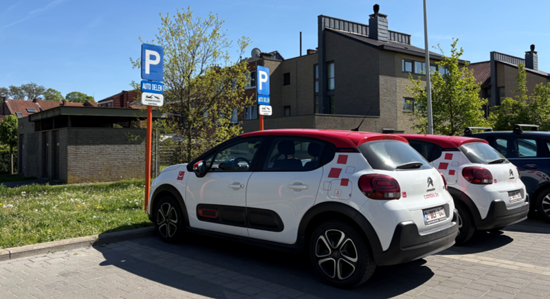 re onderzoeken naar de vervangratio in Vlaanderen kwamen uit op grote bandbreedtes of generieken waarden zonder veel onderbouwing. Het meest recente onderzoek van de Vlaamse netwerkorganisatie Way To Go die deelmobiliteit promoot, kwam uit op een ratio tussen de 3,1 en 9,5. Dat zijn twee uitersten die sterk van elkaar verschillen en vormt daarmee een grote bandbreedte. Dit maakt het lastig voor gemeenten of projectontwikkelaars om autodelen vanaf het begin af aan sterk te organiseren in projecten. Dat remt de groei van autodelen en roept vragen op bij toekomstige ontwikkelingen.
Immers is Gent niet hetzelfde als bijvoorbeeld het Limburgse achterland. Een dichtbebouwde centrumstad met veel openbaar vervoer heeft een andere context dan een omgeving met verspreide bebouwing en dominante auto-infrastructuur. Ook de mensen die gebruik maken van verschillende autodeelsystemen zijn niet altijd hetzelfde. Door het ontbreken van een onderbouwde methode om al deze verschillende contextafhankelijke factoren af te wegen, is het op dit moment moeilijk om voor een gemeente te bepalen welke vervangratio voor hen passend is. Laat staan hoe al die verschillende kenmerken invloed op elkaar hebben.
Daarom onderzocht ik in mijn Masterpoef Mobiliteitswetenschappen welke lokale factoren in een gemeente samenhangen met het aantal privéauto’s dat als gevolg van autodelen wordt weggedaan. Op basis daarvan heb ik een link gelegd met de vervangratio en de noodzakelijke berekeningen hiervoor. Want wat als we gemeentes een logisch rekenmodel kunnen aanbieden waarmee de afweging voor een vervangratio veel duidelijker en betrouwbaarder wordt?
Uit de eerste literatuuranalyse kwam naar voren dat tot meer dan 50 verschillende factoren invloed kunnen uitoefenen op de hoogte van de vervangratio
Een datagedreven model met echte gebruikersdata
In combinatie met diepgaand literatuuronderzoek naar belangrijke kenmerken in binnen- en buitenland heb ik op een datagedreven manier verschillende statistische modellen getest. Hiervoor gebruikte ik gegevens van verschillende Vlaamse autodelers die deelnemen aan round-trip autodelen. Dat is een vorm van autodelen waarbij de deelauto altijd teruggebracht moet worden naar de plek waar hij is opgehaald na gebruik. Door tussen deze gebruikersdata en informatie over de lokale situatie verbanden op te sporen, was het mogelijk om samenhangende kenmerken te vinden die de vervangratio in een gemeente beïnvloeden.
Op die manier heb ik een grote lijst aan mogelijke beïnvloedende kenmerken gefilterd tot een set van vier contextafhankelijke factoren: 1) het bestaand aantal beschikbare deelwagens, 2) het lokale autobezit, 3) de gemiddelde huishoudensgrootte en 4) de mate van een milieubewuste attitude in de gemeente. Doormiddel van deze statistische analyse ontwikkelde ik een rekenmodel dat toepasbaar is op alle Vlaamse gemeenten. Dit rekenmodel biedt een ambtenaar of projectontwikkelaar de mogelijkheid om op basis van de gemeente een contextafhankelijke vervangratio te berekenen, mét een onderbouwing.
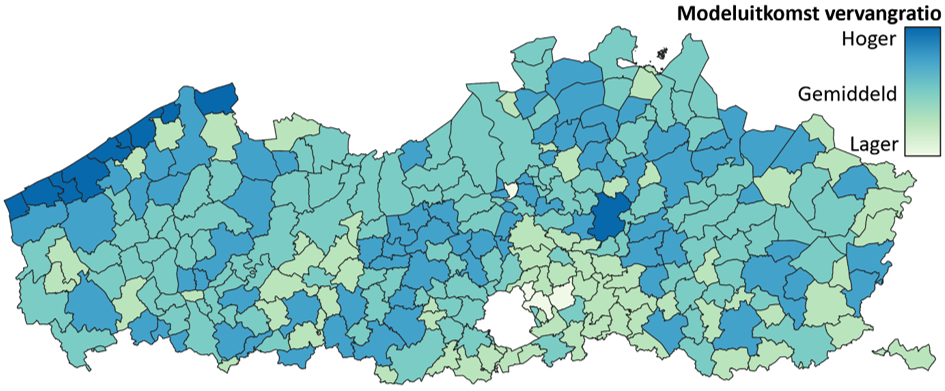
Een Vlaamse gemeente hoeft daardoor niet langer met een algemene of onduidelijke waarde te werken. Doordat het rekenmodel getraind is met publiek beschikbare data kan het met enkel de gemeentenaam een inschatting doen van de lokale vervangratio. Door de modulaire opbouw kan de gebruiker variëren in de gebruikte data en is het ook mogelijk om scenario’s te verkennen of een andere groep autodelers te analyseren. Diagrammen maken daarbij inzichtelijk welke impact ieder kenmerken afzonderlijk heeft op de berekening. Voor de Stad Gent laat de toepassing zien hoe een dergelijk model zelfs kan bijdragen aan besluitvorming in het mobiliteitsbeleid, aldus een ambtenaar van de stad:
“Nu wordt vaak op onderbuikgevoel bepaald hoeveel parkeerplaatsen kunnen verdwijnen als gevolg van autodelen, het model geeft daar straks een steviger basis voor in het gesprek met collega's”
Impact op meerdere gebieden
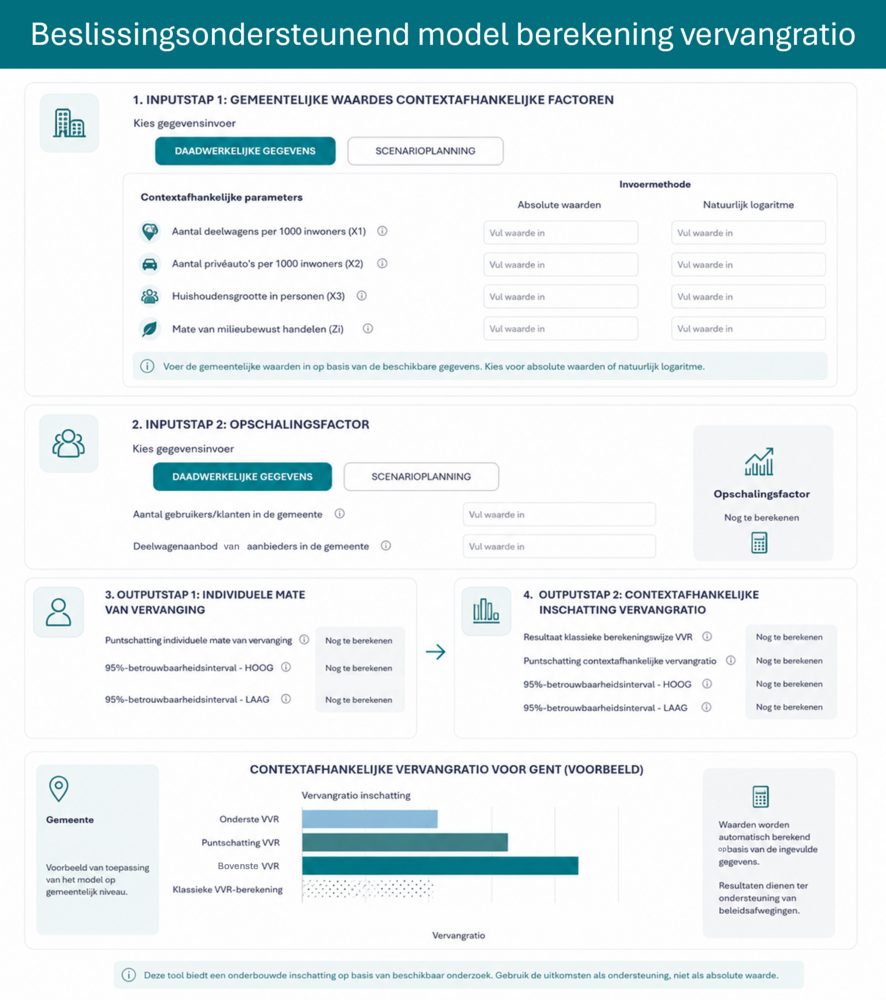
Het rekenmodel en de achterliggende statistiek tonen aan dat er duidelijke verbanden te herleiden zijn tussen de vervangratio en de lokale factoren. Door het beleid ermee te ondersteunen (beslissingsondersteunend model) kan de vervangratio een standaardonderdeel worden van een project, waardoor autodelen voor de hele maatschappij breder beschikbaar komt. Ook een koppeling met parkeerbeleid lijkt in de toekomst goed te maken, waardoor autodelen ook concreet kan leiden tot minder ruimtegebruik door auto’s en het halen van andere nationale beleidsdoelstellingen.
Het model biedt een schaalbare oplossing voor toepassingen in verschillende gemeentes en de achterliggende statistische modellen kunnen relatief gemakkelijk overgedragen worden naar nieuwe databronnen. Daarvoor moet de tool nog verder in de praktijk worden getest en dat biedt een opstap naar een nog toegankelijkere tool die in de toekomst mogelijk meer dan vier contextafhankelijke factoren integreert.
Afhankelijk van de gemiddelde huishoudensgrootte in een gemeente kan de vervangratio tot wel 10% veranderen
Het antwoord op de vraag welke waarde een gemeente of projectontwikkelaar moet gebruiken is dan ook niet één vaste vervangratio, maar een onderbouwde waarde waarin rekening is gehouden met de lokale context. Het ontwikkelde rekenmodel maakt die afweging concreet en biedt mogelijkheden om daarover in gesprek te gaan. Met deze thesis hoop ik bij te dragen aan een duidelijk inzicht in de vervangratio, waardoor autodelen in Vlaanderen verder kan groeien en bijdraagt aan een betere leefomgeving. Op naar een verdere vermenigvuldiging van het aantal deelwagens!
Bibliografie
Abdi, H., & Williams, L. J. (2010). Principal component analysis. In Wiley Interdisciplinary Reviews: Computational Statistics (Vol. 2, Nummer 4, pp. 433–459). https://doi.org/10.1002/wics.101
Abouelela, M., Al Haddad, C., & Antoniou, C. (2024). Psychological factors impacts on carsharing use. Transportation. https://doi.org/10.1007/s11116-024-10514-4
Akoglu, H. (2018). User’s guide to correlation coefficients. In Turkish Journal of Emergency Medicine (Vol. 18, Nummer 3, pp. 91–93). Emergency Medicine Association of Turkey. https://doi.org/10.1016/j.tjem.2018.08.001
Amirnazmiafshar, E., & Diana, M. (2022). A review of the socio-demographic characteristics affecting the demand for different car-sharing operational schemes. In Transportation Research Interdisciplinary Perspectives (Vol. 14). Elsevier Ltd. https://doi.org/10.1016/j.trip.2022.100616
Baarda, B. (2019). Dit is onderzoek! (3de dr.). Noordhoff Uitgevers.
Bal, F., Münzel, K., & Stoop, G. (2025). In Search for Insights for Policymakers: The Impact of Shared Mobility Amid the Transition to e-Mobility in the Netherlands. https://www.interregnorthsea.eu/sites/default/files/2025-09/SDMH_HU_WP2…
Bardhi, F., & Eckhardt, G. M. (2012). Access-Based Consumption: The Case of Car Sharing. Journal of Consumer Research, 39(4), 881–898. https://doi.org/10.1086/66
Becker, H., Ciari, F., & Axhausen, K. W. (2017). Comparing car-sharing schemes in Switzerland: User groups and usage patterns. Transportation Research Part A: Policy and Practice, 97, 17–29. https://doi.org/10.1016/j.tra.2017.01.004
Becker, H., Ciari, F., & Axhausen, K. W. (2018). Measuring the car ownership impact of free-floating car-sharing – A case study in Basel, Switzerland. Transportation Research Part D: Transport and Environment, 65, 51–62. https://doi.org/10.1016/j.trd.2018.08.003
Ben-Akiva, M., & Lerman, S. (1985). Discrete Choice Analysis: Theory and Application to Travel Demand. Economics, Engineering, Business.
Berger, V. W., & Zhou, Y. (2005). Kolmogorov-Smirnov Test: Overview. In Encyclopedia of Statistics in Behavioral Science. https://doi.org/10.1002/9781118445112.stat06558
Bieseman, H., & Strosse, V. (2022). Reducing soil sealing in Flanders by mapping and assessing opportunities. https://archief.algemeen.omgeving.vlaanderen.be/xmlui/bitstream/handle/…
Binuya, M. A. E., Engelhardt, E. G., Schats, W., Schmidt, M. K., & Steyerberg, E. W. (2022). Methodological guidance for the evaluation and updating of clinical prediction models: a systematic review. BMC Medical Research Methodology 2022 22:1, 22(1), 316-. https://doi.org/10.1186/S12874-022-01801-8
Bonat, W. H., & Kokonendji, C. C. (2017). Flexible Tweedie regression models for continuous data. Journal of Statistical Computation and Simulation, 87(11), 2138–2152. https://doi.org/10.1080/00949655.2017.1318876
Brant, R. (1990). Assessing Proportionality in the Proportional Odds Model for Ordinal Logistic Regression. Biometrics, 46(4), 1171–1178. https://doi.org/10.2307/2532457
Braun, V., & Clarke, V. (2006). Using thematic analysis in psychology. Qualitative Research in Psychology, 3, 77–101. https://doi.org/10.1191/1478088706qp063oa
Brooks, M. E., Kristensen, K., van Benthem, K. J., Magnusson, A., Berg, C. W., Nielsen, A., Skaug, H. J., Mächler, M., & Bolker, B. M. (2017). glmmTMB Balances Speed and Flexibility Among Packages for Zero-inflated Generalized Linear Mixed Modeling. The R Journal, 9, Art. 1.1.14. https://doi.org/10.32614/RJ-2017-066
Bucsky, P., & Juhász, M. (2022). Is car ownership reduction impact of car sharing lower than expected? A Europe wide empirical evidence. Case Studies on Transport Policy, 10(4), 2208–2217. https://doi.org/10.1016/j.cstp.2022.09.014
Bundesverband Carsharing. (2025). Verkehrsentlastende Wirkung von Carsharing messen - Evaluationsstandard (Version 1.2.1). https://www.carsharing.de/sites/default/files/download/2025-04/Evaluati…
Bundesverband Carsharing, & Loose, W. (2010). The State of European Car-Sharing. http://carsharing.info/images/stories/pdf_dateien/wp2_report__englisch_…
Burnham, K. P., & Anderson, D. R. (2004). Multimodel inference: Understanding AIC and BIC in model selection. In Sociological Methods and Research (Vol. 33, Nummer 2, pp. 261–304). https://doi.org/10.1177/0049124104268644
Cambio. (z.d.). Perstekst 20 jaar cambio Vlaanderen. Geraadpleegd 8 maart 2026, van https://www.cambio.be/sites/default/files/2026-01/Perstekst%2020%20jaar…
Cambio. (2025). Persbericht: Cambio actief in ca 150 steden en gemeenten in België! https://www.cambio.be/sites/default/files/2025-01/Cambio_Persbericht_20…
Carmen, R., Rousseau, S., Eyckmans, J., Chapman, D., Van Acker, K., Van Ootegem, L., & Bachus, K. (2019). Car-sharing in Flanders. https://circulareconomy.europa.eu/platform/sites/default/files/car-shar…
Carroll, P., Caulfield, B., & Ahern, A. (2017). Examining the potential for car-shedding in the Greater Dublin Area. Transportation Research Part A: Policy and Practice, 106, 440–452. https://doi.org/10.1016/j.tra.2017.10.019
Cervero, R., Golub, A., & Nee, B. (2007). City CarShare longer-term travel demand and car ownership impacts. Transportation Research Record, (1992), 70–80. https://doi.org/10.3141/1992-09
Cervero, R., & Tsai, Y. (2004). Two years into the introduction of City CarShare in San Francisco, California. Journal of the Transportation Research Board, (1887), 117–121. https://doi.org/10.3141/1887-14
Chapman, D. A., Eyckmans, J., & Van Acker, K. (2020). Does car-sharing reduce car-use? An impact evaluation of car-sharing in flanders, Belgium. Sustainability (Switzerland), 12(19). https://doi.org/10.3390/su12198155
Chatterjee, Samprit., & Simonoff, J. S. . (2013). Handbook of Regression Analysis. Wiley.
Chicco, D., Sichenze, A., & Jurman, G. (2025). A simple guide to the use of Student’s t-test, Mann-Whitney U test, Chi-squared test, and Kruskal-Wallis test in biostatistics. BioData Mining, 18(1). https://doi.org/10.1186/s13040-025-00465-6
Christensen, T. H., Friis, F., & Nielsen, M. V. (2022). Shifting from ownership to access and the future for MaaS: Insights from car sharing practices in Copenhagen. Case Studies on Transport Policy, 10(2), 841–850. https://doi.org/10.1016/j.cstp.2022.02.011
Chun, Y. Y., Matsumoto, M., Tahara, K., Chinen, K., & Endo, H. (2019). Exploring factors affecting car sharing use intention in the Southeast-Asia region: A case study in Java, Indonesia. Sustainability (Switzerland), 11(18). https://doi.org/10.3390/su11185103
Cochran, W. G. (1977). Sampling techniques (3de dr.). John Wiley and Sons, Inc.
CoMoUK. (2024). CoMoUK Annual Car Club Report UK. https://cdn.prod.website-files.com/6102564995f71c83fba14d54/6810c3d44ee…
Consul, P. C., & Famoye, F. (1992). Generalized poisson regression model. Communications in Statistics - Theory and Methods, 21:1, 89–109. https://doi.org/10.1080/03610929208830766
Cortina, J. M. (1993). Interaction, Nonlinearity, and Multicollinearity: implications for Multiple Regression. Journal of Management, 19(4), 915–922. https://doi.org/10.1016/0149-2063(93)90035-L
de Decker, P. (2011). Understanding housing sprawl: The case of flanders, Belgium. Environment and Planning A, 43(7), 1634–1654. https://doi.org/10.1068/a43242
De Vos, J. (2015). The influence of land use and mobility policy on travel behavior: A comparative case study of flanders and the netherlands. Journal of Transport and Land Use, 8(1), 171–190. https://doi.org/10.5198/jtlu.2015.709
Dégage. (2024). Persbericht - 25 jaar Dégage. https://www.degage.be/wp-content/uploads/2024/04/Persdossier_25jaarDe%C…
Dubois, M., De Meyer, L., Vandorpe, I., Lauwers, D., De Jonghe, N., Dooghe, D., & Wynants, K. (2020). Verkenning van omgevingsimpact van deelsystemen in Vlaanderen - Stand van zaken op basis van inventaris, documentanalyse en bevraging van kenners. https://omgeving.vlaanderen.be/sites/default/files/2021-10/VPO_deelsyst…
D’Urso, P., Guandalini, A., Mallamaci, F. R., Vitale, V., & Bocci, L. (2021). To Share or not to Share? Determinants of Sharing Mobility in Italy. Social Indicators Research, 154(2), 647–692. https://doi.org/10.1007/s11205-020-02574-7
Efthymiou, D., Chaniotakis, E., & Antoniou, C. (2019). Factors affecting the adoption of vehicle sharing systems. In Demand for Emerging Transportation Systems: Modeling Adoption, Satisfaction, and Mobility Patterns (pp. 189–209). Elsevier. https://doi.org/10.1016/B978-0-12-815018-4.00010-3
Ferrero, F., Perboli, G., Rosano, M., & Vesco, A. (2018). Car-sharing services: An annotated review. In Sustainable Cities and Society (Vol. 37, pp. 501–518). Elsevier Ltd. https://doi.org/10.1016/j.scs.2017.09.020
Firnkorn, J., & Shaheen, S. (2016). Generic time- and method-interdependencies of empirical impact-measurements: A generalizable model of adaptation-processes of carsharing-users’ mobility-behavior over time. Journal of Cleaner Production, 113, 897–909. https://doi.org/10.1016/j.jclepro.2015.09.115
Frey, H. C., & Patil, S. R. (2002). Identification and review of sensitivity analysis methods. Risk Analysis, 22(3), 553–578. https://doi.org/10.1111/0272-4332.00039
Fries, J., Oberleiter, S., & Pietschnig, J. (2024). Say farewell to bland regression reporting: Three forest plot variations for visualizing linear models. PLoS ONE, 19(2 February). https://doi.org/10.1371/journal.pone.0297033
Garber, M. D., Benmarhnia, T., Mason, J., Morales‐Zamora, E., & Rojas-Rueda, D. (2025). Parking and Public Health. In Current Environmental Health Reports (Vol. 12, Nummer 1). Springer Science and Business Media Deutschland GmbH. https://doi.org/10.1007/s40572-024-00465-4
Ghilagaber, G. (2008). Off-sets in GLM and MCMCpack. http://gauss.stat.su.se/f/r/RStudyGroup2008_5_GG.pdf
Gie Yong, A., & Pearce, S. (2013). A Beginner’s Guide to Factor Analysis: Focusing on Exploratory Factor Analysis. In Tutorials in Quantitative Methods for Psychology (Vol. 9, Nummer 2).
Giesel, F., & Nobis, C. (2016). The Impact of Carsharing on Car Ownership in German Cities. Transportation Research Procedia, 19, 215–224. https://doi.org/10.1016/j.trpro.2016.12.082
Gilchrist, R., & Drinkwater, D. (2000). The use of the Tweedie distribution in statistical modelling. Bethlehem, J.G., van der Heijden, P.G.M. (eds) COMPSTAT, 313–318. https://doi.org/10.1007/978-3-642-57678-2_39
Glotz-Richter, M. (2016). Reclaim Street Space! - Exploit the European Potential of Car Sharing. Transportation Research Procedia, 14, 1296–1304. https://doi.org/10.1016/j.trpro.2016.05.202
Green, J. A. (2021). Too many zeros and/or highly skewed? A tutorial on modelling health behaviour as count data with Poisson and negative binomial regression. Health Psychology and Behavioral Medicine, 9(1), 436–455. https://doi.org/10.1080/21642850.2021.1920416
Gustafsson, J. (2009). A Rule of Thumb for the Optimal Number of Runs in Monte Carlo Simulations. SSRN Electronic Journal. https://doi.org/10.2139/SSRN.1352642
Hamidi, S., Ewing, R., Preuss, I., & Dodds, A. (2015). Measuring Sprawl and Its Impacts: An Update. Journal of Planning Education and Research, 35(1), 35–50. https://doi.org/10.1177/0739456X14565247
Harris, T., Yang, Z., & Hardin, J. W. (2012). Modeling underdispersed count data with generalized Poisson regression. In The Stata Journal (Vol. 12, Nummer 4).
Hartig, F. (2020). Package ‘DHARMa’. http://download.nust.na/pub3/cran/web/packages/DHARMa/DHARMa.pdf
Hartig, F. (2024). DHARMa: Residual Diagnostics for Hierarchical (Multi-Level / Mixed) Regression Models (0.4.7). http://florianhartig.github.io/DHARMa/
Hasse, J. E., & Lathrop, R. G. (2003). Land resource impact indicators of urban sprawl. Applied Geography, 23(2–3), 159–175. https://doi.org/10.1016/j.apgeog.2003.08.002
Hayat, M. J., & Higgins, M. (2014). Understanding poisson regression. Journal of Nursing Education, 53(4), 207–215. https://doi.org/10.3928/01484834-20140325-04
Heinzl, H., & Mittlböck, M. (2003). Pseudo R-squared measures for Poisson regression models with over- or underdispersion. Computational Statistics and Data Analysis, 44(1–2), 253–271. https://doi.org/10.1016/S0167-9473(03)00062-8
Hilbe, J. M. (2014). Modeling Count Data. Cambridge University Press. https://doi.org/10.1017/CBO9781139236065
Horn, J. L. (1965). A Rationale and Test for the Number of Factors in Factor Analysis. Psychometrika, 30(2), 179–185. https://doi.org/10.1007/BF02289447
Hyndman, R. J., & Koehler, A. B. (2006). Another look at measures of forecast accuracy. International Journal of Forecasting, 22(4), 679–688. https://doi.org/10.1016/j.ijforecast.2006.03.001
Igemo. (2024). Gemeentelijk parkeerbeleid. https://omgeving.vlaanderen.be/sites/default/files/2024-05/Lokaal%20par…
Invers. (2024). INVERS Mobility Barometer Vol. 4 - European Car Sharing 2024. https://go.invers.com/hubfs/Downloads/INVERS-Mobility-Barometer%20-%20E…
Jacoby, W. G. (2000). Loess:: a nonparametric, graphical tool for depicting relationships between variables. Electoral Studies, 19(4), 577–613. https://doi.org/10.1016/S0261-3794(99)00028-1
Jain, T., Johnson, M., & Rose, G. (2020). Exploring the process of travel behaviour change and mobility trajectories associated with car share adoption. Travel Behaviour and Society, 18, 117–131. https://doi.org/10.1016/j.tbs.2019.10.006
Jain, T., Rose, G., & Johnson, M. (2022). Changes in private car ownership associated with car sharing: gauging differences by residential location and car share typology. Transportation, 49(2), 503–527. https://doi.org/10.1007/s11116-021-10184-6
Jochem, P., Frankenhauser, D., Ewald, L., Ensslen, A., & Fromm, H. (2020). Does free-floating carsharing reduce private vehicle ownership? The case of SHARE NOW in European cities. Transportation Research Part A: Policy and Practice, 141, 373–395. https://doi.org/10.1016/j.tra.2020.09.016
Joe, H., & Zhu, R. (2005). Generalized poisson distribution: The property of mixture of poisson and comparison with negative binomial distribution. Biometrical Journal, 47(2), 219–229. https://doi.org/10.1002/bimj.200410102
Jollife, I. T., & Cadima, J. (2016). Principal component analysis: A review and recent developments. In Philosophical Transactions of the Royal Society A: Mathematical, Physical and Engineering Sciences (Vol. 374, Nummer 2065). Royal Society of London. https://doi.org/10.1098/rsta.2015.0202
Jorritsma, P., Witte, J.-J., Alonso González, M. J., & Hamersma, M. (2021). Deelauto- en deelfietsmobiliteit in Nederland - Ontwikkelingen, effecten en potentie. https://www.kimnet.nl/documenten/2021/10/05/deelauto--en-deelfietsmobil…
Kaiser, H. F. (1960). The Application of Electronic Computers to Factor Analysis. Educational and Psychological Measurement, 20(1). https://doi.org/10.1177/001316446002000116
Karamizadeh, S., Abdullah, S. M., Manaf, A. A., Zamani, M., & Hooman, A. (2013). An Overview of Principal Component Analysis. Journal of Signal and Information Processing, 04(03), 173–175. https://doi.org/10.4236/jsip.2013.43b031
Karbaumer, R., & Metz, F. (2022). Gids voor het universum van de deelmobiliteit. https://share-north.eu/wp-content/uploads/2022/05/Shared-Mobility-Guide…
Katzev, R. (2003). Car Sharing: A New Approach to Urban Transportation Problems. Analyses of Social Issues and Public Policy, 3(1), 65–86. https://doi.org/10.1111/j.1530-2415.2003.00015.x
Khoshvaght, H., Permala, R. R., Razmjou, A., & Khiadani, M. (2025). A critical review on selecting performance evaluation metrics for supervised machine learning models in wastewater quality prediction. Journal of Environmental Chemical Engineering, 13(6), 119675. https://doi.org/10.1016/J.JECE.2025.119675
Kim, D., Ko, J., & Park, Y. (2015). Factors affecting electric vehicle sharing program participants’ attitudes about car ownership and program participation. Transportation Research Part D: Transport and Environment, 36, 96–106. https://doi.org/10.1016/j.trd.2015.02.009
Kim, D., Park, Y., & Ko, J. (2019). Factors underlying vehicle ownership reduction among carsharing users: A repeated cross-sectional analysis. Transportation Research Part D: Transport and Environment, 76, 123–137. https://doi.org/10.1016/j.trd.2019.09.018
Kleiber, C., & Zeileis, A. (2016). Visualizing Count Data Regressions Using Rootograms. American Statistician, 70(3), 296–303. https://doi.org/10.1080/00031305.2016.1173590
Klincevicius, M. G. Y., Morency, C., & Trépanier, M. (2014). Assessing impact of carsharing on household car ownership in Montreal, Quebec, Canada. Transportation Research Record, 2416, 48–55. https://doi.org/10.3141/2416-06
Ko, J., Ki, H., & Lee, S. (2019). Factors affecting carsharing program participants’ car ownership changes. Transportation Letters, 11(4), 208–218. https://doi.org/10.1080/19427867.2017.1329891
Kodransky, M., & Lewenstein, G. (2014). Connecting Low-Income People to Opportunity with Shared Mobility. https://www.livingcities.org/resources/275-
Kolleck, A. (2021). Does car-sharing reduce car ownership? Empirical evidence from Germany. Sustainability (Switzerland), 13(13). https://doi.org/10.3390/su13137384
Koppelman, F. S., & Wilmot, C. G. (1982). TRANSFERABILITY ANALYSIS OF DISAGGREGATE CHOICE MODELS - TRID. Transportation Research Record, (895), 18–24. http://onlinepubs.trb.org/Onlinepubs/trr/1982/895/895-004.pdf
Koutsandreas, D., Spiliotis, E., Petropoulos, F., & Assimakopoulos, V. (2022). On the selection of forecasting accuracy measures. Journal of the Operational Research Society, 73(5), 937–954. https://doi.org/10.1080/01605682.2021.1892464
KpVV-CROW. (2016). 5 Argumenten voor autodelen. https://corp-kentico-productie.crow.nl/downloads/pdf/verkeer-en-vervoer…
Lane, C. (2005). PhillyCarShare First-Year Social and Mobility Impacts of Carsharing in Philadelphia, Pennsylvania. Transportation Research Record: Journal of the Transportation Research Board, (1927), 158–166. https://doi.org/10.1177/0361198105192700118
Lauwers, D., Baert, W., & Caers, I. (2019). Van parkeer- en stallingsnormen naar een mobiliteitsnorm - Cahier No. 5. https://www.kenniscentrumvlaamsesteden.be/Gedeelde%20%20documenten/2020…
Lavrakas, P. J. (2008). Encyclopedia Of Survey Research Methods (Vols. 1–0). Sage Publications, Inc. https://doi.org/10.4135/9781412963947
Liang, L., Tian, L., Xie, J., Xu, J., & Zhang, W. (2021). Optimal pricing model of car-sharing: market pricing or platform pricing. Industrial Management & Data Systems, 121(3), 594–612. https://doi.org/10.1108/IMDS-04-2020-0230
Liao, F., Molin, E., Timmermans, H., & van Wee, B. (2020). Carsharing: the impact of system characteristics on its potential to replace private car trips and reduce car ownership. Transportation, 47(2), 935–970. https://doi.org/10.1007/s11116-018-9929-9
Lopez, E., Etxebarria-Elezgarai, J., Amigo, J. M., & Seifert, A. (2023). The importance of choosing a proper validation strategy in predictive models. A tutorial with real examples. Analytica Chimica Acta, 1275, 341532. https://doi.org/10.1016/J.ACA.2023.341532
Martin, E., Shaheen, S., & Lidicker, J. (2010). Impact of carsharing on household vehicle holdings. Transportation Research Record, (2143), 150–158. https://doi.org/10.3141/2143-19
Matthijs, J. (2014). Particulier autodelen in de centrumsteden: Resultaten van de opdracht tot uitbreiding van particuliere autodeelgroepen in de 13 centrumsteden. https://www.kenniscentrumvlaamsesteden.be/kennisbank/lopendonderzoek/Do…
Mattioli, G., Anable, J., & Vrotsou, K. (2016). Car dependent practices: Findings from a sequence pattern mining study of UK time use data. Transportation Research Part A: Policy and Practice, 89, 56–72. https://doi.org/10.1016/J.TRA.2016.04.010
McCullagh, P. (1989). Generalized Linear Models. In Regression Analysis with Application G.B. Wetherill (Nummer 2). Boca Raton. https://doi.org/10.1201/9780203753736
McCulloch, C. E. (1996). An Introduction to Generalized Linear Mixed Models. Conference on Applied Statistics in Agriculture. https://doi.org/10.4148/2475-7772.1314
McFadden, D. (1972). Conditional logit analysis of qualitative choice behavior. Frontiers in Econometrics, 105–142. https://www.academia.edu/53553324/Conditional_logit_analysis_of_qualita…
Michie, S., van Stralen, M. M., & West, R. (2011). The behaviour change wheel: A new method for characterising and designing behaviour change interventions. Implementation Science, 6(1). https://doi.org/10.1186/1748-5908-6-42
Migliore, M., D’Orso, G., & Caminiti, D. (2020). The environmental benefits of carsharing: The case study of Palermo. Transportation Research Procedia, 48, 2127–2139. https://doi.org/10.1016/j.trpro.2020.08.271
Millard-Ball, A., Murray, G., Schure, J. Ter, Fox, C., & Burkhardt, J. (2005). TCRP Report 108: Car-Sharing: Where and How It succeeds. Transit Cooperative Research Program, (108), 264. https://trid.trb.org/View/767312
Mounika. (2023). Path of process. https://mounika.studio/
Münzel, K., Boon, W., Frenken, K., Blomme, J., & van der Linden, D. (2020). Explaining carsharing supply across Western European cities. International Journal of Sustainable Transportation, 14(4), 243–254. https://doi.org/10.1080/15568318.2018.1542756
Namazu, M., & Dowlatabadi, H. (2018). Vehicle ownership reduction: A comparison of one-way and two-way carsharing systems. Transport Policy, 64, 38–50. https://doi.org/10.1016/j.tranpol.2017.11.001
Nansubuga, B., & Kowalkowski, C. (2021). Carsharing: a systematic literature review and research agenda. In Journal of Service Management (Vol. 32, Nummer 6, pp. 55–91). Emerald Group Holdings Ltd. https://doi.org/10.1108/JOSM-10-2020-0344
Neuendorf, K. A. (2018). Content analysis and thematic analysis. Advanced Research Methods for Applied Psychology, 211–223. https://doi.org/10.4324/9781315517971-21
Nijland, H., & van Meerkerk, J. (2017). Mobility and environmental impacts of car sharing in the Netherlands. Environmental Innovation and Societal Transitions, 23, 84–91. https://doi.org/10.1016/j.eist.2017.02.001
Ogero, M., Ndiritu, J., Sarguta, R., Tuti, T., Aluvaala, J., & Akech, S. (2023). Recalibrating prognostic models to improve predictions of in-hospital child mortality in resource-limited settings. Paediatric and Perinatal Epidemiology, 37(4), 313–321. https://doi.org/10.1111/PPE.12948;WGROUP:STRING:PUBLICATION
Okraszewska, R., Romanowska, A., Clarissa Laetsch, D., Gobis, A., Reisch, L. A., Kamphuis, C. B. M., Lakerveld, J., Krajewski, P., Banik, A., den Braver, N. R., Forberger, S., Brenner, H., & Żukowska, J. (2024). Interventions reducing car usage: Systematic review and meta-analysis. Transportation Research Part D: Transport and Environment, 131, 104217. https://doi.org/10.1016/J.TRD.2024.104217
O.Nyumba, T., Wilson, K., Derrick, C. J., & Mukherjee, N. (2018). The use of focus group discussion methodology: Insights from two decades of application in conservation. Methods in Ecology and Evolution, 9(1), 20–32. https://doi.org/10.1111/2041-210X.12860
Ozili, P. K. (2023). The acceptable R-square in empirical modelling for social science research. In C. A. Saliya (Red.), Social Research Methodology and Publishing Results (pp. 134–143). Springer. https://doi.org/https://doi.org/10.1007/978-981-19-3780-4
Patel, V. H., Singh, S. N., Mishra, S., & Donavan, T. (2017). Parallel Analysis Engine to Aid in Determining Number of Factors to Retain using R [Computer software]. https://analytics.gonzaga.edu/parallelengine/
Paul, J. (2024). Beyond the Company Carpool: Disadvantage and Informal Automobile Sharing Within and Between U.S. Households. Transportation Research Record, 2678(12), 1271–1288. https://doi.org/10.1177/03611981241250338
Payne, E. H., Gebregziabher, M., Hardin, J. W., Ramakrishnan, V., & Egede, L. E. (2018). An empirical approach to determine a threshold for assessing overdispersion in Poisson and negative binomial models for count data. Communications in Statistics: Simulation and Computation, 47(6), 1722–1738. https://doi.org/10.1080/03610918.2017.1323223
Poelmans, L., Crols, T., Vermeiren, K., Vanacker, S., Willems, P., & Pisman, A. (2024). Verstedelijkte, randstedelijke en landelijke gebieden in Vlaanderen. https://indicatoren.omgeving.vlaanderen.be/indicatoren/verstedelijkt-ra…
Poelmans, L., & Van Rompaey, A. (2009). Detecting and modelling spatial patterns of urban sprawl in highly fragmented areas: A case study in the Flanders-Brussels region. Landscape and Urban Planning, 93(1), 10–19. https://doi.org/10.1016/j.landurbplan.2009.05.018
Prettenthaler, F. E., & Steininger, K. W. (1999). From ownership to service use lifestyle: the potential of car sharing. In Ecological Economics (Vol. 28).
Prieto, M., Baltas, G., & Stan, V. (2017). Car sharing adoption intention in urban areas: What are the key sociodemographic drivers? Transportation Research Part A: Policy and Practice, 101, 218–227. https://doi.org/10.1016/j.tra.2017.05.012
Puig, P., Valero, J., & Fernández-Fontelo, A. (2024). Some mechanisms leading to underdispersion: Old and new proposals. Scandinavian Journal of Statistics, 51(1), 245–267. https://doi.org/10.1111/sjos.12677
Rabiee, F. (2004). Focus-group interview and data analysis. Proceedings of the Nutrition Society, 63(4), 655–660. https://doi.org/10.1079/pns2004399
Ramos, É. M. S., Bergstad, C. J., Chicco, A., & Diana, M. (2020). Mobility styles and car sharing use in Europe: attitudes, behaviours, motives and sustainability. European Transport Research Review, 12(1). https://doi.org/10.1186/s12544-020-0402-4
Rebel Group. (2023). Dynamisch analysemodel voor Amsterdam Autodelen. https://openresearch.amsterdam/image/2024/2/5/las22156_rapport_ruimte_v…
Rifkin, J. (2000). The Age of Access: The New Culture of Hypercapitalism, where All of Life is a Paid-for Experience. https://archive.org/details/ageofaccessnewcu00rifk/mode/2up
Rijkswaterstaat. (z.d.). Sitearchief - Fact Sheet Car sharing. Geraadpleegd 12 maart 2026, van https://rijkswaterstaat.sitearchief.nl/?subsite=rwsenvironment#archive
Roblek, V., Meško, M., & Podbregar, I. (2021). Impact of car sharing on urban sustainability. Sustainability (Switzerland), 13(2), 1–19. https://doi.org/10.3390/su13020905
Roelens, J., Van Damme, T., & Strome, T. (2023). Succesfactoren deelmobiliteit - onderzoek naar deelmobiliteit in Vlaanderen.
Rousseeuw, P. J. (1991). A diagnostic plot for regression outliers and leverage points. Computational Statistics & Data Analysis, 11(1), 127–129. https://doi.org/10.1016/0167-9473(91)90059-B
Rudin, C. (2019). Stop explaining black box machine learning models for high stakes decisions and use interpretable models instead. Nature Machine Intelligence, 206–215. https://doi.org/10.1038/s42256-019-0048-x
Ruppert, D. (2001). Statistical Analysis, Special Problems of: Transformations of Data. International Encyclopedia of the Social & Behavioral Sciences, 15007–15014. https://doi.org/10.1016/B0-08-043076-7/00513-1
Rydén, C. (2005). Environmental effects of carsharing-results from the moses project. http://213.170.188.3/moses/Downloads/reports/del_6.pdf
Salet, W., & Coppens, T. (2024). International Policy and Practice Creating places of distinction: spatial conditions for climate policies in Flanders. Town Planning Review, 95(3), 231–247. https://doi.org/10.3828/tpr.2024.2
Scheiner, J., & Holz-Rau, C. (2013). A comprehensive study of life course, cohort, and period effects on changes in travel mode use. Transportation Research Part A: Policy and Practice, 47, 167–181. https://doi.org/10.1016/J.TRA.2012.10.019
Schober, P., & Schwarte, L. A. (2018). Correlation coefficients: Appropriate use and interpretation. Anesthesia and Analgesia, 126(5), 1763–1768. https://doi.org/10.1213/ANE.0000000000002864
Schreier, H., Grimm, C., Brümmer, M., & Hericks, K. (2025). Evaluation Carsharing in Bremen 2025. https://mobilpunkt-bremen.de/app/uploads/2026/01/Bremen-Carsharing-Eval…
Schreier, H., Grimm, C., Kurz, U., Schwieger, B., Keßler, S., & Möser, G. (2018). Analysis of the impacts of car-sharing in Bremen, Germany. https://share-north.eu/wp-content/uploads/2018/08/Analysis-of-the-Impac…
Sellers, K. F., Borle, S., & Shmueli, G. (2012). The COM-Poisson model for count data: A survey of methods and applications. Applied Stochastic Models in Business and Industry, 28(2), 104–116. https://doi.org/10.1002/asmb.918
Shaheen, S., Cohen, A., Chan, N., & Bansal, A. (2019). Sharing strategies: Carsharing, shared micromobility (bikesharing and scooter sharing), transportation network companies, microtransit, and other innovative mobility modes. In Transportation, Land Use, and Environmental Planning (pp. 237–262). Elsevier. https://doi.org/10.1016/B978-0-12-815167-9.00013-X
Shaheen, S., Sperling, D., & Wagner, C. (2001). Carsharing in Europe and North America: Past, Present and Future. https://escholarship.org/uc/item/14d994bn
Shoup, D. (1997). The High Cost of Free Parking. Journal of Planning Education and Research, (17), 3–20. https://www.researchgate.net/publication/235359727_The_High_Cost_of_Fre…
Sprague, R. H. (1980). A framework for the development of decision support systems. MIS Quarterly: Management Information Systems, 4(4), 1–26. https://doi.org/10.2307/248957
Stad Brugge. (2023). Gemeentelijke stedenbouwkundige verordening op het bouwen, verkavelen en op de beplantingen. https://www.brugge.be/sites/default/files/2024-02/GemeentelijkeStedenbo…
Stad Gent. (2015). Mobiliteitsplan Gent - Strategische mobiliteitsvisie. https://stad.gent/sites/default/files/page/documents/20150929_DO_%20Mob…
Stad Gent. (2024). Parkeerrichtlijnen fiets en auto. https://stad.gent/sites/default/files/media/documents/20240223_deelnota…
Stad Leuven. (2023). Herziening parkeerverordening Leuven. https://besluitvorming.leuven.be/document/63d3ee4a3ae2953dbe9f06dc;jses…
Stad Mechelen. (2023). Algemene stedenbouwkundige verordening. https://www.mechelen.be/sites/default/files/huren-verhuren/files/2025-0…
Statbel. (2010). Gemiddelde huishoudgrootte - Census 2011. https://census2011.fgov.be/data/fresult/householdsize_nl.html
Steg, L. (2007). SUSTAINABLE TRANSPORTATION: A Psychological Perspective. IATSS Research, 31(2), 58–66. https://doi.org/10.1016/S0386-1112(14)60223-5
Steyerberg, E. W., & Harrell, F. E. (2016). Prediction models need appropriate internal, internal-external, and external validation. In Journal of Clinical Epidemiology (Vol. 69, pp. 245–247). Elsevier USA. https://doi.org/10.1016/j.jclinepi.2015.04.005
Straume, M., & Johnson, M. L. (1992). [5] Analysis of Residuals: Criteria for determining goodness-of-fit. Methods in Enzymology, 210(C), 87–105. https://doi.org/10.1016/0076-6879(92)10007-Z
Sun, Z., Wang, Y., Zhou, H., Jiao, J., & Overstreet, R. E. (2021). Travel behaviours, user characteristics, and social-economic impacts of shared transportation: a comprehensive review. International Journal of Logistics Research and Applications, 24(1), 51–78. https://doi.org/10.1080/13675567.2019.1663162
Taskforce Bouwshift. (2021). Taskforce Bouwshift einddocument. https://omgeving.vlaanderen.be/sites/default/files/2022-01/Taskforce%20…
Taylor, M. (2009). What is sensitivity analysis? https://exinfm.com/excel_lessons/lesson02/What_is_sens_analy.pdf
Too, M. A., Alter, U., & Flora, D. B. (2025). Modelling Count Data in Psychological Research: An Applied Tutorial. International Journal of Psychology, 60(2). https://doi.org/10.1002/ijop.70018
Turoń, K. (2023). Factors Affecting Car-Sharing Services. Smart Cities, 6(2), 1185–1201. https://doi.org/10.3390/smartcities6020057
Tüzen, M. F., & Erbaş, S. (2018). A comparison of count data models with an application to daily cigarette consumption of young persons. In Communications in Statistics - Theory and Methods (Vol. 47, Nummer 23, pp. 5825–5844). Taylor and Francis Inc. https://doi.org/10.1080/03610926.2017.1402050
Vafakhah, M., & Janizadeh, S. (2021). Application of artificial neural network and adaptive neuro-fuzzy inference system in streamflow forecasting. In Advances in Streamflow Forecasting: From Traditional to Modern Approaches (pp. 171–191). Elsevier. https://doi.org/10.1016/B978-0-12-820673-7.00002-0
Van Eenoo, E., Fransen, K., & Boussauw, K. (2022). Perceived car dependence and multimodality in urban areas in Flanders (Belgium). European Journal of Transport and Infrastructure Research, 22(1), 42–62. https://doi.org/10.18757/ejtir.2022.22.1.6044
Van Neck, J. (2018). De slimme parkeernorm voor de stad van morgen. https://blog.antwerpmanagementschool.be/hubfs/Whitepaper%20-%20de%20sli…
van Vessem, C., Macharis, C., Keseru, I., & Mommens, K. (2024). 30 Days with less cars: The effect of a month-long car-free campaign in Flanders, Belgium. Transportation Research Interdisciplinary Perspectives, 27. https://doi.org/10.1016/j.trip.2024.101227
Vansevenant, M. (2024, september 17). Waarom is het nu tijd voor de ‘Green Deal Deelmobiliteit en wonen’? . https://omgeving.vlaanderen.be/nl/green-deal-deelmobiliteit-en-wonen/wa…
Vatcheva, K., Lee, M., McCormick, J., & Rahbar, M. (2016). Multicollinearity in Regression Analyses Conducted in Epidemiologic Studies. Epidemiology: Open Access, 06(02). https://doi.org/10.4172/2161-1165.1000227
Verbeke, G., & Molenberghs, G. (2013). Generalized Linear Mixed Models-Overview. In M. A. Scott, J. S. Simonoff, & B. D. Marx (Red.), The SAGE Handbook of Multilevel Modeling (8). SAGE Publications Ltd. https://doi.org/10.4135/9781446247600.n8
Vergouwe, Y., Nieboer, D., Oostenbrink, R., Debray, T. P. A., Murray, G. D., Kattan, M. W., Koffijberg, H., Moons, K. G. M., & Steyerberg, E. W. (2017). A closed testing procedure to select an appropriate method for updating prediction models. Statistics in Medicine, 36(28), 4529–4539. https://doi.org/10.1002/sim.7179
Vives, J., & Losilla, J.-M. (2006). Count data in psychological applied research. Psychological Reports, 98(3), 82–83. https://doi.org/10.2466/pr0.98.3.821-835
Vlaams Instituut Gezond Leven. (z.d.). De walkabilityscore | Gezond Leven. Geraadpleegd 28 maart 2026, van https://www.gezondleven.be/settings/gezonde-gemeente/gezonde-publieke-r…
Vlaams Parlement. (2023). Verslag vergadering Commissie voor Mobiliteit en Openbare Werken. https://www.vlaamsparlement.be/nl/parlementair-werk/commissies/commissi…
Vlaamse Overheid. (z.d.-a). Bereikbaarheid openbaar vervoer | Gemeente-Stadsmonitor. Geraadpleegd 28 maart 2026, van https://gemeente-stadsmonitor.vlaanderen.be/over-de-monitor/overzicht-i…
Vlaamse Overheid. (z.d.-b). Bevolking naar leeftijd en geslacht | Vlaanderen.be. Geraadpleegd 14 mei 2026, van https://app.powerbi.com/view?r=eyJrIjoiODc0YmM0MGYtYjAwNS00NjFlLWIyMWEt…
Vlaamse Overheid. (2008). Vademecum Duurzaam Parkeerbeleid. https://publicaties.vlaanderen.be/view-file/4336
Vlaamse Overheid. (2018). Richtlijnenboek Mobiliteitseffectenstudies, Mobiliteitstoets en MOBER. http://www.mobielvlaanderen.be/vademecums/mober.php
Vlaamse Overheid. (2019). Groen in de gemeente | Gemeente-Stadsmonitor. https://gemeente-stadsmonitor.vlaanderen.be/over-de-monitor/overzicht-i…
Vlaamse Overheid. (2021). Vlaamse Mobiliteitsvisie 2040. https://assets.vlaanderen.be/image/upload/v1645112287/Vlaamse_mobilitei…
Vlaamse Overheid. (2022). Synthese knooppuntwaarde en voorzieningenniveau - toestand 2022 | Vlaanderen.be. https://www.vlaanderen.be/datavindplaats/catalogus/synthese-knooppuntwa…
Vlaamse Overheid. (2023). Milieubewust handelen | Gemeente-Stadsmonitor. Gemeente-stadmonitor. https://gemeente-stadsmonitor.vlaanderen.be/over-de-monitor/overzicht-i…
Vlaamse Overheid. (2024). Greendeal 019 - Deelmobiliteit en Wonen Samenwerkingsconvenant. https://omgeving.vlaanderen.be/sites/default/files/2024-08/Convenanttek…
Vlaamse Overheid. (2025a, februari 26). Beroepsinkomen | Vlaanderen.be. https://www.vlaanderen.be/statistiek-vlaanderen/inkomen-en-armoede/bero…
Vlaamse Overheid. (2025b, oktober 15). Verharding in ruimtebeslag. https://indicatoren.omgeving.vlaanderen.be/indicatoren/verharding-ruimt…
Vuong, Q. H. (1989). Likelihood Ratio Tests for Model Selection and Non-Nested Hypotheses. Econometrica, 57(2), 307. https://doi.org/10.2307/1912557
Wang, J., Dane, G. Z., & Timmermans, H. J. P. (2021). Carsharing-facilitating neighbourhood choice: a mixed logit model. Journal of Housing and the Built Environment, 36(3), 1033–1054. https://doi.org/10.1007/s10901-020-09791-z
Way To Go. (2023). Impactrapport - Autodelen in België 2022. https://www.waytogo.be/files/Publicaties/Impactrapport.-Autodelen-in-Be…
Way To Go. (2024). Autodelen in Vlaanderen in 2023 - Jaarrapport.
Way To Go. (2025). Rapport 2024 - Deelmobiliteit in België. https://www.waytogo.be/files/Publicaties/Deelmobiliteit-in-Belgi%C3%AB-…
Way To Go. (2026). Deelmobiliteit in België 2025. https://www.waytogo.be/files/Publicaties/Deelmobiliteit-in-Belgie-in-20…
Williams, R. (2012). Using the margins command to estimate and interpret adjusted predictions and marginal effects. In The Stata Journal (Vol. 12, Nummer 2).
Witowski, V. (2013). dgenpois: The Generalized Poisson Distribution in HMMpa: Analysing Accelerometer Data Using Hidden Markov Models. https://rdrr.io/cran/HMMpa/man/dgenpois.html
Wu, C., Le Vine, S., Clark, M., Gifford, K., & Polak, J. (2020). Factors associated with round-trip carsharing frequency and driving-mileage impacts in London. International Journal of Sustainable Transportation, 14(3), 177–186. https://doi.org/10.1080/15568318.2018.1538401
Xu, J., van Lierop, D., & Ettema, D. (2026). How does carsharing impact private car ownership and the use of other travel modes? A review of different operational carsharing schemes. Transport Reviews, 46(1), 28–51. https://doi.org/10.1080/01441647.2025.2545226
Ye, J., Wang, D., Li, X., Axhausen, K. W., & Jin, Y. (2021). Assessing one-way carsharing’s impacts on vehicle ownership: Evidence from Shanghai with an international comparison. Transportation Research Part A: Policy and Practice, 150, 16–32. https://doi.org/10.1016/j.tra.2021.05.012