Hoe bevallingsverhalen ons vertellen wie baas is over het baren
Ken jij het bevallingsverhaal van je moeder? De kans is groot van wel. Het is er ééntje dat typisch op verjaardagen of familiefeesten weer eens wordt verteld. Zulke verhalen doen echter meer dan alleen herinneringen ophalen: ze vormen ook mee ons begrip en onze verwachtingen over het baren van een eigen kind. Wat is precies een bevalling en hoe moeten we ermee omgaan? Is het vooral een medische gebeurtenis, een natuurlijk lichamelijk proces, een empowerende overgang naar het moederschap, of iets daartussenin? Uit het masterproefonderzoek van sociologiestudente Emilie Gillain (UAntwerpen) blijkt dat vrouwen beroep doen op al deze verschillende representaties om betekenis te verlenen aan hun bevalling. Toch krijgt medische kennis vaak het meeste gewicht zodra er concrete zorgbeslissingen moeten worden genomen. Dat wordt niet alleen zichtbaar in wat vrouwen vertellen, maar ook in hoe ze dit doen.
Wat kunnen bevallingverhalen ons vertellen?
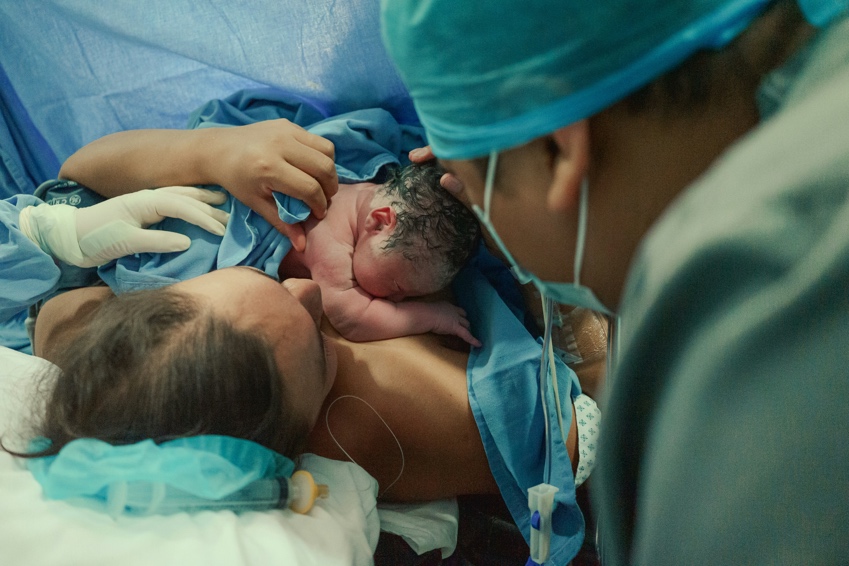 Al enkele decennia wordt in de verloskunde gepleit voor ‘shared decision-making’: medische beslissingen samen met patiënten nemen, in plaats van voor hen. Toch blijkt dat ideaal in de praktijk moeilijk te realiseren. Zo blijkt uit onderzoek in België en Nederland dat vandaag nog steeds bijna de helft van de medische ingrepen tijdens een bevalling zonder enigszins afgestemde toestemming van de barende vrouw gebeuren. Hoe kan die kloof tussen dit ideaal en praktijk zo hardnekkig blijven bestaan? Gillain wilde begrijpen wat er achter die kloof tussen ideaal en praktijk schuil gaat. Daarom luisterde ze naar hoe vrouwen zelf over hun bevalling vertellen. In zo’n verhaal wordt niet alleen duidelijk wat er gebeurde en hoe dat voelde. Ook wordt zichtbaar welke kennis als vanzelfsprekend geldt, wie als beslisser wordt gepositioneerd en hoeveel ruimte er overblijft voor de stem van de vrouw.
Luisteren tussen de regels door
Gillain interviewde dertien vrouwen die recent van hun eerste kind waren bevallen. Eén open vraag stond centraal: “Zou je me willen vertellen hoe je bevalling voor jou is verlopen, van begin tot einde, gewoon zoals jij het hebt beleefd?”. Vervolgens keek ze niet alleen naar wat de vrouwen vertelden, maar vooral naar hoe ze via taal hun verhaal vormgaven. Welke woorden gebruikten ze? Wie handelde er in hun zinnen? Welke metaforen gebruikten ze? En wat vertelt ons dit over het statuut van een barende vrouw in de geboortezorg?
 Het verschil kan klein lijken: “ik vroeg om een epidurale” klinkt anders dan “ze gaven me een epidurale”. Maar juist in zulke taalkeuzes wordt zichtbaar wie in het verhaal de handelende persoon is of wiens kennis invloed heeft op zorgbeslissingen. Zo wordt tastbaar welke verschillende discoursen, verschillende manieren van praten, in de bevalverhalen voorkomen en hoe deze bestaande sociale verhoudingen blootleggen.
Medische blik als vanzelfsprekendheid
Eens je op zo’n manier gaat luisteren naar hoe vrouwen hun geboorteverhaal vertellen, valt op dat de meerderheid voornamelijk spreekt in medisch getinte termen. Woorden zoals ‘inleiding’, ‘misoprostol’, ‘monitor’ of ‘ziekenhuis’ werden bijvoorbeeld regelmatig gebruikt zonder veel extra uitleg. Ook metaforisch werden bevallingen medisch geframed. Noor (pseudoniem)vergeleek bijvoorbeeld een ‘natuurlijke’ bevalling met het winnen van de Lotto: iets wat je graag wilt, maar waarvan je niet mag verwachten dat het ook werkelijk gebeurt. Ook de grammatica veranderde naarmate de medische interventies toenamen. Aan het begin van een bevallingsverhaal vertellen vrouwen vaker wat zij zelf doen en voelen. Naarmate het bevallingsverhaal vorderde worden zorgverleners vaker de handelende personen: zij plaatsen, controleren, geven of beslissen, terwijl de vrouw degene is bij wie iets gebeurt. Toch betekent een passieve positie niet automatisch dat vrouwen zich machteloos voelen. Soms betekende het juist dat ze verantwoordelijkheid bewust alleen bij de zorgverlener legden, omdat die volgens hen over de nodige expertise beschikte.
Toch was de medische blik niet de  enige van waaruit vrouwen over hun bevalling vertelden. Sommige vrouwen combineerden medische taal met een meer alternatief register: bevallen als een natuurlijk lichamelijk proces, een empowerende ervaring of zelfs een rite naar het moederschap. Al deze verschillende discoursen konden frictieloos naast elkaar staan in eenzelfde bevallingsverhaal, maar ze kregen elk een andere plaats in het verhaal. Alternatieve discoursen kwamen vooral naar voren wanneer vrouwen vertelden over hun persoonlijke voorbereiding, hun vertrouwen in hun lichaam of de persoonlijke betekenis van de bevalling. Zodra het verhaal verschoof naar concrete zorgbeslissingen, traden medische discoursen echter opnieuw naar de voorgrond. Dan komen alternatieve discoursen op de achtergrond te staan en laten medische besluitvorming dus onverstoord. Terwijl er dus op alternatieve discoursen beroep leek te worden gedaan voor het koesteren van een gevoel van zelfvertrouwen en autonomie, nemen vrouwen opnieuw de positie van patiënt binnen de medische zorg in zodra er tijdens de bevalling concrete zorgkeuzes moesten worden gemaakt.
Gedeelde besluitvorming, ongelijk verdeeld
Wat vertellen deze verhalen ons dan? Wel, recent bevallen vrouwen lijken te bewegen tussen verschillende denkwijzes over wat bevallen is of zou moeten zijn, maar die ideeën vertalen zich niet automatisch naar participatie in medische besluitvorming. Wanneer er concrete keuzes moeten worden gemaakt, krijgt medische kennis vaak toch het meeste gewicht. Niet alleen omdat zorgverleners die kennis aanbrengen, maar ook omdat vrouwen hun eigen inschattingen regelmatig als minder betrouwbaar of relevant ervaren. Zo deelde Lisa (pseudoniem)het volgende: “Ik denk omdat ik vrij onzeker was en eerder dacht van, die vroedvrouw weet het wel. Allee, ik ben hier de ondergeschikte bij wijze van spreken… Terwijl ik nu denk... Een mama gevoel is eigenlijk heel veel waard.”
Dit legt een belangrijke spanning bloot binnen het ideaal van gedeelde besluitvorming. Om samen beslissingen te kunnen nemen, zouden de medische expertise van zorgverleners en de voorkeuren en lichamelijke beleving van de vrouw elkaar moeten aanvullen. Uit de bevallingsverhalen blijkt echter dat die vormen van kennis niet altijd als even waardevol worden beschouwd en behandeld. Een bevallingsverhaal haalt dus niet enkel een herinnering op. Het weerspiegeldt ook hoe we geleerd hebben om een bevalling te begrijpen, hoe erover te praten en wie uiteindelijk een beslissende rol overhoudt in ons handelen rondom een bevalling.
Bibliografie
Abiola, O., Anyanwu, P., & Christou, M. (2025). Barriers to informed consent and shared decision-making in maternity care: A systematic review. Midwifery, 128, Article 103874. https://doi.org/10.1016/j.midw.2024.103874
Afulani, P. A., Diamond-Smith, N., Golub, G., & Sudhinaraset, M. (2020). Development and validation of a tool to measure person-centered maternity care in low- and middle-income countries: Facility-based survey findings from Kenya. Reproductive Health, 16(1), Article 60. https://doi.org/10.1186/s12978-019-0722-8
Ahmadpour, P., Faroughi, F., & Mirghafourvand, M. (2023). The relationship of childbirth experience with postpartum depression and anxiety: A cross-sectional study. BMC Psychology, 11(1), Article 58. https://doi.org/10.1186/s40359-023-01065-4
Akrich, M., & Pasveer, B. (2004). Embodiment and disembodiment in childbirth narratives. Body & Society, 10(2–3), 63–84. https://doi.org/10.1177/1357034X04042938
Andreassen, H. K., & Trondsen, M. (2010). The empowered patient and the sociologist. Social Theory & Health, 8(3), 280–287. https://doi.org/10.1057/sth.2009.20
Armstrong, D. (1995). The rise of surveillance medicine. Sociology of Health & Illness, 17(3), 393–404. https://doi.org/10.1111/1467-9566.ep10933329
Ayers, S. (2024). Traumatic childbirth: Understanding and addressing birth trauma. Current Opinion in Psychology, 55, Article 101732. https://doi.org/10.1016/j.copsyc.2023.101732
Barry, M. J., & Edgman-Levitan, S. (2012). Shared decision making: The pinnacle of patient-centered care. New England Journal of Medicine, 366(9), 780–781. https://doi.org/10.1056/NEJMp1109283
Beck, U. (1992). Risk society: Towards a new modernity. Sage Publications.
Beck, U. (1997). The reinvention of politics: Rethinking modernity in the global social order. Polity Press.
Boston Women's Health Book Collective. (1973). Our bodies, ourselves. Simon & Schuster.
Branckaerts, J. (1982). Geneeskunde en samenleving: Een plaatsbepaling van de crisisliteratuur en de medicaliseringsstellingen. Tijdschrift voor Sociologie, 3, 229–253.
Brubaker, S. J., & Dillaway, H. E. (2009). Medicalization, natural childbirth and birthing experiences. Sociology Compass, 3(1), 31–48. https://doi.org/10.1111/j.1751-9020.2008.00183.x
Busfield, J. (2017). The concept of medicalisation reassessed. Sociology of Health & Illness, 39(5), 759–774. https://doi.org/10.1111/1467-9566.12538
Cahill, H. A. (2001). Male appropriation and medicalization of childbirth: An historical analysis. Journal of Advanced Nursing, 33(3), 334–342. https://doi.org/10.1046/j.1365-2648.2001.01669.x
Chadwick, R. J., & Foster, D. (2014). Negotiating risky bodies: Childbirth and constructions of risk. Health, Risk & Society, 16(1), 68–83. https://doi.org/10.1080/13698575.2013.863852
Chanial, P. (2010). The fugitive moment in which society takes: The gift, the game and the whole. Revue du MAUSS, 36, 521–538.
Cheyney, M., & Davis-Floyd, R. (2022). Rituals and rites of childbirth across cultures. In S. Han & C. Tomori (Eds.), The Routledge handbook of anthropology and reproduction (pp. 480–492). Routledge. https://doi.org/10.4324/9781003216452
Christiaens, W. (2008). Het ‘bevalt’ anders in Vlaanderen en Nederland [Doctoral dissertation, Ghent University].
Christiaens, W., & van Teijlingen, E. (2009). Four meanings of medicalization: Childbirth as a case study. Salute e Società, 8(2), 123–141. https://doi.org/10.3280/SES2009-EN2009
Ciulla, M., Marinelli, L., Di Biase, G., Cacciatore, I., Santoleri, F., Costantini, A., Dimmito, M. P., & Di Stefano, A. (2023). Healthcare systems across Europe and the US: The managed entry agreements experience. Healthcare, 11(3), Article 447. https://doi.org/10.3390/healthcare11030447
Clancy, G., Boardman, F., & Rees, S. (2022). Exploring trust in (bio)medical and experiential knowledge of birth: The perspectives of pregnant women, new mothers and maternity care providers. Midwifery, 107, Article 103272. https://doi.org/10.1016/j.midw.2022.103272
Clarke, A. E., Shim, J. K., Mamo, L., Fosket, J. R., & Fishman, J. R. (2003). Biomedicalization: Technoscientific transformations of health, illness, and U.S. biomedicine. American Sociological Review, 68(2), 161–194. https://doi.org/10.2307/1519765
Clarke, A. E., Mamo, L., Fosket, J. R., Fishman, J. R., & Shim, J. K. (Eds.). (2010). Biomedicalization: Technoscience, health, and illness in the U.S. Duke University Press. https://doi.org/10.1515/9780822391258
Clesse, C., Lighezzolo-Alnot, J., De Lavergne, S., Hamlin, S., & Scheffler, M. (2018). The evolution of birth medicalisation: A systematic review. Midwifery, 66, 161–167. https://doi.org/10.1016/j.midw.2018.08.003
Conrad, P. (1992). Medicalization and social control. Annual Review of Sociology, 18, 209–232. https://doi.org/10.1146/annurev.so.18.080192.001233
Conrad, P. (2005). The shifting engines of medicalization. Journal of Health and Social Behavior, 46(1), 3–14. https://doi.org/10.1177/002214650504600102
Conrad, P. (2013). Medicalization: Changing contours, characteristics, and contexts. In W. C. Cockerham (Ed.), Medical sociology on the move: New directions in theory (pp. 195–214). Springer. https://doi.org/10.1007/978-94-007-6193-3_10
Conrad, P., & Leiter, V. (2004). Medicalization, markets, and consumers. Journal of Health and Social Behavior, 45(Suppl.), 158–176. https://doi.org/10.1177/002214650404500112
Conrad, P., Mackie, T., & Mehrotra, A. (2010). Estimating the costs of medicalization. Social Science & Medicine, 70(12), 1943–1947. https://doi.org/10.1016/j.socscimed.2010.02.019
Conrad, P ., & Schneider, J. W. (1980). Deviance and medicalization: From badness to sickness. Mosby.
Courtial, J. P., & Le Dreff, G. (2004). Story analysis of pregnant women. Santé Publique, 16(1), 105–121. https://doi.org/10.3917/spub.041.0105
Dahlborg, E., Eriksson, N., Ahlström, L., Svensson, A., Karlsson, A. C., & Johansson, I. L. (2023). Critical discourse analysis: A way to deepen understanding of health and caring sciences. Nursing Open, 10(5), 2967–2975. https://doi.org/10.1002/nop2.1567
Davis-Floyd, R. E. (2001). The technocratic, humanistic, and holistic paradigms of childbirth. International Journal of Gynecology & Obstetrics, 75(Suppl. 1), S5–S23. https://doi.org/10.1016/S0020-7292(01)00510-0
Davis-Floyd, R. E., & Sargent, C. F. (Eds.). (1996). Childbirth and authoritative knowledge: Cross-cultural perspectives. University of California Press.
De Freitas, C., Massag, J., Amorim, M., & Fraga, S. (2020). Involvement in maternal care by migrants and ethnic minorities: A narrative review. Public Health Reviews, 41, Article 5. https://doi.org/10.1186/s40985-020-00121-w
Degrie, L., Dierckx de Casterlé, B., Gastmans, C., & Denier, Y. (2020). “Can you please hold my hand too, not only my breast?” The experiences of Muslim women from Turkish and Moroccan descent giving birth in maternity wards in Belgium. PLOS ONE, 15(7), Article e0236008. https://doi.org/10.1371/journal.pone.0236008
Delicate, A., Ayers, S., Easter, A., & McMullen, S. (2018). The impact of childbirth-related post-traumatic stress disorder on a couple's relationship: A systematic review and meta-synthesis. Journal of Reproductive and Infant Psychology, 36(1), 102–115. https://doi.org/10.1080/02646838.2017.1397270
Earle, S. (2003). Bumps and boobs: Fatness and women's experiences of pregnancy. Women's Studies International Forum, 26(3), 245–252. https://doi.org/10.1016/S0277-5395(03)00057-X
Elwyn, G., Gray, J., & Clarke, A. (2000). Shared decision making and non-directiveness in genetic counselling. Journal of Medical Genetics, 37(2), 135–138. https://doi.org/10.1136/jmg.37.2.135
Eri, T. S., Blystad, A., Gjengedal, E., & Blaaka, G. (2010). Negotiating credibility: First-time mothers' experiences of contact with the labour ward before hospitalisation. Midwifery, 26(6), e25–e30. https://doi.org/10.1016/j.midw.2008.11.005
Fairclough, N. (1992). Discourse and social change. Polity Press.
Fairclough, N. (1995). Critical discourse analysis: The critical study of language. Longman.
Fairclough, N. (2003). Analysing discourse: Textual analysis for social research. Routledge.
Fassin, D., & Memmi, D. (Eds.). (2004). Le gouvernement des corps. Éditions de l'École des Hautes Études en Sciences Sociales.
Filc, D. (2006). Physicians as “organic intellectuals”: A contribution to the stratification versus deprofessionalization debate. Acta Sociologica, 49(3), 273–285. https://doi.org/10.1177/0001699306067684
Fontein-Kuipers, Y. J., de Groot, R., & van Staa, A. (2018). Woman-centred care 2.0: Bringing the concept into focus. European Journal of Midwifery, 2, Article 5. https://doi.org/10.18332/ejm/91492
Foucault, M. (1963). Naissance de la clinique. Presses Universitaires de France.
Foucault, M. (1975). Surveiller et punir: Naissance de la prison. Gallimard.
Foucault, M. (1976). Histoire de la sexualité: La volonté de savoir (Vol. 1). Gallimard.
Foucault, M. (1977). Discipline and punish: The birth of the prison (A. Sheridan, Trans.). Pantheon Books.
Fox, N., & Ward, K. (2006). Health identities: From expert patient to resisting consumer. Health, 10(4), 461–479. https://doi.org/10.1177/1363459306067314
Freeman, L. (2015). Confronting diminished epistemic privilege and epistemic injustice in pregnancy by challenging a “panoptics of the womb.” Journal of Medicine and Philosophy, 40(1), 44–68. https://doi.org/10.1093/jmp/jhu046
Freestun, M., George, K., O'Brien, C., & Nagle, C. (2025). The conceptualisation and evolution of psychological birth trauma in the absence of identifiable risk factors: A scoping review. Sexual & Reproductive Healthcare, 44, Article 101084. https://doi.org/10.1016/j.srhc.2025.101084
Freidson, E. (1970). The profession of medicine. Dodd, Mead & Co.
Gill, V. T., & Maynard, D. (1995). On “labeling” in actual interaction: Delivering and receiving diagnoses of developmental disabilities. Social Problems, 42(1), 11–37. https://doi.org/10.2307/3097157
Greene, J. A. (2007). Prescribing by numbers: Drugs and the definition of disease. Johns Hopkins University Press.
Gregory, S., Caffrey, L., Daly, D., & Sheaf, G. (2025). How woman-centred care is experienced and understood in maternity services by women and professionals: A rapid review. Scandinavian Journal of Caring Sciences, 39(3), e70086. https://doi.org/10.1111/scs.70086
Halfmann, D. (2011). Recognizing medicalization and demedicalization: Discourses, practices, and identities. Health, 16(2), 186–207. https://doi.org/10.1177/1363459311403947
Halpin, M., & Cortez, D. (2025). Rethinking medicalization: Unequal relations, hegemonic medicalization, and the medicalizing dividend. Theory and Society, 54(2), 243–276. https://doi.org/10.1007/s11186-025-09611-9
Healy, S., Humphreys, E., & Kennedy, C. (2016). Can maternity care move beyond risk? Implications for midwifery as a profession. British Journal of Midwifery, 24(3), 203–209. https://doi.org/10.12968/bjom.2016.24.3.203
Heyman, B. (2010). Values and health risks. In B. Heyman, M. Shaw, A. Alaszewski, & M. Titterton (Eds.), Risk, safety and clinical practice: Health care through the lens of risk. Oxford University Press.
Illich, I. (1976). Limits to medicine: Medical nemesis, the expropriation of health. Marion Boyars.
Institute of Medicine. (2001). Crossing the quality chasm: A new health system for the 21st century. National Academies Press.
Johanson, R., Newburn, M., & Macfarlane, A. (2002). Has the medicalisation of childbirth gone too far? BMJ, 324(7342), 892–895. https://doi.org/10.1136/bmj.324.7342.892
Jordan, B. (1993). Birth in four cultures: A crosscultural investigation of childbirth in Yucatan, Holland, Sweden, and the United States (4th ed., rev. and exp. by R. Davis-Floyd). Waveland Press.
Jørgensen, K., Dahl, M. B., & Frederiksen, J. (2020). Coherence in intersectoral collaboration between psychiatric centres and community mental healthcare: A critical discourse analysis. Nordic Journal of Nursing Research, 40(3), 130–141. https://doi.org/10.1177/2057158520935388
Kuipers, Y. J., Greig, Y., Martinez, S. A., King, M., & Martin, C. H. (2025). Emotional touchpoints and emotions of childbirth: A systematic mixed studies review and epistemic network analysis. Perspectives on Sexual and Reproductive Health, 57(3), 301–320. https://doi.org/10.1111/psrh.70022
Lee, K. G., Gagliardi, A. R., Lofters, A. K., Pinto, A. D., & Maunder, R. G. (2025). Shared decision-making, the working alliance, and patient-centered care: A simultaneous concept analysis and review of the literature. Patient Education and Counseling, 141, Article 109316. https://doi.org/10.1016/j.pec.2025.109316
Légaré, F., Adekpedjou, R., Stacey, D., Turcotte, S., Kryworuchko, J., Graham, I. D., Lyddiatt, A., Politi, M. C., Thomson, R., Elwyn, G., & Donner-Banzhoff, N. (2018). Interventions for increasing the use of shared decision making by healthcare professionals. Cochrane Database of Systematic Reviews, 7, CD006732. https://doi.org/10.1002/14651858.CD006732.pub4
Lincoln, Y. S., & Guba, E. G. (1985). Naturalistic inquiry. Sage Publications.
Liscum, M., & Garcia, M. L. (2021). You can't keep a bad idea down: Dark history, death, and potential rebirth of eugenics. The Anatomical Record, 305(4), 902–937. https://doi.org/10.1002/ar.24849
López-Toribio, M., Pla, M., García-Martínez, J. M., & Fina-Lubaki, S. (2021). Informed consent in obstetrics: A scoping review. Midwifery, 101, Article 103049. https://doi.org/10.1016/j.midw.2021.103049
Loudon, I. (2008). General practitioners and obstetrics: A brief history. Journal of the Royal Society of Medicine, 101(11), 531–535. https://doi.org/10.1258/jrsm.2008.080264
Luhmann, N. (1993). Risk: A sociological theory. Aldine de Gruyter.
Lupton, D. (1999). Risk. Routledge.
Lupton, D. (2011). The best thing for the baby: Mothers' concepts and experiences related to promoting their infants' health and development. Health, Risk & Society, 13(7–8), 637–651. https://doi.org/10.1080/13698575.2011.624179
MacLellan, J. (2022). The birth story as a window on women's experience of maternity care. British Journal of Midwifery, 30(2), 84–90. https://doi.org/10.12968/bjom.2022.30.2.84
Maffi, I., & Gouilhers, S. (2019). Conceiving of risk in childbirth: Obstetric discourses, medical management and cultural expectations in Switzerland and Jordan. Health, Risk & Society, 21(3–4), 185–206. https://doi.org/10.1080/13698575.2019.1621996
Martin, E. (2001). The woman in the body: A cultural analysis of reproduction. Beacon Press.
Mauadie, R. A., De Figueiredo Pereira, A. L., Prata, J. A., & Mouta, R. J. O. (2022). Discursive practices about the decision-making power of women in childbirth. Interface: Comunicação, Saúde, Educação, 26. https://doi.org/10.1590/interface.220259
McKinlay, J. B., & Marceau, L. D. (2002). The end of the golden age of doctoring. International Journal of Health Services, 32(2), 379–416. https://doi.org/10.2190/QHML-AY5G-QDXL-NM8T
McNaughton, D. B. (2011). A feminist critique of preconception care: Toward an ethic of reproductive justice. Public Health Nursing, 28(3), 228–234. https://doi.org/10.1111/j.1525-1446.2010.00899.x
Mead, N., & Bower, P. (2000). Patient-centredness: A conceptual framework and review of the empirical literature. Social Science & Medicine, 51(7), 1087–1110. https://doi.org/10.1016/S0277-9536(00)00098-8
Miller, S., Abalos, E., Chamillard, M., Ciapponi, A., Colaci, D., Comandé, D., Diaz, V., Geller, S., Hanson, C., Langer, A., Manuelli, V., Millar, K., Morhason-Bello, I., Castro, C. P., Pileggi, V. N., Robinson, N., Skaer, M., Souza, J. P., Vogel, J. P., & Althabe, F. (2016). Beyond too little, too late and too much, too soon: A pathway towards evidence-based, respectful maternity care worldwide. The Lancet, 388(10056), 2176–2192. https://doi.org/10.1016/S0140-6736(16)31472-6
Muir, D. (1970). The social basis of language. Oxford University Press.
Murphy, E. (2000). Risk, responsibility, and rhetoric in infant feeding. Journal of Contemporary Ethnography, 29(3), 291–325. https://doi.org/10.1177/089124100129023927
Needham, E. (2025). “The birth was traumatic, but the aftercare was worse”: Discourse, identity and institutional power in maternal birth accounts. Women & Birth, 38(2), Article 101882. https://doi.org/10.1016/j.wombi.2025.101882
Nisha, A. (2022). Medicalization of women's bodies: A sociological analysis. Journal of International Women's Studies, 23(5), 1–14.
Oakley, A. (2016). The sociology of childbirth: An autobiographical journey through four decades of research. Sociology of Health & Illness, 38(5), 689–705. https://doi.org/10.1111/1467-9566.12400
Oakley, A., & Houd, S. (1990). Helpers in childbirth: Midwifery today. Hemisphere Publishing.
Office of the Secretary, United States Department of Health, Education, and Welfare. (1979). Protection of human subjects; Belmont Report. Federal Register, 44(76), 23191–23197.
Olsson, P., Jansson, L., & Norberg, A. (2000). A qualitative study of childbirth as spoken about in midwives' ante- and postnatal consultations. Midwifery, 16(2), 123–134. https://doi.org/10.1054/midw.1999.0201
O'Malley, P. (2004). Risk, uncertainty and government. Glasshouse Press.
O'Malley, P. (2009). Governmentality and risk (Sydney Law School Legal Studies Research Paper No. 09/98). University of Sydney. https://ssrn.com/abstract=1478289
Parsons, T. (1950). The social system and the action theory. British Journal of Sociology, 1(2), 177–196. https://doi.org/10.2307/588064
Parsons, T. (1951). The social system. Routledge.
Peters, I. A., Posthumus, A. G., Steegers, E. A. P., & Denktaş, S. (2019). Satisfaction with obstetric care in a population of low-educated native Dutch and non-western minority women: Focus group research. PLOS ONE, 14(1), Article e0210506. https://doi.org/10.1371/journal.pone.0210506
Plateforme Citoyenne pour une Naissance Respectée. (2021). Rapport d'enquête sur les violences obstétricales et gynécologiques en Belgique francophone. https://naissance-respectee.be
Pollard, K. (2011). How midwives' discursive practices contribute to the maintenance of the status quo in maternity care [Doctoral dissertation, University of the West of England].
Possamai-Inesedy, A. (2006). Confining risk: Choice and responsibility in childbirth in a risk society. Health Sociology Review, 15(4), 406–414. https://doi.org/10.5172/hesr.2006.15.4.406
Reeder, L. G. (1972). The patient-client as a consumer. Journal of Health and Social Behavior, 13(4), 406–412. https://doi.org/10.2307/2136534
Scamell, M. (2011). The swan effect in midwifery talk and practice. Sociology of Health & Illness, 33(7), 987–1001. https://doi.org/10.1111/j.1467-9566.2011.01366.x
Scamell, M. (2014). Childbirth within the risk society. Sociology Compass, 8(7), 917–928. https://doi.org/10.1111/soc4.12077
Scamell, M., & Alaszewski, A. (2012). Fateful moments and the categorisation of risk. Health, Risk & Society, 14(2), 207–221. https://doi.org/10.1080/13698575.2012.661041
Scamell, M., & Alaszewski, A. (2023). Sociology of the pregnant and birthing body. In A. Petersen (Ed.), Handbook on the sociology of health and medicine (pp. 393–406). Edward Elgar Publishing.
Schepers, R. (1989). De opkomst van het medisch beroep in België. Rodopi.
Seefeld, L., Weise, V., Kopp, M., Knappe, S., & Garthus-Niegel, S. (2021). Birth experience mediates the association between fear of childbirth and mother–child bonding up to 14 months postpartum: Findings from the prospective cohort study DREAM. Frontiers in Psychiatry, 12, Article 776922. https://doi.org/10.3389/fpsyt.2021.776922
Sharma, S., van Teijlingen, E., Hundley, V., Angell, C., & Simkhada, P. (2016). Dirty and 40 days in the wilderness: Eliciting childbirth and postnatal cultural practices and beliefs in Nepal. BMC Pregnancy and Childbirth, 16, Article 147. https://doi.org/10.1186/s12884-016-0938-4
Shilling, C. (1993). The body and social theory. Sage.
Smeenk, A. D. J., & Ten Have, H. A. M. J. (2003). Medicalization and obstetric care. Medicine, Health Care and Philosophy, 6(2), 153–165. https://doi.org/10.1023/A:1023917031455
Stivers, T. (2002). Presenting the problem in pediatric encounters. Health Communication, 14(3), 299–338. https://doi.org/10.1207/S15327027HC1403_2
Stivers, T. (2007). Prescribing under pressure. Oxford University Press.
Timmermans, S. (2020). The engaged patient: The relevance of patient–physician communication for twenty-first-century health. Journal of Health and Social Behavior, 61(3), 259–273. https://doi.org/10.1177/0022146520943514
Timmermans, S., & Kolker, E. S. (2004). Evidence-based medicine and the reconfiguration of medical knowledge. Journal of Health and Social Behavior, 45(Suppl.), 177–193. https://doi.org/10.1177/002214650404500113
Van der Pijl, M. S. G., Hollander, M., van der Linden, T., Verhoeven, C., Holten, L., Kingma, E., de Jonge, A., & Leemhuis, A. G. (2024). Consent and refusal of obstetric interventions: A retrospective population-based cohort study. Birth, 51(2), 327–338. https://doi.org/10.1111/birt.12826
Van der Waal, R. (2025). Birth justice: From obstetric violence to abolitionist care. Routledge. https://doi.org/10.5117/9789048562398
Van Dijk, T. A. (1997). The study of discourse. In T. A. Van Dijk (Ed.), Discourse as structure and process (Vol. 1, pp. 1–34). Sage.
Weiss, J., Moritz, S., Grether, C., & Margraf, J. (2022). Fear of childbirth: A cultural and historical perspective. Journal of Anxiety Disorders, 85, Article 102504. https://doi.org/10.1016/j.janxdis.2021.102504
Westfall, R., & Benoit, C. (2008). Interpreting compliance and resistance to medical dominance in women's accounts of their pregnancies. Sociological Research Online, 13(3), Article 4. https://doi.org/10.5153/sro.1714
Williams, S. J., Seale, C., Boden, S., Lowe, P., & Steinberg, D. L. (2008). Waking up to sleepiness: Modafinil, the media and the pharmaceuticalization of everyday/night life. Sociology of Health & Illness, 30(6), 839–855. https://doi.org/10.1111/j.1467-9566.2008.01084.x
World Health Organization. (2018). WHO recommendations: Intrapartum care for a positive childbirth experience. https://www.who.int/publications/i/item/9789241550215
Zola, I. K. (1972). Medicine as an institution of social control. Sociological Review, 20(4), 487–504. https://doi.org/10.1111/j.1467-954X.1972.tb00220.x