Het geluid dat niet wilt zwijgen
Een aanhoudend gepiep in je oren dat nooit stopt, zelfs niet in een muisstille kamer: voor ongeveer één op de zeven volwassenen is dat de realiteit van tinnitus. Dat tinnitus door verschillende mechanismen wordt veroorzaakt, staat intussen vast — maar hoe elk daarvan op celniveau ontstaat, én hoe ze elkaar onderling beïnvloeden, blijft grotendeels onbekend. Om dat onderzoek te bevorderen en uit te breiden, werd een computermodel gebouwd van een cruciale hersencel — de fusiforme cel — en enkele van zijn connecties. Zo komen we stap voor stap dichter bij het uiteindelijke doel: het tot zwijgen brengen van het geluid dat er niet hoort te zijn.
De reis van een geluidsgolf
Je wordt wakker van je wekker. Tijdens het ontbijt staat de radio aan. Onderweg naar het werk hoor je het verkeer... Overal waar je komt is er geluid, en zonder enige moeite weet je meteen wat je hoort. Achter die schijnbare vanzelfsprekendheid schuilt een verbluffend systeem.
Het begint bij de haartjes in je oor, die geluidstrillingen omzetten in elektrische signalen. Die signalen worden van cel tot cel doorgegeven, tot ze uiteindelijk de hersencellen bereiken waar de elektrische stroom wordt omgezet naar een begrijpbare boodschap. Die volledige route, van oor tot brein, wordt de gehoorbaan genoemd.
Onderweg communiceren de cellen met elkaar via elektrische signalen die — afhankelijk van het type cel — kunnen werken als een rem of gaspedaal: ze hinderen of stimuleren de informatiestroom. Dat samenspel bepaalt mee wat je uiteindelijk hoort, maar kan uit balans geraken bij tinnitus.
Pleisters op de wonde
Wie met tinnitus kampt, krijgt vandaag vooral hulpmiddelen om ermee te leren leven: cognitieve gedragstherapie, geluidstherapie, hoorapparaten of medicatie kunnen de last verlichten, maar pakken de oorzaak in de hersenen zelf niet aan. Nieuwere behandelingen die dat wél proberen — zoals gerichte stimulatie van hersenen of zenuwen, soms gecombineerd met geluid — staan nog in de kinderschoenen. Voor die volgende stap is één ding onmisbaar: een veel beter begrip van wat er zich precies afspeelt in de hersencellen die het probleem veroorzaken.
Een cel die niet kan zwijgen
Zo komen de fusiforme cellen in beeld. Dit zijn cruciale cellen in de gehoorbaan die zowel auditieve als niet-auditieve signalen verwerken. Bij tinnitus na gehoorverlies kunnen deze cellen overactief worden, en die verhoogde activiteit kan vervolgens bijdragen aan het waarnemen van een geluid dat er niet is.
Uit de literatuur is bekend dat die overactiviteit ontstaat door een combinatie van twee soorten veranderingen. Enerzijds wordt de cel zelf gevoeliger en geeft sneller informatie door. Anderzijds verschuift ook de balans tussen de gaspedaal- en remsignalen die de cel ontvangt, richting de meer actieve kant. Hoe die twee veranderingen precies ontstaan en op elkaar inspelen, is echter nog onbekend.
Dat is moeilijk rechtstreeks te onderzoeken in een levende hersencel, aangezien deze mechanismen niet eenvoudig afzonderlijk te modificeren zijn. Een computermodel biedt die controle wel, en laat bovendien toe om snel tal van combinaties te testen. Daarom werd een computermodel ontwikkeld van de fusiforme cel, ingebed in een vereenvoudigd netwerk.
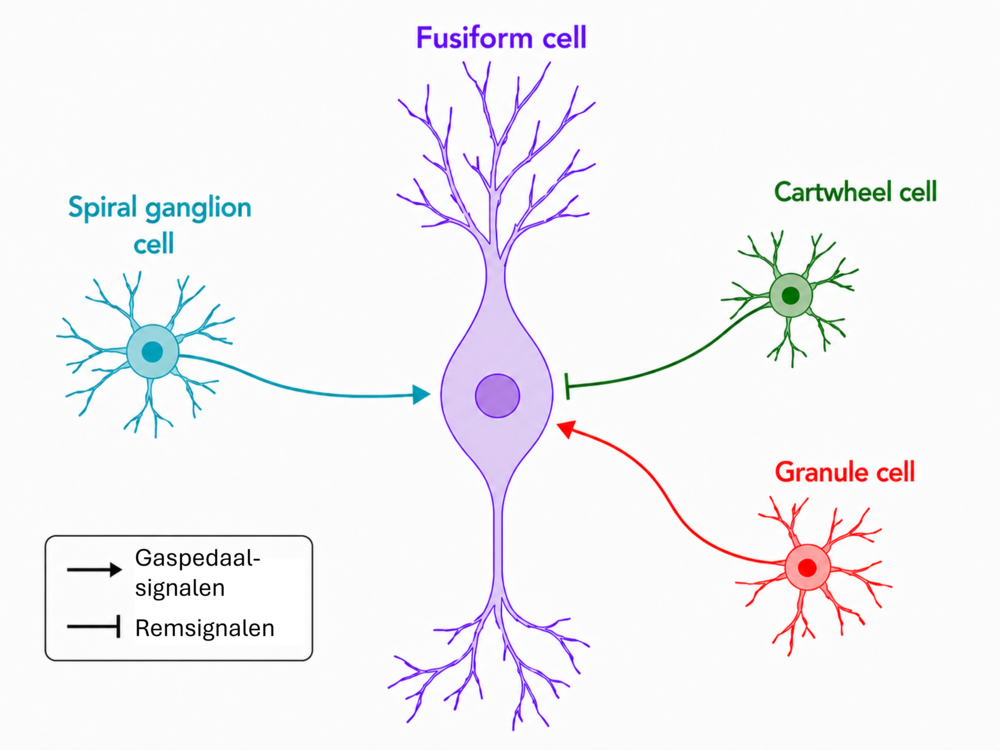
Figuur 1: Vereenvoudigde voorstelling van de fusiforme cel en haar netwerk
Digitaal bouwplan van een hersencel
Het model is eigenlijk een digitale versie van een fusiforme cel. De elektrische eigenschappen van de cel werden wiskundig beschreven aan de hand van verschillende ionenstromen die bepalen hoe gemakkelijk de cel een elektrisch signaal afvuurt. Rond die digitale cel werd vervolgens een vereenvoudigd netwerk gebouwd met de belangrijkste connecties die een echte fusiforme cel in het brein ook heeft.
Een model bouwen is één ding; de parameters aanpassen zodat het zich ook gedraagt als een echte hersencel, is iets anders. De precieze biologische waarde van veel van die parameters is immers niet gekend, en het was onmogelijk om voor elke parameter één uniek juiste waarde vast te leggen.
Daarom werd op een gestructureerde en onderbouwde manier stap voor stap gezocht naar een mogelijke combinatie van parameters zodat het gedrag van de fusiforme cel overeenkwam met wat uit experimenten bekend is. De reeks bepaalde parameterwaarden is daarbij niet het belangrijkste resultaat, maar wel het framework zelf: een vaste, onderbouwde structuur die reproduceerbaar blijft en dus bruikbaar is voor toekomstig onderzoek. Dit framework werd gebruikt om eerst een niet-tinnitus model te bouwen, en om dit later aan te passen tot een tinnitus-model.
Toekomstmuziek
Wanneer de twee soorten veranderingen samen in het model werden doorgevoerd, kon het tinnitusachtige gedrag worden nagebootst. Dat maakt het model, ondanks dat het nog een sterk vereenvoudigde versie is, een vertrekpunt waarop verder gebouwd kan worden. Verfijnd en uitgebreid naar grotere delen van de gehoorbaan, zou het op termijn kunnen tonen hoe veranderingen in één hersencel zich door het hele netwerk verspreiden — en misschien zelfs hoe gerichte stimulatie van hersenen of zenuwen die verspreiding kan bijsturen.
De meerwaarde van deze thesis zit dan ook niet in het blootleggen van een nieuwe oorzaak, maar in het samenbrengen van gekende mechanismen in één computermodel, waarin ze afzonderlijk én in combinatie kunnen worden onderzocht. Het geluid dat er niet hoort te zijn is daarmee nog niet tot zwijgen gebracht, maar het model kan dat doel wel een kleine stap dichterbij brengen.
Bibliografie
[1] Casey Henley. The neuron. In Introduction to Neurobiology. Pressbooks, n.d.
[2] Olivia Guy-Evans. What is action potential? https://www.simplypsychology.org/ what-is-action-potential.html, 2025.
[3] Richard Naud Wulfram Gerstner, Werner M. Kistler and Liam Paninski. Neuronal Dynamics: From Single Neurons to Networks and Models of Cognition. Cambridge University Press, 2014. Online edition available at https://neuronaldynamics.epfl.ch.
[4] NIDCD. How Do We Hear?, March 2022.
[5] ENT Education Swansea. Physiology of hearing, n.d.
[6] Susan E. Shore and Calvin Wu. Mechanisms of Noise-Induced Tinnitus: Insights from Cellular Studies. Neuron, 103(1):8–20, July 2019.
[7] T. J. Brozoski, C. A. Bauer, and D. M. Caspary. Elevated Fusiform Cell Activity in the Dorsal Cochlear Nucleus of Chinchillas with Psychophysical Evidence of Tinnitus. The Journal of Neuroscience, 22(6):2383–2390, March 2002.
[8] Ricardo M. Leao, Shuang Li, Brent Doiron, and Thanos Tzounopoulos. Diverse levels of an inwardly rectifying potassium conductance generate heterogeneous neuronal behavior in a population of dorsal cochlear nucleus pyramidal neurons. Journal of Neurophysiology, 107(11):3008–3019, June 2012.
[9] Mishaela DiNino, Lori L. Holt, and Barbara G. Shinn-Cunningham. Cutting Through the Noise: Noise-Induced Cochlear Synaptopathy and Individual Differences in Speech Understanding Among Listeners With Normal Audiograms. Ear & Hearing, 43(1):9–22, January 2022.
[10] Kevin A. Davis and Eric D. Young. Granule Cell Activation of Complex-Spiking Neurons in Dorsal Cochlear Nucleus. The Journal of Neuroscience, 17(17):6798–6806, September 1997.
[11] Jaime G. Mancilla and Paul B. Manis. Two Distinct Types of Inhibition Mediated by Cartwheel Cells in the Dorsal Cochlear Nucleus. Journal of Neurophysiology, 102(2):1287–1295, August 2009.
[12] Cesar C. Ceballos, Shuang Li, Antonio C. Roque, Thanos Tzounopoulos, and Ricardo M. Le˜ao. Ih Equalizes Membrane Input Resistance in a Heterogeneous Population of Fusiform Neurons in the Dorsal Cochlear Nucleus. Frontiers in Cellular Neuroscience, 10, October 2016.
[13] Ceballos et al. fuscurr.mod: Fusiform cell ion channel mechanisms. https://modeldb.science/ 206252?tab=2&file=FUS_model/fuscurr.mod, 2016. ModelDB accession number 206252.
[14] Susan E. Shore, Larry E. Roberts, and Berthold Langguth. Maladaptive plasticity in tinnitus — triggers, mechanisms and treatment. Nature Reviews Neurology, 12(3):150–160, March 2016.
[15] A. Henton and T. Tzounopoulos. What’s the buzz? The neuroscience and the treatment of tinnitus. Physiological Reviews, 101(4):1609–1632, October 2021.
[16] Kendra L. Marks, David T. Martel, Calvin Wu, Gregory J. Basura, Larry E. Roberts, Kara C. Schvartz-Leyzac, and Susan E. Shore. Auditory-somatosensory bimodal stimulation desynchronizes brain circuitry to reduce tinnitus in guinea pigs and humans. Science Translational Medicine, 10(422):eaal3175, January 2018.
[17] Sarah Vandepitte. Biophysically inspired and experimentally validated models of the pathology of tinnitus., 2025. Internal document, not publicly available.
[18] Fitzpatrick D Purves D, Augustine GJ, editor. Neuroscience. 2nd edition. Sinauer Associates, Sunderland, MA, 2001. NCBI Bookshelf online version available at https://www.ncbi.nlm.nih. gov/books/NBK11001/.
[19] Michael H. Grider, Rishita Jessu, and Rian Kabir. Physiology, action potential, 2023. Last updated May 8, 2023. Available at https://www.ncbi.nlm.nih.gov/books/NBK538143/.
[20] J.T. Sanchez, S. Ghelani, and S. Otto-Meyer. From development to disease: Diverse functions of NMDA-type glutamate receptors in the lower auditory pathway. Neuroscience, 285:248–259, January 2015.
[21] Augustine C. Lee and Donald A. Godfrey. Cochlear Damage Affects Neurotransmitter Chemistry in the Central Auditory System. Frontiers in Neurology, 5, November 2014.
[22] Amarins N. Heeringa, Calvin Wu, Christopher Chung, Michael West, David Martel, Leslie Liberman, M. Charles Liberman, and Susan E. Shore. Glutamatergic Projections to the Cochlear Nucleus are Redistributed in Tinnitus. Neuroscience, 391:91–103, November 2018.
[23] Liqin Zhang, Calvin Wu, David T. Martel, Michael West, Michael A. Sutton, and Susan E. Shore. Noise Exposure Alters Glutamatergic and GABAergic Synaptic Connectivity in the Hippocampus and Its Relevance to Tinnitus. Neural Plasticity, 2021:1–16, January 2021.
[24] France Rousseau, Karin R. Aubrey, and St´ephane Supplisson. The Glycine Transporter GlyT2 Controls the Dynamics of Synaptic Vesicle Refilling in Inhibitory Spinal Cord Neurons. The Journal of Neuroscience, 28(39):9755–9768, September 2008.
[25] Arnd Roth and Mark C. W. van Rossum. Modeling synapses. chapter 6, pages 139–160. 2009. PDF available at https://web.stanford.edu/class/cs379c/archive/2016/class_messages_ listing/articles/RothandvanRossumCMMN-09.pdf.
[26] Diana C. Peterson, Vamsi Reddy, Debra A. Mayes, and Renee N. Hamel. Neuroanatomy, Auditory Pathway. StatPearls Publishing, 2025. Last updated December 13, 2025. Available at https: //www.ncbi.nlm.nih.gov/books/NBK532311/.
[27] Donald A. Godfrey, Augustine C. Lee, Walter D. Hamilton, Louis C. Benjamin, Shilpa Vishwanath, Hermann Simo, Lynn M. Godfrey, Abdurrahman I.A.A. Mustapha, and Rickye S. Heffner. Volumes of cochlear nucleus regions in rodents. Hearing Research, 339:161–174, September 2016.
[28] Miaomiao Mao, Johanna M. Montgomery, M. Fabiana Kubke, and Peter R. Thorne. The Structural Development of the Mouse Dorsal Cochlear Nucleus. Journal of the Association for Research in Otolaryngology, 16(4):473–486, August 2015.
[29] Veeramuthu Balakrishnan and Laurence O. Trussell. Synaptic Inputs to Granule Cells of the Dorsal Cochlear Nucleus. Journal of Neurophysiology, 99(1):208–219, January 2008.
[30] Sidney P. Kuo, Hsin-Wei Lu, and Laurence O. Trussell. Intrinsic and synaptic properties of vertical cells of the mouse dorsal cochlear nucleus. Journal of Neurophysiology, 108(4):1186–1198, August 2012.
[31] Kenneth E. Hancock and Herbert F. Voigt. Intracellularly Labeled Fusiform Cells in Dorsal Cochlear Nucleus of the Gerbil. II. Comparison of Physiology and Anatomy. Journal of Neurophysiology, 87(5):2520–2530, May 2002.
[32] Michael A. Muniak and David K. Ryugo. Tonotopic organization of vertical cells in the dorsal cochlear nucleus of the CBA/J mouse. Journal of Comparative Neurology, 522(4):937–949, March 2014.
[33] Calvin Wu, David T. Martel, and Susan E. Shore. Increased Synchrony and Bursting of Dorsal Cochlear Nucleus Fusiform Cells Correlate with Tinnitus. The Journal of Neuroscience, 36(6):2068– 2073, February 2016.
[34] Mar´ıa E Rubio, Yugo Fukazawa, Naomi Kamasawa, Cheryl Clarkson, Elek Moln´ar, and Ryuichi Shigemoto. Target- and input-dependent organization of AMPA and NMDA receptors in synaptic connections of the cochlear nucleus. Journal of Comparative Neurology, 522(18):4023–4042, December 2014.
[35] Joshua J. Sturm and Catherine J. C. Weisz. Hyperactivity in the medial olivocochlear efferent system is a common feature of tinnitus and hyperacusis in humans. Journal of Neurophysiology, 114(5):2551–2554, November 2015.
[36] Gusta Van Zwieten, Jana V. P. Devos, Sonja A. Kotz, Linda Ackermans, Pia Brinkmann, Lobke Dauven, Erwin L. J. George, A. Miranda L. Janssen, Bernd Kremer, Carsten Leue, Michael Schwartze, Yasin Temel, Jasper V. Smit, and Marcus L. F. Janssen. A Protocol to Investigate Deep Brain Stimulation for Refractory Tinnitus: From Rat Model to the Set-Up of a Human Pilot Study. Audiology Research, 13(1):49–63, December 2022.
[37] Hyung Jin Jun and Moo Kyun Park. Cognitive Behavioral Therapy for Tinnitus: Evidence and Efficacy. Korean Journal of Audiology, 17(3):101, 2013.
[38] Zhengrong Liang, Haidi Yang, Gui Cheng, Lingfei Huang, Tao Zhang, and Haiying Jia. Repetitive transcranial magnetic stimulation on chronic tinnitus: a systematic review and meta-analysis. BMC Psychiatry, 20(1):547, December 2020.
[39] Landon Basner, Jasper V. Smit, Daniel M. Zeitler, Seth R. Schwartz, Katie Krause, Aiyush Bansal, and Farrokh Farrokhi. Deep Brain Stimulation for Primary Refractory Tinnitus: A Systematic Review. Brain Sciences, 14(5):452, April 2024.
[40] Matthew Solan. Tinnitus: Ringing or humming in your ears? Sound therapy is one option, December 2021.
[41] Haiyan Wang, Dongmei Tang, Yongzhen Wu, Li Zhou, and Shan Sun. The state of the art of sound therapy for subjective tinnitus in adults. Therapeutic Advances in Chronic Disease, 11:2040622320956426, January 2020.
[42] Dirk De Ridder, Sven Vanneste, Navzer D. Engineer, and Michael P. Kilgard. Safety and Efficacy of Vagus Nerve Stimulation Paired With Tones for the Treatment of Tinnitus: A Case Series. Neuromodulation: Technology at the Neural Interface, 17(2):170–179, February 2014.
[43] Navzer D. Engineer, Jonathan R. Riley, Jonathan D. Seale, Will A. Vrana, Jai A. Shetake, Sindhu P. Sudanagunta, Michael S. Borland, and Michael P. Kilgard. Reversing pathological neural activity using targeted plasticity. Nature, 470(7332):101–104, February 2011.
[44] Zoe R. Berman, Cole Citrenbaum, Juliana Corlier, Andrew F. Leuchter, Robert L. Folmer, and Michael K. Leuchter. Sequential Multilocus Repetitive Transcranial Magnetic Stimulation for Treatment of Tinnitus With and Without Comorbid Major Depressive Disorder. Neuromodulation: Technology at the Neural Interface, 27(4):774–780, June 2024.
[45] Michael L. Hines and Nicholas T. Carnevale. The neuron simulation environment. Neural Computation, 9(6), 1997.
[46] NEURON Developers. Neuron simulator documentation. https://www.neuronsimulator.org/en/ 9.0.1/, 2023. Version 9.0.1.
[47] Patrick O. Kanold and Paul B. Manis. A Physiologically Based Model of Discharge Pattern Regulation by Transient K+ Currents in Cochlear Nucleus Pyramidal Cells. Journal of Neurophysiology, 85(2):523–538, February 2001.
[48] Bruce P. Bean. The action potential in mammalian central neurons. Nature Reviews Neuroscience, 8(6):451–465, June 2007.
[49] Hiroshi Hibino, Atsushi Inanobe, Kazuharu Furutani, Shingo Murakami, Ian Findlay, and Yoshihisa Kurachi. Inwardly Rectifying Potassium Channels: Their Structure, Function, and Physiological Roles. Physiological Reviews, 90(1):291–366, January 2010.
[50] A. M. Brown, P. C. Schwindt, and W. E. Crill. Different voltage dependence of transient and persistent Na+ currents is compatible with modal-gating hypothesis for sodium channels. Journal of Neurophysiology, 71(6):2562–2565, June 1994.
[51] H. Rheinallt Parri and Vincenzo Crunelli. Sodium Current in Rat and Cat Thalamocortical Neurons: Role of a Non-Inactivating Component in Tonic and Burst Firing. The Journal of Neuroscience, 18(3):854–867, February 1998.
[52] Cheng-Shih Chen, Edmund Cheung So, and Sheng-Nan Wu. Modulating HyperpolarizationActivated Cation Currents through Small Molecule Perturbations: Magnitude and Gating Control. Biomedicines, 11(8):2177, August 2023.
[53] Jason S. Rothman and Paul B. Manis. The Roles Potassium Currents Play in Regulating the Electrical Activity of Ventral Cochlear Nucleus Neurons. Journal of Neurophysiology, 89(6):3097– 3113, June 2003.
[54] Li Zhang, Sen Chen, and Yu Sun. Mechanism and Prevention of Spiral Ganglion Neuron Degeneration in the Cochlea. Frontiers in Cellular Neuroscience, 15:814891, January 2022.
[55] Kaidi D. Zhang and Thomas M. Coate. Recent advances in the development and function of type II spiral ganglion neurons in the mammalian inner ear. Seminars in Cell & Developmental Biology, 65:80–87, May 2017.
[56] Mark A. Rutherford, Henrique Von Gersdorff, and Juan D. Goutman. Encoding sound in the cochlea: from receptor potential to afferent discharge. The Journal of Physiology, 599(10):2527–2557, May 2021.
[57] Sarah Verhulst, Alessandro Alto`e, and Viacheslav Vasilkov. Computational modeling of the human auditory periphery: Auditory-nerve responses, evoked potentials and hearing loss. Hearing Research, 360:55–75, March 2018.
[58] Peter T. Johannesen, Thibaud Lecl`ere, Aswin Wijetillake, Manuel Segovia-Mart´ınez, and Enrique A. Lopez-Poveda. Modeling temporal information encoding by the population of fibers in the healthy and synaptopathic auditory nerve. Hearing Research, 426:108621, December 2022.
[59] Paul Chadderton, Troy W. Margrie, and Michael H¨ausser. Integration of quanta in cerebellar granule cells during sensory processing. Nature, 428(6985):856–860, April 2004.
[60] Calvin Wu and Susan E. Shore. Multisensory activation of ventral cochlear nucleus D-stellate cells modulates dorsal cochlear nucleus principal cell spatial coding. The Journal of Physiology, 596(18):4537–4548, September 2018.
[61] Kiyohiro Fujino and Donata Oertel. Cholinergic Modulation of Stellate Cells in the Mammalian Ventral Cochlear Nucleus. The Journal of Neuroscience, 21(18):7372–7383, September 2001.
[62] Duke University, Yale University, and the Blue Brain Project. Conceptual overview of sections. https://nrn.readthedocs.io/en/8.0.0/hoc/modelspec/programmatic/topology/ geometry.html#stylized-specification-of-geometry, 2021. NEURON HOC documentation, Version 8.0.0.
[63] Paul B. Manis and Luke Campagnola. A biophysical modelling platform of the cochlear nucleus and other auditory circuits: From channels to networks. Hearing Research, 360:76–91, March 2018.
[64] Richard Arnold, Stefanka Chukova, Yu Hayakawa, and Sarah Marshall. Geometric-Like Processes: An Overview and Some Reliability Applications. Reliability Engineering & System Safety, 201:106990, September 2020.
[65] Stephanie M. Gardner, Laurence O. Trussell, and Donata Oertel. Time Course and Permeation of Synaptic AMPA Receptors in Cochlear Nuclear Neurons Correlate with Input. The Journal of Neuroscience, 19(20):8721–8729, October 1999.
[66] Neuroservices Alliance. Delivering scientifically relevant insights. https://www. neuroservices-alliance.com/mepsc-recordings/, n.d. Accessed: 2026-04-13.
[67] Salvador Dura-Bernal, Erica Y. Griffith, Annamaria Barczak, Monica N. O’Connell, Tammy McGinnis, Joao V.S. Moreira, Charles E. Schroeder, William W. Lytton, Peter Lakatos, and Samuel A. Neymotin. Data-driven multiscale model of macaque auditory thalamocortical circuits reproduces in vivo dynamics. Cell Reports, 42(11):113378, November 2023.
[68] Nl Golding and D Oertel. Context-dependent synaptic action of glycinergic and GABAergic inputs in the dorsal cochlear nucleus. The Journal of Neuroscience, 16(7):2208–2219, April 1996.
[69] Daniel B. Yaeger and Laurence O. Trussell. Single Granule Cells Excite Golgi Cells and Evoke Feedback Inhibition in the Cochlear Nucleus. The Journal of Neuroscience, 35(11):4741–4750, March 2015.
[70] Monica Trevino, Edward Lobarinas, Amanda C. Maulden, and Michael G. Heinz. The chinchilla animal model for hearing science and noise-induced hearing loss. The Journal of the Acoustical Society of America, 146(5):3710–3732, November 2019.
[71] Carlotta M. Jarach, Alessandra Lugo, Marco Scala, Piet A. Van Den Brandt, Christopher R. Cederroth, Anna Odone, Werner Garavello, Winfried Schlee, Berthold Langguth, and Silvano Gallus. Global Prevalence and Incidence of Tinnitus: A Systematic Review and Meta-analysis. JAMA Neurology, 79(9):888, September 2022.