Een rog als venster op plasticvervuiling
Microplastics zijn overal in de oceaan te vinden, van de poolgebieden tot de diepzee. Maar komen ze ook terecht in dieren hoger in het voedselweb? Onderzoek bij de blauwgevlekte maskerrog aan de oostkust van Sri Lanka toont dat microplastics daadwerkelijk worden opgenomen door deze bodembewonende rog.
Voor veel mensen zijn haaien en roggen dieren waar je liever niet te dicht bij in de buurt komt. Toch hebben deze dieren meer reden om bang te zijn voor ons dan omgekeerd. Overbevissing, habitatverlies en vervuiling zetten wereldwijd druk op hun populaties. Tegelijk zijn haaien en roggen belangrijke onderdelen van mariene ecosystemen.
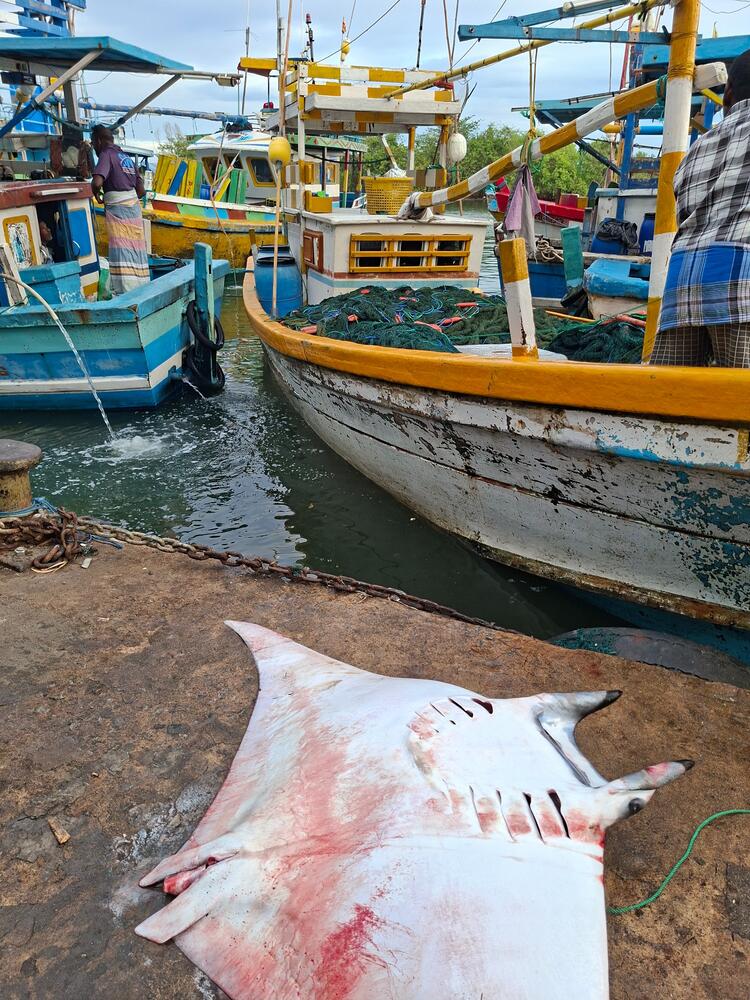
Een van de minder zichtbare vormen van vervuiling is microplastic. Dat zijn plasticdeeltjes kleiner dan vijf millimeter. Sommige worden bewust zo klein geproduceerd, maar de meeste ontstaan wanneer grotere stukken plastic onder invloed van zonlicht, golven en andere processen langzaam afbreken. Ze verdwijnen dus niet wanneer een plastic voorwerp uit het zicht raakt. De deeltjes kunnen via rivieren en zeestromingen worden verspreid en zijn inmiddels aangetroffen van de poolgebieden tot de diepzee.
Microplastics zijn daarmee onderdeel geworden van het mariene milieu zelf. Kleine organismen kunnen ze opnemen, waarna ze via het voedselweb bij grotere dieren terechtkomen. Dieren kunnen de deeltjes ook rechtstreeks inslikken tijdens het foerageren. De gevolgen daarvan zijn nog niet volledig bekend, maar microplastics kunnen het spijsverteringsstelsel belasten en chemische stoffen bevatten of uit hun omgeving opnemen.
Om beter te begrijpen hoe ver deze vervuiling in het mariene voedselweb doordringt, onderzocht ik de blauwgevlekte maskerrog (Neotrygon indica) aan de oostkust van Sri Lanka. Deze soort leeft voornamelijk dicht bij de zeebodem, waar ze naar voedsel zoekt. Dat maakt haar interessant voor microplasticonderzoek: de zeebodem is een belangrijke verzamelplaats voor plasticdeeltjes.
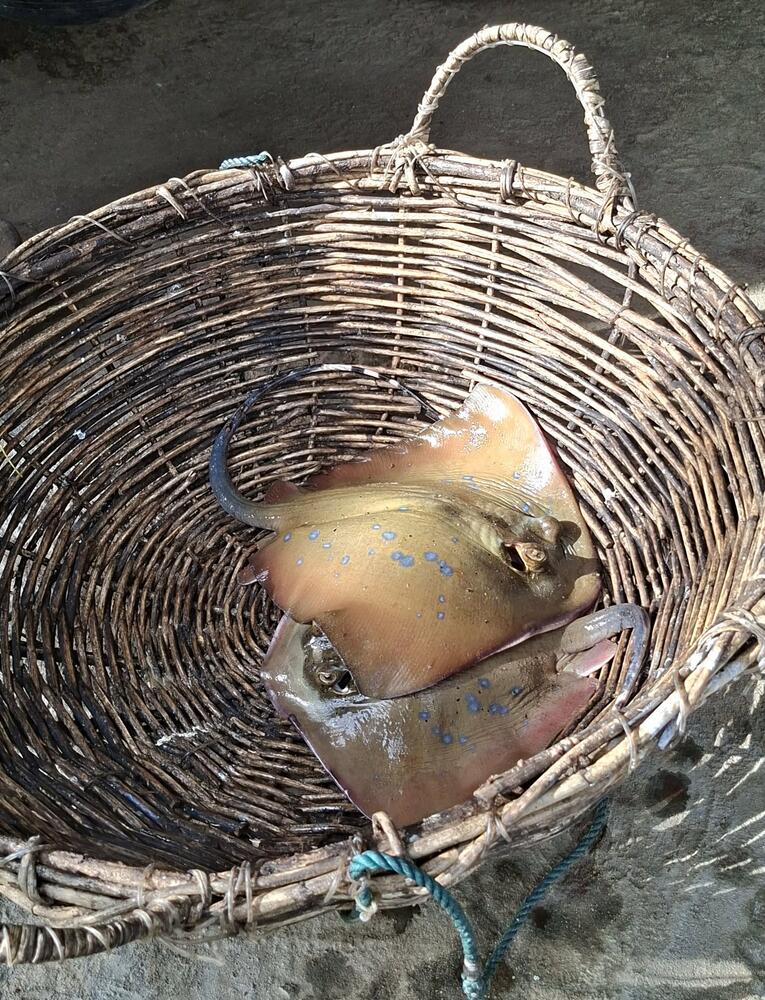
Samen met Blue Resources Trust verzamelde ik stalen bij drie visaanlandingsplaatsen. De onderzochte roggen waren voornamelijk bijvangst uit de lokale visserij. Zo hoefden er geen dieren speciaal voor het onderzoek gevangen te worden.
Van 24 roggen onderzocht ik het volledige maagdarmkanaal. Dat leverde 186 bevestigde microplasticdeeltjes op. In 16 van de 24 roggen, oftewel 66,7 procent, werden microplastics gevonden.
De hoeveelheid verschilde sterk tussen de dieren. Sommige bevatten geen enkel deeltje, terwijl bij één rog maar liefst 89 deeltjes werden aangetroffen. Een grotere rog bevatte daarbij niet automatisch meer microplastics. Er werd geen verband gevonden tussen lichaamsgrootte en het aantal deeltjes.
Opvallend was vooral hoe klein veel van de gevonden deeltjes waren. Ongeveer 64 procent was kleiner dan 100 micrometer, ongeveer de dikte van een mensenhaar. De gebruikte analysemethode kon bovendien niet alle nog kleinere deeltjes identificeren. Het werkelijke aantal microplastics kan daardoor hoger liggen.
Met micro-FTIR-spectroscopie, een techniek waarmee de chemische samenstelling van de deeltjes kan worden bepaald, identificeerde ik vier soorten plastic. PET was met 77,4 procent veruit het meest voorkomende polymeer, gevolgd door polystyreen, polyethyleen en polypropyleen.
De resultaten vertellen niet waar elk individueel deeltje vandaan kwam. Wel tonen ze dat plasticvervuiling niet beperkt blijft tot het wateroppervlak of tot gebieden met veel menselijke activiteit. Plasticdeeltjes bereiken ook de zeebodem en worden opgenomen door dieren die daar leven.
Dat betekent niet automatisch dat deze roggen hierdoor ziek worden. Daarvoor is verder onderzoek nodig naar bijvoorbeeld de opname van microplastics in weefsels, chemische blootstelling en mogelijke effecten op groei en voortplanting. Wel toont het onderzoek aan dat blootstelling daadwerkelijk plaatsvindt bij een soort die een belangrijke plaats inneemt binnen het mariene ecosysteem.
Een tweede doel van mijn onderzoek was daarom om een praktische methode te ontwikkelen waarmee microplastics in het maagdarmkanaal van elasmobranchen, de groep waartoe haaien en roggen behoren, kunnen worden onderzocht. Een groot deel van de verwerking gebeurde met relatief eenvoudige laboratoriumapparatuur. Voor de uiteindelijke identificatie van de plastics werkte ik samen met het Blue Growth Research Lab van de Universiteit Gent.
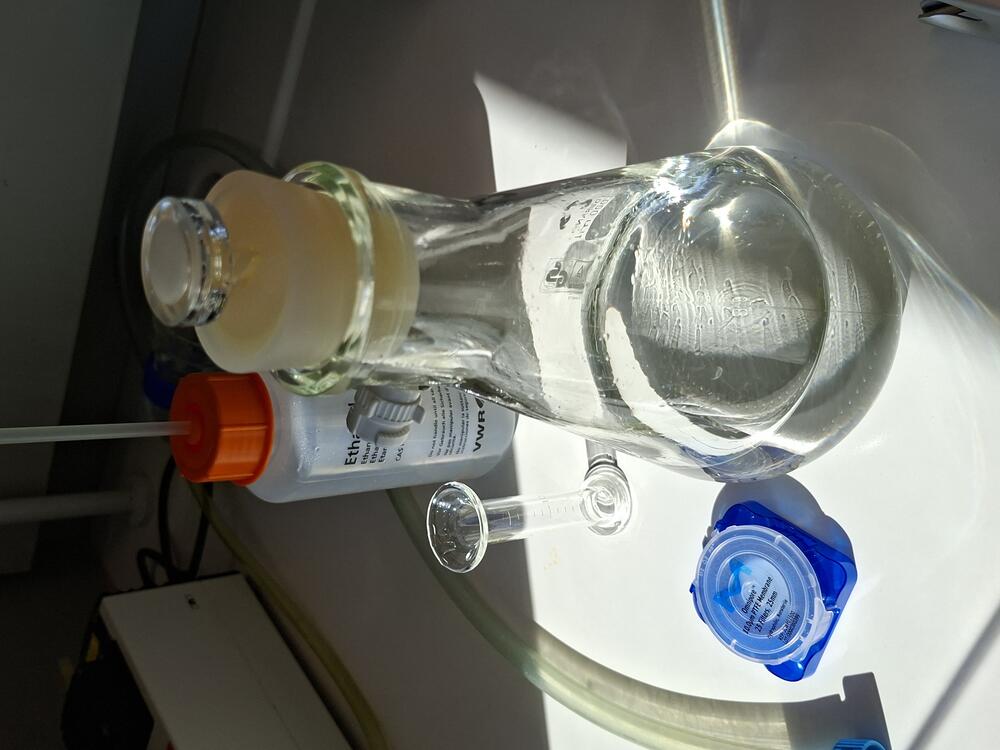
De methode bleek in een hersteltest 96 procent van bewust toegevoegde plasticdeeltjes terug te vinden. Tegelijk werden microplastics aangetroffen in luchtstalen uit het laboratorium. Dat onderstreept hoe gemakkelijk kleine plasticdeeltjes als verontreiniging kunnen binnendringen en hoe belangrijk een strikte werkwijze is.
Mijn onderzoek geeft zo niet alleen een eerste beeld van microplasticblootstelling bij Neotrygon indica, maar biedt ook een basis voor toekomstig onderzoek naar andere haaien en roggen.
Een gezonde oceaan is bovendien niet alleen belangrijk voor haaien en roggen. Miljoenen mensen zijn afhankelijk van de zee voor voedsel, inkomen en bescherming van kustgebieden. Wat wij produceren en weggooien kan uiteindelijk dus veel verder reiken dan onze eigen leefomgeving.
Een rog kan ons laten zien hoe ver plasticvervuiling in de oceaan is doorgedrongen. De volgende stap ligt niet alleen bij onderzoekers die dat proberen te meten, maar ook bij ons allemaal. Als we gezonde oceanen willen behouden, zullen we niet alleen beter moeten begrijpen wat er onder water gebeurt. We zullen ook kritischer moeten kijken naar wat we boven water produceren, gebruiken en weggooien.
Bibliografie
Andrady, A. L. (2011). Microplastics in the marine environment. Marine Pollution Bulletin, 62(8), 1596– 1605. https://doi.org/10.1016/j.marpolbul.2011.05.030
Bhuyan, S., et al. (2021). Plastics in marine ecosystem: A review of their sources and pollution conduits. Regional Studies in Marine Science, 41, 101539. https://doi.org/10.1016/j.rsma.2020.101539
Bond, M. E., Valentin-Albanese, J., Babcock, E. A., Hussey, N. E., Heithaus, M. R., & Chapman, D. D. (2018). The trophic ecology of Caribbean reef sharks (Carcharhinus perezi) relative to other large teleost predators on an isolated coral atoll. Marine Biology, 165(4). https://doi.org/10.1007/s00227-018-3322-2
Bucking, C. (2015). Feeding and digestion in elasmobranchs: Tying diet and physiology together. In Fish physiology (pp. 347–394). https://doi.org/10.1016/b978-0-12-801286-4.00006-x
Dehaut, A., Cassone, A., Frère, L., Hermabessiere, L., Himber, C., Rinnert, E., Rivière, G., Lambert, C., Soudant, P., Huvet, A., Duflos, G., & Paul-Pont, I. (2016). Microplastics in seafood: Benchmark protocol for their extraction and characterization. Environmental Pollution, 215, 223–233. https://doi.org/10.1016/j.envpol.2016.05.018
De Oliveira Soares Espinosa, L., Lacerda, A. L., Oddone, M. C., Kessler, F., & Proietti, M. C. (2025). Interaction of elasmobranchs with litter in South Brazil: ingestion and oviposition patterns. Marine Pollution Bulletin, 216, 117992. https://doi.org/10.1016/j.marpolbul.2025.117992
De Witte, B.; Catarino, A.I.; Vandecasteele, L.; Dekimpe, M.; Meyers, N.; Deloof, D.; Pint, S.; Hostens, K.; Everaert, G.; Torreele, E. (2022). Fish gastrointestinal sampling protocol for microplastics extraction and quantification. ILVO/VLIZ: Ostend. 4 pp. https://dx.doi.org/10.48470/6
El-Sherif, D. M., Eloffy, M. G., Elmesery, A., Abouzid, M., Gad, M., El-Seedi, H. R., Brinkmann, M., Wang, K., & Naggar, Y. A. (2022). Environmental risk, toxicity, and biodegradation of polyethylene: a review. Environmental Science and Pollution Research, 29(54), 81166–81182. https://doi.org/10.1007/s11356-022-23382-1
Fernando, D., & Stewart, J. D. (2021). High bycatch rates of manta and devil rays in the “small-scale” artisanal fisheries of Sri Lanka. PeerJ, 9, e11994. https://doi.org/10.7717/peerj.11994
Foekema, E. M., De Gruijter, C., Mergia, M. T., Van Franeker, J. A., Murk, A. J., & Koelmans, A. A. (2013). Plastic in North Sea fish. Environmental Science & Technology, 47(15), 8818–8824. https://doi.org/10.1021/es400931b
Fossi, M. C., Pedà, C., Compa, M., Tsangaris, C., Alomar, C., Claro, F., Ioakeimidis, C., Galgani, F., Hema, T., Deudero, S., Romeo, T., Battaglia, P., Andaloro, F., Caliani, I., Casini, S., Panti, C., & Baini, M. (2018). Bioindicators for monitoring marine litter ingestion and its impacts on Mediterranean biodiversity. Environmental Pollution, 237, 1023– 1040. https://doi.org/10.1016/j.envpol.2017.11.019
Galli, M., Garcia, T. O., Baini, M., R, J. U., Ramírez-Macías, D., Viloria-Gómora, L., Panti, C., Martellini, T., Cincinelli, A., & Fossi, M. C. (2023). Microplastic occurrence and phthalate ester levels in neuston samples and skin biopsies of filter-feeding megafauna from La Paz Bay (Mexico). Marine Pollution Bulletin, 192, 115086. https://doi.org/10.1016/j.marpolbul.2023.115086
Germanov, E. S., Marshall, A. D., Bejder, L., Fossi, M. C., & Loneragan, N. R. (2018). Microplastics: No Small Problem for Filter-Feeding Megafauna. Trends in Ecology & Evolution, 33(4), 227– 232. https://doi.org/10.1016/j.tree.2018.01.005
Geyer, R., Jambeck, J. R., & Law, K. L. (2017). Production, use, and fate of all plastics ever made. Science Advances, 3(7). https://doi.org/10.1126/sciadv.1700782
Guruge, K., Siriwardhana, S., Bandara, T., Suwandhahannadi, W., Jayarathna, W., Hewathilake, H., & Kumara, P. (2025). Assessment of marine debris and plastic pollution along the western coast of Sri Lanka. Regional Studies in Marine Science, 86, 104176. https://doi.org/10.1016/j.rsma.2025.104176
Habib, R. Z., Aldhanhani, J. a. K., Ali, A. H., Ghebremedhin, F., Elkashlan, M., Mesfun, M., Kittaneh, W., Kindi, R. A., & Thiemann, T. (2022). Trends of microplastic abundance in personal care products in the United Arab Emirates over the period of 3 years (2018–2020). Environmental Science and Pollution Research, 29(59), 89614–89624. https://doi.org/10.1007/s11356-022-21773-y
Hermsen, E., Mintenig, S. M., Besseling, E., & Koelmans, A. A. (2018b). Quality Criteria for the analysis of microplastic in biota samples: A Critical review. Environmental Science & Technology, 52(18), 10230–10240. https://doi.org/10.1021/acs.est.8b01611
Huang, X., Gao, H., Li, Z., Wu, F., Gong, Y., & Li, Y. (2022). Microplastic contamination and risk assessment in blue shark (Prionace glauca) from the eastern tropical Pacific Ocean. Marine Pollution Bulletin, 184, 114138. https://doi.org/10.1016/j.marpolbul.2022.114138
Jang, Y. C., Ranatunga, R., Mok, J. Y., Kim, K. S., Hong, S. Y., Choi, Y. R., & Gunasekara, A. (2018). Composition and abundance of marine debris stranded on the beaches of Sri Lanka: Results from the first island-wide survey. Marine Pollution Bulletin, 128, 126–131. https://doi.org/10.1016/j.marpolbul.2018.01.018
Jansen, M. A. K., Andrady, A. L., Bornman, J. F., Aucamp, P. J., Bais, A. F., Banaszak, A. T., Barnes, P. W., Bernhard, G. H., Bruckman, L. S., Busquets, R., et al. (2024). Plastics in the environment in the context of UV radiation, climate change and the Montreal Protocol: UNEP Environmental Effects Assessment Panel, Update 2023. Photochemical & Photobiological Sciences, 23(4), 629– 650. https://doi.org/10.1007/s43630-024-00552-3
Jambeck, J. R., Geyer, R., Wilcox, C., Siegler, T. R., Perryman, M., Andrady, A., Narayan, R., & Law, K. L. (2015). Plastic waste inputs from land into the ocean. Science, 347(6223), 768–771. https://doi.org/10.1126/science.1260352
Jayasinghe, R. R., Abeyrathna, W. P., Jayasingha, K. R., Hendawitharana, M. P., Bandara, T. S., Liyanage, C. L., & Williams, K. S. (2023). Exploring the plastic collection and recycling trends in Sri Lanka. Recycling, 8(6), 94. https://doi.org/10.3390/recycling8060099
Katupotha, J., & Gamage, S. (2021). UNDERSTANDING THE RIVER BASIN CLASSIFICATION OF SRI LANKA. WILDLANKA, 25. http://dr.lib.sjp.ac.lk/handle/123456789/9130
Koelmans, A. A., Besseling, E., Wegner, A., & Foekema, E. M. (2013). Plastic as a Carrier of POPs to Aquatic Organisms: A Model Analysis. Environmental Science & Technology, 47(14), 7812–7820. https://doi.org/10.1021/es401169n
Leigh, S. C., Papastamatiou, Y., & German, D. P. (2017b). The nutritional physiology of sharks. Reviews in Fish Biology and Fisheries, 27(3), 561–585. https://doi.org/10.1007/s11160-017-9481-3
Löder, M. G. J., & Gerdts, G. (2015). Methodology Used for the Detection and Identification of Microplastics—A Critical Appraisal. In Marine Anthropogenic Litter (pp. 201–227). https://doi.org/10.1007/978-3-319-16510-3_8
Lusher, A., McHugh, M., & Thompson, R. (2013). Occurrence of microplastics in the gastrointestinal tract of pelagic and demersal fish from the English Channel. Marine Pollution Bulletin, 67(1–2), 94-99. https://doi.org/10.1016/j.marpolbul.2012.11.028
Lusher, A., Tirelli, V., O’Connor, I., & Officer, R. (2015). Microplastics in Arctic polar waters: the first reported values of particles in surface and sub-surface samples. Scientific Reports, 5(1). https://doi.org/10.1038/srep14947
Maes, T., Barry, J., Stenton, C., Roberts, E., Hicks, R., Bignell, J., et al. (2020a). The world is your oyster: low-dose, long-term microplastic exposure of juvenile oysters. Heliyon 6(1), e03103. https://doi.org/10.1016/j.heliyon.2019.e03103
Maes, T., Van Diemen de Jel, J., Vethaak, A. D., Desender, M., Bendall, V. A., Van Velzen, M., & Leslie, H. A. (2020b). You Are What You Eat, Microplastics in Porbeagle Sharks From the North East Atlantic: Method Development and Analysis in Spiral Valve Content and Tissue. Frontiers in Marine Science, 7. https://doi.org/10.3389/fmars.2020.00273
Mason, V. G., Skov, M. W., Hiddink, J. G., & Walton, M. (2022). Microplastics alter multiple biological processes of marine benthic fauna. The Science of the Total Environment, 845, 157362. https://doi.org/10.1016/j.scitotenv.2022.157364
Matupang, D. M., Zulkifli, H. I., Arnold, J., Lazim, A. M., Ghaffar, M. A., & Musa, S. M. (2023). Tropical sharks feasting on and swimming through microplastics: First evidence from Malaysia. Marine Pollution Bulletin, 189, 114762. https://doi.org/10.1016/j.marpolbul.2023.114762
Pasalari, M., Esmaeili, H. R., Keshavarzi, B., Busquets, R., Abbasi, S., & Momeni, M. (2025). Microplastic footprints in sharks and rays: First assessment of microplastic pollution in two cartilaginous fishes, hardnose shark and whitespotted whipray. Marine Pollution Bulletin, 212, 117350. https://doi.org/10.1016/j.marpolbul.2024.117350
Pavan-Kumar, A., Singh, S., Mishra, A., Suman, S., Gireesh-Babu, P., Chaudhari, A., Shen, K., & Borsa, P. (2022). Characterization of mitochondrial genome of Indian Ocean blue-spotted maskray, Neotrygon indica and its phylogenetic relationship within Dasyatidae Family. International Journal of Biological Macromolecules, 223(Pt A), 458–467. https://doi.org/10.1016/j.ijbiomac.2022.10.277
Pegado, T., Brabo, L., Schmid, K., Sarti, F., Gava, T. T., Nunes, J., Chelazzi, D., Cincinelli, A., & Giarrizzo, T. (2021). Ingestion of microplastics by Hypanus guttatus stingrays in the Western Atlantic Ocean (Brazilian Amazon Coast). Marine Pollution Bulletin, 162, 111799. https://doi.org/10.1016/j.marpolbul.2020.111799
Prata, J. C., Da Costa, J. P., Duarte, A. C., & Rocha-Santos, T. (2018). Methods for sampling and detection of microplastics in water and sediment: A critical review. TrAC Trends in Analytical Chemistry, 110, 150–159. https://doi.org/10.1016/j.trac.2018.10.029
Ranjith, L., Saravanan, R., Kalidas, C., Kavitha, M., Ramkumar, S., Joshi, K. K., & Manojkumar, P. P. (2018). Morphological Deformities in Neotrygon kuhlii (Muller & Henle, 1841) from Gulf of Mannar, Bay of Bengal, India. Thalassas an International Journal of Marine Sciences, 35(1), 49–56. https://doi.org/10.1007/s41208-018-0083-0
Rochman, C. M., Hoh, E., Kurobe, T., & Teh, S. J. (2013). Ingested plastic transfers hazardous chemicals to fish and induces hepatic stress. Scientific Reports, 3(1), 3263. https://doi.org/10.1038/srep03263
Rochman, C. M. (2015). The Complex Mixture, Fate and Toxicity of Chemicals Associated with Plastic Debris in the Marine Environment. In Marine Anthropogenic Litter (pp. 117–140). https://doi.org/10.1007/978-3-319-16510-3_19
Rochman, C. M., Brookson, C., Bikker, J., Djuric, N., Earn, A., Bucci, K., Athey, S., Huntington, A., McIlwraith, H., Munno, K., De Frond, H., Kolomijeca, A., Erdle, L., Grbic, J., Bayoumi, M., Borrelle, S. B., Wu, T., Santoro, S., Werbowski, L. M., . . . Hung, C. (2019). Rethinking microplastics as a diverse contaminant suite. Environmental Toxicology and Chemistry, 38(4), 703–711. https://doi.org/10.1002/etc.4379
Ryan, P. G., Moore, C. J., Van Franeker, J. A., & Moloney, C. L. (2009). Monitoring the abundance of plastic debris in the marine environment. Philosophical Transactions Of The Royal Society B Biological Sciences, 364(1526), 1999–2012. https://doi.org/10.1098/rstb.2008.0207
Schirinzi, G. F., Pedà, C., Battaglia, P., Laface, F., Galli, M., Baini, M., Consoli, P., Scotti, G., Esposito, V., Faggio, C., Farré, M., Barceló, D., Fossi, M. C., Andaloro, F., & Romeo, T. (2020). A new digestion approach for the extraction of microplastics from gastrointestinal tracts (GITs) of the common dolphinfish (Coryphaena hippurus) from the western Mediterranean Sea. Journal Of Hazardous Materials, 397, 122794. https://doi.org/10.1016/j.jhazmat.2020.122794
Sutton, R., Mason, S. A., Stanek, S. K., Willis-Norton, E., Wren, I. F., & Box, C. (2016). Microplastic contamination in the San Francisco Bay, California, USA. Marine Pollution Bulletin, 109(1), 230– 235. https://doi.org/10.1016/j.marpolbul.2016.05.077
Thiele, C. J., Hudson, M. D., & Russell, A. E. (2019). Evaluation of existing methods to extract microplastics from bivalve tissue: Adapted KOH digestion protocol improves filtration at single-digit pore size. Marine Pollution Bulletin, 142, 384–393. https://doi.org/10.1016/j.marpolbul.2019.03.003
Torres, S., Compa, M., Box, A., Pinya, S., & Sureda, A. (2024). Presence and Potential Effects of Microplastics in the Digestive Tract of Two Small Species of Shark from the Balearic Islands. Fishes, 9(2), 55. https://doi.org/10.3390/fishes9020055
Valente, T., Sbrana, A., Scacco, U., Jacomini, C., Bianchi, J., Palazzo, L., De Lucia, G. A., Silvestri, C., & Matiddi, M. (2019). Exploring microplastic ingestion by three deep-water elasmobranch species: A case study from the Tyrrhenian Sea. Environmental Pollution, 253, 342–350. https://doi.org/10.1016/j.envpol.2019.07.001
Vandermeersch, G., Van Cauwenberghe, L., Janssen, C. R., Marques, A., Granby, K., Fait, G., Kotterman, M. J., Diogène, J., Bekaert, K., Robbens, J., & Devriese, L. (2015). A critical view on microplastic quantification in aquatic organisms. Environmental Research, 143(Pt B), 46–55. https://doi.org/10.1016/j.envres.2015.07.016
Van Melkebeke, M., Janssen, C., & De Meester, S. (2020). Characteristics and sinking behavior of typical microplastics including the potential effect of biofouling: Implications for remediation. Environmental Science & Technology, 54(14), 8668–8680. https://doi.org/10.1021/acs.est.9b07380
Wesch, C., Barthel, A., Braun, U., Klein, R., & Paulus, M. (2016). No microplastics in benthic eelpout ( Zoarces viviparus ): An urgent need for spectroscopic analyses in microplastic detection. Environmental Research, 148, 36–38. https://doi.org/10.1016/j.envres.2016.03.017
Worm, B., Lotze, H. K., Jubinville, I., Wilcox, C., & Jambeck, J. (2017). Plastic as a Persistent Marine Pollutant. Annual Review Of Environment And Resources, 42(1), 1– 26. https://doi.org/10.1146/annurev-environ-102016-060700
Wright, S. L., Thompson, R. C., & Galloway, T. S. (2013). The physical impacts of microplastics on marine organisms: A review. Environmental Pollution, 178, 483–492. https://doi.org/10.1016/j.envpol.2013.02.031
Wu, B., Yu, H., Lei, P., He, J., Yi, J., Wu, W., Wang, H., Yang, Q., Zeng, G., & Sun, D. (2025). Microplastics in aquatic ecosystems: Detection, source tracing, and sustainable management strategies. Ecotoxicology and Environmental Safety, 291, 117883. https://doi.org/10.1016/j.ecoenv.2025.117883