Kan AI sociale angst herkennen? Wat je ogen, berichten en games vertellen.
- CharlotteVan Bogaert
Vijftien jaar. Zo lang duurt het gemiddeld voor sociale angst wordt herkend en behandeld. Daarom onderzoeken wetenschappers of artificiële intelligentie signalen sneller kan oppikken. In mijn masterproef bracht ik een jong en snel groeiend onderzoeksveld systematisch in kaart.
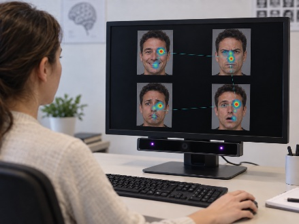 Je kijkt naar een reeks gezichten op een scherm. Sommige zijn blij, andere boos of neutraal. Terwijl jij kijkt, registreert een apparaat bijna onmerkbaar waar je ogen naartoe bewegen en hoe lang je blik ergens blijft hangen. Wat als een computer uit dat kijkgedrag zou kunnen afleiden of je sociaal angstig bent?
Het klinkt futuristisch, maar zulke experimenten bestaan vandaag al. In mijn masterproef onderzocht ik hoe ver dat onderzoek staat: wat kunnen deze modellen al, waar schieten ze nog tekort en welk verder onderzoek is er nodig?
Vijftien jaar onder de radar
Sociale angst is meer dan verlegenheid. Mensen met een sociale angststoornis ervaren intense angst voor negatieve beoordeling door anderen. Die angst kan school, werk, relaties en dagelijkse activiteiten sterk beïnvloeden. Sociale angst begint bovendien vaak op jonge leeftijd. Meer dan de helft van de mensen die de stoornis ontwikkelen, krijgt er al voor of tijdens de adolescentie mee te maken. Zonder herkenning van de stoornis kan geen gepaste hulp worden aangeboden.
Er zijn goede redenen om AI in te zetten als tool voor de detectie van sociale angst: er zit gemiddeld vijftien jaar tussen het ontstaan van een sociale angststoornis en de start van een behandeling en zorgverleners zien de stoornis vaak over het hoofd: slechts 1 op 4 van de mensen met sociale angst gaf bijvoorbeeld aan dat een zorgverlener de stoornis bij hen had herkend. Vandaag gebruiken psychologen vooral klinische interviews en vragenlijsten om sociale angst te herkennen. Die steunen voor een belangrijk deel op wat iemand zelf over zijn klachten vertelt. Herinneringsfouten, beperkt zelfinzicht of sociale wenselijkheid kunnen dat beeld beïnvloeden.
Kan AI helpen om signalen van sociale angst sneller op te merken?
Om die vraag beter te begrijpen, voerde ik een systematische literatuurstudie uit. Dat betekent dat ik volgens vaste wetenschappelijke richtlijnen eerder onderzoek verzamelde en analyseerde. Ik doorzocht zes wetenschappelijke databanken en selecteerde uiteindelijk zeventien studies waarin AI werd gebruikt om sociale angst te detecteren of te voorspellen. Wat opviel, was niet één spectaculair algoritme, maar de verscheidenheid aan data-input waarmee onderzoekers experimenteerden.
Van vragenlijst tot oogbewegingen
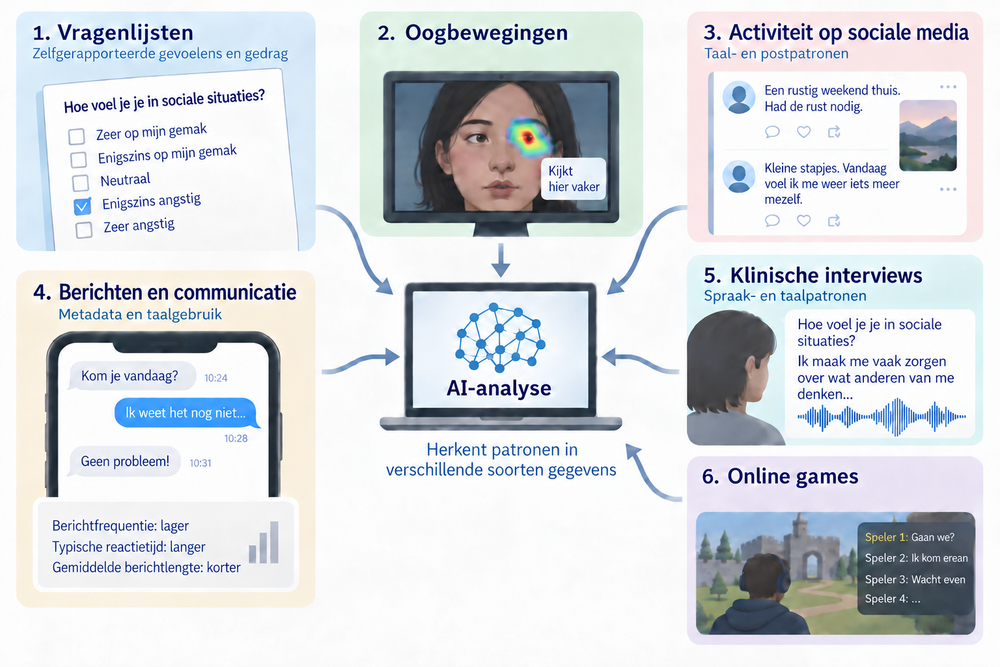
Een deel van de studies gebruikten gegevens uit vragenlijsten. Andere gingen op zoek naar
patronen in Facebookgegevens, oogbewegingen, sms-data, taal uit klinische interviews of communicatie in online games. Dat roept een interessante vraag op.
“Zou jij het prettig vinden als AI uit je oogbewegingen, berichten of online gedrag probeert af te leiden of je sociaal angstig bent?”
Dit maakt de technologie niet alleen wetenschappelijk interessant, maar ook ethisch gevoelig. Als zulke modellen ooit in de praktijk worden gebruikt, moeten mensen weten welke gegevens worden verzameld, welke conclusies daaruit kunnen worden getrokken en waarvoor die informatie vervolgens wordt gebruikt.
Hoe leert een computer zoiets?
De gebruikte technologie verschilde sterk tussen studies. De meeste studies gebruikten klassieke machine learning. Daarbij krijgt een model vooraf geselecteerde kenmerken en leert het welke combinaties vaker voorkomen bij mensen met meer of minder sociale angst.
Andere studies gebruikten deep learning, vooral bij complexere gegevens zoals taal, beelden, oogbewegingen en gedrag in virtual reality. Daaronder zaten ook taalmodellen die verwant zijn aan de technologie achter toepassingen zoals ChatGPT en die werden ingezet om interviewteksten te analyseren. Net daar kan AI een meerwaarde bieden. Waar een klassieke vragenlijst eindigt op een totaalscore, kan AI naar patronen zoeken in grote hoeveelheden complexe gegevens die voortdurend veranderen.
Veelbelovend, maar (nog) werk aan de winkel
De resultaten van de studies waren veelbelovend. Verschillende modellen konden sociale angst vrij goed voorspellen. Toch is enige voorzichtigheid nodig.
Onderzoekers definieerden “sociale angst” niet altijd hetzelfde. In sommige studies betekende “sociale angst” dat iemand boven een bepaalde grenswaarde op een vragenlijst scoorde. Andere onderzoekers gebruikten een klinisch interview of deelden deelnemers op een andere manier in groepen in. Daardoor zijn prestaties van verschillende modellen moeilijk rechtstreeks te vergelijken.
Daarnaast werden de meeste modellen getest op de gegevens waarmee ze werden ontwikkeld. Onderzoekers verdeelden daarbij één dataset in verschillende delen: op het ene deel leert het model patronen te herkennen, op een ander deel wordt getest hoe goed dat lukt. Dat is een noodzakelijke eerste stap, maar zegt nog niet of hetzelfde model even goed werkt bij mensen die helemaal niet in die oorspronkelijke dataset voorkwamen zoals mensen uit andere leeftijdsgroepen of culturen. Met andere woorden: een model kan uitstekend presteren in een specifieke dataset en toch minder betrouwbaar blijken in de echte wereld.
Van experiment naar praktijk
Mijn review laat zien dat AI potentieel heeft om de herkenning van sociale angst te ondersteunen. Vooral complexe en rijke gegevens zoals taal, digitale sporen, oogbewegingen en gedrag in virtuele omgevingen kunnen waardevolle informatie bevatten die in antwoorden op traditionele vragenlijsten moeilijker te vatten is.
Tegelijkertijd staat het onderzoek nog in de kinderschoenen. Vooraleer AI een plaats kan krijgen in de klinische praktijk, moeten onderzoekers kunnen aantonen dat de betrouwbaarheid van de modellen ook generaliseert naar nieuwe mensen en in andere settings dan waarop ze getraind werden. Als zulke technologie uiteindelijk in de praktijk wordt ingezet, moet dat bovendien op een transparante en ethisch verantwoorde manier gebeuren.
AI zal de psycholoog niet vervangen, maar kan wel ondersteunen, bijvoorbeeld bij screening, detectie of klinische besluitvorming. Daarom is ook AI-geletterdheid bij psychologen en andere hulpverleners belangrijk: zij moeten kunnen inschatten wat zulke modellen wel en niet kunnen, en hoe betrouwbaar hun resultaten zijn.
En dat brengt ons terug bij het scherm met gezichten uit het begin van dit verhaal. Vandaag kunnen computers al patronen zien in complexe en rijke data die voor mensen onzichtbaar blijven. De vraag is echter niet alleen wat AI kan herkennen, maar ook wanneer we erop kunnen vertrouwen. Pas als die vraag overtuigend beantwoord is, kan AI helpen om te voorkomen dat sociale angst nog vijftien jaar onder de radar blijft.
Bibliografie
Aanvullende bron voor het beeldmateriaal in het ingezonden artikel (niet voor het beeldmateriaal in de masterproef):
OpenAI. (2026). ChatGPT [AI tool used to generate visual material].
Bibliographie thesis
Ahmadi Majd, S., Parsaeian, M. R., Madani, M., Moradi, H., & Mohammadi, A. (2025). A machine learning web application for screening social anxiety disorder based on participants’ emotion regulation (ML-SAD). Frontiers in Robotics and AI, 12, Article 1620609. https://doi.org/10.3389/frobt.2025.1620609
Ali, S., Abuhmed, T., El-Sappagh, S., Muhammad, K., Alonso-Moral, J. M., Confalonieri, R., Guidotti, R., Del Ser, J., Díaz-Rodríguez, N., & Herrera, F. (2023). Explainable Artificial Intelligence (XAI): What we know and what is left to attain Trustworthy Artificial Intelligence. Information Fusion, 99, Article 101805. https://doi.org/10.1016/j.inffus.2023.101805
American Psychiatric Association. (2013). Diagnostic and statistical manual of mental disorders (5th ed.). https://doi.org/10.1176/appi.books.9780890425596
Babuška, R., & Verbruggen, H. (2003). Neuro-fuzzy methods for nonlinear system identification.
Annual Reviews in Control, 27(1), 73–85. https://doi.org/10.1016/S1367-5788(03)00009-9
Bathula, S., Chadaga, K., Prabhu, S., & Sampathila, N. (2024). Classification of social anxiety disorder using explainable machine learning and Pearson’s correlation technique. In Proceedings of the 8th IEEE International Conference on Distributed Computing, VLSI, Electrical Circuits and Robotics (DISCOVER 2024) (pp. 292–297). IEEE. https://doi.org/10.1109/DISCOVER62353.2024.10750623
Brown, T. A., Di Nardo, P. A., Lehman, C. L., & Campbell, L. A. (2001). Reliability of DSM-IV anxiety and mood disorders: Implications for the classification of emotional disorders. Journal of Abnormal Psychology, 110(1), 49–58. https://doi.org/10.1037//0021-843X.110.1.49
Cesa, H. A., Lawsin, J. D., Chiongbian, C. J., Zaragoza, M. A., Pepito, G., & Álvarez, R. (2022). Memores: A web-based intelligent screening tool for predicting social anxiety disorder using a machine learning model. Journal of Engineering Science and Technology, Special Issue on ICITE2022, 32–47. https://jestec.taylors.edu.my/Special%20Issue%20ICITE2022/ICITE_2022_03.pdf
Chapdelaine, A., Carrier, J.-D., Fournier, L., Duhoux, A., & Roberge, P. (2018). Treatment adequacy for social anxiety disorder in primary care patients. PLOS ONE, 13(11), e0206357. https://doi.org/10.1371/journal.pone.0206357
Chadaga, K., Prabhu, S., Sampathila, N., Chadaga, R., Bhat, D., Sharma, A. K., & Swathi, K. S. (2024). SADXAI: Predicting social anxiety disorder using multiple interpretable artificial intelligence techniques. SLAS Technology, 29(2), 100129. https://doi.org/10.1016/j.slast.2024.100129
Chang, M.-Y., & Tseng, C.-Y. (2020). Detecting social anxiety with online social network data. In 2020, 21st IEEE International Conference on Mobile Data Management (MDM) (pp. 333–336). IEEE. https://doi.org/10.1109/MDM48529.2020.00073
Chlasta, K., Wisiecka, K., Krejtz, K., & Krejtz, I. (2024). AI-based screening for depression and social anxiety through eye tracking: An exploratory study. International Journal of Marketing, Communication and New Media, 15, 75–91. https://doi.org/10.54663/2182-9306.2024.SpecialIssueMBP.75-91
Connor, K. M., Davidson, J. R. T., Churchill, L. E., Sherwood, A., Foa, E., & Weisler, R. H. (2000).
Psychometric properties of the Social Phobia Inventory (SPIN): New self-rating scale. The British Journal of Psychiatry, 176(4), 379–386. https://doi.org/10.1192/bjp.176.4.379
Çorbacıoğlu, Ş. K., & Aksel, G. (2023). Receiver operating characteristic curve analysis in diagnostic accuracy studies: A guide to interpreting the area under the curve value. Turkish Journal of Emergency Medicine, 23(4), 195–198. https://doi.org/10.4103/tjem.tjem_182_23
Cruz-Gonzalez, P., He, A. W.-J., Lam, E. P. P., Ng, I. M. C., Li, M. W., Hou, R., Chan, J. N.-M., Sahni, Y.,
Vinas-Guasch, N., Miller, T., Lau, B. W.-M., & Sánchez Vidaña, D. I. (2025). Artificial intelligence in mental health care: A systematic review of diagnosis, monitoring, and intervention applications. Psychological Medicine, 55, Article e18. https://doi.org/10.1017/S0033291724003295
Demetriou, E. A., Park, S. H., Ho, N., Pepper, K. L., Song, Y. J. C., Naismith, S. L., Thomas, E. E., Hickie, I. B., & Guastella, A. J. (2020). Machine learning for differential diagnosis between clinical conditions with social difficulty: Autism spectrum disorder, early psychosis, and social anxiety disorder. Frontiers in Psychiatry, 11, 545. https://doi.org/10.3389/fpsyt.2020.00545
Ertekin, E., Çelebi, F., Koyuncu, A., Uysal, Ö., Demir, E. Y., & Tükel, R. (2015). Predictors of early or late treatment seeking in patients with social anxiety disorder. Annals of Clinical Psychiatry, 27(4), 236–241. https://doi.org/10.1177/104012371502700402
Fan, Y., Zhang, L., Yang, X., Zhou, Z., Zhang, Y., & Fang, T. (2025). Multimodal detection of social anxiety disorder: A deep learning and large language model approach using microblog data. In 2025 5th International Conference on Machine Learning and Intelligent Systems Engineering (MLISE) (pp. 1–4). https://ieeexplore.ieee.org/document/11100179
Faouzi, J., & Colliot, O. (2023). Classic machine learning methods. In O. Colliot (Ed.), Machine learning for brain disorders (Neuromethods, Vol. 197, pp. 25–75). Humana. https://doi.org/10.1007/978-1-0716-3195-9_2
Fathi, S., & Ahmadi, M. (2020). Data for: Development and use of a clinical decision support system for the diagnosis of social anxiety disorder (Version 2) [Data set]. Mendeley Data. https://doi.org/10.17632/4jycfwhb4g.2
Fathi, S., Ahmadi, M., Birashk, B., & Dehnad, A. (2020). Development and use of a clinical decision support system for the diagnosis of social anxiety disorder. Computer Methods and Programs in Biomedicine, 190, 105354. https://doi.org/10.1016/j.cmpb.2020.105354
Goan, E., & Fookes, C. (2020). Bayesian neural networks: An introduction and survey. In K. L. Mengersen, P. Pudlo, & C. P. Robert (Eds.), Case studies in applied Bayesian data science: CIRM Jean-Morlet Chair, fall 2018 (pp. 45–87). Springer International Publishing. https://doi.org/10.1007/978-3-030-42553-1_3
Haddaway, N. R., Page, M. J., Pritchard, C. C., & McGuinness, L. A. (2022). PRISMA2020: An R package and Shiny app for producing PRISMA 2020-compliant flow diagrams, with interactivity for optimised digital transparency and Open Synthesis. Campbell Systematic Reviews, 18, e1230. https://doi.org/10.1002/cl2.1230
Hadie, S. N. H. (2024). ABC of a scoping review: A simplified JBI scoping review guideline. Education in Medicine Journal, 16(2), 185–197. https://doi.org/10.21315/eimj2024.16.2.14
Heimberg, R. G., Horner, K. J., Juster, H. R., Safren, S. A., Brown, E. J., Schneier, F. R., & Liebowitz, M.
R. (1999). Psychometric properties of the Liebowitz Social Anxiety Scale. Psychological Medicine, 29(1), 199–212. https://doi.org/10.1017/S0033291798007879
Hicks, S. A., Strümke, I., Thambawita, V., Hammou, M., Riegler, M. A., Halvorsen, P., & Parasa, S. (2022). On evaluation metrics for medical applications of artificial intelligence. Scientific Reports, 12(1), Article 5979. https://doi.org/10.1038/s41598-022-09954-8
Henrich, J., Heine, S. J., & Norenzayan, A. (2010). The weirdest people in the world? Behavioral and Brain Sciences, 33(2-3), 61–83. https://doi.org/10.1017/S0140525X0999152X
James, G., Witten, D., Hastie, T., & Tibshirani, R. (2021). An introduction to statistical learning: With applications in R (2nd ed.). Springer. https://doi.org/10.1007/978-1-0716-1418-1
Koul, A., Becchio, C., & Cavallo, A. (2018). Cross-validation approaches for replicability in psychology.
Frontiers in Psychology, 9, Article 1117. https://doi.org/10.3389/fpsyg.2018.01117
LeCun, Y., Bengio, Y., & Hinton, G. (2015). Deep learning. Nature, 521(7553), 436–444. https://doi.org/10.1038/nature14539
Li, C., Xu, B., Chen, Z., Huang, X., He, J., & Xie, X. (2024). A stacking model-based classification algorithm is used to predict social phobia. Applied Sciences, 14(1), 433. https://doi.org/10.3390/app14010433
Mahajan, P., Uddin, S., Hajati, F., Moni, M. A., & Gide, E. (2024). A comparative evaluation of machine learning ensemble approaches for disease prediction using multiple datasets. Health and Technology, 14, 597–613. https://doi.org/10.1007/s12553-024-00835-w
Mattick, R. P., & Clarke, J. C. (1998). Development and validation of measures of social phobia, scrutiny fear, and social interaction anxiety. Behaviour Research and Therapy, 36(4), 455–470. https://doi.org/10.1016/S0005-7967(97)10031-6
Mezzi, R., Yahyaoui, A., Krir, M. W., Boulila, W., & Koubaa, A. (2022). Mental health intent recognition for Arabic-speaking patients using the Mini International Neuropsychiatric Interview (MINI) and BERT model. Sensors, 22(3), 846. https://doi.org/10.3390/s22030846
National Institute of Mental Health. (n.d.). Social anxiety disorder. Retrieved January 11, 2026, from https://www.nimh.nih.gov/health/statistics/social-anxiety-disorder
National Institute of Standards and Technology. (2023). Artificial Intelligence Risk Management Framework (AI RMF 1.0) (NIST AI 100-1). https://doi.org/10.6028/NIST.AI.100-1
Ohse, J., Hadžić, B., Mohammed, P., Peperkorn, N., Fox, J., Krutzki, J., Lyko, A., Fan, M., Zheng, X., Rätsch, M., & Shiban, Y. (2024). GPT-4 shows potential for identifying social anxiety from clinical interview data. Scientific Reports, 14(1), 30498. https://doi.org/10.1038/s41598-024-82192-2
Olariu, E., Forero, C. G., Castro-Rodríguez, J. I., Rodrigo-Calvo, M. T., Álvarez, P., Martín-López, L. M., Sánchez-Toto, A., Adroher, N. D., Blasco-Cubedo, M. J., Vilagut, G., Fullana, M. A., & Alonso, J. (2015). Detection of anxiety disorders in primary care: A meta-analysis of assisted and unassisted diagnoses. Depression and Anxiety, 32(7), 471–484. https://doi.org/10.1002/da.22360
Organisation for Economic Co-operation and Development. (2024). Explanatory memorandum on the updated OECD definition of an AI system (OECD Artificial Intelligence Papers No. 8). OECD Publishing. https://doi.org/10.1787/623da898-en
Osório, F. L., Loureiro, S. R., Hallak, J. E. C., Machado-de-Sousa, J. P., Ushirohira, J. M., Baes, C. V. W., Apolinario, T. D., Donadon, M. F., Bolsoni, L. M., Guimarães, T., Fracon, V. S., Silva-Rodrigues,
A. P. C., Pizeta, F. A., Souza, R. M., Sanches, R. F., dos Santos, R. G., Martin-Santos, R., & Crippa, J. A. S. (2019). Clinical validity and intrarater and test-retest reliability of the Structured Clinical Interview for DSM-5—Clinician Version (SCID-5-CV). Psychiatry and Clinical Neurosciences, 73(12), 754–760. https://doi.org/10.1111/pcn.12931
Ouzzani, M., Hammady, H., Fedorowicz, Z., & Elmagarmid, A. (2016). Rayyan—a web and mobile app for systematic reviews. Systematic Reviews, 5, Article 210. https://doi.org/10.1186/s13643-016-0384-4
Page, M. J., McKenzie, J. E., Bossuyt, P. M., Boutron, I., Hoffmann, T. C., Mulrow, C. D., Shamseer, L.,
Tetzlaff, J. M., Akl, E. A., Brennan, S. E., Chou, R., Glanville, J. M., Grimshaw, J. M.,
Hróbjartsson, A., Lalu, M. M., Li, T., Loder, E. W., Mayo-Wilson, E., McDonald, S., ... Moher, D. (2021). The PRISMA 2020 statement: An updated guideline for reporting systematic reviews. BMJ, 372, n71. https://doi.org/10.1136/bmj.n71
Pardini, M., Frumento, S., Martini, M., Rho, G., Vatteroni, V., Tharun, K., Alaimo, M., Galatolo, F. A., De Marinis, M., Scilingo, E. P., Menicucci, D., Cimino, M. G. C. A., Chessa, M., & Greco, A. (2025). Deep learning-based classification of social anxiety disorder using continuous self-reported anxiety in virtual reality. In 2025 IEEE International Symposium on Medical Measurements and Applications (MeMeA) (pp. 1–6). IEEE. https://doi.org/10.1109/MEMEA65319.2025.11068082
Raffel, C., Shazeer, N., Roberts, A., Lee, K., Narang, S., Matena, M., Zhou, Y., Li, W., & Liu, P. J. (2020).
Exploring the limits of transfer learning with a unified text-to-text transformer. Journal of Machine Learning Research, 21(140), 1–67. https://jmlr.org/papers/v21/20-074.html
Rajkomar, A., Dean, J., & Kohane, I. (2019). Machine learning in medicine. New England Journal of Medicine, 380(14), 1347-1358. https://doi.org/10.1056/NEJMra1814259
Rosellini, A. J., Liu, S., Anderson, G. N., Sbi, S., Tung, E. S., & Knyazhanskaya, E. (2020). Developing algorithms to predict adult-onset internalizing disorders: An ensemble learning approach. Journal of Psychiatric Research, 121, 189–196. https://doi.org/10.1016/j.jpsychires.2019.12.006
Rosenbacke, R., Melhus, Å., McKee, M., & Stuckler, D. (2024). How explainable artificial intelligence can increase or decrease clinicians’ trust in AI applications in health care: Systematic review. JMIR AI, 3, e53207. https://doi.org/10.2196/53207
Salari, N., Heidarian, P., Hassanabadi, M., Babajani, F., Abdoli, N., Aminian, M., & Mohammadi, M. (2024). Global prevalence of social anxiety disorder in children, adolescents, and youth: A systematic review and meta-analysis. Journal of Prevention, 45(5), 795–813. https://doi.org/10.1007/s10935-024-00789-9
Sarker, I. H. (2021). Machine learning: Algorithms, real-world applications, and research directions.
SN Computer Science, 2(3), 160. https://doi.org/10.1007/s42979-021-00592-x
Shihabudheen, K. V., & Pillai, G. N. (2018). Recent advances in neuro-fuzzy system: A survey.
Knowledge-Based Systems, 152, 136–162. https://doi.org/10.1016/j.knosys.2018.04.014
Stein, D. J., Lim, C. C. W., Roest, A. M., de Jonge, P., Aguilar-Gaxiola, S., Al-Hamzawi, A., Alonso, J., Benjet, C., Bromet, E. J., Bruffaerts, R., de Girolamo, G., Florescu, S., Gureje, O., Haro, J. M., Harris, M. G., He, Y., Hinkov, H., Horiguchi, I., Hu, C., ... WHO World Mental Health Survey Collaborators. (2017). The cross-national epidemiology of social anxiety disorder: Data from the World Mental Health Survey Initiative. BMC Medicine, 15, Article 143. https://doi.org/10.1186/s12916-017-0889-2
Stein, M. B., & Stein, D. J. (2008). Social anxiety disorder. The Lancet, 371(9618), 1115–1125. https://doi.org/10.1016/S0140-6736(08)60488-2
Thalmayer, A. G., Toscanelli, C., & Arnett, J. J. (2021). The neglected 95% revisited: Is American psychology becoming less American? American Psychologist, 76(1), 116–129. https://doi.org/10.1037/amp0000622
Thölke, P., Mantilla-Ramos, Y.-J., Abdelhedi, H., Maschke, C., Dehgan, A., Harel, Y., Kemtur, A., Mekki Berrada, L., Sahraoui, M., Young, T., Bellemare Pépin, A., El Khantour, C., Landry, M., Hadid, V., Combrisson, E., O’Byrne, J., & Jerbi, K. (2023). Class imbalance should not throw you off balance: Choosing the right classifiers and performance metrics for brain decoding with imbalanced data. NeuroImage, 277, 120253. https://doi.org/10.1016/j.neuroimage.2023.120253
Tlachac, M. L., & Ogden, S. S. (2024). Student mental health screening with text message metadata. In 2024 International Conference on Machine Learning and Applications (ICMLA) (pp. 1337–1342). IEEE. https://doi.org/10.1109/ICMLA61862.2024.00208
Tourangeau, R., & Yan, T. (2007). Sensitive questions in surveys. Psychological Bulletin, 133(5), 859–883. https://doi.org/10.1037/0033-2909.133.5.859
Tricco, A. C., Lillie, E., Zarin, W., O’Brien, K. K., Colquhoun, H., Levac, D., Moher, D., Peters, M. D. J.,
Horsley, T., Weeks, L., Hempel, S., Akl, E. A., Chang, C., McGowan, J., Stewart, L., Hartling, L., Aldcroft, A., Wilson, M. G., Garritty, C., … Straus, S. E. (2018). PRISMA extension for scoping reviews (PRISMA-ScR): Checklist and explanation. Annals of Internal Medicine, 169(7), 467–473. https://doi.org/10.7326/M18-0850
Wang, P. S., Berglund, P., Olfson, M., Pincus, H. A., Wells, K. B., & Kessler, R. C. (2005). Failure and delay in initial treatment contact after the first onset of mental disorders in the National Comorbidity Survey Replication. Archives of General Psychiatry, 62(6), 603–613. https://doi.org/10.1001/archpsyc.62.6.603
World Health Organization. (2025, September 2). Over a billion people living with mental health conditions – services require urgent scale. https://www.who.int/news/item/02-09-2025-over-a-billion-people-living-with-mental-health-conditions-services-require-urgent-scale-up
Xiong, H., Berkovsky, S., Romano, M., Sharan, R. V., Liu, S., Coiera, E., & McLellan, L. F. (2021).
Prediction of anxiety disorders using a feature ensemble–based Bayesian neural network. Journal of Biomedical Informatics, 123, 103921. https://doi.org/10.1016/j.jbi.2021.103921
Yokotani, K., Takano, M., Abe, N., & Kato, T. A. (2025). Predicting social anxiety disorder based on communication logs and social network data from a massively multiplayer online game: Using a graph neural network. Psychiatry and Clinical Neurosciences, 79(5), 274–281. https://doi.org/10.1111/pcn.13804
Zhou, J., Cui, G., Hu, S., Zhang, Z., Yang, C., Liu, Z., Wang, L., Li, C., & Sun, M. (2020). Graph neural networks: A review of methods and applications. AI Open, 1, 57–81. https://doi.org/10.1016/j.aiopen.2021.01.001