Als ik val en niemand het merkt: waarom automatische valdetectie levens kan veranderen
Ik herinner me het moment nog goed. Mijn grootmoeder lag op de grond, alleen, zonder alarmknop, en niemand wist hoelang ze daar al lag. Dat beeld liet me niet meer los. Het werd de aanleiding voor mijn bachelorproef: een onderzoek naar automatische valdetectiesystemen en hun mogelijke rol bij het verkorten van de responstijd na een val. Want wat als technologie hulp kan inschakelen wanneer iemand dat zelf niet meer kan?
Het gevaar begint soms pas na de val
Valincidenten bij ouderen zijn een groter probleem dan veel mensen denken. In België valt jaarlijks ongeveer één op de vier 65-plussers. Wereldwijd behoort vallen tot de belangrijkste oorzaken van letsel en accidentele sterfte bij ouderen. Maar het grootste gevaar is niet altijd de val zelf. Het is wat er daarna gebeurt.
Veel ouderen kunnen na een val niet zelfstandig rechtstaan. Ze blijven minuten, soms zelfs uren, op de grond liggen. Dat wordt ook wel een long lie genoemd. Hoe langer iemand blijft liggen, hoe groter het risico op onderkoeling, uitdroging, spierafbraak en drukletsels. Onderzoek toont bovendien aan dat bijna de helft van de ouderen na een val niet zelfstandig kan opstaan, ook wanneer ze geen ernstig letsel hebben opgelopen.
Daarom is de tijd tussen een val en het krijgen van hulp zo belangrijk.
Eén druk op de knop… als je erbij kunt
In de ouderenzorg worden al jaren traditionele personenalarmsystemen gebruikt. Een polsband, halsketting of knop aan de muur moet ervoor zorgen dat iemand na een val hulp kan inschakelen.
Maar daarvoor moet de gebruiker wel bij de knop kunnen.
Tijdens mijn studentenjob en stages in de ouderenzorg zag ik hoe dit in de praktijk mis kan lopen. Ouderen vergeten hun alarmknop, leggen hem op het nachtkastje of laten hem aan de rollator hangen. Sommigen doen hem uit tijdens het douchen. Bij een val is de knop dan simpelweg niet binnen handbereik.
Ik kwam kamers binnen waar iemand op de grond lag en de alarmknop netjes op het nachtkastje lag. Dan besef je hoe kwetsbaar zo'n systeem kan zijn.
Ook wanneer iemand bewusteloos, verward of motorisch beperkt is, kan zelf alarmeren onmogelijk worden. Net op het moment waarop hulp het hardst nodig is, kan het systeem dus tekortschieten.
Kan technologie het overnemen?
Dat was het vertrekpunt van mijn bachelorproef. Ik onderzocht of automatische valdetectie een oplossing kan bieden wanneer iemand zelf geen alarm kan slaan.
Smartwatches, draagbare sensoren en gespecialiseerde valdetectiesystemen proberen een val automatisch te herkennen. Ze registreren onder andere beweging, versnelling en plotselinge veranderingen in lichaamshouding. Wanneer het systeem een mogelijke val detecteert, kan het automatisch een alarm versturen naar een contactpersoon of alarmcentrale.
De gebruiker hoeft op dat moment niets te doen.
Wat ik zelf onderzocht
Voor mijn bachelorproef voerde ik een literatuurstudie uit naar automatische draagbare valdetectiesystemen bij thuiswonende ouderen. Ik vergeleek verschillende technologieën, waaronder smartwatches, gespecialiseerde valdetectoren en zogenoemde man-down-systemen.
Ik keek daarbij niet alleen naar de vraag of een systeem een val kan herkennen, maar vooral naar wat er daarna gebeurt. Hoe snel wordt een alarm verstuurd? Hoe betrouwbaar is de detectie? En is het systeem bruikbaar in het dagelijkse leven?
Daarnaast vergeleek ik deze automatische systemen met traditionele personenalarmering. Zo probeerde ik niet alleen de technologie zelf te beoordelen, maar ook te kijken naar de mogelijke meerwaarde ervan in de verpleegkundige praktijk.
Niet elke smartwatch is een valdetector
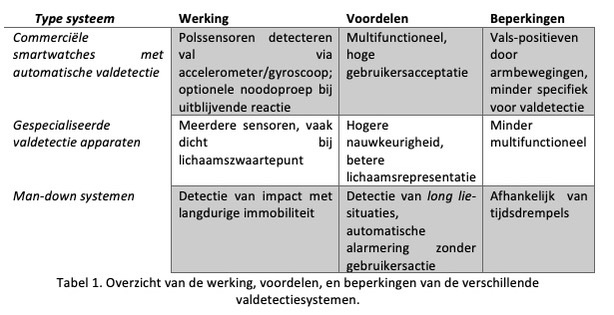
Mijn onderzoek laat zien dat automatische valdetectie veelbelovend is, maar dat niet elk systeem hetzelfde werkt.
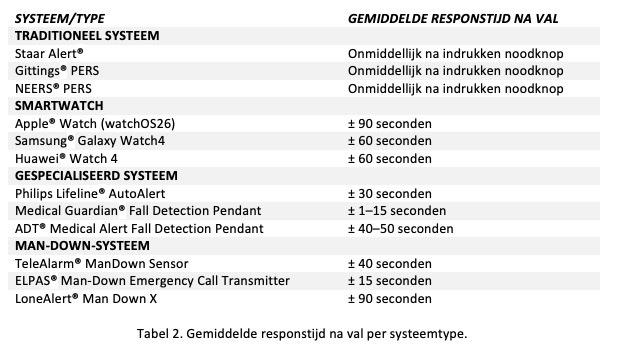
Smartwatches kunnen een val detecteren zonder dat de gebruiker een knop moet indrukken. Toch zijn ze oorspronkelijk niet uitsluitend voor valdetectie ontwikkeld. In de onderzochte systemen lag de detectie- en alarmtijd doorgaans rond 60 tot 90 seconden.
Gespecialiseerde systemen zijn specifiek ontworpen voor het herkennen van vallen en langdurige immobiliteit. In de onderzochte studies werden vallen, afhankelijk van het systeem, binnen enkele seconden tot tientallen seconden gedetecteerd. De gerapporteerde sensitiviteit en specificiteit waren over het algemeen hoog, maar verschilden sterk tussen systemen en onderzoeken.
Ook man-down-systemen, die oorspronkelijk onder meer voor werknemers in risicovolle omgevingen werden ontwikkeld, kunnen interessant zijn voor situaties waarin iemand na een val onbeweeglijk blijft liggen.
Toch is automatische detectie geen wondermiddel. Systemen kunnen een val missen of juist een alarm geven wanneer iemand niet gevallen is. Vooral fout-negatieve meldingen zijn zorgwekkend: een val wordt dan niet herkend en hulp kan uitblijven. Ook gebruiksgemak blijft belangrijk. Een technisch perfect systeem heeft weinig waarde wanneer een oudere het niet wil of kan dragen.
Van technologie naar zorg
Mijn onderzoek maakt duidelijk dat de keuze voor een alarmsysteem meer is dan de keuze voor een toestel. Ook de gebruiker, de thuissituatie en de opvolging van een alarm spelen een rol.
Automatische valdetectie kan een belangrijke aanvulling vormen op traditionele personenalarmering, vooral wanneer iemand na een val niet meer zelf kan reageren. Tegelijk is verder onderzoek nodig om systemen onder realistische omstandigheden bij ouderen te testen en de betrouwbaarheid en gebruiksvriendelijkheid verder te verbeteren. Nieuwe ontwikkelingen in artificiële intelligentie en machine learning kunnen daarbij in de toekomst helpen om valpatronen beter te herkennen.
Wat begon bij een valincident in mijn eigen familie, groeide uit tot een onderzoek naar een bredere uitdaging in de ouderenzorg: hoe kunnen we ervoor zorgen dat hulp niet pas komt wanneer iemand zelf nog in staat is om erom te vragen?
Een val duurt seconden. De uren die daarop volgen, hoeven dat niet te zijn.
Bibliografie
ADT. (2024, 21 maart). ADT Medical Alert Fall Detection pendant. ADT Home Security Support Center. Geraadpleegd op 10 maart 2026, van https://help.adt.com/s/article/Medical-Alert-Fall-Detection-Pendant
Agboola, S., Golas, S., Fischer, N., Nikolova-Simons, M., Op den Buijs, J., Schertzer, L., Kvedar, J., & Jethwani, K. (2017). Healthcare utilization in older patients using personal emergency response systems: an analysis of electronic health records and medical alert data: Brief Description: A Longitudinal Retrospective Analyses of healthcare utilization rates in older patients using Personal Emergency Response Systems from 2011 to 2015. BMC health services research, 17(1), 282. https://doi.org/10.1186/s12913-017-2196-1
Appeadu, M. K., Bordoni, B. (2023, 4 juni) Falls and Fall Prevention in Older Adults. In StatPearls [Internet]. Treasure Island (FL): StatPearls Publishing; 2025 Jan. https://www.ncbi.nlm.nih.gov/books/NBK560761/
Apple Support. (2026, 6 februari). Valdetectie gebruiken met Apple Watch. Apple. Geraadpleegd op 19 maart 2026, van https://support.apple.com/nl-be/108896
Apple Support. (z.d.). Valdetectie beheren op de Apple Watch. Apple. Geraadpleegd op 19 maart 2026, van https://support.apple.com/nl-nl/guide/watch/apd34c409704/watchos
Bikova, M., Ambugo, E. A., Tjerbo, T., Jalovcic, D., & Førland, O. (2024). Does assistive technology contribute to safety among home-dwelling older adults? BMC Health Services Research, 24, 750. https://doi.org/10.1186/s12913-024-11185-8
Bloch, F. (2012). Critical Falls: Why Remaining on the Ground After a Fall can be Dangerous, Whatever the Fall. Journal of the American Geriatrics Society, 60(7), 1375–1376. https://doi.org/10.1111/j.1532-5415.2012.04017.x
Boström, M., Kjellström, S., Malmberg, B., & Björklund, A. (2011). Personal emergency response system (PERS) alarms may induce insecurity feelings. Gerontechnology, 10(3). https://doi.org/10.4017/gt.2011.10.3.001.00
Bourke, A. K., O'Brien, J. V., & Lyons, G. M. (2007). Evaluation of a threshold-based tri-axial accelerometer fall detection algorithm. Gait & Posture, 26(2), 194–199. https://doi.org/10.1016/j.gaitpost.2006.09.012
Brew, B., Faux, S. G., & Blanchard, E. (2022). Effectiveness of a Smartwatch App in Detecting Induced Falls: Observational Study. JMIR formative research, 6(3), e30121. https://doi.org/10.2196/30121
Cha S. M. (2025). A Systematic Review of Home Modifications for Aging in Place in Older Adults. Healthcare, 13(7), 752. https://doi.org/10.3390/healthcare13070752
Chai, X., Wu, R., Pike, M., Jin, H., Chung, W.-Y., & Lee, B.-G. (2021). Smart Wearables with Sensor Fusion for Fall Detection in Firefighting. Sensors, 21(20), 6770. https://doi.org/10.3390/s21206770
Chaudhuri, S., Thompson, H., & Demiris, G. (2014). Fall detection devices and their use with older adults: a systematic review. Journal of geriatric physical therapy (2001), 37(4), 178–196. https://doi.org/10.1519/JPT.0b013e3182abe779
Chithra, V., Vidusha, M., Eldho, A. M., Saleem, P. S., & Charley, E. J. (2025). Accident alert system using sensors and IoT devices. International Journal of Creative Research Thoughts (IJCRT), 13(3). https://www.ijcrt.org/papers/IJCRT2503798.pdf
Clegg, A., Young, J., Iliffe, S., Rikkert, M. O., & Rockwood, K. (2013). Frailty in elderly people. Lancet, 381(9868), 752–762. https://doi.org/10.1016/S0140-6736(12)62167-9
Drieskens, S., Janssens, M., & Hermans, L. (2025). Gezondheidsenquête 2023–2024: Valincidentie bij oudere personen. Sciensano. https://www.sciensano.be/sites/default/files/fi_report_nl_his2023.pdf
Elpas. (2013, januari). Elpas Man-Down Emergency Call Transmitter: User Guide [PDF]. Elpas. Geraadpleegd op 12 maart 2026, van https://fccid.io/O4X5-MDA00433/User-Manual/User-Manual-1917416.pdf
European Commission. (z.d.). The interoperable EU-wide eCall. Geraadpleegd op 12 maart 2026, van https://transport.ec.europa.eu/transport-themes/smart-mobility/road/its…
Expertisecentrum Val‑ en fractuurpreventie Vlaanderen. (z.d.-a). Expertisecentrum Val‑ en fractuurpreventie Vlaanderen. Valpreventie.be. Geraadpleegd op 6 februari 2026, van https://www.valpreventie.be/
Expertisecentrum Val- en fractuurpreventie Vlaanderen. (z.d.-b). Vallen voorkomen in de thuissetting. Valpreventie. Geraadpleegd op 6 februari 2026, van https://www.valpreventie.be/vallen-voorkomen-in-de-thuissetting (valpreventie.be)
Facchinetti, G., Petrucci, G., Albanesi, B., De Marinis, M. G., & Piredda, M. (2023). Can Smart Home Technologies Help Older Adults Manage Their Chronic Condition? A Systematic Literature Review. International Journal of Environmental Research and Public Health, 20(2), 1205. https://doi.org/10.3390/ijerph20021205
Fall Prevention Foundation. (2025, juni 23). Staying safe at home and beyond: A complete guide to senior alert systems with fall detection. Fall Prevention Foundation. Geraadpleegd op 6 februari 2026, van https://fallpreventionfoundation.org/2025/06/23/staying-safe-at-home-and-beyond-a-complete-guide-to-senior-alert-systems-with-fall-detection/
Falls and patient safety for older adults. (2006, oktober). Wound Management & Prevention. HMP Global Learning Network. https://www.hmpgloballearningnetwork.com/site/wmp/content/falls-and-pat…
Fletcher, R. H., Fletcher, S. W., & Fletcher, G. S. (2014). Clinical epidemiology: The essentials (5th ed.) [PDF]. Lippincott Williams & Wilkins. Geraadpleegd op 12 maart 2026, van https://elibrary.klintapscohas.edu.gh/wp-content/uploads/2024/06/Clinic…
Flor-Unda, O., Arcos-Reina, R., Estrella-Caicedo, C., Toapanta, C., Villao, F., Palacios-Cabrera, H., Nunez-Nagy, S., & Alarcos, B. (2025). A Comparative Overview of Technological Advances in Fall Detection Systems for Elderly People. Sensors, 25(24), 7423. https://doi.org/10.3390/s25247423
Giovannini, S., Brau, F., Galluzzo, V., Santagada, D. A., Loreti, C., Biscotti, L., Laudisio, A., Zuccalà, G., & Bernabei, R. (2022). Falls among Older Adults: Screening, Identification, Rehabilitation, and Management. Applied Sciences, 12(15), 7934. https://doi.org/10.3390/app12157934
Gittings Protective Security INC. (2026). Personal emergency response systems (PERS). Gittings. Geraadpleegd op 12 maart 2026, van https://gittingspi.com/personal-emergency-response-systems/
González-Cañete, F. J., & Casilari, E. (2021). A Feasibility Study of the Use of Smartwatches in Wearable Fall Detection Systems. Sensors, 21(6), 2254. https://doi.org/10.3390/s21062254
Gorce, P., & Jacquier-Bret, J. (2025). Fall Detection in Elderly People: A Systematic Review of Ambient Assisted Living and Smart Home-Related Technology Performance. Sensors, 25(21), 6540. https://doi.org/10.3390/s25216540
Griffin, R. L., Carroll, S., & Jansen, J. O. (2020). Automatic collision notification availability and emergency response times following vehicle collision-an analysis of the 2017 crash investigation sampling system. Traffic injury prevention, 21(sup1), S135–S139. https://doi.org/10.1080/15389588.2020.1817418
Guilbeault-Sauvé, A., De Kelper, B., & Voix, J. (2021). Man Down Situation Detection Using an in-Ear Inertial Platform. Sensors, 21(5), 1730. https://doi.org/10.3390/s21051730
Harari, Y., Shawen, N., Mummidisetty, C. K., Albert, M. V., Kording, K. P., & Jayaraman, A. (2021). A smartphone-based online system for fall detection with alert notifications and contextual information of real-life falls. Journal of neuroengineering and rehabilitation, 18(1), 124. https://doi.org/10.1186/s12984-021-00918-z
Hu, X., & Qu, X. (2016). Pre-impact fall detection. BioMedical Engineering OnLine, 15(1), 61. https://doi.org/10.1186/s12938-016-0194-x
Huawei Support. (2026). Fall detection and emergency SOS on your HUAWEI watch. Huawei Support. Geraadpleegd op 9 maart 2026, van https://consumer.huawei.com/en/support/content/en-us16066705/
Igual, R., Medrano, C., & Plaza, I. (2013). Challenges, issues and trends in fall detection systems. Biomedical engineering online, 12, 66. https://doi.org/10.1186/1475-925X-12-66
Izadi-Avanji, F. S., Safa, A., Abedzadeh-Kalahroudi, M., & Shaterian, N. (2024). Fear of falling and its related factors in older adults following a fall in Kashan, Iran (2023-2024). BMC geriatrics, 24(1), 965. https://doi.org/10.1186/s12877-024-05560-7
Johnston, K., Worley, A., Grimmer-Somers, K., Sutherland, M., & Amos, L. (2010). Personal Alarm Use to Call the Ambulance after a Fall in Older People: Characteristics of Clients and Falls. Journal of Emergency Primary Health Care Australasian Journal of Paramedicine, 8(4), 86–92. https://doi.org/10.33151/ajp.8.4.86
Karpusenko, T., Alfonsi, M., Cirino, N. T. O., Ishigaki, E. Y., Sanudo, A., Paschoal, S. M. P., Leme, L. E. G., & Perracini, M. R. (2023). Factors associated with unrecovered falls among older adults. Geriatric Nursing, 51, 323–329. https://doi.org/10.1016/j.gerinurse.2023.03.010
Keiro. (2025, november 4). Personal emergency response systems (PERS). Keiro. https://www.keiro.org/fact-sheets/personal-emergency-response-systems
Khan, S. S., & Hoey, J. (2016, 23 november). Review of fall detection techniques: A data availability perspective. Medical Engineering & Physics, 39(1), 12–22. https://doi.org/10.1016/j.medengphy.2016.10.014
La Blunda, L., Gutiérrez-Madroñal, L., Wagner, M. F., & Medina-Bulo, I. (2020). A wearable fall detection system based on body area networks. IEEE Access, 8, 192586–192598. https://doi.org/10.1109/ACCESS.2020.3032497
Lathouwers, E., Dillen, A., Díaz, M.A., Tassignon, B., Verschueren, J., Verté, D., De Witte, N., & De Pauw, K. (2022). Characterizing fall risk factors in Belgian older adults through machine learning: a data-driven approach. BMC Public Health, 22 , 2210. https://doi.org/10.1186/s12889-022-14694-5
Lee, A., Lee, H., & Lee, S.-H. (2025). Digital Healthcare Approaches for Fall Detection and Prediction in Older Adults: A Systematic Review of Evidence from Hospital and Long-Term Care Settings. Medicina, 61(11), 1926. https://doi.org/10.3390/medicina61111926
LoneAlert. (2022). Product Manual Man Down X (Document 367‑1001). https://www.lonealert.co.uk/wp-content/uploads/2023/03/367-1001-Man-Down-X-Product-Manual95.pdf
Lydahl D. (2023). Good care and adverse effects: Exploring the use of social alarms in care for older people in Sweden. Health, 28(4), 559–577. https://doi.org/10.1177/13634593231185260
Masoumian Hosseini, M., Masoumian Hosseini, S. T., Qayumi, K., Hosseinzadeh, S., & Sajadi Tabar, S. S. (2023). Smartwatches in healthcare medicine: assistance and monitoring; a scoping review. BMC medical informatics and decision making, 23(1), 248. https://doi.org/10.1186/s12911-023-02350-w
McKenna, A. C., Kloseck, M., Crilly, R., & Polgar, J. (2015). Purchasing and Using Personal Emergency Response Systems (PERS): how decisions are made by community-dwelling seniors in Canada. BMC Geriatrics, 15, 81. https://doi.org/10.1186/s12877-015-0079-z
Medical Guardian. (2023, 24 februari). Benefits of Fall Detection & How It Works. Medical Guardian. Geraadpleegd op 10 maart 2026, van https://www.medicalguardian.com/medical-alert-blog/technology/benefits-…
Min, J. G., Smith, M., Englehart, M. S., Riha, G. M., Palm, C. E., Orr, L. C., Pathak, M., & Thompson, S. J. (2026). The Golden Hour is elusive in rural trauma: A 10-year analysis from a Level I trauma center in Montana. The American journal of emergency medicine, 103, 127–131. https://doi.org/10.1016/j.ajem.2026.01.053
Mondal, R., & Ghosal, P. (2023). Recall-driven precision refinement: Unveiling accurate fall detection using LSTM. ResearchGate. Geraadpleegd op 12 maart 2026, van https://www.researchgate.net/publication/375000114
New England Emergency Response Systems, INC. (z.d.). Medical Alert Products. Geraadpleegd op 12 maart 2026, van https://www.neers.com/products.php
Nisbet, C., & McLay, J. (2025). Guidelines for the Care of residents within a care home setting who are at risk of Long Lie. NHS Lanarkshire – Care Homes Guidance & Governance Group. https://www.rightdecisions.scot.nhs.uk/media/5jbdqvih/care-of-residents…
Özdemir A. T. (2016). An Analysis on Sensor Locations of the Human Body for Wearable Fall Detection Devices: Principles and Practice. Sensors, 16(8), 1161. https://doi.org/10.3390/s16081161
Palmerini, L., Klenk, J., Becker, C., & Chiari, L. (2020). Accelerometer-Based Fall Detection Using Machine Learning: Training and Testing on Real-World Falls. Sensors, 20(22), 6479. https://doi.org/10.3390/s20226479
Panneman, M. J. M., van Beeck, E. F., Olij, B. F., Haagsma, J. A., van Zoest, F., Kuiper, J. I., & Polinder, S. (2025). A societal cost-benefit analysis of falls prevention in community-dwelling older people in the Netherlands. Experimental Gerontology, 205, 112755. https://doi.org/10.1016/j.exger.2025.112755
Parikh, R., Mathai, A., Parikh, S., Chandra Sekhar, G., & Thomas, R. (2008). Understanding and using sensitivity, specificity and predictive values. Indian journal of ophthalmology, 56(1), 45–50. https://doi.org/10.4103/0301-4738.37595
Paul, P. (2025, december 30). Counterpoint Research: Apple, HUAWEI top smartwatch market in Q3 2025. GizGuide. https://www.gizguide.com/2025/12/apple-huawei-top-smartwatch-vendor-202…
Philips Cares. (2022). Philips Cares Be there for the moments that matter [PDF]. Philips Lifeline. Geraadpleegd op 10 maart 2026, van https://manuals.plus/m/b99572e36da4e2e3b468c38e2305ba83ea645dd8eed07bd3…
Rijksinstituut voor Volksgezondheid en Milieu. (2025). Valpreventie in Beweging. Monitor Valpreventie: Stand van zaken ketenaanpak in 2024 en eerste kwartaal 2025. RIVM. https://www.rivm.nl/publicaties/valpreventie-in-beweging-monitor-valpreventie-stand-van-zaken-ketenaanpak-in-2024-en
Samsung Support. (2022, 21 januari). How to set up fall detection on the Galaxy Watch. Samsung UK Support. Geraadpleegd op 12 maart 2026, van https://www.samsung.com/uk/support/mobile-devices/how-to-set-up-fall-de…
STAAR Alert. (2026). In-home personal emergency response systems (PERS): STAAR Alert. Geraadpleegd op 12 maart 2026, van https://www.staaralert.com/personal-emergency-response-systems
Stefanacci, R. G., & Wilkinson, J. R. (2025, augustus). Falls in older adults. MSD Manual Professional Version. MSD Manual. https://www.msdmanuals.com/professional/geriatrics/falls-in-older-adult…
Stokke R. (2016). The Personal Emergency Response System as a Technology Innovation in Primary Health Care Services: An Integrative Review. Journal of medical Internet research, 18(7), e187. https://doi.org/10.2196/jmir.5727
Tamulaityte-Morozoviene, I., Dadoniene, J., Stukas, R., Tamulaitiene, M., Alekna, V., & Jakubauskiene, M. (2024). Fear of falling as a psychological consequence of fall in older adults. European Journal of Public Health, 34(Suppl 3), ckae144.2240. https://doi.org/10.1093/eurpub/ckae144.2240
TeleAlarm. (2016). ManDown sensor [Datasheet]. TeleAlarm. Geraadpleegd op 12 maart 2026, van https://www.telealarm.com/wp-content/uploads/2016/12/ManDown_DS_EN_V1.0…
Tseng, C. K., Huang, S. J., & Kau, L. J. (2025). Wearable Fall Detection System with Real-Time Localization and Notification Capabilities. Sensors, 25(12), 3632. https://doi.org/10.3390/s25123632
Van Oosterhout, T., & Kröse, B. (2011). Cameratoezicht voor valdetectie: het ValLab als onderzoekslab voor WO en HBO studenten. In Nederlands Informatica Onderwijs Congres (NIOC 2011). Hogeschool van Amsterdam; Universiteit van Amsterdam. https://www.digitallifecentre.nl/redactie/resources/van-oosterhout-2011…
Vanhauwaert, E., Joossens, S., & Verbeyst, L. (2023). De relevantie en kwaliteit van bronnen beoordelen: Ondersteunende praktijktool evidence-based practice. UC Leuven-Limburg, Expertisecentrum Health Innovation.
Villa, M., & Casilari, E. (2024). Wearable Fall Detectors Based on Low Power Transmission Systems: A Systematic Review. Technologies, 12(9), 166. https://doi.org/10.3390/technologies12090166
Vlaeyen, E., Milisen, K., Vandervelde, S., Valy, S., Poels, J., Balligand, E., Bautmans, I., Belaen, G., Bergen, L., Bouckaert, L., Buelens, S., Cambier, D., De Coninck, L., Deneyer, H., Gielen, E., Goditiabois, F., Goemaere, S., Lafosse, A., Lipkens, L., Meurrens, J., Nieuwboer, A., Sevenants, S., Stouten, A., Tessier, J., Vyncke, P., & Walgraeve, K. (2025). Vlaamse richtlijn “Valpreventie in woonzorgcentra”. Expertisecentrum Val- en fractuurpreventie Vlaanderen. https://www.valpreventie.be
Wang, Y., Sun, H., Xu, S., Xia, Q., Ge, S., Li, M., & Tang, X. (2025). Smart Home Technologies for Enhancing Independence of Living and Reducing Care Dependence in Older Adults: A Systematic Review. Journal of Advanced Nursing, 81(6), 2885–2912. https://doi.org/10.1111/jan.16569
Warrington, D. J., Shortis, E. J., & Whittaker, P. J. (2021). Are wearable devices effective for preventing and detecting falls: an umbrella review (a review of systematic reviews). BMC public health, 21(1), 2091. https://doi.org/10.1186/s12889-021-12169-7
Weinlich, M., Kurz, P., Blau, M. B., Walcher, F., & Piatek, S. (2018). Significant acceleration of emergency response using smartphone geolocation data and a worldwide emergency call support system. PloS one, 13(5), e0196336. https://doi.org/10.1371/journal.pone.0196336
World Health Organization. (2021, april 26). Falls. World Health Organization. Geraadpleegd op 6 februari 2026, van https://www.who.int/news-room/fact-sheets/detail/falls
Zaninotto, P., Huang, Y. T., Di Gessa, G., Abell, J., Lassale, C., & Steptoe, A. (2020). Polypharmacy is a risk factor for hospital admission due to a fall: evidence from the English Longitudinal Study of Ageing. BMC Public Health, 20, 1804. https://doi.org/10.1186/s12889-020-09920-x