Waarom de BRICS-munt er voorlopig niet komt
Wanneer India goederen invoert, betaalt het in 86 procent van de gevallen met Amerikaanse dollars. Nochtans komt amper 5 procent van die invoer uit de Verenigde Staten. Brazilië, Rusland, India, China en Zuid-Afrika, samen de BRICS-landen, willen die greep van de dollar breken met een eigen munt.
Geld als wapen
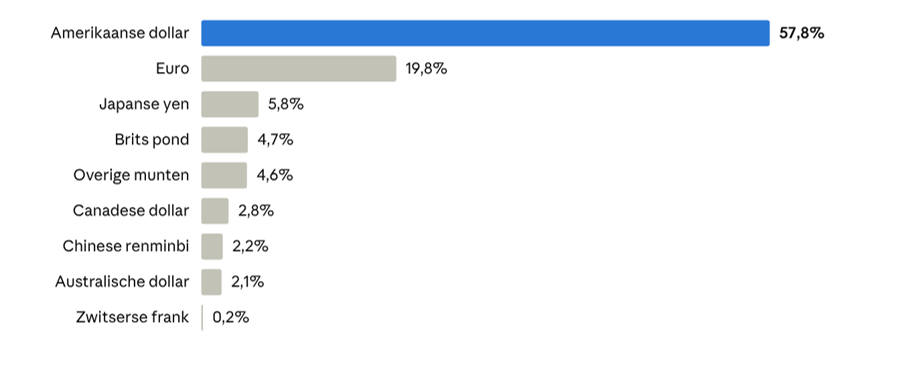
Toen Rusland in 2022 Oekraïne binnenviel, werden Russische banken afgesloten van SWIFT, het netwerk waarlangs banken wereldwijd hun betalingsopdrachten uitwisselen. Russische valutareserves werden bevroren. Voor veel landen buiten het Westen was dat een wake-upcall: wie afhangt van de dollar, hangt af van Washington. En die afhankelijkheid is groot. Bijna 58 procent van alle valutareserves ter wereld, het geld dat centrale banken achter de hand houden voor slechte tijden, staat in dollar, de euro volgt met 20 procent. Zelfs in handel waar de Verenigde Staten geen partij zijn, regeert de dollar. Niet alleen in India: bij de Braziliaanse uitvoer gebeurt 94 procent van de facturatie in dollar, terwijl slechts 17 procent naar de VS vertrekt.
Te verschillend om samen te gaan
Een muntunie betekent één rentevoet en één wisselkoers voor alle leden. Dat werkt alleen als hun economieën ongeveer in hetzelfde tempo bewegen. Volgens de theorie van Nobelprijswinnaar Robert Mundell moeten arbeid en kapitaal ook vrij kunnen bewegen en moeten lonen en prijzen zich vlot aanpassen. De BRICS-landen voldoen aan geen van die voorwaarden, waarbij de verschillen enorm zijn. China had in 2024 een economie van ongeveer 18.000 miljard dollar, Zuid-Afrika nog geen 410 miljard. China noteerde 2,1 procent inflatie, de anderen schommelden rond 5 procent. Opvallend: ondanks jaarlijkse toppen sinds 2010 zijn die economieën amper naar elkaar toegegroeid.
Ook goud biedt geen redding. Goud schommelt te sterk in prijs en een goudgedekte munt dwingt landen om hun uitgaven aan banden te leggen. Precies daarom gaven de Verenigde Staten in 1971 de koppeling aan goud op. Bovendien zijn de goudvoorraden binnen het blok zeer ongelijk verdeeld.
De euro als spiegel
De eurozone is het enige vergelijkbare voorbeeld. Tussen de oprichting van de Europese Gemeenschap voor Kolen en Staal in 1951 en de eerste euromunten in 2002 zat meer dan een halve eeuw voorbereiding: een gemeenschappelijke markt, vrij kapitaalverkeer, een gedeeld parlement en hof. Zelfs tussen vrij gelijkaardige Europese landen verliep die toenadering moeizaam. De BRICS-landen hebben die eerste stappen nog niet eens gezet.
Rivalen aan dezelfde tafel
Politiek ontbreekt het basisvertrouwen dat een muntunie nodig heeft. India en China, de twee grootste economieën van het blok, liggen in een grensconflict. India werkt bovendien samen met de VS in het Quad-bondgenootschap, een samenwerkingsverband tussen India, de VS, Japan en Australië, dat China ziet als een poging om zijn invloed in de Indo-Pacific te beperken. De uitbreiding met onder meer Iran, Egypte, Ethiopië en de Verenigde Arabische Emiraten bracht extra rivaliteiten binnen, zoals het conflict tussen Egypte en Ethiopië over de Nijldam.
China heeft daarnaast weinig zin om zijn monetaire macht te delen: het promoot liever zijn eigen yuan. Toen Iran in maart 2026 voorstelde om olie door de Straat van Hormuz enkel tegen betaling in yuan door te laten, ging het om een deal tussen twee landen, niet om een stap richting een BRICS-munt.
Geen centrale bank, geen betaalnet
Een munt heeft meer nodig dan een naam. Er moet een centrale bank achter staan die de rente bepaalt en de munt verdedigt in moeilijke tijden. Daarnaast is er een betaalsysteem nodig waarmee banken onderling geld kunnen overmaken. De eurozone heeft daarvoor de Europese Centrale Bank en het betaalsysteem TARGET. BRICS heeft niets vergelijkbaars.
Dreigende tarieven
Tot slot is er Washington. Eind november 2024 waarschuwde Donald Trump dat landen die een alternatief voor de dollar steunen, kunnen rekenen op invoertarieven van 100 procent. Voor landen met grote belangen op de Amerikaanse markt is dat een sterke reden om op de rem te staan.
Conclusie
Een BRICS-munt lijkt op korte en middellange termijn niet realistisch. De werkelijke betekenis zit niet in het vervangen van de dollar, maar in het signaal dat het uitzendt. Steeds meer landen willen minder afhankelijk zijn van één munt die ook als drukmiddel kan dienen.
De geschiedenis leert bovendien dat geen enkele reservemunt eeuwig heerst. Het Britse pond verloor zijn leidende rol in enkele decennia, en ook het aandeel van de dollar ligt vandaag een stuk lager dan in de jaren zeventig. Zulke verschuivingen gaan wel traag.
Bibliografie
Acevedo, R., Menard Family Center for Economic Inquiry, Creighton University, University of Illinois Springfield, Western New Mexico University, Econintech, Lorca-Susino, M., Department of Economics, University of Miami, & Econintech. (2024). The Euro and the U.S. Dollar: Reserve Currency Rivalry in the 21st Century - A Review [Journal-article]. The Economic Research Guardian, 14–14(2), 176–202. https://www.ecrg.ro/files/p2024.14(2)38y7.pdf Anagba, J. O., Adamu, B. M., & Olotu, T. I. (2026). BRICS and the Politics of Multi Polarity: Rethinking Global Governance. Journal Of Contemporary International Relations And Diplomacy, 6(2), 16–30. https://doi.org/10.53982/jcird.2025.0602.02-j Asteriou, D., Katsikas, E., & Spanos, K. (2026). An Optimum Currency Area Index for BRICS: A Bayesian Prediction model. ScienceDirect. Bacchoo, A. D. (2025). A Future Brics Currency as a Competitor to the US Dollar. International Journal Of Innovations in Science Engineering And Management., 241–249. https://doi.org/10.69968/ijisem.2025v4i3241-249 Baselli, V. (2025, 9 oktober). Kan de euro de dollar uitdagen als wereldreservemunt? Morningstar. https://global.morningstar.com/nl/markten/kan-de-euro-de-dollar uitdagen-als-wereldreservemunt Bastanifar, I., Khan, K. H., & Koch, H. (2024). Understanding BRICSIZATION through an economic geopolitical model. In Journal of Open Innovation: Technology, Market, and Complexity, Journal Of Open Innovation: Technology, Market, And Complexity (p. 100440) [Journal-article]. https://doi.org/10.1016/j.joitmc.2024.100440 Batista Jr., P. N. (2023). A BRICS currency? In BRICS Seminar On Governance & Cultural Exchange Forum 2023. Batista, P. N., Jr. (z.d.). Analytics. Valdai Club. https://valdaiclub.com/a/highlights/brics-financial-and-monetary-initia… Batista, P. N., Jr. (2024). BRICS: transactions in national currencies, cross border payment systems and a new reserve currency. In Paper That Served As The Basis For A Presentation Made in The Session “Society Of Equal Opportunities: What Does This Mean in The 21st Century?” in The 21st Annual Meeting Of The Valdai Discussion Club in Sochi, Russia, November 5th, 2024. Benefits of adopting the euro. (z.d.). Europese Raad. https://www.consilium.europa.eu/en/policies/benefits-of-adopting-the-eu… Bullough, O. (2019). Moneyland. Thomas Rap. Cai, Y. (2025). Study on the Trend of De-Dollarization. In Transactions On Economics, Business And Management Research (Vol. 15). Carlson, S. (2025, 21 juli). What Is a Reserve Currency? | Chase. https://www.chase.com/personal/investments/learning-and insights/article/what-is-a-reserve-currency Cipriani, M., Goldberg, L. S., & La Spada, G. (2023). Financial Sanctions, SWIFT, and the Architecture of the International Payments System. In Federal Reserve Bank of New York, Federal Reserve Bank Of New York Staff Reports (Nr. 1047). https://www.newyorkfed.org/medialibrary/media/research/staff_reports/sr…. pdf Coquidé, C., Lages, J., & Shepelyansky, D. L. (2023). Prospects of BRICS currency dominance in international trade. Applied Network Science, 8(1). https://doi.org/10.1007/s41109-023-00590-3 Dahmer, W. (2023). BRICS Currency Lessons from the Past. De Borst, M., & De Borst, S. (2024). Crypto voor intelligente beleggers. Business Contact. Delen, B. (2025, 29 augustus). De Amerikaanse dollar onder druk: storm of rimpeling? Delen. https://www.delen.bank/nl-be/blog/de-amerikaanse-dollar onder-druk-storm-of-rimpeling D’Italia, B. (z.d.). Banca d’Italia - T2 and the settlement of gross payments. (C) Banca D’Italia. https://www.bancaditalia.it/compiti/sistema pagamenti/target2/index.html?com.dotmarketing.htmlpage.language=1&dotca che=refresh EFSAS. (2023). The BRICS | Origins, Evolution & 2023 Expansion. In EFSAS STUDY PAPER. Eurobarometer shows record high trust in the EU, and strong support for the euro and a common defence and security policy. (z.d.). Europese Commissie. https://ec.europa.eu/commission/presscorner/detail/en/ip_25_1318 European Central Bank. (2026, 9 januari). The euro in a changing world. https://www.ecb.europa.eu/press/key/date/2026/html/ecb.sp260109~7a044d3 6db.en.html Evaluating BRICS as an optimum currency area: insights from SVAR modeling. (2024). In Cogent Economics & Finance (p. 2399321). https://doi.org/10.1080/23322039.2024.2399321 Gangat, M., Ncube, A., & University of Johannesburg. (z.d.). Economic Feasibility of the Monetary Integration of BRICS and BRICS Plus Countries. In University Of Johannesburg [Journal-article]. Ghizoni, S. K. (z.d.). Creation of the Bretton Woods System. Federal Reserve History. https://www.federalreservehistory.org/essays/bretton-woods created#:~:text=The%20Bretton%20Woods%20system%20was%20a%20new ,Chief%20international%20economist%20at%20the%20Treasury%20Departm ent Gift, M. M. (2026, 31 maart). The BRICS currency conundrum: Weighing the pros and cons of a unified monetary system. APRI. https://afripoli.org/the-brics currency-conundrum-weighing-the-pros-and-cons-of-a-unified-monetary system Gluschenko, K., Institute of Economics and Industrial Engineering, & Novosibirsk State University. (2024). How the dollar became the world currency [Journal article]. Munich Personal RePEc Archive, 2. https://doi.org/10.2139/ssrn.4941211 Hall, J. (2025, 8 augustus). What is Fiat Currency? The Motley Fool. https://www.fool.com/terms/f/fiat-currency/ Heylen, K. (2026, 16 maart). Iran zou olie alleen doorlaten via Straat van Hormuz als er in yuan betaald wordt: wat betekent dat voor de dollar? | VRT NWS Nieuws. VRTNWS. https://www.vrt.be/vrtnws/nl/2026/03/16/iraans-voorstel-voor hormuz-olie-betalen-met-yuan-china-petrodo/ Imam, M. (2025). BRICS Expansion and The Emergence of A New Economic World Order. Bulletin Of Islamic Research, 3(3), 397–408. https://doi.org/10.69526/bir.v3i3.341 International role of the euro. (z.d.). Europese Raad. https://www.consilium.europa.eu/en/policies/international-role-euro/ Issing, O., Center for Financial Studies at Goethe University Frankfurt, & Executive Board of the European Central Bank. (2021). A highly symbolic act. In THE INTERNATIONAL ECONOMY. http://www.international economy.com/TIE_Su21_Issing.pdf JAMMOUL, M. M. (2024). FEASIBILITY OF a BRICS COMMON CURRENCY (Door AMERICAN UNIVERSITY OF BEIRUT; N. Yamout, A. Abboud, & S. Neaimi, Reds.). https://scholarworks.aub.edu.lb/bitstream/handle/10938/24436/JammoulMays sa_2024.pdf?sequence=1 Jimoh, A.-R. (2010). Reducing the inherent risks in BRICS currency to the global acceptable level. How BRICS currency can coexists with US dollars. In Abstract [Journal-article]. https://ssrn.com/abstract=4635959 Johnston, L. A. (2025). The BRICS, the dollar and SWIFT: A review of evolving interests and monetary reform momentum. South African Journal Of International Affairs, 32(1–2), 243–266. https://doi.org/10.1080/10220461.2025.2523509 Kamin, K., & Langhammer, R. J. (2023). From BRICS to BRICS+: Sheer More Members is not a Challenge to G7. The Economists Voice, 20(2), 259–265. https://doi.org/10.1515/ev-2023-0065 Krause, D. & Marquette University. (2024). The Future of Global Payments: BRICS Pay and the Evolving Financial Order [Journal-article]. Marquette University, 1–5. Liu, Z. Z., & Papa, M. (2022). Can BRICS De-dollarize the Global Financial System? In Cambridge University Press eBooks. https://doi.org/10.1017/9781009029544 Lu, Y. (2020). The Causes of the Collapse of the Bretton Woods System and Its Influence on International Relationship. Finance And Market, 5(4), 320. https://doi.org/10.18686/fm.v5i4.2963 Moch, E. (2025). The Introduction of a BRICS Currency and Its Impact on the International Financial Architecture. International Journal Of Finance And Accounting, 4(1), 103–119. https://doi.org/10.37284/ijfa.4.1.3053 Molodyko, K. (2020). From Reserve Currencies to Reserves of Critical Goods: Designing a New BRICS International Currency. BRICS Law Journal, 7(4), 67–84. https://doi.org/10.21684/2412-2343-2020-7-4-67-84 Nach, M., Ncwadi, R., & Nelson Mandela University. (2024). BRICS economic integration: Prospects and challenges. South African Journal Of International Affairs, 151–166. https://doi.org/10.1080/10220461.2024.2380676 Papaioannou, E., Portes, R., & EUROPEANCOMMISSION. (2008). Costs and benefits of running an international currency. In Economic Papers (Vol. 348) [Journal-article]. https://doi.org/10.2765/20451 Popov, V. (2023). US dollar is losing it position of a reserve currency: How the BRICS development bank can ensure the soft landing. In Central Economics And Mathematics Institute, Russian Academy Of Sciences (pp. 1–4) [Journal article]. https://ssrn.com/abstract=4546254 Saaida, M. B. E. & Department of International Relations and Diplomacy, Faculty of Administration Sciences and Informatics, Al-Istiqlal University, Jericho, Palestine. (2023). The BRICS’ move away from US Dollar: The implications for international politics. In International Journal Of Multidisciplinary Research And Development (pp. 35–39) [Journal-article]. https://www.allsubjectjournal.com Shahrokhi, M., Cheng, H., Dandapani, K., Figueiredo, A., Parhizgari, A. M., & Shachmurove, Y. (2016). The Evolution and Future of the BRICS: Unbundling Politics from Economics. Global Finance Journal. Shameem, C., & Jayaprasad, K. (2020). The Evolution of BRICS in International Political Economy. American Review Of Political Economy, 15(1). https://doi.org/10.38024/arpe.sj.6.28.20 Siripurapu, A., & Berman, N. (2023, 19 juli). The dollar: the world’s reserve currency. Council On Foreign Relations. https://www.cfr.org/backgrounders/dollar worlds-reserve-currency Smith, G. (2025, 18 februari). Shared Brics money: a basket currency or a basket case? OMFIF. https://www.omfif.org/2025/02/shared-brics-money-a-basket currency-or-a-basket-case/ Spring-Ragain, H. & Centre d’Etudes Diplomatiques et Stratégiques (CEDS). (2025). International Sanctions and Economic Restructuring: Modelling the BRICS Monetary Initiative as Counter-Power. In Journal Of BRICS Studies (JBS) (Vol. 4, Nummer 2). Tan, D. (2025). The decoupling dilemma: How US sanctions erode global economic governance. International Organization, 79(S1), S134–S147. https://doi.org/10.1017/s0020818325100994 TARGET. (z.d.). https://www.bundesbank.de/en/tasks/payment systems/target/target-626752 The road to the euro. (2021, 17 februari). NBB Museum. https://museum.nbb.be/en/resources/road-euro Waarom de dollar nog steeds overgewaardeerd is. (2025, 4 november). ABN AMRO Bank. https://www.abnamro.com/research/nl/onze-research/fx-special waarom-de-dollar-nog-steeds-overgewaardeerd-is What are foreign currency reserves and can they help combat the global economic crisis? (2025, 3 juni). World Economic Forum. https://www.weforum.org/stories/2022/08/foreign-currency-reserves-global economic-crisis/ Would Floating Rates Sink the System? (z.d.). International Monetary Fund. https://www.imf.org/external/np/exr/center/mm/eng/mm_rs_01.htm Youvan, D. C. (2024). The BRICS Currency: A New Era of Global Finance Backed by Gold.