"Ik pas hier niet": De onverwachte daling in ingenieursidentiteit na een STEM-project op school
Stel je voor: je school organiseert een groots project waarbij je een shelter voor vluchtelingen ontwerpt of een valdetectiesysteem met AI bouwt. Het doel is om je warm te maken voor een toekomst als ingenieur. Met andere woorden: om je ingenieursidentiteit, de mate waarin je jezelf als een toekomstige ingenieur ziet, een boost te geven. Je zou verwachten dat het enthousiasme na afloop door het dak gaat. Maar wat blijkt uit recent onderzoek? Na zo'n project zien veel Vlaamse scholieren een toekomst als ingenieur juist mínder zitten. De grote boosdoener is bovendien niet enkel de zware wiskunde of fysica, maar vaak het simpele gevoel: "Ik hoor hier niet thuis".
Een valse startlijn
Voordat jongeren in het vijfde of zesde middelbaar überhaupt aan zo'n project beginnen, is de startlijn al ongelijk. Uit bevragingen bij ruim 450 Vlaamse scholieren met interesse in techniek, blijkt dat het klassieke, stereotiepe beeld van de ingenieur nog steeds prominent aanwezig is. Denk aan de eenzame, mannelijke techneut of het aangeboren wiskundige genie.
Dat hardnekkige stereotype zorgt ervoor dat meisjes met een flinke achterstand aan de startlijn verschijnen. Zelfs als ze oprechte interesse hebben, schatten ze hun eigen kunnen structureel lager in dan jongens en voelen ze zich minder erkend in die rol. Ook jongeren waarvan de ouders geen universitair diploma hebben, starten met minder zelfvertrouwen. Ze missen vaak het onzichtbare 'academische rugzakje' vol extra stimulans en voorkennis dat jongeren uit hoogopgeleide gezinnen wel van thuis uit meekrijgen.
De realitycheck in de klas
Om die drempels te verlagen en meer jongeren warm te maken voor een ingenieursrichting, halen veel scholen de praktijk naar de klas via actieve initiatieven zoals het Innovation Lab of de STEM-Award. Leerlingen werken dan in groepjes aan levensechte, maatschappelijke problemen, zoals het 3D-printen van een boot of het meten van stress op school. De logische verwachting is dat zo'n project leerlingen over de streep trekt om later effectief voor een ingenieursstudie te kiezen.
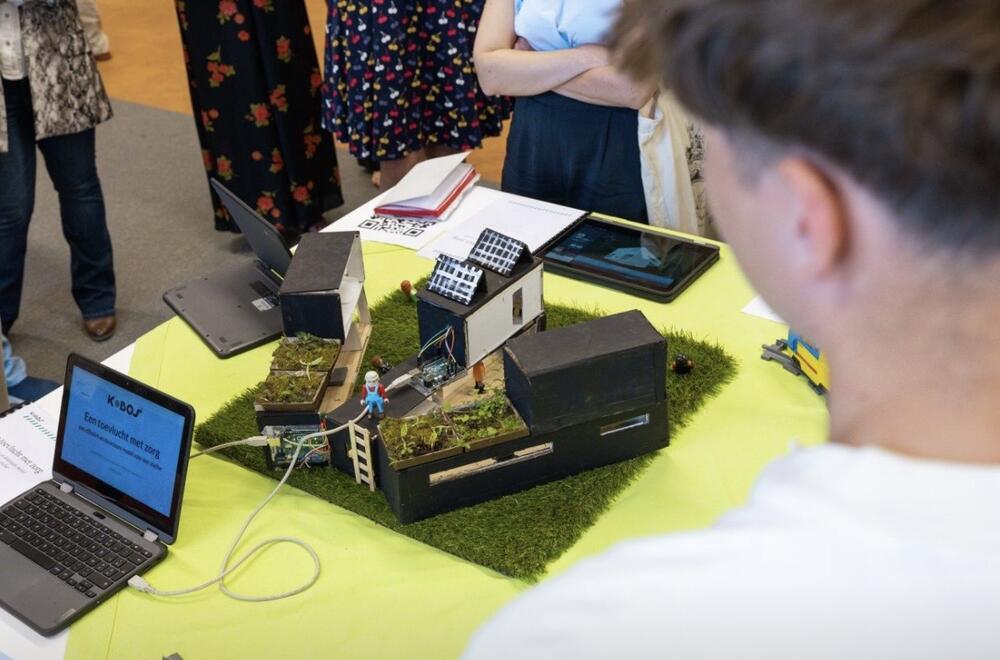
Afbeelding 1 - Leerlingen presenteren een menswaardige shelter voor vluchtelingen tijdens de STEM-Award. (Foto: Willem Bormans)
De realiteit is verrassend: na het project kelderde de ingenieursidentiteit. Bij de 'twijfelaars' daalde zowel de interesse, het geloof in eigen kunnen als het gevoel van erkenning. Zelfs bij de leerlingen die vooraf al luidop droomden van een ingenieursstudie, nam de algemene interesse af.
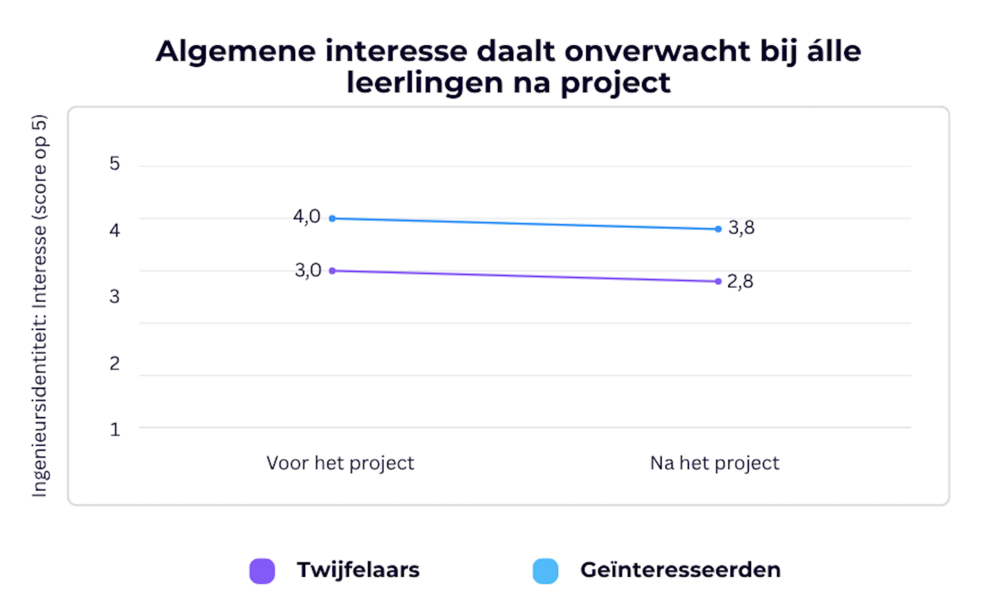
Figuur 1 - Bron: Eigen onderzoek bij ruim 450 Vlaamse scholieren in het kader van de masterproef
Is dat een ramp? Niet per se. Dit onverwachte effect kan simpelweg het gevolg zijn van een soort realitycheck. Leerlingen overschatten vooraf vaak hun eigen kunnen. Wanneer ze tijdens zo'n project plotseling botsen op de werkelijke wiskundige en technische complexiteit, stellen ze hun soms rooskleurige verwachtingen bij. Het project kan dus fungeren als een waardevolle oriëntatietool, die kan vermijden dat jongeren later in het hoger onderwijs onvoorbereid in een verkeerde richting starten.
Het ontbrekende puzzelstuk
Toch is er meer aan de hand dan enkel de confrontatie met moeilijke leerstof. Waarom haken sommige getalenteerde leerlingen na zo'n project af, terwijl anderen met evenveel talent wél doorzetten? Het antwoord schuilt in één cruciale menselijke behoefte: het thuisgevoel.
Uit de verzamelde data blijkt dat de sense of belonging, het psychologische gevoel dat je écht geaccepteerd wordt en in de groep past, met absolute voorsprong de allersterkste verklarende factor is voor wie zichzelf als toekomstig ingenieur ziet. Dat 'thuisgevoel' weegt aanzienlijk zwaarder door dan de vraag of je de wetenschap inhoudelijk boeiend vindt. Je kan robots bouwen nog zo fascinerend vinden, maar als je constant het gevoel hebt dat je een buitenbeentje bent in de klas, zal je jezelf nooit een ingenieur noemen. Als een schoolproject zich blindstaart op het oplossen van technische problemen, maar vergeet om een veilige groepssfeer te creëren, brokkelt de motivatie onherroepelijk af.
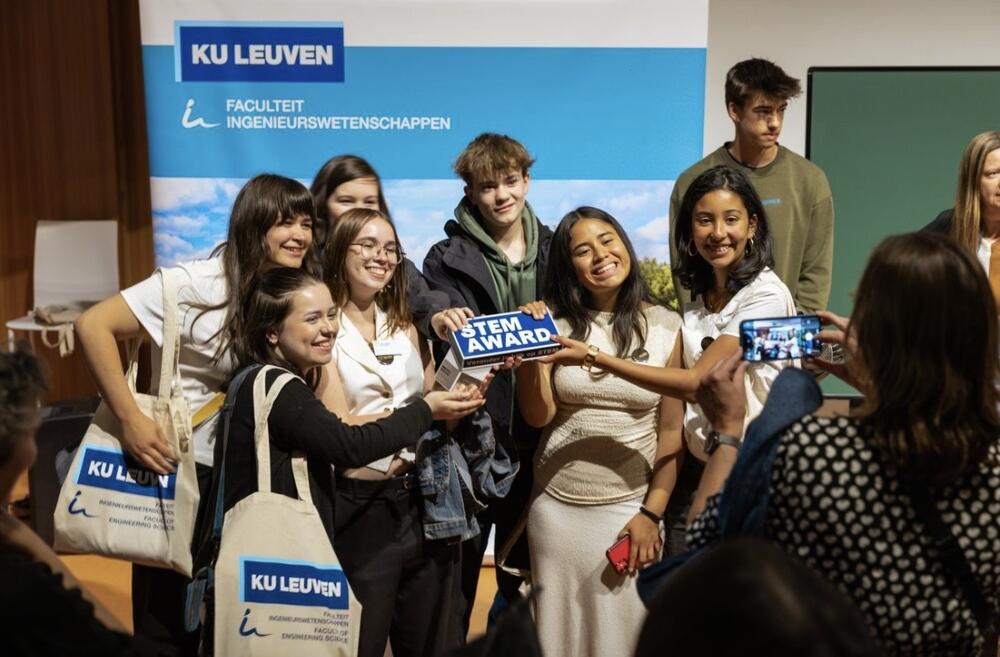
Afbeelding 2 - Vreugde bij de winnende klas na de uitreiking van de STEM-Award. (Foto: Willem Bormans)
Naar een klas zonder buitenbeentjes
Wat is dan de belangrijkste les voor leerkrachten en scholen die het naderende tekort aan ingenieurs willen aanpakken? Indrukwekkende experimenten opzetten en techniek in de klas brengen is een fantastische eerste stap, maar het is simpelweg niet genoeg.
Als we willen dat meer jongeren, en vooral meer meisjes, de sprong wagen, moeten we onze focus verleggen. We moeten bewust investeren in een warm, inclusief klasklimaat en actief afrekenen met het verouderde imago van de ingenieur. Pas wanneer elke jongere het gevoel ervaart dat hij of zij er volwaardig bij hoort, zullen ze zichzelf de ingenieurs van morgen durven noemen.
Dit artikel is gebaseerd op de masterproef “Ingenieur in de maak? De Impact van een Projectmatige STEM-Interventie op de Ingenieursidentiteit van Vlaamse Scholieren". Lola Demol behaalde met dit onderzoek haar masterdiploma in de Arbeids- en Organisatiepsychologie aan de KU Leuven, onder begeleiding van prof. dr. ir. Hanne Deprez en dr. Sofie Craps.
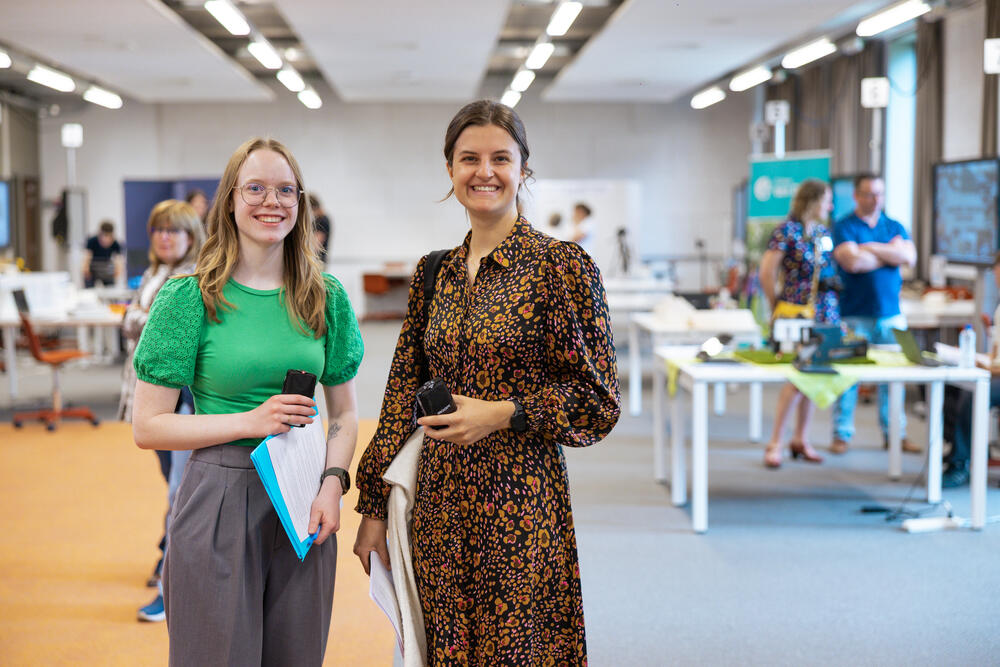
Afbeelding 3 - Onderzoeksters Britney Goffin (links) en Lola Demol (rechts) verzamelden data voor hun masterproeven tijdens de finale van de STEM-Award (Foto: Willem Bormans)
Bibliografie
Literatuur
Altindis, N., Ocheni, C. A., Tong, Y., & Obafemi, K. (2025). Impacts of gender, engineering, and role models on high school students’ overall STEM interest and perceptions of engineering. Education Sciences, 15(9), 1196-1202. https://doi.org/10.3390/educsci15091217
Amer, A., Sidhu, G., Alvarez, M. I. R., Ramos, J. A. L., & Srinivasan, S. (2024). Equity, diversity, and inclusion strategies in engineering and computer science. Education Sciences, 14(1), 1-14. https://doi.org/10.3390/educsci14010110
Archer, L., DeWitt, J., Godec, S., Henderson, M., Holmegaard, H., Liu, Q., MacLeod, E., Mendick, H., Moote, J., & Watson, E. (2023a). ASPIRES 3: Main Report. UCL Institute of Education. https://discovery.ucl.ac.uk/id/eprint/10181968/1/ASPIRES3%20Main%20Repo…
Archer, L., DeWitt, J., Godec, S., Henderson, M., Holmegaard, H., Liu, Q., MacLeod, E., Mendick, H., Moote, J., & Watson, E. (2023b). ASPIRES 3: Young people’s STEM trajectories, age 10-22. UCL Institute of Education. https://discovery.ucl.ac.uk/id/eprint/10182300/1/ASPIRES3%20Engineering…
Archer, L., Dewitt, J., & Osborne, J. (2015). Is science for us? Black students’ and parents’ views of science and science careers. Science Education, 99(2), 199-237. https://doi.org/10.1002/sce.21146
Archer, L., DeWitt, J., Osborne, J., Dillon, J., Willis, B., & Wong, B. (2012). Science aspirations, capital, and family habitus: How families shape children’s engagement and identification with science. American Educational Research Journal, 49(5), 881-908. https://doi.org/10.3102/0002831211433290
Avraamidou, L. (2020). Science identity as a landscape of becoming: Rethinking recognition and emotions through an intersectionality lens. Cultural Studies of Science Education, 15(2), 323-345. https://doi.org/10.1007/s11422-019-09954-7
Avraamidou, L. (2022). Identities in/out of physics and the politics of recognition. Journal of Research in Science Teaching, 59(1), 58-94. https://doi.org/10.1002/tea.21721
Bakhtin, M. (1981). The dialogic imagination: Four essays. University of Texas Press.
Ball, S. J. (2003). Class Strategies and the Education Market: The Middle Classes and Social Advantage. Routledge. https://doi.org/10.4324/9780203218952
Bandura, A. (1977). Self-efficacy: Toward a unifying theory of behavioral change. Psychological Review, 84(2), 191-215. https://doi.org/10.1037/0033-295X.84.2.191
Barton, A. C., & Tan, E. (2010). We be burnin’! Agency, identity, and science learning. Journal of the Learning Sciences, 19(2), 187-229. https://doi.org/10.1080/10508400903530044
Beier, M. E., Kim, M. H., Saterbak, A., Leautaud, V., Bishnoi, S., & Gilberto, J. M. (2019). The effect of authentic project‐based learning on attitudes and career aspirations in STEM. Journal of Research in Science Teaching, 56(1), 3-23. https://doi.org/10.1002/tea.21465
Bian, L., Leslie, S.-J., Murphy, M. C., & Cimpian, A. (2018). Messages about brilliance undermine women’s interest in educational and professional opportunities. Journal of Experimental Social Psychology, 76, 404-420. https://doi.org/10.1016/j.jesp.2017.11.006
Bleeker, M. M., & Jacobs, J. E. (2004). Achievement in math and science: Do mothers’ beliefs matter 12 years later? Journal of Educational Psychology, 96(1), 97-109. https://doi.org/10.1037/0022-0663.96.1.97
Boaler, J. (2002). Paying the price for “sugar and spice”: Shifting the analytical lens in equity research. Mathematical Thinking and Learning, 4(2-3), 127-144. https://doi.org/10.1207/S15327833MTL04023_3
Boaler, J. (2006). How a detracked mathematics approach promoted respect, responsibility, and high achievement. Theory Into Practice, 45(1), 40-46. https://doi.org/10.1207/s15430421tip4501_6
Bock, S. J., Lindsay, T. J., Zachary, P. E., & Wenying, S. (2013). Women and minorities in computer science majors: Results on barriers from interviews and a survey. Issues In Information Systems, 14(1), 143-152. https://doi.org/10.48009/1_iis_2013_143-152
Bourdieu, P. (1986). The forms of capital. In J. G. Richardson (Red.), Handbook of Theory and Research for the Sociology of Education (pp. 241-258). Greenwood.
Brickhouse, N. W. (2001). Embodying science: A feminist perspective on learning. Journal of Research in Science Teaching, 38(3), 282-295. https://doi.org/10.1002/1098-2736(200103)38:3%3C282::AID-TEA1006%3E3.0…
Busch-Vishniac, I. J., & Jarosz, J. P. (2004). Can diversity in the undergraduate engineering population be enhanced through curricular change? Journal of Women and Minorities in Science and Engineering, 10(3), 255-282. https://doi.org/10.1615/JWomenMinorScienEng.v10.i3.50
Buxton, C. A., Carlone, H. B., & Carlone, D. (2005). Boundary spanners as bridges of student and school discourses in an urban science and mathematics high school. School Science and Mathematics, 105(6), 302-312. https://doi.org/10.1111/j.1949-8594.2005.tb18131.x
Cabell, A. L., Brookover, D., Livingston, A., & Cartwright, I. (2021). “It’s never too late”: High school counselors’ support of underrepresented students’ interest in STEM. The Professional Counselor, 11(2), 143-160. https://doi.org/10.15241/alc.11.2.143
Cadaret, M. C., Hartung, P. J., Subich, L. M., & Weigold, I. K. (2017). Stereotype threat as a barrier to women entering engineering careers. Journal of Vocational Behavior, 99, 40-51. https://doi.org/10.1016/j.jvb.2016.12.002
Cannaerts, M., Craps, S., Draulans, V., & Langie, G. (2023). A look inside the engineering students’ backpack: Differences in engineering capital according to gender of migration background. European Society for Engineering Education (SEFI). https://doi.org/10.21427/MZBQ-S62711.
Cannaerts, M., Craps, S., & Langie, G. (2025). Engineering, more than meets the eye? An intervention to stimulate engineering interest for last-year pupils in secondary education. The 16th Conference of The European Science Education Research Association (ESERA). https://www.researchgate.net/publication/385194032_The_15th_Conference_…
Cannaerts, M., Craps, S., Veldman, J., Van Laar, C., Draulans, V., & Langie, G. (2025). Belonging in engineering education: A systematic literature review of its impact on recruitment and retention for female students and students from ethnic minority backgrounds. European Journal of Engineering Education, 50(3), 512-538. https://doi.org/10.1080/03043797.2024.2449212
Cannaerts, M., Craps, S., Veldman, J., Van Laar, C., Draulans, V., & Langie, G. (2025). Gendered pathways to interest in engineering programmes: The role of identity and anticipated sense of belonging. [Manuscript ingediend voor publicatie]. Katholieke Universiteit Leuven.
Carlone, H. B. (2004). The cultural production of science in reform‐based physics: Girls’ access, participation, and resistance. Journal of Research in Science Teaching, 41(4), 392-414. https://doi.org/10.1002/tea.20006
Carlone, H. B., & Johnson, A. (2007). Understanding the science experiences of successful women of color: Science identity as an analytic lens. Journal of Research in Science Teaching, 44(8), 1187-1218. https://doi.org/10.1002/tea.20237
Cheryan, S., Master, A., & Meltzoff, A. N. (2015). Cultural stereotypes as gatekeepers: Increasing girls’ interest in computer science and engineering by diversifying stereotypes. Frontiers in Psychology, 6. https://doi.org/10.3389/fpsyg.2015.00049
Cheryan, S., Plaut, V. C., Handron, C., & Hudson, L. (2013). The stereotypical computer scientist: Gendered media representations as a barrier to inclusion for women. Sex Roles, 69(1-2), 58-71. https://doi.org/10.1007/s11199-013-0296-x
Clark, A., & Kajfez, R. (2019). Engineering identity in pre-college students: A literature review. 2019 ASEE Annual Conference & Exposition Proceedings. https://doi.org/10.18260/1-2--32727
Codiroli Mcmaster, N. (2017). Who studies STEM subjects at A level and degree in England? An investigation into the intersections between students’ family background, gender and ethnicity in determining choice. British Educational Research Journal, 43(3), 528-553. https://doi.org/10.1002/berj.3270
Craps, S. (2022). Breaking through stereotypes: Professional roles for future engineers. [Doctoraatsthesis, KU Leuven]. Lirias. https://kuleuven.limo.libis.be/discovery/fulldisplay?docid=lirias376806…
Craps, S., Cannaerts, M., Veldman, J., Draulans, V., Van Laar, C., & Greet, L. (2022). Enhancing (future) students’ sense of belonging to increase diversity and inclusion in engineering. SEFI 50th Annual Conference: Towards a New Future in Engineering Education, 215-224. https://doi.org/10.5821/conference-9788412322262.1367
Dawson, E. (2014). “Not designed for us”: How science museums and science centers socially exclude low‐income, minority ethnic groups. Science Education, 98(6), 981-1008. https://doi.org/10.1002/sce.21133
Dawson, E., Archer, L., Seakins, A., Godec, S., DeWitt, J., King, H., Mau, A., & Nomikou, E. (2020). Selfies at the science museum: Exploring girls’ identity performances in a science learning space. Gender and Education, 32(5), 664-681. https://doi.org/10.1080/09540253.2018.1557322
Dawson, E., Bista, R., Colborne, A., McCubbin, B., Godec, S., Patel, U., Archer, L., & Mau, A. (2024). Inclusion for STEM, the institution, or minoritized youth? Exploring how educators navigate the discourses that shape social justice in informal science learning practices. Science Education, 108(3), 792-819. https://doi.org/10.1002/sce.21856
De Coen, A., & Van Hoed, M. (2021). STEM in Vlaanderen: Terugblik en ambities voor de toekomst. Agentschap Innoveren en Ondernemen. https://www.google.com/url?sa=t&source=web&rct=j&opi=89978449&url=https…
De Vlaamse Onderwijsraad. (2025). Jaarverslag 2024-2025 Vlaamse Onderwijsraad. https://www.vlor.be/publicaties/jaarverslag/jaarverslag-2024-2025
Deci, E. L., & Ryan, R. M. (2000). The “what” and “why” of goal pursuits: Human needs and the self-determination of behavior. Psychological Inquiry, 11(4), 227-268. https://doi.org/10.1207/S15327965PLI1104_01
DeLisi, J., Liu, E., & Fields, E. (2025). Implementing project-based learning in urban high school stem career pathways. Urban Education, 60(5), 1361-1384. https://doi.org/10.1177/00420859231214174
Departement Onderwijs en Vorming. (2025). STEM-monitor: Opvolging onderwijsindicatoren STEM-agenda 2030. De Vlaamse Overheid. https://www.vlaanderen.be/publicaties/stem-monitor
DeWaters, J., Moosbrugger, J., & Sharma, P. (2017). Development and application of a questionnaire to measure student attitudes toward and understanding of engineering. 2017 ASEE Annual Conference & Exposition Proceedings, Article 28153. https://doi.org/10.18260/1-2--28153
Diekman, A. B., Brown, E. R., Johnston, A. M., & Clark, E. K. (2010). Seeking congruity between goals and roles: a new look at why women opt out of science, technology, engineering, and mathematics careers. Psychological Science, 21(8), 1051-1057. https://doi.org/10.1177/0956797610377342
Dorie, B., Jones, T., Pollock, M., & Cardella, M. (2014). Parents as critical influence: insights from five different studies. 2014 ASEE Annual Conference & Exposition Proceedings, 24.968.1-24.968.13. https://doi.org/10.18260/1-2--22901
Dou, R., & Cian, H. (2022). Constructing STEM identity: An expanded structural model for STEM identity research. Journal of Research in Science Teaching, 59(3), 458-490. https://doi.org/10.1002/tea.21734
Dou, R., Hazari, Z., Dabney, K., Sonnert, G., & Sadler, P. (2019). Early informal STEM experiences and STEM identity: The importance of talking science. Science Education, 103(3), 623-637. https://doi.org/10.1002/sce.21499
Eccles, J. S., & Wigfield, A. (2002). Motivational beliefs, values, and goals. Annual Review of Psychology, 53(1), 109-132. https://doi.org/10.1146/annurev.psych.53.100901.135153
Ehrlinger, J., Plant, E. A., Hartwig, M. K., Vossen, J. J., Columb, C. J., & Brewer, L. E. (2018). Do gender differences in perceived prototypical computer scientists and engineers contribute to gender gaps in computer science and engineering? Sex Roles, 78(1-2), 40-51. https://doi.org/10.1007/s11199-017-0763-x
European Schoolnet. (2018). Science, technology, engineering and mathematics education policies in europe. European Schoolnet. https://www.scientix.eu/documents/10137/782005/Scientix_Texas-Instrumen…
Europese Commissie. (2011). Science education in Europe: National policies, practices and research. Publications Office of the European Union. https://doi.org/10.2797/7170
Europese Commissie. (2020). European skills agenda for sustainable competitiveness, social fairness and resilience. https://employment-social-affairs.ec.europa.eu/policies-and-activities/…
Europese Commissie. (2025). International Computer and Information Literacy Study (ICILS) in Europe, 2023: Main findings and educational policy implications. Publications Office of the European Union.https://doi.org/10.2766/5221263
Gee, J. P. (2000). Chapter 3: identity as an analytic lens for research in education. Review of Research in Education, 25(1), 99-125. https://doi.org/10.3102/0091732X025001099
Gillborn, D., & Mirza, H. S. (2000). Educational inequality: Mapping race, class and gender: A synthesis of research evidence (HMI 232). Office for Standards in Education. https://dera.ioe.ac.uk/id/eprint/4428/2/Educational_inequality_mapping_…
Godec, S., Archer, L., Moote, J., Watson, E., DeWitt, J., Henderson, M., & Francis, B. (2024). A missing piece of the puzzle? Exploring whether science capital and stem identity are associated with stem study at university.International Journal of Science and Mathematics Education, 22(7), 1615-1636. https://doi.org/10.1007/s10763-023-10438-y
Godwin, A. (2016). The development of a measure of engineering identity. 2016 ASEE Annual Conference & Exposition Proceedings, 26122. https://doi.org/10.18260/p.26122
Godwin, A., Cribbs, J., & Kayumova, S. (2020). Perspectives of identity as an analytic framework in stem education. In C. C. Johnson, M. J. Mohr-Schroeder, T. J. Moore, & L. D. English (Red.), Handbook of research on STEM education (pp. 267–277). Routledge. https://doi.org/10.4324/9780429021381-25
Godwin, A., & Kirn, A. (2020). Identity‐based motivation: Connections between first‐year students’ engineering role identities and future‐time perspectives. Journal of Engineering Education, 109(3), 362-383. https://doi.org/10.1002/jee.20324
Godwin, A., Potvin, G., Hazari, Z., & Lock, R. (2016). Identity, critical agency, and engineering: an affective model for predicting engineering as a career choice. Journal of Engineering Education, 105(2), 312-340. https://doi.org/10.1002/jee.20118
Good, C., Rattan, A., & Dweck, C. S. (2012). Why do women opt out? Sense of belonging and women’s representation in mathematics. Journal of Personality and Social Psychology, 102(4), 700-717. https://doi.org/10.1037/a0026659
Gottfredson, L. S. (1981). Circumscription and compromise: A developmental theory of occupational aspirations. Journal of Counseling Psychology, 28(6), 545–57928(6), 545-579.
Hamilton, A. F., Malin, J., & Hackmann, D. (2015). Racial/ethnic and gender equity patterns in Illinois high school career and technical education coursework. Journal of Career and Technical Education, 30(1). https://doi.org/10.21061/jcte.v30i1.712
Hazari, Z., Sonnert, G., Sadler, P. M., & Shanahan, M. (2010). Connecting high school physics experiences, outcome expectations, physics identity, and physics career choice: A gender study. Journal of Research in Science Teaching, 47(8), 978-1003. https://doi.org/10.1002/tea.20363
Heikamp, T., Phalet, K., Van Laar, C., & Verschueren, K. (2020). To belong or not to belong: Protecting minority engagement in the face of discrimination. International Journal of Psychology, 55(5), 779-788. https://doi.org/10.1002/ijop.12706
Henderson, M., Sullivan, A., Anders, J., & Moulton, V. (2018). Social class, gender and ethnic differences in subjects taken at age 14. The Curriculum Journal, 29(3), 298-318. https://doi.org/10.1080/09585176.2017.1406810
Hill, C., Corbett, C., & St. Rose, A. (2010). Why so few? Women in science, technology, engineering, and mathematics. American Association of University Women (AAUW). https://www.researchgate.net/publication/234647120_Why_So_Few_Women_in_…
Holland, D. C. (Red.). (2001). Identity and agency in cultural worlds. Harvard University Press.
Huff, J. L., & Ross, M. S. (2023). Advancing an integrative perspective of identity in engineering education. In A. Johri (Red.), International Handbook of Engineering Education Research (pp. 183-198). Routledge. https://doi.org/10.4324/9781003287483-11
Isaacs, B. (2001). Mystery of the missing women engineers: A solution. Journal of Professional Issues in Engineering Education and Practice, 127(2), 85-91. https://doi.org/10.1061/(ASCE)1052-3928(2001)127:2(85)
Iyer, A., Jetten, J., Tsivrikos, D., Postmes, T., & Haslam, S. A. (2009). The more (and the more compatible) the merrier: Multiple group memberships and identity compatibility as predictors of adjustment after life transitions. British Journal of Social Psychology, 48(4), 707-733. https://doi.org/10.1348/014466608X397628
Jacobs, J. E., & Eccles, J. S. (1992). The impact of mothers’ gender-role stereotypic beliefs on mothers’ and children’s ability perceptions. Journal of Personality and Social Psychology, 63(6), 932–944. https://doi.org/10.1037/0022-3514.63.6.932
Jiang, H., Zhang, L., & Lv, W. (2022). The impact of STEM competitions on students’ career interest and persistence in STEM. 2022 4th International Conference on Computer Science and Technologies in Education (CSTE), 279-283. https://doi.org/10.1109/CSTE55932.2022.00058
Jiang, Z., Wei, B., Chen, S., & Tan, L. (2024). Examining the formation of high school students’ science identity: The role of STEM-PBL experiences. Science & Education, 33(1), 135-157. https://doi.org/10.1007/s11191-022-00388-2
Jones, B. D., Ruff, C., & Paretti, M. C. (2013). The impact of engineering identification and stereotypes on undergraduate women’s achievement and persistence in engineering. Social Psychology of Education, 16(3), 471-493. https://doi.org/10.1007/s11218-013-9222-x
Jones, M. G., Brader-Araje, L., Carboni, L. W., Carter, G., Rua, M. J., Banilower, E., & Hatch, H. (2000). Tool time: Gender and students’ use of tools, control, and authority. Journal of Research in Science Teaching, 37(8), 760-783. https://doi.org/10.1002/1098-2736(200010)37:8%3C760::AID-TEA2%3E3.0.CO;…
Jose, P. E., Ryan, N., & Pryor, J. (2012). Does social connectedness promote a greater sense of well‐being in adolescence over time? Journal of Research on Adolescence, 22(2), 235-251. https://doi.org/10.1111/j.1532-7795.2012.00783.x
Kalanathan, T., & Weißenrieder, F. (2025). Gendered Views on Computer Science in Secondary Education[Posterpresentatie]. 12th ACM Celebration of Women in Computing (womENcourage 2025), Brașov, Roemenië. https://womencourage.acm.org/2025/wp-content/uploads/2025/12/Gendered-V…
Kalender, Z. Y., Marshman, E., Schunn, C. D., Nokes-Malach, T. J., & Singh, C. (2019). Why female science, technology, engineering, and mathematics majors do not identify with physics: They do not think others see them that way. Physical Review Physics Education Research, 15(2), 020148. https://doi.org/10.1103/PhysRevPhysEducRes.15.020148
Kim, A. Y., Sinatra, G. M., & Seyranian, V. (2018). Developing a STEM identity among young women: A social identity perspective. Review of Educational Research, 88(4), 589-625. https://doi.org/10.3102/0034654318779957
Kimps, D., Daniels, D., Van Hoed, M., & De Smedt, E. (2023). Inventarisatie van drempels en hefbomen in STEM en het STEM-ecosysteem in Vlaanderen. Departement Onderwijs en Vorming. https://www.vlaanderen.be/publicaties/inventarisatie-van-drempels-en-he…
Kinnunen, P., Butler, M., Morgan, M., Nylen, A., Peters, A.-K., Sinclair, J., Kalvala, S., & Pesonen, E. (2018). Understanding initial undergraduate expectations and identity in computing studies. European Journal of Engineering Education, 43(2), 201-218. https://doi.org/10.1080/03043797.2016.1146233
Koul, R. (2018). Work and family identities and engineering identity. Journal of Engineering Education, 107(2), 219-237. https://doi.org/10.1002/jee.20200
Kroger, J., Martinussen, M., & Marcia, J. E. (2010). Identity status change during adolescence and young adulthood: A meta‐analysis. Journal of Adolescence, 33(5), 683-698. https://doi.org/10.1016/j.adolescence.2009.11.002
Kruger, J., & Dunning, D. (2009). Unskilled and unaware of it: How difficulties in recognizing one’s own incompetence lead to inflated self-assessments. Journal of Personality and Social Psychology, 77(6), 1121–1134. https://10.1037/0022-3514.77.6.1121
Kuchynka, S. L., Gates, A. E., & Rivera, L. M. (2020). Identity Development during STEM Integration for Underrepresented Minority Students. Cambridge University Press. https://doi.org/10.1017/9781108882071
Lent, R. W., Brown, S. D., & Hackett, G. (1994). Toward a unifying social cognitive theory of career and academic interest, choice, and performance. Journal of Vocational Behavior, 45(1), 79-122. https://doi.org/10.1006/jvbe.1994.1027
Lent, R. W., Brown, S. D., Schmidt, J., Brenner, B., Lyons, H., & Treistman, D. (2003). Relation of contextual supports and barriers to choice behavior in engineering majors: Test of alternative social cognitive models. Journal of Counseling Psychology, 50(4), 458-465. https://doi.org/10.1037/0022-0167.50.4.458
Lent, R. W., Lopez, A. M., Lopez, F. G., & Sheu, H.-B. (2008). Social cognitive career theory and the prediction of interests and choice goals in the computing disciplines. Journal of Vocational Behavior, 73(1), 52-62. https://doi.org/10.1016/j.jvb.2008.01.002
Leslie, S.-J., Cimpian, A., Meyer, M., & Freeland, E. (2015). Expectations of brilliance underlie gender distributions across academic disciplines. Science, 347(6219), 262-265. https://doi.org/10.1126/science.1261375
Lewis, B. F. (2003). A critique of the literature on the underrepresentation of African Americans in science: Directions for future research. Journal of College Science Teaching, 32(6), 361–373.https://doi.org/10.1615/JWomenMinorScienEng.v9.i34.100
Lichtenstein, G., Loshbaugh, H. G., Claar, B., Chen, H. L., Jackson, K., & Sheppard, S. D. (2009). An engineering major does not (necessarily) an engineer make: career decision making among undergraduate engineering majors. Journal of Engineering Education, 98(3), 227-234. https://doi.org/10.1002/j.2168-9830.2009.tb01021.x
Marcia, J. E. (1966). Development and validation of ego-identity status. Journal of Personality and Social Psychology, 551-558. https://doi.org/10.1037/h0023281
Martin, J. P., Simmons, D. R., & Yu, S. L. (2013). The role of social capital in the experiences of hispanic women engineering majors. Journal of Engineering Education, 102(2), 227-243. https://doi.org/10.1002/jee.20010
Martínez-Moreno, J., Santos, P., & Hernandez-Leo, D. (2021). Maker Education in Primary Education: Changes in Students’ Maker-Mindset and Gender Differences. Ninth International Conference on Technological Ecosystems for Enhancing Multiculturality (TEEM’21), 120–125. https://doi.org/10.1145/3486011.3486431
Maslow, A. H. (1943). A theory of human motivtion. Psychological Review, 50(4), 370–396. https://doi.org/10.1037/h0054346
Master, A. (2021). Gender stereotypes influence children’s stem motivation. Child Development Perspectives, 15(3), 203-210. https://doi.org/10.1111/cdep.12424
Master, A., Meltzoff, A. N., & Cheryan, S. (2021). Gender stereotypes about interests start early and cause gender disparities in computer science and engineering. Proceedings of the National Academy of Sciences, 118(48), e2100030118. https://doi.org/10.1073/pnas.2100030118
Meschede, T., Erickson, M., Hoover, M., Haque, Z., Zhang, M., Melchior, A., & Burack, C. (2024). The FIRST Longitudinal Study: 10 Years of Follow-up Data. Brandeis University.
Meyer, M., Cimpian, A., & Leslie, S.-J. (2015). Women are underrepresented in fields where success is believed to require brilliance. Frontiers in Psychology, 6, Artikel 235. https://doi.org/10.3389/fpsyg.2015.00235
Meyers, K. L., Ohland, M. W., Pawley, A. L., Silliman, S. E., & Smith, K. A. (2012). Factors relating to engineering identity. Global Journal of Engineering Education, 14(1), 119–131.
Miller, K., Sonnert, G., & Sadler, P. (2018). The influence of students’ participation in STEM competitions on their interest in STEM careers. International Journal of Science Education, Part B, 8(2), 95-114. https://doi.org/10.1080/21548455.2017.1397298
Ministerie van Onderwijs, Cultuur en Wetenschap. (2022). Beslisnota: Verzending onderzoek SEO en ROA arbeidsmarktkrapte technici aan TK.
Mutegi, J. W. (2013). “Life’s first need is for us to be realistic” and other reasons for examining the sociocultural construction of race in the science performance of African American students. Journal of Research in Science Teaching, 50(1), 82-103. https://doi.org/10.1002/tea.21065
Nash, R. (1990). Bourdieu on education and social and cultural reproduction. British Journal of Sociology of Education, 11(4), 431-447. https://doi.org/10.1080/0142569900110405
O’Brien, L. T., Blodorn, A., Adams, G., Garcia, D. M., & Hammer, E. (2015). Ethnic variation in gender-STEM stereotypes and STEM participation: An intersectional approach. Cultural Diversity & Ethnic Minority Psychology, 21(2), 169-180. https://doi.org/10.1037/a0037944
OECD. (2019). OECD Skills Strategy Flanders: Assessment and Recommendations. OECD Publishing. https://doi.org/10.1787/9789264309791-en
OECD. (2023). PISA 2022 Results (Volume I): The State of Learning and Equity in Education. OECD Publishing. https://doi.org/10.1787/53f23881-en
Patrick, A. D., Borrego, M., & Prybutok, A. N. (2018). Predicting Persistence in Engineering through an Engineering Identity Scale. In 2018 IEEE Frontiers in Education Conference (FIE) (pp. 351–363).
Pierrakos, O., Beam, T. K., Constantz, J., Johri, A., & Anderson, R. (2009). On the development of a professional identity: Engineering persisters vs engineering switchers. 2009 39th IEEE Frontiers in Education Conference, 1-6. https://doi.org/10.1109/FIE.2009.5350571
Polanco-Jimenez, J., & De Witte, K. (2025). Factors influencing STEM participation and effective intervention strategies. Publications Office of the European Union. https://doi.org/10.2766/6852280
Portillo-Blanco, A., Deprez, H., De Cock, M., Guisasola, J., & Zuza, K. (2024). A systematic literature review of integrated STEM education: Uncovering consensus and diversity in principles and characteristics. Education Sciences, 14(9), 1028. https://doi.org/10.3390/educsci14091028
Rattan, A., Good, C., & Dweck, C. S. (2012). “It’s ok — Not everyone can be good at math”: Instructors with an entity theory comfort (and demotivate) students. Journal of Experimental Social Psychology, 48(3), 731-737. https://doi.org/10.1016/j.jesp.2011.12.012
Roland Berger. (2021). Imagining our common future: Acting now: ESG Report 2021.
Rosa, K. (2018). Science identity possibilities: A look into blackness, masculinities, and economic power relations. Cultural Studies of Science Education, 13(4), 1005-1013. https://doi.org/10.1007/s11422-018-9859-z
Rossi, A. S. (1965). Women in Science: Why So Few? Social and psychological influences restrict women’s choice and pursuit of careers in science. Science, 148(3674), 1196–1202.
Royal Society. (2008). Exploring the relationship between socioeconomic status and participation and attainment in science education.
Schilling, M., & Pinnell, M. (2018). The STEM gender gap: An evaluation of the efficacy of women in engineering camps. 2018 ASEE Annual Conference & Exposition Proceedings, 31126. https://doi.org/10.18260/1-2--31126
Sfard, A., & Prusak, A. (2005). Telling identities: In search of an analytic tool for investigating learning as a culturally shaped activity. Educational Researcher, 34(4), 14-22.
Simpson, A., & Bouhafa, Y. (2020). Youths’ and adults’ identity in stem: A systematic literature review. Journal for STEM Education Research, 3(2), 167-194. https://doi.org/10.1007/s41979-020-00034-y
Smith, M., Cihlarova, P., Lardot, M., Zell, T., & Williams, R. (2022). Green Skills Roadmap Flanders: Final Report on Green Skills Need in Flanders. Trinomics; Departement Werk en Sociale Economie. https://www.vlaanderen.be/publicaties/green-skills-roadmap-flanders-fin…
Sonnert, G., Reid, T., Sunbury, S., & Sadler, P. M. (2025). How do formal and informal science learning experiences during high school shape students’ career interest and STEM identity? International Journal of STEM Education, 12(1), 55. https://doi.org/10.1186/s40594-025-00568-w
Stake, J. E. (2006). The critical mediating role of social encouragement for science motivation and confidence among high school girls and boys. Journal of Applied Social Psychology, 36(4), 1017-1045. https://doi.org/10.1111/j.0021-9029.2006.00053.x
Starr, C. R. (2018). “I’m not a science nerd!”: STEM stereotypes, identity, and motivation among undergraduate women. Psychology of Women Quarterly, 42(4), 489-503. https://doi.org/10.1177/0361684318793848
Starr, C. R. (2025). A latent profile analysis of gender and ethnic/racial stereotypes about who belongs in physical sciences, technology, engineering, and mathematics fields. Journal of Diversity in Higher Education. Advance Online Publication. https://doi.org/10.1037/dhe0000666
Starr, C. R., & Leaper, C. (2019). Do adolescents’ self-concepts moderate the relationship between STEM stereotypes and motivation? Social Psychology of Education, 22(5), 1109-1129. https://doi.org/10.1007/s11218-019-09515-4
Steele, C. M., & Aronson, J. (1995). Stereotype threat and the intellectual test performance of African Americans. Journal of Personality and Social Psychology, 69(5), 797–811. https://doi.org/10.1037/0022-3514.69.5.797
Steinke, J. (2005). Cultural representations of gender and science: Portrayals of female scientists and engineers in popular films. Science Communication, 27(1), 27-63. https://doi.org/10.1177/1075547005278610
Steinke, J. (2017). Adolescent girls’ STEM identity formation and media images of stem professionals: Considering the influence of contextual cues. Frontiers in Psychology, 8, 716. https://doi.org/10.3389/fpsyg.2017.00716
STEM-platform. (2019). Aanbevelingen van het STEM-platform voor een STEM-actieplan 2020-2030. https://data-onderwijs.vlaanderen.be/documenten/bestanden/aanbevelingen…
Struyf, A., De Loof, H., Boeve-de Pauw, J., & Van Petegem, P. (2019). Students’ engagement in different STEM learning environments: Integrated STEM education as promising practice? International Journal of Science Education, 41(10), 1387-1407. https://doi.org/10.1080/09500693.2019.1607983
Tan, D., & Maeda, Y. (2021). Perceptions of science teachers’ growth-mindset practices and U.S. high school students’ initial science identity and its development. International Journal of Science Education, 43(13), 2206-2225. https://doi.org/10.1080/09500693.2021.1958021
Thibaut, L., Knipprath, H., Dehaene, W., & Depaepe, F. (2018). The influence of teachers’ attitudes and school context on instructional practices in integrated STEM education. Teaching and Teacher Education, 71, 190-205. https://doi.org/10.1016/j.tate.2017.12.014
Tiedemann, J. (2000a). Gender-related beliefs of teachers in elementary school mathematics. Educational Studies in Mathematics, 41(2), 191–207. https://doi.org/10.1023/A:1003953801526.
Tiedemann, J. (2000b). Parents’ gender stereotypes and teachers’ beliefs as predictors of children’s concept of their mathematical ability in elementary school. Journal of Educational Psychology, 92(1), 144–151. https://doi.org/10.%201007/s11199-011-9996-2
Tonso, K. L. (2006). Teams that work: Campus culture, engineer identity, and social interactions. Journal of Engineering Education, 95(1), 25-37. https://doi.org/10.1002/j.2168-9830.2006.tb00875.x
Urhahne, D., & Wijnia, L. (2023). Theories of motivation in education: An integrative framework. Educational Psychology Review, 35(2), 45. https://doi.org/10.1007/s10648-023-09767-9
Van Houte, H., Merckx, B., De Lange, J., & De Bruyker, M. (2013). Zin in wetenschap, wiskunde en techniek. Acco.
VARIO. (2021, september). STEM-agenda 2030 stem-competenties voor een toekomst- en missiegericht beleid (Advies nr. 23). Vlaamse Adviesraad voor Innoveren & Ondernemen.
Vervoort, S. (2023). What is the potential positive impact of belonging on the well-being of minority and majority youth in Flemish schools? [Masterproef, KU Leuven]
VLOR. (2019). Krijtlijnen voor een STEMactieplan 2020-2030 (AR-AR-ADV-1819-017). https://www.vlor.be/adviezen/krijtlijnen-voor-een-stem-actieplan-2020-2…
Walton, G. M., & Cohen, G. L. (2007). A question of belonging: Race, social fit, and achievement. Journal of Personality and Social Psychology, 92(1), 82-96. https://doi.org/10.1037/0022-3514.92.1.82
Walton, G. M., & Wilson, T. D. (2018). Wise interventions: Psychological remedies for social and personal problems. Psychological Review, 125(5), 617–655. https://doi.org/10.1037/rev0000115
Warne, R. T., Sonnert, G., & Sadler, P. M. (2019). The relationship between advanced placement mathematics courses and students’ STEM career interest. Educational Researcher, 48(2), 101-111. https://doi.org/10.3102/0013189X19825811
Waterman, A. S. (2007). Doing well: The relationship of identity status to three conceptions of well-being. Identity, 7(4), 289-307. https://doi.org/10.1080/15283480701600769
Wenger, E. (1998). Communities of practice: Learning, meaning, and identity. Cambridge University Press. https://doi.org/10.1017/CBO9780511803932
Wigfield, A., & Eccles, J. S. (2000). Expectancy–value theory of achievement motivation. Contemporary Educational Psychology, 25(1), 68-81. https://doi.org/10.1006/ceps.1999.1015
Wright, C., & Riley, A. (2021). Mitigating the need for resiliency for Black girls: Reimagining the cultural brokering through a lens of science as white property. Cultural Studies of Science Education, 16(2), 495-500. https://doi.org/10.1007/s11422-020-10005-9
Young, A., Dawes, L., & Senadji, B. (2023). Using journey maps as a holistic, reflective approach to capture student engineering identity experiences. European Journal of Engineering Education, 49(1), 22-44. https://doi.org/10.1080/03043797.2023.2268023
Youngblut, J. M., & Casper, G. R. (1993). Focus on psychometrics: Single‐item indicators in nursing research. Research in Nursing & Health, 16(6), 459-465. https://doi.org/10.1002/nur.4770160610