30% van de oceaan beschermen? Het maakt uit welke 30%
Amper één procent van het leefgebied van de Australische langsnuitrog (Dentiraja confusa) is beschermd tegen visserij. Dat klinkt vreemd in een land waar bijna de helft van de zee beschermd is. Ons onderzoek naar 335 soorten haaien en roggen toont aan dat niet alleen de hoeveelheid oceaan die we beschermen telt, maar vooral waar die bescherming ligt.
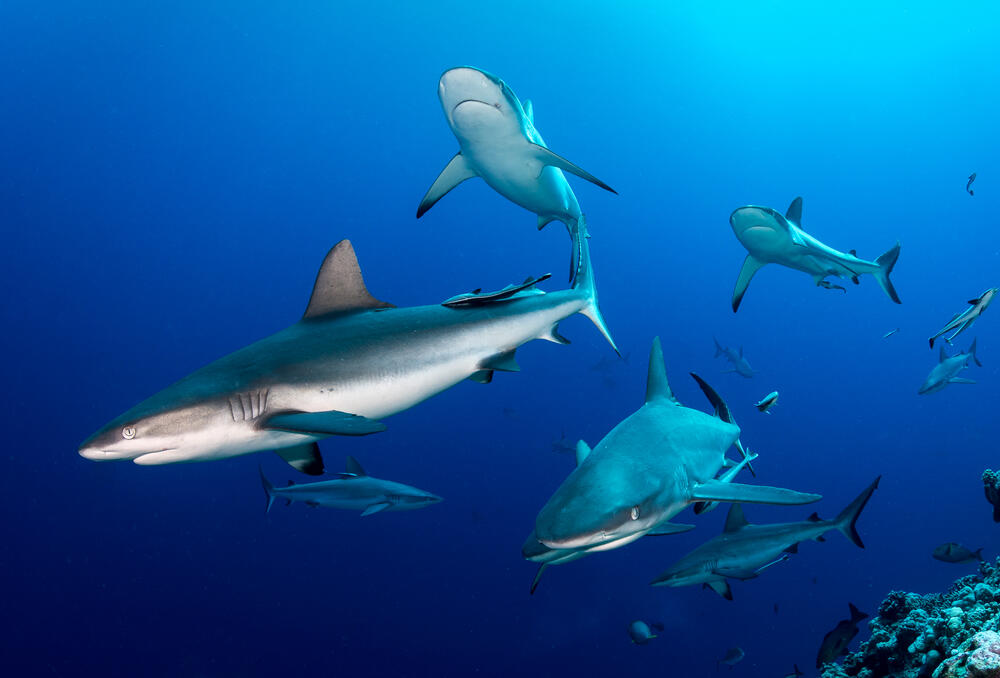
Rifhaaien in Australië (© Ocean Image Databank - Matt Curnock)
Sinds Jaws in 1975 verscheen, zwemt bij vele mensen een haai mee in het achterhoofd zodra ze in de zee gaan. Tegelijk betalen toeristen honderden euro’s om naast een walvishaai te snorkelen. Angst en fascinatie gaan hand in hand.
De werkelijkheid draait dat beeld bijna volledig om. Jaarlijks sterven wereldwijd hooguit een tiental mensen door een haaienbeet. Mensen doden er naar schatting tientallen miljoenen. Meer dan een derde van de soorten wordt met uitsterven bedreigd. Daarmee behoren ze tot de meest bedreigde gewervelde dieren in zee. De belangrijkste oorzaak is de visserij, zowel gericht als via onbedoelde bijvangst.
Haaien en roggen zijn extra kwetsbaar omdat ze traag groeien, pas laat volwassen worden en weinig jongen krijgen. Populaties herstellen daarom maar langzaam. Tegelijk zijn ze als roofdieren belangrijk voor het evenwicht in de voedselketen. Hun bescherming is dus niet alleen belangrijk voor de dieren zelf, maar ook voor het ecosysteem waarvan zij deel uitmaken.
Dertig procent tegen 2030
Om het verlies aan biodiversiteit af te remmen, beloofden bijna 200 landen, waaronder België, om tegen 2030 dertig procent van hun zee te beschermen. Maar een beschermd gebied is maar zo goed als zijn ligging en zijn regels. In veel ervan mag bijvoorbeeld nog steeds gevist worden.
Australië lijkt nochtans goed op weg. Bijna de helft van zijn wateren is beschermd en ongeveer de helft daarvan is volledig gesloten voor de visserij. Zulke gebieden noemen we no-take-zones. Bovendien leven in Australische wateren zowat een kwart van alle haaien- en roggensoorten ter wereld. Een ideaal proefterrein dus om te testen of veel beschermde zee ook goed beschermde zee is.
Beschermd, maar niet waar het telt
Voor ons onderzoek legden we de kaarten van de Australische beschermde gebieden en de leefgebieden van 335 soorten haaien en roggen over elkaar. Het verschil was opvallend: de strengste bescherming ligt vaak niet waar de meeste soorten leven. In no-take-zones komen gemiddeld slechts zo’n tien soorten voor. In beschermde gebieden waar wél nog gevist mag worden, zijn dat er meer dan dertig. Gemiddeld ligt meer dan de helft van het leefgebied van een soort zelfs buiten elk beschermd gebied. En dan is er de Australische langsnuitrog (Dentiraja confusa). Die soort komt nergens anders ter wereld voor, maar amper één procent van zijn leefgebied is beschermd tegen visserij. Waarom? De rijkste gebieden voor haaien en roggen liggen vooral in ondiepere kustwateren. Veel grote no-take-gebieden liggen daarentegen verder uit de kust en in diepere wateren rond afgelegen eilanden.
Maar waar moet bescherming dan wél komen?
Een natuurgebied afbakenen voor een dier dat duizenden kilometers zwemt, lijkt lastig. Toch gebruiken haaien en roggen niet elk deel van hun leefgebied op dezelfde manier. Veel soorten keren terug naar specifieke plekken om te paren, jongen te krijgen, te eten of uit te rusten. De Shark Specialist Group van de internationale natuurbeschermingsorganisatie IUCN duidt zulke sleutelgebieden daarom aan als Important Shark and Ray Areas (ISRA’s). Voor Australië is die kaart pas sinds februari 2026 compleet.
Wat blijkt? Die kraamkamers, foerageerzones en rustplaatsen beslaan samen amper twee procent van de Australische wateren. Toch ligt slechts een vijfde daarvan in een no-take-zone. Een groot deel bevindt zich buiten het bestaande beschermde netwerk. We weten dus steeds beter waar de belangrijkste plekken voor haaien en roggen liggen. Alleen ligt de strengste bescherming vaak ergens anders.
Dezelfde 30%, een ander resultaat
Australië wil zijn no-take-bescherming uitbreiden tot 30% van zijn zeegebied. Maar wat als je die extra bescherming gericht inzet? Om dat te testen, verdeelden we de Australische wateren in meer dan honderdduizend stukken. Een algoritme legde vervolgens de puzzel: welke combinatie van gebieden komt zo dicht mogelijk bij onze natuurdoelen, zonder de 30% te overschrijden? We wilden twee doelen bereiken: minstens 30% van het leefgebied van elke soort beschermen én alle belangrijke gebieden voor haaien en roggen volledig beschermen. We testten twee mogelijkheden. In het eerste scenario mochten nieuwe no-take-zones alleen binnen bestaande beschermde gebieden komen. In het tweede mocht het model overal kiezen.
De totale oppervlakte bleef dus dezelfde. Het resultaat niet. Met nieuwe zones binnen de bestaande grenzen bleef gemiddeld nog 19% van onze natuurdoelen niet ingevuld. Als het model vrij mocht kiezen waar nieuwe zones kwamen, bleef nog amper 3% over. Ook voor de sleutelgebieden was het verschil groot. Binnen de bestaande grenzen raakten 51 van de 138 volledig beschermd. Met vrije keuze waren dat er 136. Een computermodel beslist natuurlijk niet waar morgen nieuwe natuurgebieden komen. Visserij, lokale gemeenschappen en de economie spelen altijd mee. Toch leggen de resultaten een fundamenteel probleem bloot. Dezelfde oppervlakte kan een heel andere natuurwinst opleveren, afhankelijk van waar de bescherming terechtkomt.
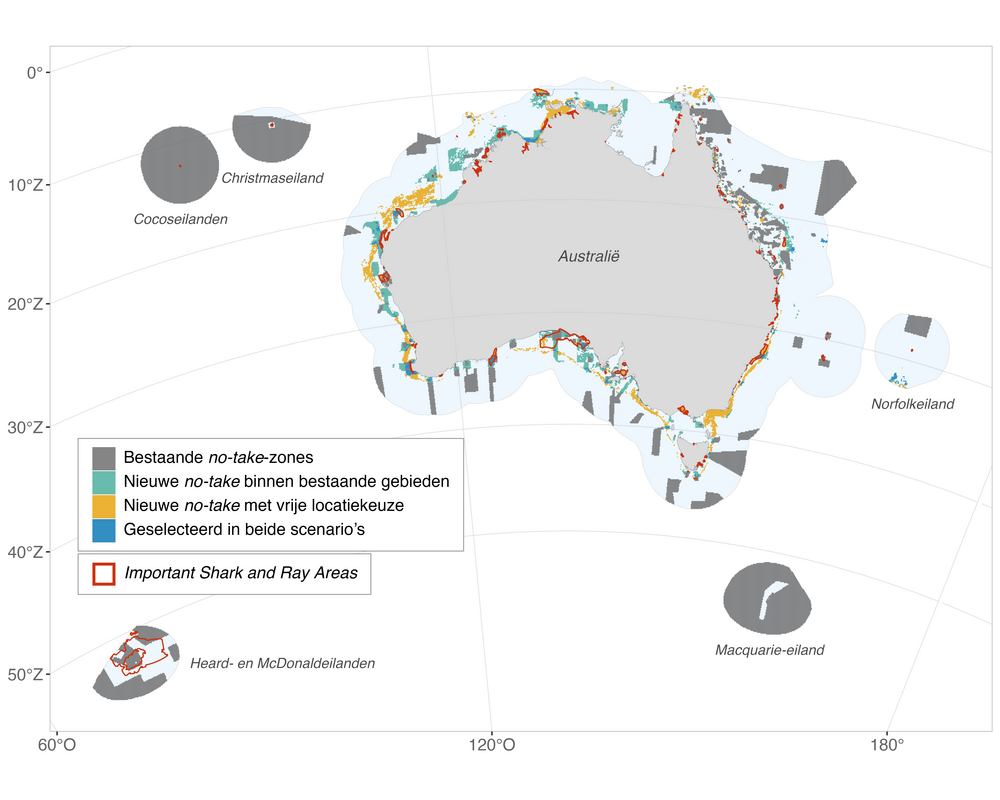
De kaart toont waar extra no-take-bescherming werd geselecteerd. De sleutelgebieden voor haaien en roggen zijn ook weergegeven (bron: Helena Verbruggen).
Niet alleen een haaienverhaal
De les reikt veel verder dan haaien en roggen. Biodiversiteit is niet gelijkmatig verspreid over de oceaan. Honderd vierkante kilometer diepzee is ecologisch niet hetzelfde als honderd vierkante kilometer kustwater vol kraamkamers, voedselgebieden en soortenrijke habitats. Net daarom wordt ecologische informatie steeds belangrijker. De sleutelgebieden voor haaien en roggen tonen waar cruciale gebieden voor deze dieren liggen. Vergelijkbare kaarten bestaan ook voor vogels, zeezoogdieren en zeeschildpadden. Zulke gegevens kunnen helpen om beschermde netwerken niet alleen groter, maar ook effectiever te maken.
Dertig procent beschermen blijft een belangrijke maatstaf voor vooruitgang, maar het is geen eindpunt. Wat telt, is waar de bescherming ligt en welke bedreiging daadwerkelijk vermindert. In 2030 zal de vraag dus niet alleen zijn of we dertig procent hebben ingekleurd, maar vooral wat er binnen die lijnen leeft.
Bibliografie
Arnold, A. E., Matsushiba, J. H., & Dulvy, N. K. (2026). Sharks, rays and MPAs: A global assessment of Marine Protected Area coverage in national waters across species ranges. Conservation Letters. https://doi.org/https://doi.org/10.1111/con4.70071
Ban, N. C., Gurney, G. G., Marshall, N. A., Whitney, C. K., Mills, M., Gelcich, S., Bennett, N. J., Meehan, M. C., Butler, C., Ban, S., Tran, T. C., Cox, M. E., & Breslow, S. J. (2019). Well-being outcomes of Marine Protected Areas. In Nature Sustainability (Vol. 2, Number 6, pp. 524–532). Nature Publishing Group. https://doi.org/10.1038/s41893-019-0306-2
Baum, J. K., & Worm, B. (2009). Cascading top-down effects of changing oceanic predator abundances. In Journal of Animal Ecology (Vol. 78, Number 4, pp. 699–714). https://doi.org/10.1111/j.1365-2656.2009.01531.x
BirdLife International. (2006). Monitoring Important Bird Areas: a global framework: 1.2.
Birkmanis, C. A., Partridge, J. C., Simmons, L. W., Heupel, M. R., & Sequeira, A. M. M. (2020). Shark conservation hindered by lack of habitat protection. Global Ecology and Conservation, 21. https://doi.org/10.1016/j.gecco.2019.e00862
Boyd, C., Charles, R., García-Rodríguez, E., Gonzalez-Pestana, A., Kyne, P. M., Rohner, C. A., Notarbartolo di Sciara, G., & Jabado, R. W. (2025). Applying the Key Biodiversity Area standard to important sites for sharks. Conservation Letters, 18(3). https://doi.org/10.1111/conl.13117
Buenafe, K. C. V., Dunn, D. C., Everett, J. D., Brito-Morales, I., Schoeman, D. S., Hanson, J. O., Dabalà, A., Neubert, S., Cannicci, S., Kaschner, K., & Richardson, A. J. (2023). A metric-based framework for climate-smart conservation planning. Ecological Applications, 33(4). https://doi.org/10.1002/eap.2852
Butchart, S. H. M., Crowe, O., Scott, T., Plumptre, A. J., Eldred, M., McKee, E., Waliczky, Z., Hasani, I. Al, Azpiroz, A. B., Baisero, D., Barasa, F., Beresford, A. E., Bezeng, B. S., Boyd, C., Brooks, T. M., Buchanan, G., Bunting, G., Capellan, S., Cox, N., … Upgren, A. (2026). Extent, characteristics and policy applications of Key Biodiversity Areas. Biological Reviews. https://doi.org/10.1002/brv.70144
CBD. (2022, December 19). Kunming-Montreal global biodiversity framework. https://www.cbd.int/conferences/post20202CBD/WG8J/11/7,CBD/SBSTTA/23/9,….
Clarke, T. M., Espinoza, M., Romero Chaves, R., & Wehrtmann, I. S. (2018). Assessing the vulnerability of demersal elasmobranchs to a data-poor shrimp trawl fishery in Costa Rica, Eastern Tropical Pacific. Biological Conservation, 217, 321–328. https://doi.org/10.1016/J.BIOCON.2017.11.015
Cochran, J. E. M., Charles, R., Temple, A. J., Kyne, P. M., García‐Rodríguez, E., Gonzalez‐Pestana, A., Batlle‐Morera, A., Mouton, T. L., Armstrong, A. O., Rohner, C. A., Coker, D. J., Hardenstine, R. S., Kattan, A., McIvor, A. J., Peinemann, V. N., O’Toole, K. A., Palm, L., Richardson, E. B., Akhilesh, K. V., … Jabado, R. W. (2026). Only one percent of Important Shark and Ray Areas in the Western Indian Ocean are fully protected from fishing pressure. Ecology and Evolution, 16(1). https://doi.org/10.1002/ece3.72690
Commonwealth of Australia. (2024). Achieving 30 by 30 on land: National roadmap for protecting and conserving 30% of Australia’s land by 2030, Commonwealth of Australia 2024. www.dcceew.gov.au/about/contact
Cortés, E., Arocha, F., Beerkircher, L., Carvalho, F., Domingo, A., Heupel, M., Holtzhausen, H., Santos, M. N., Ribera, M., & Simpfendorfer, C. (2010). Ecological risk assessment of pelagic sharks caught in Atlantic pelagic longline fisheries. Aquatic Living Resources, 23(1), 25–34. https://doi.org/10.1051/alr/2009044
Dabalà, A., Dahdouh-Guebas, F., Dunn, D. C., Everett, J. D., Lovelock, C. E., Hanson, J. O., Buenafe, K. C. V., Neubert, S., & Richardson, A. J. (2023). Priority areas to protect mangroves and maximise ecosystem services. Nature Communications, 14(1). https://doi.org/10.1038/s41467-023-41333-3
Davidson, L. N. K., & Dulvy, N. K. (2017). Global Marine Protected Areas to prevent extinctions. Nature Ecology and Evolution, 1(2). https://doi.org/10.1038/s41559-016-0040
Day, J., Dudley, N., Hockings, M., Holmes, G., Laffoley, D., Stolton, S., & Wells, S. (2012). Guidelines for applying the IUCN protected area management categories to Marine Protected Areas. www.iucn.org/pa_guidelines
Dedman, S., Moxley, J. H., Papastamatiou, Y. P., Braccini, M., Caselle, J. E., Chapman, D. D., Cinner, J. E., Dillon, E. M., Dulvy, N. K., Dunn, R. E., Espinoza, M., Harborne, A. R., Harvey, E. S., Heupel, M. R., Huveneers, C., Graham, N. A. J., Ketchum, J. T., Klinard, N. V., Kock, A. A., … Heithaus, M. R. (2024). Ecological roles and importance of sharks in the Anthropocene Ocean. In Science (Vol. 385, Number 6708). American Association for the Advancement of Science. https://doi.org/10.1126/science.adl2362
Devillers, R., Pressey, R. L., Grech, A., Kittinger, John. N., Edgar, G. J., Ward, T., & Watson, R. (2015). Reinventing residual reserves in the sea: Are we favouring ease of establishment over need for protection? Aquatic Conservation: Marine and Freshwater Ecosystems, (25), 480–504.
Doxa, A., Adam, C., Nagkoulis, N., Mazaris, A. D., & Katsanevakis, S. (2025). prior3D: An R package for three-dimensional conservation prioritization. Ecological Modelling, 499. https://doi.org/10.1016/j.ecolmodel.2024.110919
Dulvy, N. K., Pacoureau, N., Matsushiba, J. H., Yan, H. F., VanderWright, W. J., Rigby, C. L., Finucci, B., Sherman, C. S., Jabado, R. W., Carlson, J. K., Pollom, R. A., Charvet, P., Pollock, C. M., Hilton-Taylor, C., & Simpfendorfer, C. A. (2024). Ecological erosion and expanding extinction risk of sharks and rays. Science,386(6726), eadn1477. https://doi.org/10.1126/science.adn1477
Dulvy, N. K., Pacoureau, N., Rigby, C. L., Pollom, R. A., Jabado, R. W., Ebert, D. A., Finucci, B., Pollock, C. M., Cheok, J., Derrick, D. H., Herman, K. B., Sherman, C. S., VanderWright, W. J., Lawson, J. M., Walls, R. H. L., Carlson, J. K., Charvet, P., Bineesh, K. K., Fernando, D., … Simpfendorfer, C. A. (2021). Overfishing drives over one-third of all sharks and rays toward a global extinction crisis. Current Biology, 31(21), 4773-4787.e8. https://doi.org/10.1016/j.cub.2021.08.062
Edgar, G. J., Stuart-Smith, R. D., Willis, T. J., Kininmonth, S., Baker, S. C., Banks, S., Barrett, N. S., Becerro, M. A., Bernard, A. T. F., Berkhout, J., Buxton, C. D., Campbell, S. J., Cooper, A. T., Davey, M., Edgar, S. C., Försterra, G., Galván, D. E., Irigoyen, A. J., Kushner, D. J., … Thomson, R. J. (2014). Global conservation outcomes depend on Marine Protected Areas with five key features. Nature, 506(7487), 216–220. https://doi.org/10.1038/nature13022
Ellis, J. R., McCully Phillips, S. R., & Poisson, F. (2017). A review of capture and post-release mortality of elasmobranchs. In Journal of Fish Biology (Vol. 90, Number 3, pp. 653–722). Blackwell Publishing Ltd. https://doi.org/10.1111/jfb.13197
Faure-Beaulieu, N., Lombard, A. T., Olbers, J., Goodall, V., da Silva, C., Daly, R., Jordaan, G., Kerwath, S. E., Kock, A., Mann, B. Q., Murray, T. S., Albano, P., Cliff, G., dos Santos, N. A., Gennari, E., Hammerschlag, N., Bester-van der Merwe, A. E., Watson, R., Andreotti, S., … Harris, J. (2023). A systematic conservation plan identifying critical areas for improved chondrichthyan protection in South Africa. Biological Conservation, 284. https://doi.org/10.1016/j.biocon.2023.110163
Fernández Bejarano, S. J., & Phol, L. (2024). mregions2: Access Data from Marineregions.org: Gazetteer & Data Products. https://doi.org/10.32614/CRAN.package.mregions2
Ferrier, S., Pressey, R. L., & Barrett, T. W. (2000). A new predictor of the irreplaceability of areas for achieving a conservation goal, its application to real-world planning, and a research agenda for further refinement. Biological Conservation, (93), 303–325. www.elsevier.com/locate/biocon
Finucci, B., Pacoureau, N., Rigby, C. L., Matsushiba, J. H., Faure-Beaulieu, N., Sherman, C. S., VanderWright, W. J., Jabado, R. W., Charvet, P., Mejía-Falla, P. A., Navia, A. F., Derrick, D. H., Kyne, P. M., Pollom, R. A., Walls, R. H. L., Herman, K. B., Kinattumkara, B., Cotton, C. F., Cuevas, J.-M., … Dulvy, N. K. (2024). Fishing for oil and meat drives irreversible defaunation of deepwater sharks and rays. Science, 383(6687), 1135–1141. https://doi.org/10.1126/science.ade9121
Fitzsimons, J. A. (2011). Mislabeling Marine Protected Areas and why it matters-a case study of Australia. Conservation Letters, 4(5), 340–345. https://doi.org/10.1111/j.1755-263X.2011.00186.x
Fleury, A. G., O’Hara, C. C., Butt, N., Restrepo, J., Halpern, B. S., Klein, C. J., Kuempel, C. D., Gaynor, K. M., Bentley, L. K., Richardson, A. J., & Dunn, D. C. (2024). Spatial and life history variation in a trait-based species vulnerability and impact model. PLoS ONE, 19(6). https://doi.org/10.1371/journal.pone.0305950
Flowers, K. I., Heithaus, M. R., & Papastamatiou, Y. P. (2021). Buried in the sand: Uncovering the ecological roles and importance of rays. Fish and Fisheries, 22(1), 105–127. https://doi.org/10.1111/faf.12508
Fourchault, L., Dahdouh-Guebas, F., Dunn, D. C., Everett, J. D., Hanson, J. O., Buenafe, K. C. V., Neubert, S., Dabalà, A., Yapa, K. K. A. S., Cannicci, S., & Richardson, A. J. (2024). Generating affordable protection of high seas biodiversity through cross-sectoral spatial planning. One Earth, 7(2), 253–264. https://doi.org/10.1016/j.oneear.2023.12.006
Gearty, W., & Chamberlain, S. (2025). rredlist: IUCN Red List Client. https://doi.org/10.32614/CRAN.package.rredlist
Gilman, E., Chaloupka, M., Benaka, L. R., Bowlby, H., Fitchett, M., Kaiser, M., & Musyl, M. (2022). Phylogeny explains capture mortality of sharks and rays in pelagic longline fisheries: A global meta-analytic synthesis. Scientific Reports, 12(1). https://doi.org/10.1038/s41598-022-21976-w
Giménez, J., Cardador, L., Mazor, T., Kark, S., Bellido, J. M., Coll, M., & Navarro, J. (2020). Marine Protected Areas for demersal elasmobranchs in highly exploited Mediterranean ecosystems. Marine Environmental Research, 160, 105033. https://doi.org/10.1016/J.MARENVRES.2020.105033
Gurobi Optimization, & LLC. (2026). gurobi: Gurobi Optimizer 13.0 interface. https://www.gurobi.com
Halpern, B. S., Frazier, M., Afflerbach, J., Lowndes, J. S., Micheli, F., O’Hara, C., Scarborough, C., & Selkoe, K. A. (2019). Recent pace of change in human impact on the world’s ocean. Scientific Reports, 9(1). https://doi.org/10.1038/s41598-019-47201-9
Hanson, J. O., Schuster, R., Strimas-Mackey, M., Morrell, N., Edwards, B. P. M., Arcese, P., Bennett, J. R., & Possingham, H. P. (2024). Systematic conservation prioritization with the prioritizr R package. Conservation Biology, 39(1). https://doi.org/10.1111/cobi.14376
Harry, A. V., Everett, B., Faria, V., Fordham, S., Grand, M. I., Haque, A. B., Ho, H., Jabado, R. W., Jones, G. C. A., Lear, K. O., Morgan, D. L., Philips, N. M., Spaet, J. L. Y., Tanna, A., & Wuerigner, B. E. (2022). Pristis zijsron. The IUCN Red List of Threatened Species 2022: e.T39393A58304631. In IUCN Red List of Threatened Species. https://doi.org/https://doi.org/10.2305/IUCN.UK.2022-2.RLTS.T39393A5830…
Heithaus, M. R., Frid, A., Wirsing, A. J., & Worm, B. (2008). Predicting ecological consequences of marine top predator declines. Trends in Ecology and Evolution, 4(23), 202–210. www.lenfestocean.org
Henriksen, M., Barnett, A., Butcher, P., Chin, A., Frisch, K., Green, M., How, J., McPhee, D., Mikitis, M., Scott-Holland, T., Simpfendorfer, C., Taylor, S., & Huveneers, C. (2025). Novel risk assessment framework to compare shark-bite mitigation strategies. People and Nature, 7(7), 1559–1580. https://doi.org/10.1002/pan3.70054
Heupel, M. R., Simpfendorfer, C. A., Espinoza, M., Smoothey, A. F., Tobin, A., & Peddemors, V. (2015). Conservation challenges of sharks with continental scale migrations. Frontiers in Marine Science, 2(FEB). https://doi.org/10.3389/fmars.2015.00012
Hyde, C. A., Notarbartolo di Sciara, G., Sorrentino, L., Boyd, C., Finucci, B., Fowler, S. L., Kyne, P. M., Leurs, G., Simpfendorfer, C. A., Tetley, M. J., Womersley, F., & Jabado, R. W. (2022). Putting sharks on the map: A global standard for improving shark area-based conservation. Frontiers in Marine Science, 9. https://doi.org/10.3389/fmars.2022.968853
IUCN Red List. (2026). The IUCN red list of threatened Species. https://www.iucnredlist.org
IUCN SSC Shark Specialist Group. (2024). Important Shark and Ray Area (ISRA): Guidance on Criteria Application 3rd Edition.
Jabado, R. W., García-Rodríguez, E., Armstrong, A. O., Rohner, C. A., Palacios, M. D., Gonzalez-Pestana, A., Bettcher, B. V., Charles, R., & Batlle-Morera, A. (2024). New Zealand and Pacific Islands: A regional compendium of Important Shark and Ray Areas. www.sharkrayareas.org
Jabado, R. W., García-Rodríguez, E., Kyne, P. M., Charles, R., Bettcher, B. V., Armstrong, A. O., Gonzalez-Pestana, A., Batlle-Morera, A., Palacios, M. D., & Rohner, C. A. (2024). Polar Waters: A regional compendium of Important Shark and Ray Areas. www.sharkrayareas.org
Jabado, R. W., García-Rodríguez, E., Kyne, P. M., Rohner, C. A., Palacios, M. D., Armstrong, A. O., Gonzalez-Pestana, A., Bettcher, B. V., Charles, R., & Batlle-Morera, A. (2026). Australia and Southeast Indian Ocean: A regional compendium of Important Shark and Ray Areas. www.sharkrayareas.org
Jones, P. J. S., & De Santo, E. M. (2016). Is the race for remote, Very Large Marine Protected Areas (VLMPAs) taking us down the wrong track? Marine Policy, 73, 231–234. https://doi.org/10.1016/J.MARPOL.2016.08.015
Jouffray, J. B., Blasiak, R., Norström, A. V., Österblom, H., & Nyström, M. (2020). The blue acceleration: The trajectory of human expansion into the ocean. In One Earth (Vol. 2, Number 1, pp. 43–54). Cell Press. https://doi.org/10.1016/j.oneear.2019.12.016
Jung, M., Arnell, A., de Lamo, X., García-Rangel, S., Lewis, M., Mark, J., Merow, C., Miles, L., Ondo, I., Pironon, S., Ravilious, C., Rivers, M., Schepaschenko, D., Tallowin, O., van Soesbergen, A., Govaerts, R., Boyle, B. L., Enquist, B. J., Feng, X., … Visconti, P. (2021). Areas of global importance for conserving terrestrial biodiversity, carbon and water. Nature Ecology and Evolution, 5(11), 1499–1509. https://doi.org/10.1038/s41559-021-01528-7
Klein, C. J., Brown, C. J., Halpern, B. S., Segan, D. B., McGowan, J., Beger, M., & Watson, J. E. M. (2015). Shortfalls in the global protected area network at representing marine biodiversity. Scientific Reports, 5. https://doi.org/10.1038/srep17539
Kyne, P. M. ., Heupel, M. R. ., White, W. T. ., & Simpfendorfer, C. A. . (2021). The action plan for Australian sharks and rays 2021. National Environmental Science Program, Marine Biodiversity Hub.
Lester, S. E., Halpern, B. S., Grorud-Colvert, K., Lubchenco, J., Ruttenberg, B. I., Gaines, S. D., Airamé, S., & Warner, R. R. (2009). Biological effects within no-take marine reserves: A global synthesis. Marine Ecology Progress Series, 384, 33–46. https://doi.org/10.3354/meps08029
MacKeracher, T., Diedrich, A., & Simpfendorfer, C. A. (2019). Sharks, rays and marine protected areas: A critical evaluation of current perspectives. Fish and Fisheries, 20(2), 255–267. https://doi.org/10.1111/faf.12337
MacNeil, M. A., Chapman, D. D., Heupel, M., Simpfendorfer, C. A., Heithaus, M., Meekan, M., Harvey, E., Goetze, J., Kiszka, J., Bond, M. E., Currey-Randall, L. M., Speed, C. W., Sherman, C. S., Rees, M. J., Udyawer, V., Flowers, K. I., Clementi, G., Valentin-Albanese, J., Gorham, T., … Cinner, J. E. (2020). Global status and conservation potential of reef sharks. Nature, 583(7818), 801–806. https://doi.org/10.1038/s41586-020-2519-y
McGowan, J., Smith, R. J., Di Marco, M., Clarke, R. H., & Possingham, H. P. (2018). An evaluation of Marine Important Bird and Biodiversity Areas in the context of spatial conservation prioritization. In Conservation Letters (Vol. 11, Number 3). Wiley-Blackwell. https://doi.org/10.1111/conl.12399
Moreno, D., Tracey, S., Woolley, B., Semmens, J. M., & Semmens, J. (2025). 2014-2024 Macquarie Harbour Maugean skate population status and monitoring report.
Mouton, T. L., Gonzalez-Pestana, A., Rohner, C. A., Charles, R., García-Rodríguez, E., Kyne, P. M., Batlle-Morera, A., di Sciara, G. N., Armstrong, A. O., Acuña, E., Alfaro-Shigueto, J., Arauz, R., Avalos-Castillo, C. G., Augustinus, E., Bessudo, S., Barraza, E., Bustamante, C., Chávez, E. J., Espinoza, E. R., … Jabado, R. W. (2025). Shortfalls in the protection of Important Shark and Ray Areas undermine shark conservation efforts in the Central and South American Pacific. Marine Policy, 171. https://doi.org/10.1016/j.marpol.2024.106448
MPAtlas. (2026, June 19). The Marine Protection Atlas. Marine Conservation Institute. https://mpatlas.org
Neubert, S., McGowan, J., Metcalfe, K., Hanson, J. O., Buenafe, K. C. V., Dabalà, A., Dunn, D. C., Everett, J. D., Possingham, H. P., Stelzenmüller, V., Estep, A., Ervin, J., & Richardson, A. J. (2025). Multiple-use spatial planning for sustainable development and conservation. Trends in Ecology & Evolution, 40(11), 1126–1142. https://doi.org/10.1016/J.TREE.2025.09.007
O’Hara, C. C., Afflerbach, J. C., Scarborough, C., Kaschner, K., & Halpern, B. S. (2017). Aligning marine species range data to better serve science and conservation. PLoS ONE, 12(5). https://doi.org/10.1371/journal.pone.0175739
Pike, E. P., MacCarthy, J. M. C., Hameed, S. O., Harasta, N., Grorud-Colvert, K., Sullivan-Stack, J., Claudet, J., Horta e Costa, B., Gonçalves, E. J., Villagomez, A., & Morgan, L. (2024). Ocean protection quality is lagging behind quantity: Applying a scientific framework to assess real marine protected area progress against the 30 by 30 target. In Conservation Letters (Vol. 17, Number 3). John Wiley and Sons Inc. https://doi.org/10.1111/conl.13020
Pimiento, C., Albouy, C., Silvestro, D., Mouton, T. L., Velez, L., Mouillot, D., Judah, A. B., Griffin, J. N., & Leprieur, F. (2023). Functional diversity of sharks and rays is highly vulnerable and supported by unique species and locations worldwide. Nature Communications, 14(1). https://doi.org/10.1038/s41467-023-43212-3
Plumptre, A. J., Butchart, S. H. M., von Staden, L., Smith, R. J., Matimele, H., Starnes, T., Brooks, T. M., Baisero, D., Costa, H., & Duarte, E. (2023). Key Biodiversity Areas are proving useful for spatial planning if the criteria are applied correctly. Perspectives in Ecology and Conservation, 21(3), 263–264. https://doi.org/10.1016/J.PECON.2023.07.001
R Core Team. (2026). R: A language and environment for statistical computing. R Foundation for Statistical Computing. https://www.R-project.org/
Raabe, N. L., King, T. J., Cardilini, A. P. A., Miller, K. K., Bangay, S., & Singleton, A. (2024). Casting a wider net: A national survey of Australian attitudes to Marine Protected Areas. Ocean and Coastal Management, 251. https://doi.org/10.1016/j.ocecoaman.2024.107100
Relano, V., & Pauly, D. (2023). The ‘Paper Park Index’: Evaluating Marine Protected Area effectiveness through a global study of stakeholder perceptions. Marine Policy, 151. https://doi.org/10.1016/j.marpol.2023.105571
Reygondeau, G., Egorova, Y., Boerder, K., Tittensor, D. P., Kaschner, K., Kesner-Reyes, K., Bailly, N., & Cheung, W. W. L. (2026). AquaX: An enhanced and revised AquaMaps framework to model marine species distributions and biodiversity. PLOS One, 21(2). https://doi.org/10.1371/journal.pone.0335823
Riley, M., Meagher, P., Huveneers, C., Leto, J., Peddemors, V. M., Slip, D., West, J., & Bradshaw, C. J. A. (2022). The Australian shark-incident database for quantifying temporal and spatial patterns of shark-human conflict. Scientific Data, 9(1). https://doi.org/10.1038/s41597-022-01453-9
Rodrigues, A. S. L., Resit Akçakaya, H., Andelman, S. J., Bakarr, M. I., Boitani, L., Brooks, T. M., Chanson, J. S., Fishpool, L. D. C., Da Fonseca, G. A. B., Gaston, K. J., Hoffmann, M., Marquet, P. A., Pilgrim, J. D., Pressey, R. L., Schipper, J., Sechrest, W., Stuart, S. N., Underhill, L. G., Waller, R. W., … Yan, X. (2004). Global gap analysis: Priority regions for expanding the global protected-area network (Vol. 54, Number 12).
Rohner, C. A., Richardson, A. J., García-Rodríguez, E., Charles, R., Batlle-Morera, A., Bortoluzzi, J. R., Mouton, T. L., Notarbartolo di Sciara, G., Armstrong, A. O., Everett, J. D., Bakiu, R., Barash, A., Bariche, M., Başusta, N., Bousquet, C., Ćetković, I., Giovos, I., Guallart, J., Milazzo, M., … Jabado, R. W. (2025). Important Shark and Ray Areas can inform conservation planning in the Mediterranean and Black Seas. IScience, 28(8). https://doi.org/10.1016/j.isci.2025.113192
Ryan, L. A., Lynch, S. K., Harcourt, R., Slip, D. J., Peddemors, V., Everett, J. D., Harrison, L. M., & Hart, N. S. (2019). Environmental predictive models for shark attacks in Australian waters. Marine Ecology Progress Series, 631, 165–179. https://doi.org/10.3354/meps13138
Sala, E., & Giakoumi, S. (2018). No-take marine reserves are the most effective protected areas in the ocean. ICES Journal of Marine Science, 75(3), 1166–1168. https://doi.org/10.1093/icesjms/fsx059
Shea, B. D., Gallagher, A. J., Bomgardner, L. K., & Ferretti, F. (2023). Quantifying longline bycatch mortality for pelagic sharks in western Pacific shark sanctuaries. Science Advances. https://www.science.org
Sherman, K., & Alexander, L. (1986). Variability and management of large marine ecosystems. Westview Press, Inc.,Boulder, CO. https://www.osti.gov/biblio/6958679
Simpfendorfer, C. A., Heupel, M. R., & Kendal, D. (2021). Complex human-shark conflicts confound conservation action. Frontiers in Conservation Science, 2. https://doi.org/10.3389/fcosc.2021.692767
Simpfendorfer, C., Chin, A., Rigby, C., Sherman, S., & White, W. (2019). Shark futures: A report card for Australia’s sharks and rays. www.frdc.com.au
Sreekar, R., & Watson, J. E. M. (2026). Updating species representation targets for protected and conserved area planning. Nature Reviews Biodiversity. https://doi.org/10.1038/s44358-026-00169-7
Tetley, M. J., Braulik, G. T., Lanfredi, C., Minton, G., Panigada, S., Politi, E., Zanardelli, M., Notarbartolo di Sciara, G., & Hoyt, E. (2022). The Important Marine Mammal Area network: A tool for systematic spatial planning in response to the marine mammal habitat conservation crisis. Frontiers in Marine Science, 9. https://doi.org/10.3389/fmars.2022.841789
Turnbull, J. W., Johnston, E. L., & Clark, G. F. (2021). Evaluating the social and ecological effectiveness of partially protected marine areas. Conservation Biology, 35(3), 921–932. https://doi.org/10.1111/cobi.13677
UNEP-WCMC. (2019). User manual for the World Database on Protected Areas and world database on other effective area-based conservation measures: 1.6. http://wcmc.io/WDPA_Manual
UNEP-WCMC, & IUCN. (2026). Protected Planet: The World Database on Protected Areas (WDPA). In 2026. UNEP-WCMC and IUCN. https://www.protectedplanet.net/en
Vianna, G. M. S., Meekan, M. G., Ruppert, J. L. W., Bornovski, T. H., & Meeuwig, J. J. (2016). Indicators of fishing mortality on reef-shark populations in the world’s first shark sanctuary: The need for surveillance and enforcement. Coral Reefs, 35(3), 973–977. https://doi.org/10.1007/s00338-016-1437-9
Ward-Paige, C. A., & Worm, B. (2017). Global evaluation of shark sanctuaries. Global Environmental Change, 47, 174–189. https://doi.org/10.1016/j.gloenvcha.2017.09.005
Watson, J. E. M., Venegas-Li, R., Grantham, H., Dudley, N., Stolton, S., Rao, M., Woodley, S., Hockings, M., Burkart, K., Simmonds, J. S., Sonter, L. J., Sreekar, R., Possingham, H. P., & Ward, M. (2023). Priorities for protected area expansion so nations can meet their Kunming-Montreal Global Biodiversity Framework commitments. In Integrative Conservation (Vol. 2, Number 3, pp. 140–155). Blackwell Publishing. https://doi.org/10.1002/inc3.24
WHO, & CBD. (2015). Connecting global priorities: Biodiversity and human health a state of knowledge review.
Yan, H. F., Kyne, P. M., Jabado, R. W., Leeney, R. H., Davidson, L. N. K., Derrick, D. H., Finucci, B., Freckleton, R. P., Fordham, S. V, & Dulvy, N. K. (2021). Overfishing and habitat loss drives range contraction o