Buiten de lijntjes om: hoe middeleeuwse grensgemeenschappen hun identiteit bevochten met recht en religie
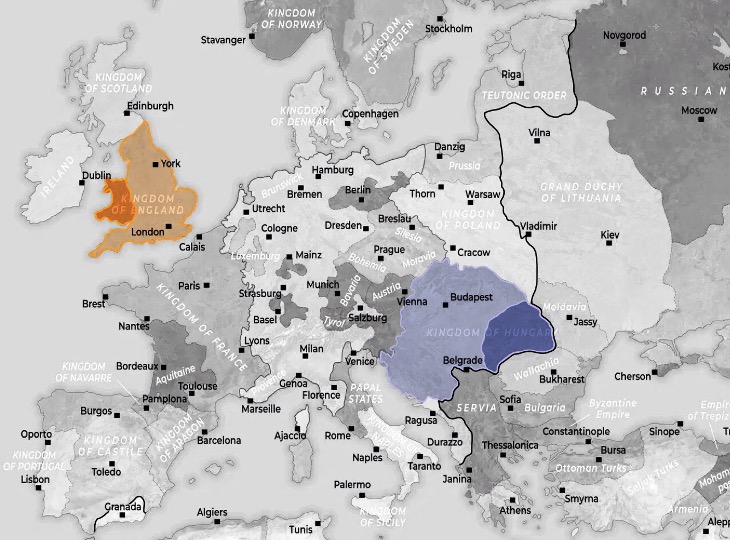
Grenzen lijken vandaag vanzelfsprekend: een strakke lijn op een kaart suggereert keurige hokjes, hoewel identiteit zich niet zo eenvoudig laat vatten. Tijdens de late middeleeuwen lag dit nog minder vast. In grensgebieden zoals Wales en Transsylvanië gebruikten lokale gemeenschappen recht en religie om hun positie te verdedigen en zichzelf collectief te definiëren. Hun verhalen laten zien hoe identiteit ontstaat op plaatsen waar verschillende talen, geloven, rechten, culturen of machtsstructuren elkaar raken.
Volgens de 14de-eeuwse Welshe legende van de heilige Beuno plantte hij ooit een eik die dodelijk was voor Engelsen, maar niet voor Welshmen. Historisch bewijs voor moorddadige botanie levert het uiteraard niet op. Interessanter is wat het verhaal wél doet: het biedt een literair motief voor een natuurlijke grens tussen een ‘wij’ en een ‘zij’.
Elders was de realiteit minder eenduidig. Het Hongaarse Transsylvanië vormde een ware smeltkroes waar Vlachen of Roemenen zij aan zij woonden met Hongaren, Saksen en Szeklers. Taal, geloof, gebruiken en privileges liepen er volstrekt door elkaar, waardoor hier gemeenschapsgrenzen op een heel andere manier afgebakend werden dan in Wales.
Maar hoe definieerden en bewaakten gemeenschappen in zulke uiteenlopende grensgebieden onder druk hun identiteit?
Recht als geheugen
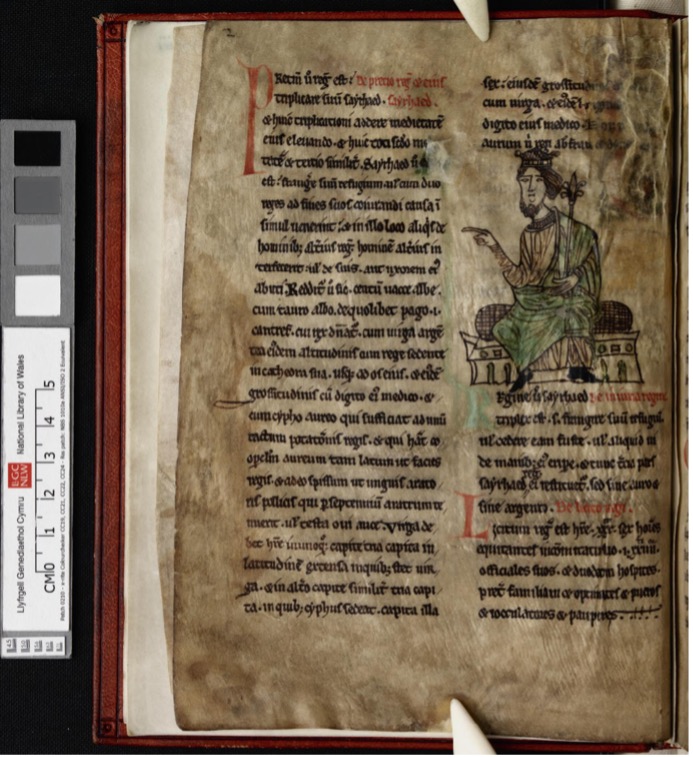
Een cruciaal antwoord ligt in het gewoonterecht. In laatmiddeleeuws Wales grepen geleerden terug naar Cyfraith Hywel, het vermeende wetboek van de 10de-eeuwse vorst Hywel de Goede. Hoewel de overgeleverde handschriften pas uit de 13de eeuw en later stammen, was die vroege toeschrijving belangrijk: het recht werd gepresenteerd als een oude, eigen traditie. Rechtsregels dienden zo als een legitimiteitspasje voor een eigen juridische orde, juist wanneer de politieke macht in Engelse handen viel. Recht was aldus een middel waarmee mensen hun positie verdedigden en betekenis gaven aan hun plaats binnen de samenleving.
In Transsylvanië werkte het lokale gewoonterecht van de Vlachen, het ius valachicum, volgens een andere dynamiek. In tegenstelling tot het Welshe corpus betrof dit geen neergepend wetboek. Veel regels bleven mondeling en zijn vandaag alleen indirect te reconstrueren via oorkonden en regionale statuten. Niettemin bepaalde dit recht de materiële werkelijkheid van een onderdrukte herdersbevolking. Het structureerde grondgebruik, feodale verplichtingen, lokale rechtspraak en sociale organisatie in een landschap waar transhumance sociale status mee bepaalde.
In beide gevallen bewaarde het recht een idee van autonomie en continuïteit. Het verankerde een collectief besef van toe-eigening: “Zo deden wij het al, en dus hebben wij hier recht van spreken.”
Religie als wijder grensverhaal
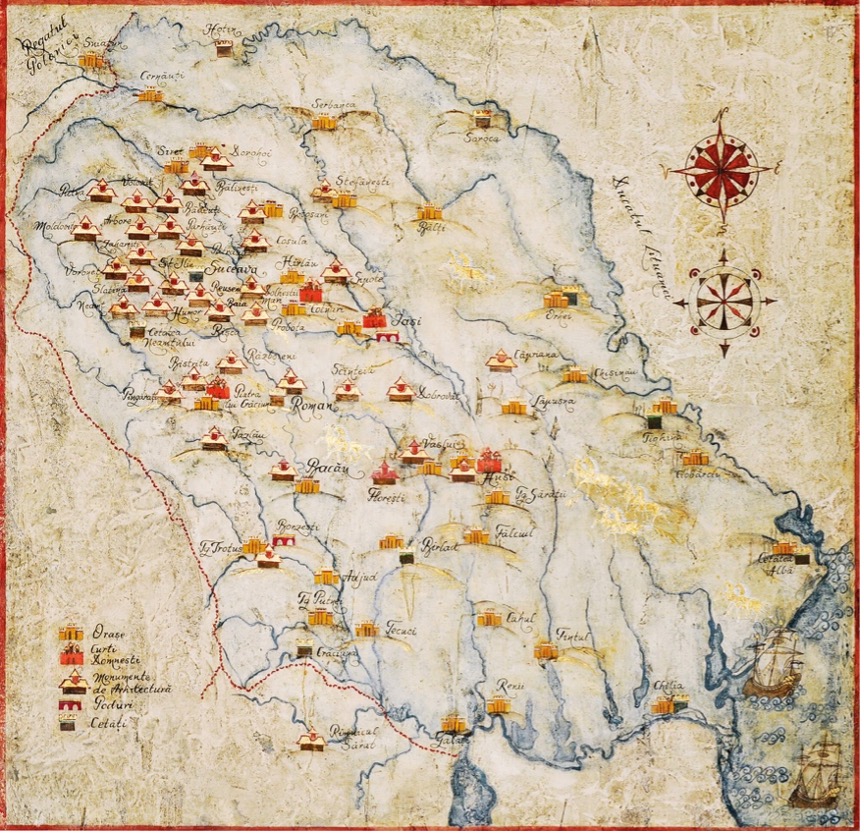
Wat recht deed met het verleden, kon religie met het landschap. Heiligenverhalen en heilige plaatsen koppelden gemeenschappen aan specifieke plekken, die tegelijk verder reikten dan hun directe omgeving. Religie trok niet alleen grenzen: ze creëerde ook net een grenzeloos netwerk.
In Holywell (Noord-Wales), groeide de cultus rond Beuno’s nicht Winifred uit tot een belangrijk bedevaartsoord. Haar bron gold als geneeskrachtig, haar relieken werden naar het Engelse Shrewsbury overgebracht en ook Engelse vorsten bezochten haar cultus. Ze werd zo meer dan een lokale Welshe heilige. Niet voor niets wordt Holywell vandaag het ‘Lourdes van Wales’ genoemd.
Iets vergelijkbaars gebeurde rond Putna, in het middeleeuwse Moldavië naast Transsylvanië. Het klooster en het graf van 15de-eeuwse vorst Stefanus de Grote groeiden uit tot een religieus en cultureel referentiepunt voor orthodoxe Roemenen uit verschillende regio’s. Eeuwen later noemde de Roemeense volksdichter Mihai Eminescu die plek het “Jeruzalem van het Roemeense volk”, met het graf van Stefanus als altaar van een nationaal bewustzijn.
Religie gaf identiteit dus niet alleen een grens, maar ook een plaats om samen te komen. Een rechtstraditie kon zeggen: “Dit zijn onze oude regels.” Een heilige plaats kon zeggen: “Hier vinden wij elkaar.”
Wanneer grenzen botsen
In Wales was verzet tegen de Engelse overheersing al langer onderdeel van het politieke landschap. Na de verovering van 1282–83 braken geregeld kleinere, lokale opstanden uit die telkens werden neergeslagen. Tot 1400, wanneer de Welshe edelman Owain Glyndŵr en zijn strijders open veldslagen combineerden met verrassingsaanvallen vanuit het Welshe bergland. De aanpak was zo effectief dat Fidel Castro hem eeuwen later zou omschrijven als de eerste effectieve guerrillaleider. Zijn verzet groeide uit tot een bredere Welshe politieke beweging, met plannen voor een eigen kerk, bestuur en onderwijs. De opstand doofde tegen 1408 uit, maar Glyndŵr bleef voortleven in het Welshe geheugen en dook eeuwen later op als held in nationalistische beeldvorming.
In Transsylvanië verliep de confrontatie minder binair. De opstand van Bobâlna in 1437 begon rond sociale en juridische grieven, maar bracht Hongaarse en Vlachische boeren, stedelingen en lagere edelen samen. De opstand werd uiteindelijk neergeslagen, terwijl de bevoorrechte elites zich verenigden in een verbond dat de politieke orde van Transsylvanië nog eeuwen zou bepalen. Ook Bobâlna verdween niet uit het collectieve geheugen: in latere Roemeense geschiedschrijving kreeg de opstand een nationale betekenis die de gemengde sociale werkelijkheid van 1437 sterk overschaduwde.
Juist rebellie maakt zichtbaar hoe veranderlijk groepsidentiteit kon zijn. Identiteit was geen vaststaand bezit, maar iets wat mensen in tijden van conflict konden inzetten, aanscherpen of tijdelijk herschikken.
Van bovenaf, van onderuit
En precies daar wordt de vraag ingewikkelder: wie bepaalt eigenlijk waar de grens ligt?
Middeleeuwse machthebbers, vorsten en kerkelijke instellingen konden bepalen welke rechten officieel werden erkend en welke groepen politieke privileges kregen. In die zin werden identiteiten en grenzen onmiskenbaar ook van bovenaf vormgegeven. Maar de voorbeelden hierboven laten zien dat gemeenschappen die indelingen niet zomaar ondergingen. Ze grepen terug naar oude wetten, gebruikten religieuze verhalen, verdedigden lokale rechten en sloten zich soms zelfs aan bij andere groepen. Identiteit was geen etiket dat uitsluitend door machthebbers werd uitgedeeld: het was ook iets waar mensen zelf mee werkten.
Grenzen waren er dus wel. Maar net zoals nu, bepaalde wie ertussen leefde voor een groot deel wat die grenzen precies betekenden.
Bibliografie
Primary sources
An extent of all the lands and rents of the Lord Bishop of St. David's. Edited by John William Willis-Bund. London: Honourable Society of Cymmrodorion, 1902.
Aneurin Owen. Ancient laws and institutes of Wales; comprising laws supposed to be enacted by Howel the Good.London: Printed by G. E. Eyre and A. Spottiswoode, 1841.
Bonedd y Saint. An Edition and Study of the Genealogies of the Welsh Saints. Edited by Barry J. Lewis. Dublin: Dublin Institute for Advanced Studies, School of Celtic Studies, 2023.
Buchedd Beuno: The Middle Welsh Life of St Beuno. Edited by Patrick Sims-Williams. Dublin: Dublin Institute for Advanced Studies, School of Celtic Studies (Medieval and Modern Welsh Series, 15), 2018.
Documenta historiam Valachorum in Hungaria illustrantia, usque ad annum 1400 p. Christum. Edited by Antonius Fekete Nagy and Ladislaus Makkai. Budapest: Études sur l'Europe Centre-Orientale, 1941.
Ion Neculce, Letopisețul Țării Moldovei și O Samă de Cuvinte. Bucharest: Editură de Stat pentru Literatură și Arte, 1955.
István Werbőczy. Opus tripartitum juris consuetudinarii inclyti regni Hungaria. Vienna: Joannes Singrenius, 1517. Modern edition: The Customary Law of the Renowned Kingdom of Hungary: A Work in Three Parts Rendered by Stephen Werböczy (The ‘Tripartitum’). Translated and edited by Péter Banyó, János M. Bak and Martyn Rady. Idyllwild/Budapest: Charles Schlacks Jr Publisher and Central European University, 2005.
Rășinari, Book of Boundaries. National Archives (Sibiu): Colecția de acte fasciculate, Seria V. Localități, no. 66, f. 1.
Rhygyfarch. Planctus Ricemarch. Edited and translated by Michael Lapidge, “The Welsh-Latin Poetry of Sulien’s Family,” Studia Celtica 8 (1973): 89–93.
The Court Rolls of the Lordship of Ruthin or Dyffryn-Clwydd of the Reign of King Edward the First. Edited by Richard Arthur Roberts. London: Chas. J. Clark, 1893.
The Law of Hywel Dda. Law Texts from Medieval Wales. Translated and edited by Dafydd Jenkins. Llandysul: Gomer Press, 1986.
The Laws of Hywel Dda (The Book of Blegywryd). Translated and edited by Melville Richards. Liverpool: University Press, 1954.
The Statutes of Wales. Edited by Ivor Bowen. London/Leipzig: T. Fisher Unwin, 1908.
The Welsh Assize Roll, 1277–1284. Edited by James Conway Davies. Cardiff: University of Wales Press, 1940.
Urkundenbuch zur Geschichte der Deutschen in Siebenbürgen, vol. I. Edited by Franz Zimmermann. Hermannstadt: Wilhelm Krafft, 1892.
Urkundenbuch zur Geschichte der Deutschen in Siebenbürgen, vol. II. 1342-1390. Edited by Franz Zimmermann. Sibiu: Verlag bei Michaelis, 1897.
Urkundenbuch zur Geschichte der Deutschen in Siebenbürgen, vol. IV. 1416-1437. Edited Franz Zimmermann and Gustav Gündisch. Sibiu: Krafft & Dortleff, 1937.
Vita Sancte Wenefrede (Anonymous; Claudius), edited by David Callander. www.welshsaints.ac.uk/theedition.
Vitae Sanctorum Britanniae et Genealogiae. Edited by Arthur W. Wade-Evans. Cardiff: University of Wales Press, 1944.
Welsh Medieval Law, edited by Arthur W. Wade-Evans. Aalen: Scientia, 1979.
Secondary literature
Abulafia, David. Mediterranean Encounters, Economic, Religious, Political, 1100-1550. Aldershot: Ashgate Variorum, 2000.
Adamovsky, Ezequiel. “Euro-Orientalism and the Making of the Concept of Eastern Europe in France, 1810-1880.” The Journal of Modern History 77.3 (2005): 591-628.
Agamben, Giorgio. Homo Sacer: Sovereign Power and Bare Life. Stanford: Stanford University Press, 1998.
Agrigoroaei, Vladimir. “An Interpretatio Wallachica of Serbian Cultural Patterns: The Cases of Ribița, Streisângeorgiu and Crișcior (but also Râmeț).” Annales Universitatis Apulensis Historica, 16 (2012): 105-135.
–––. “The Issue of Cretan or Serbian Models in the Depiction of the Individual Punishments in the Medieval Churches of Leșnic and Ribița: Once Again About the First Edogenous Testimony of the Romanian Language.” Annales Universitatis Apulensis Historica 28 (2025): 11-33.
Albera, Dionigi and John Eade, eds. New Pathways in Pilgrimage Studies. London: Routledge, 2017.
Algazi, Gadi. “Lords Ask, Peasants Answer: Making Traditions in Late Medieval Village Assemblies.” In Between History and Histories: The Making of Silences and Commemmorations, edited by Gerald Sider and Gavin Smith, 199-229. Toronto: University of Toronto Press, 1997.
Almaráz, Felix D. “The Status of Borderlands Studies: History.” Social Science Journal 13.1 (1976): 9-18.
Anderson, Benedict. Imagined Communities: Reflections on the Origin and Spread of Nationalism. Londen/New York: Verso, 2016.
Armstrong, John Alexander. Nations Before Nationalism. Chapel Hill: University of North Carolina Press, 1982.
Arnold, John H. “Believing in Belief: Gibbon, Latour and the Social History of Religion.” Past & Present 260 (2023): 236-68.
Assmann, Jan. Das kulturelle Gedächtenis: Schrift, Erinnerung und politische Identität in frühen Hochkulturen. Munich: Beck, 1992.
Baker, Nigel. “The Historical Context.” In Shrewsbury Abbey: Studies in the Archaeology and History of an Urban Abbey, edited by Nigel Baker, 15-19. Shropshire Archaeological and Historical Society, 2002.
Barrell, Andrew D.M., et al. “The Dyffryn Clwyd Court Roll Project, 1340–1352 and 1389–1399: A Methodology and Some Preliminary Findings.” In Medieval Society and the Manor Court, edited by Zvi Razi and Richard Smith. Oxford: Oxford University Press, 1996.
Barrett, Robert W. Against All England: Regional Identity and Cheshire Writing, 1195-1656. Indiana: University of Notre Dame, 2009.
Barth, Fredrik. Ethnic Groups and Boundaries: The Social Organisation of Culture Difference. Bergen: Universitetsforlaget, 1970.
–––. Models of Social Organisation. London: Royal Anthropological Institute, 1966.
Bartlett, Robert, and Angus MacKay, eds. Medieval Frontier Studies. Oxford: Clarendon Press, 1989.
–––. Gerald of Wales, 1146-1223. Oxford: Oxford University Press, 1982.
–––. The Making of Europe: Conquest, Colonisation and Cultural Change, 950-1350. Princeton: Princeton University Press, 1993.
–––. Why Can the Dead Do Such Great Things? Saints and Worshippers from the Martyrs to the Reformation. Princeton: Princeton University Press, 2013.
Benton, Lauren. Law and Colonial Cultures. Legal Regimes in World History, 1400-1900. Cambridge: Cambridge University Press, 2001.
Berend, Nora. “Interconnection and Separation: Medieval Perspectives on the Modern Problem of the ‘Global Middle Ages’.” Medieval Encounters 29 (2023): 285-314.
–––. “Medievalists and the Notion of the Frontier.” Medieval History Journal 2.1 (1999): 55-72.
–––. “The Medieval Imagery of Frontiers in Hungary.” Quaestiones medii aevi novae 16 (2011): 171-8.
–––. At the Gate of Christendom; Jews, Muslims and Pagans in Medieval Hungary, c. 1000-c.1300. Cambridge: Cambridge University Press, 2001.
Beverly-Smith, Llinos. “Disputes and Settlements in Medieval Wales: The Role of Arbitration.” The English Historical Review 106:421 (1991), 835-60.
Bhabha, Homi. The Location of Culture. London: Routledge, 2004.
Binder, Pál. “Antecedente și Consecințe Sud-Transilvănene ale Formării Voievodatului Munteniei (sec. XIII-XIV).” Arhiva Heraldică 2 (1996): 265-278.
Bogue, Allan G. “Frederick Jackson Turner Reconsidered.” The History Teacher 27.2 (1994): 199-217.
Boia, Lucian. History and Myth in Romanian Consciousness. Budapest: Central European University Press, 2001.
Bourdieu, Pierre. “Social Space and Symbolic Power.” Sociological Theory 7.1 (1989): 14-25.
Bowen, Ivor, ed. “Introduction.” In The Statutes of Wales, xxiii-cxxvii. London/Leipzig: T. Fisher Unwin, 1908.
Brooks, Simon. Why Wales Never Was: The Failure of Welsh Nationalism. Cardiff: University of Wales Press, 2017.
Brough, Gideon. “Owain’s Revolt? Glyn Dŵr’s Role in the Outbreak of the Rebellion.” Studies in History, Archaeology, Religion and Conservation 2 (2015): 1-30.
Bucur, Ioan-Marius and Ionuț Costea. “Transylvania between Two National Historiographies. Historical Consciousness and Political Identity.” In Frontiers, Regions and Identities in Europe, edited by Steven G. Ellis et al., 271-85. Pisa: Pisa University Press, 2009.
Burlacu, Constanța. “The Rendering of Infinitival Constructions in the Psalter Text: Greek to Slavonic, and Slavonic to Romanian.” Palaeobulgarica 1 (2021): 37-56.
Burton, Janet and Karen Stöber (eds.). Abbeys and Priories of Medieval Wales. Cardiff: University of Wales Press, 2015.
Buylaert, Frederik, Kaat Cappelle, and Klaas van Gelder. “Princely Legislation and Seigneurial Justice in the County of Flanders, c. 1400-1600.” In Jurists and the Medieval State, 1000-1500: Varieties and Development of a Symbiotic Relationship, edited by André Miguel da Cunha Vitoria, 1–20. Leiden: Brill, 2026.
Byng, Gabriel. Church Building and Society in the Late Middle Ages. Cambridge: Cambridge UP, 2020.
Camby, Christophe. “The Wergeld, Following the Manuscripts,” International Medieval Congress. Leeds, 2011: 1-12.
Cartwright, Jane. “The Welsh Versions of the Life of Gwenfrewy.” In Seintiau Cymry, Sancti Cambrenses. Astudiaethau ar Seintiau Cymru/Studies in the Saints of Wales, edited by David N. Parsons and Paul Russell, 237-67. Aberystwyth: University of Wales Centre for Advanced Welsh and Celtic Studies, 2022.
Cercel, Cristian. “Transylvanian Saxon Symbolic Geographies.” Civilisations 60.2 (2012): 83-101.
Cincheza-Buculei, Ecaterina. "Implicatii sociale si politice în iconografia picturii medievale românesti din Transilvania, secolele 14-15: Sfintii militari.” Studii si Cercetari de Istoria Artei (1981): 3-34.
Coelho, Fábio Ulhoa. “Customary Law.” In The First Law, 11-22. Berlin: Springer, 2026.
Cohen, Jeffrey Jerome. The Postcolonial Middle Ages. MacMillan Press, 2000.
Coleman, Simon and John Eade, eds. Reframing Pilgrimage: Cultures in Motion. London: Routledge, 2004.
Cosma, Ela. “‘Ius Valachicum’ legiferat în ‘Statutele Făgărașului’ (15 mai 1508),” Acta Terrae Fogarasiensis 12 (2023), 43–58.
–––. “Enacted Jus Valachicum in South Transylvania (14th-18th Centuries).” Studia Universitatis Babes-Bolyai Historia67.17 (2022), 3-19.
–––. “The Bishops’ House in the Romanian Pastoral Village of Rășinari (Mărginimea Sibiului) and its Hidden Treasures: A Short Legal History of the Book of Village Boundaries and the Deed of Donation (1488, 1383) and Transmissionales in causa Possessionis Resinar contra Liberam Regiamque Civitatem Cibiniensem (1784).” In Imago, ius, religio. Religious Iconographies in Illustrated Legal Manuscripts and Printed Books (9th-20th Centuries), edited by Maria Alessandra Bilotta and Gianluca del Monaco. Monographic Issue, Eikón/Imago 12 (2023), 95-112.
Croxton, Derek. “The Peace of Westphalia of 1648 and the Origins of Sovereignty.” The International History Review21.3 (1999): 569-91.
Cusack, Carole M. “Sacred Trees in Ancient and Medieval Celtic Sources: Druids, Kings and Saints.” In The Sacred Tree: Ancient and Medieval Manifestations, 57-88. Newcastle: Cambridge Scholars Publishing, 2011.
Custred, Glynn. “Dual ethnic identity of the Transylvanian Saxons.” East European Quarterly 25.4 (1991): 483-91.
Daloz, Jean-Pascal. The Sociology of Elite Distinction: From Theoretical to Comparative Perspectives. Basingstoke: Palgrave-Macmillan, 2009.
Damari, Claudia, and Yoel Mansfeld. “Reflections on Pilgrims’ Identity, Role and Interplay with the Pilgrimage Environment.” Current Issues in Tourism 19.3 (2016): 199-222.
Daston, Lorraine. Rules: A Short History of What We Live By. Princeton: Princeton University Press, 2022.
Davies, Rees. “Frontier Arrangements in Fragmented Societies: Ireland and Wales.” In: Medieval Frontier Societies, eds. Robert Bartlett & Angus MacKay (1989): 77-100.
–––. “Nations and National Identities in the Medieval World.” Belgisch Tijdschrift voor Nieuwste Geschiedenis 4 (2004): 567-79.
Davies, Robert Rees. “The Law of the March.” Welsh History Review 5 (1970): 1-15.
–––. “The Twilight of Welsh Law, 1284–1536.” History 51:172 (1966), 143-64.
–––. Conquest, Coexistence and Change: Wales 1063-1415. Oxford: Oxford University Press, 1987.
–––. Lordship and Society in the March of Wales, 1282–1400. Oxford: Oxford University Press, 1978.
–––. The Age of Conquest: Wales, 1063-1415. Oxford: Oxford University Press, 1991.
–––. The Revolt of Owain Glyn Dŵr. Oxford: Oxford University Press, 1997.
Dawson, John P. “The Codification of the French Customs.” Michigan Law Review 765 (1940): 765-800.
Diaconescu, Marius. “Contribuţii la Datarea Donaţiei Ciceului şi Cetăţii de Baltă lui Ştefan cel Mare.” Analele Putnei 9 (2013): 91-112.
Dincă, Adinel C. “Medieval Literacy in Transylvania: Selective Evidence from Parish Churches.” Transylvanian Review24 (2015): 109-21.
Drew, Katherine Fischer. “The Carolingian Military Frontier in Italy.” Traditio 20 (1964): 437-47.
Duindam, Jeroen. “Rulers and Elites in Global History: Introductory Observations.” In: Prince, Pen, and Sword: Eurasian Perspectives, edited by Maaike Van Berkel and Jeroen Duindam, 1-31. Leiden: Brill, 2018.
Eagles, Jonathan. Stephen the Great and Balkan Nationalism: Moldova and Eastern European History. London: I.B. Tauris, 2014.
Echevarria, Ana. “Islamic Influence on Christian Legislation in the Kingdom of Castile.” Journal of Medieval History 45.3 (2019): 201-15.
Edwards, J. Goronwy. “Hywel Dda and the Welsh Lawbooks.” In Celtic Law Papers, edited by Dafydd Jenkins, 135-60. Brussel, 1973.
Eliade, Mircea. Zalmoxis, the Vanishing God: Comparative Studies in the Religions and Folklore of Dacia and Eastern Europe. Chicago: University of Chicago Press, 1972.
Eller, Jack David and Reed M. Coughlan, “The Poverty of Primordialism: The Demystification of Ethnic Attachments.” Ethnic and Racial Studies 16.2 (1993): 183-202.
Ellis, Steven G. “Why the History of ‘the Celtic Fringe’ Remains Unwritten.” European Review of History 10.2 (2003): 221-31.
–––. Tudor Frontiers and Noble Power. The Making of the British State. Oxford: Oxford University Press, 1995.
Engel, Pál. The Realm of St Stephen: A History of Medieval Hungary, 895-1526. London/New York: I.B. Tauris Publishers, 2001.
Epple, Angelika. “Lokalität und die Dimensionen des Globalen.” Historische Anthropologie 21 (2019): 4-25.
Evans, Robert John Weston. Austria, Hungary, and the Habsburgs: Essays on Central Europe c.1638-1867. Oxford: Oxford University Press, 2006.
Febvre, Lucien. “Frontière: The Word and the Concept.” In A New Kind of History: from the Writings of Febvre, edited by Peter Burke, 208-18. New York: Harper & Row Publishers, 1973.
Fentress, James, and Chris Wickham. Social Memory. Oxford: Blackwell, 1992.
Foucault, Michel. Discipline and Punish: The Birth of the Prison. New York: Vintage Books, 1977.
Fowle, Frances. “The Celtic Revival in Britain and Ireland: Reconstructing the Past.” In Celts: Art and Identity, edited by Julia Farley and Fraser Hunter, 234-59. London: British Museum Publishing, 2015.
Frey, Nancy. Pilgrim Stories: On and Off the Road to Santiago. Berkeley: University of California Press, 1998.
Fulton, Helen. “The Geography of Welsh Literary Production in Late Medieval Glamorgan.” Journal of Medieval History41 (2015): 325-40.
Gáll, Erwin, and Gergely Szenthe. “The ‘Migration’ Period.” In: Constitutional History of Transylvania, edited by Emőd Veress, 59-93. Cham: Springer, 2023.
Geary, Patrick Joseph. “Peasant Religion in Medieval Europe.” Cahiers d’Extrême-Asie 12 (2001): 185-209.
–––. The Myth of Nations: The Medieval Origins of Europe. Princeton: Princeton University Press, 2002.
Geertz, Clifford. The Interpretation of Cultures. New York: Basic Books, 1973.
Gellner, Ernest. Nations and Nationalism. Oxford: Blackwell Publishing, 2006.
Giurescu, Constantin C. Istoria românilor din cele mai vechi timpuri pînă astăzi. Bucharest: Albatros, 1975.
Gorovei, Ştefan S. “Feudele Ardelene ale lui Ştefan cel Mare: Observaţii pe Marginea Izvoarelor.” Analele Putnei 1 (2005): 123–32.
Gregory, James Ryan. “A Welsh Saint in England: Translation, Orality, and National Identity in the Cult of St. Gwenfrewy, 1138–1512.” Unpublished Ph.D. thesis. University of Georgia, 2012.
Griffiths, John. “The Revolt of Madog ap Llywelyn, 1294-5.” Transactions of Caernarfonshire Historical Society 16 (1955): 12-24.
–––. “The Social Working of Legal Rules,” Journal of Legal Pluralism and Unofficial Law 35 (2003): 1-84.
Groves, Beatrice. “Those Sanctified Places Where Our Sauiours Feete Had Trode: Jerusalem in Early Modern English Travel Narratives.” Sixteenth Century Journal 43.3 (2012), 681-700.
Gurevič, Aron Iakovlevič. Categories of Medieval Culture. London: Routledge, 1985.
Halbwachs, Maurice. La mémoire collective. Paris: Albin Michel, 1950.
–––. Les cadres sociaux de la mémoire. Paris: Alcan, 1923.
Hamaker, Catherine. “Winefride’s Well-Cult.” In Two Mediaeval Lives of Saint Winefride, edited by Ronald Pepin and Hugh Feiss. Toronto: Peregrina Pub., 2000.
Hamlin, David D. “’Wo sind wir?’ Orientalism, Gender and War in the German Encounter with Romania.” German History28.4 (2010): 424-52.
Hanga, Vladimir. Les institutions du droit coutumier Roumain. Bucharest: Editura Academiei Republicii Socialiste Romania, 1988.
Harvey, Sally. “The Knight and the Knight’s Fee in England.” Past & Present 49 (1970): 3-43.
Hechter, Michael. Internal Colonialism: Celtic Fringe in British National Development. London: Routledge, 1999.
Held, Joseph. "The Peasant Revolt of Babolna, 1437–1438," Slavic Review 36.1 (1977), 25–38.
Heng, Geraldine. The Global Middle Ages. Cambridge: Cambridge University Press, 2021.
Henken, Elissa. “The Saint as Secular Ruler: Aspects of Welsh Hagiography.” Folklore 98, no. 2 (1987): 226–32.
Henken, Elissa. “Welsh Hagiography and the Nationalist Impulse.” In Celtic Hagiography and Saints’ Cults, ed. Jane Cartwright, 26-44. Cardiff: University of Wales Press, 2003.
Higounet, Charles. Les Allemands en Europe Centrale et Orientale au Moyen Âge. Paris: Aubier, 1989.
Hitchins, Keith. “Historiography of the Countries of Eastern Europe: Romania.” The American Historical Review 94.4 (1992): 1064-1083.
Hobsbawm, Eric, and Terence Ranger, eds. The Invention of Tradition. Cambridge: Cambridge University Press, 1984.
Holy Putna Monastery, 1466–2016: 550 Years Since the Laying of the Foundational Stone. Putna: Editura Mitropolit Iacov Putneanul, 2016.
Hughes, Kathleen. “The Welsh Latin Chronicles: ‘Annales Cambriae’ and Related Texts.” In Celtic Britain in the Early Middle Ages, edited by Kathleen Hughes and David Dumville, 67-85. Woodbridge: Boydell, 1980.
Hurlock, Kathryn. Medieval Welsh Pilgrimage, c. 1100–1500. London: Palgrave Macmillan, 2018.
Huß, Richard. “Die Besiedelung des Sachsenlandes in Siebenbürgen.” Zeitschrift für Deutsche Mundarten 18.3 (1923): 258-85.
Hutchinson, John. “Moral Innovators and the Politics of Regeneration: The Distinctive Role of Cultural Nationalists in Nation-Building.” In Ethnicity and Nationalism, edited by Anthony D. Smith, 101-17. Leiden: Brill, 1992.
–––. The Dynamics of Cultural Nationalism: The Gaelic Revival and the Creation of the Irish Nation State. Londen: Routledge, 1987.
Hutton, Ronald. Blood and Mistletoe: The History of the Druids in Britain. New Haven: Yale University Press, 2011.
Iggers, Georg G. Historiography in the Twentieth Century: From Scientific Objectivity to the Postmodern Challenge.Middletown: Wesleyan University Press, 1997.
Iorga, Nicolae. A History of Roumania: Land, People, Civilisation. London: Histria Books, 2019.
Jack, Robert Ian. “Ruthin.” In Boroughs of Mediaeval Wales, edited by R. A. Griffiths, 244-61. Cardiff: University of Wales Press, 1978.
Jenkins, Dafydd, ed. “Glossary and Index to Notes.” In The Law of Hywel Dda. Law Texts from Medieval Wales, 309-94. Llandysul: Gomer Press, 1986.
–––. “Introduction.” In The Law of Hywel Dda. Law Texts from Medieval Wales, xi-xxxviii. Llandysul: Gomer Press, 1986.
Jenkins, Geraint H. Bard of Liberty: The Political Radicalism of Iolo Morganwg. Cardiff: University of Wales Press, 2012.
Jones, Craig Owen. Compact History of Welsh Heroes: Llywelyn Bren. Llanrwst: Gwasg Carreg Gwalch, 2007.
Jones, Francis. The Holy Wells of Wales. Cardiff: University of Wales Press, 1954; repr. 2003.
Jørgensen, Dolly. “Pigs and Pollards: Medieval Insights for UK Wood Pasture Restoration.” Sustainability 5:2 (2013), 387-99.
Kantorowicz, Ernst H. The King's Two Bodies: A Study in Mediaeval Political Theology. Princeton: Princeton University Press, 1957.
Kirk, John, Andrew Noble and Michael Brown, eds. United Islands? The Languages of Resistance. Londen: Routledge, 2012.
Knowles, Michael D. “Presidential Address: Great Historical Enterprises IV. The Rolls Series.” Transactions of the Royal Historical Society 11 (1961): 137–59.
Köpeczi, Béla, ed. Kurze Geschichte Siebenbürgens. Budapest: Academic Publishing, 1990.
Kuskowski, Ada. “Cosmopolitan Local Law in the Medieval Latin West.” Journal of Legal History 46:1 (2025): 172-91.
–––. “The Time of Custom and the Medieval Myth of Ancient Customary Law.” Speculum 99:1 (2024), 143-82.
Lajos, Katalin. “The Image of Transylvania in the Works of Two Contemporary Romanian Historians.” Acta Universitatis Sapientiae Philologica 9.1 (2017): 17-31.
Lamont, Michèle. “Culture and Identity.” In: Handbook of Sociological Theory, edited by Jonathan H. Turner, 171-85. New York: Springer, 2001.
Langer, Christian, and Manuel Fernández-Götz. “Boundaries, Borders and Frontiers: Contemporary and Past Perspectives.” Journal for Ancient Studies 7 (2020): 33-47.
Laurie, Elena. “A Society Organized for War: Medieval Spain.” Past & Present 35.1 (1966): 54-76.
Lavric, Aurelian. “The Emergence of the Problem of Bukovina within the European Geopolitical Space.” Codrul Cosminului 18 (2012): 51-66.
Lefebvre, Henri. La production de l’espace. Paris: Anthropos, 1974.
Lesaffer, Randall. European Legal History: A Cultural and Political Perspective. Cambridge: Cambridge University Press, 2009.
Lieberman, Max. The Medieval March of Wales: The Creation and Perception of a Frontier, 1066-1283. Cambridge: Cambridge University Press, 2010.
Liulevicius, Vejas Gabriel. The German Myth of the East: 1800 to the Present. Oxford: Oxford University Press, 2009.
Livingston, Michael. “An Amazing Claim: The Tripartite Indenture.” In Owain Glyndŵr: A Casebook, edited by Michael Livingston and John K. Bollard. Liverpool: Liverpool University Press, 2013.
–––. “Owain Glyndŵr’s Grand Design: The Tripartite Indenture and the Vision of a New Wales.” Proceedings of the Harvard Celtic Colloquium 33 (2013): 145-68.
Lloyd, John Edward. Owen Glendower. Oxford: Oxford University Press, 1931.
Ludanyi, Andrew. “Controversies about the ‘History of Transylvania’ Revisited (1986-2004).” Hungarian Studies Review36.1-2 (2009): 131-52.
Lumbley, Coral. “The ‘Dark Welsh’: Color, Race, and Alterity in the Matter of Medieval Wales.” Literature Compass 16 (2019): 1-19.
Lupescu, Radu. “Ethnicity in Transylvania: From Medieval Peoples to Modern Nations.” Historia Actual Online 34 (2014): 105-13.
Mac Sweeney, Naoise, ed. Foundation Myths in Ancient Societies: Dialogues and Discourses. Philadelphia: University of Pennsylvania Press, 2015.
MacKay, Angus. Spain in the Middle Ages: From Frontier to Empire, 1000-1500. London: MacMillan, 1977.
Magina, Adrian. “From Custom to Written Law: Ius Valachicum in the Banat.” In Government and Law in Medieval Moldavia, Transylvania and Wallachia, edited by Martyn Rady and Alexandru Simon, 71-8. Londen: UCL, 2013.
–––. “Universitas Valachorum: Privilege and Community in the Medieval Banat." Reform and Renewal in Medieval East and Central Europe: Politics, Law and Society (2019): 493-502.
Makkai, Lászlo. "The Emergence of the Estates (1172–1526)." In History of Transylvania, ed. Béla Köpeczi et al., 178-243. Budapest: Akadémiai Kiadó, 1994.
–––. Histoire de Transylvanie. Paris: Les Presses Universitaires de France, 1946.
Mbembe, Achille. Necropolitics. Durham: Duke University Press, 2019.
McIntosh, Alison J., Tom Hinch and Takiora Ingram. “Cultural Identity and Tourism.” International Journal of Arts Management 4.2 (2002): 39-49.
Mertens, Bernd. “Gesetzgeber und Verfasser der Carolina.” Zeitschrift der Savigny-Stiftung für Rechtsgeschichte 138 (2021): 120-54.
Mezey, Barna. “Transylvania in the Medieval Hungarian Kingdom (1000-1540).” In Constitutional History of Transylvania, edited by Emöd Veress, 125-92. Berlin: Springer, 2023.
Miguélez Alicia, and Pedro Martins. “The Uses of the Medieval Past in Contemporary European Political Discourse: Some Reflections Arising from the Portuguese Case.” Journal of Portuguese History (2023): 75.
Mitu, Sorin. National Identity of Romanians in Transylvania. Budapest: Central European University Press, 2001.
Moldt, Dirk. Deutsche Stadtrechte im mittelalterlichen Siebenbürgen. Cologne/Vienna: Böhlau, 2009.
Moon, David S., and Tomos Evans, “Welsh Devolution and the Problem of Legislative Competence,” British Politics 12.3 (2017): 335-60.
Moore, Sally Falk. “Law and Social Change: The Semi-Autonomous Social Field as an Appropriate Subject of Study.” Law & Society Review 7 (1973): 719-46.
–––. Law as a Process: An Anthropological Approach. Oxford: Oxford University Press, 1978.
Morse, Michael A. How the Celts Came to Britain: Druids, Ancient Skulls and the Birth of Archaeology. Stroud: Tempus, 2005.
Mureșan, Dan Ioan. “The Romanian Tradition.” In The Orthodox Christian World, edited by Augustine Casiday, pp. 141-53. London: Routledge, 2012.
Nägler, Thomas. Die Ansiedlung der Siebenbürger Sachsen. Bucharest: Kriterion Verlag, 1992.
Năstăsoiu, Dragoș Gheorghe. “The Social Status of Romanian Orthodox Noblemen in Late-medieval Transylvania According to Donor Portraits and Church Inscriptions.” In Études Byzantines et Post-Byzantines, edited by Nicolae-Șerban Tanașoca and Alexandru Madgearu, vol. VII, 205–64. Bucharest: Editura Academiei Române, 2016.
Nirenberg, David. Communities of Violence: Persecution of Minorities in the Middle Ages. Princeton: Princeton University Press, 1996.
Nora, Pierre. Les lieux de mémoire. Paris: Gallimard, 1984.
Obolensky, Dimitri. The Byzantine Commonwealth: Eastern Europe, 500-1453. New York: Cardinal, 1971.
Oviedo, Lluis, Scarlett de Courcier and Miguel Farias. “Rise of Pilgrims on the ‘Camino’ to Santiago: Sign of Change or Religious Revival?” Review of Religious Research 56.3 (2014): 433-42
Owen, Morfydd E. “Shame and Reparation: Women’s Place in the Kin.” In The Welsh Law of Women, edited by Dafydd Jenkins, 40-68. Cardiff: University of Wales Press, 1980.
Özkirimli, Umut and Spyros Sofos. Tormented by History: Nationalism in Greece and Turkey. New York: Oxford University Press, 2008.
Özkirimli, Umut. Theories of Nationalism: A Critical Introduction. Basingstoke: Palgrave, 2000.
Pascu, Ștefan. Voievodatul Transilvaniei vol. 4. Cluj-Napoca: Editura Dacia, 1986.
Pearce, Sarah J. “The Myth of the Myth of the Andalusian Paradise.” In The Extreme Right and the Revision of History, edited by Louie Valencia-García, 29-67. London: Routledge, 2020.
Perreau-Saussine, Amanda and James Bernard Murphy, eds. The Nature of Customary Law: Legal, Historical and Philosophical Perspectives. Cambridge: Cambridge University Press, 2007.
Petroviciu, Irina, Ina Vanden Berghe, Ileana Cretu and Jan Wouters. “Analysis of dyestuffs in 15th–17th-century Byzantine embroideries from Putna Monastery, Romania.” Dyes History Archaeology 24 (2017): 208-24.
Petrovics, István. “Foreign Ethnic Groups in the Towns of Southern Hungary in the Middle Ages.” In Segregation-Integration-Assimilation: Religious and Ethnic Groups in the Medieval Towns of Central and Eastern Europe, edited by Derek Keene, Balázs Nagy and Katalin Szende. London: Ashgate, 2009.
Pitchford, Susan, ed. Identity Tourism: Imaging and Imagining the Nation. Bingley: Emerald Group Publishing Limited, 2008.
Pollock, Frederick, and Frederic William Maitland, eds. The History of English Law before the Time of Edward I, vol. 1.Cambridge: Cambridge University Press, 1898.
Pop, “Privilegiu Regal Solemn de la 1366 și Implicațiile Sale,” Mediaevalia Transilvanica 1 (1997): 69-86.
Pop, Ioan-Aurel. “‘De Manibus Valachorum Scismaticorum…’: Romanians and Power in the Mediaeval Kingdom of Hungary. The Thirteenth and Fourteenth Centuries. Lausanne: Peter Lang, 2013.
–––. “Adunarea Generală a Stărilor Transilvaniei din Mai 1355.” Mediævalia Transilvanica 2.1 (1998): 61-70.
–––. “Istoria și semnificația numelor de român/valah și România/Valahia.” Revista Limba Română 4 (2020): 56-86.
–––. “Nations and Denominations in Transylvania (13th–16th Century).” In Tolerance and Intolerance in Historical Perspective, edited by Csaba Lévai and Vasile Vese. Pisa: University of Pisa, 2003.
–––. “Religiones and Nationes in Transylvania during the 16th Century.” Journal for the Study of Religions and Ideologies12 (2013): 209-36.
Popa-Gorjanu, Cosmin. “From Kenezii to Nobiles Valachi: The Evolution of the Romanian Elite of the Banat in the Fourteenth and Fifteenth Centuries.” Annual of Medieval Studies at CEU 6 (2000): 109-28.
Popa-Gorjanu, Cosmin. “The Nobility as Bearers of Regional Identity in Fourteenth Century Transylvania.” Annales Universitatis Apulensis: Historica 16.2 (2012): 41-58.
Popa, Radu. “Streisîngeorgiu: Mărturii de Istorie Românească din Secolele XI-XIV în Sudul Transilvaniei.” Revista Muzeelor şi Monumentelor - Monumente Istorice şi de Artă 47 (1978), 9-32.
–––. La Începuturile Evului Mediu Românesc: Țara Hațegului. Bucharest: Editura Științifica și Enciclopedica, 1988.
Popescu-Dolj, Șerban. “Rezultatele cercetărilor de arhitectură la biserica din Streisîngeorgiu, judeţul Hunedoara.” Revista Muzeelor şi Monumentelor - Monumente Istorice şi de Artă 47 (1978): 43-6.
Pratt, Mary Louise. “Arts of the Contact Zone.” Profession (1991), 33-40.
Preda, Emil. Dicționar al sfinților ortodocși. Bucharest: Editură Lucman, 2000.
Prioteasa, Elena Dana. “Medieval Wall Paintings in Transylvanian Orthodox Churches and Their Donors.” PhD Dissertation. Budapest: Central European University, 2011.
Pritchard, Thomas William. St Winefride, Her Holy Well and the Jesuit Mission, c. 650-1930. Wrexham: Bridge Books, 2009.
Pryce, Huw. Native Law and the Church in Medieval Wales. Oxford: Clarendon Press, 1993.
–––. Writing Welsh History: From the Early Middle Ages to the Twenty-First Century. Oxford: Oxford University Press, 2022.
Puttkamer, Joachim von. Schulalltag und nationale Integration in Ungarn. Slowaken, Rumänen und Siebenbürger Sachsen in der Auseinandersetzung mit der ungarischen Staatsidee 1867-1914. München: Oldenbourg Verlag, 2003.
Rady, Martyn. “The Prologue to Werbőczy’s Tripartitum and its Sources.” English Historical Review 121 (2006): 104-45.
–––. Customary Law in Hungary: Courts, Texts, and the Tripartitum. Oxford: Oxford University Press, 2015.
–––. Nobility, Land and Service in Medieval Hungary. London: Palgrave Macmillan, 2000.
Rees, William. An Historical Atlas of Wales. From Early to Modern Times. London: Faber and Faber, 1951.
Reynolds, Susan. “Medieval ‘Origines Gentium’ and the Community of the Realm.” History 68.224 (1983): 375-90.
Richter, Michael. Giraldus Cambrensis: Growth of the Welsh Nation. Aberystwyth: National Library of Wales, 1976.
Roberts, Brynley F. Writers of Wales: Gerald of Wales. Cardiff: University of Wales Press, 1982.
Roberts, Sara Elin. “The Iorwerth Triads.” In Tome: Studies in Medieval Celtic History and Law in Honour of Thomas Charles-Edwards, edited by Fiona Edmonds and Paul Russell, 155-164. Suffolk: Boydell Press, 2011.
–––. The Growth of Law in Medieval Wales, c.1100-c.1500. Suffolk: Boydell & Brewer, 2022.
–––. The Legal Triads of Medieval Wales. Cardiff: University of Wales Press, 2007.
Rodseth, Lara, and Bradley J. Parker, eds. “Theoretical Considerations in the Study of Frontiers.” In Untaming the Frontier in Anthropology, Archaeology, and History, edited by Lara Rodseth and Bradley J. Parker, 3-22. Tucson: University of Arizona Press, 2005.
Rossignol, Sébastien. “Doit-on encore parler de colonisation allemande au Moyen Âge? Réflexions sur l’historiographie récente concernant l’Europe du Centre-Est aux xiie et xiiie siècles.” Revue Historique 4.680 (2016): 905-40.
Rusu, Adrian Andrei. “Ştefan cel Mare şi Transilvania. Un Inventar Critic, Date Nevalorificate şi Interpretări Noi.” Analele Putnei 2 (2005): 91-122.
–––. Ioan de Hunedoara și Românii din Vremea Sa. Cluj: Editura Presa Universitară, 1999.
Safta, Mihai. “Vechiul drept Românesc, ius valachicum: studiu asupra cnezatelor supuse lui lex sau modus olachorum.” SUBB Iurisprudentia 2 (2015): 143-155.
Săgeată, Radu, Mircea Buza and Traian Crăcea. “The Germans in Romania, with Special Regard to the Transylvanian Saxons.” Mitteilungen der Österreichischen Geographischen Gesellschaft 159 (2017): 297-322.
Sahlins, Peter. Boundaries: The Making of France and Spain in the Pyrenees. Berkeley: University of California Press, 1989.
Said, Edward. Orientalism. New York: Pantheon Books, 1978.
Salway, Peter. The Frontier People of Roman Britain. Cambridge: Cambridge University Press, 1967.
Scales, Len. “Ever Closer Union? Unification, Difference, and the ‘Making of Europe’, c. 950-1350.” English Historical Review 137 (2022): 321-61.
Schwartz, Ellen C. The Oxford Handbook of Byzantine Art and Architecture. Oxford: Oxford UP, 2021.
Shao, Dan. “Borders and Borderlands.” In The Palgrave Dictionary of Transnational History, edited by Akira Iriye and Pierre-Yves Saunier, 99-102. Basingstoke: Palgrave Macmillan, 2009.
Shapiro, Daniel L. “Relational Identity Theory: A Systematic Approach for Transforming the Emotional Dimension of Conflict.” American Psychologist 65 (2010): 634-45.
Shils, Edward. “Primordial, Personal, Sacred and Civil Ties: Some Particular Observations on the Relationships of Sociological Research and Theory.” The British Journal of Sociology 8.2 (1957): 130-45.
Sims-Williams, Patrick. “Clas Beuno and the Four Branches of the Mabinogi.” In: 150 Jahre ‘Mabinogion’: Deutsch-walische Kulturbeziehungen, edited by Bernhard Maier et al., 111-27. Berlin: De Gruyter, 2001.
Skocpol, Theda, and Margaret Somers. “The Uses of Comparative History in Macrosocial Inquiry.” Comparative Studies in Society and History 22.2 (1980): 174-97.
Smith, Anthony D. Ethno-Symbolism and Nationalism. A Cultural Approach. London: Routledge, 2009.
–––. The Nation in History: Historiographical Debates about Ethnicity and Nationalism. Hanover: University Press of New England, 2000.
Smith, Jenkyn Beverley. “Edward II and the Allegiance of Wales.” The Welsh History Review 8.2 (1976): 146–53.
Smultea, Teodora. “Figuri din Sfinți Ierarhi in Iconografia Ortodoxă de Secol XIV în Spațiul Românesc.” Studia UBB Historia Artium 67 (2022): 65-90.
Stephenson, David. The Governance of Gwynedd. Cardiff: University of Wales Press, 1984.
Stöber, Karen. “Ecclesiastical Identity in the Making: The Medieval Cathedral and Bishopric of St David’s (Wales).” Imago Temporis: Medium Aevum 14 (2020): 185-97.
–––. “Hagiography and National Consciousness: The Case of Sant Beuno of Wales.” Imago Temporis: Medium Aevum 13 (2019): 41-54.
Stubbs, William. The Constitutional History of England. Oxford: Clarendon Press, 1896.
Subrahmanyam, Sanjay. “Connected Histories: Notes towards a Reconfiguration of Early Modern Asia.” Modern Asian Studies 31.3 (1997): 735-62.
Sullivan, Alice Isabella. The Eclectic Visual Culture of Medieval Moldavia. Leiden: Brill, 2023.
Swenson, Geoffrey. “Legal Pluralism in Theory and Practice.” International Studies Review (2018): 438-62.
Székely, Maria Magdalena. “Mănăstirea Putna: Loc de Memorie.” Ștefan cel Mare și Sfânt. Atlet al Credinți Creștine. Putna: Simpozion, 2004.
Szumski, Jan. “The USSR’s Politics of History toward the Slavic Countries of the Eastern Bloc: Formal and Institutional Frameworks, 1945-1989.” Quarterly Journal of the History of Science and Technology 64.4 (2019): 61-81.
Tamanaha, Brian Z. “Understanding Legal Pluralism: Past to Present, Local to Global.” In Legal Theory and the Social Sciences, edited by Maksymilian Del Mar and Michael Guidice, 447-83. Londen: Routledge, 2017.
–––. General Jurisprudence of Law and Society. Oxford: Oxford University Press, 2001.
Taylor, Larissa Juliet. “Introduction.” In Encyclopedia of Medieval Pilgrimage, edited by Larissa J. Taylor et al. Leiden: Brill, 2010.
Teutsch, Günther. “Legiferarea Statutară şi Jurisdicţia ca Atribuţii Fundamentale ale Universităţii Saşilor.” Transilvania şi Saşii Ardeleni în Istoriografie. Sibiu: Hora, 2001.
Thomas, Rebecca. History and Identity in Early Medieval Wales. Cardiff: D.S. Brewer, 2022.
Trivellato, Francesca. “The Paradoxes of Global History.” Cyber Review of Modern Historiography (2024).
Turner, Frederick Jackson. The Frontier in American History. New York: Henry Holt and Company, 1920.
Turner, Rick. "The architecture, patronage and date of St Winefride's Well, Holywell." Archaeologia Cambrensis 168 (2018): 245–275.
Váli, Ferenc A. “Transylvania and the Hungarian Minority.” Journal of International Affairs 20.1 (1966): 32-44.
Van Caenegem, Raoul Charles. “The English Common Law: A Divergence from the European Pattern.” Tijdschrift voor Rechtsgeschiedenis 1.47 (1979), 1-18.
–––. The Birth of the English Common Law. Cambridge: Cambridge University Press, 1988.
Van der Vleuten, Erik, and Torsten Feys. “Borders and Frontiers in Global and Transnational History.” Journal of Modern European History 14.1 (2016), 29-34.
Vasile, Cristian. “The Suppression of the Romanian Greek Catholic (Uniate) Church.” East European Quarterly 36 (2002): 313-22.
Vizauer, Victor. “The Statutes of the Transylvanian Romanians from Făgăraș (1508). A Historical Perspective and a Comparison with the Transylvanian Saxon and Szekler Customary Laws.” Balcanica Posnaniensia 31 (2024): 51-75.
Voinea, Alina Elena. “Saxon Transylvania: An Identity Potpourri and a Cultural Catalysis in the Social Network Context of the Last Millenium.” Transylvanian Journal of Multidisciplinary Research in Humanities (2022): 261-79.
Watkin, Thomas Glyn. The Legal History of Wales. Cardiff: University of Wales Press, 2007.
Webb, Diana. Medieval European Pilgrimage c. 700-1500. Basingstoke: Palgrave, 2002.
Werner, Michael, and Bénédicte Zimmermann, “Penser l’histoire croisée: entre empirie et réflexivité.” Annales 58.1 (2003): 7-36.
Williams, David H. “Basingwerk Abbey.” Cîteaux 32 (1981): 87-113.
Williams, Glanmor. The Welsh Church: From Conquest to Reformation. Cardiff: University of Wales Press, 1976.
Williams, Gwyn A. When Was Wales? Londen: Penguin Books, 1985.
Wilson, Thomas M., and Hastings Donnan. “Borders and Border Studies.” In A Companion to Border Studies, edited by Thomas M. Wilson and Hastings Donnan, 1-25. Oxford: Blackwell Publishing, 2012.
Wimmer, Andreas. Ethnic Boundary Making: Institutions, Power, Networks. Oxford: Oxford University Press, 2013.
Winward, Fiona. “The Lives of St Wenefred (BHL 8847–8851).” Analecta Bollandiana 117 (1999), 89-132.
Zimmermann, Harald. Der Deutsche Orden im Burzenland: Eine diplomatische Untersuchung. Cologne: Böhlau, 2000.