Op maat van jouw lichaam – De zoektocht naar geautomatiseerd maatwerk in ergonomische bureaustoelen
De helft van de Belgische werknemers brengt meer dan vijf uur per dag zittend door; een kwart van hen zit zelfs meer dan zeven uur. En hoewel de meeste bureaustoelen verstelbaar zijn in de zithoogte, armleuning en lendensteun blijken rug- en nekklachten opvallend vaak voor te komen. Verrassend, of toch niet? Hoe goed je zo’n stoel ook afstelt, het blijft in essentie een standaardproduct. En daar wringt het. Want geen twee lichamen zijn hetzelfde.
“Waarom zou iedereen op dezelfde stoel moeten zitten?”
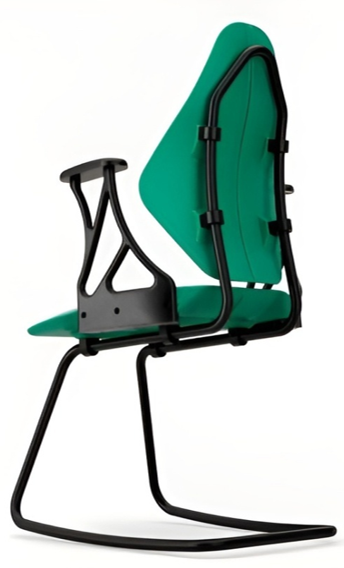
Die vraag vormde het vertrekpunt van deze masterproef. Als een ergonomische bureaustoel niet langer als standaardproduct wordt ontworpen, maar als massapersonaliseerbaar product, kan het ontwerp veel beter worden afgestemd op de ergonomische noden van elke gebruiker.
De Brugse start-up Nozzle maakt vandaag al ergonomische bureaustoelen op maat, die zorgvuldig ontworpen zijn door een ergotherapeut met ervaring in ergonomie en rug revalidatie en een ingenieur gespecialiseerd in 3D-printtechnologie. Hoewel het resultaat prima is, vergt deze aanpak gemiddeld ongeveer anderhalf uur ontwerpwerk per stoel.
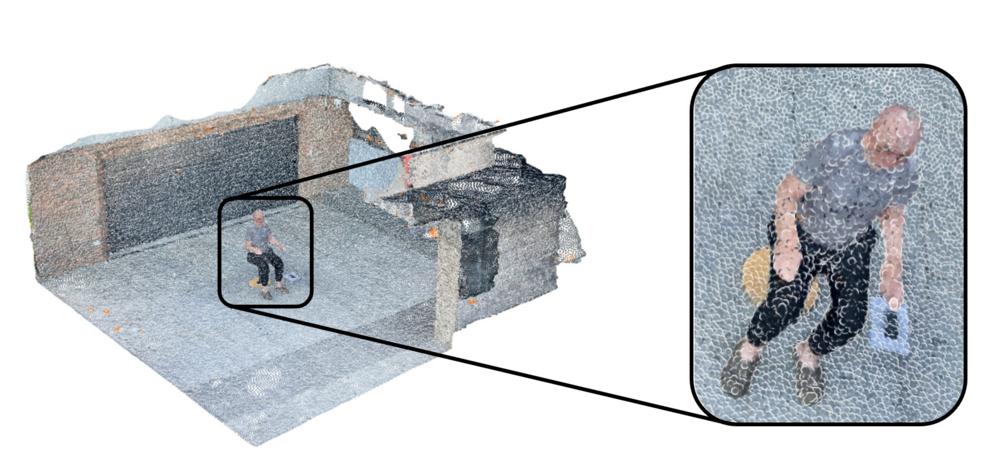
Dat moet sneller kunnen. Het concept achter deze masterproef is dan ook eenvoudig: geef de computer een gedetailleerde 3D-scan van iemands lichaam en laat hem vervolgens een bureaustoel ontwerpen die specifiek bij die persoon past. Zo’n 3D-scan is opgebouwd uit duizenden meetpunten die met elkaar verbonden zijn. Vervolgens maakt het computerprogramma gebruik van vooraf gedefinieerde patronen om deze puntcoördinaten betekenis te geven en te koppelen aan specifieke lichaamsonderdelen, bijvoorbeeld de knieën, heupen en wervelkolom. De computer leert als het ware wat de afmetingen en de lichaamshouding van de persoon is. Deze informatie vormt vervolgens de basis voor het latere stoelontwerp.
De volgende vraag is een stuk moeilijker: hoe weet de computer bij welk lichaam welke stoel past?
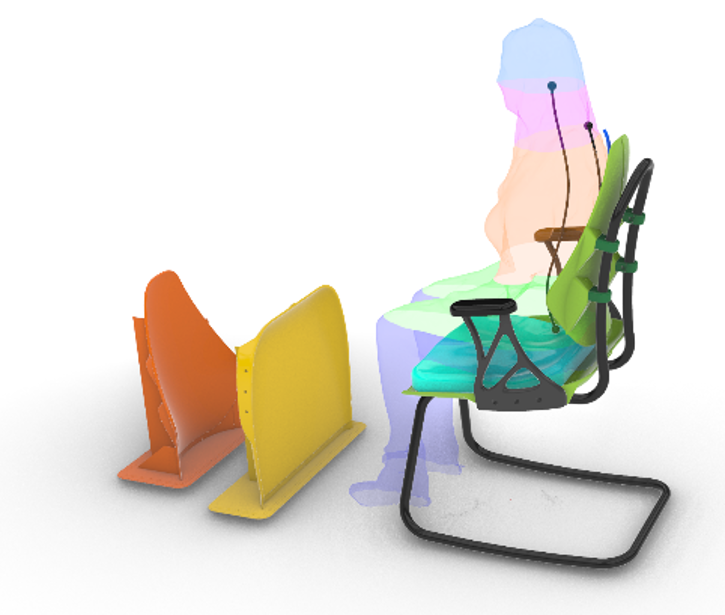
Daarvoor werden geometrische ontwerpregels ontwikkeld die de computer kan toepassen. Die regels leggen verbanden tussen de afmetingen van het lichaam, de lichaamshouding en de vorm van de stoel. Op basis van deze regels zal dan een complex programma de stoelgeometrie genereren. Zo kan de hoogte van de heup in zittende houding bijvoorbeeld gebruikt worden om de ideale zithoogte te bepalen. Op dezelfde manier kunnen andere lichaamsmaten worden vertaald naar de afmetingen van de zitting, armleuningen en rugleuning.
Daarbij speelt parametrisch ontwerpen een belangrijke rol. In plaats van voor elke persoon helemaal opnieuw een stoel te tekenen, wordt één slim digitaal model gemaakt. Dat model bevat verschillende variabelen die automatisch kunnen veranderen. Heeft iemand bijvoorbeeld langere benen? Dan past de computer de zithoogte aan. Verandert een andere lichaamsmaat, dan verandert de stoelgeometrie mee.
Eén digitaal model kan zo een hele reeks unieke stoelen opleveren, steeds getuned naar het lichaam van elke individuele gebruiker.
De rugleuning: de grootste uitdaging
Een goede rugleuning moet niet alleen de juiste afmetingen hebben, maar ook aansluiten bij de natuurlijke kromming van iemands lichaam.
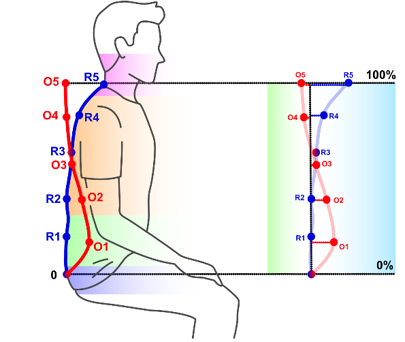
Om dat mogelijk te maken, werd een statistisch model ontwikkeld op basis van verschillende lichaamsscans. Een ervaren ergotherapeut bepaalde voor elke scan welke vorm de rugleuning moest krijgen. Vervolgens leerde het model verbanden leggen tussen de houding van het lichaam en de gewenste vorm van de rugleuning. Op die manier leert de computer van menselijke expertise.
Van de theorie naar de praktijk
Doorheen het masterproeftraject werd een methode ontwikkeld die op basis van een 3D scan van een persoon, iemand toelaat om binnen de 10 minuten een correct ergonomische bureaustoel te genereren. De methode werd toegepast op 12 verschillende kwalitatieve lichaamsscans gecombineerd met meer dan 40 verschillende patronen voor de rugleuning en in alle gevallen leverde de computer een passend stoelmodel op. Zolang de lichaamsscans een correcte geometrie bevatten maakt het programma geen fouten.
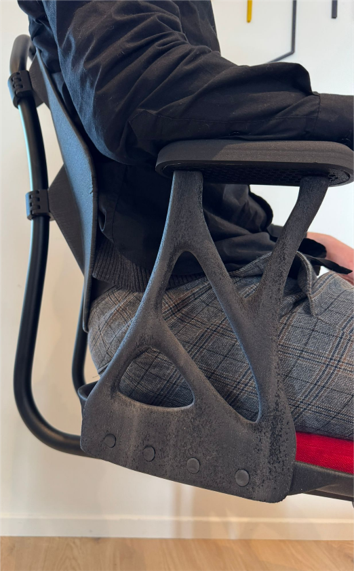
Het programma analyseert de 3D-scan, bepaalt de relevante lichaamsmaten en genereert vervolgens automatisch een stoelmodel.
Ook wordt het model voorbereid voor 3D-printing, zodat het ontwerp niet alleen digitaal mooi is, maar ook daadwerkelijk geproduceerd kan worden en voldoende stevig is.
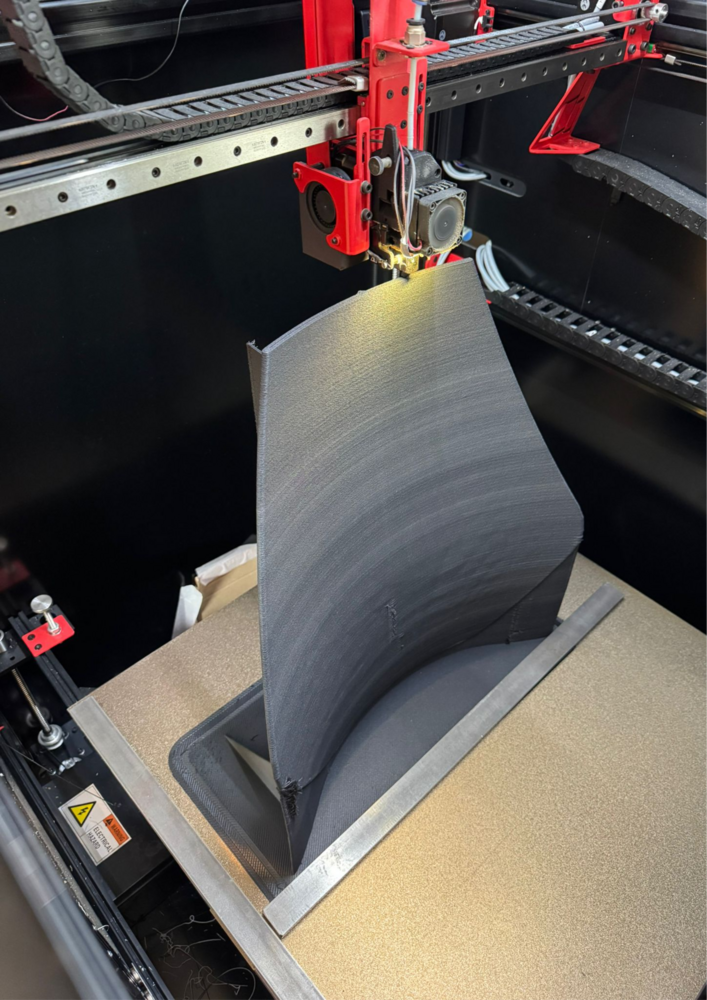
En het bleef niet bij een digitaal ontwerp. Met de ontwikkelde methode werd een volledig gepersonaliseerde bureaustoel op ware grootte geproduceerd met behulp de 3D-printtechnologie bij Nozzle. De stoel werd vervolgens getest op meerdere ergonomische aspecten, automatiseerbaarheid en reproduceerbaarheid. De gelukkige gebruiker kon de stoel vervolgens zelf uitproberen.
De computer als ontwerp assistent
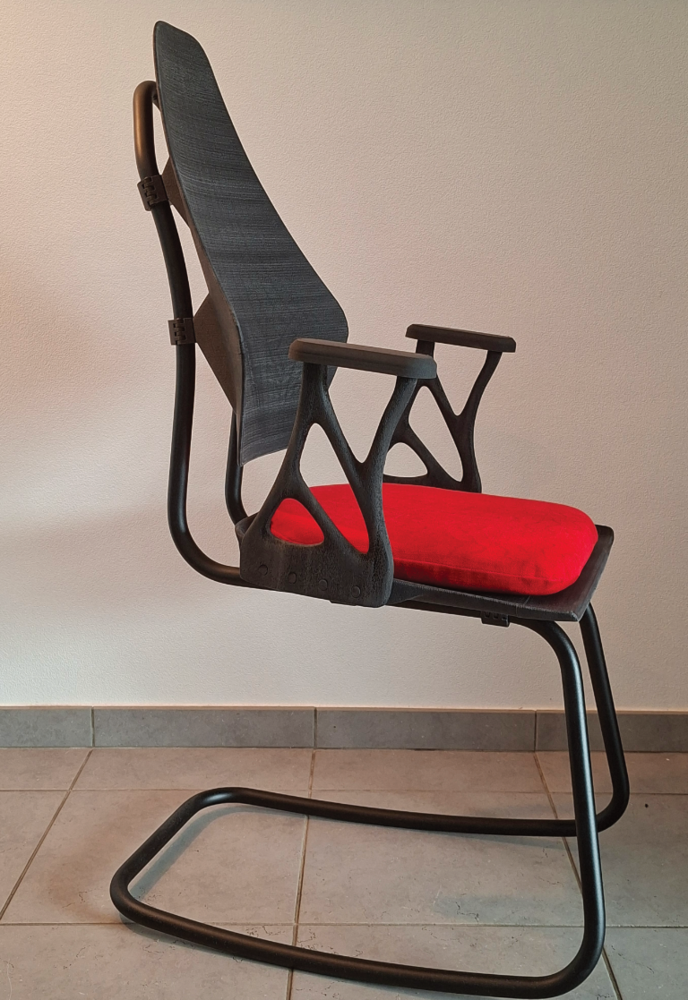
De computer kan duizenden berekeningen uitvoeren en telkens opnieuw geometrische aanpassingen maken, in minuten. Daardoor kan een proces dat vandaag veel handmatig werk vraagt, grotendeels worden geautomatiseerd.
Maar de computer neemt het ontwerp niet volledig over. Menselijke expertise blijft belangrijk bij onder meer kwaliteitscontrole, bijsturing in bijzondere situaties en context
De grote verandering zit dus niet in een computer die de mens vervangt, maar in een computer die de mens extra tools biedt.
Het onderzoek toont aan dat individueel maatwerk perfect combineerbaar is met een doorgedreven automatisatie waardoor het ontwerp en productieproces efficiënter en sneller kan plaatsvinden.
Bibliografie
[1] GBD 2021 Low Back Pain Collaborators, „Global, regional, and national burden of low
back pain, 1990-2020, its attributable risk factors, and projections to 2050: a systematic
analysis of the Global Burden of Disease Study 2021,” The Lancet Rheumatology, vol. 5,
no. 6, pp. e316–e329, 2023. doi: 10.1016/S2665-9913(23)00098-X. [Online]. Available:
https://pubmed.ncbi.nlm.nih.gov/37273833/.
[2] GBD 2019 Diseases and Injuries Collaborators, „Global burden of 369 diseases and
injuries in 204 countries and territories, 1990-2019: a systematic analysis for the Global
Burden of Disease Study 2019,” The Lancet, vol. 396, no. 10258, pp. 1204–1222, 2020.
doi: 10.1016/S0140-6736(20)30925-9. [Online]. Available: https://doi.org/10.1016/S0140-
6736(20)30925-9.
[3] World Health Organization, „Low back pain,” WHO Fact Sheet, 19 Jun 2023. [Online].
Available: https://www.who.int/news-room/fact-sheets/detail/low-back-pain.
[4] L. Manchikanti, „Epidemiology of low back pain,” Pain Physician, 3 Apr 2000. [Online].
Available: https://pubmed.ncbi.nlm.nih.gov/16906196/.
[5] Federal Institute for Occupational Safety and Health (BAuA) & Deutsche Gesetzliche
Unfallversicherung (DGUV), „Identification and prioritisation of relevant prevention issues
for work-related musculoskeletal disorders (MSDs),” European Agency for Safety and
Health at Work (EU-OSHA report)– IPP-aMSE,” Project Report (Work Package 1–4), 2008.
[Online]. Available:
https://www.dguv.de/medien/content/prevention/project/msd/review/ap_1_e….
[6] N. Alaca, A. Ö. Acar, and S. Öztürk, „Low back pain and sitting time, posture and behavior
in office workers: A scoping review,” Journal of Back and Musculoskeletal Rehabilitation,
vol. 38, no. 5, pp. 919–943, 2025. [Online]. Available:
https://journals.sagepub.com/doi/10.1177/10538127251320320.
[7] Eurofound, „New pan-European survey reveals stark inequalities in working conditions,”
Eurofound Press Release (Mynewdesk), 3 Sep 2025. [Online]. Available:
https://www.mynewsdesk.com/eurofound/pressreleases/new-pan-european-sur…. [Geopend 26 01 2026].
[8] Statista Research Department, „Number of full-time workers in the European Union from
2002 to 2023,” Statista, 2024. [Online]. Available:
https://www.statista.com/statistics/1197123/full-time-workers-in-the-eu/. [Geopend 26
01 2026].
[9] Eurofound, Agnès Parent-Thirion et al., „European Working Conditions Survey 2024: First
findings,” Eurofound, 3 Sep 2025. [Online]. Available:
https://www.eurofound.europa.eu/en/publications/all/european-working-co….
[10] L. Boulbayem, „Sedentary behaviour at work in adults between 18 and 64 years,”
Sciensano – National Food Consumption Survey 2022–2023, 13 Jan 2025. [Online].
Available: https://www.sciensano.be/en/results-national-food-consumption-survey202…-
years. [Geopend 26 01 2026].
[11] ReumaNet vzw, „De impact van musculoskeletale aandoeningen op gezondheid en
economie,” ReumaNet vz, 4 Aug 2023. [Online]. Available: https://reumanet.be/deimpact-van-musculoskeletale-aandoeningen-op-gezon…. [Geopend
26 01 2026].
[12] V. Gorasso et al., „The health and economic burden of musculoskeletal disorders in
Belgium from 2013 to 2018,” Population Health Metrics, vol. 21, no. 4, 2023. doi:
10.1186/s12963-023-00303-z. [Online]. Available:
https://link.springer.com/article/10.1186/s12963-023-00303-z.
[13] E. Al-Eisa, D. Egan, K. Deluzio, and R. Wassersug, „Effects of pelvic asymmetry and low
back pain on trunk kinematics during sitting: a comparison with standing,” Spine, vol. 31,
no. 5, pp. E135–E143, Apr 2006. [Online]. Available: doi:
10.1097/01.brs.0000201325.11336.29.
[14] Vlaams Instituut Gezond Leven vzw, „Goede zithouding – Gezond Leven,” Vlaams Instituut
Gezond Leven vzw, 2025. [Online]. Available:
https://www.gezondleven.be/themas/beweging-sedentairgedrag/beweegoefeni…. [Geopend 26 01 2026].
[15] R. Motmans, „Wat is een goede zithouding,” ErgonomieSite.be, 2018. [Online]. Available:
https://www.ergonomiesite.be/goede-zithouding/. [Geopend 26 01 2026].
[16] Institute, New York Spine, „What Are the Four Normal Curves of the Spine?,” New York
Spine Institute, 2020. [Online]. Available: https://www.nyspine.com/blog/what-are-thefour-normal-curves-of-the-spin…. [Geopend 26 01 2026].
[17] M. Cho, J.-S. Han, S. Kang, C.-H. Ahn, D.-H. Kim, C.-H. Kim, K.-T. Kim, A.-R. Kim, J.-M.
Hwang, „Biomechanical Effects of Different Sitting Postures and Physiologic Movements
on the Lumbar Spine: A Finite Element Study,” bioengineering, 7 Sep 2023. [Online].
Available: DOI: 10.3390/bioengineering10091051.
[18] D. D. Harrison, S. O. Harrison, A. C. Croft, D. E. Harrison, S. J. Troyanovich, „Sitting
biomechanics part I: review of the literature,” Journal of Manipulative and Physiological
Therapeutics, vol. 22, no. 9, pp. 594–609, 1999. doi: 10.1016/S0161-4754(99)70020-5.
[Online]. Available: https://doi.org/10.1016/S0161-4754(99)70020-5.
[19] S. Pheasant and C. M. Haslegrave, Bodyspace: Anthropometry, Ergonomics and the
Design of Work, Boca Raton, FL, USA: CRC ress (Taylor & Francis Group), 2005.
[20] B. J. G. Andersson, R. Örtengren, A. Nachemson, and G. Elfström, „Lumbar disc pressure
and myoelectric back muscle activity during sitting. IV. Studies on a car driver's seat,”
Scandinavian Journal of Rehabilitation Medicine, vol. 6, no. 3, pp. 128–133, 1974.
[Online]. Available:
https://www.researchgate.net/publication/18747810_Lumbar_disc_pressure_…
ectric_back_muscle_activity_during_sitting_IV_Studies_on_a_car_driver's_seat.
[21] S. M. Carcone and P. J. Keir, „Effects of backrest design on biomechanics and comfort
during seated work,,” Ergonomics, vol. 38, no. 6, pp. 755–764, Nov 2007. [Online].
Available: https://doi.org/10.1016/j.apergo.2006.11.001.
[22] IDEWE, „Onderzoek beeldschermwerk: 71% stelt bureaustoel verkeerd in en 49% heeft
last van rugklachten,” IDEWE - Groep IDEWE, 16 Oct 2024. [Online]. Available:
https://www.idewe.be/-/persbericht-onderzoekbeeldschermwerk. [Geopend 2026 01
2026].
[23] IsGeschiedenis.nl, „De geschiedenis van de bureaustoel,” IsGeschiedenis.nl, [Online].
Available: https://isgeschiedenis.nl/reportage/de-geschiedenis-van-de-bureaustoel.
[Geopend 24 12 2025].
[24] R. Green, „The evolution of ergonomics in the contract furniture industry,” CCI Media, LLC
(Woodworking Network), 10 Dec 2020. [Online]. Available:
https://www.woodworkingnetwork.com/design/evolution-ergonomics-contract…. [Geopend 24 12 2025].
[25] E. Koops, „Over de geschiedenis en ontwikkeling van de bureaustoel,” Historiek.nl, 27
Mar 2021. [Online]. Available: https://historiek.net/bureaustoel-uitvinding-geschiedenisontwikkeling/1…. [Geopend 24 12 2025].
[26] ChairsFX, „History Of Ergonomic Desk Chair Technologies: 1850-2023,” ChairsFX, 12 Jan
2026. [Online]. Available: https://chairsfx.com/gaming-chair-news/ergonomicinnovation-history/. [Geopend 24 12 2025].
[27] Vitra, „Lounge Chair & Ottoman,” Vitra International AG, 2025. [Online]. Available:
https://www.vitra.com/nl-be/product/details/lounge-chair-and-ottoman. [Geopend 24 12
2025].
[28] G. Pahl and W. Beitz, „Engineering Design: A Systematic Approach,” 3rd ed. London, UK:
Springer, 2007. [Online]. Available: https://link.springer.com/book/10.1007/978-1-84628-
319-2.
[29] T. Brown, „Design Thinking,” Harvard Business Review, vol. 86, no. 6, Jun 2008. [Online].
Available: https://readings.design/PDF/Tim%20Brown,%20Design%20Thinking.pdf.
[30] D. A. Norman, The Design of Everyday Things, New York, NY, USA: Basic Books, 2013.
[31] S. S. Bae, T. Fujiwara, A. Ynnerman, E. Y.-L. Do, M. L. Rivera, en D. A. Szafir, „A
Computational Design Pipeline to Fabricate Sensing Network Physicalizations,” arXiv
preprint arXiv:2308.04714, 2023. [Online]. Available: https://arxiv.org/pdf/2308.04714.
[32] „Computational Pipelines,” Rescale Glossary, [Online]. Available:
https://rescale.com/glossary/computational-pipelines/. [Geopend 01 05 2026].
[33] GRAITEC, „The Ultimate Guide to Computational Design,” GRAITEC, mei 2023. [Online].
Available: https://graitec.com/ca-en/ultimate-guide-to-computational-design/.
[34] T. B. Sheridan and R. Parasuraman, „Human-Automation Interaction,” Reviews of Human
Factors and Ergonomics, vol. 1, no. 1, pp. 89–129, 2005. [Online]. Available:
https://doi.org/10.1518/155723405783703082.
[35] S. E. McBride, W. A. Rogers, and A. D. Fisk, „Understanding human management of
automation errors,” Theoretical Issues in Ergonomics Science, vol. 15, no. 6, pp. 545–577,
2014. [Online]. Available: https://pubmed.ncbi.nlm.nih.gov/25383042/.
[36] W. Li, A. Aboutorabi, H. Lyu, K. Qian, M. Fleming, B. C. Goehring, and N. Thompson,
„Economics of Human and AI Collaboration: When is Partial Automation More Attractive
than Full Automation?,” Arxiv, Mar 2026. [Online]. Available:
https://arxiv.org/html/2603.29121v1.
[37] L. Bainbridge, „Ironies of automation,” Automatica, vol. 19, no. 6, pp. 775–779, 1983. doi:
10.1016/0005-1098(83)90046-8. [Online]. Available:
https://www.sciencedirect.com/science/article/pii/0005109883900468.
[38] M. Lambrecht, „Scoliose – Chiropraxie Lochristi Wiki,” Chiropraxie Lochristi, 2026.
[Online]. Available: https://chiropraxielochristi.be/wiki/scoliose/.
[39] „Wat is scoliose?,” Scoliose vereniging, 2025. [Online]. Available: https://scoliose.nl/watis-scoliose/. [Geopend 07 02 2026].
[40] BlueWeave Consulting, „Europe Ergonomic Chair Market Size Booming to Touch USD
4.33 Billion by 2030,” BlueWeave Consulting & Research Pvt Ltd, 2 Apr 2024. [Online].
Available: https://www.blueweaveconsulting.com/press-release/europe-ergonomicchair…. [Geopend 26 01 2026].
[41] Deep Market Insights, „Benelux ergonomic chair market size, trends & forecast analysis
(2025–2033),” Deep Market Insights, 2025. [Online]. Available:
https://deepmarketinsights.com/vista/insights/ergonomic-chair-market/be….
[Geopend 26 01 2026].
[42] Herman Miller, „Supporting the Spine When Seated: The Science and Research Behind
the Mirra 2 Chair,” 2013. [Online]. Available:
https://www.hermanmiller.com/research/categories/white-papers/supportin….
[43] L. Lescop, „PLY importer for Grasshopper,” Digital Methodologies and Concepts, 8 Feb
2022. [Online]. Available: https://www.keris-studio.fr/blog/?p=12461.
[44] APN Photography School, „White balance: correct the color temperature of your
pictures,” APN Photography, 2008. [Online]. Available:
https://www.apnphotographyschool.com/concepts/white-balance-correct-the…. [Geopend 16 03 2026].
[45] Y. Xiang, Y. Yue, T. Peters, and K. Schindler, „A Review of Panoptic Segmentation for
Mobile Mapping Point Clouds,” ISPRS Journal of Photogrammetry and Remote Sensing,
vol. 203, pp. 373–391, 2023. [Online]. Available:
https://www.sciencedirect.com/science/article/pii/S092427162300223X.
[46] Laurent Delrieu, „Wish: Concave Hull,” McNeel Forum (Grasshopper2 discussion thread),
Jun 2018. [Online]. Available: https://discourse.mcneel.com/t/wish-concavehull/66329/2.
[47] University of Melbourne (NExT Lab), „Data analysis in Grasshopper: Body tracking,” MSKB MSD Unimelb., 2024. [Online]. Available: https://ms-kb.msd.unimelb.edu.au/nextlab/sensing/body-tracking/data-ana…. [Geopend 08 03 2026].
[48] J. Martinez Castro, W. Song, and T. Huysmans, „Computational Design for (Industrial)
Designers Using Rhino Grasshopper – Rhino Grasshopper Open Access Education,”Delft
University of Technology, 17 Feb 2024. [Online]. Available:
https://interactivetextbooks.tudelft.nl/rhinograsshopper/Grasshopper_Rh…
D_Shape_Data_and_Models/%21index.html. [Geopend 08 03 2026].
[49] A. Tursi, G. Kurillo, and R. Bajcsy, „Automatic Detection of Body Landmarks in Human
Body Scans: Lower Limb Analysis for Biomedical and Footwear Applications,” in Proc.
3DBODY.TECH 2017 – 8th Int. Conf. and Exhibition on 3D Body Scanning and Processing
Technologies, Montreal, Canada, [Online]. Available:
https://www.researchgate.net/publication/320333509_Automatic_Detection_…
andmarks_in_Human_Body_Scans_-
_Lower_Limb_Analysis_for_Biomedical_and_Footwear_Applications.
[50] K. S. Lee, „Automation of 3D average human body shape modeling using Rhino and
Grasshopper Algorithm,” Fashion and Textiles, vol. 8, art. 23, Jun 2021. [Online]. Available:
https://www.researchgate.net/publication/352397441_Automation_of_3D_ave…
an_body_shape_modeling_using_Rhino_and_Grasshopper_Algorithm.
[51] E. J. Ryu, „Automatic extraction of upper body landmarks using Rhino and Grasshopper
algorithms,” Fashion and Textiles, vol. 3, no. 1, art. 20, 2022. [Online]. Available:
https://www.researchgate.net/publication/364707317_Automatic_extraction…
ody_landmarks_using_Rhino_and_Grasshopper_algorithms.
[52] Elsevier, „Pose estimation,” ScienceDirect Topics: Computer Science, 2023. [Online].
Available: https://www.sciencedirect.com/topics/computer-science/pose-estimation.
[Geopend 08 03 2026].
[53] Mathur, Ar. Praneet, „Catwalk – Grasshopper plugin for human detection,” Food4Rhino –
Rhino & Grasshopper Plugins, 3 Mei 2020. [Online]. Available:
https://www.food4rhino.com/en/app/catwalk. [Geopend 08 03 2026].
[54] mahdiyar, „Euglena – Computer Vision plugin for Grasshopper,” Food4Rhino – Rhino &
Grasshopper Plugins, 25 12 2023. [Online]. Available:
https://www.food4rhino.com/en/app/euglena. [Geopend 08 03 2026].
[55] Edge, Google AI, „Pose Landmark Detection Guide – Google AI for Developers,” Google
LLC, 2024. [Online]. Available:
https://ai.google.dev/edge/mediapipe/solutions/vision/pose_landmarker. [Geopend 08
03 2026].
[56] S. Dill, A. Rösch, M. Rohr, G. Güney, L. De Witte, E. Schwartz, and C. H. Antink, „Accuracy
Evaluation of 3D Pose Estimation with MediaPipe Pose for Physical Exercises,” Current
Directions in Biomedical Engineering, Sep 2023. [Online]. Available:
https://www.researchgate.net/publication/374081734_Accuracy_Evaluation_…
_Estimation_with_MediaPipe_Pose_for_Physical_Exercises.
[57] L. Yang, B. Kang, Z. Huang, Z. Zhao, X. Xu, J. Feng, and H. Zhao, „Depth Anything V2,” arXiv,
13 Jun 2024. [Online]. Available: https://depth-anything-v2.github.io/. [Geopend 08 03
2026].
[58] Topics, ScienceDirect, „Anthropometric Data,” Elsevier, 2019. [Online]. Available:
https://www.sciencedirect.com/topics/engineering/anthropometric-data. [Geopend 08
03 2026].
[59] R. Motmans, „DINBelg,” Ergonomie RC, Leuven, 2005. [Online]. Available:
https://www.dinbelg.be/. [Geopend 08 03 2026].
[60] F. Michaud, U. Lugrís, and J. Cuadrado, „Determination of the 3D Human Spine Posture
from Wearable Inertial Sensors and a Multibody Model of the Spine,” Sensos, vol. 22, no.
13, p. 4796, 2022. [Online]. Available: https://www.mdpi.com/1424-8220/22/13/4796.
[61] MFES, „Motion and Force Engineering Solutions,” MFES, 2025. [Online]. Available:
https://mfes.es/en/. [Geopend 01 01 2026].
[62] M. Ardito, F. Mascolo, M. Valentini, F. Dell’Olio, „Low-Cost Wireless Wearable System for
Posture Monitoring,” Electronics (Switzerland), 21 Oct 2021. [Online]. Available:
https://www.mdpi.com/2079-9292/10/21/2569.
[63] K. Zeraatkar, M. Khalili, „Design and Development of a Rotary 3D Scanner for Human
Body Scanning,” Proceedings of the 8th International Conference and Exhibition on 3D
Body Scanning and Processing Technologies, Oct 2017. [Online]. Available:
https://www.researchgate.net/publication/320333722_Design_and_Developme…
Rotary_3D_Scanner_for_Human_Body_Scanning.
[64] J. C. Rodríguez-Quiñonez, O. Sergiyenko, V. Tyrsa, L. C. Básaca-Preciado, M. Rivas-Lopez,
D. Hernández-Balbuena en M. Peña-Cabrera, „3D Body & Medical Scanners’
Technologies: Methodology and Spatial Discriminations,” 3D Body Scanning
Technologies, IntechOpen, 2011. [Online]. Available: https://doi.org/10.5772/16233.
[65] S. Streuber, M. Quiros-Ramirez, M. Hill en M. J. Black, „Generating Statistically Plausible
Body Shape Variations for Perception Studies,” Proceedings of Mensch und Computer
(MuC 2016), Aachen, Germany, 2016. [Online]. Available:
https://www.researchgate.net/publication/307639132_Generating_Statistic…
e_Body_Shape_Variations_for_Perception_Studies.
[66] Siemens PLM Software, „Transforming the Digital Enterprise,” Siemens PLM Software
White Paper, 2014. [Online]. Available:
https://www.plm.automation.siemens.com/en_us/Images/7172_tcm1023-4287.p….
[Geopend 04 04 2026].
[67] T. Rose, „Use your iPhone to create 3D facial models with Trimensional,” The Next Web,
08 Jan 2011. [Online]. Available: https://thenextweb.com/news/use-your-iphone-tocreate-3d-facial-models-w….
[68] L. C. T. Coelho, M. F. C. Pinho, F. M. de Carvalho, A. L. M. M. Franco, O. C. QuispeEnriquez, F. A. Altónaga, and J. L. Lerma, „Evaluating the Accuracy of Smartphone-Based
Photogrammetry and Videogrammetry in Facial Asymmetry Measurement,” Symmetry,
vol. 17, no. 3, art. 376, 2025. [Online]. Available: https://www.mdpi.com/2073-
8994/17/3/376.
[69] E. Botti, B. Jansen, F. Ballen-Moreno, A. Kapila, and R. Brahimetaj, „Evaluating the
Accuracy and Repeatability of Mobile 3D Imaging Applications for Breast Phantom
Reconstruction,” Sensors, vol. 25, no. 15, p. 4596, 2025. [Online]. Available:
https://www.mdpi.com/1424-8220/25/15/4596.
[70] E. Strunevich, U. Detering-Koll, and B. Quattelbaum, „Investigation of usability and
measurement accuracy of 3D body scanning mobile applications,” Communications in
Development and Assembling of Textile Products, Dec 2020. [Online]. Available:
https://www.researchgate.net/publication/348198093_Investigation_of_usa…
easurement_accuracy_of_3D_body_scanning_mobile_applications.
[71] S. E. McBride, W. A. Rogers, and A. D. Fisk, „Clinical anthropometrics and body
composition from 3D whole-body surface scans,” European Journal of Clinical Nutrition,
vol. 70, 2016. [Online]. Available: https://doi.org/10.1038/ejcn.2016.109.
[72] B. K. Ng et al., „Clinical anthropometrics and body composition from 3D whole-body
surface scans,” European Journal of Clinical Nutrition, vol. 70, pp. 1265–1270, 2016. doi:
10.1038/ejcn.2016.109. [Online]. Available: https://doi.org/10.1038/ejcn.2016.109.
[73] al., C. Lugaresi et al., „MediaPipe: A Framework for Building Perception Pipeline,” arXiv
preprint arXiv:1906.08172, Jun 2019. [Online]. Available:
https://arxiv.org/abs/1906.08172.
[74] R. Poppe, „Vision-based human motion analysis: An overview,” Computer Vision and
Image Understanding, vol. 108, no. 1–2, 2007. [Online]. Available:
https://www.sciencedirect.com/science/article/pii/S1077314206002293?via….
[75] K. Razzaq and M. Shah, „Machine Learning and Deep Learning Paradigms: From
Techniques to Practical Applications and Research Frontiers,” Computers, vol. 14, no. 3,
article 93, pp. Vol. 14, nr. 3, Art. 93 (12), 2025.
[76] X. Ying, „An Overview of Overfitting and its Solutions,” Journal of Physics: Conference
Series, 2019. [Online]. Available:
https://www.researchgate.net/publication/331677125_An_Overview_of_Overf…
its_Solutions.
[77] S. Solutions, „Multiple Regression,” Statistics Solutions – Free Resources Directory of
Statistical Analyses, n.d.. [Online]. Available: https://www.statisticssolutions.com/freeresources/directory-of-statisti…. [Geopend 09 03 2026].
[78] J. Chen, J. Chen, H. Wang, L. He, B. Huang, S. Dadbakhsh, and P. Bartolo, „Fabrication
and development of mechanical metamaterials via additive manufacturing for
biomedical applications: a review,” International Journal of Extreme Manufacturing, Nov
2024. [Online]. Available: https://iopscience.iop.org/article/10.1088/2631-7990/ad88e3.
[79] R. Tilley, E. Pickering, M. Woodruff, and D. Holmes, „Design of a 3D printed wheelchair
cushion for offloading using functionally graded materials and novel FEM topology
optimization,” Research Square, Aug 2025. [Online]. Available:
https://www.researchgate.net/publication/396117802_Design_of_a_3D_print…
hair_cushion.
[80] R. Tilley, E. Pickering, M. A. Woodruff, and D. W. Holmes, „Functionally graded TPU gyroid
structures for cushioning applications,” Mechanics of Advanced Materials and
Structures, 2025. [Online]. Available: https://doi.org/10.1080/15376494.2025.2530146.
[81] O. Alawneh, X. Zhong, R. Faieghi, and F. Xi, „Finite element methods for modeling the
pressure distribution in human body–seat interactions: A systematic review,” Applied
Sciences, vol. 12, no. 12, p. 6160, 17 Jun 2022. [Online]. Available:
https://www.mdpi.com/2076-3417/12/12/6160.
[82] D. W. Holmes, D. Singh, R. Lamont, R. Daley, D. P. Forrestal, P. Slattery, E. Pickering, N. C.
Paxton, S. K. Powell, and M. A. Woodruff, „Mechanical behaviour of flexible 3D printed
gyroid structures as a tuneable replacement for soft padding foam,” Materials & Design,
vol. 192, p. 108749, Feb 2022. [Online]. Available:
https://www.sciencedirect.com/science/article/pii/S2214860421007028.
[83] V. Beloshenko, Y. Beygelzimer, V. Chishko, B. Savchenko, N. Sova, D. Verbylo, A. Voznyak,
and I. Vozniak, „Mechanical Properties of Flexible TPU-Based 3D Printed Lattice
Structures: Role of Lattice Cut Direction and Architecture,” Polymers, vol. 13, no. 17, p.
2986, 2021. [Online]. Available: https://www.mdpi.com/2073-4360/13/17/2986.
[84] S. de la Rosa, P. F. Mayuet, C. S. Silva, Á. M. Sampaio, and L. Rodríguez-Parada, „Design
and characterization of 3D-printed TPU-based lattice structures: Application to
methodology for the design of personalized therapeutic products,” Rapid Prototyping
Journal, vol. 30, no. 11, pp. 72–86, 2024. [Online]. Available: https://doi.org/10.1108/RPJ08-2023-0287.
[85] D. E. De Carvalho and J. P. Callaghan, „Effect of office chair design features on lumbar
spine posture, muscle activity and perceived pain during prolonged sitting,” Ergonomics,
vol. 66, no. 10, pp. 1465–1476, 2023. doi: 10.1080/00140139.2022.2152113. [Online].
Available: https://doi.org/10.1080/00140139.2022.2152113.
[86] ADVYS, „Thermoplastisch orthesemateriaal platen – Advys,” Advys, 2025. [Online].
Available: https://www.advys.be/nl/Producten/Orthopedie/Splinting/Thermoplastischo…. [Geopend 01 01 2026].
[87] Seveso, „Seves – Home (homepage van Seves Sports / Loopcentrum),” Seveso.nl, n.d..
[Online]. Available: https://seves.nl/. [Geopend 2026 01 01].
[88] Loopcentrum voor Sport en Orthopedie, „De vacuümmethode,” Loopcentrum, n.d..
[Online]. Available: https://loopcentrum.nl/onze-methode/de-vacuummethode/.
[Geopend 01 01 2026].
[89] H. Sutedi, N. Yuselin, N. N. Aisa, E. Rosyidi, R. Zahabiyah, Y. Fauziah, I. Setiawan, A. A.
Farhan, G. I. Muffazal, J. B. Setyawan, M. I. A. Hakim, A. Mursyid, E. Satria, M. Padillah, S.
Effendi, „Anthropometric Chair Design Using the Reverse Engineering Method to Support
Practical Learning,” TEKNOSAINS: Jurnal Sains, Teknologi dan Informatika, 2025. [Online].
Available: https://doi.org/10.37373/tekno.v12i2.1580.
[90] S. M. C. e. P. J. Keir, „Effects of backrest design on biomechanics and comfort during
seated work,” Applied Ergonomics, p. 10, 2007.
[91] B. f. A. u. A. (BAuA), „Sicherheit und Gesundheit bei der Arbeit 2002 -
Unfallverhütungsbericht Arbeit,” Wirtschaftsverlag NW Verlag für neue Wissenschaft
GmbH, p. 215, 2004.
[92] M. Pepe, A. Restuccia Garofalo, D. Costantino, F. F. Tana, D. Palumbo, V. S. Alfio, and E.
Spacone, „From Point Cloud to BIM: A New Method Based on Efficient Point Cloud
Simplification by Geometric Feature Analysis and Building Parametric Objects in
Rhinoceros/Grasshopper Software,” Remote Sensing, vol. 16, no. 9, art. no. 1630, 2024,
doi: 10.3390/rs16091630, 15 Apr 2024. [Online]. Available: https://www.mdpi.com/2072-
4292/16/9/1630.
[93] S. Nace, J. Tiernan, A. Ní Annaidh, and D. Holland, „Development and evaluation of a
facile mesh-to-surface tool for customised wheelchair cushions,” 3D Printing in
Medicine, vol. 9, no. 1, art. no. 3, 13 02 2023. [Online]. Available:
https://link.springer.com/article/10.1186/s41205-022-00165-5.
[94] Saiga1105, „Scan-to-BIM-Grasshopper: Scan-to-BIM toolbox for Grasshopper Rhino
including mesh/pcd segmentation, classification and reconstruction,” GitHub, 2019.
[Online]. Available: https://github.com/Saiga1105/Scan-to-BIM-Grasshopper. [Geopend
24 03 2026].