Caesars beroemde woorden: ‘Vertaald, Veranderd, Verdwenen’
De huidige AI-taalmodellen zijn allesbehalve volmaakt, maar toch wordt deze technologie massaal gebruikt waar het maar mogelijk is. Hoe lang duurt het voordat er op de covers van je favoriete boekenreeks ‘Translated by AI’ komt te staan? En wat voor effect zou dit hebben op de betekenis en nuance ten opzichte van de originele tekst?
Het klinkt als een logische en eenvoudige optie: laat kunstmatige intelligentie je teksten in een handomdraai vertalen. Maar de huidige systemen zijn hier gewoon nog niet klaar voor. Hoewel teksten en vertalingen door AI razendsnel evolueren, blijven er fundamentele problemen bestaan. Eén van de grote blinde vlekken van deze technologie is de weergave van cultuur. Een taal is immers veel meer dan een verzameling woorden en grammaticale regels; het is een drager van geschiedenis, humor, tradities en unieke wereldbeelden.
Een ongelijke verhouding
Achter de ogenschijnlijke magie van AI-chatbots schuilt een onverwacht probleem: ze bekijken de wereld grotendeels door een Engelstalige, westerse bril. Omdat ze getraind zijn op gigantische hoeveelheden – voornamelijk Engelstalige – data op het internet, passen ze die denkwijze regelmatig toe op wat ze verwerken. Ook bij het vertalen worden AI-modellen beïnvloed door deze ongelijke verhouding, wat gevaarlijk is voor andere talen en culturen. Zeker bij vertalingen vanuit een kleinere of historische taal, zoals het Latijn, dreigt het eigen culturele gedachtegoed overschreven of weggelaten te worden.
Stel je voor: je leest een gedicht over een uiterst stoere, traditionele Romeinse man die, tot ieders grote verbazing, onlangs als 'bruid' in het huwelijksbootje stapte. In het oude Rome was dit een scherpe grap over heersende genderrollen, aangezien ‘trouwen als bruid’ en ‘trouwen als bruidegom’ aparte termen zijn in het Latijn. Laat je dit echter vertalen door een modern AI-model, dan verdwijnt de pointe volledig en staat er simpelweg dat de man ‘is getrouwd’. Door het gebrek aan culturele nuance is de grap letterlijk ‘lost in translation’.
Tijd voor een schaderapport
Dit is geen alleenstaand geval. In mijn masterthesis onderzocht ik hoe grote AI-taalmodellen, de zogenaamde Large Language Models, omgaan met cultureel gedachtegoed in vertalingen. Hiervoor liet ik drie AI-modellen (Gemini 3.1 Pro, M365 Copilot Chat en Kimi-K2.6) los op de epigrammen van de Romeinse dichter Martialis. Deze satirische gedichten zitten vol historische en culturele referenties over het alledaagse leven, randfiguren en seksualiteit in het oude Rome.
Om de betekenisverschuivingen op te sporen, vergeleek ik de AI-vertalingen met zowel de Latijnse tekst als twee menselijke vertalingen. Op die manier had ik referenties door ervaren vertalers om mijn bevindingen mee te staven. Daarna classificeerde ik alle verschuivingen op basis van het MQM-framework, waardoor het mogelijk werd om algemene trends in kaart te brengen. Het hele proces ging een stuk vlotter dankzij mijn speciaal hiervoor ontwikkelde applicatie, waarmee je de resultaten ook overzichtelijk kunt groeperen.
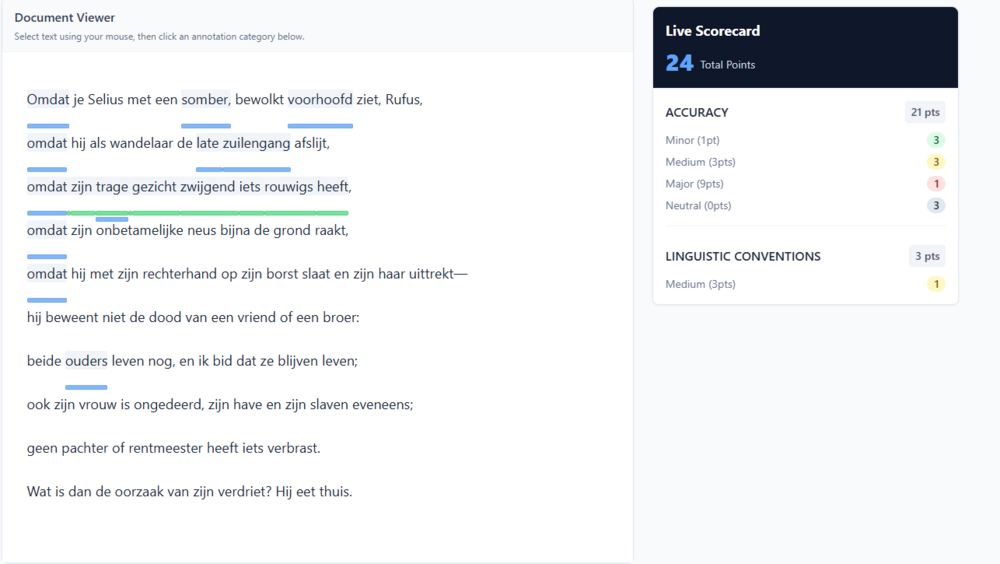
De resultaten zijn veelzeggend. Uit de analyse van de vertalingen bleek al snel dat de AI-modellen vaak te letterlijk en generiek vertalen, waardoor culturele nuance verloren gaat. Zo werd het Latijnse woord fornix door het model Kimi vertaald als 'boog'. Hoewel dat inderdaad de letterlijke basisbetekenis is, bedoelde Martialis in die context een 'bordeel'. Dit zou voor een menselijke vertaler geen struikelblok zijn geweest, dankzij de overduidelijke erotische thematiek in dat specifieke gedicht. Een ander model, Copilot, weigerde dan weer om het gedicht te vertalen omdat het te veel expliciet seksuele taal bevatte. Hierdoor werd de historische en culturele inhoud simpelweg gecensureerd.
Zelfde invoer, een wereld van verschil
Toch is niet elke AI-chatbot even blind voor cultuur. Een vergelijking van de drie modellen toonde aan dat Gemini opmerkelijk beter presteerde en veel minder culturele verschuivingen produceerde in vergelijking met Copilot en Kimi. Daar staat echter tegenover dat Gemini een neiging had naar ‘assimilerende’ vertalingen, waarin de inhoud van de originele tekst toegankelijker en minder ‘vreemd’ werd gemaakt. Dit is bijvoorbeeld op te merken aan extra woorden die ter verduidelijking zijn toegevoegd. Een mogelijke oorzaak van die assimilatie is de Engelstalige dominantie die in de trainingsdata van de modellen zit ingebakken. Daarnaast viel het ook op dat de langere gedichten in verhouding meer verschuivingen bevatten dan de kortere.
Conclusie
Als we de vertaalwereld blindelings overleveren aan kunstmatige intelligentie, riskeren we een verlies van de culturele rijkdom die in de originele teksten te vinden is. Mijn onderzoek toont aan dat AI-modellen nog te vaak als een culturele stoomwals optreden om bruikbaar te zijn voor literaire vertalingen. De gevolgen hiervan reiken helaas veel verder dan enkel Latijnse poëzie: denk maar aan literatuur uit niet-westerse culturen of vertalingen uit kleinere, moderne talen. Zonder grondige veranderingen aan de manier waarop deze taalmodellen worden getraind en ingezet, dreigt het unieke wereldbeeld van talloze culturen te verdwijnen in vertaling.
Toch hoeven we de AI-vertaaltechnologie niet af te schrijven; we moeten ze alleen kritischer evalueren. In mijn onderzoek heb ik daarom een concrete methode en een software-applicatie aangereikt om dit soort culturele verschuivingen systematisch te analyseren. Alleen door de blinde vlekken van AI structureel bloot te leggen, kunnen we de modellen van de toekomst trainen om niet enkel onze woorden te vertalen, maar ook onze cultuur te begrijpen.
Bibliografie
Aguilar, S. T. (2025). “Don’t Teach Minerva”: Guiding LLMs Through Complex Syntax for Faithful Latin Translation with RAG (arXiv:2511.01454). arXiv. https://doi.org/10.48550/arXiv.2511.01454
Ahmed, I., & Islam, R. (2024). Gemini-the most powerful LLM: Myth or Truth. Preprints. https://doi.org/10.36227/techrxiv.171177477.70151414/v1
Akavarapu, V. S. D. S. M., Terdalkar, H., Bhattacharyya, P., Agarwal, S., Deulgaonkar, Dr. V., Dangarikar, C., Manna, P., & Bhattacharya, A. (2025). A Case Study of Cross-Lingual Zero-Shot Generalization for Classical Languages in LLMs. In W. Che, J. Nabende, E. Shutova, & M. T. Pilehvar (Red.), Findings of the Association for Computational Linguistics: ACL 2025 (pp. 2745-2761). Association for Computational Linguistics. https://doi.org/10.18653/v1/2025.findings-acl.141
Almeida, F., & Xexéo, G. (2023). Word Embeddings: A Survey (arXiv:1901.09069). arXiv. https://doi.org/10.48550/arXiv.1901.09069
Amos, F. R. (1920). Early Theories of Translation (Nummer v. 28). Columbia University Press. https://books.google.be/books?id=Tjfb0xz6PgcC
Andrews, E. A. (Ethan A. (with Internet Archive). (1879). A Latin dictionary founded on Andrews’ edition of Freund’s Latin dictionary. Oxford : Clarendon Press. http://archive.org/details/latindictionaryf0000andr_i5j7
Bai, Y., Kadavath, S., Kundu, S., Askell, A., Kernion, J., Jones, A., Chen, A., Goldie, A., Mirhoseini, A., McKinnon, C., Chen, C., Olsson, C., Olah, C., Hernandez, D., Drain, D., Ganguli, D., Li, D., Tran-Johnson, E., Perez, E., … Kaplan, J. (2022). Constitutional AI: Harmlessness from AI Feedback (arXiv:2212.08073). arXiv. https://doi.org/10.48550/arXiv.2212.08073
Bamman, D., & Burns, P. J. (2020). Latin BERT: A Contextual Language Model for Classical Philology (arXiv:2009.10053). arXiv. https://doi.org/10.48550/arXiv.2009.10053
Banh, L., & Strobel, G. (2023). Generative artificial intelligence. Electronic Markets, 33(1), 63. https://doi.org/10.1007/s12525-023-00680-1
Barthel, M., Stocking, G., Holcomb, J., & Mitchell, A. (2016, februari 25). Reddit news users more likely to be male, young and digital in their news preferences. Pew Research Center. https://www.pewresearch.org/journalism/2016/02/25/reddit-news-users-more-likely-to-be-male-young-and-digital-in-their-news-preferences/
Bender, E. M., Gebru, T., McMillan-Major, A., & Shmitchell, S. (2021). On the Dangers of Stochastic Parrots: Can Language Models Be Too Big? 🦜. Proceedings of the 2021 ACM Conference on Fairness, Accountability, and Transparency, FAccT ’21, 610-623. https://doi.org/10.1145/3442188.3445922
BigScience Workshop, Scao, T. L., Fan, A., Akiki, C., Pavlick, E., Ilić, S., Hesslow, D., Castagné, R., Luccioni, A. S., Yvon, F., Gallé, M., Tow, J., Rush, A. M., Biderman, S., Webson, A., Ammanamanchi, P. S., Wang, T., Sagot, B., Muennighoff, N., … Wolf, T. (2023). BLOOM: A 176B-Parameter Open-Access Multilingual Language Model (arXiv:2211.05100). arXiv. https://doi.org/10.48550/arXiv.2211.05100
Blagec, K., Dorffner, G., Moradi, M., Ott, S., & Samwald, M. (2022). A global analysis of metrics used for measuring performance in natural language processing. Proceedings of NLP Power! The First Workshop on Efficient Benchmarking in NLP, 52-63. https://doi.org/10.18653/v1/2022.nlppower-1.6
Boserup-Lemire, P. (2024). ‘me manus una capit’: Martial and the Codex. Classica et Mediaevalia, 73, 315-332. https://doi.org/10.7146/classicaetmediaevalia.v73i.145235
Bouras, A. (2024). Integrating Randomness in Large Language Models: A Linear Congruential Generator Approach for Generating Clinically Relevant Content (arXiv:2407.03582; Versie 1). arXiv. https://doi.org/10.48550/arXiv.2407.03582
Brown, T., Mann, B., Ryder, N., Subbiah, M., Kaplan, J. D., Dhariwal, P., Neelakantan, A., Shyam, P., Sastry, G., Askell, A., Agarwal, S., Herbert-Voss, A., Krueger, G., Henighan, T., Child, R., Ramesh, A., Ziegler, D., Wu, J., Winter, C., … Amodei, D. (2020). Language Models are Few-Shot Learners. Advances in Neural Information Processing Systems, 33, 1877-1901. https://proceedings.neurips.cc/paper_files/paper/2020/hash/1457c0d6bfcb4967418bfb8ac142f64a-Abstract.html
Burns, P. J. (2023, mei 19). Research Recap: How much Latin does ChatGPT “know”? Institute for the Study of the Ancient World. https://isaw.nyu.edu/library/blog/research-recap-how-much-latin-does-chatgpt-know
Cambridge Dictionary. (2026). Bias. @CambridgeWords. https://dictionary.cambridge.org/nl/woordenboek/engels/bias
Celik, Y., Lakshika, L., Goel, S., & Singh, S. (2025, mei 5). Comparison of Large Language Models (LLM).
Center for AI Safety, Phan, L., Gatti, A., Li, N., Khoja, A., Kim, R., Ren, R., Hausenloy, J., Zhang, O., Mazeika, M., Hendrycks, D., Scale AI, Han, Z., Hu, J., Zhang, H., Zhang, C. B. C., Shaaban, M., Ling, J., Shi, S., … Scaramuzza, D. (2026). A benchmark of expert-level academic questions to assess AI capabilities. Nature, 649(8099), 1139-1146. https://doi.org/10.1038/s41586-025-09962-4
Dabre, R., Hour, K., & Song, H. (2025). bytF: How Good Are Byte Level N-Gram F-Scores for Automatic Machine Translation Evaluation? In P. Bouillon, J. Gerlach, S. Girletti, L. Volkart, R. Rubino, R. Sennrich, A. C. Farinha, M. Gaido, J. Daems, D. Kenny, H. Moniz, & S. Szoc (Red.), Proceedings of Machine Translation Summit XX: Volume 1 (pp. 378-387). European Association for Machine Translation. https://aclanthology.org/2025.mtsummit-1.29/
Davis, K. (2026, april 15). Overview of Microsoft 365 Copilot Chat. https://learn.microsoft.com/en-us/copilot/overview
Dillon, E. W., Jaffe, S., Peng, S., & Cambon, A. (2025). Early Impacts of M365 Copilot (arXiv:2504.11443). arXiv. https://doi.org/10.48550/arXiv.2504.11443
Domhan, T., & Zhu, D. (2025). Same evaluation, more tokens: On the effect of input length for machine translation evaluation using Large Language Models (arXiv:2505.01761). arXiv. https://doi.org/10.48550/arXiv.2505.01761
Eyben, E., Laes, C., & Van Houdt, T. (2003). Amor-Roma. Davidsfonds.
Fernandes, P., Deutsch, D., Finkelstein, M., Riley, P., Martins, A. F. T., Neubig, G., Garg, A., Clark, J. H., Freitag, M., & Firat, O. (2023). The Devil is in the Errors: Leveraging Large Language Models for Fine-grained Machine Translation Evaluation (arXiv:2308.07286). arXiv. https://doi.org/10.48550/arXiv.2308.07286
Fitzgerald, william. (2007). Martial: The world of the epigram. The University of Chicago Press. https://doi.org/10.5860/CHOICE.45-0707
Freitag, M., Foster, G., Grangier, D., Ratnakar, V., Tan, Q., & Macherey, W. (2021). Experts, Errors, and Context: A Large-Scale Study of Human Evaluation for Machine Translation. Transactions of the Association for Computational Linguistics, 9, 1460-1474. https://doi.org/10.1162/tacl_a_00437
Freitag, M., Mathur, N., Deutsch, D., Lo, C.-K., Avramidis, E., Rei, R., Thompson, B., Blain, F., Kocmi, T., Wang, J., Adelani, D. I., Buchicchio, M., Zerva, C., & Lavie, A. (2024). Are LLMs Breaking MT Metrics? Results of the WMT24 Metrics Shared Task. In B. Haddow, T. Kocmi, P. Koehn, & C. Monz (Red.), Proceedings of the Ninth Conference on Machine Translation (pp. 47-81). Association for Computational Linguistics. https://doi.org/10.18653/v1/2024.wmt-1.2
Fusi, A. (2017). Nota al testo di Marziale 2.7. Lexis, 35, 321-334.
Galanis, N.-I., Vafiadis, P., Mirzaev, K.-G., & Papakostas, G. A. (2021). Machine Learning Meets Natural Language Processing—The story so far (arXiv:2104.10213). arXiv. https://doi.org/10.48550/arXiv.2104.10213
Gao, Y. (2023). Analysis of Eugene Nida’s Translation Theory. International Journal of Education and Humanities, 10, 203-206. https://doi.org/10.54097/ijeh.v10i1.11120
Gao, Y., Xiong, Y., Gao, X., Jia, K., Pan, J., Bi, Y., Dai, Y., Sun, J., Wang, M., & Wang, H. (2024). Retrieval-Augmented Generation for Large Language Models: A Survey (arXiv:2312.10997). arXiv. https://doi.org/10.48550/arXiv.2312.10997
Gemini 3.1 Pro Preview—Intelligence, Performance & Price Analysis. (z.d.). Artificial Analysis. Geraadpleegd 18 mei 2026, van https://artificialanalysis.ai/models/gemini-3-1-pro-preview
Gogräfe, R., Rupprecht, G., & Mikle, H. (z.d.). Latinus. Geraadpleegd 24 mei 2026, van https://www.theatrum.de/2253.html
Google. (z.d.). Text error annotation scorecard app [Generative AI chat]. Gemini.
Google Gemini. (z.d.). [Generative AI chat]. Gemini. Geraadpleegd 5 juli 2026, van https://gemini.google.com
Graves, R. (Red.). (1957). Foreword (R. Graves, Vert.). In Suetonius, The twelve Caesars. Penguin. (Original work published 121AD)
Hassabis, D., Pichai, S., & Kavukcuoglu, K. (2025, november 18). A new era of intelligence with Gemini 3. Google. https://blog.google/products-and-platforms/products/gemini/gemini-3/
He, J., Rungta, M., Koleczek, D., Sekhon, A., Wang, F. X., & Hasan, S. (2024). Does Prompt Formatting Have Any Impact on LLM Performance? (arXiv:2411.10541). arXiv. https://doi.org/10.48550/arXiv.2411.10541
Held, G. (2016). Martial IX.10, VIII.19, VII.93. Transference, 3(1). https://scholarworks.wmich.edu/transference/vol3/iss1/5
Hofmann, V., Kalluri, P. R., Jurafsky, D., & King, S. (2024). Dialect prejudice predicts AI decisions about people’s character, employability, and criminality. arXiv preprint arXiv:2403.00742.
Huang, P.-S., Zhang, H., Jiang, R., Stanforth, R., Welbl, J., Rae, J., Maini, V., Yogatama, D., & Kohli, P. (2020). Reducing Sentiment Bias in Language Models via Counterfactual Evaluation. In T. Cohn, Y. He, & Y. Liu (Red.), Findings of the Association for Computational Linguistics: EMNLP 2020 (pp. 65-83). Association for Computational Linguistics. https://doi.org/10.18653/v1/2020.findings-emnlp.7
Hudspeth, M., Burns, P. J., & O’Connor, B. (2026). RespondeoQA: A Benchmark for Bilingual Latin-English Question Answering (arXiv:2604.20738; Versie 1). arXiv. https://doi.org/10.48550/arXiv.2604.20738
Huxley, H. (2019). Martial | Roman poet. In Encyclopædia Britannica. https://www.britannica.com/biography/Martial-Roman-poet
Karpouzis, K. (2024). Plato’s Shadows in the Digital Cave: Controlling Cultural Bias in Generative AI. Electronics, 13(8), 1457. https://doi.org/10.3390/electronics13081457
Kim, A. (2025). RUBRIC-MQM: Span-Level LLM-as-judge in Machine Translation For High-End Models. In G. Rehm & Y. Li (Red.), Proceedings of the 63rd Annual Meeting of the Association for Computational Linguistics (Volume 6: Industry Track) (pp. 147-165). Association for Computational Linguistics. https://doi.org/10.18653/v1/2025.acl-industry.12
Kim, H. J., Kim, Y., Park, C., Kim, J., Park, C., Yoo, K. M., Lee, S., & Kim, T. (2024). Aligning Language Models to Explicitly Handle Ambiguity. In Y. Al-Onaizan, M. Bansal, & Y.-N. Chen (Red.), Proceedings of the 2024 Conference on Empirical Methods in Natural Language Processing (pp. 1989-2007). Association for Computational Linguistics. https://doi.org/10.18653/v1/2024.emnlp-main.119
Kimi AI. (z.d.). [Generative AI chat]. Kimi AI. Geraadpleegd 5 juli 2026, van https://www.kimi.com/?chat_enter_method=new_chat
Kimi K2.6—Intelligence, Performance & Price Analysis. (z.d.). Artificial Analysis. Geraadpleegd 18 mei 2026, van https://artificialanalysis.ai/models/kimi-k2-6
Kimi Team, Bai, T., Bai, Y., Bao, Y., Cai, S. H., Cao, Y., Charles, Y., Che, H. S., Chen, C., Chen, G., Chen, H., Chen, J., Chen, J., Chen, J., Chen, J., Chen, K., Chen, L., Chen, R., Chen, X., … Zu, X. (2026). Kimi K2.5: Visual Agentic Intelligence (arXiv:2602.02276). arXiv. https://doi.org/10.48550/arXiv.2602.02276
Klubička, F., Toral, A., & Sánchez-Cartagena, V. M. (2018). Quantitative Fine-Grained Human Evaluation of Machine Translation Systems: A Case Study on English to Croatian. Machine Translation, 32(3), 195-215. https://doi.org/10.1007/s10590-018-9214-x
Kocmi, T., Avramidis, E., Bawden, R., Bojar, O., Dvorkovich, A., Federmann, C., Fishel, M., Freitag, M., Gowda, T., Grundkiewicz, R., Haddow, B., Koehn, P., Marie, B., Monz, C., Morishita, M., Murray, K., Nagata, M., Nakazawa, T., Popel, M., … Suzuki, J. (2023). Findings of the 2023 Conference on Machine Translation (WMT23): LLMs Are Here but Not Quite There Yet. In P. Koehn, B. Haddow, T. Kocmi, & C. Monz (Red.), Proceedings of the Eighth Conference on Machine Translation (pp. 1-42). Association for Computational Linguistics. https://doi.org/10.18653/v1/2023.wmt-1.1
Kohankhaki, F., Emerson, D. B., Tian, J.-J., Seyyed-Kalantari, L., & Khattak, F. K. (2026). Template-Based Probes Are Imperfect Lenses for Counterfactual Bias Evaluation in LLMs (arXiv:2404.03471). arXiv. https://doi.org/10.48550/arXiv.2404.03471
Lee, S., Kim, S., Seo, M., Jo, Y., Go, D., Hwang, H., Park, J., Yue, X., Welleck, S., Neubig, G., Lee, M., & Seo, M. (2025). The CoT Encyclopedia: Analyzing, Predicting, and Controlling how a Reasoning Model will Think (arXiv:2505.10185). arXiv. https://doi.org/10.48550/arXiv.2505.10185
Lefevere, A. (1975). Translating Poetry: Seven Strategies and a Blueprint. BRILL. https://books.google.be/books?id=h0ZZAAAAMAAJ
Li, H., Dong, Q., Chen, J., Su, H., Zhou, Y., Ai, Q., Ye, Z., & Liu, Y. (2024). LLMs-as-Judges: A Comprehensive Survey on LLM-based Evaluation Methods (arXiv:2412.05579). arXiv. https://doi.org/10.48550/arXiv.2412.05579
Li, J., Tang, T., Zhao, W. X., & Wen, J.-R. (2021). Pretrained Language Model for Text Generation: A Survey. Proceedings of the Thirtieth International Joint Conference on Artificial Intelligence, 4492-4499. https://doi.org/10.24963/ijcai.2021/612
Li, X., Yu, Z., Zhang, Z., Chen, X., Zhang, Z., Zhuang, Y., Sadagopan, N., & Beniwal, A. (2025). When Thinking Fails: The Pitfalls of Reasoning for Instruction-Following in LLMs (Versie 3). arXiv. https://doi.org/10.48550/ARXIV.2505.11423
Li, Y., Suzuki, J., Morishita, M., Abe, K., & Inui, K. (2024, augustus 29). MQM-Chat: Multidimensional Quality Metrics for Chat Translation. arXiv.Org. https://arxiv.org/abs/2408.16390v1
Liang, P. P., Wu, C., Morency, L.-P., & Salakhutdinov, R. (2021). Towards Understanding and Mitigating Social Biases in Language Models (arXiv:2106.13219). arXiv. https://doi.org/10.48550/arXiv.2106.13219
Lin, J., Nogueira, R., & Yates, A. (2021). Pretrained Transformers for Text Ranking: BERT and Beyond (arXiv:2010.06467). arXiv. https://doi.org/10.48550/arXiv.2010.06467
Liu, Y., Han, T., Ma, S., Zhang, J., Yang, Y., Tian, J., He, H., Li, A., He, M., Liu, Z., Wu, Z., Zhao, L., Zhu, D., Li, X., Qiang, N., Shen, D., Liu, T., & Ge, B. (2023). Summary of ChatGPT-Related Research and Perspective Towards the Future of Large Language Models. Meta-Radiology, 1(2), 100017. https://doi.org/10.1016/j.metrad.2023.100017
Lommel, A., Gladkoff, S., Melby, A., Wright, S. E., Strandvik, I., Gasova, K., Vaasa, A., Benzo, A., Marazzato Sparano, R., Foresi, M., Innis, J., Han, L., & Nenadic, G. (2024). The Multi-Range Theory of Translation Quality Measurement: MQM scoring models and Statistical Quality Control. In M. Martindale, J. Campbell, K. Savenkov, & S. Goel (Red.), Proceedings of the 16th Conference of the Association for Machine Translation in the Americas (Volume 2: Presentations) (pp. 75-94). Association for Machine Translation in the Americas. https://aclanthology.org/2024.amta-presentations.6/
Lund-Tonnesen, M., Lauridsen, S. V., Rosenberg, J., Lund-Tonnesen, M., Lauridsen, S. V., & Rosenberg, J. (2025). Evaluating Microsoft Copilot in Qualitative Health Research: Accurate for Manifest Content Coding but Limited in Latent Interpretation. Cureus, 17(10). https://doi.org/10.7759/cureus.95719
M365 Copilot. (z.d.). [Generative AI chat]. M365 Copilot. Geraadpleegd 5 juli 2026, van https://m365.cloud.microsoft/chat
Manchanda, J., Boettcher, L., Westphalen, M., & Jasser, J. (2025). The Open Source Advantage in Large Language Models (LLMs) (arXiv:2412.12004; Versie 2). arXiv. https://doi.org/10.48550/arXiv.2412.12004
Mariana, V., Cox, T., & Melby, A. (2015). The Multidimensional Quality Metrics (MQM) Framework: A new framework for translation quality assessment. The Journal of Specialised Translation, (23), 137-161. https://doi.org/10.26034/cm.jostrans.2015.343
Martial. (1947). Epigrams (W. C. A. Ker, Vert.). In Epigrams. Volume I. Harvard University Press.
Martial. (1976). M. Valerii Martialis Epigrammaton Libri (J. Borovskij & W. Heraeus., Red.). B.G. Teubner.
Martial. (1993). Epigrams.: Volume I (D. R. S. Bailey, Vert.). In Epigrams. Volume I. Harvard University Press.
Martialis, M. V. (1996). Romeinse epigrammen (F. Van Dooren, Vert.). Querido.
Martialis, M. V. (2019). Verzamelde epigrammen (P. Schrijvers, Vert.). Athenaeum.
McElduff, S. (2013). Roman Theories of Translation (0 dr.). Routledge. https://doi.org/10.4324/9780203588611
Microsoft Copilot: Drie versies. (2026, februari 4). [Pagina]. KU Leuven onderwijs. https://www.kuleuven.be/onderwijs/learninglab/ondersteuning/tools-multimedia/toledopedia/Copilot
MQM Foundation. (2026). MQM (Multidimensional Quality Metrics) – The place to go to learn about MQM. Themqm.Org. https://themqm.org/
Munday, J. (2016). Introducing Translation Studies: Theories and Applications. Taylor & Francis Group. http://ebookcentral.proquest.com/lib/kuleuvenul/detail.action?docID=4542283
Nadas, M., Diosan, L., & Tomescu, A. (2025). Synthetic Data Generation Using Large Language Models: Advances in Text and Code. IEEE Access, 13, 134615-134633. https://doi.org/10.1109/ACCESS.2025.3589503
Naveed, H., Khan, A. U., Qiu, S., Saqib, M., Anwar, S., Usman, M., Akhtar, N., Barnes, N., & Mian, A. (2024). A Comprehensive Overview of Large Language Models (arXiv:2307.06435). arXiv. https://doi.org/10.48550/arXiv.2307.06435
Navigli, R., Conia, S., & Ross, B. (2023). Biases in Large Language Models: Origins, Inventory, and Discussion. J. Data and Information Quality, 15(2), 10:1-10:21. https://doi.org/10.1145/3597307
Ngweta, L., Kate, K., Tsay, J., & Rizk, Y. (2025, april 9). Towards LLMs Robustness to Changes in Prompt Format Styles. arXiv.Org. https://arxiv.org/abs/2504.06969v1
Noor, M. H. M., & Ige, A. O. (2025). A Survey on State-of-the-art Deep Learning Applications and Challenges. Engineering Applications of Artificial Intelligence, 159, 111225. https://doi.org/10.1016/j.engappai.2025.111225
Open Source LLM Leaderboard 2026—Compare Open-Weight Models. (2026, maart 23). Vellum. https://www.vellum.ai/open-llm-leaderboard
OpenAI. (2024, september 12). LLM’s leren redeneren. https://openai.com/nl-NL/index/learning-to-reason-with-llms/
Papineni, K., Roukos, S., Ward, T., & Zhu, W.-J. (2002). Bleu: A Method for Automatic Evaluation of Machine Translation. In P. Isabelle, E. Charniak, & D. Lin (Red.), Proceedings of the 40th Annual Meeting of the Association for Computational Linguistics (pp. 311-318). Association for Computational Linguistics. https://doi.org/10.3115/1073083.1073135
Patrick De Rynck. (2019). Meer dan Porno. De Standaard.
Phan, L., Gatti, A., Han, Z., Li, N., Hu, J., Zhang, H., Zhang, C. B. C., Shaaban, M., Ling, J., Shi, S., Choi, M., Agrawal, A., Chopra, A., Khoja, A., Kim, R., Ren, R., Hausenloy, J., Zhang, O., Mazeika, M., … Hendrycks, D. (2026). Humanity’s Last Exam. Nature, 649(8099), 1139-1146. https://doi.org/10.1038/s41586-025-09962-4
Pinkster, H. (2012a). Balneum. In Woordenboek Latijn-Nederlands (4. opl., 5. herz. dr). Amsterdam University Press.
Pinkster, H. (2012b). Cor. In Woordenboek Latijn-Nederlands (4. opl., 5. herz. dr). Amsterdam University Press.
Pinkster, H. (2012c). Decus. In Woordenboek Latijn-Nederlands (4. opl., 5. herz. dr). Amsterdam University Press.
Pinkster, H. (2012d). Furtum. In Woordenboek Latijn-Nederlands (4. opl., 5. herz. dr). Amsterdam University Press.
Pinkster, H. (2012e). Lupa. In Woordenboek Latijn-Nederlands (4. opl., 5. herz. dr). Amsterdam University Press.
Pinkster, H. (2012f). Natus. In Woordenboek Latijn-Nederlands (4. opl., 5. herz. dr). Amsterdam University Press.
Pinkster, H. (2012g). Pecco. In Woordenboek Latijn-Nederlands (4. opl., 5. herz. dr). Amsterdam University Press.
Popović, M. (2015). chrF: Character n-gram F-score for automatic MT evaluation. In O. Bojar, R. Chatterjee, C. Federmann, B. Haddow, C. Hokamp, M. Huck, V. Logacheva, & P. Pecina (Red.), Proceedings of the Tenth Workshop on Statistical Machine Translation (pp. 392-395). Association for Computational Linguistics. https://doi.org/10.18653/v1/W15-3049
Priyanshu, A., Maurya, Y., & Hong, Z. (2024). AI Governance and Accountability: An Analysis of Anthropic’s Claude (arXiv:2407.01557; Versie 1). arXiv. https://doi.org/10.48550/arXiv.2407.01557
Qian, Q., Huang, C., Xu, J., Lv, C., Wu, M., Liu, W., Wang, X., Wang, Z., Huang, Z., Tian, M., Xu, J., Hu, K., Wang, H.-D., Hu, Y., Huang, X., & Zheng, X. (2026). Benchmark^2: Systematic Evaluation of LLM Benchmarks (arXiv:2601.03986). arXiv. https://doi.org/10.48550/arXiv.2601.03986
Radford, A., & Narasimhan, K. (2018). Improving Language Understanding by Generative Pre-Training. https://www.semanticscholar.org/paper/Improving-Language-Understanding-by-Generative-Radford-Narasimhan/cd18800a0fe0b668a1cc19f2ec95b5003d0a5035
Resnik, P. (2025). Large Language Models are Biased Because They Are Large Language Models (arXiv:2406.13138). arXiv. https://doi.org/10.48550/arXiv.2406.13138
Reuel, A., Hardy, A., Smith, C., Lamparth, M., Hardy, M., & Kochenderfer, M. J. (2024). BetterBench: Assessing AI Benchmarks, Uncovering Issues, and Establishing Best Practices (arXiv:2411.12990; Versie 1). arXiv. https://doi.org/10.48550/arXiv.2411.12990
Rigouts Terryn, A., & de Lhoneux, M. (2024). Exploratory Study on the Impact of English Bias of Generative Large Language Models in Dutch and French. In S. Balloccu, A. Belz, R. Huidrom, E. Reiter, J. Sedoc, & C. Thomson (Red.), Proceedings of the Fourth Workshop on Human Evaluation of NLP Systems (HumEval) @ LREC-COLING 2024 (pp. 12-27). ELRA and ICCL. https://aclanthology.org/2024.humeval-1.2/
Rohera, P., Ginimav, C., Sawant, G., & Joshi, R. (2025). Better To Ask in English? Evaluating Factual Accuracy of Multilingual LLMs in English and Low-Resource Languages (arXiv:2504.20022; Versie 1). arXiv. https://doi.org/10.48550/arXiv.2504.20022
Rosenthal, G. (2023). Machina Cognoscens: Neural Machine Translation for Latin, a Case-Marked Free-Order Language.
Ross, E. A. S. (2023). A New Frontier: AI and Ancient Language Pedagogy. Journal of Classics Teaching, 24(48), 143-161. https://doi.org/10.1017/S2058631023000430
Rosu, P. (2025). LITERA: An LLM Based Approach to Latin-to-English Translation. In L. Chiruzzo, A. Ritter, & L. Wang (Red.), Findings of the Association for Computational Linguistics: NAACL 2025 (pp. 7796-7809). Association for Computational Linguistics. https://doi.org/10.18653/v1/2025.findings-naacl.434
Schmidt, C. F., Petzolt, S., Beinhauer, W., Weber, I., & Langer, S. (2026). Generative AI in Knowledge Work: Perception, Usefulness, and Acceptance of Microsoft 365 Copilot (arXiv:2602.18576). arXiv. https://doi.org/10.48550/arXiv.2602.18576
Schmidt, G., Gorovaia, S., & Yamshchikov, I. P. (2024). Sui Generis: Large Language Models for Authorship Attribution and Verification in Latin (arXiv:2410.09245). arXiv. https://doi.org/10.48550/arXiv.2410.09245
Schmidt, R. M. (2019). Recurrent Neural Networks (RNNs): A gentle Introduction and Overview (arXiv:1912.05911). arXiv. https://doi.org/10.48550/arXiv.1912.05911
Schrijvers, P. (2019). Inleiding. In M. V. Martialis, Verzamelde epigrammen. Athenaeum.
Schrijvers, P. (2020). Over vertalen, opleuken en redden van Martialis, een reactie. Filter. Tijdschrift voor vertalen en vertaalwetenschap., 2(Jaargang 27). https://www.dbnl.org/tekst/_fil005202001_01/_fil005202001_01_0024.php
Schut, L., Gal, Y., & Farquhar, S. (2025). Do Multilingual LLMs Think In English? (arXiv:2502.15603). arXiv. https://doi.org/10.48550/arXiv.2502.15603
Snicket, L. (2006). Plutarch’s heroes and the ‘biographical synecdoche’. In A Series of Unfortunate Events: (Ch. 7). https://livrepository.liverpool.ac.uk/3011371/1/Zadorojnyi%20Plutarch%20Biographical%20Synecdoche.pdf
Snow, T. (2015). Establishing the Viability of the Multidimensional Quality Metrics Framework. Theses and Dissertations. https://scholarsarchive.byu.edu/etd/5593
Søgaard, A. (2022). Should We Ban English NLP for a Year? In Y. Goldberg, Z. Kozareva, & Y. Zhang (Red.), Proceedings of the 2022 Conference on Empirical Methods in Natural Language Processing (pp. 5254-5260). Association for Computational Linguistics. https://doi.org/10.18653/v1/2022.emnlp-main.351
Strachan, S. S. (2023). Finetuning an LLM on Contextual Knowledge of Classics for Q&A (arXiv:2312.07848). arXiv. https://doi.org/10.48550/arXiv.2312.07848
Sutskever, I., Vinyals, O., & Le, Q. V. (2014, september 10). Sequence to Sequence Learning with Neural Networks. arXiv.Org. https://arxiv.org/abs/1409.3215v3
The Gemini Team. (2026, februari 19). Gemini 3.1 Pro: A smarter model for your most complex tasks. Google. https://blog.google/innovation-and-ai/models-and-research/gemini-models/gemini-3-1-pro/
Van Dooren, F. (1996). Martialis, grootmeester in de kleinkunst. In M. V. Martialis, Romeinse epigrammen. Querido.
Van Houdt, T. (2020). Onverkort, onverbloemd. Een nieuwe, volledige Martialisvertaling [Rev. of Martialis, Verzamelde epigrammen. Vertaald, ingeleid en toegelicht door P. Schrijvers]. https://static1.squarespace.com/static/582ec919725e25f108ae1138/t/5eb31e426480bb4b6e350d71/1588796996623/T.VanHoudt-Onverkort_onverbloemd_Martialis2020.pdf
Vaswani, A., Shazeer, N., Parmar, N., Uszkoreit, J., Jones, L., Gomez, A. N., Kaiser, L., & Polosukhin, I. (2023). Attention Is All You Need (arXiv:1706.03762). arXiv. https://doi.org/10.48550/arXiv.1706.03762
Venuti, L. (2017). The Translator’s Invisibility: A History of Translation (1ste dr.). Routledge. https://doi.org/10.4324/9781315098746
Venuti, L. (2021). The Translation Studies Reader (L. Venuti, Red.; 4de dr.). Routledge. https://doi.org/10.4324/9780429280641
Volk, M., Fischer, D. P., Fischer, L., Scheurer, P., & Ströbel, P. B. (2024). LLM-based Machine Translation and Summarization for Latin. In R. Sprugnoli & M. Passarotti (Red.), Proceedings of the Third Workshop on Language Technologies for Historical and Ancient Languages (LT4HALA) @ LREC-COLING-2024 (pp. 122-128). ELRA and ICCL. https://aclanthology.org/2024.lt4hala-1.15/
Wang, J., & Gu, Q. (2024). Quantitative Assessment of Translation Quality in Education, Certification, and Industry: An Overview. Open Journal of Modern Linguistics, 14(2), 209-223. https://doi.org/10.4236/ojml.2024.142012
Wang, J., & Yu, X. (2025). Research on Automatic Evaluation Methods for English Translation Quality Integrated With Deep Learning. IEEE Access, 13, 212959-212972. https://doi.org/10.1109/ACCESS.2025.3639245
Wang, Y., Ma, X., Zhang, G., Ni, Y., Chandra, A., Guo, S., Ren, W., Arulraj, A., He, X., Jiang, Z., Li, T., Ku, M., Wang, K., Zhuang, A., Fan, R., Yue, X., & Chen, W. (2024). MMLU-Pro: A More Robust and Challenging Multi-Task Language Understanding Benchmark (arXiv:2406.01574). arXiv. https://doi.org/10.48550/arXiv.2406.01574
Wendler, C., Veselovsky, V., Monea, G., & West, R. (2024). Do Llamas Work in English? On the Latent Language of Multilingual Transformers (arXiv:2402.10588). arXiv. https://doi.org/10.48550/arXiv.2402.10588
Wu, N. (2025). Beyond Prompt Engineering: The Evolution of Reasoning in Advanced Large Language Models. International Journal on Science and Technology, 16(1), 3719. https://doi.org/10.71097/IJSAT.v16.i1.3719
Xu, L., Xie, H., Qin, S.-Z. J., Tao, X., & Wang, F. L. (2023). Parameter-Efficient Fine-Tuning Methods for Pretrained Language Models: A Critical Review and Assessment (arXiv:2312.12148). arXiv. https://doi.org/10.48550/arXiv.2312.12148
Xu, Y., Hu, L., Zhao, J., Qiu, Z., XU, K., Ye, Y., & Gu, H. (2025). A Survey on Multilingual Large Language Models: Corpora, Alignment, and Bias. Frontiers of Computer Science, 19(11), 1911362. https://doi.org/10.1007/s11704-024-40579-4
Yan, J., Yan, P., Chen, Y., Li, J., Zhu, X., & Zhang, Y. (2024). GPT-4 vs. Human Translators: A Comprehensive Evaluation of Translation Quality Across Languages, Domains, and Expertise Levels (arXiv:2407.03658). arXiv. https://doi.org/10.48550/arXiv.2407.03658
Yang, W., & Yang, M. (2026). Evaluating literary translation by large language models: A multidimensional quality assessment of Shen Congwen’s Border Town. Humanities and Social Sciences Communications, 13(1), 628. https://doi.org/10.1057/s41599-026-06868-y
Yenduri, G., Murugan, R., Govardanan, C., Supriya, Y., Srivastava, G., Reddy, P., Raj, D., Jhaveri, R., B, P., Wang, W., Vasilakos, A., & Gadekallu, T. (2024). GPT (Generative Pre-Trained Transformer)—A Comprehensive Review on Enabling Technologies, Potential Applications, Emerging Challenges, and Future Directions. IEEE Access, PP, 1-1. https://doi.org/10.1109/ACCESS.2024.3389497
Yin, S., Fu, C., Zhao, S., Li, K., Sun, X., Xu, T., & Chen, E. (2024). A Survey on Multimodal Large Language Models. National Science Review, 11(12), nwae403. https://doi.org/10.1093/nsr/nwae403
Yong, Z. X., Schoelkopf, H., Muennighoff, N., Aji, A. F., Adelani, D. I., Almubarak, K., Bari, M. S., Sutawika, L., Kasai, J., Baruwa, A., Winata, G., Biderman, S., Raff, E., Radev, D., & Nikoulina, V. (2023). BLOOM+1: Adding Language Support to BLOOM for Zero-Shot Prompting. In A. Rogers, J. Boyd-Graber, & N. Okazaki (Red.), Proceedings of the 61st Annual Meeting of the Association for Computational Linguistics (Volume 1: Long Papers) (pp. 11682-11703). Association for Computational Linguistics. https://doi.org/10.18653/v1/2023.acl-long.653
Yu, J., Bekerian, D., & Osback, C. (2024). Navigating the Digital Landscape: Challenges and Barriers to Effective Information Use on the Internet. Encyclopedia, 4, 1665-1680. https://doi.org/10.3390/encyclopedia4040109
Zhang, B., Cheng, Y., Shakeri, S., Wang, X., Ma, M., & Firat, O. (2025). Encoder-Decoder or Decoder-Only? Revisiting Encoder-Decoder Large Language Model (arXiv:2510.26622). arXiv. https://doi.org/10.48550/arXiv.2510.26622
Zhang, D., Song, J., Bi, Z., Song, X., Yuan, Y., Wang, T., Yeong, J., & Hao, J. (2025). Mixture of Experts in Large Language Models (arXiv:2507.11181). arXiv. https://doi.org/10.48550/arXiv.2507.11181
Zhang, M., Press, O., Merrill, W., Liu, A., & Smith, N. A. (2023). How Language Model Hallucinations Can Snowball (arXiv:2305.13534). arXiv. https://doi.org/10.48550/arXiv.2305.13534
Zhang, Y., Li, Y., Cui, L., Cai, D., Liu, L., Fu, T., Huang, X., Zhao, E., Zhang, Y., Chen, Y., Wang, L., Luu, A. T., Bi, W., Shi, F., & Shi, S. (2025). 🧜Siren’s Song in the AI Ocean: A Survey on Hallucination in Large Language Models. Computational Linguistics, 51(4), 1373-1418. https://doi.org/10.1162/COLI.a.16
Zhong, T., Yang, Z., Liu, Z., Zhang, R., You, W., Liu, Y., Sun, H., Pan, Y., Li, Y., Zhou, Y., Jiang, H., Chen, J., & Liu, T. (2026). Opportunities and Challenges of Large Language Models for Low-Resource Languages in Humanities Research (arXiv:2412.04497). arXiv. https://doi.org/10.48550/arXiv.2412.04497