De verborgen kwetsbaarheid van hardnekkige plastics
Moeilijk afbreekbare plasticfracties blijken toch onder milde omstandigheden te kunnen worden ontleed. De sleutel ligt bij UV-licht en reactieve chloorradicalen.
Polyolefinen, de achilleshiel van recyclage
Plastics zijn door hun sterke en lichte eigenschappen niet meer weg te denken uit onze maatschappij. Ze zijn overal rondom ons, bij ons en onmisbaar in vrijwel elke sector.
Ondanks de beschikbaarheid van verschillende recyclagetechnieken blijft een grote fractie, polyethyleen en polypropyleen, moeilijk afbreekbaar door hun stabiele chemische opbouw. Het afbreken van deze materialen met de huidige technieken vereist hoge temperaturen en veel energie, waardoor de verwerking economisch oninteressant blijft.
Net deze hardnekkige fractie zorgt voor een aanzienlijke toename van de afvalberg, met gevolgen voor zowel de gezondheid als het milieu. Een circulaire plastic economie kan pas werkelijkheid worden wanneer ook de meest hardnekkige plastics, die twee derde van onze plasticafvalberg vormen, efficiënt kunnen worden afgebroken en hergebruikt. Daarom is de zoektocht naar een methode die deze stabiele plastics toch onder milde omstandigheden kan afbreken urgenter dan ooit.
Hardnekkige plasticfracties efficiënt afbreken: kan dit wel?
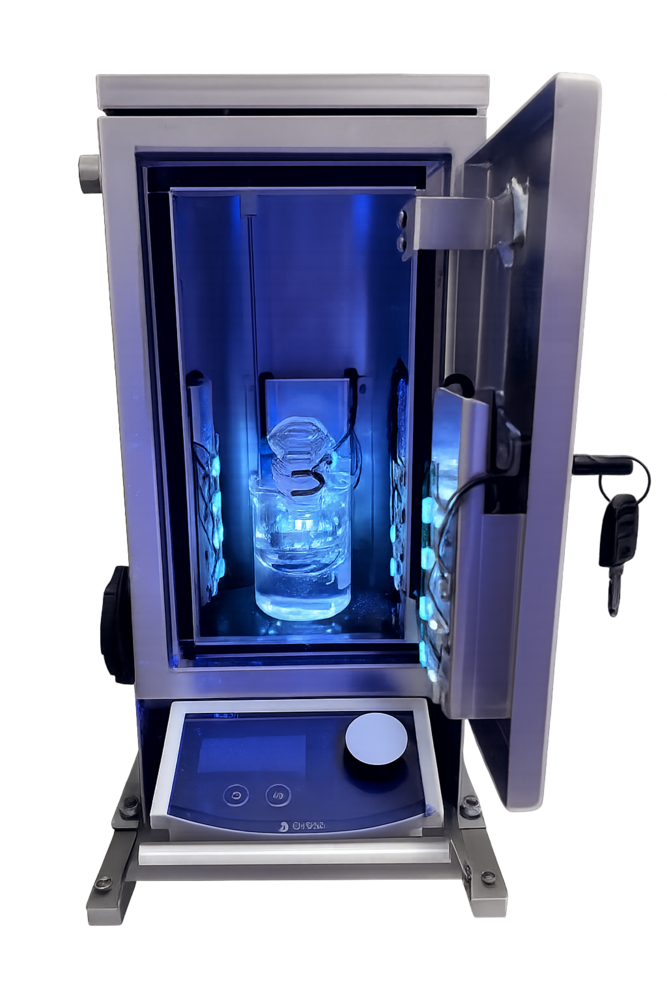
Onderzoekers stortten zich op de vraag hoe deze fotochemische methode stabiele plastics toch kan afbreken. Ze ontwikkelden en optimaliseerden een fotochemische afbraaktechniek die sterk inzet op korte reactietijden en eenvoudige recepten.
De afbraak wordt aangedreven door reactieve chloorradicalen, die onder UV-licht uit het gechloreerde oplosmiddel vrijkomen. Deze radicalen vallen de stabiele polymeerketens aan en breken ze op. Het oplosmiddel speelt een dubbele rol: het zet radicalen vrij die de ketens aanvallen, maar kan deze ook zelf opvangen. Daardoor werkt het oplosmiddel tegelijk bevorderend en remmend op de afbraak van het polymeer.
In de meest efficiënte experimenten worden polymeerketens sterk verkort. Het moleculair gewicht, een maat voor de lengte van polymeerketens, daalt onder stikstofatmosfeer met ongeveer 85%. Onder zuurstofatmosfeer wordt een bijna volledige afbraak vastgesteld. Door de reactieve aard van zuurstof, worden de ketens verder verzwakt en dus verder afgebroken. Die sterke daling trok meteen de aandacht van de onderzoekers.
"Het was verrassend hoe snel de polymeerketens afbraken zodra de radicalen waren gevormd onder UV-licht," zegt onderzoeker Wout B. "Het lijkt wel alsof we de zwakke schakel hebben gevonden."
De chemische sleutel tot lokale recyclage
Hoewel de resultaten veelbelovend zijn, brengt de methode ook nieuwe uitdagingen met zich mee. Omdat gechloreerde solventen milieubelastend zijn, is het opschalen van dit laboratoriumsysteem niet vanzelfsprekend. Voor industriële toepassingen zijn efficiënte scheidingstechnieken en solventhergebruik cruciaal. Vervangende niet-gechloreerde oplosmiddelen en bijkomende chloorradicaalbronnen kunnen de milieu-impact van deze nieuwe techniek verder verlagen.
Deze fotochemische afbraakmethode biedt, omwille van zijn milde reactietemperatuur, lage energiebehoefte en korte reactietijd van 5 minuten, een alternatieve, economische weg voor polymeerrecyclage in Europa. Daardoor kan deze methode economisch aantrekkelijker worden dan klassieke recyclagetechnieken en een waardevolle stroom secundaire grondstoffen opleveren. Verdere ontwikkeling moet uitwijzen hoe deze methode zich gedraagt in industriële context, maar ze vormt nu al een veelbelovende stap richting een efficiëntere recyclage van de meest hardnekkige plastics.
Bibliografie
[1] ‘Sustainable use • Plastics Europe’, Plastics Europe. Accessed: Feb. 18, 2026. [Online]. Available: https://plasticseurope.org/sustainability/sustainable-use/
[2] J. E. Lee, D. Lee, J. Lee, and Y.-K. Park, ‘Current methods for plastic waste recycling: Challenges and opportunities’, Chemosphere, vol. 370, p. 143978, Feb. 2025, doi: 10.1016/j.chemosphere.2024.143978.
[3] P. G. C. Nayanathara Thathsarani Pilapitiya and A. S. Ratnayake, ‘The world of plastic waste: A review’, Clean. Mater., vol. 11, p. 100220, Mar. 2024, doi: 10.1016/j.clema.2024.100220.
[4] ‘Polyolefins • Plastics Europe’, Plastics Europe. Accessed: Feb. 19, 2026. [Online]. Available: https://plasticseurope.org/plastics-explained/a-large-family/polyolefin…
[5] ‘Plastics the Fast Facts 2025 • Plastics Europe’, Plastics Europe. Accessed: Feb. 19, 2026. [Online]. Available: https://plasticseurope.org/knowledge-hub/plastics-the-fast-facts 2025/
[6] ‘Recycling technologies • Plastics Europe’, Plastics Europe. Accessed: Feb. 18, 2026. [Online]. Available: https://plasticseurope.org/sustainability/circularity/recycling/recycli…
[7] M. Namjoufar et al., ‘Overcoming technical barriers in mechanical recycling of plastic waste: The role of engineered additives’, J. Environ. Chem. Eng., vol. 14, no. 2, p. 121559, Apr. 2026, doi: 10.1016/j.jece.2026.121559.
[8] Garcia-Gutierrez P. et al., Environmental and economic assessment of plastic waste recycling: a comparison of mechanical, physical, chemical recycling and energy recovery of plastic waste. LU: Publications Office, 2023. doi: 10.2760/0472. plastics’,
[9] Y. Tan, Y. Cheng, J. Xu, and H. Wang, ‘Catalytic chemical recycling and upcycling of polyolefin Giant, 10.1016/j.giant.2024.100307. vol. 19, p. 100307, Aug. 2024, doi: 10.1016/j.giant.2024.100307.
[10] D. Almeida and M. D. F. Marques, ‘Thermal and catalytic pyrolysis of plastic waste’, Polímeros, vol. 26, no. 1, pp. 44–51, Mar. 2016, doi: 10.1590/0104-1428.2100.
[11] R. Miandad, M. A. Barakat, A. S. Aburiazaiza, M. Rehan, and A. S. Nizami, ‘Catalytic pyrolysis of plastic waste: A review’, Process Saf. Environ. Prot., vol. 102, pp. 822–838, Jul. 2016, doi: 10.1016/j.psep.2016.06.022.
[12] L. Zou, R. Xu, H. Wang, Z. Wang, Y. Sun, and M. Li, ‘Chemical recycling of polyolefins: a closed-loop cycle of waste to olefins’, Natl. Sci. Rev., vol. 10, no. 9, p. nwad207, Aug. 2023, doi: 10.1093/nsr/nwad207.
[13] H. S. Wang et al., ‘Visible light–triggered depolymerization of commercial polymethacrylates’, Science, vol. 387, no. 6736, pp. 874–880, Feb. 2025, doi: 10.1126/science.adr1637.
[14] T. Li, A. Vijeta, C. Casadevall, A. S. Gentleman, T. Euser, and E. Reisner, ‘Bridging Plastic Recycling and Organic Catalysis: Photocatalytic Deconstruction of Polystyrene via a C–H Oxidation Pathway’, ACS Catal., vol. 12, no. 14, pp. 8155–8163, Jul. 2022, doi: 10.1021/acscatal.2c02292.
[15] J. Henrotte, F. Zaccaria, C. Cioce, S. Eyley, W. Thielemans, and A. Ginzburg, ‘Photocatalytic Transformation of Isotactic Polypropylene Using Phthalimide N‐Oxyl Radicals Under Mild Conditions’, Macromol. Rapid Commun., vol. 46, no. 19, p. e00385, Oct. 2025, doi: 10.1002/marc.202500385.
[16] W. Zeb et al., ‘Purification and characterisation of post-consumer plastic pyrolysis oil fractionated by vacuum distillation’, J. Clean. Prod., vol. 416, p. 137881, Sep. 2023, doi: 10.1016/j.jclepro.2023.137881.
[17] ‘Polyolefins • Plastics Europe’, Plastics Europe. Accessed: Mar. 06, 2026. [Online]. Available: https://plasticseurope.org/plastics-explained/a-large-family/polyolefin…
[18] W. Posch, ‘Polyolefins’, in Applied Plastics Engineering Handbook, Elsevier, 2011, pp. 23–48. doi: 10.1016/B978-1-4377-3514-7.10003-0.
[19] E. Van Hoof, Organische chemie en procestechnologie [cursus]. Diepenbeek: Gezamelijke opleiding Industriële Ingenieurswetenschappen UHasselt & KULeuven, 2023. 75
[20] D. Braun, ‘Origins and Development of Initiation of Free Radical Polymerization Processes’, Int. J. Polym. Sci., vol. 2009, pp. 1–10, 2009, doi: 10.1155/2009/893234.
[21] A. Felgel-Farnholz, A. Schweighuber, C. W. Klampfl, and J. Fischer, ‘Comparative study on the degradation of HDPE, LLDPE and LDPE during multiple extrusions’, Polym. Degrad. Stab., vol. 216, 10.1016/j.polymdegradstab.2023.110486. p. 110486, Oct. 2023, doi: 10.1016/j.polymdegradstab.2023.110486.
[22] J. B. P. Soares and T. F. L. McKenna, Polyolefin Reaction Engineering. doi: 10.1002/9783527646944.
[23] R. Robinson, D. S. McGuinness, and B. F. Yates, ‘The Mechanism of Ethylene Dimerization with the Ti(OR′)4 /AlR3 Catalytic System: DFT Studies Comparing Metallacycle and Cossee Proposals’, ACS Catal., vol. 3, no. 12, pp. 3006–3015, Dec. 2013, doi: 10.1021/cs4006875.
[24] X. M. Zhang, S. Elkoun, A. Ajji, and M. A. Huneault, ‘Oriented structure and anisotropy properties of polymer blown films: HDPE, LLDPE and LDPE’, Polymer, vol. 45, no. 1, pp. 217–229, Jan. 2004, doi: 10.1016/j.polymer.2003.10.057. CO.LTD.
[25] shobeir shimi, ‘LDPE, LLDPE, and HDPE: Polyethylene Types Compared’, SHOBEIR SHIMI Accessed: Mar. 25, https://shobeirshimi.com/ldpe-lldpe-and-hdpe/ 2026. [Online]. Available: https://shobeirshimi.com/ldpe-lldpe-and-hdpe/
[26] J. De Keyzer, Kunststoffen [cursus]. Diepenbeek: Gezamelijke opleiding Industriële Ingenieurswetenschappen UHasselt & KULeuven, 2024.
[27] A. Hassan Awad, R. El Gamasy, A. Abd El Wahab, and M. Hazem Abdellatif, ‘Mechanical and Physical Properties of PP and HDPE’, Eng. Sci., vol. 4, no. 2, p. 34, 2019, doi: 10.11648/j.es.20190402.12.
[28] R. Kumar, A. K. Pandey, and A. Singla, ‘Recent advances in functional additives for polyolefins: chemistry, applications, and sustainable approaches – a review’, J. Polym. Res., vol. 33, no. 2, p. 54, Feb. 2026, doi: 10.1007/s10965-025-04739-9.
[29] H. A. Maddah, ‘Polypropylene as a Promising Plastic: A Review’, 2016, doi: 10.5923/j.ajps.20160601.01.
[30] laurencevermeersch, ‘Plastics Europe launches Plastics – the Facts 2022 at the K-Fair • Plastics Europe’, Plastics Europe. Accessed: Feb. 18, 2026. [Online]. Available: https://plasticseurope.org/media/plastics-europe-launches-plastics-the-… the-k-fair/
[31] K. Hamad, M. Kaseem, and F. Deri, ‘Recycling of waste from polymer materials: An overview of the recent works’, Polym. Degrad. Stab., vol. 98, no. 12, pp. 2801–2812, Dec. 2013, doi: 10.1016/j.polymdegradstab.2013.09.025.
[32] N. Singh and T. R. Walker, ‘Plastic recycling: A panacea or environmental pollution problem’, Npj Mater. Sustain., vol. 2, no. 1, p. 17, Aug. 2024, doi: 10.1038/s44296-024 00024-w.
[33] Communication from the commission to the european parliament, the council, the european economic and social committee and the committee of the regions: A European Strategy for Plastics in a Circular Economy. 2018. Accessed: Feb. 22, 2026. [Online]. Available: https://eur-lex.europa.eu/legal-content/EN/TXT/?uri=celex:52018DC0028
[34] Communication from the commission to the european parliament, the council, the european economic and social committee and the committee of the regions: A new Circular Economy Action Plan For a cleaner and more competitive Europe. 2020. Accessed: Mar. 09, 2026. [Online]. Available: https://eur-lex.europa.eu/legal content/EN/TXT/?qid=1583933814386&uri=COM:2020:98:FIN
[35] ‘Regulation (EU) 2025/40 of the European Parliament and of the Council of 19 December 2024 on packaging and packaging waste, amending Regulation (EU) 2019/1020 and Directive (EU) 2019/904, and repealing Directive 94/62/EC (Text with EEA relevance)’.
[36] P. D. Goring and R. D. Priestley, ‘Polymer Recycling and Upcycling: Recent Developments toward a Circular Economy’, JACS Au, vol. 3, no. 10, pp. 2609–2611, Oct. 2023, doi: 10.1021/jacsau.3c00544.
[37] R. J. D. O. Silva, K. Graf, and M. L. Leite Ribeiro Okimoto, ‘Plastic waste recycling: an overview of the mechanical, chemical, and thermal technologies’, J. Eng. Appl. Sci., vol. 72, no. 1, p. 251, Dec. 2025, doi: 10.1186/s44147-025-00799-2.
[38] X. Liu, S. Kozarekar, A. Shaw, T.-Q. Xu, E. Y.-X. Chen, and L. J. Broadbelt, ‘Understanding ceiling temperature as a predictive design parameter for circular 76 polymers’, Cell Rep. Phys. Sci., vol. 5, no. 4, p. 101910, Apr. 2024, doi: 10.1016/j.xcrp.2024.101910. Waste
[39] K. Ragaert, L. Delva, and K. Van Geem, ‘Mechanical and chemical recycling of solid plastic waste’, Manag., 10.1016/j.wasman.2017.07.044. vol. 69, pp. 24–58, Nov. 2017, doi:
[40] R. Giel, M. Fiedeń, and A. Dąbrowska, ‘Real-Time Automatic Identification of Plastic Waste Streams for Advanced Waste Sorting Systems’, Sustainability, vol. 17, no. 5, p. 2157, Mar. 2025, doi: 10.3390/su17052157.
[41] M. A. Anwar, Suprihatin, N. A. Sasongko, M. Najib, and B. Pranoto, ‘Challenges and prospects of multilayer plastic waste management in several countries: A systematic literature review’, Case Stud. Chem. Environ. Eng., vol. 10, p. 100911, Dec. 2024, doi: 10.1016/j.cscee.2024.100911.
[42] C. T. D. M. Soares, M. Ek, E. Östmark, M. Gällstedt, and S. Karlsson, ‘Recycling of multi material multilayer plastic packaging: Current trends and future scenarios’, Resour. Conserv. Recycl., vol. 176, p. 105905, Jan. 2022, doi: 10.1016/j.resconrec.2021.105905.
[43] P. Quicker, M. Seitz, and J. Vogel, ‘Chemical recycling: A critical assessment of potential process approaches’, Waste Manag. Res. J. Sustain. Circ. Econ., vol. 40, no. 10, pp. 1494 1504, Oct. 2022, doi: 10.1177/0734242X221084044.
[44] M. J. Keith, B. Al-Duri, T. O. McDonald, and G. A. Leeke, ‘Solvent-Based Recycling as a Waste Management Strategy for Fibre-Reinforced Polymers: Current State of the Art’, Polymers, vol. 17, no. 7, p. 843, Mar. 2025, doi: 10.3390/polym17070843.
[45] S. Chen and Y. H. Hu, ‘Advancements and future directions in waste plastics recycling: From mechanical methods to innovative chemical processes’, Chem. Eng. J., vol. 493, p. 152727, Aug. 2024, doi: 10.1016/j.cej.2024.152727.
[46] S. Kartik et al., ‘Valorization of plastic wastes for production of fuels and value-added chemicals through pyrolysis – A review’, Therm. Sci. Eng. Prog., vol. 32, p. 101316, Jul. 2022, doi: 10.1016/j.tsep.2022.101316.
[47] O. Y. Yansaneh and S. H. Zein, ‘Recent Advances on Waste Plastic Thermal Pyrolysis: A Critical Overview’, Processes, vol. 10, no. 2, p. 332, Feb. 2022, doi: 10.3390/pr10020332.
[48] R. K. Singh and B. Ruj, ‘Time and temperature depended fuel gas generation from pyrolysis of real world municipal plastic waste’, Fuel, vol. 174, pp. 164–171, Jun. 2016, doi: 10.1016/j.fuel.2016.01.049.
[49] P. Nalluri, P. Prem Kumar, and M. R. Ch Sastry, ‘Experimental study on catalytic pyrolysis of plastic waste using low cost catalyst’, Mater. Today Proc., vol. 45, pp. 7216–7221, 2021, doi: 10.1016/j.matpr.2021.02.478.
[50] O. Dogu et al., ‘The chemistry of chemical recycling of solid plastic waste via pyrolysis and gasification: State-of-the-art, challenges, and future directions’, Prog. Energy Combust. Sci., vol. 84, p. 100901, May 2021, doi: 10.1016/j.pecs.2020.100901.
[51] G. Lourinho, O. Alves, B. Garcia, B. Rijo, P. Brito, and C. Nobre, ‘Costs of Gasification Technologies for Energy and Fuel Production: Overview, Analysis, and Numerical Estimation’, Recycling, vol. 8, no. 3, p. 49, May 2023, doi: 10.3390/recycling8030049.
[52] C. Zhang, Z. Huang, J. Lu, N. Luo, and F. Wang, ‘Generation and Confinement of Long Lived N-Oxyl Radical and Its Photocatalysis’, J. Am. Chem. Soc., vol. 140, no. 6, pp. 2032 2035, Feb. 2018, doi: 10.1021/jacs.7b12928.
[53] L. Wimberger, G. Ng, and C. Boyer, ‘Light-driven polymer recycling to monomers and small molecules’, Nat. Commun., vol. 15, no. 1, p. 2510, Mar. 2024, doi: 10.1038/s41467 024-46656-3.
[54] G. Noirbent and F. Dumur, ‘Photoinitiators of polymerization with reduced environmental impact: Nature as an unlimited and renewable source of dyes’, Eur. Polym. J., vol. 142, p. 110109, Jan. 2021, doi: 10.1016/j.eurpolymj.2020.110109.
[55] W. Tomal and J. Ortyl, ‘Water-Soluble Photoinitiators in Biomedical Applications’, Polymers, vol. 12, no. 5, p. 1073, May 2020, doi: 10.3390/polym12051073.
[56] D. Bassenheim, M. Mitterbauer, R. Liska, and P. Knaack, ‘Novel thermal initiator systems for radical induced cationic frontal polymerization’, Polym. Chem., vol. 15, no. 22, pp. 2229–2234, 2024, doi: 10.1039/D4PY00343H.
[57] M. F. A. C. Ruslan, D. J. Youn, R. Aarons, Y. Sun, and S. Sun, ‘Numerical Study of CH4 Generation and Transport in XLPE-Insulated Cables in Continuous Vulcanization’, Materials, vol. 13, no. 13, p. 2978, Jul. 2020, doi: 10.3390/ma13132978. 77
[58] ‘High Temperature GPC (HT-GPC): A Complete Guide’, Polymer Char. Accessed: Mar. 29, 2026. [Online]. Available: https://polymerchar.com/library/learning-center/high temperature-gpc-a-complete-guide
[59] ‘Agilent Technologies | Agilent’. Accessed: Mar. 29, 2026. [Online]. Available: https://www.agilent.com/en/
[60] ‘An Introduction to gel permeation chromatography and size exclusion chromatography’. Accessed: Mar. 29, 2026. https://www.agilent.com/cs/library/primers/public/5990 [Online]. Available: 6969EN%20GPC%20SEC%20Chrom%20Guide.pdf?srsltid=AfmBOopoPZmy908Lw4M l5eQ7KB2YBJY9M7l8vouX4Q5pKDv4gu9M_dSK
[61] W. Lee, H. Lee, J. Cha, T. Chang, K. J. Hanley, and T. P. Lodge, ‘Molecular Weight Distribution of Polystyrene Made by Anionic Polymerization’, Macromolecules, vol. 33, no. 14, pp. 5111–5115, Jul. 2000, doi: 10.1021/ma000011c.
[62] ‘Analysis of polyolefins by GPC or SEC’. [Online]. Available: https://www.agilent.com/cs/library/applications/5990-6971EN%20GPC SEC%20Polyolefins%20app%20compend.pdf?srsltid=AfmBOoqGb7zJylPC1XKGuLLjA y0V2U9c1Fam5Q0aDnwtLcKHRIgeppOZ
[63] M. R. Kasaai, ‘Calculation of Mark–Houwink–Sakurada (MHS) equation viscometric constants for chitosan in any solvent–temperature system using experimental reported viscometric constants data’, Carbohydr. Polym., vol. 68, no. 3, pp. 477–488, Apr. 2007, doi: 10.1016/j.carbpol.2006.11.006.
[64] Y. Maeda and H. Kanetsuna, ‘Crystallite Size Analysis of Pressure-Crystallized Polyethylene by Nitric Acid Etching and Gel-Permeation Chromatography. I. Extended Chain Crystals’, Polym. J., vol. 13, no. 4, pp. 357–369, Apr. 1981, doi: 10.1295/polymj.13.357.
[65] K. Wang, H. Huang, and J. Sheng, ‘Determination of the Mark-Houwink Equation Parameters and their Interrelationship’, J. Liq. Chromatogr. Relat. Technol., vol. 21, no. 10, pp. 1457–1470, Jun. 1998, doi: 10.1080/10826079808000527.
[66] ‘GPC/SEC Detection – What You Should Know When You Need To Analyze Polymers, Biopolymers, and Proteins’. Accessed: May 01, 2026. [Online]. Available: https://www.agilent.com/cs/library/brochures/br-gpc-sec-polymers-biopol… proteins-5994-5937en agilent.pdf?srsltid=AfmBOoptQoZnTAZ9TGyFwleTwJNUHhSb0tpRf2vmP3CmG1aoTD f2o-gH
[67] ‘How to choose the most appropriate combination of detectors for high temperature SEC/GPC analysis of polyolefins’, Polymer Char. Accessed: May 02, 2026. [Online]. Available: https://polymerchar.com/blog/how-to-choose-the-most-appropriate detectors-for-size-exclusion-chromatography-analysis-of-polyolefins
[68] M. A. Haney, ‘The differential viscometer. II. On‐line viscosity detector for size‐exclusion chromatography’, J. Appl. Polym. Sci., vol. 30, no. 7, pp. 3037–3049, Jul. 1985, doi: 10.1002/app.1985.070300725. [Online].
[69] ‘introduction-fourier-transform-infrared-spectroscopy-br50555’. Accessed: Mar. 30, 2026. Available: https://documents.thermofisher.com/TFS Assets/MSD/brochures/introduction-fourier-transform-infrared-spectroscopy br50555.pdf
[70] Kristel Sniegowski, Instrumentele analyse [cursus]. Diepenbeek: Gezamelijke opleiding Industriële Ingenieurswetenschappen UHasselt & KULeuven, 2024.
[71] ‘Gas chromatography mass spectrometry basic principles | Agilent’. Accessed: Apr. 02, 2026. [Online]. Available: https://www.agilent.com/en/product/gas-chromatography mass-spectrometry-gc-ms/gcms fundamentals?srsltid=AfmBOop6iNQsYvLEQdu9axRgCxsJUzpzbvAIQMsdu0EQxJ4CA ehUqsev
[72] J. Magano and J. R. Dunetz, ‘Large-Scale Carbonyl Reductions in the Pharmaceutical Industry’, Org. Process Res. Dev., vol. 16, no. 6, pp. 1156–1184, Jun. 2012, doi: 10.1021/op2003826.
[73] H.-Y. Wang, X.-H. Wang, B.-A. Zhou, C.-L. Zhang, and S. Ye, ‘Ketones from aldehydes via alkyl C(sp3)−H functionalization under photoredox cooperative NHC/palladium 78 catalysis’, Nat. Commun., vol. 14, no. 1, p. 4044, Jul. 2023, doi: 10.1038/s41467-023 39707-8.