Wellness in het apenverblijf
Stel je voor: je voelt je onrustig, trekt je jas aan en gaat het bos in om diep adem te halen. Ook geredde chimpansees lijken baat te hebben bij de geuren van de natuur en de verklaring ligt niet in aromatherapie, maar in hun eigen bosapotheek. Een simpele sok, gevuld met gedroogde rozemarijn, deed hun stressgedrag significant dalen en hun natuurlijke zoekgedrag toenemen.
Mensenkwaaltjes, apenoplossingen
Geuren hebben een grote impact op onze gemoedstoestand: een boswandeling na een rotdag, verse kruiden tussen je vingers, de geur van net gemaaid gras. Maar hoe zit dat bij dieren in gevangenschap?
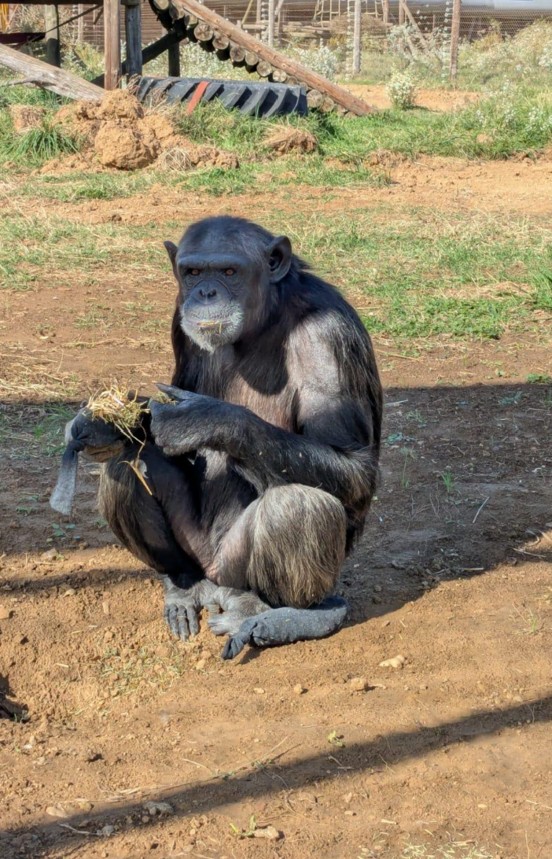
In het opvangcentrum Fundació MONA bij Girona verblijven chimpansees die gered zijn uit de huisdierenhandel, het circus en de amusementsindustrie. Sommigen leefden jarenlang alleen. Ze hebben het nu goed, maar een omheind park blijft armer aan prikkels dan een regenwoud. Dat kan leiden tot stress of verveling.
Verzorgers vullen dat gat met verrijking: klimtouwen, voedselpuzzels, hangmatten, verstopt voer. Bijna al dat gereedschap richt zich op ogen, handen en buik. Geur komt er zelden aan te pas, terwijl het idee dat mensapen slecht ruiken intussen achterhaald is. Chimpansees snuffelen aan hun eten, aan hun omgeving en aan elkaar; zo onderscheiden ze familie van vreemden.
Waarom rozemarijn?
Rozemarijn hoort bij de lipbloemenfamilie, net als munt en kattenkruid. In het leefgebied van wilde chimpansees groeit Afrikaanse basilicum, een verwant kruid met veel van dezelfde aromatische stoffen.
En wilde chimpansees staan bekend om hun bosapotheek: ze zoeken planten op die hen goed doen. Zo'n geur is voor hen dus geen willekeurig parfum, maar iets wat ecologisch klopt.
Waarom een lege sok cruciaal is
Geen dure speeltjes, maar honderdveertig gewone katoenen sokken dienden als geurverspreiders. Ik waste ze twee keer, liet ze vierentwintig uur weken in rozemarijnthee en vulde ze met minstens veertig gram gedroogde rozemarijn en wat stro.
Het experiment liep vier weken, met achtenveertig observatie-uren op twaalf testdagen: vier dagen met geurende sokken in het buitenverblijf, vier dagen met lege controlesokken, enkel gevuld met stro, en vier gewone dagen zónder sok.
Waarom die lege sok er lag? Zonder die geurloze variant weet je niet of een gedragsverandering komt door de rozemarijngeur, of gewoon doordat er ineens een gek, nieuw object in het gras ligt.
Vanuit de observatietoren noteerde ik om de twee minuten wat elk zichtbaar dier deed. Momentopnames dus, geen stopwatch.
Sokken als sloffen aan de voeten
De reacties waren verrassend herkenbaar. De chimpansees toonden een overduidelijke voorkeur voor de rozemarijnsokken: ze begonnen er vaker een interactie mee dan met de geurloze (p = 0,002), en op meer meetmomenten hadden ze er ook effectief een vast (p = 0,012).
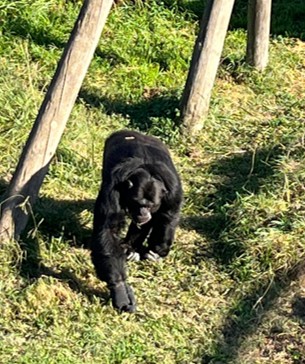
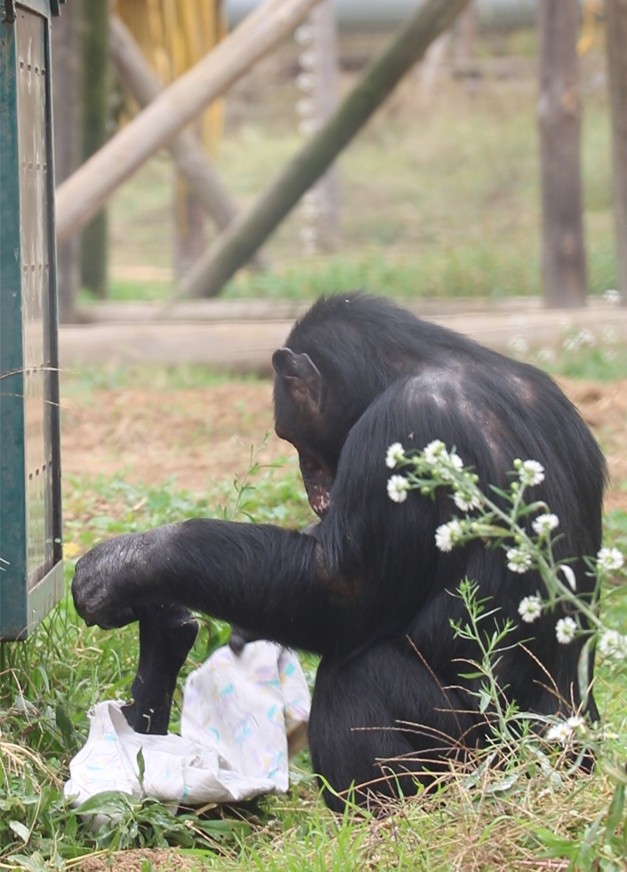
Neem het dominante mannetje Bongo: hij schoof een sok als een warme slof over zijn voet en wandelde er hele namiddagen mee rond. Vrouwtje Africa maakte er een heel project van. Ze raapte een sok op, verderop een tweede, en ook nog een dekentje dat in het gras lag. Ze ging zitten, schudde de sokken leeg, proefde van de rozemarijn, stak de ene sok in de andere en propte daar ook het dekentje nog in, alles in één keer mee. Nico droeg de zijne om zijn arm, zelfs onderweg naar een medische behandeling. Victor balanceerde er één op een teen tot het ding eraf viel.
Minder stress, meer ontspannen aap
 Het welzijnseffect ging verder dan speels gedrag. Stressgerelateerd gedrag zoals krabben of plukken, lag op rozemarijndagen significant lager dan op dagen zonder sok (p = 0,012). Tegelijk spendeerden de dieren meer tijd aan foerageren, het rustige zoeken naar voedsel waar wilde chimpansees het grootste deel van hun dag mee vullen (p = 0,002).
Door de geur, of door het voorwerp? Vermoedelijk door de geur: bij de lege sokken doken die effecten niet op. Maar de rechtstreekse vergelijking tussen een geurende en een geurloze sok haalde net geen significantie (p = 0,055). Een sterke aanwijzing dus, geen sluitend bewijs.
Cheeta deed niet mee
En dan is er chimpansee Cheeta, veertig jaar, in het wild geboren en al negenentwintig toen ze, na jaren in de entertainmentsector, in MONA aankwam. In vier weken raakte ze een sok welgeteld twee keer aan.
Toch gold de daling in stressgedrag voor de hele groep op rozemarijndagen. En bij het foerageren draaide het helemaal om: hoe meer een chimpansee met de sok bezig was, hoe kleiner de toename in foerageren was. Die toename kwam dus niet van het spelen. Ze kwam van de geur in de lucht, en die bereikte ook de dieren die de sokken niet of minder aanraakten.
Eerlijk is eerlijk: wie een sok vasthoudt, kan op dat moment niet naar eten zoeken, een stuk van dat verband is gewoon tijd. Maar de toename zelf blijft overeind. En in elk asiel en elk opvangcentrum zit een Cheeta: een teruggetrokken dier dat er al maanden of jaren zit en met geen enkele verrijking in gang te krijgen is.
Eén studie, tien apen
Dit is verkennend werk, geen bewijs. Tien dieren, één opvangcentrum, vier weken, één geur. Ik wist zelf welke dag ik observeerde, wat onbewuste kleuring niet uitsluit. En met momentopnames kan kort, sporadisch gedrag onderschat zijn, net stressgedrag is vaak precies dat.
Let op: puur natuur, géén flesjes
Een goedkope, natuurlijke geurprikkel kan de leefwereld van geredde apen dus enorm verrijken. Toch hoort er één waarschuwing bij voor wie thuis aan de slag wil.
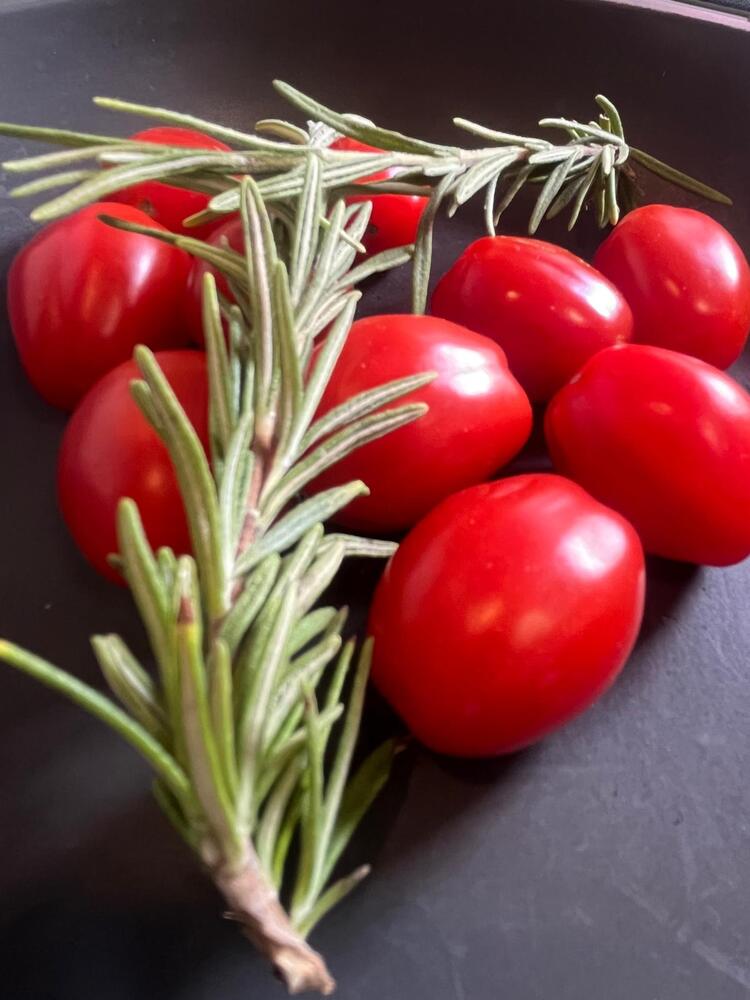
Ik werkte uitsluitend met natuurlijk plantmateriaal en een veilig aftreksel. Dat is een heel ander verhaal dan geconcentreerde etherische oliën uit flesjes. Die kunnen ronduit giftig zijn voor huisdieren, zeker voor katten.
Dus geen druppeltjes olie gebruiken bij je eigen viervoeter. Maar de volgende keer dat je een takje verse rozemarijn in de pastasaus gooit, denk dan even aan Bongo en Africa die met haar sokken en haar dekentje liet zien dat een klein geurspoor soms tot een verrassend groot avontuur leidt.
En laat je hond gerust stilstaan en snuffelen tijdens de wandeling, misschien is dat het begin van een verrijkende reis.
Bibliografie
Aebischer, T., Siguindo, G., Rochat, E., Arandjelovic, M., Heilman, A., Hickisch, R., ... & Wegmann, D. (2017). First quantitative survey delineates the distribution of chimpanzees in the Eastern Central African Republic. Biological Conservation, 213, 84-94.
Alegre Maurer, S., Ross, M., & Gil Dolz, J. (2024). Visitor effect on the behavior of chimpanzees (Pan troglodytes) at a primate rescue center. bioRxiv, 2024-09.
Altmann, J. (1974). Observational study of behavior: sampling methods. Behaviour, 49(3-4), 227-266.
Angley, L. P., Vale, G. L., & Cronin, K. A. (2024). The impact of care on chimpanzee welfare: A comprehensive review. Applied Animal Behaviour Science, 275, 106272. https://doi.org/10.1016/j.applanim.2024.106272
Aziz, E., Batool, R., Akhtar, W., Shahzad, T., Malik, A., Shah, M., Iqbal, S., Rauf, A., Zengin, G., Bouyahya, A., Rebezov, M., Dutta, N., Khan, M., Khayrullin, M., Babaeva, M., Goncharov, A., Shariati, M., & Thiruvengadam, M. (2021). Rosemary species: a review of phytochemicals, bioactivities and industrial applications. South African Journal of Botany. https://doi.org/10.1016/j.sajb.2021.09.026.
Baker, B., Taylor, S., & Montrose, V. T. (2018). The effects of olfactory stimulation on the behavior of captive ring‐tailed lemurs (Lemur catta). Zoo biology, 37(1), 16-22.
Barton, R., Purvis, A., & Harvey, P. H. (1995). Evolutionary radiation of visual and olfactory brain systems in primates, bats and insectivores. Philosophical Transactions of the Royal Society of London. Series B: Biological Sciences, 348(1326), 381-392.
Barton, R. A. (2006). Primate brain evolution: integrating comparative, neurophysiological, and ethological data. Evolutionary Anthropology: Issues, News, and Reviews: Issues, News, and Reviews, 15(6), 224-236.
Bates, D., Mächler, M., Bolker, B., & Walker, S. (2015). Fitting linear mixed-effects models using lme4. Journal of statistical software, 67, 1-48.
Bernstein-Kurtycz, L. M., Hopper, L. M., Ross, S. R., & Lonsdorf, E. V. (2020). Zoo-housed chimpanzees can spontaneously use tool sets in a sequential task. Animal Behaviour and Cognition, 7(3), 288–309. https://doi.org/10.26451/abc.07.03.03.2020.
Birkett, L. P., & Newton-Fisher, N. E. (2011). How abnormal is the behaviour of captive, zoo-living chimpanzees? PLoS ONE, 6(6), e20101. https://doi.org/10.1371/journal.pone.0020101.
Brent, L. (1992). Woodchip Bedding as Enrichment for Captive Chimpanzees in an Outdoor Enclosure. Animal Welfare, 1(3), 161–170. https://doi.org/10.1017/S0962728600014986.
Buchanan-Smith, H. M. (2011). Environmental enrichment for primates in laboratories. Advances in Science and Research, 5(1), 41-56.
Box, H. O., & Smith, P. (1995). Age and gender differences in response to food enrichment in family groups of captive marmosets (Callithrix-Callitrichidae). Animal Technology, 46(1), 11-18.
Capitanio, J. P., Vandeleest, J., & Hannibal, D. L. (2023). Physiological measures of welfare. In Nonhuman primate welfare: from history, science, and ethics to practice (pp. 231-254). Cham: Springer International Publishing.
Celli, M. L., Tomonaga, M., Udono, T., Teramoto, M., & Nagano, K. (2003). Tool use task as environmental enrichment for captive chimpanzees. Applied Animal Behaviour Science, 81(2), 171-182.
Chen, E., Pipolo, G., Crailsheim, D., & Morimoto, J. (2025). The lasting impact of social isolation: behavioral insights from former pet and entertainer chimpanzees in a sanctuary in Spain. American Journal of Primatology, 87(1), https://doi.org/10.1002/ajp.23715.
Clark, F., & King, A. J. (2008). A critical review of zoo-based olfactory enrichment. Chemical signals in vertebrates 11, 391-398.
Cousins, D. (2002). African apes and ethno medicine. Gorilla Journal, 25, 10-12.
Cousins, D. (2006). Review of the use of herb gardens and medicinal plants in primate exhibits in zoos. International Zoo Yearbook, 40(1), 341-350.
Crast, J., Bloomsmith, M. A., & Jonesteller, T. J. (2016). Behavioral effects of an enhanced enrichment program for group-housed sooty mangabeys (Cercocebus atys). Journal of the American Association for Laboratory Animal Science, 55(6), 756-764.
Csatádi, K., Leus, K., & Pereboom, J. J. (2008). A brief note on the effects of novel enrichment on an unwanted behaviour of captive bonobos. Applied Animal Behaviour Science, 112(1-2), 201-204.
Elwell, E. J., & Vaglio, S. (2023). The scent enriched primate. Animals, 13(10), 1617.
Eskelinen, H. C., Winship, K. A., & Borger-Turner, J. L. (2015). Sex, age, and individual differences in bottlenose dolphins (Tursiops truncatus) in response to environmental enrichment. Animal Behaviour and Cognition, 2(3), 241-253.
Ferlemi, A. V., Katsikoudi, A., Kontogianni, V. G., Kellici, T. F., Iatrou, G., Lamari, F. N., ... & Margarity, M. (2015). Rosemary tea consumption results to anxiolytic-and anti-depressant-like behavior of adult male mice and inhibits all cerebral area and liver cholinesterase activity; phytochemical investigation and in silico studies. Chemico-biological interactions, 237, 47-57.
Freymann, E., Carvalho, S., Garbe, L. A., Dwi Ghazhelia, D., Hobaiter, C., Huffman, M. A., ... & Schultz, F. (2024). Pharmacological and behavioral investigation of putative self-medicative plants in Budongo chimpanzee diets. Plos one, 19(6), e0305219.
Freymann, E., Hobaiter, C., Huffman, M. A., Klein, H., Muhumuza, G., Reynolds, V., ... & Carvalho, S. (2025). Self-directed and prosocial wound care, snare removal, and hygiene behaviors amongst the Budongo chimpanzees. Frontiers in Ecology and Evolution, 13, https://www.frontiersin.org/news/2025/05/14/chimpanzees-medicinal-leaves-first-aid-frontiers-ecology-evolution.
Ghasemzadeh Rahbardar, M., & Hosseinzadeh, H. (2020). Therapeutic effects of rosemary (Rosmarinus officinalis L.) and its active constituents on nervous system disorders. Iranian journal of basic medical sciences, 23(9), 1100–1112. https://doi.org/10.22038/ijbms.2020.45269.10541.
Gil-Dolz, J., Ayuso, P. R., Riba, D., & Crailsheim, D. (2024). Neighbors, Pros and Cons: Impact of Intergroup Interactions on the Welfare of Captive Chimpanzee Groups (Pan troglofytes). Ecologies, 5(2), 279-295.
Gilad, Y., Wiebe, V., Przeworski, M., Lancet, D., & Pääbo, S. (2004). Loss of olfactory receptor genes coincides with the acquisition of full trichromatic vision in primates. PLoS biology, 2(1), e5.
Go, Y., & Niimura, Y. (2008). Similar numbers but different repertoires of olfactory receptor genes in humans and chimpanzees. Molecular biology and evolution, 25(9), 1897-1907.
Gronqvist, G., Kingston-Jones, M., May, A., & Lehmann, J. (2013). The effects of three types of environmental enrichment on the behaviour of captive Javan gibbons (Hylobates moloch). Applied Animal Behaviour Science, 147(1-2), 214-223.
Henkel, S., & Setchell, J. M. (2018). Group and kin recognition via olfactory cues in chimpanzees (Pantroglodytes). Proceedings of the Royal Society B, 285(1889), 20181527.
Hoover, K. C. (2010). Smell with inspiration: the evolutionary significance of olfaction. American Journal of Physical Anthropology, 143(S51), 63-74.
Howell, S., Schwandt, M., Fritz, J., Roeder, E., & Nelson, C. (2003). A stereo music system as environmental enrichment for captive chimpanzees. Lab animal, 32(10), 31-36.
Huffman, M. A. (1997). Current evidence for self‐medication in primates: A multidisciplinary perspective. American Journal of Physical Anthropology: The Official Publication of the American Association of Physical Anthropologists, 104(S25), 171-200.
Humle, T.; Maisels, F.; Oates, J. F.; Plumptre, A.; Williamson, E. A. (2016) Pan Troglodytes. The IUCN Red List of Threatened Species 2016. https://www.iucnredlist.org/species/15933/129038584. Accessed on 30 November 2025
Inegbedion, A. (2022). Medicinal potential of Ocimum gratissimum (scent leaf) and Vernonia Amygdalina del (bitter leaf). International journal of innovative research and development.
Inoue, N., & Shimada, M. (2020). Comparisons of Activity Budgets, Interactions, and Social Structures in Captive and Wild Chimpanzees (Pan troglodytes). Animals, 10(6), 1063. https://doi.org/10.3390/ani10061063.
Kawamura, S., & Melin, A. D. (2018). Evolution of genes for color vision and the chemical senses in primates. In Evolution of the human genome I: The genome and genes (pp. 181-216). Tokyo: Springer Japan.
Kovar, K., Gropper, B., Friess, D., & Ammon, H. (1987). Blood Levels of 1,8-Cineole and Locomotor Activity of Mice After Inhalation and Oral Administration of Rosemary Oil1. Planta Medica, 53(4), 315.
Krief, S., Wrangham, R. W., & Lestel, D. (2006). Diversity of items of low nutritional value ingested by chimpanzees from Kanyawara, Kibale National Park, Uganda: an example of the etho-ethnology of chimpanzees. Social science information, 45(2), 227-263.
Labban, L., Mustafa, U. E. S., & Ibrahim, Y. M. (2014). The effects of rosemary (Rosmarinus officinalis) leaves powder on glucose level, lipid profile and lipid perodoxation. International Journal of Clinical Medicine, 5(06), 297-304.
LaDue, C. A., & Schulte, B. A. (2021). Pheromonal enrichment in the zoo: An empirical approach with Asian elephants (Elephas maximus). Applied Animal Behaviour Science, 235, 105228.
Laska, M., & Salazar, L. T. H. (2015). Olfaction in nonhuman primates. Handbook of olfaction and gustation, 605-622.
Lonsdorf, E. V., Eberly, L. E., & Pusey, A. E. (2004). Sex differences in learning in chimpanzees. Nature, 428(6984), 715-716.
Matsumoto-Oda A, Kutsukake N, Hosaka K, Matsusaka T. 2007 Sniffing behaviors in Mahale chimpanzees. Primates 48, 81–85.
Mellor, D. J. (2016). Updating animal welfare thinking: Moving beyond the “Five Freedoms” towards “a Life Worth Living”. Animals, 6(3), 21.
Moss, M., Cook, J., Wesnes, K., & Duckett, P. (2003). Aromas of rosemary and lavender essential oils differentially affect cognition and mood in healthy adults. International Journal of Neuroscience, 113(1), 15-38.
Mota-Rojas, D., Orihuela, A., Napolitano, F., Mora-Medina, P., Orozco-Gregorio, H., & Alonso-Spilsbury, M. (2018). Olfaction in animal behaviour and welfare. CABI Reviews, (2018), 1-13.
Myles, S., & Montrose, V. T. (2015). The effects of olfactory stimulation on the behaviour of captive meerkats (Suricata suricatta). Journal of Zoo and Aquarium Research, 3(2), 37-42.
Nevo, O., & Heymann, E. W. (2015). Led by the nose: Olfaction in primate feeding ecology. Evolutionary Anthropology: Issues, News, and Reviews, 24(4), 137-148.
Nieto, G., Ros, G., & Castillo, J. (2018). Antioxidant and antimicrobial properties of rosemary (Rosmarinus officinalis, L.): A review. Medicines, 5(3), 98.
Niimura, Y. (2012). Olfactory receptor multigene family in vertebrates: from the viewpoint of evolutionary genomics. Current genomics, 13(2), 103-114.
Ostrower S., Brent L. (2000) Olfactory enrichment for captive chimpanzees: responses to different odors. Laboratory Primate Newsletter, 36: 8–12.
Padrell, M., Amici, F., Córdoba, M. P., Giberga, A., Broekman, A., Almagro, S., & Llorente, M. (2021). Artificial Termite-Fishing Tasks as Enrichment for Sanctuary-Housed Chimpanzees: Behavioural Effects and Impact on Welfare. Animals, 11(10), 2941. https://doi.org/10.3390/ani11102941
Padrell, M., Amici, F., Córdoba, M. P., & Llorente, M. (2022). Cognitive enrichment in a social setting: Assessing the use of a novel food maze in sanctuary-housed chimpanzees. Primates, 63(5), 509–524. https://doi.org/10.1007/s10329-022-00996-0.
Powell, D. M. (1995). Preliminary evaluation of environmental enrichment techniques for African lions (Panthera leo). Animal Welfare, 4(4), 361-370.
Pruetz, J. D., & Bloomsmith, M. A. (1992). Comparing two manipulable objects as enrichment for captive chimpanzees. Animal Welfare, 1(2), 127–137. https://doi.org/10.1017/S096272860001486X
Quirke, T., & O’Riordan, R. M. (2011). The effect of different types of enrichment on the behaviour of cheetahs (Acinonyx jubatus) in captivity. Applied Animal Behaviour Science, 133(1-2), 87-94.
R Core Team. (2025). R: A language and environment for statistical computing. R Foundation for Statistical Computing. Vienna, Austria. https://www.R-project.org/
Richardson, S. (2024). Primate enrichment categories: A literature review of current trends. Animal Behaviour and Cognition, 11(1), 87-100.
Rooney, N. J., & Parr-Cortes, Z. (2023). Olfaction and Dog Welfare. In Olfactory Research in Dogs (pp. 205-234). Cham: Springer International Publishing.
Rose, J. P., Xiang, C. L., Sytsma, K. J., & Drew, B. T. (2022). A timeframe for mint evolution: towards a better understanding of trait evolution and historical biogeography in Lamiaceae. Botanical Journal of the Linnean Society, 200(1), 15-38.
Sassi, A., Laouani, A., Abdessalem, M. A. B., Jarray, I., Nasrallah, H., Ferdousi, F., ... & Saguem, S. (2025). The effect of Rosmarinus officinalis L infusion supplementation on blood pressure among healthy volunteers and grade 1 hypertensive patients. Phytomedicine Plus, 5(2), 100783.
Schapiro, S. J., Coleman, K., Akinyi, M., Koenig, P., Hau, J., & Domaingue, M. C. (2014). Nonhuman primate welfare in the research environment. In Laboratory animal welfare (pp. 197-212). Academic Press.
Scordato, E. S., & Drea, C. M. (2007). Scents and sensibility: information content of olfactory signals in the ringtailed lemur, Lemur catta. Animal Behaviour, 73(2), 301-314.
Shaw, D., Annett, J. M., Doherty, B., & Leslie, J. C. (2007). Anxiolytic effects of lavender oil inhalation on open-field behaviour in rats. Phytomedicine, 14(9), 613-620.
Shepherd, G. M. (2004). The human sense of smell: are we better than we think?. PLoS biology, 2(5), e146.
Shepherdson, D. J. (1998). Introduction: Tracing the Path of Environmental Enrichment in Zoos. In Second nature: environmental enrichment for captive animals (pp. 1-14). Smithsonian Institution Press.
Singletary, M., & Hagerty, S. (2023). Peripheral olfactory pathway anatomy, physiology, and genetics. In Olfactory research in dogs (pp. 3-37). Cham: Springer International Publishing.
Steiger, S. S., Kuryshev, V. Y., Stensmyr, M. C., Kempenaers, B., & Mueller, J. C. (2009). A comparison of reptilian and avian olfactory receptor gene repertoires: species-specific expansion of group γ genes in birds. BMC genomics, 10(1), 446.
Struthers, E.J., Campbell, J., (1996). Scent-specific behavioral response to olfactory enrichment in captive chimpanzees (Pan troglodytes). In: XVI Congress of the International Primatological Society and the XIX Conference of the American Society of Primatology, Madison, WI.
Uikey, J. (2024). Reviewing of plant belonging to Lamiaceae family. International Journal of Scientific Development and Research, 9(3), 186–191.
Vaglio, S., Kaburu, S. S., Pearce, R., Bryant, L., McAuley, A., Lott, A., ... & Accorsi, P. A. (2021). Effects of scent enrichment on behavioral and physiological indicators of stress in zoo primates. American Journal of Primatology, 83(5), e23247.
Wallace, E. K., Altschul, D., & Slocombe, K. E. (2017). Is music enriching for group-housed captive chimpanzees (Pan troglodytes)? PLOS ONE, 12(3), e0172672. https://doi.org/10.1371/journal.pone.0172672.
Wark, J. D., Cronin, K. A., Niemann, T., Shender, M. A., Horrigan, A., Kao, A., & Ross, M. R. (2019). Monitoring the behavior and habitat use of animals to enhance welfare using the ZooMonitor app. Anim. Behav. Cogn, 6(3), 158-167.
Wells, D. L., Hepper, P. G., Coleman, D., & Challis, M. G. (2007). A note on the effect of olfactory stimulation on the behaviour and welfare of zoo-housed gorillas. Applied Animal Behaviour Science, 106(1-3), 155-160.
Wells, D. L. (2009). Sensory stimulation as environmental enrichment for captive animals: A review. Applied Animal Behaviour Science, 118(1-2), 1-11.
Wowk, Z. M., & Behie, A. M. (2023). The influence of olfactory enrichment on the behavior of two captive New World primates: Black‐capped capuchin (Sapajus apella) and common marmoset (Callithrix jacchus). Zoo Biology, 42(2), 231-242.
Wyatt, T. D. (2014). Pheromones and animal behavior: chemical signals and signatures. Cambridge University Press.
Yamanashi, Y., Matsunaga, M., Shimada, K., Kado, R., & Tanaka, M. (2016). Introducing tool-based feeders to zoo-housed chimpanzees as a cognitive challenge: spontaneous acquisition of new types of tool use and effects on behaviours and use of space. Journal of Zoo and Aquarium Research, 4(3), 147-155.
Young, R. J. (2013). Environmental enrichment for captive animals. John Wiley & Sons.
Lincoln Park Zoo, 2022. ZooMonitor (version 4.1) [Mobile application software]. Available from https:// zoomonitor.org