Niet de migranten, maar de stad maakt het verschil
Migratie wordt vandaag vaak voorgesteld als een nieuwe uitdaging voor lokale gemeenschappen. Toch woonden ook zeshonderd jaar geleden al migranten in kleine Europese steden. Mijn onderzoek naar twee Engelse havensteden toont aan dat hun aanwezigheid niet automatisch tot spanningen leidde. Integendeel: waar nieuwkomers kansen kregen, groeiden ze uit tot volwaardige leden van de gemeenschap.
Een actueel debat met middeleeuwse wortels
Migratie is tegenwoordig niet weg te slaan uit ons nieuws. Vaak gaat het debat over grote steden, zoals Brussel of Antwerpen, waar mensen uit verschillende landen, elk met hun eigen taal en cultuur, samenleven en de samenwerking niet altijd van een leien dakje loopt. De laatste paar jaar worden ook kleinere steden of dorpen vaker belicht, vooral wanneer migratie voor zogezegde “overlast” zorgt. Migratie is echter geen modern fenomeen en de botsing tussen autochtone en immigrantengemeenschappen al evenmin. Ook in de vijftiende eeuw trokken mensen naar andere steden en landen op zoek naar werk, een thuis en nieuwe kansen.
Voor Engeland hebben historici tot nu toe migratie vooral onderzocht voor grote steden zoals Londen, Southampton en Bristol. Over kleinere steden weten we veel minder. Nochtans woonde een groot deel van de stedelijke bevolking van laatmiddeleeuws Engeland juist in kleinere nederzettingen en vestigden migranten zich daar evengoed; net zoals in het hedendaagse België. Daarom focuste ik in mijn masterproef op twee kleine havensteden: Harwich in Essex en Fowey in Cornwall.
Twee bijna identieke steden
Op het eerste gezicht hadden Harwich en Fowey veel gemeen. Beide leefden van handel en scheepvaart, telden slechts enkele honderden inwoners en trokken migranten uit verschillende delen van Europa aan.
Toch gingen ze op een opvallend verschillende manier om met hun buitenlandse inwoners; en ik wilde weten waarom.
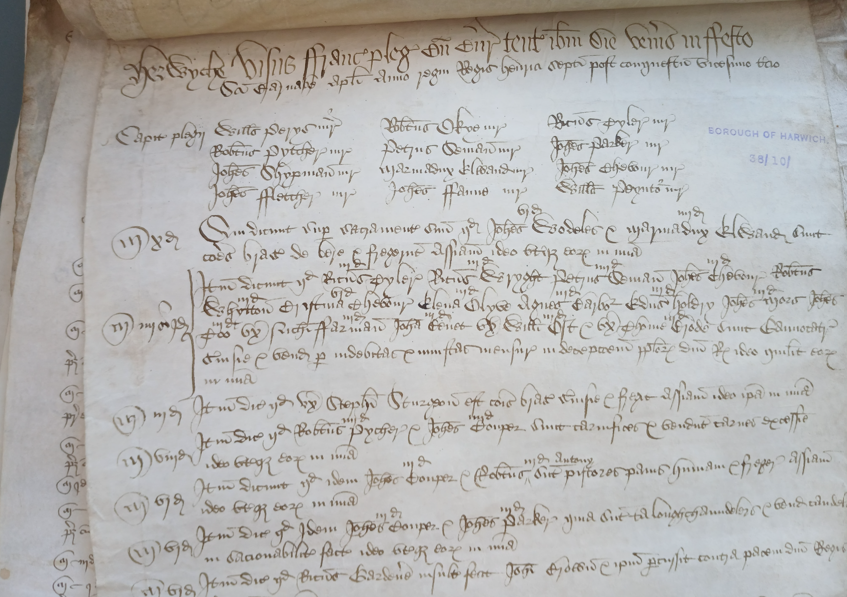
Om een antwoord op mijn vraag te vinden, verdiepte ik mij in honderden pagina’s aan 15e-eeuwse lokale rechtbankverslagen en specifieke belastingregisters van de Engelse overheid met betrekking tot migranten. Met de informatie uit die bronnen reconstrueerde ik wie deze mensen waren, waar ze vandaan kwamen, welk werk ze deden en hoe ze deelnamen aan het dagelijkse leven in hun nieuwe woonplaats.
Van brouwers tot bestuurders
In beide steden maakten migranten deel uit van de lokale economie. Ze werkten als zeelieden, handelaars, ambachtslieden en brouwers. Ze verschenen in rechtbanken, dreven handel en stonden in contact met hun buren.
Maar daar stopten de gelijkenissen.
In Fowey lijken migranten verrassend goed geïntegreerd te zijn geweest. Sommigen bekleedden zelfs openbare functies en namen actief deel aan het bestuur en de rechtspleging van de stad. Ze waren dus niet enkel inwoners, maar ook betrokken leden van de gemeenschap.
In Harwich zat de zaak duidelijk anders in een. Daar kregen migranten te maken met politieke en rechtelijke beperkingen, alsook extra controles van en boetes op hun economische ondernemingen. In de rechtbankverslagen verschenen ze bovendien meerdere keren als slachtoffers van verbaal en fysiek geweld omwille van hun niet-Engelse afkomst.
De vraag lag voor de hand: waarom was de situatie voor migranten in twee steden die zo sterk op elkaar leken zo verschillend?
Meer dan alleen afkomst
Mijn onderzoek toont aan dat er geen eenduidige verklaring bestaat.
Het bleek dat het vooral de combinatie was van de samenstelling van de migrantenbevolking, hun al dan niet concurrerende economische betrekkingen en de impact van bredere politieke gebeurtenissen die een belangrijke rol speelde.
In Harwich was een groot deel van de migranten namelijk afkomstig uit de Lage Landen. Velen van hen waren actief als bierbrouwers, een relatief nieuw en winstgevend beroep in Engeland, en hun economische succes maakte hen zichtbaar aanwezig in de stad. Dit maakte dat zij herhaaldelijk het doelwit werden van extra belastingen, beperkingen en controles. Tegelijk versterkten politieke spanningen tussen Engeland, Frankrijk en de hertog van Bourgondië, in de context van de Honderdjarige Oorlog, bestaande vooroordelen over die “Dutchmen”, wat de lokale bevolking nog meer wantrouwig maakte.
In Fowey was de migrantengemeenschap weliswaar gelijkaardig van grootte, maar was ze veel diverser samengesteld zowel qua afkomst als qua beroepen. Zeker door de verscheidenheid aan beroepen, die complementair waren aan de beroepen van de lokale bevolking, lijken ze sterker verweven en betrokken te zijn geweest in het lokale sociale leven.
Wat kleine steden ons kunnen leren
De kleinschaligheid van de stad had daarnaast ook een grote invloed.
In een gemeenschap van enkele honderden inwoners valt een nieuwkomer veel meer op dan in een grote stad. Mensen ontmoeten elkaar voortdurend: op de markt, in de haven, in de kerk of voor de rechtbank. Die nabijheid kan wantrouwen versterken. Maar ze kan ook leiden tot dagelijkse samenwerking en wederzijds begrip.
Mijn onderzoek laat zien dat migratie op zichzelf geen vast resultaat heeft. Dezelfde soort migratie kon in de ene stad leiden tot conflicten en in de andere tot succesvolle integratie. Het verschil lag dus niet per se bij de migranten, maar juist grotendeels bij de lokale gemeenschap die hen ontving. De houding van de ontvangende gemeenschap speelde namelijk een cruciale rol in hoe samenleven in de praktijk verliep.
Een les uit het verleden
De discussies over migratie die vandaag gevoerd worden, lijken vaak nieuw. Toch worstelden mensen eeuwen geleden al met vergelijkbare vragen. Hoe ga je om met nieuwkomers? Welke plaats krijgen zij in de gemeenschap? En wanneer worden zij gezien als volwaardige leden van die samenleving of juist als vijanden?
De geschiedenis van Fowey en Harwich toont dat verschillende antwoorden mogelijk zijn. In de ene stad kregen migranten de kans om verantwoordelijkheid op te nemen en deel uit te maken van het bestuur. In de andere bleven ze gedwongen aan de zijlijn staan.
Deze middeleeuwse voorbeelden bevestigen dat samenleven geen vanzelfsprekendheid is, maar iets wat mensen actief vormgeven. Migratie hoeft geen verhaal van tegenstellingen te zijn. Zeshonderd jaar geleden kon ze al leiden tot samenwerking, participatie en gemeenschapsvorming.
Misschien is dat wel de belangrijkste conclusie van mijn onderzoek: niet migratie zelf bepaalt de uitkomst, maar de manier waarop een samenleving kiest om met nieuwkomers om te gaan. Een open gemeenschap creëert mogelijkheden.
Bibliografie
Archival sources:
Essex Record Office (ERO), D/B 4/38/6-10 (Court Rolls, Manor of Harwich), 1433-1508.
ERO, D/B 4/38/10.
ERO, D/B 4/38/7, fol. 1 v.
ERO, D/B 4/38/7, fol. 2 r.
ERO, D/B 4/38/8, fol. 4 r.
ERO, D/B 4/38/8, fol. 4-6 r.
ERO, D/B 4/38/8, fol. 5-8.
ERO, D/B 4/38/8, fol. 8 v.
ERO, D/B 4/38/8, fol. 9-10 r.
ERO, D/B 4/38/9, fol. 2 r.
ERO, D/B 4/38/9, fol. 5 r.
ERO, D/B 4/38/9, fol. 6-8.
ERO, D/B 4/38/10, fol. 9 r.
ERO, D/B 4/38/10, fol. 3 r.
ERO, D/B 4/38/10, fol. 9.
ERO, D/B 4/38/10, fol. 13 r.
ERO, T/A 122/1-3
‘Essex, Tendring Hundred : 1430-1439, oath of fealty’, England’s Immigrants [database], accessed on 25 May 2026, https://www.englandsimmigrants.com/search/.
‘Fowey: 1400-1600, tax assessment’, England’s Immigrants 1330-1550: Resident Aliens in the Late Middle Ages [database], accessed on 25 May 2026, https://www.englandsimmigrants.com/search/.
‘Harwich: 1400-1600, tax assessment’, England’s Immigrants 1330-1550: Resident Aliens in the Late Middle Ages [database], accessed on 25 May 2026, https://www.englandsimmigrants.com/search/.
Kresen Kernow (KK), ART/2/1/2-12, mm. 2-39 (Court Rolls, Manor of Fowey), 1445-1470.
KK, ART/2/1/2, m. 2, c. 1 r.
KK, ART/2/1/4, m. 8, c. 3 r.
KK, ART/2/1/6, m. 16, c. 1 r.
KK, ART/2/1/6, m. 17, c. 7 v.
KK, ART/2/1/7, m. 19, c. 1 r.
KK, ART/2/1/8, m. 22, c. 1-10.
KK, ART/2/1/8-11, mm. 19-37.
The National Archives, E 179/108/178.
Secondary sources:
AMOR, N., Late Medieval Ipswich: Trade and Industry, Suffolk: Boydell & Brewer, 2011.
BAILEY, M., The English manor, c. 1200 - c. 1500, Manchester: Manchester University Press, 2002.
BAILEY, M., ‘Self-Government in the Small Towns of Late Medieval England’, in: DODDS, B. & LIDDY, C. (eds.), Commercial Activity, Markets and Entrepreneurs in the Middle Ages, Cambridge: Cambridge University Press, 2013, pp. 107-128.
BARBERIS, E. & PAVOLINI, E., ‘Settling outside gateways: The state of the art, and the issues at stake’, Sociologica, 2, 2015, pp. 1-33.
BARRON, C., ‘Introduction: England and the Low Countries 1327—1477’, in: BARRON, C. & SAUL, N. (eds.), England and the Low Countries in the late Middle Ages, Stroud: Alan Sutton, 1995, pp. 1-28.
BENNETT, J., Ale, Beer, and Brewsters in England: women's work in a changing world, 1300- 1600, Oxford: Oxford University Press, 1996.
BERRY, C., ‘Guilds, Immigration, and Immigrant Economic Organization: Alien Goldsmiths in London, 1480-1540’, Journal of British Studies, 60 (3), pp. 534-562.
BLAU, P.M., Inequality and Heterogeneity. A Primitive Theory of Social Structure, New York: The Free Press, 1977.
BOLTON, J. L., The Alien Communities of London in the Fifteenth Century: The Subsidy Rolls of 1440 and 1483–4, Stamford: Paul Watkins, Richard III and Yorkist History Trust, 1998.
BOLTON, J. L., ‘Irish Migration to England in the Late Middle Ages: The Evidence of 1394 and 1440’, Irish Historical Studies, 32 (125), 2000, pp. 1-21.
BOLTON, J.L., ‘London and the Anti-Alien Legislation of 1439–40’, in: ORMROD, M. W., MCDONALD, N. & TAYLOR, C. (eds.), Resident Aliens in Later Medieval England, Studies in European Urban History 1100-1800, 42, Turnhout: Brepols, 2017, pp. 33-47.
BRADLEY, H., The Views of the Hosts of Alien Merchants, 1440-1444, Woodbridge: Boydell & Brewer, 2012.
BUTLER, S., ‘Getting medieval on Steven Pinker: Violence and medieval England’, Historical Reflections, 44 (1), 2018, pp. 29-40.
CURRY, A., ‘Southern England and Campaigns to France, 1415–1453’, in: CLARK, L. & FLEMING, P., The Fifteenth Century XVIII: Rulers, Regions and Retinues. Essays presented to A.J. Pollard, Boydell & Brewer, 2020, pp. 133-150.
DAVIES, M., ‘Aliens, Crafts, and Guilds in Late Medieval London’, in: NEW, E. & STEER, C. (eds.), Medieval Londeners – Essays to mark the eightieth birthday of Caroline M. Barron, IHR Conference Series, London: University of London Press, 2019, pp. 119-148.
DAVIS, J., ‘Baking for the common good: A reassessment of the assize of bread in medieval England’, Economic History Review, 57 (3), 2004, pp. 465-502.
DE VRIES, J., European Urbanization, 1500-1800, Cambridge: Harvard University Press, 1984.
DOBSON, R.B., ‘Admissions to the Freedom of the City of York in the Later Middle Ages’, The Economic History Review, 26 (1), 1973, pp. 1-22.
DRAKE, S.J., ‘Pirates and Pilchards: the Wealth and Peopling of Fowey during the Hundred Years War’, Royal Holloway Research Portal, 2015, pp. 23-44.
DRAKE, S.J., ‘‘The Gallaunts of Fawey’: A case study of Fowey during the Hundred Years’ War, c.1337-1399’, Historical Research, 90 (248), 2017, pp. 296-317.
DRAKE, S.J., Cornwall, Connectivity and Identity in the Fourteenth Century, Woodbridge: The Boydell Press, 2019.
DRAKE, S.J., ‘Mariners and Marauders: A Case Study of Fowey during the Hundred Years’ War, c.1400–c.1453’, in: CLARK, L. (ed.), The Fifteenth Century XIX: Enmity and Amity, Boydell & Brewer, 2022, pp. 16-34.
DYER, A., Decline and Growth in English Towns, London: Macmillan, 1991.
DYER, C., ‘Small places with large consequences: The importance of small towns in England, 1000-1540’, Historical Research, 75 (187), 2002, pp. 1-24.
DYER, C., ‘Migration in Rural England in the Later Middle Ages’, in: ORMROD, W.M., STORY, J. & TYLER, E.M. (eds.), Migrants in Medieval England, c. 500 - c. 1500, Oxford: Oxford University Press, 2020, pp. 238-264.
FENWICK, C., The Poll Taxes of 1377, 1379 and 1381. Part 1, Bedfordshire-Leicestershire, Oxford: Oxford University Press, 1998.
FLEMING, P., ‘Identity and Belonging: Irish and Welsh in Fifteenth-Century Bristol’, in: CLARK, L., The Fifteenth Century VII : Conflicts, Consequences and the Crown in the Late Middle Ages, Woodbridge: The Boydell Press, 2007, pp. 175-194.
GARCÍA-FAROLDI, L., ‘Determinants of Attitudes towards Immigration: Testing the Influence of Interculturalism, Group Threat Theory and National Contexts in Time of Crisis’, International Migration, 55 (2), 2017, pp. 10-22.
HANAWALT, B., 'Of Good and Ill Repute': Gender and Social Control in Medieval England, Oxford: Oxford University Press, 1998.
HANSEN, G., Die drei Bevölkerungsstufen: Ein Versuch, die Ursachen fir das Bliihen und Altern der Vilker nachzuweisen, Munich, 1889.
HERSLUND, L., ‘Everyday life as a refugee in a rural setting – What determines a sense of belonging and what role can the local community play in generating it?’, Journal of Rural Studies, 82, 2021, pp. 233-241.
HJERM, M., ‘Do numbers really count? Group threat theory revisited’, Journal of Ethnic and Migration Studies, 33 (8), 2007, pp. 1253-1275.
HJERM, M. & NAGAYOSHI, K., ‘The composition of the minority population as a threat: Can real economic and cultural threats explain xenophobia?’, International Sociology, 26 (6), 2011, pp. 815-843.
HUGHES, B., The History of Harwich Harbour: Particularly the Work of the Harwich Harbour Conservancy Board 1863-1939, Harwich: The Standard Printing & Publishing Company Dovercourt, 1939.
JOHNSON, T., Law in Common: Legal Cultures in Late-Medieval England, Oxford: Oxford University Press, 2019.
KISSANE, A. & MACKMAN, J., ‘Aliens and the Law in Late Medieval Lincolnshire’, , in: ORMROD, M. W., MCDONALD, N. & TAYLOR, C. (eds.), Resident Aliens in Later Medieval England, Studies in European Urban History 1100-1800, 42, Turnhout: Brepols, 2017, pp. 105-124.
KOWALESKI, M., ‘The Expansion of the South-Western Fisheries in Late Medieval England’, Economic History Review, 53 (3), 2000, pp. 429-454.
KOWALESKI, M., ‘The Assimilation of Foreigners in Late Medieval Exeter: a Prosopographical Analysis’, in: ORMROD, M. W., MCDONALD, N. & TAYLOR, C. (eds.), Resident Aliens in Later Medieval England, Studies in European Urban History 1100-1800, 42, Turnhout: Brepols, 2017, pp. 163-180.
KOWALESKI, M., ‘Breton immigration in late medieval England’, in: DODD, G., LACEY, H. & MUSSON, A. (eds.), People, Power and Identity in the Late Middle Ages: Essays in Memory of W. Mark Ormrod, London: Routledge, 2021, pp. 115-134.
KREICHAUF, R., ‘Ghettos in small towns? The research on ethnic segregation and stigmatisation processes in small town Germany’, Sociologica, 2, 2015, pp. 1-27.
LAMBERT, B. & PAJIC, M., ‘Drapery in Exile: Edward III, Colchester and the Flemings, 1351- 1367’, History, 99 (338), 2014, pp. 733-753.
LAMBERT, B. & PAJIC, M., ‘Immigration and the Common Profit: Native Cloth Workers, Flemish Exiles, and Royal Policy in Fourteenth-Century London’, Journal of British Studies, 55 (4), 2016, pp. 633-657.
LAMBERT, B., ‘Citizenry and Nationality: the Participation of Immigrants in Urban Politics in Later Medieval England’, History Workshop Journal, 90, 2020, pp. 52-73.
LAMBERT, B. & ORMROD, W.M., ‘The State and the Immigrant: Negotiating Nationalities in Later Medieval England’, in: ORMROD, W.M., STORY, J. & TYLER, E. (eds.), Migrants in Medieval England, c. 500 – c. 1500, London: The British Academy, pp. 298-325.
LAMBERT, B. & RAVENHILL, J., ‘‘Bawd, Traitor, Fleming, Thief and Other Horrible Names’’, Vierteljahrschrift fur Sozial und Wirtschaftsgeschichte, 112 (1), 2025, pp. 3-38.
LAMBERT, B., ‘Writing a Missing Chapter: Trends in the Historiography of Migration in Late Medieval Europe’, forthcoming.
LIDDY, C. & LAMBERT, B., ‘The Civic Franchise and the Regulation of Aliens in Great Yarmouth, c. 1430 – c. 1490’, in: ORMROD, M. W., MCDONALD, N. & TAYLOR, C. (eds.), Resident Aliens in Later Medieval England, Studies in European Urban History 1100-1800, 42, Turnhout: Brepols, 2017, pp. 125-143.
LIDDY, C., ‘The making of towns, the making of polities: Towns and lords in late medieval Europe’, Past & Present, 264 (1), 2024, pp. 3-47.
LORD SMAIL, D., ‘Violence and Predation in Late Medieval Mediterranean Europe’, Comparative Studies in Society and History, 54 (1), 2012, pp. 7-34.
MADDOCK, S., ‘Livelihoods and Liberties of Low Countries Immigrants in Late Medieval Lynn’, History, 110 (390), 2024, pp. 154-172.
MCLAREN, L. & JOHNSON, M., ‘Resources, group conflict and symbols: Explaining antiimmigrant hostility in Britain’, Political Studies, 55 (4), 2007, pp. 709–732.
MORÉN-ALEGRET, R.,’Ruralphilia and Urbophobia versus Urbophilia and Ruralphobia? Lessons from Immigrant Integration Processes in Small Towns and Rural Areas in Spain’, Population, Space and Place, 14 (6), 2008, pp. 537-552.
MORÉN-ALEGRET, R. & WLADYKA, D., International Immigration, Integration and Sustainability in Small Towns and Villages: Socio-Territorial Challenges in Rural and SemiRural Europe, London: Palgrave Macmillan, 2020.
ORMROD, W.M. & MACKMAN, J., ‘Resident Aliens in Later Medieval England: Sources, Contexts, and Debates’, in: ORMROD, W.M., MCDONALD, N. & TAYLOR, C. (eds.), Resident Aliens in Later Medieval England, Studies in European Urban History 1100-1800, 42, Turnhout: Brepols, 2017, pp. 3-32.
ORMROD, W.M., MCDONALD, N. & TAYLOR, C. (eds.), Resident Aliens in Later Medieval England, Studies in European Urban History 1100-1800, 42, Turnhout: Brepols, 2017.
ORMROD, W.M., LAMBERT, B. & MACKMAN, J., Immigrant England, 1300 – 1500, Manchester: Manchester University Press, 2019.
PAJIC, M., ‘‘Ale for an Englishman is a natural drink’: The Dutch and the origins of beer brewing in late medieval England’, Journal of Medieval History, 45 (3), 2019, pp. 285-300.
POSTLES, D., ‘Migration and Mobility in a Less Mature Economy: English Internal Migration, c. 1200-1350’, Social History, 25 (3), 2000, pp. 285-299.
RAGIN, C., The Comparative Method: moving beyond qualitative and quantitative strategies, Berkeley: University of California Press, 1987.
RAVENHILL, J., The Experiences of Aliens in Later Medieval London and the Negotiation of Belonging, 1400-1540, PhD thesis, University of York, 2019.
ROTHWELL, W., ‘‘Strange’, ‘Foreign’, and ‘Alien’: the Semantic History of Three QuasiSynonyms in a Trilingual Medieval England’, The Modern Language Review, 105 (1), 2010, pp. 1-19.
RUDDOCK, A.A., ‘Alien Merchants in Southampton in the Later Middle Ages’, The English Historical Review, 61 (239), 1946, pp. 1-17.
STONE, L., ‘Interpersonal Violence in English Society 1300-1980’, Past & Present, 101, 1983, pp. 22-33.
STRUILLOU, A., ZEHNI, M. & MANNEH, L., ‘Immobility’, Past and Present, 268 (1), 2025, pp. 1-35.
SUMMERSON, H., ‘The Criminal Underworld of Medieval England’, Journal of Legal History, 17(3), 1996, pp. 197-224. TAEUBER, C., ‘Rural-Urban Migration’, Agricultural History, 15 (3), 1941, pp. 151-160.
WEAVER, L., The Harwich Story, Dovercourt: Harwich Printing Company, 1975.
WOODS, M., ‘International Migration, Agency and Regional Development in Rural Europe’, Documents d'Analisi Geografica, 62 (3), 2016, pp. 569-593.
WOODS, M., ‘Precarious Rural Cosmopolitanism: Negotiating Globalization, Migration and Diversity in Irish Small Towns’, Journal of Rural Studies, 64, 2018, pp. 164-176.