Wat na een dag op zee? Meer kennis, niet automatisch meer actie.

“Fan-tas-tisch! Ik wil terug naar de zee!”, “Een unieke ervaring om nooit te vergeten!”
Na een dag op de Belgische Noordzee waren de reacties unaniem enthousiast. De zee lag er spiegelglad bij, de diversiteit aan levende soorten in de stalen was indrukwekkend en er werd live onderzoek gedaan. Verwondering alom. Maar wat blijft er zes maanden later nog over van zo’n ervaring?
Geen onbelangrijke vraag. We leven tenslotte op een blauwe planeet. Meer dan zeventig procent van het aardoppervlak bestaat uit oceaan. Ze regelt ons klimaat, produceert zuurstof, voedt miljarden mensen en staat centraal in bijna elk groot maatschappelijk vraagstuk van onze tijd, van klimaatverandering over biodiversiteit tot voedselzekerheid. We weten meer over het oppervlak van Mars dan over de oceaanbodem.
Wetenschappers noemen dat een gebrek aan oceaangeletterdheid. Je bent oceaangeletterd als je begrijpt hoe de zee werkt, wat ze voor jou doet en hoe jij haar beïnvloedt. UNESCO, de VN en de Europese Commissie zetten er zwaar op in, omdat duurzaam omgaan met de oceaan begint bij mensen die haar kennen en zich er iets bij voelen. Maar hoe bouw je dat op? En werkt een concrete ervaring op zee daar ook echt voor?
Een dag op de Simon Stevin
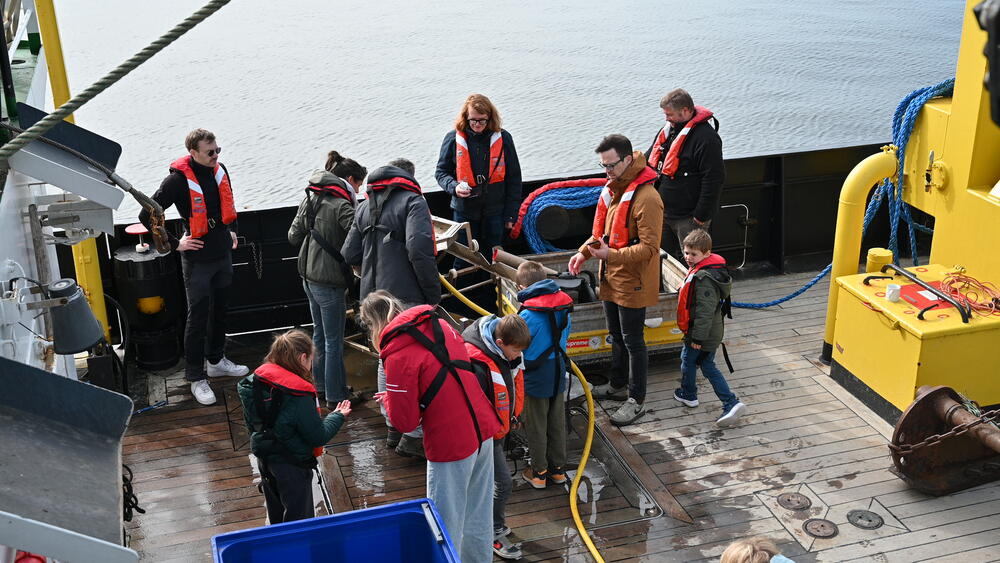
 Vorige lente stapten 63 personen aan boord van het onderzoeksschip RV Simon Stevin voor een dag marien onderzoek op de Noordzee. Kinderen en volwassenen werden gerekruteerd via wedstrijden bij Natuurpunt, Ketnet en Eos Magazine. Ze namen watermonsters op microplastics, bekeken wat er in de visnet- en bodemstalen zat en spraken met onderzoekers van het Vlaams Instituut voor de Zee.
Voor de tocht, vlak erna en zes maanden later vulden de volwassen deelnemers een vragenlijst in. Want uiteindelijk draait alles om dezelfde vraag: wat blijft hangen?
Kennis blijft drijven
Het goede nieuws eerst: mensen leerden. Na de vaardag wisten deelnemers meer over de oceaan dan ervoor, en zes maanden later was dat nog steeds zo. Wie abstracte begrippen als microplastics of voedselwebben eenmaal live heeft gezien, onthoudt ze beter.
Dat lijkt misschien vanzelfsprekend, maar dat is het niet. Veel studies meten enkel wat er onmiddellijk na een activiteit verandert. Of die effecten weken of maanden later nog bestaan, blijft vaak onbekend.
Dat deelnemers een half jaar later nog steeds beter scoorden op oceaankennis, is dus een belangrijke (en bemoedigende!) bevinding. Wie een zeester uit een net ziet komen, microplastics onder een microscoop bekijkt of onderzoekers live aan het werk ziet, onthoudt meer dan wie er enkel over leest.
Wanneer de golf gaat liggen
Met het gevoel lag het anders. Direct na de tocht voelden deelnemers zich meer verbonden met de natuur. Dat hoeft niet te verbazen: nieuwe ervaringen laten indruk na, zeker wanneer ze plaatsvinden op een plek waar de meeste mensen zelden komen. Maar zes maanden later was dat alweer gezakt. Wat bleef was niet de emotionele lading, maar eerder een nuchterder, soms kritischer blik. Sommigen dachten bewuster na over plasticvervuiling, biodiversiteit of natuurbehoud. Een deelnemer schreef het zo op: "Ik denk er nog aan terug, maar het speelt geen rol in mijn dagelijks leven. Ik heb mijn gewoontes er niet aan aangepast." Confronterend? Zeker. Maar ook eerlijk. Verwondering en verbondenheid opwekken is eenvoudig, ze vasthouden blijkt een stuk moeilijker.
Verrassende bijvangst
Opmerkelijk was dat het niet uitmaakt hoe natuurverbonden iemand al was voor de tocht. Of je nu iemand bent die elke week in de natuur gaat kamperen of iemand die zelden buiten komt: de leerwinst was voor iedereen vergelijkbaar.
Dat is goed nieuws voor iedereen die inzet op wetenschapscommunicatie en oceaaneducatie. Brede outreach werkt. De zee werkt ook voor wie haar nog niet kende. Oceaangeletterdheid is niet voorbehouden aan mensen die toch al overtuigd zijn.

Goed begonnen is half gewonnen, maar half is niet genoeg
Een dag op zee is een krachtige inleiding. Kennis zet zich vast, verwondering flakkert op en de oceaan wordt even heel concreet. Maar voor blijvende verandering in houding of gedrag volstaat één dag niet.
Wat dat betekent voor wie educatieve programma’s ontwikkelt: de ervaring mag niet het eindpunt zijn, maar het beginpunt. Een terugkommoment, een citizen-science project dat doorloopt, een vervolgactiviteit die de verwondering structureel maakt.
De ingrediënten die deze vaardag sterk maakten (zintuiglijk, participatief, sociaal, met ruimte voor reflectie) zijn precies wat effectieve milieu-educatie nodig heeft.
Want wie de natuur wil beschermen, moet haar eerst leren kennen. Ervaring is een sterk begin, verankering doet de rest.
Bibliografie
Ardoin, N. M., Bowers, A. W., & Gaillard, E. (2020). Environmental education outcomes for conservation: A systematic review. Biological Conservation, 241, 108224. https://doi.org/10.1016/j.biocon.2019.108224
Asikin, N., Suwono, H., Sumitro, S. B., & Dharmawan, A. (2025). Teaching ocean literacy in science education: a systematic review. Environmental Education Research, 1–26. https://doi.org/10.1080/13504622.2025.2490227
Ballantyne, R., & Packer, J. (2009). Introducing a fifth pedagogy: experience‐based strategies for facilitating learning in natural environments. Environmental Education Research, 15(2), 243–262. https://doi.org/10.1080/13504620802711282
Bamberg, S., & Möser, G. (2007). Twenty years after Hines, Hungerford, and Tomera: A new meta-analysis of psycho-social determinants of pro-environmental behaviour. Journal of Environmental Psychology, 27(1), 14–25. https://doi.org/10.1016/j.jenvp.2006.12.002
Capaldi, C. A., Dopko, R. L., & Zelenski, J. M. (2014). The relationship between nature connectedness and happiness: A meta-analysis. Frontiers in psychology, 5, 92737. https://doi.org/10.3389/fpsyg.2014.00976
Carson, R. T. (2012). Contingent valuation: A practical alternative when prices aren't available. Journal of Economic Perspectives, 26(4), 27–42. https://doi.org/10.1257/jep.26.4.27
Cava, F., Schoedinger, S., Strang, C., & Tuddenham, P. (2005). Science Content and Standards for Ocean Literacy: A Report on Ocean Literacy. https://doi.org/10.13140/RG.2.2.12126.84804
Chawla, L. (2006). Learning to love the natural world enough to protect it. Barn, 2(2), 57–78. https://doi.org/10.5324/barn.v24i2.4401
Clayton, S. (2003). Environmental Identity: A Conceptual and an Operational Definition. Identity and the Natural Environment: The Psychological Significance of Nature, 45-65
Cohen, J. (1988). Statistical power analysis for the behavioral sciences (2nd ed.). Lawrence Erlbaum Associates.
Fritz, C. O., Morris, P. E., & Richler, J. J. (2012). Effect size estimates: Current use, calculations, and interpretation. Journal of Experimental Psychology: General, 141(1), 2–18. https://doi.org/10.1037/a0024338
Geng, L., Xu, J., Ye, L., Zhou, W., & Zhou,K. (2015). Connections with nature and environmental behaviors. PLoS ONE, 10(5), https://doi.org/10.1371/journal.pone.0127247
Glithero, L. D., Bridge, N., Hart, N., Mann-Lang, J., McPhie, R., Paul, K., Peebler, A., Wiener, C., Yen, C., Kelly, R., McRuer, J., Hodgins, D., & Curtin, F. (2024). Ocean Decade Vision 2030 White Papers - Challenge 10: Restoring Society’s Relationship with the Ocean. Paris, UNESCO-IOC. (The Ocean Decade Series, 51.10.). https://doi.org/10.25607/ekwn-wh61
Guest, H., Lotze, H. K., & Wallace, D. (2015). Youth and the sea: Ocean literacy in Nova Scotia. Marine Policy, 58, 98–107. https://doi.org/10.1016/j.marpol.2015.04.007
Illeris, K. (2014). Transformative learning and identity. Routledge.
IPCC. (2023). Climate Change 2023: Synthesis Report. Contribution of Working Groups I, II and III to the Sixth Assessment Report of the Intergovernmental Panel on Climate Change [Core Writing Team, H. Lee & J. Romero (eds.)]. IPCC. https://doi.org/10.59327/IPCC/AR6-9789291691647
Kals, E., Schumacher, D., & Montada, L. (1999). Emotional Affinity toward Nature as a Motivational Basis to Protect Nature. Environment and Behavior, 31(2), 178-202. https://doi.org/10.1177/00139169921972056
Kellert, S. R. (2002). Experiencing nature: Affective, cognitive, and evaluative development in children. Children and nature: Psychological, sociocultural, and evolutionary investigations, 117151.
Kelly, R., Evans, K., Alexander, K. et al. Connecting to the oceans: supporting ocean literacy and public engagement. Rev Fish Biol Fisheries 32, 123–143 (2022). https://doi.org/10.1007/s11160-020-09625-9
Kolb, D. A. (1984). Experiential learning: Experience as the source of learning and development. Prentice Hall.
Kollmuss, A., & Agyeman, J. (2002). Mind the Gap: Why do people act environmentally and what are the barriers to pro-environmental behavior? Environmental Education Research, 8(3), 239–260. https://doi.org/10.1080/13504620220145401
Lakens, D. (2013). Calculating and reporting effect sizes to facilitate cumulative science: A practical primer for t-tests and ANOVAs. Frontiers in Psychology, 4, 863. https://doi.org/10.3389/fpsyg.2013.00863
Lumber, R., Richardson, M., & Sheffield, D. (2017). Beyond knowing nature: Contact, emotion, compassion, meaning, and beauty are pathways to nature connection. PLoS ONE, 12(5). https://doi.org/10.1371/journal.pone.0177186
Martin, L., White, M. P., Hunt, A., Richardson, M., Pahl, S., & Burt, J. (2020). Nature contact, nature connectedness and associations with health, wellbeing and pro-environmental behaviours. Journal of Environmental Psychology, 68, 101389. https://doi.org/10.1016/j.jenvp.2020.101389
Mayer, F. S., & Frantz, C. M. (2004). The connectedness to nature scale: A measure of individuals’ feeling in community with nature. Journal of Environmental Psychology, 24(4), 503–515. https://doi.org/10.1016/j.jenvp.2004.10.001
McKinley, E., Acott, T., & Yates, K. L. (2020). Marine social sciences: Looking towards a sustainable future. Environmental Science & Policy, 108, 85–92. https://doi.org/10.1016/j.envsci.2020.03.015
McKinley, E., Burdon, D., & Shellock, R. J. (2023). The evolution of ocean literacy: A new framework for the United Nations Ocean Decade and beyond. Marine Pollution Bulletin, 186, 114467. https://doi.org/10.1016/j.marpolbul.2022.114467
McKinley, E., Fradera, K. (2025). Shouting into the void: Democratising ocean literacy through integrating process literacy. Marine Policy, 178, 106731. https://doi.org/10.1016/j.marpol.2025.106731
McKinley, E., McAteer, B., Kaae, B. C., & Trouillet, B. (2025). Ocean Literacy as a Mechanism for Change Across and Beyond the UN Ocean Decade. Ocean and Society, 2, 11340. https://doi.org/10.17645/oas.11340
McRuer, J., McKinley, E., Glithero, D. L., & Paiz-Domingo, M. (2024). Ocean literacy research community: Co-identifying gaps and priorities to advance the UN Ocean Decade. Frontiers in Marine Science, 11, 1469451. https://doi.org/10.3389/fmars.2024.1469451
Mokos, M., Realdon, G., & Zubak Čižmek, I. (2020). How to Increase Ocean Literacy for Future Ocean Sustainability? The Influence of Non-Formal Marine Science Education. Sustainability, 12(24), 10647. https://doi.org/10.3390/su122410647
Nisbet, E. K., Zelenski, J. M., & Murphy, S. A. (2009). The nature relatedness scale: Linking individuals' connection with nature to environmental concern and behavior. Environment and behavior, 41(5), 715-740. https://doi.org/10.1177/0013916508318748
Paredes-Coral, E., Deprez, T., Mokos, M., Vanreusel, A., & Roose, H. (2022). The Blue Survey: Validation of an instrument to measure ocean literacy among adults. Mediterranean Marine Science, 23(2), 321–326. https://doi.org/10.12681/mms.26608
Paredes-Coral, E., Mokos, M., Vanreusel, A., & Deprez, T. (2021). Mapping global research on ocean literacy: Implications for science, policy, and the Blue Economy. Frontiers in Marine Science, 8, 648492. https://doi.org/10.3389/fmars.2021.648492
Parkinson, S., et al. (2025). Citizen science and ocean literacy: Bridging the gap between society and the ocean. In C. Certomà (Ed.), Blue kinships (Chap. 7). Palgrave Macmillan. https://doi.org/10.1007/978-3-031-78619-8_7
Popova, E., Aksenov, Y., Amoudry, L. O., Becker, A., Bricheno, L., Brown, J. M., Clare, M. A., Evans, A., Evans, C., Fowell, S. E., Jevrejeva, S., Jacobs, Z., Jones, D. O. B., Hibbert, A., O’Hara, F., McKinley, E., Payo-Payo, M., Pearce, C. R., Taylor, S. F. W., Sams, C., & Yool, A. (2023). Socio-oceanography: An opportunity to integrate marine social and natural sciences. Frontiers in Marine Science, 10, 1209356. https://doi.org/10.3389/fmars.2023.1209356
Richardson, M., Dobson, J., Abson, DJ, Lumber, R., Hunt, A., Young, R., & Moorhouse, B. (2020). Applying the pathways to nature connectedness at a societal scale: a leverage points perspective. Ecosystems and People, 16 (1), 387–401. https://doi.org/10.1080/26395916.2020.1844296
Rickinson, M., Dillon, J., Teamey, K., Morris, M., Choi, M. Y., Sanders, D., & Benefield, P. (2004). A review of research on outdoor learning. National Foundation for Educational Research (NFER) & Field Studies Council. https://www.field-studies-council.org/resource/a-review-of-research-on-…
Santoro, F., Santin, S., Scowcroft, G., Fauville, G., Tuddenham, P., & Lantz-Andersson, A. (2017). Ocean Literacy for all: A toolkit (Vol. 80). UNESCO Publishing. https://unesdoc.unesco.org/ark:/48223/pf0000260721
Schultz, P.W. (2002). Inclusion with Nature: The Psychology Of Human-Nature Relations. In: Schmuck, P., Schultz, W.P. (eds) Psychology of Sustainable Development. Springer, Boston, MA. https://doi.org/10.1007/978-1-4615-0995-0_4
Schultz, P. W. (2001). The structure of environmental concern: Concern for self, other people, and the biosphere. Journal of Environmental Psychology, 21(4), 327–339. https://doi.org/10.1006/jevp.2001.0227
Shellock, R. J., Fullbrook, L., McKinley, E., Cvitanovic, C., & Kelly, R. (2024). The nature and use of Ocean Literacy in achieving sustainable ocean futures: A systematic map. Ocean and Coastal Management, 257, 107325. https://doi.org/10.1016/j.ocecoaman.2024.107325
Spalding, A. K., & McKinley, E. (2025). The state of marine social science: Yesterday, today, and into the future. Annual Review of Marine Science, 17(1), 143–165. https://doi.org/10.1146/annurev-marine-121422-015345
48
Strang, C. (2025). EMSEA 2025 considers the future of ocean literacy. Current: The Journal of Marine Education, 40(3), 1–5. https://doi.org/10.5334/cjme.147
Tam, K. P. (2013). Concepts and measures related to connection to nature: Similarities and differences. Journal of Environmental Psychology, 34, 64–78. https://doi.org/10.1016/j.jenvp.2013.01.004
UNESCO. (2025). Promoting ocean literacy: An education policy brief. https://unesco.org.uk/resources/promoting-ocean-literacy-an-education-p…
Whitburn, J., Linklater, W. L., & Abrahamse, W. (2020). Meta‐analysis of human connection to nature and proenvironmental behavior. Conservation Biology, 34(1), 180–193. https://doi.org/10.1111/cobi.13381
Young, A. F., Powers, J. R., & Bell, S. L. (2006). Attrition in longitudinal studies: Who do you lose? Australian and New Zealand Journal of Public Health, 30(4), 353–361. https://doi.org/10.1111/j.1467-842X.2006.tb00849.x
Zylstra, M. J., Knight, A. T., Esler, K. J., & Le Grange, L. L. (2014). Connectedness as a core conservation concern: An interdisciplinary review of theory and a call for practice. Springer Science Reviews, 2(1), 119–143. https://doi.org/10.1007/s40362-014-0021-3