Wondermedicijn of levensgevaarlijke drug?
Wist je dat cocaïne ooit begon als legaal geneesmiddel? Een stof die we nu ‘drug’ noemen, zagen we ooit als medicijn. Betekenissen kunnen veranderen naargelang de maatschappij verandert. Voor mijn masterthesis geschiedenis onderzocht ik hoe dat zit bij één bepaalde drug: ayahuasca, een brouwsel dat inheemse gemeenschappen van het Amazonewoud al honderden jaren gebruiken.
Aya-watte?
Op 13 april 2024 publiceert De Standaard het artikel ‘Zingeving tussen het kotsen door: eeuwenoude ‘tripthee’ ayahuasca wordt ook bij ons gesmaakt.’ Daarin wordt ayahuasca beschreven als een heilig ritueel dat in het Amazonegebied gebruikt wordt voor "reiniging, genezing, voorspellingen en andere magie,” maar tegelijkertijd in Europa gelinkt wordt aan “meditatie en wellness, zelfzorg en retraites.” Iets verder wordt de drank beschreven als “een stof die in ons land op de lijst van de verboden harddrugs staat.”
Veel betekenissen naast elkaar. Hoe zijn die ontstaan? Om dat te achterhalen, las ik een eeuw aan krantenartikels over ayahuasca in de Nederlandse pers. Vanaf 1924, toen ayahuasca voor het eerst in de pers verscheen, tot 2019, toen het gebruik volledig werd verboden in Nederland.
Wie bepaalt eigenlijk hoe wij over een drank als ayahuasca denken? Een deel van het antwoord ligt in de pers. De onderzochte kranten zijn Nederlands, geschreven door Nederlanders voor Nederlanders. De mensen die ayahuasca al eeuwen gebruiken, komen er amper in aan het woord.
Een flesje heldenmoed
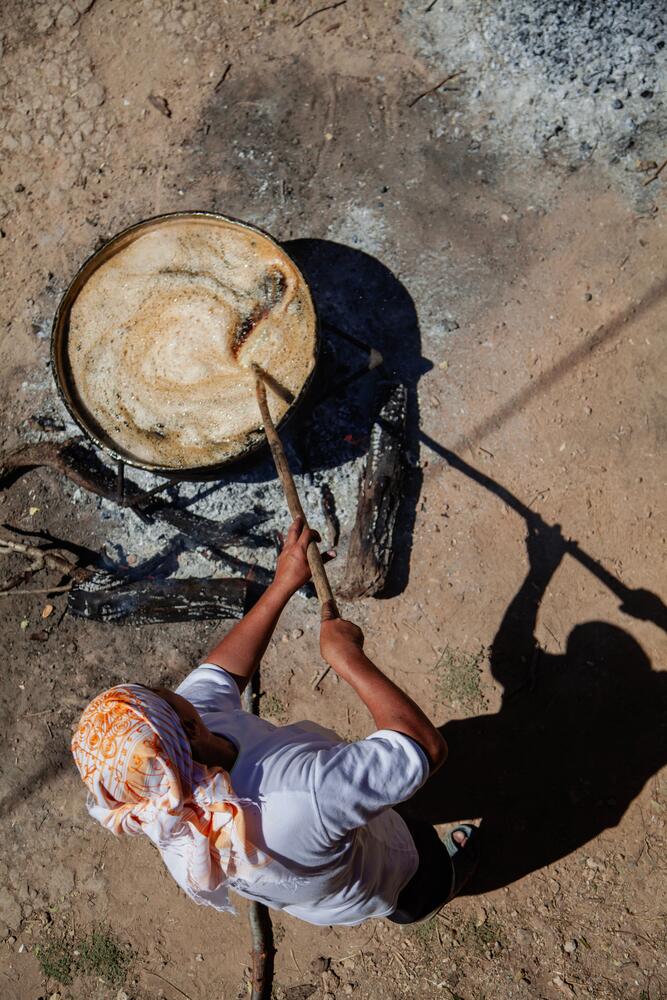
In de jaren twintig en dertig van de vorige eeuw zitten we volop in de koloniale periode. Verschillende Europese landen, alsook Noord-Amerika sturen expedities naar Zuid-Amerika om medicinale planten te gaan zoeken. Ze nemen onder andere ayahuasca mee, dat meteen tot de verbeelding spreekt in Nederlandse kranten. Enerzijds zou ayahuasca, dat toen nog caapi heette, moed geven. Een pintje uit de Amazone, bij wijze van spreken.
Tegelijk heerst er ook angst voor de mysterieuze plant. Ayahuasca wordt omschreven als ‘verslavingsvergif’ of een ‘griezelig wapen in menschenhand.’ Enkele artikels grappen zelfs dat ayahuasca, gedronken door soldaten, een gevaar zou vormen voor de wereldvrede
Toch zien wetenschappers vooral het potentieel en onderzoeken ze de medische mogelijkheden. Ook het idee om ayahuasca te verkopen duikt op. In 1924 staat er in de krant: “Niets belet een ondernemende firma fleschjes met heldenmoed gevuld tegen een matigen prijs op de wereldmarkt te brengen.”
Het gevaar van de Flower-power
In de jaren zestig en zeventig slaat de stemming om. In de Verenigde Staten worden verschillende drugs verboden, na een reeks ongelukken met LSD. Die strenge aanpak waait over naar Europa en Nederland, en ook de kranten veranderen hun toon. Van de plant is geen sprake meer. De berichten gaan nog enkel over de stof waarvan je gaat trippen: DMT. De pers zet die in één rij met LSD en waarschuwt ervoor.
Ook de hippies krijgen het zwaar te verduren in de pers, want DMT wordt aan hen gelinkt. Een krant beschrijft hun bijeenkomst in het Vondelpark als “een bonte stoet van heksen en tovenaars, heiligen en zieners, (…) zwervers en gekken.” Dat maakt DMT vooral een bedreiging voor de jeugd, schrijven de kranten. Zo wordt ayahuasca, na een potentieel medicijn, een gevaarlijke drug.
Hype bij therapie en zelfhulp
In de jaren negentig en 2000 komen ayahuascarituelen ook in Nederland voor, in kerkgemeenschappen en bij zelfverklaarde spirituele helers. Wie deelneemt doet dat vooral voor therapie of om zichzelf te vinden. Tegen 2017 kan je in Nederland op wel twintig plekken ayahuascaceremonies bijwonen, en in 2019 gaat dat naar bijna zeventig.
Dit zien we weerspiegeld in de kranten. Ayahuasca is in de meeste artikels een middel voor groei en zelfontwikkeling, een heilig medicijn waarmee mensen zichzelf kunnen vinden. Heel belangrijk hierbij is de link met de inheemse gemeenschappen in de Amazone. Wie verwijst naar ‘oeroude kennis’, geeft de ceremonies geloofwaardigheid, en doet mensen er steeds meer voor betalen.
‘Oeroude kennis’ is goud waard
En dat is een opmerkelijke bevinding. De kranten geven aan dat ayahuasca steeds populairder wordt en verandert in een handelswaar. Maar waarom? Neem cocaïne. Coca was en is nog steeds een heilige plant voor verschillende groepen in Zuid-Amerika. Maar vanaf dat cocaïne over de hele wereld verhandeld werd, bleef van dat heilige niets over. Wie vandaag aan cocaïne denkt, denkt aan misdaadbendes, niet aan ceremonies, genezing of rituelen.
Bij ayahuasca liep het net andersom. Precies het heilige, het eeuwenoude, de band met de Amazone maakt de drank populair en verhandelbaar. Zo ontstaan ‘plastic sjamans’: westerse aanbieders die inheemse kennis en symbolen overnemen zonder iets terug te geven aan de inheemse gemeenschappen. Daar bestaat een vakterm voor: culturele toe-eigening. Je neemt iets van een andere cultuur over en strijkt er zelf de winst van op.
Psychedelica
In honderd jaar evolueert ayahuasca van een wonderdrank, over een gevaarlijke drug, naar een quick fix voor mentaal welzijn. De drank bleef dezelfde, maar de verhalen erover veranderden mee met de tijdsgeest. Een eeuw lang bepaalde de westerse politiek en pers de publieke opinie over ayahuasca. Misschien is het tijd om eens te luisteren naar wie het al eeuwen drinkt, nu Europese landen op zoek gaan naar regelgeving voor het eventuele therapeutisch gebruik van psychedelica. Wordt vervolgd...
Bibliografie
Appadurai, Arjun. "Introduction: commodities and the politics of value." In The social life of things: commodities in cultural perspective, uitgegeven door Arjun Appadurai, 3–63. Cambridge: Cambridge University Press, 2014. https://doi.org/10.1017/CBO9780511819582.
Atkinson, Jane Monnig. ‘Shamanisms today.’ Annual Review of Anthropology 21 (1992): 307-30. https://doi.org/10.1146/annurev.an.21.100192.001515.
Aupers, Stef en Dick Houtman. "Beyond the spiritual supermarket: the social and public significance of New Age spirituality." Journal of Contemporary Religion 21, nr. 2 (2006): 201–22. https://doi.org/10.1080/13537900600655894.
Barker, Steven A. "N,N-dimethyltryptamine (DMT), an endogenous hallucinogen: past, present, and future research to determine its role and function." Frontiers in Neuroscience 12 (2018): artikel 536. https://doi.org/10.3389/fnins.2018.00536.
Bender, David A. et al. “Trends in the psychedelic renaissance: applying artificial intelligence to measure media portrayal of psychedelic drugs in the 21st century.” BJPsych Open 12 nr. 2, (2026): 1-10. https://doi.org/10.1192/bjo.2025.10974.
Blainey, Marc G. "Forbidden therapies: Santo Daime, ayahuasca, and the prohibition of entheogens in Western society." Journal of Religion and Health 54, nr. 1 (2015): 287–302. https://doi.org/10.1007/s10943-014-9826-2.
Blok, Gemma. De roes als metafoor: het debat over drank en drugs na 1800. Maastricht: Datawyse, 2018.
Boumediene, Samir. La colonisation du savoir: une histoire des plantes médicinales du 'Nouveau Monde' (1492–1750). Vaux-en-Velin: Les editions des mondes à faire, 2026.
Cohen, Stanley. Folk devils and moral panics: the creation of the Mods and Rockers. Londen: Routledge, 2011.
Confino, Alon. "Memory and the history of mentalities." In Cultural Memory Studies: An International and Interdisciplinary Handbook, uitgegeven door Astrid Erll en Ansgar Nünning, 77–84. Berlijn: De Gruyter, 2008. https://doi.org/10.1525/MAQ.1989.3.2.02A00060.
Corin, Ellen en June Nash. Recensie van Shamanism, colonialism, and the wild man: a study in terror and healing, door Michael Taussig. Medical Anthropology Quarterly 3, nr. 2 (1989): 190–6. https://doi.org/10.1525/MAQ.1989.3.2.02A00060.
Cornwell, Benjamin en Annulla Linders. “The myth of ‘moral panic’: an alternative account of LSD prohibition.” Deviant Behavior 23, nr. 4 (2002): 307–330. https://doi.org/10.1080/01639620290086404.
Costa, Francisco de Assis. A brief economic history of the Amazon, 1720–1970. Newcastle upon Tyne: Cambridge Scholars Publishing, 2019.
Courtwright, David T. "A short history of drug policy or why we make war on some drugs but not on others." In Governing the global drug wars, LSE Ideas Special Report SR014, uitgegeven door John Collins, 7–13. Londen: Londen School of Economics and Political Science, 2012. https://doi.org/10.1515/9783110207262.2.77.
Cuvi, Nicolás, Anna Guiteras Mombiola en Zulema Lehm Ardaya. "Chapter 9: peoples of the Amazon and European colonization, 16th–18th centuries." In Amazon Assessment Report 2021, uitgegeven door Carlos Nobre et al. New York: United Nations Sustainable Development Solutions Network, 2021. https://doi.org/10.55161/RWSX6527.
De Kort, Marcel. Tussen patiënt en delinquent: geschiedenis van het Nederlandse drugsbeleid. Hilversum: Verloren, 1995. https://books.google.nl/books?vid=ISBN90-6550-420-6.
De Lima, Vinícius Maurício en Maria Gabriela Silva Martins Da Cunha Marinho. “Reports by explorers and travelers and the first scientific studies on ayahuasca (dating from 1850 to 1950) within the current debate on the ‘psychedelic renaissance’.” História, Ciências, Saúde-Manguinhos 30 (2023). https://doi.org/10.1590/s0104-59702023000100023en.
Dyck, Erika en Chris Elcock, eds. Expanding mindscapes: a global history of psychedelics. Cambridge, MA: MIT Press, 2023. https://doi.org/10.7551/mitpress/14417.001.0001.
Fotiou, Evgeia. "From medicine men to day trippers: shamanic tourism in Iquitos, Peru." PhD diss., University of Wisconsin-Madison, 2010. https://doi.org/10.13140/RG.2.2.29990.32327.
Foucault, Michel. The archaeology of knowledge. Londen: Routledge, 2013.
Goode, Erich. “Moral panics and disproportionality: the case of LSD use in the sixties.” Deviant Behavior 29, nr. 6 (2008): 533–43. https://doi.org/10.1080/01639620701839377.
Gootenberg, Paul. Andean cocaine: the making of a global drug. Chapel Hill: University of North Carolina Press, 2008. https://www.jstor.org/stable/10.5149/9780807887790_gootenberg.
Gootenberg, Paul. “Introduction: a new global history of drugs,” In The Oxford handbook of global drug history, uitgegeven door Paul Gootenberg, 1-20. Oxford: Oxford University Press, 2022. https://doi.org/10.1093/oxfordhb/9780190842642.001.0001.
Hall, Stuart. "Encoding/decoding." In Culture, media, language: working papers in cultural studies, 1972–79, uitgegeven door Stuart Hall, Dorothy Hobson, Andrew Lowe en Paul Willis, 128–38. Londen: Hutchinson, 1980.
Hamill, Jonathan et al. "Ayahuasca: psychological and physiologic effects, pharmacology and potential uses in addiction and mental illness." Current Neuropharmacology 17, nr. 2 (2019): 108–28. https://doi.org/10.2174/1570159X16666180125151047.
Hanegraaff, Wouter J. "Ayahuasca groups and networks in the Netherlands: a challenge to the study of contemporary religion." In The internationalization of ayahuasca, uitgegeven door Beatriz Caiuby Labate en Henrik Jungaberle, 85–104. Zürich: LIT Verlag, 2011. https://books.google.nl/books?vid=ISBN978-3-643-90148-4.
Harner, Michael J. The way of the shaman. New York: Harper & Row, 1980.
Harvey, David. The condition of Postmodernity: an enquiry into the origins of cultural change. Oxford: Blackwell Publishers, 1992. https://books.google.nl/books?vid=ISBN978-3-643-90148-4.
Holman, Christine L. “Spirituality for sale. An analysis of ayahuasca tourism.” PhD diss., Arizona State University, 2010.
Hudson, Jesse H. en Deward E. Walker. “Ayahuasca and globalization.” Undergraduate Honors Theses. University of Colorado, 2011.
Illouz, Eva. Saving the modern soul: therapy, emotions and the culture of self-help. Berkeley: University of California Press, 2008, https://www.jstor.org/stable/10.1525/j.ctt1pp4br.
Introvigne, Massimo en Wouter J. Hanegraaff. "The Santo Daime Church in the Netherlands: why the ECHR should consider the case." The Journal of CESNUR 4, nr. 2 (2020): 157-162, https://doi.org/10.26338/TJOC.2020.SUPP.4.2.7.
Jameson, Fredric. Postmodernism, or, the cultural logic of late capitalism. Durham: Duke University Press, 1991, https://doi.org/10.2307/j.ctv12100qm.
Kloosterman, Ingrid. "Psychical research and parapsychology interpreted." History of the Human Sciences 25, nr. 2 (2012): 2-22, https://doi.org/10.1177/0952695111421580.
Labate, Beatriz Caiuby en Clancy Cavnar, eds. Ayahuasca shamanism in the Amazon and beyond. Oxford Ritual Studies. Oxford: Oxford University Press, 2014. https://books.google.nl/books?vid=ISBN978-0-19-934120-7.
Labate, Beatriz Caiuby, en Gustavo Pacheco. "The historical origins of Santo Daime. Academics, adepts and ideology." In The internationalization of ayahuasca, uitgegeven door Beatriz Caiuby Labate en Henrik Jungaberle, 71-84. Zürich: LIT Verlag, 2011, https://books.google.nl/books?vid=ISBN978-3-643-90148-4.
Lee, Martin A. en Bruce Shlain. Acid dreams: the complete social history of LSD: the CIA, the sixties, and beyond. New York: Grove Weidenfeld, 1992. https://books.google.nl/books?vid=ISBN978-0-8021-9606-4.
Lenard, Patti Tamara en Peter Balint. "What is (the wrong of) cultural appropriation?" Ethnicities 20, nr. 2 (2020): 331–52. https://doi.org/10.1177/1468796819866498.
Loures de Assis, Glauber et al. "From renaissance to confluence: a call for paradigm shift in psychedelic studies." Psychedelics 3 (2026): 1-8. https://doi.org/10.1016/j.psyche.2026.100010.
Luna, Luis Eduardo. "Some reflections on the global expansion of ayahuasca." In The internationalization of ayahuasca, uitgegeven door Beatriz Caiuby Labate en Henrik Jungaberle, 123–30. Zürich: LIT Verlag, 2011, https://books.google.nl/books?vid=ISBN978-3-643-90148-4.
Luna, Luis Eduardo. “Indigenous and mestizo use of ayahuasca: an overview.” In The Ethnopharmacology of Ayahuasca, uitgegeven door Rafael Guimarães dos Santos, 1–22. Kerala: Transworld Research Network, 2011.
Madancy, Joyce A. “Producing drug histories: conquest and commerce, culture and control. In The Oxford handbook of commodity history,” uitgegeven door Jonathan Curry-Machado et al, 533-54. Oxford: Oxford University Press, 2024.
Manning, Paul. Drugs and popular culture. Cullompton: Willan, 2007. https://doi.org/10.4324/9781843926016.
Manning, Paul. Drugs and popular culture in the age of new media. Londen: Routledge, 2013. https://doi.org/10.4324/9781315871080.
Marx, Karl. Capital: a critique of political economy, Volume 1. Londen: Penguin, 1992.
May, Timothy. “A boom for whom? A critical engagement with ayahuasca tourism in Iquitos, Peru.” Masterproef, Girton College, 2015.
McGaa Ed. Mother earth spirituality: native American paths to healing ourselves and our World. San Francisco: Harper San Francisco, 1990. https://doi.org/10.2307/541635.
Meeus, Ben. “Ayahuasca in Brazil, Belgium and the Netherlands. The transnationalization of a new religious movement and the legal issues related to its religious use of ayahuasca.” Masterscriptie, Universiteit van Amsterdam, 2018.
Metzner, Ralph. Sacred vine of spirits. Ayahuasca. Rochester, VT: Inner Traditions, 2005. https://books.google.nl/books?vid=ISBN9781594770531.
Nunn, Nathan en Nancy Qian. “The Columbian exchange: a history of disease, food, and ideas.” Journal of Economic Perspectives 24, nr. 2 (2010): 163-188. https://doi.org/10.1257/jep.24.2.163.
Oostra, Menno. "De ijzeren god en andere verhalen: vijf eeuwen mythe en geschiedenis in Amazonia." Masterscriptie, Radboud Universiteit Nijmegen, 1993.
Partridge, Christopher. The re-enchantment of the West, Vol. 1: alternative spiritualities, sacralization, popular culture and occulture. Londen: T&T Clark, 2005. https://doi.org/10.1525/nr.2006.10.1.126.
Peláez, Ismael Eduardo. Ayahuasca. Between cognition and culture. Perspectives from an interdisciplinary and reflexive ethnography. Tarragona: Publicacions de la Universitat Rovira i Virgili, 2020. https://doi.org/10.17345/9788484248347.
Peluso, Daniela M. “Global ayahuasca: an entrepreneurial ecosystem.” In The world ayahuasca diaspora: reinventions and controversies, uitgegeven door Beatriz Caiuby Labate, Clancy Cavnar en Alex K. Gearin, 203–222. Londen: Routledge, 2017. https://doi.org/10.4324/9781315551425.
Perrot, Em en Raymond-Hamet. “Yagé, ayahuasca, caapi et leur alcaloïde: télépathine ou yagéine.” Bulletin des Sciences Pharmacologiques 324, nr. 6 (1927): 1-2.
Plotkin, Mark J. The Amazon: what everyone needs to know. Oxford: Oxford University Press, 2020. https://doi.org/10.1093/wentk/9780190668297.001.0001.
Pollan, Michael. How to change your mind. New York: Penguin Press, 2018. http://books.google.com/books?vid=ISBN9780525558941.
Relke, Diana M. A. Greenwor(l)ds: ecocritical readings of Canadian women's poetry. Calgary: University of Calgary Press, 1999. https://doi.org/10.1515/9781552383582.
Robins, Nicholas A. en Barbara J. Fraser. Landscapes of inequity: environmental justice in the Andes-Amazon Region. Lincoln: University of Nebraska Press, 2020. https://doi.org/10.5250/9781496208026.
Roersch van der Hoogte, Arjo en Toine Pieters. "From Javanese coca to Java coca: an exemplary product of Dutch colonial agro-industrialism, 1880–1920." Technology and Culture 54, nr. 1 (2013): 90–116. https://doi.org/10.1353/tech.2013.0045.
Ros, Ruben. Recensie van De krant. Een cultuurgeschiedenis, door Huub Wijfjes en Frank Harbers. De Moderne Tijd 5, nr. 1 (2021): 108–11. https://doi.org/10.5117/dmt2021.1.007.ros.
Ruiz, Jean L. "Civilized people in uncivilized places. Rubber, race and civilization during the Amazonian rubber boom." Masterproef, University of Saskatchewan, 2006.
Rusby, H.H. “The Pharmacodynamics of caapi.” Journal of the American Pharmaceutical Association 13, nr. 2 (1924): 98–9. https://doi.org/10.1002/jps.3080130203.
Rusby, H.H. “The aboriginal uses of caapi.” Journal of the American Pharmaceutical Association 13 (1923): 1123.
Russell, Jamie. The Beat Generation. Harpenden: Pocket Essentials, 2002. http://books.google.com/books?vid=ISBN9781842439241.
Said, Edward W. Orientalism. New York: Vintage Books, 1979. http://books.google.com/books?vid=ISBN9780394740676.
Schultes, Richard Evans, Albert Hofmann en Christian Rätsch. Plants of the gods: their sacred, healing, and hallucinogenic powers. Vermont: Inner Traditions, 2001. http://books.google.com/books?vid=ISBN9781506052205.
Sessa, Ben. The psychedelic renaissance: reassessing the role of psychedelic drugs in 21st century psychiatry and society. Londen: Muswell Hill Press, 2012. https://doi.org/10.1192/pb.bp.112.042275.
Smith, Amanda Mignonne. “From the rubber boom to ayahuasca tourism, shamanic initiation narratives and the commodification of Amazonia.” Contracorriente 14, nr. 3 (2017): 1-22.
Solmi, Marco et al. "A century of research on psychedelics: a scientometric analysis on trends and knowledge maps of hallucinogens, entactogens, entheogens and dissociative drugs." European Neuropsychopharmacology 64 (2022): 44–60, https://doi.org/10.1016/j.euroneuro.2022.09.004.
Suny, Ronald Grigor. "Back and beyond: reversing the cultural turn?" The American Historical Review 107, nr. 5 (2002): 1476–1499. https://doi.org/10.1086/ahr/107.5.1476.
Taussig, Michael. "Nervous system, part 1: homesickness and dada." Kroeber Anthropological Society Papers 69-70 (1989): 32-61. https://doi.org/10.4324/9780203397244.
Taylor, Charles. The ethics of authenticity. Cambridge, MA: Harvard University Press, 1991. http://books.google.com/books?vid=ISBN9780674268630.
Todorov, Tzvetan. The conquest of America: the question of the other. Vertaald door Richard Howard. New York: Harper & Row, 1984. http://books.google.com/books?vid=ISBN9780806131375.
Tully, John. The devil's milk: a social history of rubber. New York: Monthly Review Press, 2011. http://books.google.com/books?vid=ISBN9781583672600.
Tupper, Kenneth W. "Ayahuasca healing beyond the Amazon: the globalization of a traditional indigenous entheogenic practice." Global Networks 9, nr. 1 (2009): 117–36. https://doi.org/10.1111/j.1471-0374.2009.00245.x.
Tupper, Kenneth W. "The globalization of ayahuasca: harm reduction or benefit maximization?" International Journal of Drug Policy 19, nr. 4 (2008): 297–303. https://doi.org/10.1016/j.drugpo.2008.01.005.
Tupper, Kenneth W. "The economics of ayahuasca: money, markets, and the value of the vine." In The world ayahuasca diaspora. Reinventions and controversies, uitgegeven door B.C. Labate, C. Cavnar en A.K. Gearin, 183–200. Londen: Routledge, 2017. https://doi.org/10.4324/9781315551425.
Van der Braak, André. "Ayahuasca: drug, sacrament of medicijn?" NTKR: Tijdschrift voor Recht en Religie 2020, nr. 1 (2020): 47–71. https://doi.org/10.7590/ntkr_2020_004.
Van Dijk, Teun A. “Aims of critical discourse analysis.” Japanese Discourse 1 (1995): 17-27.
Van Laar, Margriet en Marianne van Ooyen-Houben, red. Evaluatie van het Nederlandse drugsbeleid. Utrecht: Trimbos-instituut, 2009.
Wijfjes, Huub en Jo Bardoel. Journalistieke cultuur in Nederland. Amsterdam: Amsterdam University Press, 2019. http://books.google.com/books?vid=ISBN9789053565285.
Wijfjes, Huub. Recensie van Trouw. 75 jaar tegen de stroom in, door Peter Bootsma. Low Countries Historical Review, 133 (2018): recensie 82. https://doi.org/10.18352/bmgn-lchr.10604.
Williams, Justin C. "Investigating a century-long hole in history: the untold story of ayahuasca from 1755–1865." Masterproef, University of Colorado, 2015.
Winkelman, Michael. “Drug Tourism or Spiritual Healing? Ayahuasca Seekers in Amazonia.” Journal of Psychoactive Drugs 37, nr. 2 (2005): 209-18. https://doi.org/10.1080/02791072.2005.10399803.
Ybema, Sierk. “De koers van de krant, vertogen over identiteit bij Trouw en de Volkskrant.” Phd diss., Vrije Universiteit Amsterdam, 2003. https://research.vu.nl/en/publications/de-koers-van-de-krant-vertogen-over-identiteit-bij-trouw-en-de-vo/.