Hoe een kleine vis ons in staat stelt om zeldzame afweerziekten op te sporen
Eind 2023 wordt Jules* geboren. Op het eerste gezicht lijkt hij kerngezond. Maar wanneer Jules vijf maanden oud is, verandert zijn situatie drastisch. Hij wordt opgenomen in het ziekenhuis met een ernstige longinfectie. Ondanks een intensieve behandeling gaat zijn toestand snel achteruit. Wanneer hij zes maanden oud is, kunnen zijn longen niet langer voldoende zuurstof opnemen, waardoor hij overlijdt.
Voor de meeste kinderen zou de infectie die Jules fataal werd nauwelijks een probleem vormen. Een gezond afweersysteem kan de infectie probleemloos bestrijden. Maar bij Jules werkte dat afweersysteem niet zoals het hoort. Hij bleek te lijden aan Severe Combined Immunodeficiency, kortweg SCID.
“Zonder voldoende T-cellen kunnen infecties die normaal onschuldig zijn levensbedreigend worden.”
Wanneer je afweersysteem faalt
SCID is een zeldzame erfelijke aandoening waarbij T-cellen niet goed ontwikkelen. Deze cellen vormen een belangrijk onderdeel van ons afweersysteem: ze helpen ons lichaam om infecties te bestrijden. Zonder voldoende T-cellen kunnen infecties die normaal onschuldig zijn levensbedreigend worden.
In de meeste gevallen is SCID behandelbaar, maar bij Jules is dat niet gelukt. Erfelijke aandoeningen ontstaan door veranderingen in genen, stukjes DNA die de bouwplannen van ons lichaam bevatten. SCID kan ontstaan door veranderingen in vele verschillende genen. De meeste daarvan kennen we ondertussen, maar sommige nog niet. Jules had net zo’n ongekende afwijking.
In het UZ Gent werd daarom onderzocht welk gen verantwoordelijk was voor Jules’ ziekte. Het bleek om GTF3A te gaan, een gen waarvan we voordien niet wisten dat het SCID kon veroorzaken. GTF3A speelt een belangrijke rol bij de aanmaak van ribosomen, de eiwitfabrieken van onze cellen. Zonder voldoende werkende ribosomen kunnen cellen onvoldoende eiwitten aanmaken. Bij T-cellen is dat een groot probleem: ze kunnen zich niet normaal ontwikkelen waardoor ons afweersysteem ernstig verzwakt raakt.
Al snel na deze ontdekking werden wereldwijd meer dan tien patiënten gevonden die, net als Jules, een verandering in GTF3A hadden. Ook zij hadden SCID. Toch was de verandering niet bij iedereen hetzelfde: verschillende patiënten hadden verschillende varianten, kleine veranderingen in het gen. Dat riep een belangrijke vraag op: ‘Wat doen die veranderingen in GTF3A precies? En zijn ze allemaal even schadelijk?’
Van menselijk gen naar kleine vis
Om die vragen te beantwoorden, maakte ik in mijn masterproef gebruik van een onverwacht hulpmiddel: de zebravis. Deze kleine vis ontwikkelt zich razendsnel en is bijzonder geschikt om te bestuderen hoe het afweersysteem ontstaat. Doordat de ontwikkeling van T-cellen sterk op die van de mens lijkt, is de zebravis een ideaal model om te onderzoeken wat er gebeurt wanneer GTF3A niet meer werkt.
Met de CRISPR-techniek, een biologische ‘schaar’ waarmee we gericht genen kunnen aanpassen, schakelde ik het GTF3A gen in zebravissen uit. Zo kon ik onderzoeken wat er gebeurt wanneer dit gen niet meer werkt. De gevolgen waren opvallend: de vissen hadden veel minder T-cellen in de thymus, het orgaan waar die cellen ontwikkelen. Het resultaat leek dus sterk op wat we bij Jules en de andere patiënten zagen: zonder goed werkend GTF3A raakt de ontwikkeling van T-cellen verstoord.
Kunnen we de genetische afwijking redden?
Om te onderzoeken of het T-cel probleem rechtstreeks komt door het verlies van GTF3A, keek ik of ik dit defect kon herstellen. Hiervoor ontwikkelde ik een genetische reddingproef. Ik bracht in de zebravissen waar het ‘vis-eigen’ GTF3A-gen was uitgeschakeld een werkende versie van het menselijke gen binnen. Als het menselijke gen de ontbrekende functie kon overnemen, zou de verstoorde T-celontwikkeling moeten herstellen.
Dat gebeurde ook:
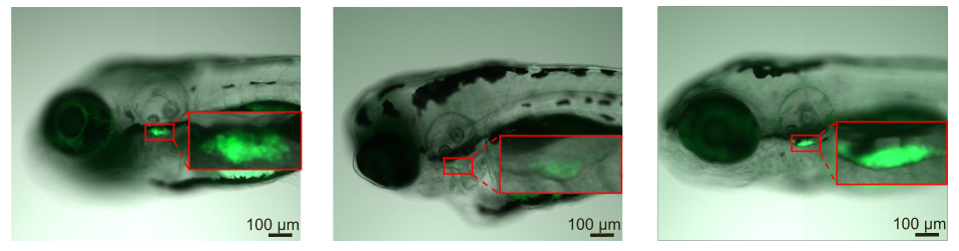
Normale zebravis (links), GTF3A-uitgeschakelde zebravis (midden) en zebravis met uitgeschakeld GTF3A en ingebracht menselijk GTF3A (rechts). Zonder GTF3A ontwikkelen er minder T-cellen (groen) in de thymus (rood kader). Het werkende menselijke GTF3A herstelt deze ontwikkeling.
De T-celontwikkeling werd hersteld. Dit bevestigde dat het verlies van GTF3A aan de basis ligt van het T-celprobleem. Tegelijk toonde het aan dat het menselijke GTF3A voldoende gelijkenissen vertoont met het zebravis-gen om de ontbrekende functie over te nemen.
Zo kreeg ik met de zebravis een levend modelsysteem waarin ik verschillende genetische veranderingen kon testen.
Niet elke genetische afwijking is hetzelfde
Een verandering in een gen maakt ons niet automatisch ziek. Sommige varianten hebben geen merkbaar effect, terwijl andere ervoor zorgen dat een gen niet meer werkt. Daartussen bevindt zich een grijze zone: varianten waarbij een gen slechts een deel van zijn functie verliest.
“Een genetische verandering is niet altijd simpelweg ‘goed’ of ‘slecht’. Soms zit de werkelijkheid er tussenin.”
Om de impact van de verschillende varianten bij de patiënten te testen, gebruikte ik het nieuw ontwikkelde zebravismodel. Eerst testte ik twee varianten waarvan al gekend was dat ze schadelijk zijn. Geen van beide kon de ontwikkeling van de T-cellen herstellen. De test kon dus het verschil tussen een werkende en een defecte variant van GTF3A herkennen.
Vervolgens onderzocht ik varianten waarvan de impact onbekend was. Eén daarvan kon de T-celontwikkeling niet herstellen, wat erop wees dat deze de werking van GTF3A ernstig verstoort en ziekteverwekkend is. Een andere variant zorgde daarentegen voor een gedeeltelijk herstel, wat suggereert ze nog een deel van haar normale werking behoudt.
Dit onderscheid is belangrijk: een genetische verandering is niet altijd simpelweg ‘goed’ of ‘slecht’. Soms zit de werkelijkheid er tussenin.
Een kleine vis met een grote betekenis
Voor patiënten met een zeldzame genetische aandoening is het vaak moeilijk om te bepalen welke veranderingen de oorzaak van hun ziekte zijn. Enkel naar de genetische code kijken is daarvoor doorgaans niet genoeg.
Met het zebravismodel dat ik tijdens mijn masterproef ontwikkelde, kunnen we varianten testen in een levend organisme. Zo kunnen we onderzoeken wat een specifieke verandering doet met de ontwikkeling van T-cellen.
Op termijn kan dit model bijdragen aan een snellere en accuratere interpretatie van varianten bij patiënten met SCID. Dat kan artsen helpen om sneller duidelijkheid te krijgen over de oorzaak van de ziekte, wat zorgt voor een snellere diagnose. Want achter elke onbekende variant zit niet alleen een abstract stukje DNA, maar ook een patiënt: een kind zoals Jules en een familie die zo snel mogelijk geholpen wil worden.
* Jules is een schuilnaam
Bibliografie
Aalders J, Ali S, de Jong TJ & Richardson MK (2016) Assessing Teratogenicity from the Clustering of Abnormal Phenotypes in Individual Zebrafish Larvae. Zebrafish 13: 511–522
Abolhassani H, Azizi G, Sharifi L, Yazdani R, Mohsenzadegan M, Delavari S, Sohani M, Shirmast P, Chavoshzadeh Z, Mahdaviani SA, et al (2020) Global systematic review of primary immunodeficiency registries. Expert Review of Clinical Immunology 16: 717–732
Aiuti A, Cattaneo F, Galimberti S, Benninghoff U, Cassani B, Callegaro L, Scaramuzza S, Andolfi G, Mirolo M, Brigida I, et al (2009) Gene Therapy for Immunodeficiency Due to Adenosine Deaminase Deficiency. New England Journal of Medicine 360: 447–458
Aleström P, D’Angelo L, Midtlyng PJ, Schorderet DF, Schulte-Merker S, Sohm F & Warner S (2020) Zebrafish: Housing and husbandry recommendations. Lab Anim 54: 213–224
Bajoghli B, Dick AM, Claasen A, Doll L & Aghaallaei N (2019) Zebrafish and Medaka: Two Teleost Models of T-Cell and Thymic Development. International Journal of Molecular Sciences 20: 4179
Bakaros E, Sarrou S, Gkantaras A, Matziri A, Galanopoulos AP, Charisi K, Bangeas A, Taparkou A, Papadimitriou E, Mouchtouri VA, et al (2025) Targeted Next-Generation Sequencing in the Molecular Diagnosis of Severe Combined Immunodeficiency. Medicina 61: 1644
Barbosa GR, de Souza AM, Silva PF, Fávero CS, de Oliveira JL, Carvalho HF, Luchiari AC & Reis LO (2025) Zebrafish as a Model for Translational Immuno-Oncology. Journal of Personalized Medicine 15: 304
Beler M, Ünal İ, Cansız D & Emekli-Alturfan E (2024) Alcian Blue Staining for Chondrocranium Development in Zebrafish. In Teratogenicity Testing: Methods and Protocols, Félix L (ed) pp 447–457. New York, NY: Springer US
Blom M, Soomann M, Soler-Palacín P, Šedivá A, Stray-Pedersen A, Zetterström R, Speckmann C, Gennery AR & van der Burg M (2025) Newborn screening for SCID and severe T lymphocytopenia in Europe. Journal of Allergy and Clinical Immunology 155: 377–386
Boehm T, Hess I & Swann JB (2012) Evolution of lymphoid tissues. Trends in Immunology 33: 315–321
Boulon S, Westman BJ, Hutten S, Boisvert F-M & Lamond AI (2010) The Nucleolus under Stress. Molecular Cell 40: 216–227
Bousfiha AA, Jeddane L, Moundir A, Poli MC, Aksentijevich I, Cunningham-Rundles C, Hambleton S, Klein C, Morio T, Picard C, et al (2025) The 2024 update of IUIS phenotypic classification of human inborn errors of immunity. J Hum Immun 1: e20250002
Buckley RH (2012) The long quest for neonatal screening for severe combined immunodeficiency. Journal of Allergy and Clinical Immunology 129: 597–604
Burke W, Parens E, Chung WK, Berger SM & Appelbaum PS (2022) The Challenge of Genetic Variants of Uncertain Clinical Significance. Ann Intern Med 175: 994–1000
Castillo Duque de Estrada NM, Thoms M, Flemming D, Hammaren HM, Buschauer R, Ameismeier M, Baßler J, Beck M, Beckmann R & Hurt E (2023) Structure of nascent 5S RNPs at the crossroad between ribosome assembly and MDM2–p53 pathways. Nat Struct Mol Biol 30: 1119–1131
Chan K & Puck JM (2005) Development of population-based newborn screening for severe combined immunodeficiency. Journal of Allergy and Clinical Immunology 115: 391–398
Chiang JJ, Sparrer KMJ, van Gent M, Lässig C, Huang T, Osterrieder N, Hopfner K-P & Gack MU (2018) Viral unmasking of cellular 5S rRNA pseudogene transcripts induces RIG-I-mediated immunity. Nat Immunol 19: 53–62
Ciganda M & Williams N (2011) Eukaryotic 5S rRNA biogenesis. Wiley Interdiscip Rev RNA 2: 523–533
Clemens KR, Liao X, Wolf V, Wright PE & Gottesfeld JM (1992) Definition of the binding sites of individual zinc fingers in the transcription factor IIIA-5S RNA gene complex. Proceedings of the National Academy of Sciences 89: 10822–10826
Currier R & Puck JM (2021) SCID newborn screening: What we’ve learned. Journal of Allergy and Clinical Immunology 147: 417–426
Daniel JG, Yu X, Ferguson AC & Shavit JA (2023) CRISPR/Cas9-Mediated Genome Editing in Zebrafish. In Transgenesis: Methods and Protocols, Saunders TL (ed) pp 371–380. New York, NY: Springer US
Del Rio S & Setzer DR (1993) The role of zinc fingers in transcriptional activation by transcription factor IIIA. Proceedings of the National Academy of Sciences 90: 168–172
Departement Zorg (2026) Pasgeboren baby’s krijgen nu ook screening op zeldzame aandoening SCID. Departement Zorg
Derrick CJ, Szenker-Ravi E, Santos-Ledo A, Alqahtani A, Yusof A, Eley L, Coleman AHL, Tohari S, Ng AY-J, Venkatesh B, et al (2024) Functional analysis of germline VANGL2 variants using rescue assays of vangl2 knockout zebrafish. Hum Mol Genet 33: 150–169
Dinakar C (2006) Alleviating disease burden in primary immunodeficiency diseases. Annals of Allergy, Asthma & Immunology 96: 260–262
Donati G, Peddigari S, Mercer CA & Thomas G (2013) 5S Ribosomal RNA Is an Essential Component of a Nascent Ribosomal Precursor Complex that Regulates the Hdm2-p53 Checkpoint. Cell Reports 4: 87–98
Dutto I, Tillhon M, Cazzalini O, Stivala LA & Prosperi E (2015) Biology of the cell cycle inhibitor p21CDKN1A: molecular mechanisms and relevance in chemical toxicology. Arch Toxicol 89: 155–178
Dvorak CC, Haddad E, Heimall J, Dunn E, Buckley RH, Kohn DB, Cowan MJ, Pai S-Y, Griffith LM, Cuvelier GDE, et al (2023) The diagnosis of severe combined immunodeficiency (SCID): The Primary Immune Deficiency Treatment Consortium (PIDTC) 2022 Definitions. Journal of Allergy and Clinical Immunology 151: 539–546
El-Brolosy MA, Kontarakis Z, Rossi A, Kuenne C, Günther S, Fukuda N, Kikhi K, Boezio GLM, Takacs CM, Lai S-L, et al (2019) Genetic compensation triggered by mutant mRNA degradation. Nature 568: 193–197
Engelke DR, Ng S-Y, Shastry BS & Roeder RG (1980) Specific interaction of a purified transcription factor with an internal control region of 5S RNA genes. Cell 19: 717–728
Fedotova AA, Bonchuk AN, Mogila VA & Georgiev PG (2017) C2H2 Zinc Finger Proteins: The Largest but Poorly Explored Family of Higher Eukaryotic Transcription Factors. Acta Naturae 9: 47–58
Fischer A, Le Deist F, Hacein-Bey-Abina S, André-Schmutz I, De Saint Basile G, De Villartay J-P & Cavazzana-Calvo M (2005) Severe combined immunodeficiency. A model disease for molecular immunology and therapy. Immunological Reviews 203: 98–109
Fischer A, Notarangelo LD, Neven B, Cavazzana M & Puck JM (2015) Severe combined immunodeficiencies and related disorders. Nat Rev Dis Primers 1: 15061
Forlanini F, Chan A, Dara J, Dvorak CC, Cowan MJ, Puck JM & Dorsey MJ (2023) Impact of Genetic Diagnosis on the Outcome of Hematopoietic Stem Cell Transplant in Primary Immunodeficiency Disorders. J Clin Immunol 43: 636–646
Gaspar HB, Cooray S, Gilmour KC, Parsley KL, Adams S, Howe SJ, Al Ghonaium A, Bayford J, Brown L, Davies EG, et al (2011) Long-term persistence of a polyclonal T cell repertoire after gene therapy for X-linked severe combined immunodeficiency. Sci Transl Med 3: 97ra79
Gatti RichardA, Meuwissen HilaireJ, Allen HughD, Hong R & Good RobertA (1968) IMMUNOLOGICAL RECONSTITUTION OF SEX-LINKED LYMPHOPENIC IMMUNOLOGICAL DEFICIENCY. The Lancet 292: 1366–1369
Gupta MN & Uversky VN (2024) Biological importance of arginine: A comprehensive review of the roles in structure, disorder, and functionality of peptides and proteins. International Journal of Biological Macromolecules 257: 128646
Hacein-Bey-Abina S, Hauer J, Lim A, Picard C, Wang GP, Berry CC, Martinache C, Rieux-Laucat F, Latour S, Belohradsky BH, et al (2010) Efficacy of Gene Therapy for X-Linked Severe Combined Immunodeficiency. New England Journal of Medicine 363: 355–364
Han J, Flemington C, Houghton AB, Gu Z, Zambetti GP, Lutz RJ, Zhu L & Chittenden T (2001) Expression of bbc3, a pro-apoptotic BH3-only gene, is regulated by diverse cell death and survival signals. Proceedings of the National Academy of Sciences 98: 11318–11323
Han Y, Yan C, Fishbain S, Ivanov I & He Y (2018) Structural visualization of RNA polymerase III transcription machineries. Cell Discov 4: 40
Hasan A, Macias JJ, Wood B, Malone-Perez M, Park G, Foster CA & Frazer JK (2024) Dynamic Changes in Lymphocyte Populations Establish Zebrafish as a Thymic Involution Model. J Immunol 212: 1733–1743
Hashimoto K, Sohn SJ, Levin SD, Tada T, Perlmutter RM & Nakayama T (1996) Requirement for p56lck tyrosine kinase activation in T cell receptor-mediated thymic selection. J Exp Med 184: 931–943
Hodorovich DR, Lindsley PM, Berry AA, Burton DF & Marsden KC (2023) Morphological and sensorimotor phenotypes in a zebrafish CHARGE syndrome model are domain‐dependent. Genes Brain Behav 22: e12839
Höijer I, Emmanouilidou A, Östlund R, van Schendel R, Bozorgpana S, Tijsterman M, Feuk L, Gyllensten U, den Hoed M & Ameur A (2022) CRISPR-Cas9 induces large structural variants at on-target and off-target sites in vivo that segregate across generations. Nat Commun 13: 627
Jeffrey Modell Foundation (2026) Newborn Screening for SCID: Advocating for Early Diagnosis. Jeffrey Modell Foundation
Kanehisa M, Furumichi M, Sato Y, Kawashima M & Ishiguro-Watanabe M (2023) KEGG for taxonomy-based analysis of pathways and genomes. Nucleic Acids Res 51: D587–D592
Kaplan EL & Meier P (1958) Nonparametric Estimation from Incomplete Observations. Journal of the American Statistical Association 53: 457–481
Kassavetis GA, Braun BR, Nguyen LH & Peter Geiduschek E (1990) S. cerevisiae TFIIIB is the transcription initiation factor proper of RNA polymerase III, while TFIIIA and TFIIIC are assembly factors. Cell 60: 235–245
Kelly BT, Tam JS, Verbsky JW & Routes JM (2013) Screening for severe combined immunodeficiency in neonates. Clin Epidemiol 5: 363–369
Lam SH, Chua HL, Gong Z, Lam TJ & Sin YM (2004) Development and maturation of the immune system in zebrafish, Danio rerio: a gene expression profiling, in situ hybridization and immunological study. Developmental & Comparative Immunology 28: 9–28
Langenau DM, Ferrando AA, Traver D, Kutok JL, Hezel J-PD, Kanki JP, Zon LI, Look AT & Trede NS (2004) In vivo tracking of T cell development, ablation, and engraftment in transgenic zebrafish. Proceedings of the National Academy of Sciences 101: 7369–7374
Layat E, Probst AV & Tourmente S (2013) Structure, function and regulation of Transcription Factor IIIA: From Xenopus to Arabidopsis. Biochimica et Biophysica Acta (BBA) - Gene Regulatory Mechanisms 1829: 274–282
Levin SD, Anderson SJ, Forbush KA & Perlmutter RM (1993) A dominant‐negative transgene defines a role for p56lck in thymopoiesis. EMBO J 12: 1671–1680
Li EB, Truong D, Hallett SA, Mukherjee K, Schutte BC & Liao EC (2017) Rapid functional analysis of computationally complex rare human IRF6 gene variants using a novel zebrafish model. PLOS Genetics 13: e1007009
Liberzon A, Birger C, Thorvaldsdóttir H, Ghandi M, Mesirov JP & Tamayo P (2015) The Molecular Signatures Database Hallmark Gene Set Collection. Cell Systems 1: 417–425
Lim BWD & Abdul Latiff AH (2024) Accessibility to plasma-derived medicinal products in Malaysia: The challenges faced by patients with inborn errors of immunity. Asia Pac Allergy 14: 1–4
Livak KJ & Schmittgen TD (2001) Analysis of Relative Gene Expression Data Using Real-Time Quantitative PCR and the 2−ΔΔCT Method. Methods 25: 402–408
Luo J, Tao B, Chen J, Song Y & Hu W (2025) General transcription factor IIIAa regulates the transcription of somatic 5S rRNA and influences embryonic organ development in zebrafish. Mar Life Sci Technol 8: 68–81
MacArthur DG, Manolio TA, Dimmock DP, Rehm HL, Shendure J, Abecasis GR, Adams DR, Altman RB, Antonarakis SE, Ashley EA, et al (2014) Guidelines for investigating causality of sequence variants in human disease. Nature 508: 469–476
Maehama T, Nishio M, Otani J, Mak TW & Suzuki A (2023) Nucleolar stress: Molecular mechanisms and related human diseases. Cancer Science 114: 2078–2086
Magdalena Cardenas-Rodriguez & Iain A. Drummond (2023) The challenge of dissecting gene function in model organisms: Tools to characterize genetic mutants and assess transcriptional adaptation in zebrafish. In Methods in Cell Biology pp 1–25. Academic Press
McCusker C, Upton J & Warrington R (2018) Primary immunodeficiency. Allergy Asthma Clin Immunol 14: 61
Mehravar M, Shirazi A, Nazari M & Banan M (2019) Mosaicism in CRISPR/Cas9-mediated genome editing. Developmental Biology 445: 156–162
Miller J, McLachlan AD & Klug A (1985) Repetitive zinc‐binding domains in the protein transcription factor IIIA from Xenopus oocytes. EMBO J 4: 1609–1614
Mongkonsritragoon W, Huang J, Fredrickson M, Seth D & Poowuttikul P (2023) Positive Newborn Screening for Severe Combined Immunodeficiency: What Should the Pediatrician Do? Clin Med Insights Pediatr 17: 11795565231162839
Naesens L, Muppala S, Acharya D, Nemegeer J, Bogaert D, Lee J-H, Staes K, Debacker V, De Bleser P, De Bruyne M, et al (2022) GTF3A mutations predispose to herpes simplex encephalitis by disrupting biogenesis of the host-derived RIG-I ligand RNA5SP141. Science Immunology 7: eabq4531
Nakielny S, Fischer U, Michael WM & Dreyfuss G (1997) RNA TRANSPORT. Annual Review of Neuroscience 20: 269–301
Narla A & Ebert BL (2010) Ribosomopathies: human disorders of ribosome dysfunction. Blood 115: 3196–3205
Nissa M un, Feng Y, Ali S & Bao B (2026) Precision, Reproducibility, and Validation in Zebrafish Genome Editing: A Critical Review of CRISPR, Base, and Prime Editing Technologies. Fishes 11: 41
Nolte RT, Conlin RM, Harrison SC & Brown RS (1998) Differing roles for zinc fingers in DNA recognition: Structure of a six-finger transcription factor IIIA complex. Proceedings of the National Academy of Sciences 95: 2938–2943
Notarangelo LD (2010) Primary immunodeficiencies. Journal of Allergy and Clinical Immunology 125: S182–S194
Notarangelo LD, Bacchetta R, Casanova J-L & Su HC (2020) Human inborn errors of immunity: An expanding universe. Science Immunology 5: eabb1662
Oh S, Parikh D, Xiao J, Liu X, Gu K & Chong MM (2023) Mapping the two distinct proliferative bursts early in T-cell development. Immunology & Cell Biology 101: 766–774
Onofrillo C, Galbiati A, Montanaro L & Derenzini M (2016) The pre-existing population of 5S rRNA effects p53 stabilization during ribosome biogenesis inhibition. Oncotarget 8: 4257–4267
Pai S-Y, Logan BR, Griffith LM, Buckley RH, Parrott RE, Dvorak CC, Kapoor N, Hanson IC, Filipovich AH, Jyonouchi S, et al (2014) Transplantation Outcomes for Severe Combined Immunodeficiency, 2000–2009. New England Journal of Medicine 371: 434–446
Parichy DM, Elizondo MR, Mills MG, Gordon TN & Engeszer RE (2009) Normal table of postembryonic zebrafish development: Staging by externally visible anatomy of the living fish. Developmental Dynamics 238: 2975–3015
Pelagiadis I, Kyriakidis I, Katzilakis N, Kosmeri C, Veltra D, Sofocleous C, Glentis S, Kattamis A, Makis A & Stiakaki E (2023) The Diverse Genomic Landscape of Diamond–Blackfan Anemia: Two Novel Variants and a Mini-Review. Children 10: 1812
Poli MC, Aksentijevich I, Bousfiha AA, Cunningham-Rundles C, Hambleton S, Klein C, Morio T, Picard C, Puel A, Rezaei N, et al (2025) Human inborn errors of immunity: 2024 update on the classification from the International Union of Immunological Societies Expert Committee. J Hum Immun 1: e20250003
Postlethwait JH (2007) The zebrafish genome in context: ohnologs gone missing. Journal of Experimental Zoology Part B: Molecular and Developmental Evolution 308B: 563–577
Quarello P, Garelli E, Carando A, Brusco A, Calabrese R, Dufour C, Longoni D, Misuraca A, Vinti L, Aspesi A, et al (2010) Diamond-Blackfan anemia: genotype-phenotype correlations in Italian patients with RPL5 and RPL11 mutations. Haematologica 95: 206–213
Revy P, Buck D, Deist FL & Villartay JD (2005) The Repair of DNA Damages/Modifications During the Maturation of the Immune System: Lessons from Human Primary Immunodeficiency Disorders and Animal Models. In Advances in Immunology pp 237–295. Elsevier
Richards S, Aziz N, Bale S, Bick D, Das S, Gastier-Foster J, Grody WW, Hegde M, Lyon E, Spector E, et al (2015) Standards and guidelines for the interpretation of sequence variants: a joint consensus recommendation of the American College of Medical Genetics and Genomics and the Association for Molecular Pathology. Genetics in Medicine 17: 405–424
Robert PA, Kunze-Schumacher H, Greiff V & Krueger A (2021) Modeling the Dynamics of T-Cell Development in the Thymus. Entropy (Basel) 23: 437
Rojo-Bartolomé I, Souza JES de, Cerio OD de & Cancio I (2020) Duplication and subfunctionalisation of the general transcription factor IIIA (gtf3a) gene in teleost genomes, with ovarian specific transcription of gtf3ab. PLOS ONE 15: e0227690
Rudd ML, Tua-Smith A & Straus DB (2006) Lck SH3 Domain Function Is Required for T-Cell Receptor Signals Regulating Thymocyte Development. Molecular and Cellular Biology 26: 7892–7900
Rudt F & Pieler T (1996) Cytoplasmic retention and nuclear import of 5S ribosomal RNA containing RNPs. EMBO J 15: 1383–1391
Slatter MA & Gennery AR (2022) Advances in the treatment of severe combined immunodeficiency. Clinical Immunology 242: 109084
Smith M (2021) Validating Real-Time Polymerase Chain Reaction (PCR) Assays. Encyclopedia of Virology: 35–44
Sørensen PD & Frederiksen S (1991) Characterization of human 5S rRNA genes. Nucleic Acids Res 19: 4147–4151
Staal YCM, Meijer J, van der Kris RJC, de Bruijn AC, Boersma AY, Gremmer ER, Zwart EP, Beekhof PK, Slob W & van der Ven LTM (2018) Head skeleton malformations in zebrafish (Danio rerio) to assess adverse effects of mixtures of compounds. Arch Toxicol 92: 3549–3564
Suzuki H, Li S, Tokutomi T, Takeuchi C, Takahashi M, Yamada M, Okuno H, Miya F, Takenouchi T, Numabe H, et al (2022) De novo non-synonymous DPYSL2 (CRMP2) variants in two patients with intellectual disabilities and documentation of functional relevance through zebrafish rescue and cellular transfection experiments. Hum Mol Genet 31: 4173–4182
Sztal TE & Stainier DYR (2020) Transcriptional adaptation: a mechanism underlying genetic robustness. Development 147: dev186452
Talyzina A, Han Y, Banerjee C, Fishbain S, Reyes A, Vafabakhsh R & He Y (2023) Structural basis of TFIIIC-dependent RNA polymerase III transcription initiation. Molecular Cell 83: 2641-2652.e7
Tasnim M, Wahlquist P & Hill JT (2024) Zebrafish: unraveling genetic complexity through duplicated genes. Dev Genes Evol 234: 99–116
Teame T, Zhang Z, Ran C, Zhang H, Yang Y, Ding Q, Xie M, Gao C, Ye Y, Duan M, et al (2019) The use of zebrafish (Danio rerio) as biomedical models. Anim Fron 9: 68–77
Thakar MS, Logan BR, Puck JM, Dunn EA, Buckley RH, Cowan MJ, O’Reilly RJ, Kapoor N, Satter LF, Pai S-Y, et al (2023) Measuring the effect of newborn screening on survival after haematopoietic cell transplantation for severe combined immunodeficiency: a 36-year longitudinal study from the Primary Immune Deficiency Treatment Consortium. The Lancet 402: 129–140
Ticli G, Cazzalini O, Stivala LA & Prosperi E (2022) Revisiting the Function of p21CDKN1A in DNA Repair: The Influence of Protein Interactions and Stability. International Journal of Molecular Sciences 23: 7058
Ulirsch JC, Verboon JM, Kazerounian S, Guo MH, Yuan D, Ludwig LS, Handsaker RE, Abdulhay NJ, Fiorini C, Genovese G, et al (2018) The Genetic Landscape of Diamond-Blackfan Anemia. The American Journal of Human Genetics 103: 930–947
Vadivel Gnanasundram S & Fåhraeus R (2018) Translation Stress Regulates Ribosome Synthesis and Cell Proliferation. Int J Mol Sci 19: 3757
Vandepoele K, De Vos W, Taylor JS, Meyer A & Van de Peer Y (2004) Major events in the genome evolution of vertebrates: Paranome age and size differ considerably between ray-finned fishes and land vertebrates. Proceedings of the National Academy of Sciences 101: 1638–1643
Vanhooydonck M, De Neef E, De Saffel H, Boel A, Willaert A, Callewaert B & Claes KBM (2025) Prime editing outperforms homology-directed repair as a tool for CRISPR-mediated variant knock-in in zebrafish. Lab Anim 54: 165–172
Waldschmidt R, Jahn D, Teichmann M, Jahn M, Meissner W & Seifart KH (1990) Physical and immunological characterization of human transcription factor IIIA. European Journal of Biochemistry 194: 167–174
Wang B, Wang C, Wan Y, Gao J, Ma Y, Zhang Y, Tong J, Zhang Y, Liu J, Chang L, et al (2022) Decoding the pathogenesis of Diamond–Blackfan anemia using single-cell RNA-seq. Cell Discov 8: 41
Watson CJ, Monstad-Rios AT, Bhimani RM, Gistelinck C, Willaert A, Coucke P, Hsu Y-H & Kwon RY (2020) Phenomics-Based Quantification of CRISPR-Induced Mosaicism in Zebrafish. Cell Systems 10: 275-286.e5
Westerfield M (2000) The zebrafish book: a guide for the laboratory use of zebrafish Danio (Brachydanio) rerio 4th ed. Eugene, Or: ZFIN
Wiley DS, Redfield SE & Zon LI (2017) Chemical screening in zebrafish for novel biological and therapeutic discovery. Methods Cell Biol 138: 651–679
Winter MJ, Ono Y, Ball JS, Walentinsson A, Michaelsson E, Tochwin A, Scholpp S, Tyler CR, Rees S, Hetheridge MJ, et al (2022) A Combined Human in Silico and CRISPR/Cas9-Mediated in Vivo Zebrafish Based Approach to Provide Phenotypic Data for Supporting Early Target Validation. Front Pharmacol 13: 827686
Wischnewski J, Rudt F & Pieler T (2004) Signals and receptors for the nuclear transport of TFIIIA in Xenopus oocytes. European Journal of Cell Biology 83: 55–66
Wu RS, Lam II, Clay H, Duong DN, Deo RC & Coughlin SR (2018) A Rapid Method for Directed Gene Knockout for Screening in G0 Zebrafish. Developmental Cell 46: 112-125.e4
Yoder JA, Nielsen ME, Amemiya CT & Litman GW (2002) Zebrafish as an immunological model system. Microbes and Infection 4: 1469–1478
Yu B, Pettitt BM & Iwahara J (2020) Dynamics of Ionic Interactions at Protein–Nucleic Acid Interfaces. Acc Chem Res 53: 1802–1810
Yu G, Wang L-G, Han Y & He Q-Y (2012) clusterProfiler: an R Package for Comparing Biological Themes Among Gene Clusters. OMICS: A Journal of Integrative Biology 16: 284–287
Yuan J-R, Tang J & Sheng R (2026) The stress responsive transcription factor ATF4: from molecular structure to disease mechanisms. Journal of Advanced Research
Zhang J, Harnpicharnchai P, Jakovljevic J, Tang L, Guo Y, Oeffinger M, Rout MP, Hiley SL, Hughes T & Woolford JL (2007) Assembly factors Rpf2 and Rrs1 recruit 5S rRNA and ribosomal proteins rpL5 and rpL11 into nascent ribosomes. Genes Dev 21: 2580–2592
Zhang W, Zhang M, Ma L, Jariyasakulroj S, Chang Q, Lin Z, Lu Z & Chen J-F (2024) Recapitulating and reversing human brain ribosomopathy defects via the maladaptive integrated stress response. Science Advances 10: eadk1034
Zhang Y & Wiest DL (2016) Using the Zebrafish Model to Study T Cell Development. In T-Cell Development: Methods and Protocols, Bosselut R & S. Vacchio M (eds) pp 273–292. New York, NY: Springer