Wat vertellen patiëntendata ons? Met AI op zoek naar de onverklaarde oorzaak van bloedvatvernauwingen
Dagen na een hersenbloeding kan een nieuw gevaar opduiken: bloedvaten in de hersenen vernauwen plots, een complicatie die vasospasme heet. Artsen kennen het fenomeen al tientallen jaren, maar begrijpen nog altijd niet goed waarom het ontstaat. Zonder duidelijke oorzaak blijft het moeilijk om patiënten gericht te beschermen of in te grijpen. Daarom onderzocht ik met AI gegevens van duizenden patiënten met één cruciale vraag: waarom ontstaan vasospasmen?
Vernauwingen kunnen de bloedtoevoer naar delen van de hersenen sterk verminderen. Daardoor ontstaat zuurstoftekort, met soms blijvende hersenschade of overlijden tot gevolg. Zelfs wanneer de oorspronkelijke hersenbloeding succesvol werd behandeld, blijft het risico hierop groot. Mijn analyses suggereren dat vasospasme niet door één afzonderlijke factor wordt verklaard, maar eerder ontstaat uit een samenspel van processen in het lichaam.
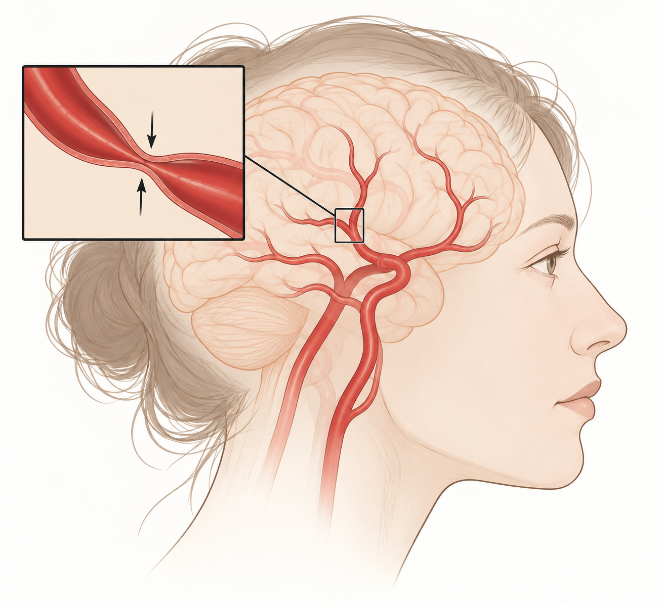
Om te begrijpen welke processen daarbij een rol spelen, zocht ik naar patronen in grote hoeveelheden patiëntendata. In theorie kun je simpelweg zulke gegevens vergelijken tussen patiënten met en zonder vasospasme. In de praktijk dook eerst een fundamenteler probleem op: uit die patiëntendata was lang niet altijd duidelijk af te leiden wie daadwerkelijk vasospasme had.
De informatie bestaat, maar zit verstopt
Voor mijn onderzoek gebruikte ik de grote publieke dataset MIMIC-IV met medische gegevens van patiënten op intensieve zorg. Ziekenhuizen verzamelen dagelijks enorme hoeveelheden gegevens, zoals bloedwaarden, medicatie en verslagen van artsen. Veel relevante informatie zit dus ergens in het dossier opgeslagen. Maar wie specifiek naar vasospasme zoekt, merkt dat die informatie moeilijk terug te vinden is.
Zo een ernstige complicatie zou eenvoudig terug te vinden moeten zijn. Toen ik patiëntengegevens onderzocht, vond ik echter slechts bij een klein deel een officiële diagnose voor vasospasme. In de verslagen van artsen en radiologen stond het daarentegen veel vaker vermeld.
Wat klinisch zichtbaar is, is administratief vaak onzichtbaar. Ongeveer vier op de vijf gevallen ontbreken in de officiële registratie. De informatie is er wel, maar verspreid over tientallen documenten. Hoe haal je daar uit wie vasospasme heeft gehad?
Structuur brengen in de chaos
Om dat probleem op te lossen, bouwde ik een systeem dat gestructureerde gegevens combineert met tekst uit medische dossiers. Met behulp van een taalmodel, dezelfde technologie achter ChatGPT, werden honderden ontslagbrieven en radiologische verslagen doorgenomen.
Daarbij werd niet alleen gezocht naar het woord vasospasme, maar ook naar wat artsen erover schreven: dat een patiënt opnieuw op de scanner moest, dat er een buisje werd geplaatst om druk in de hersenen te verlagen, of dat op beelden duidelijk werd dat bloedvaten nauwer waren geworden.
Belangrijk was dat het systeem niet zomaar antwoorden gaf. Elke vaststelling moest terug te vinden zijn in de bron. Het model wees exact aan in welke zin van het dossier de informatie stond.
De zoektocht naar patronen
Daarna begon de kern van het onderzoek. Veel toepassingen van artificiële intelligentie proberen vooral te voorspellen welke patiënten het grootste risico lopen. Ik wilde een andere vraag stellen: welke gebeurtenissen lijken elkaar op weg naar vasospasme op te volgen? Daarvoor gebruikte ik methodes die in patiëntengegevens zoeken naar mogelijke oorzaak-gevolgrelaties.
Die methodes worden causal discovery genoemd. Verschillende technieken bekijken dezelfde gegevens elk op hun eigen manier. Ze onderzoeken welke kenmerken met elkaar samenhangen en of zo’n verband blijft bestaan wanneer ook andere factoren worden meegenomen.
Vervolgens keek ik niet naar één resultaat van één algoritme. De analyses werden herhaald met verschillende instellingen en op verschillende steekproeven van de data. Zo kon ik nagaan welke verbanden terugkwamen. Het idee is eenvoudig. Wat echt in de data zit, blijft terugkomen, ook wanneer je de manier van kijken verandert. Wat toevallig is, verschijnt maar één keer en verdwijnt weer zodra je iets aanpast.
Niet één oorzaak, maar een keten
Toen ik de verschillende analyses naast elkaar legde, kwam eenzelfde patroon opnieuw naar voren. Eerst verschenen de directe gevolgen van de bloeding zelf, zoals vochtophoping in de hersenen en de daaropvolgende medische ingreep. Verderop in de keten doken ontstekingsreacties en verhoogde bloedsuiker op, met vasospasme aan het uiteinde.
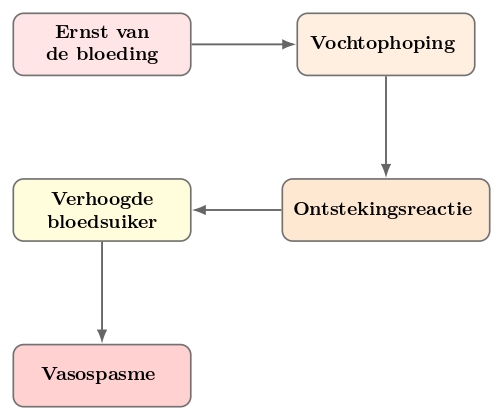
Al deze stappen vormen een soort keten die zich lijkt op te bouwen na de bloeding. Het gaat dus niet om één duidelijke oorzaak, maar om een reeks gebeurtenissen die elkaar mogelijk opvolgen. In dat geheel lijken vooral ontsteking en bloedsuiker dichter bij het mechanisme achter vasospasmen te liggen. Een mogelijke verklaring is dat witte bloedcellen en hoge bloedsuiker de wanden van de bloedvaten irriteren en bijgevolg gevoeliger maken voor samentrekking.
Dit geeft richting aan verder onderzoek. De data tonen een mogelijke biologische keten die kan helpen verklaren hoe vasospasme ontstaat.
Waar artsen en algoritmen elkaar nodig hebben
Dit onderzoek kon alleen ontstaan door geneeskunde en computerwetenschappen samen te brengen. Artsen hebben een diep inzicht in wat er bij patiënten gebeurt, maar het is onmogelijk om handmatig duizenden pagina’s medische verslagen te doorzoeken. Informatica kan dat wel, maar zonder medische kennis blijven die gegevens moeilijk te interpreteren.
Daarom werden de resultaten teruggekoppeld naar de klinische praktijk. De gevonden keten bleek goed aan te sluiten bij wat artsen op intensieve zorg zien. Vooral de mogelijke rol van ontsteking en bloedsuiker kwam naar voren als een interessante hypothese die verder onderzocht moet worden.
Steeds vaker worden inzichten gezocht in bestaande patiëntengegevens. Alleen zijn die gegevens nooit ontworpen voor onderzoek. Artificiële intelligentie kan daarbij helpen als een hulpmiddel dat grote hoeveelheden tekst doorzoekt, informatie samenbrengt en zo nieuwe hypotheses zichtbaar maakt.
Voor patiënten die enkele dagen na een hersenbloeding onverwacht achteruitgaan, kan dat op termijn een verschil maken. Niet omdat een computer de arts vervangt, maar door de mogelijkheid om automatisch verbanden te zoeken die anders verborgen blijven.
Bibliografie
[1] A. Abdulazim, M. Heilig, G. J. Rinkel, and N. Etminan. Diagnosis of delayed cerebral ischemia in patients with aneurysmal subarachnoid hemorrhage and triggers for intervention. Neurocritical Care, 2023. [2] H. Adam, J. Lin, J. Lin, H. Keenan, A. Wilson, and M. Ghassemi. Clinical information extraction with large language models: A case study on organ procurement. AMIA Annual Symposium Proceedings, 2024:115–123, May 2025. [3] A. J. Admon, A. M. Bohnert, C. R. Cooke, and S. P. Taylor. Beyond confounding: Identifying selection bias in observational pulmonary and critical care research. Annals of the American Thoracic Society, 2022. [4] D. Agniel, I. S. Kohane, and G. M. Weber. Biases in electronic health record data due to processes within the healthcare system: retrospective observational study. British medical journal, 2018. [5] M. Agrawal, S. Hegselmann, H. Lang, Y. Kim, and D. Sontag. Large language models are few-shot clinical information extractors. Conference on Empirical Methods in Natural Language Processing, 2022. [6] I. Al-Hassani, N. A. Khan, E. Elmenyar, A. Al-Hassani, S. Rizoli, H. Al-Thani, and A. ElMenyar. The interaction and implication of stress-induced hyperglycemia and cytokine release following traumatic injury: A structured scoping review. Diagnostics, 2024. [7] M. Aleksandrowicz, E. Kozniewska, M. Aleksandrowicz, and E. Kozniewska. Hyponatremia as a risk factor for microvascular spasm following subarachnoid hemorrhage. Experimental Neurology, 2022. [8] E. Alsentzer, J. R. Murphy, W. Boag, W. Weng, D. Jin, T. Naumann, and M. B. A. McDermott. Publicly available clinical bert embeddings. Proceedings of the 2nd Clinical Natural Language Processing Workshop, 2019. [9] E. Asgari, N. Montaña-Brown, M. Dubois, S. Khalil, J. Balloch, and D. Pimenta. A framework to assess clinical safety and hallucination rates of llms for medical text summarisation. medRxiv (Cold Spring Harbor Laboratory), 2024. [10] U. Athiraman, A. J. Norris, K. Jayaraman, A. Lele, R. Kentner, P. Singh, O. Higo, G. Zipfel, and R. Dhar. Intraoperative blood pressure and carbon dioxide values during aneurysmal repair and the outcomes after aneurysmal subarachnoid hemorrhage. Journal of Clinical Medicine, 2023. [11] R. Banerjee, B. Andrews, and E. Kummerfeld. An extensive simulation study evaluating the interaction of resampling techniques across multiple causal discovery contexts. arXiv.org, 2025. [12] E. Bignami, L. J. Darhour, and V. Bellini. Sustainable ai in medicine: Navigating innovation, challenges, and environmental impact. Health Economics Review, 15(1):110, Dec. 2025. [13] P. Bose, S. Srinivasan, W. Sleeman, J. Palta, R. Kapoor, and P. Ghosh. A survey on recent named entity recognition and relationship extraction techniques on clinical texts. Applied Sciences, 2021. [14] I. Buce-Satoba, D. Rozkalne, B. Mamaja, G. Kr¯umin, a, and A. Ozolin, a. Leukocytosis and c-reactive protein may predict development of secondary cerebral vasospasm in patients with aneurysmal subarachnoid hemorrhage. 2022. [15] S. Byeon and W. Lee. Directed acyclic graphs for clinical research: a tutorial. Journal of Minimally Invasive Surgery, 2023. [16] L. Capiau, W. Pype, and H. Vanoverschelde. The epidemiology, treatment, complications and outcome of subarachnoid haemorrhages in uz gent: A retrospective cohort study. Master of medicine dissertation, Ghent University, Ghent, Belgium, 2019. Supervisor: Prof. dr. Kirsten Colpaert. [17] A. Casey, E. Davidson, M. T. C. Poon, H. Dong, D. Duma, A. Grivas, C. Grover, V. SuárezPaniagua, R. Tobin, W. Whiteley, H. Wu, and B. Alex. A systematic review of natural language processing applied to radiology reports. BMC Medical Informatics and Decision Making, 2021. [18] S. Chavali, J. R. Seshan, and G. P. Rath. Management of cerebral vasospasm after aneurysmal subarachnoid hemorrhage: An update. Journal of Neuroanaesthesiology and Critical Care, 2025. [19] L. Chen, Y. Meng, Q. Xue, Y. Zhao, X. Zhou, K. Hu, and H. He. Risk factors of shuntdependent hydrocephalus after subarachnoid hemorrhage: a systematic review and metaanalysis based on observational cohort studies. Neurosurgical review, 2024. [20] A. V. Ciurea, C. Palade, D. C. Voinescu, and D. A. Nica. Subarachnoid hemorrhage and cerebral vasospasm – literature review. Journal of Medicine and Life, 2013. [21] J. Claassen, G. L. Bernardini, K. T. Kreiter, J. E. Bates, Y. Du, D. Copeland, E. S. Connolly, and S. A. Mayer. Effect of cisternal and ventricular blood on risk of delayed cerebral ischemia after subarachnoid hemorrhage:: The fisher scale revisited. Stroke, 2001. [22] J. Claassen and S. Park. Spontaneous subarachnoid haemorrhage. The Lancet, 400(10355):846–862, 2022. [23] B. Colnet, I. Mayer, G. Chen, A. Dieng, R. Li, G. Varoquaux, J.-P. Vert, J. Josse, and S. Yang. Causal inference methods for combining randomized trials and observational studies: a review. arXiv: Methodology, 2020. [24] D. Colombo and M. H. Maathuis. Order-independent constraint-based causal structure learning. Journal of Machine Learning Research, 2014. [25] I. Dankwa-Mullan. Health equity and ethical considerations in using artificial intelligence in public health and medicine. Preventing Chronic Disease, 21:E64, Aug. 2024. [26] J. B. C. de Andrade, N. de Lima Froio, P. S. Nascimento, S. O. Querobin, N. S. de Oliveira, and T. S. Carneiro. Cerebral vasospasm detection and delayed cerebral ischemia prediction after aneurysmal subarachnoid hemorrhage: A scoping review. Neurocritical Care, apr 2026. Epub ahead of print. [27] K. J. Diehl, B. R. Weil, J. J. Greiner, B. L. Stauffer, and C. A. DeSouza. White blood cell count and endothelin-1 vasoconstrictor tone in middle-aged and older adults. Artery Research, 6(2):65–70, June 2012. [28] J. C. Digitale, M. J. N. Martin, and M. Glymour. Tutorial on directed acyclic graphs. Journal of Clinical Epidemiology, 2022. [29] W. Dodd, D. Laurent, A. S. Dumont, D. Hasan, P. Jabbour, R. M. Starke, K. Hosaka, A. Polifka, B. L. Hoh, and N. Chalouhi. Pathophysiology of delayed cerebral ischemia after subarachnoid hemorrhage: A review. Journal of the American Heart Association : Cardiovascular and Cerebrovascular Disease, 2021. [30] M. Doutreligne, T. Struja, J. Abecassis, C. Morgand, L. A. Celi, and G. Varoquaux. Stepby-step causal analysis of ehrs to ground decision-making. PLOS Digital Health, 2025. [31] Elizabeth2424. Vasoconstriction and vasodilation.png. Wikimedia Commons, 2012. Licensed under CC BY-SA 3.0. Accessed May 2, 2026. [32] L. Evans, A. Rhodes, W. Alhazzani, M. Antonelli, C. Coopersmith, C. French, F. Machado, L. McIntyre, M. Ostermann, H. Prescott, C. Schorr, S. Simpson, W. Wiersinga, F. Alshamsi, D. Angus, Y. Arabi, L. Azevedo, R. Beale, G. Beilman, E. Belley-Cote, L. Burry, M. Cecconi, J. Centofanti, A. O. C. Yataco, J. D. D. Waele, R. Dellinger, K. Doi, B. Du, E. Estenssoro, R. Ferrer, C. Gomersall, C. Hodgson, M. Møller, T. Iwashyna, S. T. Jacob, R. Kleinpell, M. Klompas, Y. Koh, A. Kumar, A. Kwizera, S. Lobo, H. Masur, S. Mcgloughlin, S. Mehta, Y. Mehta, M. Mer, M. Nunnally, S. Oczkowski, T. Osborn, E. Papathanassoglou, A. Perner, M. Puskarich, J. Roberts, W. Schweickert, M. A. Seckel, J. Sevransky, C. Sprung, T. Welte, J. Zimmerman, and M. Levy. Surviving sepsis campaign: international guidelines for management of sepsis and septic shock 2021. Intensive Care Medicine, 2021. [33] L. E. Fernández-Garza, V. A. Fernández-Garza, D. Mares-Custodio, V. Gutiérrez-Ruano, A. Navarrete-Rodríguez, and J. J. Arias-Alzate. Glucose/potassium ratio, a novel biomarker for the prognosis of patients with subarachnoid hemorrhage: A review. Journal of Vascular Diseases, 4(4):48, 2025. [34] J. M. Findlay, J. Nisar, and T. E. Darsaut. Cerebral vasospasm: A review. Canadian Journal of Neurological Sciences, 2016. [35] B. Franczyk, J. Dybiec, W. Frąk, J. Krzemińska, J. Kućmierz, E. Młynarska, M. Szlagor, M. Wronka, and J. Rysz. Cellular mechanisms of coronary artery spasm. Biomedicines, 2022. [36] M. O. Gani, S. Kethireddy, R. Adib, U. Hasan, P. M. Griffin, and M. Adibuzzaman. Structural causal model with expert augmented knowledge to estimate the effect of oxygen therapy on mortality in the icu. Artificial Intelligence in Medicine, 2023. [37] Google Cloud. Vertex AI and zero data retention. https://docs.cloud.google.com/ve rtex-ai/generative-ai/docs/vertex-ai-zero-data-retention, 2026. [38] A. Gragossian, K. Bashir, B. S. Bhutta, et al. Hypomagnesemia. In StatPearls. StatPearls Publishing, Treasure Island (FL), 2026. [Updated 2023 Nov 30]. [39] Y. Han, B. Zhang, X. Qi, G. Yuan, X. Li, G. Hao, and G. Liang. Comparison of sex differences on outcomes after aneurysmal subarachnoid hemorrhage: a propensity scorematched analysis. BMC Neurology, 2024. [40] P. He, M. A. H. Talukder, and F. Gao. Oxidative stress and microvessel barrier dysfunction. Frontiers in Physiology, 11:472, May 2020. [41] M. A. Hernán and J. M. Robins. Causal Inference: What If. Chapman & Hall/CRC, Boca Raton, 2020. Available online at https://www.hsph.harvard.edu/miguel-hernan/causalinference-book/. [42] M. A. Hernán. The c-word: Scientific euphemisms do not improve causal inference from observational data. American Journal of Public Health, 2018. [43] J. Holmes, J. Beinlich, M. Boland, K. Bowles, Y. Chen, T. Cook, G. Demiris, M. Draugelis, L. Fluharty, P. Gabriel, R. Grundmeier, C. Hanson, D. Herman, B. Himes, R. Hubbard, C. E. Kahn, D. Kim, R. Koppel, Q. Long, N. Mirkovic, J. S. Morris, D. Mowery, M. Ritchie, R. Urbanowicz, and J. W. Moore. Why is the electronic health record so challenging for research and clinical care? Methods of information in medicine, 2021. [44] Y. Hu, Q. Chen, J. Du, X. Peng, V. K. Keloth, X. Zuo, Y. Zhou, Z. Li, X. Jiang, Z. Lu, K. Roberts, and H. Xu. Improving large language models for clinical named entity recognition via prompt engineering. Journal of the American Medical Informatics Association, 2024. [45] J. Huang, D. M. Yang, R. Rong, K. Nezafati, C. Treager, Z. Chi, S. Wang, X. Cheng, Y. Guo, L. J. Klesse, G. Xiao, E. D. Peterson, X. Zhan, and Y. Xie. A critical assessment of using chatgpt for extracting structured data from clinical notes. npj digital medicine, 2024. [46] K. Huang, J. Altosaar, and R. Ranganath. Clinicalbert: Modeling clinical notes and predicting hospital readmission. arXiv preprint arXiv:1904.05342, 2019. Version 3, last revised November 29, 2020. [47] M. Huber. An introduction to causal discovery. Zeitschrift für schweizerische Statistik und Volkswirtschaft/Schweizerische Zeitschrift für Volkswirtschaft und Statistik/Swiss journal of economics and statistics, 2024. [48] S. A. Hussain, M. Bresnahan, and J. Zhuang. Can artificial intelligence revolutionize healthcare in the global south? a scoping review of opportunities and challenges. Digital Health, 11:20552076251348024, June 2025. [49] G. W. Imbens and D. B. Rubin. Causal Inference for Statistics, Social, and Biomedical Sciences: An Introduction. Cambridge University Press, New York, 2015. [50] T. Inagawa, K. Yahara, and N. Ohbayashi. Risk factors associated with cerebral vasospasm following aneurysmal subarachnoid hemorrhage. Neurologia Medico-chirurgica, 2014. [51] A. E. W. Johnson, L. Bulgarelli, L. Shen, A. Gayles, A. Shammout, S. Horng, T. Pollard, S. Hao, B. Moody, B. Gow, L.-w. H. Lehman, and L. A. Celi. Mimic-iv, a freely accessible electronic health record dataset. Scientific Data, 2023. [52] E. Kim, S. M. Rubinstein, K. T. Nead, A. P. Wojcieszynski, P. Gabriel, and J. L. Warner. The evolving use of electronic health records (ehr) for research. Seminars in Radiation Oncology, 2019. [53] M. Kim, C. Rouphael, J. McMichael, N. Welch, and S. Dasarathy. Challenges in and opportunities for electronic health record-based data analysis and interpretation. Gut and Liver, 2023.[54] Y. Kim, H. Jeong, S. Chen, S. S. Li, M. Lu, K. Alhamoud, J. Mun, C. Grau, M. Jung, R. R. Gameiro, L. Fan, E. Park, T. Lin, J.-H. Yoon, W. Yoon, M. Sap, Y. Tsvetkov, P. P. Liang, X. Xu, X. Liu, D. McDuff, H. Lee, S. R. Tulebaev, and C. Breazeal. Medical hallucinations in foundation models and their impact on healthcare. arXiv.org, 2025. [55] M. Kocaoglu. Characterization and learning of causal graphs with small conditioning sets. Neural Information Processing Systems, 2023. [56] M. Kruse, S. Hu, N. Derby, Y. Wu, S. Stonbraker, B. Yao, D. Wang, E. Goldberg, and Y. Gao. Large language models with temporal reasoning for longitudinal clinical summarization and prediction. In Findings of the Association for Computational Linguistics: EMNLP 2025, pages 20715–20735, Nov. 2025. [57] N. D. Kruyt, G. J. Biessels, J. H. DeVries, M. J. Luitse, M. Vermeulen, G. J. Rinkel, W. P. Vandertop, and Y. B. Roos. Hyperglycemia in aneurysmal subarachnoid hemorrhage: a potentially modifiable risk factor for poor outcome. Journal of Cerebral Blood Flow and Metabolism, 2010. [58] J. Lee, W. Yoon, S. Kim, D. Kim, S. Kim, C. H. So, and J. Kang. Biobert: a pre-trained biomedical language representation model for biomedical text mining. Bioinform., 2020. [59] I. Lefkovitz, S. Walsh, L. J. Blank, N. Jetté, and B. Kummer. Direct clinical applications of natural language processing in common neurological disorders: Scoping review. JMIR Neurotechnology, 2024. [60] Y. Li, R. M. Wehbe, F. Ahmad, H. Wang, and Y. Luo. A comparative study of pretrained language models for long clinical text. J. Am. Medical Informatics Assoc., 2022. [61] S. Lin, R. H. H. Groenwold, H. B. Mehta, J. S. Kim, and J. B. Segal. Addressing missingness in predictive models that use electronic health record data. Annals of Internal Medicine, 2025. [62] L. Liu, V. Blake, M. Barman, B. Gallego, T. Churches, G. Kennedy, S. Y. Ooi, G. P. Delaney, and L. Jorm. Using natural language processing to extract information from clinical text in electronic medical records for populating clinical registries: a systematic review. Journal of the American Medical Informatics Association, 33(2):484–499, Feb. 2026. [63] Z. Liu, T. Luo, H. Ma, J. Mo, X. Yang, Z. Huang, J. Li, and J. Kuang. Causal discovery in observational medical research: Scoping review. JMIR Medical Informatics, 14:e82499, 2026. [64] D. Machlanski, S. Samothrakis, and P. B. S. Clarke. Robustness of algorithms for causal structure learning to hyperparameter choice. arXiv.org, 2023. [65] V. Mank, W. Azhar, and K. Brown. Leukocytosis. https://www.ncbi.nlm.nih.gov/boo ks/NBK560882/, 2024. [Updated 2024 Apr 21]. In: StatPearls [Internet]. Treasure Island (FL): StatPearls Publishing; 2026 Jan–. [66] N. I. Marupudi and S. Mittal. Diagnosis and management of hyponatremia in patients with aneurysmal subarachnoid hemorrhage. Journal of clinical medicine, 2015. [67] N. Meinshausen and P. Bühlmann. Stability selection. 2008. [68] M. Mesinovic, M. Buhlan, and T. Zhu. Causal graph neural networks for healthcare. arXiv preprint arXiv:2511.02531, 2026. [69] C. Milcent and C. Milcent. Bias due to re-used databases: Coding in hospital for extremely vulnerable patients. HAL (Le Centre pour la Communication Scientifique Directe), 2023. [70] National Institutes of Health. Cerebral aneurysm nih.jpg. Wikimedia Commons, 2010. Public domain image; work of the U.S. federal government. Accessed May 2, 2026. [71] S. J. Nelson, Y. Yin, E. A. T. Rivera, Y. Shao, P. Ma, M. S. Tuttle, J. H. Garvin, and Q. Zeng-Treitler. Are icd codes reliable for observational studies? assessing coding consistency for data quality. Digital Health, 2024. [72] I. Olier, Y. Zhan, X. Liang, and V. Volovici. Causal inference and observational data. BMC Medical Research Methodology, 2023. [73] B. R. O’Driscoll, L. Howard, J. E. Earis, and V. Mak. Bts guideline for oxygen use in adults in healthcare and emergency settings. Thorax, 2017. [74] B. Petrungaro, N. K. Kitson, and A. C. Constantinou. Investigating potential causes of sepsis with bayesian network structure learning. Applied Intelligence, 55(496), 2025. [75] K. K. Ralota and J. Layland. Vasospastic angina: Pathophysiology, diagnosis, and emerging therapeutic approaches. World Journal of Cardiology, 17(10):108594, Oct. 2025. [76] J. Ramsey, B. Andrews, and P. Spirtes. Efficient latent variable causal discovery: Combining score search and targeted testing. arXiv preprint arXiv:2510.04263, 2025. [77] J. Ramsey, M. Glymour, R. Sánchez-Romero, and C. Glymour. A million variables and more: the fast greedy equivalence search algorithm for learning high-dimensional graphical causal models, with an application to functional magnetic resonance images. Journal of data science, 2017. [78] D. Rawat, P. Modi, and S. Sharma. Hypercapnia. https://www.ncbi.nlm.nih.gov/boo ks/NBK500012/, 2023. [Updated 2023 Jul 24]. In: StatPearls [Internet]. Treasure Island (FL): StatPearls Publishing; 2026 Jan–. [79] S. Rehman, B. W. Sahle, R. V. Chandra, M. Dwyer, A. G. Thrift, M. L. Callisaya, M. Breslin, H. Phan, P. Otáhal, and S. Gall. Sex differences in risk factors for aneurysmal subarachnoid haemorrhage: Systematic review and meta-analysis. Journal of the Neurological Sciences, 2019. [80] D. Reichenpfader, H. Müller, and K. Denecke. A scoping review of large language model based approaches for information extraction from radiology reports. npj Digital Medicine, 2024. [81] R. Reátegui and S. Ratté. Comparison of metamap and ctakes for entity extraction in clinical notes. BMC Medical Informatics and Decision Making, 2018. [82] M. Romoli, F. Giammello, M. G. Mosconi, A. D. Mase, G. D. Marco, A. Digiovanni, A. Ciacciarelli, R. Ornello, and B. Storti. Immunological profile of vasospasm after subarachnoid hemorrhage. International Journal of Molecular Sciences, 2023. [83] D. S. Rosen and R. Macdonald. Subarachnoid hemorrhage grading scales: a systematic review. Neurocritical Care, 2005. [84] P. R. Rosenbaum and D. B. Rubin. The central role of the propensity score in observational studies for causal effects. Biometrika, 70(1):41–55, apr 1983. [85] C. Roussos and A. Koutsoukou. Respiratory failure. European Respiratory Journal, 22(Suppl. 47):3s–14s, 2003 [86] D. Roustan and F. Bastardot. The clinicians’ guide to large language models: A general perspective with a focus on hallucinations. Interactive Journal of Medical Research, 2025. [87] T. Sarwar, S. Seifollahi, J. Chan, X. Zhang, V. Aksakalli, I. Hudson, K. Verspoor, and L. Cavedon. The secondary use of electronic health records for data mining: Data characteristics and challenges. ACM Computing Surveys, 2023. [88] T. Savage, A. Nayak, R. Gallo, E. S. Rangan, and J. Chen. Diagnostic reasoning prompts reveal the potential for large language model interpretability in medicine. npj Digital Medicine, 2024. [89] M. Scutari, C. E. Graafland, and J. Gutiérrez. Who learns better bayesian network structures: Accuracy and speed of structure learning algorithms. International Journal of Approximate Reasoning, 2018. [90] J. Segura-Egea, D. Cabanillas-Balsera, M. Jiménez-Sánchez, and J. Martín-González. Endodontics and diabetes: association versus causation. International Endodontic Journal, 2019. [91] K. Shiba and T. Kawahara. Using propensity scores for causal inference: Pitfalls and tips. Journal of Epidemiology, 2021. [92] B. Shickel, P. J. Tighe, A. Bihorac, and P. Rashidi. Deep ehr: A survey of recent advances in deep learning techniques for electronic health record (ehr) analysis. IEEE journal of biomedical and health informatics, 2018. [93] R. Shrestha, S. Rayamajhi, S. Shrestha, A. Thakali, S. Bishokarma, R. Shrestha, S. Rayamajhi, S. Shrestha, A. Thakali, and S. Bishokarma. Peripheral leukocytosis and clinical outcomes after aneurysmal subarachnoid hemorrhage. Cureus, 2022. [94] S. Sivarajkumar, M. Kelley, A. Samolyk-Mazzanti, S. Visweswaran, and Y. Wang. An empirical evaluation of prompting strategies for large language models in zero-shot clinical natural language processing: Algorithm development and validation study. JMIR Medical Informatics, 12:e55318, Apr. 2024. [95] S. Sivarajkumar, M. Kelley, A. Samolyk-Mazzanti, S. Visweswaran, and Y. Wang. An empirical evaluation of prompting strategies for large language models in zero-shot clinical natural language processing: Algorithm development and validation study. JMIR Medical Informatics, 12:e55318, Apr. 2024. [96] M. W. Sjoding, K. Luo, M. A. Miller, and T. J. Iwashyna. When do confounding by indication and inadequate risk adjustment bias critical care studies? a simulation study. Critical Care, 2015. [97] J. M. Smit, J. H. Krijthe, W. M. R. Kant, J. Labrecque, M. Komorowski, D. Gommers, J. v. Bommel, M. J. T. Reinders, and M. E. v. Genderen. Causal inference using observational intensive care unit data: a scoping review and recommendations for future practice. npj Digital Medicine, 2023. [98] P. Spirtes, C. Glymour, and R. Scheines. Causation, Prediction, and Search. Adaptive Computation and Machine Learning. MIT Press, Cambridge, MA, 2 edition, 2001. [99] P. Spirtes and K. Zhang. Causal discovery and inference: concepts and recent methodological advances. Applied Informatics, 2016. [100] SpirtesPeter. Introduction to causal inference. Journal of Machine Learning Research, 2010. [101] r. Steyers, C. M. and J. Miller, F. J. Endothelial dysfunction in chronic inflammatory diseases. International Journal of Molecular Sciences, 15(7):11324–11349, June 2014. [102] H. Stragier, H. Vandersmissen, S. Ordies, S. Thiessen, D. Mesotten, D. Peuskens, and H. Ten Cate. Pathophysiological mechanisms underlying early brain injury and delayed cerebral ischemia in the aftermath of aneurysmal subarachnoid hemorrhage: a comprehensive analysis. Frontiers in Neurology, 16:1587091, 2025. [103] S. Tang, P. Davarmanesh, Y. Song, D. Koutra, M. W. Sjoding, and J. Wiens. Democratizing ehr analyses with fiddle: a flexible data-driven preprocessing pipeline for structured clinical data. Journal of the American Medical Informatics Association, 2020. [104] M. Tayefi, P. D. Ngo, T. Chomutare, H. Dalianis, E. Salvi, A. Budrionis, and F. Godtliebsen. Challenges and opportunities beyond structured data in analysis of electronic health records. WIREs Computational Statistics, 2021. [105] S. Thilak, P. Brown, E. J. Lawrence, G. Nambi, R. Mullhi, C. Chacko, Z. Ahmed, R. Chelvarajah, J. S. Pooni, and T. Veenith. Delayed cerebral ischaemia after subarachnoid haemorrhage: pathophysiology, diagnosis and neurotherapeutic opportunities. Deleted Journal, 2025. [106] P. Upadhyaya, K. Zhang, C. Li, X. Jiang, and Y. Kim. Scalable causal structure learning: Scoping review of traditional and deep learning algorithms and new opportunities in biomedicine. JMIR Medical Informatics, 2021. [107] K. N. Vanent, T. M. Leslie-Mazwi, C. C. Matouk, K. N. Sheth, M. R. Levitt, and G. J. Falcone. Hypertension is associated with earlier onset of nontraumatic subarachnoid hemorrhage in women: A mendelian randomization study. Stroke, 2025. [108] W. V. d. Ven, J. Schuurmans, and J. Schenk. . . . Monitoring, management, and outcome of hypotension in intensive care unit patients, an international survey of the european society of intensive care . . . . Journal of Critical . . . , 2022. [109] M. D. Vergouwen, M. Vermeulen, J. v. Gijn, G. J. Rinkel, E. F. M. Wijdicks, J. P. Muizelaar, A. D. Mendelow, S. Juvela, H. Yonas, K. G. terBrugge, R. L. Macdonald, M. N. Diringer, J. P. Broderick, J. P. Dreier, and Y. B. Roos. Definition of delayed cerebral ischemia after aneurysmal subarachnoid hemorrhage as an outcome event in clinical trials and observational studies: Proposal of a multidisciplinary research group. Stroke, 2010. [110] A. E. Walker, S. M. Seibert, A. J. Donato, G. L. Pierce, and D. R. Seals. Vascular endothelial function is related to white blood cell count and myeloperoxidase among healthy middle-aged and older adults. Hypertension, 55(2):363–369, Feb. 2010. Epub 2010 Jan 4. [111] M. Walsh, P. Devereaux, A. X. Garg, A. Kurz, A. Turan, R. Rodseth, J. B. Cywiński, L. Thabane, and D. I. Sessler. Relationship between intraoperative mean arterial pressure and clinical outcomes after noncardiac surgery: Toward an empirical definition of hypotension. Anesthesiology, 2013. [112] T. S. Wettervik, H. Engquist, A. Hånell, T. Howells, E. Rostami, E. Ronne-Engström, A. Lewén, and P. Enblad. Cerebral blood flow and oxygen delivery in aneurysmal subarachnoid hemorrhage: Relation to neurointensive care targets. Neurocritical Care, 2022. [113] J.-P. Witte, R. Foraita, and V. Didelez. Multiple imputation and test-wise deletion for causal discovery with incomplete cohort data. Statistics in Medicine, 2021. [114] World Health Organization. Ethics and Governance of Artificial Intelligence for Health: WHO Guidance. World Health Organization, Geneva, 2021. [115] F. Xiu, M. Stanojcic, L. Diao, and M. G. Jeschke. Stress hyperglycemia, insulin treatment, and innate immune cells. International Journal of Endocrinology, 2014:486403, 2014. [116] Z. Yang, H. Yuan, R. Sayeed, A. L. M. Tan, E. Cai, M. Moro, X. Li, H. Ying, N. Brown, G. Weber, S. Yu, I. Kohane, and T. Cai. Clines: Clinical llm-based information extraction and structuring agent. medRxiv, 2025. [117] A. Zanga, E. Özkırımlı, F. Stella, A. Zanga, E. Ozkirimli, and F. Stella. A survey on causal discovery: Theory and practice. International Journal of Approximate Reasoning, 2022. [118] J. Zhang. On the completeness of orientation rules for causal discovery in the presence of latent confounders and selection bias. Artificial Intelligence, 2008. [119] Y. Zhou, J. Shi, R. Stein, X. Liu, R. Baldassano, C. B. Forrest, Y. Chen, and J. Huang. Missing data matter: an empirical evaluation of the impacts of missing ehr data in comparative effectiveness research. JAMIA Journal of the American Medical Informatics Association, 2023.