Zijn patronen de basis van de wiskunde?
Zijn patronen de basis van de wiskunde?
“Ik heb geen wiskundeknobbel.” Als jongste in een gezin van vijf groeit bij mij al vroeg het idee dat wiskunde iets is waar je aanleg voor hebt. Mijn vader denkt daar anders over. Volgens hem ligt het verschil niet alleen in aanleg, maar ook in het onderwijs dat we krijgen. Veel aandacht besteed ik daar als kind niet aan. Jaren later, wanneer ik zelf voor de klas sta, krijgen zijn woorden een andere betekenis. Ik geef als kleuterjuf één jaar les in het eerste leerjaar. Op het programma van de rekenles staan patronen: rood-blauw-rood-blauw. Dat kennen kinderen toch al uit de kleuterklas?, denk ik. Tot een vriend me vertelt dat patronen belangrijk zijn voor wiskunde. Die opmerking blijft hangen. Jaren later maak ik er zelf mijn masterproef van.
Meer dan een rijtje afmaken

“Wat komt hierna?”
“Blauw!”
Het antwoord is juist. Toch weten we daarmee nog niet of een kleuter het patroon ook echt begrijpt. Een kleuter kan een rij verderzetten door telkens naar het vorige stukje te kijken. Een kind kan zelfs een ontbrekend figuur correct invullen zonder te begrijpen hoe het hele patroon is opgebouwd.
De echte wiskunde zit een laag dieper.
In  is ‘rood-blauw’ het kleinste deel dat zich telkens herhaalt. Dat noemen we de patrooneenheid. Wie die herkent, ziet niet langer vier losse bolletjes, maar een patroon met de structuur AB-AB.
Dat lijkt een klein verschil. Toch is het precies waar patroonvaardigheid om draait: regelmatigheden herkennen, verderzetten, creëren en generaliseren. Kinderen leren voorbij de kleuren of figuren kijken en ontdekken de onderliggende structuur.
Leer kleuters de structuur zien
Die structuur hoeft een kind niet vanzelf te ontdekken. De leerkracht speelt hierin een cruciale rol.
In mijn studie krijgen kleuters daarom niet gewoon méér patroonopdrachten. De manier waarop de patronen worden aangeboden, verandert.
De leerkracht benoemt wat de kleuters leren, introduceert wiskundige begrippen en doet voor hoe je naar de structuur van een patroon kijkt. Daarna oefenen de kleuters samen met de leerkracht.
Ook de vragen veranderen.
Niet alleen: “Wat komt hierna?”
Maar ook: “Wat is het kleinste deel dat zich telkens herhaalt?” “Wat is de patrooneenheid?” “Kan je hetzelfde patroon maken met andere vormen?” “Wat verandert er?”
Van bewegen naar ABAB
Daar zit bovendien een mooie leerlijn in, van de jongste tot en met de oudste kleuters.
We starten heel concreet. Kleuters ontdekken herhalende patronen via beweging: hoog laag-hoog-laag. Ze leren het patroon uitvoeren, de patrooneenheid herkennen en het patroon verderzetten.
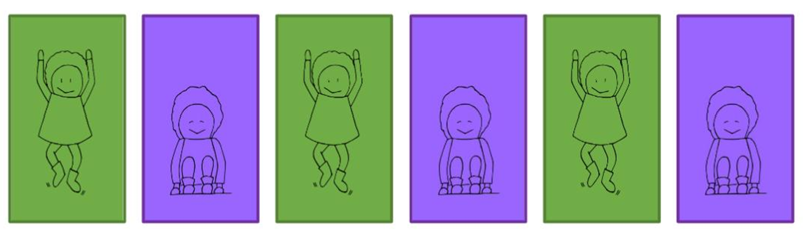
Daarna gaan we een stap verder. Eenzelfde structuur krijgt andere kleuren of vormen. ▲ □ ▲ □ kan bijvoorbeeld ♥ ● ♥ ● worden. Wat aan de buitenkant verandert, blijft wiskundig hetzelfde. Uiteindelijk krijgen de vormen zelfs letters: ABAB of AABAAB.
Vervolgens komen groeiende patronen of veranderdende patronen aan bod. Daar herhaalt niet steeds hetzelfde stukje, maar verandert het patroon volgens een regel: ▲ □▲ □□▲ □□□
Wat verandert er? En hoe weet je hoe het verdergaat?
Zo bouwen we stap voor stap verder: van bewegen en handelen met concreet materiaal naar het herkennen, verwoorden en uiteindelijk abstraheren van de onderliggende structuur.
Wiskundetaal voor kleuters
Ook taal loopt als een rode draad door de lessen.
Patroon. Herhalend patroon. Patrooneenheid. Groeiend patroon. Veranderend patroon. Meer. Minder.
Misschien klinken sommige woorden moeilijk voor vier- en vijfjarigen. Toch hoeven we wiskundetaal niet voor hen weg te houden. Door begrippen te benoemen, krijgen kinderen taal voor wat ze zien en doen.
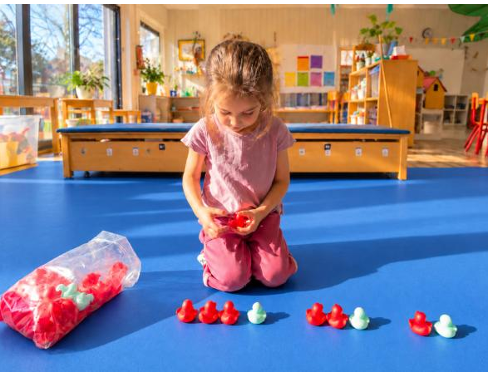
Dat gebeurt bovendien niet met een werkblad voor hun neus. We gebruiken bewegingskaarten, een hinkelpad, geometrische vormen, badeendjes, een patroonmachine en een prentenboek.
Expliciete directe instructie en spel hoeven elkaar dus niet uit te sluiten. Integendeel. De materialen maken de wiskunde tastbaar. De instructie en wiskundetaal helpen kinderen om de structuur erin te ontdekken.
En dan gebeurt er nog iets
Maar werkt zo’n aanpak ook?
Dat onderzoek ik bij 116 kleuters uit de tweede en derde kleuterklas.
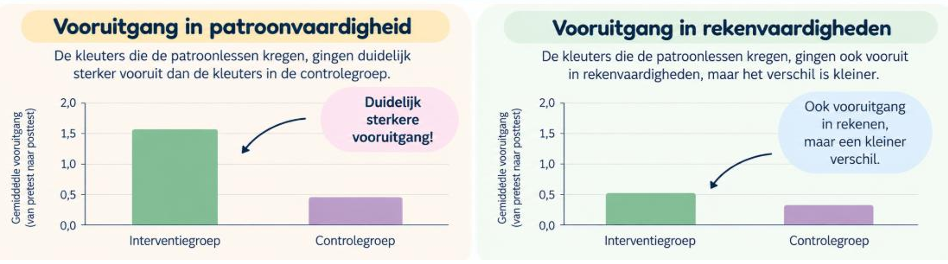
Het resultaat is duidelijk: de kleuters die de lessen krijgen, gaan sterker vooruit in patroonvaardigheid dan de kleuters in de controlegroep.
Maar er is meer.
De kleuters worden ook getest op rekenvaardigheden, zoals tellen, vergelijken en eenvoudige sommen met materiaal. Ook daar gaat de groep die de lessen krijgt sterker vooruit dan de controlegroep.
Met andere woorden: we leren de kleuters niet extra rekenen. We leren hen gericht kijken naar patronen en structuren. Toch zien we ook vooruitgang in hun rekenvaardigheden.
Dat toont dat je met patronen al vroeg een basis legt voor verdere wiskunde.
Kijk anders naar die kralenketting
Moeten kleuterleerkrachten hun klaspraktijk dan helemaal omgooien? Helemaal niet.
De kralenketting verder afmaken volgens een patroonkaart mogen zeker blijven. Maar we kunnen er meer uithalen. Laat een kind niet alleen een rijtje afmaken. Benoem het patroon. Vraag welk stukje telkens terugkomt en geef dat een naam: de patrooneenheid. Laat het patroon uitvoeren met beweging. Maak dezelfde structuur met andere materialen. Bouw daarna verder naar abstractere voorstellingen en ga een stapje verder met veranderende patronen. Gebruik daarbij bewust wiskundetaal.
Want een patroon is veel meer dan:  … welke kleur komt nu?
Het is een kans om kleuters te leren kijken naar regelmaat, onderliggende structuur.
Misschien zit daar wel de belangrijkste les uit mijn studie. Goed wiskundeonderwijs bij kleuters begint dus niet bij het juiste antwoord, maar bij leren zien wat erachter zit. Het betekent dat we wiskundige ideeën zichtbaar maken, er woorden aan geven en kinderen stap voor stap leren hoe ze ernaar kunnen kijken.
Als ze daardoor ook sterker worden in rekenen?
Dan is dat een bijzonder mooie uitkomst.
Bibliografie
Abdul Jafar, N. K., Tham, E. K. H., Eng, D. Z. H., Rifkin-Graboi, A., Gooley, J. J., Goh, D. Y. T., Teoh, O.-H., Lee, Y. S., Shek, L. P.-C., Yap, F., Gluckman, P. D., Chong, Y.-S., Meaney, M. J., Cai, S., & Broekman, B. F. P. (2023). Chronotype and time-of-day effects on spatial working memory in preschool children. Journal of Clinical Sleep Medicine: JCSM: Official Publication of the American Academy of Sleep Medicine, 19(10), 1717-1726. https://doi.org/10.5664/jcsm.10650 Bachman, H. J., Miller, P., Elliott, L., Duong, S., Libertus, M. E., & Votruba-Drzal, E. (2022). Associations among Socioeconomic Status and Preschool-aged Children’s Approximate Number System Acuity, Number and Spatial Skills: The Role of Executive Function. Journal of experimental child psychology, 221, 105453. https://doi.org/10.1016/j.jecp.2022.105453 Bailey, D., Duncan, G., Cunha, F., Foorman, B., & Yeager, D. (2020). Persistence and Fade-Out of Educational Intervention Effects: Mechanisms and Potential Solutions. Psychological Science in the Public Interest. https://doi.org/10.1177/1529100620915848 Bakker, M., Torbeyns, J., Wijns, N., Verschaffel, L., & De Smedt, B. (2019). Gender equality in 4- to 5-year-old preschoolers’ early numerical competencies. Developmental Science, 22(1), e12718. https://doi.org/10.1111/desc.12718 Bojorque, G., Gonzales, N., Wijns, N., Verschaffel, L., & Torbeyns, J. (2021). Ecuadorian children’s repeating patterning abilities and its association with early mathematical abilities. European Journal of Psychology of Education, 36(4), 945-964. https://doi.org/10.1007/s10212-020-00510-4 Burr, S. M. D. L., Xu, C., Douglas, H., LeFevre, J.-A., & Susperreguy, M. I. (2022). Walking another pathway: The inclusion of patterning in the pathways to mathematics model. Journal of Experimental Child Psychology, 222, 105478. Cohen, L., Manion, L., & Morrison, K. (2000). Research Methods in Education. http://lst-iiep.iiep-unesco.org/cgi bin/wwwi32.exe/[in=epidoc1.in]/?t2000=011160/(100). Collins, M. A., & Laski, E. V. (2015). Preschoolers’ strategies for solving visual pattern tasks. Early Childhood Research Quarterly, 32, 204-214. https://doi.org/10.1016/j.ecresq.2015.04.004 De Keyser, L., Bakker, M., Rathé, S., Wijns, N., Torbeyns, J., Verschaffel, L., & De Smedt, B. (2020). No Association Between the Home Math Environment and Numerical and Patterning Skills in a Large and Diverse Sample of 5- to 6-year-olds. Frontiers in Psychology, 11. https://doi.org/10.3389/fpsyg.2020.547626 Flynn, M. E., Guba, T. P., & Fyfe, E. R. (2020). ABBABB or 1212: Abstract language facilitates children’s early patterning skills. Journal of Experimental Child Psychology, 193, 104791. https://doi.org/10.1016/j.jecp.2019.104791 Fox, J., & Weisberg, S. (2019). An R Companion to Applied Regression (Third). Sage. https://www.john fox.ca/Companion/ Fyfe, E. R., Evans, J. L., Matz, L. E., Hunt, K. M., & Alibali, M. W. (2017). Relations between patterning skill and differing aspects of early mathematics knowledge. Cognitive Development, 44, 1-11. https://doi.org/10.1016/j.cogdev.2017.07.003 Geary, D. C. (2011). Cognitive predictors of achievement growth in mathematics: A 5-year longitudinal study. Developmental Psychology, 47(6), 1539-1552. https://doi.org/10.1037/a0025510 Hajian, S. (2019). Transfer of Learning and Teaching: A Review of Transfer Theories and Effective Instructional Practices. IAFOR Journal of Education, 7(1), 93-111. Hambleton, R. K., & Jones, R. W. (1993). An NCME Instructional Module on: Comparison of Classical Test Theory and Item Response Theory and Their Applications to Test Development. Educational Measurement: Issues and Practice, 12(3), 38-47. https://doi.org/10.1111/j.1745-3992.1993.tb00543.x Hattie, J. (2009). The Black Box of Tertiary Assessment: An Impending Revolution. Tertiary Assessment & Higher Education Student Outcomes: Policy, Practice & Research. Hendricks, C., Trueblood, L., & Pasnak, R. (2006). Effects of Teaching Patterning to 1st-Graders. Journal of Research in Childhood Education, 21(1), 79-89. https://doi.org/10.1080/02568540609594580 Hollingsworth, J. R., & Ybarra, S. E. (2009). Explicit Direct Instruction (EDI): The Power of the Well-Crafted, Well Taught Lesson. Corwin Press. Jordan, N. C., Glutting, J., & Ramineni, C. (2010). The importance of number sense to mathematics achievement in first and third grades. Learning and Individual Differences, Perspectives on Math Difficulty and Disability in Children, 20(2), 82-88. https://doi.org/10.1016/j.lindif.2009.07.004 Krajewski, K., & Schneider, W. (2009). Exploring the impact of phonological awareness, visual–spatial working memory, and preschool quantity–number competencies on mathematics achievement in elementary school: Findings from a 3-year longitudinal study. Journal of Experimental Child Psychology, Special | 44 Zijn patronen de basis van de wiskunde? Issue: Typical Development of Numerical Cognition, 103(4), 516-531. https://doi.org/10.1016/j.jecp.2009.03.009 Mercer, N., Wegerif, R., & Dawes, L. (1999). Children’s Talk and the Development of Reasoning in the Classroom. British Educational Research Journal, 25(1), 95-111. https://doi.org/10.1080/0141192990250107 Mulligan, J., & Mitchelmore, M. (2009). Awareness of pattern and structure in early mathematical development. Mathematics Education Research Journal, 21(2), 33-49. https://doi.org/10.1007/BF03217544 Mulligan, J., & Mitchelmore, M. (2018). Promoting Early Mathematical Structural Development Through an Integrated Assessment and Pedagogical Program. In I. Elia, J. Mulligan, A. Anderson, A. Baccaglini Frank, & C. Benz (Red.), Contemporary Research and Perspectives on Early Childhood Mathematics Education (pp. 17-33). Springer International Publishing. https://doi.org/10.1007/978-3-319-73432 3_2 Mulligan, J., Oslington, G., & English, L. (2020). Supporting early mathematical development through a ‘pattern and structure’ intervention program. ZDM, 52(4), 663-676. https://doi.org/10.1007/s11858-020 01147-9 NCTM. (2006). Curriculum focal points for prekindergarten through grade 8 mathematics: A quest for coherence. National Council of Teachers of Mathematics. Papic, M. (2015). An Early Mathematical Patterning Assessment: Identifying young Australian Indigenous children’s patterning skills. Mathematics Education Research Journal, 27(4), 519-534. https://doi.org/10.1007/s13394-015-0149-8 Papic, M. M., Mulligan, J. T., & Mitchelmore, M. C. (2011). Assessing the Development of Preschoolers’ Mathematical Patterning. Journal for Research in Mathematics Education, 42(3), 237-268. https://doi.org/10.5951/jresematheduc.42.3.0237 Pasnak, R., Gagliano, K., Righi, M., & K. Kidd, J. (2019). Patterning Intervention for Kindergartners. Journal of Education and Human Development, 8(2). https://doi.org/10.15640/jehd.v8n2a4 Pasnak, R., Kidd, J. K., Gadzichowski, K. M., Gallington, D. A., Schmerold, K. L., & West, H. (2015). Abstracting Sequences: Reasoning That Is a Key to Academic Achievement. The Journal of Genetic Psychology, 176(3), 171-193. https://doi.org/10.1080/00221325.2015.1024198 | 45 Zijn patronen de basis van de wiskunde? Pasnak, R., Schmerold, K. L., Robinson, M. F., Gadzichowski, K. M., Bock, A. M., O’Brien, S. E., Kidd, J. K., & Gallington, D. A. (2016). Understanding number sequences leads to understanding mathematics concepts. The Journal of Educational Research, 109(6), 640-646. https://doi.org/10.1080/00220671.2015.1020911 Pasnak, R., Thompson, B. N., Gagliano, K. M., Righi, M. T., & Gadzichowski, K. M. (2019). Complex patterns for kindergartners. The Journal of Educational Research, 112(4), 528-534. https://doi.org/10.1080/00220671.2019.1586400 Perkins, D., & Salomon, G. (1999). Transfer Of Learning. 11. Preacher, K. J., & Sterba, S. K. (2019). Aptitude-by-Treatment Interactions in Research on Educational Interventions. Exceptional Children, 85(2), 248-264. https://doi.org/10.1177/0014402918802803 R Core Team. (2024). R: A Language and Environment for Statistical Computing. R Foundation for Statistical Computing. https://www.R-project.org/ Rittle-Johnson, B., Douglas, A.-A., Zippert, E., Özel, S., & Tang, J. (2020). Early Patterning Assessment. Available from B. Rittle-Johnson. Rittle-Johnson, B., Fyfe, E. R., Hofer, K. G., & Farran, D. C. (2017). Early Math Trajectories: Low-Income Children’s Mathematics Knowledge From Ages 4 to 11. Child Development, 88(5), 1727-1742. https://doi.org/10.1111/cdev.12662 Rittle-Johnson, B., Fyfe, E. R., Loehr, A. M., & Miller, M. R. (2015a). Beyond numeracy in preschool: Adding patterns to the equation. Early Childhood Research Quarterly, 31, 101-112. https://doi.org/10.1016/j.ecresq.2015.01.005 Rittle-Johnson, B., Fyfe, E. R., Loehr, A. M., & Miller, M. R. (2015b). Beyond numeracy in preschool: Adding patterns to the equation. Early Childhood Research Quarterly, 31, 101-112. https://doi.org/10.1016/j.ecresq.2015.01.005 Rittle-Johnson, B., Zippert, E. L., & Boice, K. L. (2019). The roles of patterning and spatial skills in early mathematics development. Early Childhood Research Quarterly, Cross-domain development of academic and cognitive skills, 46, 166-178. https://doi.org/10.1016/j.ecresq.2018.03.006 Rittle-Johnson, B., Emily R. Fyfe, Laura E. McLean & Katherine L. McEldoon (2013) Emerging Understanding of Patterning in 4-Year-Olds, Journal of Cognition and Development, 14:3, 376-396, DOI: 10.1080/15248372.2012.689897 | 46 Zijn patronen de basis van de wiskunde? Rizopoulos, D. (2006). ltm: An R package for Latent Variable Modelling and Item Response Theory Analyses. Journal of Statistical Software, 17(5), 1-25. Sarama, J., & Clements, D. H. (2004). Building Blocks for early childhood mathematics. Early Childhood Research Quarterly, Special issue on Early Learning in Math and Science, 19(1), 181-189. https://doi.org/10.1016/j.ecresq.2004.01.014 Schmerold, K., Bock, A., Peterson, M., Leaf, B., Vennergrund, K., & Pasnak, R. (2017). The Relations Between Patterning, Executive Function, and Mathematics. The Journal of Psychology, 151(2), 207-228. https://doi.org/10.1080/00223980.2016.1252708 Sievertsen, H. H., Gino, F., & Piovesan, M. (2016). Cognitive fatigue influences students’ performance on standardized tests. Proceedings of the National Academy of Sciences, 113(10), 2621-2624. https://doi.org/10.1073/pnas.1516947113 Smith, S. W., Daunic, A. P., & Taylor, G. G. (2007). Treatment fidelity in applied educational research: Expanding the adoption and application of measures to ensure evidence-based practice. Education and treatment of children, 30(4), 121-134. Steen, L. A. (1988). The Science of Patterns. Science, 240(4852), 611-616. https://doi.org/10.1126/science.240.4852.611 Tricot, A., & Sweller, J. (2014). Domain-Specific Knowledge and Why Teaching Generic Skills Does Not Work. Educational Psychology Review, 26(2), 265-283. https://doi.org/10.1007/s10648-013-9243-1 van de Grift, W. J. C. M. (2014). Measuring teaching quality in several European countries. School Effectiveness and School Improvement, 25(3), 295-311. https://doi.org/10.1080/09243453.2013.794845 Weng, J., He, H., Xue, Y., Guo, M., & Wu, C. (2024). Chinese Preschoolers’ Pattern Creation: Performance and Predictors. Early Education and Development, 35(2), 307-327. https://doi.org/10.1080/10409289.2022.2148320 Wickham, H. (2016). ggplot2: Elegant Graphics for Data Analysis. Springer-Verlag New York. https://ggplot2.tidyverse.org Wickham, H., & Bryan, J. (2023). readxl: Read Excel Files. https://CRAN.R-project.org/package=readxl Wickham, H., François, R., Henry, L., Müller, K., & Vaughan, D. (2023). dplyr: A Grammar of Data Manipulation. https://CRAN.R-project.org/package=dplyr | 47 Zijn patronen de basis van de wiskunde? Wickham, H., Vaughan, D., & Girlich, M. (2024). tidyr: Tidy Messy Data. https://CRAN.R project.org/package=tidyr Wijns, N., Purpura, D., & Torbeyns, J. (2023a). Stimulating preschoolers’ repeating patterning ability by means of dialogic picture book reading. Journal of Educational Psychology, 115(5), 732-746. https://doi.org/10.1037/edu0000756 Wijns, N., Purpura, D., & Torbeyns, J. (2023b). Stimulating preschoolers’ repeating patterning ability by means of dialogic picture book reading. Journal of Educational Psychology, 115(5), 732-746. https://doi.org/10.1037/edu0000756 Wijns, N., Torbeyns, J., Bakker, M., De Smedt, B., & Verschaffel, L. (2019). Four-year olds’ understanding of repeating and growing patterns and its association with early numerical ability. Early Childhood Research Quarterly, 49, 152-163. https://doi.org/10.1016/j.ecresq.2019.06.004 Wijns, N., Torbeyns, J., De Smedt, B., & Verschaffel, L. (2019). Young Children’s Patterning Competencies and Mathematical Development: A Review. In K. M. Robinson, H. P. Osana, & D. Kotsopoulos (Red.), Mathematical Learning and Cognition in Early Childhood: Integrating Interdisciplinary Research into Practice (pp. 139-161). Springer International Publishing. https://doi.org/10.1007/978-3-030-12895 1_9 Wijns, N., Torbeyns, J., Rabaut, H., & Verschaffel, L. (2024). Alle kleuters tellen mee (eerste druk). die Keure. Wijns, N., Verschaffel, L., De Smedt, B., De Keyser, L., & Torbeyns, J. (2021). Stimulating preschoolers’ focus on structure in repeating and growing patterns. Learning and Instruction, 74, 101444. https://doi.org/10.1016/j.learninstruc.2021.101444 Wijns, N., Verschaffel, L., De Smedt, B., & Torbeyns, J. (2021). Associations Between Repeating Patterning, Growing Patterning, and Numerical Ability: A Longitudinal Panel Study in 4‐ to 6‐Year Olds. Child Development, 92(4), 1354-1368. https://doi.org/10.1111/cdev.13490 William Revelle. (2024). psych: Procedures for Psychological, Psychometric, and Personality Research. Northwestern University. https://CRAN.R-project.org/package=psych Zhang, T., Borriello, G. A., James, K. H., & Fyfe, E. R. (2025). The role of patterning skill in cognitive development and learning: A critical review. Developmental Review, 76, 101202. https://doi.org/10.1016/j.dr.2025.101202 | 48 Zijn patronen de basis van de wiskunde? Zippert, E. L., Douglas, A.-A., & Rittle-Johnson, B. (2020). Finding patterns in objects and numbers: Repeating patterning in pre-K predicts kindergarten mathematics knowledge. Journal of Experimental Child Psychology, 200, 104965. https://doi.org/10.1016/j.jecp.2020.104965 Zippert, E. L., Douglas, A.-A., Tian, F., & Rittle-Johnson, B. (2021). Helping preschoolers learn math: The impact of emphasizing the patterns in objects and numbers. Journal of Educational Psychology, 113(7), 1370 1386. https://doi.org/10.1037/edu0000656