Het (onzichtbare) duwtje in de rug
Het (onzichtbare) duwtje in de rug
Je bent in Leuven en je beslist om de Sint-Pieterskerk te bezoeken voor de mooie kunstwerken van Dirk Bouts. In het museumgedeelte van de kerk kom je een bord tegen waar veel tekst op staat. Plots krijg je een berichtje en wandel je verder zonder de tekst helemaal te lezen, laat staan dat je hem hebt begrepen. Wat je echter niet wist, was dat het bord daar geplaatst was om jou en je gedrag te beïnvloeden.
Gedragswetenschappen als beleidsinstrument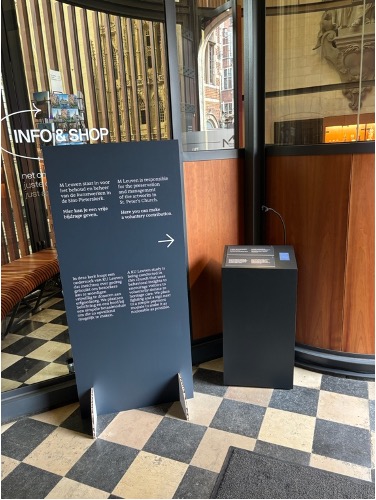
Op het bord dat je miste stond de volgende tekst:
"M Leuven staat in voor het behoud en beheer van de kunstwerken in de Sint-Pieterskerk. Dankzij de inspanningen van het museum kan je ze gratis bewonderen. Geef iets terug met een vrije bijdrage en help mee dit erfgoed te bewaren."
Het bord met de tekst is een voorbeeld van een zogenaamde “nudge”. Dit zijn aanpassingen aan je directe omgeving die ervoor zorgen dat jouw gedrag in een bepaalde richting gestuurd wordt zonder dat je gestraft of beloond wordt voor je actie. Overheden en organisaties gebruiken nudges steeds meer omdat ze eenvoudig toe te passen zijn. Andere voorbeelden van zulke nudges in het dagelijkse leven zijn voetstappen op de grond die richting een vuilbak gaan, of een lachend gezichtje wanneer je de juiste snelheid rijdt. Er wordt hierbij gebruik gemaakt van gedragswetenschappen om jouw gedrag te beïnvloeden.
Ondemocratische beïnvloeding
Critici hebben hun bedenkingen bij het gebruik van nudging. Wat als mensen niet doorhebben dat ze onbewust worden beïnvloed? Tegenstanders vinden nudging daarom ondemocratisch en onethisch. Als antwoord op deze kritiek werd het transparant nudgen ontwikkeld. Bij dit laatste wordt uitgelegd hoe de nudge werkt en hoe ze je gedrag beïnvloedt.
Aandacht voor nudging
(Transparant) nudgen klinkt als een makkelijke manier om op een laagdrempelige wijze het gedrag van mensen te sturen. Desondanks moet de nudge in veel uitwerkingen opgemerkt worden vooraleer ze iemand kan beïnvloeden. Daarnaast moet ook de transparante boodschap gelezen worden voordat iemand zich kan informeren over de werking van de techniek. Kortom, er moet genoeg aandacht besteed worden aan de nudge-opstelling voor deze kan werken.
Aandacht voor nudges is nog maar weinig onderzocht in een praktijksetting. In realiteit zijn er, in tegenstelling tot een labo-experiment, veel andere zaken die de aandacht kunnen opeisen. Misschien waren bezoekers afgeleid door een sms’je dat ze net kregen of door het spannende verhaal dat hun vriend aan het vertellen was. Daarom onderzocht deze studie hoeveel aandacht bezoekers van de Sint-Pieterskerk in Leuven hadden voor de (transparante) nudges.
Een kerk als laboratorium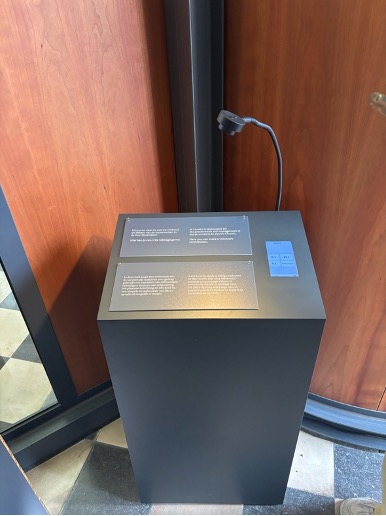
Om aandacht te onderzoeken in een realistische situatie, werd een survey-onderzoek uitgevoerd in de Sint-Pieterskerk in Leuven. In deze kerk stonden naast een betaalterminal nudginginstallaties opgesteld die bezoekers aanmoedigden om een donatie te geven voor het onderhoud van de kerk. De nudge werd op verschillende manieren uitgewerkt. Zo was er een neutrale controleversie, drie “salience”-nudges (die meer opvallen) en drie “wederkerigheidsnudges” (die inspelen op het “voor wat hoort wat” principe). Zowel de salience-nudge als de wederkerigheidsnudge hadden elk één niet-transparante opstelling en twee transparante opstellingen.
De survey en de onderzoeksopzet werden goedgekeurd door de ethische commissie SMEC. Uiteindelijk deden 785 bezoekers, verspreid over dertien dagen, vrijwillig mee aan de studie. Bezoekers werden pas na hun bezoek aan de kerk gevraagd om mee te werken aan het onderzoek, om zeker niet op voorhand al de aandacht te vestigen op de borden. In de survey werd gevraagd of de bezoekers de opstelling hadden opgemerkt en de tekst bij de opstellingen hadden gelezen. Via een meerkeuzevraag over wat er in de tekst stond, werd er nadien gecontroleerd of de bezoekers die de tekst hadden gelezen ook begrepen hadden hoe nudging werkte. Dit was belangrijk om te bestuderen of nudging beter werd begrepen wanneer er een transparante tekst bij stond, omdat dit nu eenmaal het doel is van transparante teksten.
Gezien, maar niet gelezen
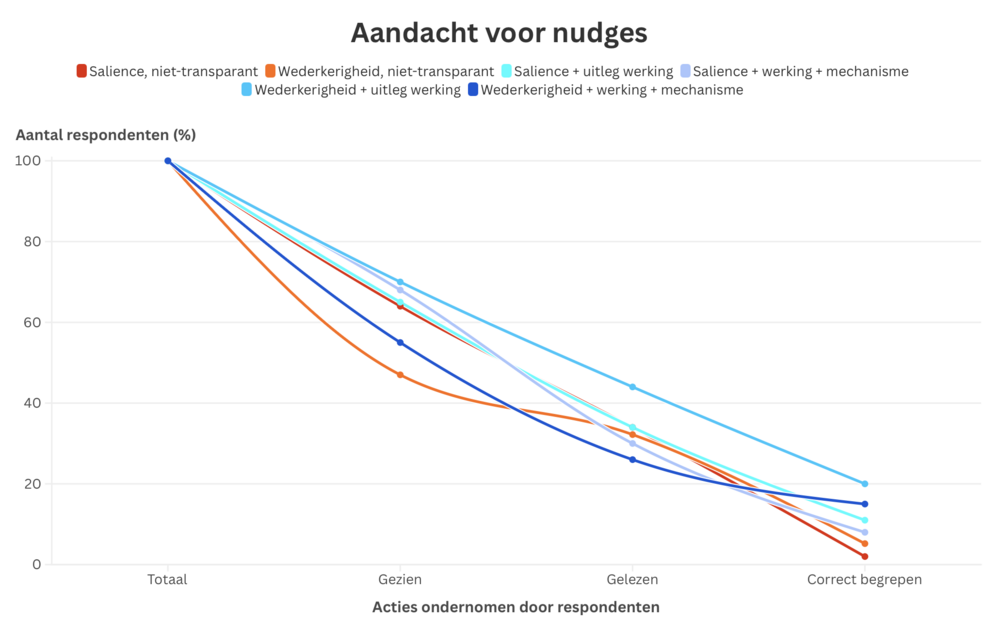
Uit de resultaten bleek dat vijf van de zes opstellingen vaker werden opgemerkt dan de neutrale controle-opstelling. Het plaatsen van een nudge zorgde ervoor dat bezoekers meer naar het bord bij de betaalterminal keken. Maar wat blijkt, slechts één op de drie bezoekers las de tekst die bij de opstelling stond. Het lezen van de boodschap was echter cruciaal om dat duwtje in de rug mee te krijgen. Niet alleen kon de boodschap van de nudge zelf gelezen worden, ook de transparante werking van de nudge kon hier teruggevonden worden. Het lezen van de tekst was dus essentieel voor de “democratische” werking van de nudge. Toch bleek dat bij de transparante nudges slechts 8,4 tot 20 procent van de bezoekers de werking van de nudge meekregen. Het plaatsen van een transparante tekst is dus niet voldoende om een nudge democratisch te maken. Aandacht van de bezoekers aan nudges is cruciaal.
Uit het onderzoek kwamen ook bemoedigende resultaten voor voorstanders van transparant nudgen. Bezoekers die de transparante tekst wel lazen, begrepen de werking van nudges beter dan bezoekers die een niet-transparante tekst lazen. Voor de kleine groep die de tijd nam om de teksten te lezen en ook te laten doordringen, was de transparante tekst nuttig.
Waarom doet dit er nu toe?
Het lijkt misschien banaal dat slechts een kleine groep een tekst leest bij een betaalterminal, maar dat is het zeker niet. Nudging wordt door overheids- en privé-instanties steeds meer gebruikt. Indien slechts een zeer beperkte groep hier effectief door kan worden beïnvloed, moet er in de toekomst een gerichte kosten-batenanalyse gemaakt worden om te bekijken of nudging efficiënt genoeg werkt. Daarnaast is het voor overheden belangrijk dat de transparante boodschap goed wordt begrepen, anders kunnen critici blijven stellen dat het gebruik van nudging door overheidsinstanties ondemocratisch is.
Vervolgonderzoek kan verder nagaan hoe aandacht voor nudging vergroot kan worden. Zolang dit nog onduidelijk is, kan een spannend verhaal of een berichtje in veel uitwerkingen meer de aandacht trekken dan een nudge.
Bibliografie
Abbey, J. D., & Meloy, M. G. (2017). Attention by design: Using attention checks to detect inattentive respondents and improve data quality. Journal of Operations Management, 53-56, 63-70. https://doi.org/10.1016/j.jom.2017.06.001
Albudaiwi, D. (2017). Surveys, Advantages and Disadvantages of. In M. Allen (Eds.), The SAGE Encyclopedia of Communication Research Methods (Vol. 4, pp. 1735-1736). SAGE Publications Ltd. https://doi.org/10.4135/9781483381411
Almqvist, G., & Andersson, P. (2024). Low support for nudging among Swedes in a population-representative sample. Behavioural Public Policy, 8(2), 382-394. https://doi.org/10.1017/bpp.2021.4
Altmann, S., Grunewald, A., & Radbruch, J. (2022). Interventions and Cognitive Spillovers. Review of Economic Studies, 89(5), 2293-2328. https://doi.org/10.1093/restud/rdab087
Alvarez, G. (2013). The representation of simple ensemble visual features outside the focus of attention. In K. Ochsner & S. M. Kosslyn (Eds.), The Oxford handbook of cognitive neuroscience (pp. 43-56). Oxford University Press. https://doi.org/10.1093/oxfordhb/9780199988693.013.0004
Arnold, M., Goldschmitt, M., & Rigotti, T. (2023). Dealing with information overload: A comprehensive review. Frontiers in Psychology, 14(1122200). https://doi.org/10.3389/fpsyg.2023.1122200
Blom, S. S. A. H., Gillebaart, M., De Boer, F., Van Der Laan, N., & De Ridder, D. T. D. (2021). Under pressure: Nudging increases healthy food choice in a virtual reality supermarket, irrespective of system 1 reasoning. Appetite, 160(105116). https://doi.org/10.1016/j.appet.2021.105116
Blumenthal-Barby, J. S., & Burroughs, H. (2012). Seeking better health care outcomes: The ethics of using the “nudge”. American Journal of Bioethics, 12(2), 1-10. https://doi.org/10.1080/15265161.2011.634481
Bordalo, P., Gennaioli, N., & Shleifer, A. (2022). Salience. Annual Review of Economics, 14, 521-552. https://doi.org/10.1146/annurev-economics-051520-011616
Bovens, L. (2008). The Ethics of Nudge 1. In M. J. Hansson & T. Grüne-Yanoff (Eds.), Preference Change: Approaches from Philosophy, Economics and Psychology (pp. 207-219). Springer.
Bruns, H., Fillon, A., Maniadis, Z., & Paunov, Y. (2025). Comparing transparent and covert nudges: A meta-analysis calling for more diversity in nudge transparency research. Journal of Behavioral and Experimental Economics, 116, 102350. https://doi.org/10.1016/j.socec.2025.102350
Bruns, H., Kantorowicz-Reznichenko, E., Klement, K., Luistro Jonsson, M., & Rahali, B. (2018). Can nudges be transparent and yet effective? Journal of Economic Psychology, 65, 41-59. https://doi.org/10.1016/j.joep.2018.02.002
Bryman, A., Clack, T., Foster, L., & Sloan, L. (2021). Bryman’s Social Research Methods (6de dr.). Oxford University Press.
Carlsson, F., Kataria, M., & Lampi, E. (2018). Demand effects in stated preference surveys. Journal of Environmental Economics and Management, 90, 294-302. https://doi.org/10.1016/j.jeem.2018.06.003
Chan, S. W., Lu, S., Cheng, N. H. C., Chui, C. H.-K., & Yat-Sang Lum, T. (2025). Promoting Charitable Donations and Volunteering Through Nudge Tools From the Perspective of Behavioral Economics: A Systematic Review. Nonprofit and Voluntary Sector Quarterly, 54(2), 435-461. https://doi.org/10.1177/08997640241258140
Cialdini, R. B. (2009). Influence: Science and practice. (5de dr.). Pearson.
Cuypers, R. (2025). Navigating Transparent Nudges: A qualitative study on nudge transparency and the experience of autonomy. [Ongepubliceerd manuscript] KU Leuven.
Davis, F. D., Riedl, R., Vom Brocke, J., Léger, P.-M., Randolph, A. B., & Fischer, T. (Eds.). (2020). Information Systems and Neuroscience: NeuroIS Retreat 2020 (Vol. 43). Springer International Publishing. https://doi.org/10.1007/978-3-030-60073-0
De Marco, G., & Douglas, T. (2023). Nudge Transparency Is Not Required for Nudge Resistibility. Ergo an Open Access Journal of Philosophy, 10(0). https://doi.org/10.3998/ergo.4635
Digitaal Vlaanderen. (2025). Nudging: Hoe kleine aanpassingen in de manier waarop keuzes worden aangeboden, veilig gedrag uitlokken. Agentschap Digitaal Vlaanderen. https://www.vlaanderen.be/digitaal-vlaanderen/onze-diensten-en-platform…-
centrum-voor-digitale-veiligheid/digitale-veiligheid-ondersteuning/cyber-security-incident-response-team/nudging-hoe-kleine-aanpassingen-in-de-manier-waarop-keuzes-worden-aangeboden-veilig-gedrag-uitlokken
Djerf-Pierre, M. (2012). The crowding-out effect: Issue dynamics and attention to environmental issues in television news reporting over 30 years. Journalism Studies, 13(4), 499-516. https://doi.org/10.1080/1461670X.2011.650924
Engelen, B. (2019). Nudging and rationality: What is there to worry? Rationality and Society, 31(2), 204-232. https://doi.org/10.1177/1043463119846743
FOD Volksgezondheid, V. van de V. en L. (2026). Registratie van orgaandonatie: Rol van de gemeentelijke overheden. Volksgezondheid Veligheid van de Voedselketen Leefmilieu. https://www.health.belgium.be/nl/professionals/overheid-beleid/gezondhe…
FOD Volksgezondheid, Veiligheid van de Voedselketen en Leefmilieu. (2026). Orgaandonatie: Een daad van solidariteit om levens te redden. Volksgezondheid Veligheid van de Voedselketen Leefmilieu. https://www.health.belgium.be/nl/themas/gezondheid/jouw-
gezondheid/orgaandonatie
Gaia, A. (2017). Social Desirability Bias and Sensitive Questions in Surveys. In M. Allen (Eds.), The SAGE Encyclopedia of Communication Research Methods. SAGE Publications Ltd. https://doi.org/10.4135/9781526421036928979
Garner, J. T. (2017). Survey Response Rates. In M. Allen (Eds.), The SAGE Encyclopedia of Communication Research Methods (Vols. 1-4, pp. 1729-1730). SAGE Publications Ltd.
Gee, L. K., & Meer, J. (2019). The Altruism Budget: Measuring and encouraging charitable giving. National Bureau of Economic Research.
Gerver, M., Banerjee, S., & John, P. (2024). Nudging against consent is effective but lowers welfare. Scientific Reports, 14(1), 14864. https://doi.org/10.1038/s41598-024-65122-0
Gillebaart, M., Blom, S. S. A. H., Benjamins, J. S., De Boer, F., & De Ridder, D. T. D. (2023). The role of attention and health goals in nudging healthy food choice. Frontiers in Psychology, 14, 1270207. https://doi.org/10.3389/fpsyg.2023.1270207
Gower, T., Pham, J., Jouriles, E. N., Rosenfield, D., & Bowen, H. J. (2022). Cognitive biases in perceptions of posttraumatic growth: A systematic review and meta-analysis. Clinical Psychology Review, 94, 102159. https://doi.org/10.1016/j.cpr.2022.102159
Grissinger, M. (2012). Inattentional blindness: What captures your attention? (Deel 542-555). P & T : A Peer-Reviewed Journal for Formulary Management, 37(10). https://linkinghub.elsevier.com/retrieve/pii/S1042099115318971
Grüne-Yanoff, T. (2012). Old wine in new casks: Libertarian paternalism still violates liberal principles. Social Choice and Welfare, 38(4), 635-645. https://doi.org/10.1007/s00355-011-0636-0
Gummer, T., Roßmann, J., & Silber, H. (2021). Using Instructed Response Items as Attention Checks in Web Surveys: Properties and Implementation. Sociological Methods and Research, 50(1), 238-264. https://doi.org/10.1177/0049124118769083
Hansen, P. G., & Jespersen, A. M. (2013). Nudge and the manipulation of choice: A framework for the responsible use of the nudge approach to behaviour change in public policy. European Journal of Risk Regulation, 4(1), 3-28. https://doi.org/10.1017/s1867299x00002762
Hill, A. (2018). Why Nudges Coerce: Experimental Evidence on the Architecture of Regulation. Science and Engineering Ethics, 24(4), 1279-1295. https://doi.org/10.1007/s11948-017-9944-9
Hobbs, J. (2017). Nudging charitable giving: The ethics of nudge in international poverty reduction. Ethics and Global Politics, 10(1), 37-57. https://doi.org/10.1080/16544951.2017.1312991
Holbrook, A. (2017). Self-Reported Measure. In M. Allen (Eds.), The SAGE Encyclopedia of Communication Research Methods (Vol. 1-0, pp. 805-806). SAGE Publications Ltd.
Hollenstein, L., & Wittmer, A. (2024). Does low-carbon nudging work for travelers of the young generation? Nudging customers to reduce personal air travel within Europe—An experiment with Swiss Generation Y and Z travelers. Journal of the air transport society, 100015. https://doi.org/10.1016/j.jatrs.2024.100015
House of Lords. (2011). Chapter 2: Definitions, Categorisation and the Ethics of behaviour change Interventions. In Behaviour Change. https://publications.parliament.uk/pa/ld201012/ldselect/ldsctech/179/17…
Huitink, M., Poelman, M. P., Van Den Eynde, E., Seidell, J. C., & Dijkstra, S. C. (2020). Social norm nudges in shopping trolleys to promote vegetable purchases: A quasi-experimental study in a supermarket in a deprived urban area in the Netherlands. Appetite, 151, 104655. https://doi.org/10.1016/j.appet.2020.104655
Hummel, D., Toreini, P., & Maedche, A. (2018). Improving Digital Nudging Using Attentive User Interfaces: Theory Development and Experiment Design.
Inukai, T., & Kawahara, J. I. (2018). Sex Differences in Temporal but Not Spatial Attentional Capture. Frontiers in Psychology, 9, 1893. https://doi.org/10.3389/fpsyg.2018.01893
Ivankovic, V., & Engelen, B. (2024). Market nudges and autonomy. Economics and Philosophy, 40(1), 138-165. https://doi.org/10.1017/S0266267122000347
Johnson-Laird, P. N. (2024). Kahneman, Tversky, and Kahneman-Tversky: Three ways of thinking. Thinking & Reasoning, 30(4), 531-547. https://doi.org/10.1080/13546783.2024.2402129
Juan, Y.-K., & Chen, Y. (2022). The influence of indoor environmental factors on learning: An experiment combining physiological and psychological measurements. Building and Environment, 109299. https://doi.org/10.1016/j.buildenv.2022.109299
Kahneman, D. (2011). Thinking, fast and slow. Farrar, Straus and Giroux.
Kahneman, D., & Tversky, A. (1974). Judgment under Uncertainty: Heuristics and Biases. Science, 185(4157), 1124-1131. https://doi.org/10.1126/science.185.4157.1124
Kahneman, D., & Tversky, A. (1979). Prospect Theory: An Analysis of Decision under Risk. Econometrica, 263-291. https://doi.org/10.2307/1914185
Kahneman, D., & Tversky, A. (2000). Choices, Values, and Frames. Cambridge University Press.
Khaleghimoghaddam, N. (2023). The Interplay Between Gender and Controlled Environments: A Study on Stimulus Perception. Mimarlık Bilimleri ve Uygulamaları Dergisi (MBUD), 865-876. https://doi.org/10.30785/mbud.1315873
Kreitz, C., Furley, P., Memmert, D., & Simons, D. J. (2015). Inattentional Blindness and Individual Differences in Cognitive Abilities. PLOS ONE, 10(8), e0134675. https://doi.org/10.1371/journal.pone.0134675
Lee, Y., & Jung, K. (2025). Gender Differences in Visual Information Perception Ability: A Signal Detection Theory Approach. Applied Sciences, 15(15), 8621. https://doi.org/10.3390/app15158621
Lemken, D., Asioli, D., & Schoppa, F. (2024). Attention to carbon footprints in food choices and the crowding out effect of attention-leading nudges. Business Strategy and the Environment, 33(8), 8493-8507. https://doi.org/10.1002/bse.3916
Lemken, D., Erhard, A., & Wahnschafft, S. (2024). A choice architect’s guide to the (autonomous) galaxy: A systematic scoping review of nudge intrusiveness in food choices. Humanities and Social Sciences Communications, 11(1030). https://doi.org/10.1057/s41599-024-03555-8
Lepenies, R., & Malecka, M. (2018). The ethics of behavioural public policy. In The Routledge Handbook of Ethics and Public Policy (pp. 513-525). Routledge.
Leustek, J., & Allen, M. (2017). Demand Characteristics. In The SAGE Encyclopedia of Communication Research Methods (Vols. 1-4, pp. 372-373).
Lindenberg, S., & Papies, E. K. (2019). Two Kinds of Nudging and the Power of Cues: Shifting Salience of Alternatives and Shifting Salience of Goals. International Review of Environmental and Resource Economics, 13(3-4), 229-263. https://doi.org/10.1561/101.00000110
Loewenstein, G., Bryce, C., Hagmann, D., & Rajpal, S. (2015). Warning: You are about to be nudged: 35-42. Behavioral Science & Policy. https://doi.org/10.1353/bsp.2015.0000
Michaelsen, P. (2024). Transparency and nudging: An overview and methodological critique of empirical investigations. Behavioural Public Policy, 8(4), 807-817. https://doi.org/10.1017/bpp.2024.7
Michaelsen, P., Johansson, L.-O., & Hedesström, M. (2024). Experiencing default nudges: Autonomy, manipulation, and choice-satisfaction as judged by people themselves. Behavioural Public Policy, 8(1), 85-106. https://doi.org/10.1017/bpp.2021.5
Michels, L., Ochmann, J., Schmitt, K., Laumer, S., & Tiefenbeck, V. (2024). Salience, transparency, and self-nudging: A digital nudge to promote healthier food product choices. European Journal of Information Systems, 33(5), 717-747. https://doi.org/10.1080/0960085X.2023.2229787
Monageng, N., Evans, C., & Steyn, T. (2022). The influence of reciprocity nudges on tax compliance in South Africa: Evidence from an experimental study. eJournal of Tax Research, 20(1), 22-47.
Monge Roffarello, A., & De Russis, L. (2023). Nudging Users Towards Conscious Social Media Use. Proceedings of the 25th International Conference on Mobile Human-Computer Interaction, 1- 7. https://doi.org/10.1145/3565066.3608703
Mukhortova, E. (2025). Visitor attention in museum and museum fatigue syndrome. Museologica Brunensia, 12(1), 29-37. https://doi.org/https://doi.org/10.5817/MuB2025-1-3
Mundt, D., Batzke, M. C. L., Bläsing, T. M., Gomera Deaño, S., & Helfers, A. (2024). Effectiveness and context dependency of social norm interventions: Five field experiments on nudging pro-environmental and pro-social behavior. Frontiers in Psychology, 15, 1392296.https://doi.org/10.3389/fpsyg.2024.1392296
Münscher, R., Vetter, M., & Scheuerle, T. (2016). A Review and Taxonomy of Choice Architecture Techniques. Journal of Behavioral Decision Making, 29(5), 511-524. https://doi.org/10.1002/bdm.1897
Nelson-Field, K. (2024). The Attention Economy: A Category Blueprint. Springer Nature Singapore. https://doi.org/10.1007/978-981-97-0084-4
Noggle, R. (2018). Manipulation, salience, and nudges. Bioethics, 32(3), 164-170. https://doi.org/10.1111/bioe.12421
Norman, G. (2010). Likert scales, levels of measurement and the “laws” of statistics. 15(5), 625-632. https://doi.org/10.1007/s10459-010-9222-y
Oberauer, K. (2019). Working Memory and Attention – A Conceptual Analysis and Review. Journal of Cognition, 2(1), 36. https://doi.org/10.5334/joc.58
Pajmon, S., & Strle, T. (2024). The Transparency of Nudging: Evaluating Its Impact on Personal Autonomy. Information Society 2024. https://doi.org/https://doi.org/10.70314/is.2024.cog.8
Peeters, R. (2019). Manufacturing responsibility: The governmentality of behavioural power in social policies. Social Policy and Society, 18(1), 51-65. https://doi.org/10.1017/S147474641700046X
Perfecto, H., & O’Donnell, M. (2025). The Use and Usefulness of Attention Checks in Behavioral Research. Journal of Consumer Research, 53(1), 182-200. https://doi.org/10.1093/jcr/ucaf058
Persson, P. (2017). Attention manipulation and information overload (NBER Working Paper No. 23823). National Bureau of Economic Research.
Pittarello, A., Schmidt, T., Segel, A., & Mayo, R. (2023). Prior behavior and wording of norm nudge requests shape compliance and reciprocity. Journal of Behavioral Decision Making, 36(4), e2327. https://doi.org/10.1002/bdm.2327
Raymaekers, P., & Brans, M. (2020). Nudging in perspectief. Beleidsonderzoek Online. https://doi.org/10.5553/bo/221335502020000004001
Reisch, L. A., & Sunstein, C. (2016). Do europeans like nudges? Judgment and Decision Making, 11(4), 310-325. https://doi.org/10.1017/s1930297500003740
Ruehle, R. C., Engelen, B., & Archer, A. (2021). Nudging Charitable Giving: What (If Anything) Is Wrong With It? Nonprofit and Voluntary Sector Quarterly, 50(2), 353-371. https://doi.org/10.1177/0899764020954266
Schertz, K. E., Bowman, J. E., Kotabe, H. P., Layden, E. A., & Jenny, Z. (2020). Environmental influences on affect and cognition: A study of natural and commercial semi-public spaces. Journal of Environmental Psychology, (83), 101852. https://doi.org/10.1016/j.jenvp.2022.101852
Schmidt, A. T., & Engelen, B. (2020). The ethics of nudging: An overview. Philosophy Compass, 15(4), e12658. https://doi.org/10.1111/phc3.12658
Schütze, T., Spitzer, C., & Wichardt, P. C. (2025). Nudging: An experiment on transparency, accounting for reactance and response time. Journal of Economic Psychology, 107, 102797. https://doi.org/10.1016/j.joep.2025.102797
Steffel, M., Williams, E. F., & Pogacar, R. (2016). Ethically Deployed Defaults: Transparency and Consumer Protection through Disclosure and Preference Articulation. Journal of Marketing Research, 53(5), 865-880. https://doi.org/10.1509/jmr.14.0421
Sunstein, C. (2014). The ethics of nudging. Harvard Public Law Working Paper Forthcoming. https://doi.org/10.2139/ssrn.2526341
Sunstein, C., Reisch, L. A., & Kaiser, M. (2019). Trusting nudges? Lessons from an international survey. Journal of European Public Policy, 26(10), 1417-1443. https://doi.org/10.1080/13501763.2018.1531912
Thaler, R., & Sunstein, C. (2008). Nudge: Improving Decisions about Health, Wealth, and Happiness. Penguin Groop.
Thaler, R., Sunstein, C., & Balz, J. (2012). Choice Architecture. https://doi.org/10.13140/2.1.4195.2321
Tummers, L. (2019). Gedragen gedragsverandering. Bestuurskunde, 28(2), 83-90. https://doi.org/10.5553/bk/092733872019029002012
Van Brenk, H. (2018). Een overzicht van drie studies naar de effecten van beloningsprikkels, omgevingsfactoren en persoonlijkheidskenmerken op oordeels- en besluitvorming van accountants. Maandblad Voor Accountancy en Bedrijfseconomie, 92(3/4), 75-85. https://doi.org/10.5117/mab.92.25063
Van Hove, S., All, A., & De Marez, L. (2018). How to (not) nudge customers? Methodological insights from a situated eye-tracking study on the intrusiveness of a location-based shopping assistant in a supermarket. Etmaal van de Communicatiewetenschap.
Van Roekel, H., Giurge, L. M., Schott, C., & Tummers, L. (2026). Nudges can be both autonomy-preserving and effective: Evidence from a survey and quasi-field experiment. Behavioural Public Policy, 10(1), 127-150. https://doi.org/10.1017/bpp.2023.18
Van Zandycke, R., & Wybo, C. (2022). Nudging & Overtuigingen. Die Keure.
Wachner, J., Adriaanse, M. A., & De Ridder, D. (2021a). The effect of nudges on autonomy in hypothetical and real life settings. PLOS One, 16(8). https://doi.org/https://doi.org/10.1371/journal.pone.0256124
Wachner, J., Adriaanse, M., & De Ridder, D. (2021b). The influence of nudge transparency on the experience of autonomy. Comprehensive Results in Social Psychology, 5(1-3), 49-63. https://doi.org/10.1080/23743603.2020.1808782
Wagler, K. R., & Wells, T. T. (2024). Effects of personality and gender on nudgeability for mental health-related behaviors. Current Opinion in Psychology, 60, 101938. https://doi.org/10.1016/j.copsyc.2024.101938
Weijers, R. J., Wachner, J., & De Koning, B. B. (2024). The Effect of a Default Nudge on Experienced and Expected Autonomy: A Field Study on Food Donation. Journal of Behavioral Decision Making, 37(4), e2404. https://doi.org/10.1002/bdm.2404
Whitehead, M., & Rhys, J. (2024). Nudging. Agenda Publishing. https://doi.org/10.1017/9781788217286
Wu, A. X., Taneja, H., & Webster, J. G. (2021). Going with the flow: Nudging attention online. New Media and Society, 23(10), 2979-2998. https://doi.org/10.1177/1461444820941183
Yao Yun Ning, C. (2019). What’s in a Nudge? How Choice Architecture Surrounding Dispute Resolution Options Can Increase Uptake of Mediation. In Contemporary Issues in Mediation (pp. 3-13).