Duivelsuitdrijving in Griekenland
Hoe kan men de invasieve Indische koraalduivel bestrijden in de Egeïsche zee?
Stel je voor: zomer op een Grieks eiland, gewapend met je zwembroek of badpak en snorkel beslis je de prachtige onderwaterwereld langs de kust te ontdekken. Tientallen soorten visjes flitsen voorbij, tot je plots oog in oog komt met een grote vis met sluierachtige vinnen, fascinerende patronen en een bijna buitenaardse uitstraling. Het lijkt het hoogtepunt van natuurpracht, maar achter deze adembenemende verschijning schuilt een meedogenloze jager met een onstilbare vraatzucht, die heel ver van zijn oorsprong het lokale ecosysteem dreigt te ontwrichten.
De bedreiging van invasieve Indische koraalduivels is ontstaan door de mensheid en we moeten nu ook ingrijpen om ze tegen te gaan. Dit kan enkel door een goede kennis van deze vissen en hun gedrag, wat in deze studie werd onderzocht. De best bewezen methode om de resistente populaties onder controle te houden is speervissen. Voor mijn bachelorproef dierenzorg onderzocht ik het gedrag van koraalduivels en vond dat ze meer verscholen zitten en minder actief zijn gedurende de dag, dus dat speervissen gedurende deze uren minder interessant is dan ‘s avonds, ‘s nachts of vroeg in de morgen.
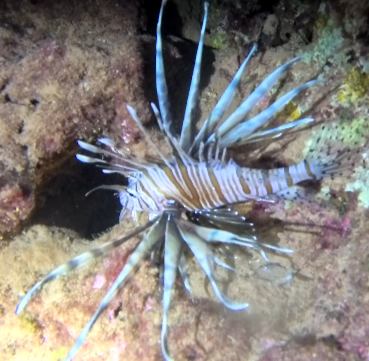 Buitenaardse invasie?
Hoewel de Indische koraalduivel niet echt buitenaards is, hoort ze zeker niet thuis in Griekse wateren of in de Middellandse Zee in het algemeen. Het is een invasieve soort in de Egeïsche Zee, wat erop neerkomt dat de soort er niet op natuurlijke wijze voorkomt en er een negatieve invloed heeft of kan hebben op het ecosysteem. De soort is afkomstig uit de Indische Oceaan en delen van de Stille Oceaan, en emigreerde doorheen het kunstmatig aangelegde Suezkanaal (net zoals honderden andere invasieve soorten). De impact van de vis wordt voornamelijk veroorzaakt door de hoge jaag-efficiëntie, efficiënte voortplanting en het gebrek aan natuurlijke vijanden. Koraalduivels jagen op een unieke manier: door gebruik te maken van hun beweeglijke lange borstvinnen jagen ze kleine vissen in het nauw om ze dan in één hap op te slokken. Deze methode is compleet onbekend voor prooidieren in de Egeïsche Zee, waardoor er zo goed als geen ontsnappen is aan deze predator. De koraalduivel heeft een schijnbaar onstilbare honger en een voorkeur voor bepaalde soorten, waardoor belangrijke vispopulaties sterk kunnen worden ingeperkt, wat het ecosysteem uit balans brengt. Er zijn weinig roofdieren opgewassen tegen de meer dan 10 giftige stekels die verscholen zitten tussen zijn prachtige vinnen, waardoor de aantallen van de invasieve soort alleen maar stijgen. De natuur in de Egeïsche zee is jammer genoeg niet opgewassen tegen deze bedreiging.
“Ze zijn hier, ze hebben zich gevestigd, het is nu aan ons om er iets aan te doen.”
Gedragsstudie van een vis
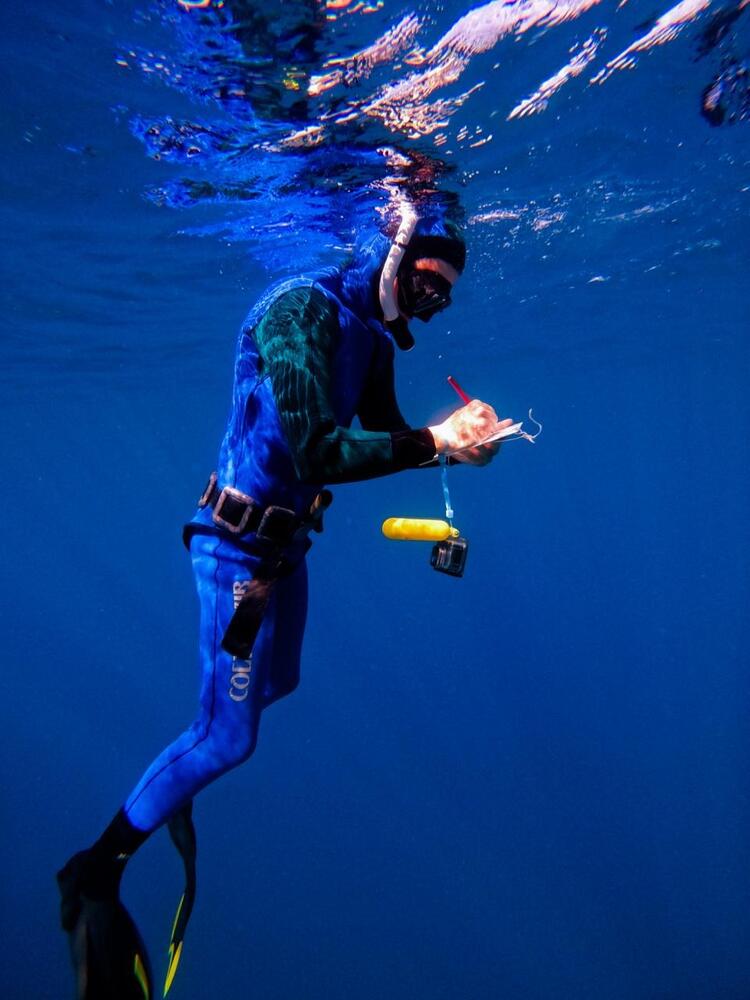 Tijdens mijn stage bij het Archipelagos Institute of Marine Conservation deed ik onderzoek naar invasieve koraalduivels. Naast dissecties en foto-ID observeerde ik gedurende 3 maanden koraalduivels op verschillende punten langs de kust van Samos, een Grieks eiland. 47 keer snorkelen gedurende 4 verschillende tijdstippen tussen 5:00-22:00 (zonsopkomst, dag, zonsondergang en nacht) en 90 observaties later had ik informatie over hun activiteit, positie, prooien, of ze verscholen waren onder rotsen of in onderwatergrotten en een hele reeks aan bijkomende data zoals lichtintensiteit en temperatuur. Na statistische analyse (zie het resultaat in onderstaande figuur) van al deze data kon ik besluiten dat de vissen duidelijk minder actief waren gedurende de dag, vergelijkbaar met hun natuurlijk gedrag in de Indische Oceaan. Ook zoeken ze vaker hun schuilplaats op gedurende de dag in vergelijking met andere tijdstippen. Dit is essentiële informatie om mee te geven aan duikers die speervissen op de invasieve vis. Deze duikers of snorkelers vangen de vis met een speer en hebben dus toegang nodig tot de dieren, wat een stuk lastiger is als ze diep verscholen zitten. De efficiëntie van de speervissers vermindert aan de ene kant rechtstreeks de aanwezigheid van koraalduivels en vermindert ook de kans dat overlevende koraalduivels leren om zich te verschuilen of duikers te ontwijken. Aangeleerde ontwijking van duikers kan maatregelen in de toekomst enorm bemoeilijken.
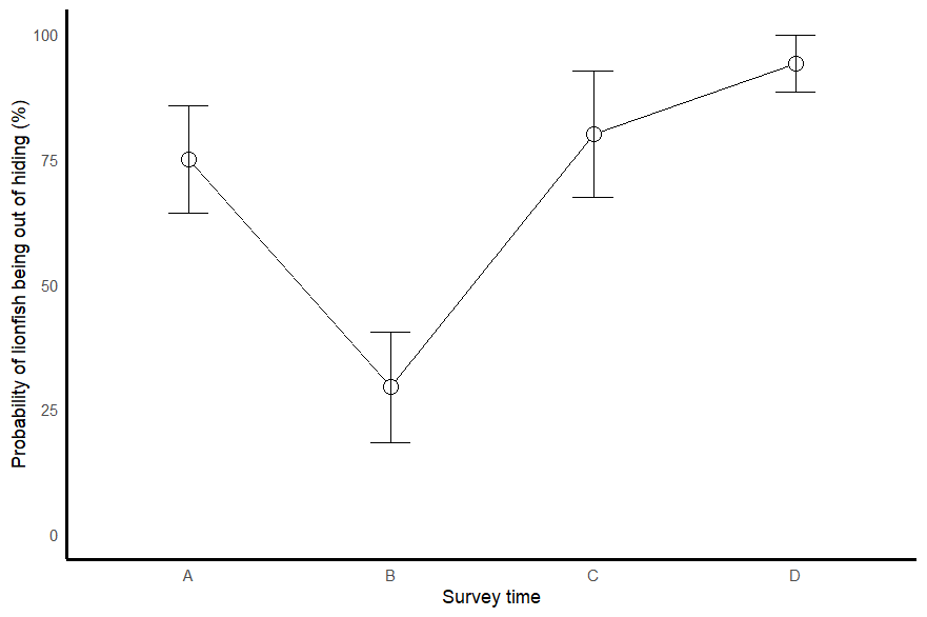
Deze figuur toont de berekende kans (in %) dat koraalduivels uit hun schuilplaats gevonden werden per tijdstip: A = zonsopkomst, B = overdag, C = zonsondergang en D = 's nachts.
Wat nu?
Om een ecologische uitdaging van deze omvang aan te pakken is een grondige kennis van het probleem essentieel. Het niet effectief bestrijden van populaties kan hen vele malen hardnekkiger maken en het aantal oplossingen in de toekomst verminderen.
“If you know the enemy and know yourself, you need not fear the result of a hundred battles. If you know yourself but not the enemy, for every victory gained you will also suffer a defeat. If you know neither the enemy nor yourself, you will succumb in every battle.”
Alhoewel ik de dieren zelf helemaal niet negatief wil afschrijven als een “vijand” illustreert deze passende quote uit “The Art of War” van Sun Tzu wel het belang van een goede voorbereiding tegenover het bestrijden van het probleem, dat door ons toedoen ontstaan is en de valkuil van een roekeloze bestrijding. De bekomen informatie kan gebruikt worden om speervissers aan te raden ‘s avonds, ‘s ochtends of ‘s nachts te vissen. Ik hoop dat dit project kan bijdragen tot het inperken van de ecologische bedreiging van koraalduivels en ik ben heel dankbaar voor deze unieke kans die ik kreeg van het Archipelagos Institute of Marine Conservation. Ik volg met trots hoe ze mijn bevindingen gebruiken in hun projecten.
Bibliografie
Albins, M., & Hixon, M. (2008). Invasive Indo-Pacific lionfish Pterois volitans reduce recruitment of Atlantic coral-reef fishes. Marine Ecology Progress Series, 367, 233–238. https://doi.org/10.3354/meps07620
Albins, M., & Lyons, P. (2012). Invasive red lionfish Pterois volitans blow directed jets of water at prey fish. Marine Ecology Progress Series, 448, 1–5. https://doi.org/10.3354/meps09580
Azzurro, E., Soto, S., Garofalo, G., & Maynou, F. (2013). Fistularia commersonii in the Mediterranean Sea: Invasion history and distribution modeling based on presence-only records. Biological Invasions, 15(5), 977–990. https://doi.org/10.1007/s10530-012-0344-4
Bariche, M., Kleitou, P., Kalogirou, S., & Bernardi, G. (2017). Genetics reveal the identity and origin of the lionfish invasion in the Mediterranean Sea. Scientific Reports, 7(1), 6782. https://doi.org/10.1038/s41598-017-07326-1
Bariche, M., Torres, M., & Azzurro, E. (2013). The Presence of the invasive Lionfish Pterois miles in the Mediterranean Sea. Mediterranean Marine Science, 14(2), 292. https://doi.org/10.12681/mms.428
Bathow, E. (n.d.). Invasive lionfish Pterois miles blow water jets at Sparus aurata to reorientate them and strike from a greater distance. [Master's thesis, Wageningen University & Research]. Wageningen University and Research eDepot.
Bernadsky, G., & Goulet, D. (1991). A Natural Predator of the Lionfish, Pterois miles. Copeia, 1991(1), 230. https://doi.org/10.2307/1446269
Bernardi, G., Azzurro, E., Bariche, M., Jimenez, C., Kalogirou, S., & Kleitou, P. (2024). Invasion genomics of lionfish in the Mediterranean Sea. Ecology and Evolution, 14(3), e11087. https://doi.org/10.1002/ece3.11087
Bottacini, D., Pollux, B. J. A., Nijland, R., Jansen, P. A., Naguib, M., & Kotrschal, A. (2024). Lionfish (Pterois miles) in the Mediterranean Sea: A review of the available knowledge with an update on the invasion front. NeoBiota, 92, 233–257. https://doi.org/10.3897/neobiota.92.110442
Chaves, L. C. T., Hall, J., Feitosa, J. L. L., & Côté, I. M. (2016). Photo‐identification as a simple tool for studying invasive lionfish Pterois volitans populations. Journal of Fish Biology, 88(2), 800–804. https://doi.org/10.1111/jfb.12857
Cohen, A. S., & Olek, A. J. (1989). An extract of lionfish (Pterois volitans) spine tissue contains acetylcholine and a toxin that affects neuromuscular transmission. Toxicon, 27(12), 1367–1376. https://doi.org/10.1016/0041-0101(89)90068-8
World Health Organization (2015). Biodiversity and human health linkages: concepts, determinants, drivers of change and approaches to integration. Connecting global priorities: Biodiversity and human health: a state of knowledge review, 11.
Côté, I., & Maljkovic, A. (2010). Predation rates of Indo-Pacific lionfish on Bahamian coral reefs. Marine Ecology Progress Series, 404, 219–225. https://doi.org/10.3354/meps08458
Crocetta, F., Agius, D., Balistreri, P., Bariche, M., Bayhan, Y. K., Çakir, M., Ciriaco, S., Corsini-Foka, M., Deidun, A., El Zrelli, R., Ergüden, D., Evans, J., Ghelia, M., Giavasi, M., Kleitou, P., Kondylatos, G., Lipej, L., Mifsud, C., Özvarol, Y., … Zenetos, A. (2015). New Mediterranean Biodiversity Records (October 2015). Mediterranean Marine Science, 16(3), 682-702. https://doi.org/10.12681/mms.1477
Cure, K., Benkwitt, C., Kindinger, T., Pickering, E., Pusack, T., McIlwain, J., & Hixon, M. (2012). Comparative behavior of red lionfish Pterois volitans on native Pacific versus invaded Atlantic coral reefs. Marine Ecology Progress Series, 467, 181–192. https://doi.org/10.3354/meps09942
D’Agostino, D., Jimenez, C., Reader, T., Hadjioannou, L., Heyworth, S., Aplikioti, M., Argyrou, M., & Feary, D. (2020). Behavioural traits and feeding ecology of Mediterranean lionfish and naiveté of native species to lionfish predation. Marine Ecology Progress Series, 638, 123–135. https://doi.org/10.3354/meps13256
deRivera, C. E., Ruiz, G. M., Hines, A. H., & Jivoff, P. (2005). Biotic resistance to invasion: native predator limits abundance and distribution of an introduced crab. Ecology, 86(12), 3364–3376. https://doi.org/10.1890/05-0479
Dimitriadis, C., Galanidi, M., Zenetos, A., Corsini-Foka, M., Giovos, I., Karachle, P. K., Fournari – Konstantinidoy, I., Kytinou, E., Issaris, Y., Azzurro, E., Castriota, L., Falautano, M., Kalimeris, A., & Katsanevakis, S. (2020). Updating the occurrences of Pterois miles in the Mediterranean Sea, with considerations on thermal boundaries and future range expansion. Mediterranean Marine Science, 21(1), 62. https://doi.org/10.12681/mms.21845
Freshwater, D. W., Hamner, R. M., Parham, S., & Wilbur, A. E. (2009). Molecular evidence that the lionfishes Pterois miles and Pterois volitans are distinct species. Journal of the North Carolina Academy of Science, 125(2), 39-46.
Galanidi, M., Zenetos, A., & Bacher, S. (2018). Assessing the socio-economic impacts of priority marine invasive fishes in the Mediterranean with the newly proposed SEICAT methodology. Mediterranean Marine Science, 19(1), 107. https://doi.org/10.12681/mms.15940
Galasso, N. M., Bonaviri, C., Trapani, F. D., Picciotto, M., Gianguzza, P., Agnetta, D., & Badalamenti, F. (2015). Fish-seastar facilitation leads to algal forest restoration on protected rocky reefs. Scientific Reports, 5(12409). https://doi.org/10.1038/srep12409
Gardner, P. G., Frazer, T. K., Jacoby, C. A., & Yanong, R. P. E. (2015). Reproductive biology of invasive lionfish (Pterois spp.). Frontiers in Marine Science, 2. https://doi.org/10.3389/fmars.2015.00007
Golani, D., & Sonin, O. (1992). New records of the Red Sea fishes, Pterois miles (Scorpaenidae) and Pteragogus pelycus (Labridae) from the eastern Mediterranean Sea. Japanese Journal of Ichthyology, 39(2), 167–169. https://doi.org/10.1007/BF02906001
Green, S., Akins, J., & Côté, I. (2011). Foraging behaviour and prey consumption in the Indo-Pacific lionfish on Bahamian coral reefs. Marine Ecology Progress Series, 433, 159–167. https://doi.org/10.3354/meps09208
Hackerott, S., Valdivia, A., Green, S. J., Côté, I. M., Cox, C. E., Akins, L., Layman, C. A., Precht, W. F., & Bruno, J. F. (2013). Native Predators Do Not Influence Invasion Success of Pacific Lionfish on Caribbean Reefs. PLoS ONE, 8(7), e68259. https://doi.org/10.1371/journal.pone.0068259
Hamner, R. M., Freshwater, D. W., & Whitfield, P. E. (2007). Mitochondrial cytochrome b analysis reveals two invasive lionfish species with strong founder effects in the western Atlantic. Journal of Fish Biology, 71, 214–222. https://doi.org/10.1111/j.1095-8649.2007.01575.x
Henderson, E. B. (2012). Economic and Ecological Implications of Interactions Between Lobsters and Invasive Lionfish in the Bahamas. [Master's thesis, Simon Fraser University]. SFU Library Catalogue.
Iglésias, S., & Frotté, L. (2015). Alien marine fishes in Cyprus: Update and new records. Aquatic Invasions, 10(4), 425–438. https://doi.org/10.3391/ai.2015.10.4.06
Johnston, M. W., & Purkis, S. J. (2014). Are lionfish set for a Mediterranean invasion? Modelling explains why this is unlikely to occur. Marine Pollution Bulletin, 88(1–2), 138–147. https://doi.org/10.1016/j.marpolbul.2014.09.013
Katsanevakis, S., Coll, M., Piroddi, C., Steenbeek, J., Ben Rais Lasram, F., Zenetos, A., & Cardoso, A. C. (2014). Invading the Mediterranean Sea: Biodiversity patterns shaped by human activities. Frontiers in Marine Science, 1. https://doi.org/10.3389/fmars.2014.00032
Kleitou, P., Moutopoulos, D. K., Giovos, I., Kletou, D., Savva, I., Cai, L. L., Hall‐Spencer, J. M., Charitou, A., Elia, M., Katselis, G., & Rees, S. (2022). Conflicting interests and growing importance of non‐indigenous species in commercial and recreational fisheries of the Mediterranean Sea. Fisheries Management and Ecology, 29(2), 169–182. https://doi.org/10.1111/fme.12531
Kleitou, P., Rees, S., Cecconi, F., Kletou, D., Savva, I., Cai, L. L., & Hall‐Spencer, J. M. (2021). Regular monitoring and targeted removals can control lionfish in Mediterranean Marine Protected Areas. Aquatic Conservation: Marine and Freshwater Ecosystems, 31(10), 2870–2882. https://doi.org/10.1002/aqc.3669
Kletou, D., Hall-Spencer, J. M., & Kleitou, P. (2016). A lionfish (Pterois miles) invasion has begun in the Mediterranean Sea. Marine Biodiversity Records, 9(1), 46. https://doi.org/10.1186/s41200-016-0065-y
Kulbicki, M., Beets, J., Chabanet, P., Cure, K., Darling, E., Floeter, S., Galzin, R., Green, A., Harmelin-Vivien, M., Hixon, M., Letourneur, Y., De Loma, T., McClanahan, T., McIlwain, J., MouTham, G., Myers, R., O’Leary, J., Planes, S., Vigliola, L., & Wantiez, L. (2012). Distributions of Indo-Pacific lionfishes Pterois spp. in their native ranges: Implications for the Atlantic invasion. Marine Ecology Progress Series, 446, 189–205. https://doi.org/10.3354/meps09442
López-Gómez, M. J., Aguilar-Perera, A., & Perera-Chan, L. (2014). Mayan diver-fishers as citizen scientists: Detection and monitoring of the invasive red lionfish in the Parque Nacional Arrecife Alacranes, southern Gulf of Mexico. Biological Invasions, 16(7), 1351–1357. https://doi.org/10.1007/s10530-013-0582-0
Lyons, T. J., Tuckett, Q. M., & Hill, J. E. (2019). Characterizing the US trade in lionfishes. PLOS ONE, 14(8), e0221272. https://doi.org/10.1371/journal.pone.0221272
Maljković, A., Van Leeuwen, T. E., & Cove, S. N. (2008). Predation on the invasive red lionfish, Pterois volitans (Pisces: Scorpaenidae), by native groupers in the Bahamas. Coral Reefs, 27(3), 501–501. https://doi.org/10.1007/s00338-008-0372-9
McTee, S., & Grubich, J. (2014). Native densities, distribution, and diurnal activity of Red Sea lionfishes (Scorpaenidae). Marine Ecology Progress Series, 508, 223–232. https://doi.org/10.3354/meps10847
Morris, J. A., & Akins, J. L. (2009). Feeding ecology of invasive lionfish (Pterois volitans) in the Bahamian archipelago. Environmental Biology of Fishes, 86(3), 389–398. https://doi.org/10.1007/s10641-009-9538-8
Morris, Jr, J. A., Sullivan, C. V., & Govoni, J. J. (2011). Oogenesis and spawn formation in the invasive lionfish, Pterois miles and Pterois volitans. Scientia Marina, 75(1), 147–154. https://doi.org/10.3989/scimar.2011.75n1147
Mouchlianitis, F. A., Kalaitzi, G., Kleitou, P., Savva, I., Kletou, D., & Ganias, K. (2022). Reproductive dynamics of the invasive lionfish ( Pterois miles ) in the Eastern Mediterranean Sea. Journal of Fish Biology, 100(2), 574–581. https://doi.org/10.1111/jfb.14971
Oray, I. K., Sınay, E., Saadet Karakulak, F., & Yıldız, T. (2015). An expected marine alien fish caught at the coast of Northern Cyprus: Pterois miles (Bennett, 1828). Journal of Applied Ichthyology, 31(4), 733–735. https://doi.org/10.1111/jai.12857
Paolucci, E. M., MacIsaac, H. J., & Ricciardi, A. (2013). Origin matters: Alien consumers inflict greater damage on prey populations than do native consumers. Diversity and Distributions, 19(8), 988–995. https://doi.org/10.1111/ddi.12073
Phillips, E. W., Bottacini, D., Schoonhoven, A. N. M., Kamstra, Y. J. J., De Waele, H., Jimenez, C., Hadjioannou, L., & Kotrschal, A. (2024). Limited effects of culling on the behavior of invasive lionfish ( Pterois miles ) in the Mediterranean. Journal of Fish Biology, 104(5), 1401–1410. https://doi.org/10.1111/jfb.15686
Phillips, E. W., & Kotrschal, A. (2021). Where are they now? Tracking the Mediterranean lionfish invasion via local dive centers. Journal of Environmental Management, 298, 113354. https://doi.org/10.1016/j.jenvman.2021.113354
Pinnegar, J. K. (2018). Why the damselfish Chromis chromis is a key species in the Mediterranean rocky littoral – a quantitative perspective. Journal of Fish Biology, 92(3), 851–872. https://doi.org/10.1111/jfb.13551
Pinnegar, J. K., & Polunin, N. V. C. (2006). Planktivorous damselfish support significant nitrogen and phosphorus fluxes to Mediterranean reefs. Marine Biology, 148(5), 1089–1099. https://doi.org/10.1007/s00227-005-0141-z
Reaser, J. K., Meyerson, L. A., Cronk, Q., De Poorter, M., Eldrege, L. G., Green, E., Kairo, M., Latasi, P., Mack, R. N., Mauremootoo, J., O’Dowd, D., Orapa, W., Sastroutomo, S., Saunders, A., Shine, C., Thrainsson, S., & Vaiutu, L. (2007). Ecological and socioeconomic impacts of invasive alien species in island ecosystems. Environmental Conservation, 34(2), 98–111. https://doi.org/10.1017/S0376892907003815
Resiere, D., Cerland, L., De Haro, L., Valentino, R., Criquet-Hayot, A., Chabartier, C., Kaidomar, S., Brouste, Y., Mégarbane, B., & Mehdaoui, H. (2016). Envenomation by the invasive Pterois volitans species (lionfish) in the French West Indies – a two-year prospective study in Martinique. Clinical Toxicology, 54(4), 313–318. https://doi.org/10.3109/15563650.2016.1143100
Sala, E., Kizilkaya, Z., Yildirim, D., & Ballesteros, E. (2011). Alien Marine Fishes Deplete Algal Biomass in the Eastern Mediterranean. PLoS ONE, 6(2), e17356. https://doi.org/10.1371/journal.pone.0017356
Savva, I., Chartosia, N., Antoniou, C., Kleitou, P., Georgiou, A., Stern, N., Hadjioannou, L., Jimenez, C., Andreou, V., Hall‐Spencer, J. M., & Kletou, D. (2020). They are here to stay: The biology and ecology of lionfish ( Pterois miles ) in the Mediterranean Sea. Journal of Fish Biology, 97(1), 148–162. https://doi.org/10.1111/jfb.14340
Schultz, E. T. (1986). Pterois volitans and Pterois miles: Two Valid Species. Copeia, 1986(3), 686. https://doi.org/10.2307/1444950
Sih, A., Bolnick, D. I., Luttbeg, B., Orrock, J. L., Peacor, S. D., Pintor, L. M., Preisser, E., Rehage, J. S., & Vonesh, J. R. (2010). Predator–prey naïveté, antipredator behavior, and the ecology of predator invasions. Oikos, 119(4), 610–621. https://doi.org/10.1111/j.1600-0706.2009.18039.x
Stachowicz, J. J., Whitlatch, R. B., & Osman, R. W. (1999). Species Diversity and Invasion Resistance in a Marine Ecosystem. Science, 286(5444), 1577–1579. https://doi.org/10.1126/science.286.5444.1577
Torchin, M. E., Lafferty, K. D., & Kuris, A. M. (2002). Parasites and marine invasions. Parasitology, 124(7), 137–151. https://doi.org/10.1017/S0031182002001506
Turan, C., Ergüden, D., Gürlek, M., Yağlıoğlu, D., Uyan, A., & Uygur, N. (2014). First record of the Indo-Pacific lionfish Pterois miles (Bennett, 1828) (Osteichthyes: Scorpaenidae) for the Turkish marine waters. Journal of Black Sea Mediterranean Environment, 20(2), 158-163. https://izlik.org/JA77KC22PC
Tuttle, L. J., Sikkel, P. C., Cure, K., & Hixon, M. A. (2017). Parasite-mediated enemy release and low biotic resistance may facilitate invasion of Atlantic coral reefs by Pacific red lionfish (Pterois volitans). Biological Invasions, 19(2), 563–575. https://doi.org/10.1007/s10530-016-1342-8
Ulman, A., Harris, H. E., Doumpas, N., Deniz Akbora, H., Al Mabruk, S. A. A., Azzurro, E., Bariche, M., Çiçek, B. A., Deidun, A., Demirel, N., Fogg, A. Q., Katsavenakis, S., Kletou, D., Kleitou, P., Papadopoulou, A., Ben Souissi, J., Hall-Spencer, J. M., Tiralongo, F., & Yildiz, T. (2021). Low Pufferfish and Lionfish Predation in Their Native and Invaded Ranges Suggests Human Control Mechanisms May Be Necessary to Control Their Mediterranean Abundances. Frontiers in Marine Science, 8, 670413. https://doi.org/10.3389/fmars.2021.670413
Van Leeuwen, J. L., & Muller, M. (1984). Optimum sucking techniques for predatory fish. The Transactions of the Zoological Society of London, 37(2), 137–169. https://doi.org/10.1111/j.1096-3642.1984.tb00069.x
Yanar, A., Turan, C., & Doğdu, S. A. (2022). Report of Nerocila bivittata (Risso, 1816) (Isopoda: Cymothoidae) Parasitic on Alien Fish, Pterois miles (Bennett, 1828) from the Aegean and Mediterranean Sea. Natural and Engineering Sciences, 7(2), 169–181. https://doi.org/10.28978/nesciences.1159261