Wat gebeurt er met organismen wanneer het magnetisch veld van de aarde verandert?
Stel je voor: je reist naar Mars, en neemt een plant mee. Je geeft ze water, licht en voedingsstoffen en ze voelt de gedeeltelijke zwaartekracht van Mars. Maar één onzichtbare factor is helemaal veranderd: het magnetisch veld. Zou die plant dat merken?
Hier op aarde zijn alle levende organismen voortdurend blootgesteld aan het aardmagnetisch veld. De sterkte en richting ervan verschillen licht naargelang je locatie, maar blijven redelijk constant. Echter, wanneer we verder van de aarde reizen, wordt het veld vele malen zwakker tot het ongeveer verdwijnt. Op toekomstige ruimtereizen kunnen planten een belangrijke rol spelen voor de productie van voedsel en zuurstof aan boord. Maar naast verschillen in zwaartekracht en straling is er misschien nog een omgevingsfactor waarmee we rekening moeten houden: het magnetisch veld. Dit onderzocht ik in mijn masterproef.
Zo gebruikte ik een pgm-mutant van Arabidopsis die weinig zetmeel opslaat in de statolieten van de wortel. Deze statolieten spelen een belangrijke rol bij het waarnemen van de zwaartekracht en het bepalen van de groeirichting van de wortel. Daarnaast onderzocht ik ook planten met veranderingen in de expressie van cryptochromen. Deze zijn lichtreceptoren die onder meer betrokken zijn bij de groei en de dag-nachtcyclus van planten. Cryptochromen zijn verder ook interessante kandidaten om magnetische gevoeligheid te onderzoeken, omdat hun reacties mogelijk beïnvloed kunnen worden door magnetische velden.
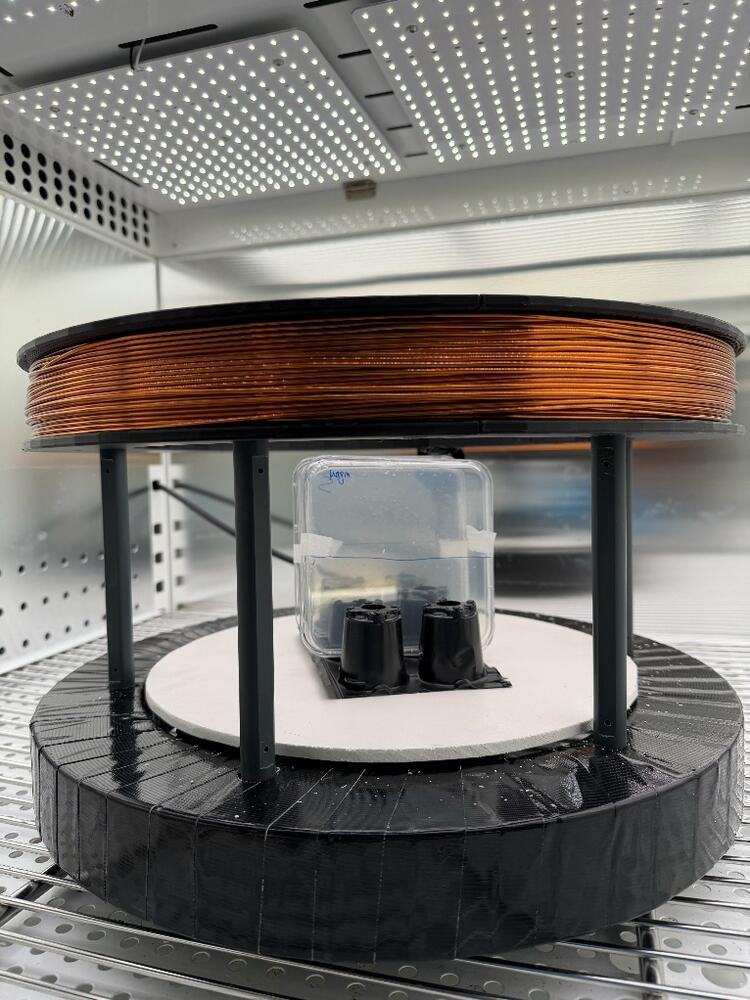
Figuur 1. Helmholtz spoelen met centraal agar platen waarop Arabidopsis thaliana zaden geplant zijn.
De planten werden gekweekt op agar, met of zonder toegevoegde suiker. Vervolgens werden ze in het licht of donker blootgesteld aan verschillende magnetische omstandigheden. Hiervoor gebruikte ik onder andere permanente magneten en Helmholtzspoelen, waarmee het magnetisch veld gecontroleerd kon worden versterkt of gecompenseerd.
Op het eerste zicht leken de planten zich weinig aan te trekken van de veranderde magnetische velden. Hun zaden kiemden grotendeels normaal en ook de wortels en scheuten groeiden over het algemeen gelijkaardig. Maar wanneer ik verder keek dan alleen de groeisnelheid, verschenen er enkele opvallende patronen.
Zo leken wortels in sommige experimenten van hun normale groeirichting af te wijken wanneer ze werden blootgesteld aan een sterk horizontaal magnetisch veld. Dit was geen effect dat systematisch werd gekwantificeerd, maar de herhaalde observatie was opvallend en interessant om verder te onderzoeken.
Nog opvallender waren de resultaten van de worteltoppen. In normale omstandigheden bevatten deze zetmeelrijke statolieten, die bij de controleplanten met een Lugolkleuring duidelijk zichtbaar waren. Bij planten die in het sterke horizontale magnetische veld groeiden, vertoonde een aanzienlijk deel van de wortels echter weinig tot geen zichtbare statolietkleuring. Van de 27 onderzochte wortels vertoonden er 11 verminderde of afwezige kleuring.
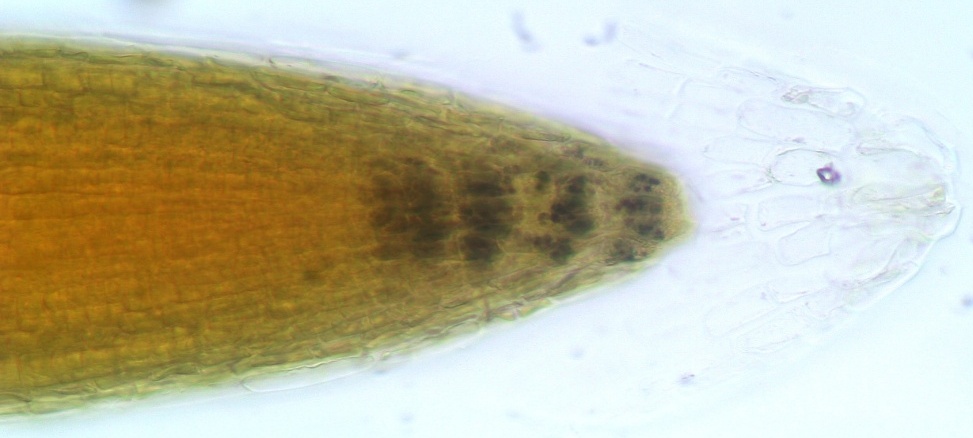
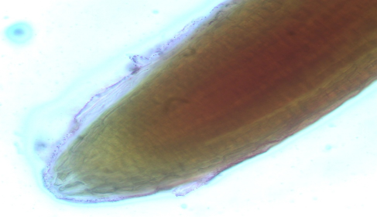
Figuur 2. Links: controleconditie met duidelijk zichtbare zetmeelkorrels, rechts: conditie in sterk horizontaal magnetisch veld met zichtbaar afwezige zetmeelkorrels
Betekent dit dat magnetische velden de zwaartekrachtswaarneming van planten verstoren? Dat kan ik op basis van dit onderzoek nog niet zeggen. Lugol kleurt namelijk het aanwezige zetmeel en bewijst niet per se dat de volledige statolietstructuren verdwenen zijn. Het resultaat kan wel wijzen op mogelijke veranderingen in de opslag, aanmaak of afbraak van zetmeel. Toch is het een interessante aanwijzing, omdat het raakt aan een van de belangrijkste problemen voor planten in de ruimte: hoe bepaal je nog welke kant “beneden” is wanneer je natuurlijke omgeving, en zwaartekracht, verandert?
Ook de experimenten met cryptochromen leverden interessante resultaten op. Door planten met verschillen in cryptochroomexpressie zowel in het licht als in het donker te laten groeien, kon ik hun ontwikkeling en groei vergelijken. In het donker groeien jonge planten snel omhoog, omdat ze op zoek zijn naar licht. Bij zowel cryptochroom knock-outplanten als planten die extra cryptochroom aanmaakten, was deze scheutgroei onder het sterke horizontale magnetische veld verminderd. Omdat beide genetische lijnen reageerden, wijst dit echter niet direct op een eenvoudig cryptochroomafhankelijk mechanisme. Het laat vooral zien dat juist meer specifieke groeiprocessen mogelijk gevoeliger zijn voor magnetische veranderingen dan grote processen als kieming of algemene wortelgroei.
Ook bij de schimmel Ganoderma lucidum waren er enkele opvallende observaties. Kolonies die in een verzwakt magnetisch veld groeiden, leken vooral in het donker sneller te groeien en vertoonden minder duidelijke concentrische groeiringen dan de controle. Omdat deze experimenten slechts op beperkte schaal werden uitgevoerd, zijn dit voorlopig verkennende resultaten.
De resultaten wijzen dus niet op een eenvoudig verhaal waarin een veranderd magnetisch veld planten plots sneller of trager laat groeien. Integendeel, de basisgroei van de planten bleek grotendeels ongewijzigd. Maar onder deze schijnbaar normale groei schuilen mogelijk subtielere veranderingen in hoe planten groeien, zich oriënteren en hun omgeving waarnemen. Dat is relevant voor het gebruik van organismen in toekomstige ruimtereizen. Op aarde zijn licht, zwaartekracht en het magnetisch veld voortdurend samen aanwezig. Tijdens lange ruimtemissies kunnen deze omstandigheden sterk veranderen.
Als we planten ooit op grote schaal willen gebruiken voor voedselproductie en andere doeleinden buiten de aarde, moeten we daarom niet alleen weten of ze efficiënt kunnen groeien, maar ook begrijpen wat de gevolgen zijn van deze nieuwe omgeving.
Bibliografie
Afraimovich, E. L., Ashkaliev, Ya. F., Aushev, V. M., Beletsky, A. B., Vodyannikov, V. V., Leonovich, L. A., Lesyuta, O. S., Lipko, Yu. V., Mikhalev, A. V., & Yakovets, A. F. (2002). Simultaneous radio and optical observations of the mid-latitude atmospheric response to a major geomagnetic storm of 6–8 April 2000. Journal of Atmospheric and Solar-Terrestrial 6826(02)00217-1 Physics, 64(18), 1943–1955. https://doi.org/10.1016/S1364 Agliassa, C., & Maffei, M. E. (2019). Reduction of geomagnetic field (GMF) to near null magnetic field (NNMF) affects some Arabidopsis thaliana clock genes amplitude in a light independent manner. Journal of Plant Physiology, 232, 23–26. https://doi.org/10.1016/j.jplph.2018.11.008 Ahmad, M., Galland, P., Ritz, T., Wiltschko, R., & Wiltschko, W. (2007). Magnetic intensity affects cryptochrome-dependent responses in Arabidopsis thaliana. Planta, 225(3), 615–624. https://doi.org/10.1007/s00425-006-0383-0 Aksyonov, S. I., Bulychev, A. A., Grunina, T. Yu., Goryachev, S. N., & Turovetsky, V. B. (2001). Effects of Elf-Emf Treatment on Wheat Seeds at Different Stages of Germination and Possible Mechanisms of Their Origin. Electro- and Magnetobiology, 20(2), 231–253. https://doi.org/10.1081/JBC-100104146 Albertini, M. C., Accorsi, A., Citterio, B., Burattini, S., Piacentini, M. P., Uguccioni, F., & Piatti, E. (2003). Morphological and biochemical modifications induced by a static magnetic field on Fusarium culmorum. https://doi.org/10.1016/j.biochi.2003.09.017 Biochimie, 85(10), 963–970. Anton-Leberre, V., Haanappel, E., Marsaud, N., Trouilh, L., Benbadis, L., Boucherie, H., Massou, S., & François, J. M. (2010). Exposure to high static or pulsed magnetic fields does not affect cellular processes in the yeast Saccharomyces cerevisiae. Bioelectromagnetics, 31(1), 28–38. https://doi.org/10.1002/bem.20523 45 Baker, D. N. (2000). Effects of the Sun on the Earth’s environment. Journal of Atmospheric and Solar-Terrestrial Physics, 62(17), 1669–1681. https://doi.org/10.1016/S1364 6826(00)00119-X Begall, S., Červený, J., Neef, J., Vojtěch, O., & Burda, H. (2008). Magnetic alignment in grazing and resting cattle and deer. Proceedings of the National Academy of Sciences, 105(36), 13451–13455. https://doi.org/10.1073/pnas.0803650105 Bellini, S. (2009). On a unique behavior of freshwater bacteria. Chinese Journal of Oceanology and Limnology, 27(1), 3–5. https://doi.org/10.1007/s00343-009-0003-5 Belova, N. A., & Acosta-Avalos, D. (2015). The Effect of Extremely Low Frequency Alternating Magnetic Field on the Behavior of Animals in the Presence of the Geomagnetic Field. Journal of Biophysics, 2015, 423838. https://doi.org/10.1155/2015/423838 Belova, N. A., & Lednev, V. V. (2001). [Activation and inhibition of the gravitropic response in the flax stem segments exposed to the permanent magnetic field with magnetic density ranging from 0 to 350 microT]. Biofizika, 46(1), 118–121. Belyavskaya. (n.d.). Biological effects due to weak magnetic field on plants—ScienceDirect. Retrieved April 17, 2026, https://www.sciencedirect.com/science/article/pii/S0273117704007148 from Belyavskaya, N. A. (2004). Biological effects due to weak magnetic field on plants. Advances in Space Research, Space Life Sciences: Life Support Systems and Biological Systems under Influence of Physical https://doi.org/10.1016/j.asr.2004.01.021 Factors, 34(7), 1566–1574. Binhi, V. N. (2001). Theoretical Concepts in Magnetobiology. Electro- and Magnetobiology, 20(1), 43–58. https://doi.org/10.1081/JBC-100103159 Blakemore, R. P. (1982). Magnetotactic Bacteria. Annual Review of Microbiology, 36(Volume 36, 1982), 217–238. https://doi.org/10.1146/annurev.mi.36.100182.001245 Blanc, M., Kallenbach, R., & Erkaev, N. V. (2005). Solar System Magnetospheres. Space Science Reviews, 116(1), 227–298. https://doi.org/10.1007/s11214-005-1958-y 46 Blumenthal & Rachel Leah. (2025). Earth’s magnetic field | Research Starters | EBSCO Research. EBSCO. https://www.ebsco.com Brown, F. A., & Chow, C. S. (1975). Non-equivalence for bean seeds of clockwise and counterclockwise magnetic motion: A novel terrestrial adaptation? The Biological Bulletin, 148(3), 370–379. https://doi.org/10.2307/1540514 Carrigan, C. R., & Gubbins, D. (1979). The Source of the Earth’s Magnetic Field. Scientific American, 240(2), 118–133. Cashmore, A. R. (2003). Cryptochromes: Enabling Plants and Animals to Determine Circadian Time. Cell, 114(5), 537–543. https://doi.org/10.1016/j.cell.2003.08.004 Caspar, T., & Pickard, B. G. (1989). Gravitropism in a starchless mutant of Arabidopsis: Implications for the starch-statolith theory of gravity sensing. Planta, 177(2), 185–197. https://doi.org/10.1007/BF00392807 Chapin, F. S., Bloom, A. J., Field, C. B., & Waring, R. H. (1987). Plant Responses to Multiple Environmental Factors. BioScience, 37(1), 49–57. https://doi.org/10.2307/1310177 Chaves, I., Pokorny, R., Byrdin, M., Hoang, N., Ritz, T., Brettel, K., Essen, L.-O., van der Horst, G. T. J., Batschauer, A., & Ahmad, M. (2011). The cryptochromes: Blue light photoreceptors in plants and animals. Annual Review of Plant Biology, 62, 335–364. https://doi.org/10.1146/annurev-arplant-042110-103759 Chen, J., Yu, R., Li, N., Deng, Z., Zhang, X., Zhao, Y., Qu, C., Yuan, Y., Pan, Z., Zhou, Y., Li, K., Wang, J., Chen, Z., Wang, X., Wang, X., He, S.-N., Dong, J., Deng, X. W., & Chen, H. (2023). Amyloplast sedimentation repolarizes LAZYs to achieve gravity sensing in plants. Cell, 186(22), 4788-4802.e15. https://doi.org/10.1016/j.cell.2023.09.014 Chen, R., Rosen, E., & Masson, P. H. (1999). Gravitropism in Higher Plants. Plant Physiology, 120(2), 343–350. https://doi.org/10.1104/pp.120.2.343 De Micco, V., Aronne, G., Caplin, N., Carnero-Diaz, E., Herranz, R., Horemans, N., Legué, V., Medina, F. J., Pereda-Loth, V., Schiefloe, M., De Francesco, S., Izzo, L. G., Le Disquet, I., & Kittang Jost, A.-I. (2023). Perspectives for plant biology in space and analogue environments. Npj Microgravity, 9(1), 67. https://doi.org/10.1038/s41526-023-00315-x 47 Dhar, S., Kim, J., Yoon, E. K., Jang, S., Ko, K., & Lim, J. (2022). SHORT-ROOT Controls Cell Elongation in the Etiolated Arabidopsis Hypocotyl. Molecules and Cells, 45(4), 243 256. https://doi.org/10.14348/molcells.2021.5008 Dhiman, S. K., Wu, F., & Galland, P. (2023). Effects of weak static magnetic fields on the development of seedlings of Arabidopsis thaliana. Protoplasma, 260(3), 767–786. https://doi.org/10.1007/s00709-022-01811-9 Dijak, M., Smith, D. L., Wilson, T. J., & Brown, D. C. W. (1986). Stimulation of direct embryogenesis from mesophyll protoplasts of Medicago sativa. Plant Cell Reports, 5(6), 468–470. https://doi.org/10.1007/BF00269644 Durieux, G., & Liedvogel, M. (2020). Orientation and Navigation in the Animal World. In Position, Navigation, and Timing Technologies in the 21st Century (pp. 1689–1709). John Wiley & Sons, Ltd. https://doi.org/10.1002/9781119458555.ch54 Froehlich, A. C., Chen, C.-H., Belden, W. J., Madeti, C., Roenneberg, T., Merrow, M., Loros, J. J., & Dunlap, J. C. (2010). Genetic and Molecular Characterization of a Cryptochrome from the Filamentous Fungus Neurospora crassa. Eukaryotic Cell, 9(5), 738–750. https://doi.org/10.1128/EC.00380-09 Galland, P., & Pazur, A. (2005). Magnetoreception in plants. Journal of Plant Research, 118(6), 371–389. https://doi.org/10.1007/s10265-005-0246-y Gegear, R. J., Casselman, A., Waddell, S., & Reppert, S. M. (2008). Cryptochrome mediates light-dependent magnetosensitivity in Drosophila. Nature, 454(7207), 1014–1018. https://doi.org/10.1038/nature07183 Grant, I. S., & Phillips, W. R. (2013). Electromagnetism. John Wiley & Sons. Gunn, R. (1929). A Theory of the Permanent Magnetic Fields of the Sun and Earth. Physical Review, 34(2), 335–343. https://doi.org/10.1103/PhysRev.34.335 Haneda, T., Fujimura, Y., & Iino, M. (2006). Magnetic field exposure stiffens regenerating plant protoplast cell walls. https://doi.org/10.1002/bem.20169 Bioelectromagnetics, 27(2), 98–104. 48 Harris, S.-R., Henbest, K. B., Maeda, K., Pannell, J. R., Timmel, C. R., Hore, P. J., & Okamoto, H. (2009). Effect of magnetic fields on cryptochrome-dependent responses in Arabidopsis thaliana. Journal of the Royal Society Interface, 6(41), 1193–1205. https://doi.org/10.1098/rsif.2008.0519 Hasenstein, K. H., Park, M. R., John, S. P., & Ajala, C. (2022). High-gradient magnetic fields and starch metabolism: Results from a space experiment. Scientific Reports, 12(1), 18256. https://doi.org/10.1038/s41598-022-22691-2 Jamil, Y., Ul, H. Z., & Iqbal, M. (2012). Enhancement in growth and yield of mushroom using magnetic field treatment. International https://doi.org/10.2478/v10247-012-0052-4 Agrophysics, 26(4), 375–380. Jasinski, S., Chardon, F., Nesi, N., Lécureuil, A., & Guerche, P. (2018). (PDF) Improving seed oil and protein content in Brassicaceae: Some new genetic insights from Arabidopsis thaliana. ResearchGate. https://doi.org/10.1051/ocl/2018047 Jin, Y., Guo, W., Hu, X., Liu, M., Xu, X., Hu, F., Lan, Y., Lv, C., Fang, Y., Liu, M., Shi, T., Ma, S., Fang, Z., & Huang, J. (2019). Static magnetic field regulates Arabidopsis root growth via auxin signaling. Scientific Reports, 9(1), 14384. https://doi.org/10.1038/s41598 019-50970-y Kato, R. (1990). Effects of a Very Low Magnetic Field on the Gravitropic Curvature of Zea Roots. Plant and Cell Physiology, https://doi.org/10.1093/oxfordjournals.pcp.a077947 31(4), 565–568. Kato, R., Kamada, H., & Asashima, M. (n.d.). Effects of High and Very Low Magnetic Fields on the Growth of Hairy Roots of Daucus carota and Atropa belladonna. Retrieved April 17, 2026, from https://dx.doi.org/10.1093/oxfordjournals.pcp.a077782 Krótki, F. J., KoÅ›cielniak, B. K., & Tomasik, P. J. (2015). The Influence of Strong Static Magnetic Field on the Germination and Growth of Garden Cress (Lepidium sativum L.) | Journal of Experimental https://journaljeai.com/index.php/JEAI/article/view/667 Agriculture International. 49 Lin, C., Ahmad, M., & Cashmore, A. R. (1996). Arabidopsis cryptochrome 1 is a soluble protein mediating blue light-dependent regulation of plant growth and development. The Plant Journal: For Cell and Molecular Biology, https://doi.org/10.1046/j.1365-313x.1996.10050893.x 10(5), 893–902. Lin, C., Yang, H., Guo, H., Mockler, T., Chen, J., & Cashmore, A. R. (1998). Enhancement of blue-light sensitivity of Arabidopsis seedlings by a blue light receptor cryptochrome 2. Proceedings of the National Academy of Sciences, 95(5), 2686–2690. https://doi.org/10.1073/pnas.95.5.2686 Maffei, M. E. (2014). Magnetic field effects on plant growth, development, and evolution. Frontiers in Plant Science, 5, 445. https://doi.org/10.3389/fpls.2014.00445 Maffei, M. E. (2025). The Radical Pair Mechanism and Its Quantum Role in Plant Reactive Oxygen Species Production Under Hypomagnetic Fields. Quantum Reports, 7(4), 52. https://doi.org/10.3390/quantum7040052 Maffei, M. E., Balestrini, R., Costantino, P., Lanfranco, L., Morgante, M., Battistelli, A., & Del Bianco, M. (2024). The physiology of plants in the context of space exploration. Communications Biology, 7(1), 1311. https://doi.org/10.1038/s42003-024-06989-7 Meinke, D. W., Cherry, J. M., Dean, C., Rounsley, S. D., & Koornneef, M. (1998). Arabidopsis thaliana: A Model Plant for Genome Analysis. Science, 282(5389), 662–682. https://doi.org/10.1126/science.282.5389.662 Mockler, T. C., Guo, H., Yang, H., Duong, H., & Lin, C. (1999). Antagonistic actions of Arabidopsis cryptochromes and phytochrome B in the regulation of floral induction. Development, 126(10), 2073–2082. https://doi.org/10.1242/dev.126.10.2073 Nagy, P., & Fischl, G. (2004). Effect of static magnetic field on growth and sporulation of some plant pathogenic fungi. https://doi.org/10.1002/bem.20015 Bioelectromagnetics, 25(4), 316–318. Nedukha, O., K.M., S., Kordyum, E., M., N., P.G., S., & V.M., F. (1984). Plant Cell Under Changes of Geophysical Factors. (Растительная Клетка при Изменении Геофизических Факторов.). 50 Negishi, Y., Hashimoto, A., Tsushima, M., Dobrota, C., Yamashita, M., & Nakamura, T. (1999). Growth of pea epicotyl in low magnetic field implication for space research. Advances in Space Research, Life Sciences: Microgravity Research I, 23(12), 2029–2032. https://doi.org/10.1016/S0273-1177(99)00342-7 Nordmann, G. C., Balay, S. D., Kapuruge, T. N., Numi, M., Leeb, C., Nimpf, S., Malkemper, E. P., Landler, L., & Keays, D. A. (2026). A global screen for magnetically induced neuronal activity in the pigeon brain. Science, 391(6790), 1155–1160. https://doi.org/10.1126/science.aea6425 Novitsky, Yu. I., Novitskaya, G. V., Kocheshkova, T. K., Nechiporenko, G. A., & Dobrovol’skii, M. V. (2001). Growth of Green Onions in a Weak Permanent Magnetic Field. Russian Journal of Plant Physiology, 48(6), 709–716. https://doi.org/10.1023/A:1012547004545 Nyqvist, D., Durif, C., Johnsen, M. G., De Jong, K., Forland, T. N., & Sivle, L. D. (2020). Electric and magnetic senses in marine animals, and potential behavioral effects of electromagnetic surveys. Marine Environmental Research, 155, 104888. https://doi.org/10.1016/j.marenvres.2020.104888 Occhipinti, A., De Santis, A., & Maffei, M. E. (2014). Magnetoreception: An unavoidable step for plant evolution? Trends in https://doi.org/10.1016/j.tplants.2013.10.007 Plant Science, 19(1), 1–4. Ohto, M., Onai, K., Furukawa, Y., Aoki, E., Araki, T., & Nakamura, K. (2001). Effects of sugar on vegetative development and floral transition in Arabidopsis. Plant Physiology, 127(1), 252–261. https://doi.org/10.1104/pp.127.1.252 Panagopoulos, D. J., Karabarbounis, A., & Chrousos, G. P. (2024). Biophysical mechanism of animal magnetoreception, orientation and navigation. Scientific Reports, 14(1), 30053. https://doi.org/10.1038/s41598-024-77883-9 Paponov, I. A., Fliegmann, J., Narayana, R., & Maffei, M. E. (2021). Differential root and shoot magnetoresponses in Arabidopsis thaliana. Scientific Reports, 11(1), 9195. https://doi.org/10.1038/s41598-021-88695-6 51 Partch, C. L., & Sancar, A. (2005). Photochemistry and Photobiology of Cryptochrome Blue light Photopigments: The Search for a Photocycle. Photochemistry and Photobiology, 81(6), 1291–1304. https://doi.org/10.1562/2005-07-08-IR-607 Pittman, U. J. (1963a). EFFECTS OF MAGNETISM OF SEEDLING GROWTH OF CEREAL PLANTS. Biomedical Sciences Instrumentation, 1, 117–122. Pittman, U. J. (1963b). Magnetism and plant growth: I. effect on germination and early growth of cereal seeds. Canadian Journal of Plant Science, 43(4), 513–518. https://doi.org/10.4141/cjps63-104 Poinapen, D., Brown, D. C. W., & Beeharry, G. K. (2013). Seed orientation and magnetic field strength have more influence on tomato seed performance than relative humidity and duration of exposure to non-uniform static magnetic fields. Journal of Plant Physiology, 170(14), 1251–1258. https://doi.org/10.1016/j.jplph.2013.04.016 Ponnu, J., & Hoecker, U. (2022). Signaling Mechanisms by Arabidopsis Cryptochromes. Frontiers in Plant Science, 13, 844714. https://doi.org/10.3389/fpls.2022.844714 Pooam, M., Arthaut, L.-D., Burdick, D., Link, J., Martino, C. F., & Ahmad, M. (2019). Magnetic sensitivity mediated by the Arabidopsis blue-light receptor cryptochrome occurs during flavin reoxidation in the dark. Planta, 249(2), 319–332. https://doi.org/10.1007/s00425 018-3002-y Rakosy-Tican, L., Aurori, C. m., & Morariu, V. v. (2005). Influence of near null magnetic field on in vitro growth of potato and wild Solanum species. Bioelectromagnetics, 26(7), 548–557. https://doi.org/10.1002/bem.20134 Reza Beiranvand. (2013). Analyzing the uniformity of the generated magnetic field by a practical one-dimensional Helmholtz coils system. Review of Scientific Instruments, 84(7), 075109. https://doi.org/10.1063/1.4813275 Reza Beiranvand. (2014). Magnetic field uniformity of the practical tri-axial Helmholtz coils systems. Review of https://doi.org/10.1063/1.4876480 Scientific Instruments, 85(5), 055115. 52 Ruzcariccar;, R., Jerman, I., Jegliccar, A., & Fefer, D. (1993). Various Effects of Pulsed and Static Magnetic Fields on the Development of Castanea Sativa Mill. In Tissue Culture. Electro- and Magnetobiology, https://doi.org/10.3109/15368379309012870 12(2), 165–177. Ružič, R., & Jerman, I. (2002). Weak Magnetic Field Decreases Heat Stress in Cress Seedlings. Electromagnetic Biology https://doi.org/10.1081/JBC-120003112 and Medicine, 21(1), 69–80. Spiro, S., & Drakesmith, H. (2026). Getting home in the dark. Science, 392(6801), 919–920. https://doi.org/10.1126/science.aeh9507 Teixeira da Silva, J. A., & Dobránszki, J. (2016). Magnetic fields: How is plant growth and development impacted? Protoplasma, https://doi.org/10.1007/s00709-015-0820-7 253(2), 231–248. The 1001 Genomes Consortium. (n.d.). Global Plant Science Events Calendar. Retrieved May 14, 2026, from https://eventform.plantae.org/plantae.calendar/ Vashisth, A., & Nagarajan, S. (2008). Exposure of seeds to static magnetic field enhances germination and early growth characteristics in chickpea (Cicer arietinum L.). Bioelectromagnetics, 29(7), 571–578. https://doi.org/10.1002/bem.20426 Wicht, J., & Tilgner, A. (2010). Theory and Modeling of Planetary Dynamos. Space Science Reviews, 152(1), 501–542. https://doi.org/10.1007/s11214-010-9638-y Xu, C., Wei, S., Lu, Y., Zhang, Y., Chen, C., & Song, T. (2013). Removal of the local geomagnetic field affects reproductive growth in Arabidopsis. Bioelectromagnetics, 34(6), 437–442. https://doi.org/10.1002/bem.21788 Xu, C., Yin, X., Lv, Y., Wu, C., Zhang, Y., & Song, T. (2012). A near-null magnetic field affects cryptochrome-related hypocotyl growth and flowering in Arabidopsis. Advances in Space Research, 49(5), 834–840. https://doi.org/10.1016/j.asr.2011.12.004 Zapata, L., Ding, J., Willing, E.-M., Hartwig, B., Bezdan, D., Jiao, W.-B., Patel, V., Velikkakam James, G., Koornneef, M., Ossowski, S., & Schneeberger, K. (2016). Chromosome level assembly of Arabidopsis thaliana Ler reveals the extent of translocation and 53 inversion polymorphisms. Proceedings of the National Academy of Sciences, 113(28), E4052–E4060. https://doi.org/10.1073/pnas.1607532113