Er was geen back-up
Er was geen back-up
“Er zijn periodes geweest dat ik niet kan zeggen dat er bij mij een back-up was. Daar heb ik mijn ‘altijd-doorzetten’ geleerd.”
Geen heldenverhaal en geen managementjargon. Wel een eenvoudige verklaring voor hoe een senior leider vandaag werkt: toen er niemand was om op terug te vallen, leerde die persoon doorgaan.
Maar moeilijke ervaringen vormen leiders niet automatisch. Ze krijgen pas betekenis wanneer mensen er achteraf een verhaal van maken. Dat blijkt uit mijn masterproef aan de Vrije Universiteit Brussel. Daarvoor interviewde ik negentien partners, directors, senior managers en CEO’s uit zes internationale consultancyorganisaties. Ik onderzocht hoe zij hun leiderschap vormgeven in een omgeving van hoge werkdruk, internationale samenwerking en maatschappelijke verwachtingen.
Werkdruk wordt een verhaal
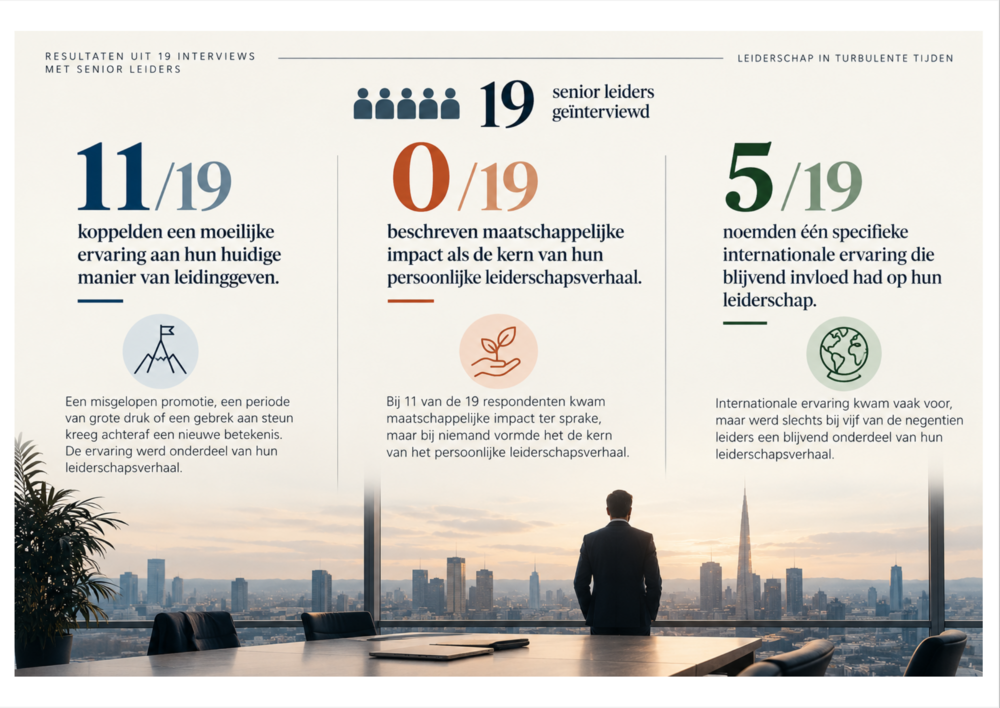
Elf van de negentien leiders koppelden een moeilijke periode uit hun loopbaan aan de manier waarop ze vandaag werken of leidinggeven. Een misgelopen promotie, een gebrek aan steun of een periode van grote druk kreeg achteraf een nieuwe betekenis. Wat eerst vooral een teleurstelling of probleem leek, kreeg een andere plaats in hun levensverhaal.
Een leider vertelde bijvoorbeeld hoe een misgelopen promotie de eigen aanpak veranderde:
“Jullie hebben toen niet geïnvesteerd in mij, dus zou beter wel hier in mij investeren. Dat heeft fundamenteel mijn aanpak veranderd.”
De gebeurtenis zelf veranderde niet. Wel veranderde de betekenis die de leider er achteraf aan gaf. De ervaring werd verbonden met de loopbaan en kreeg een plaats in de manier waarop die persoon vandaag leidinggeeft.
Dat proces verloopt bovendien zelden volledig alleen. Mentoren, collega’s, teams en vertrouwenspersonen spelen vaak een belangrijke rol. Zij helpen om moeilijke ervaringen opnieuw te bekijken. Ook wie naar eigen zeggen weinig steun kreeg, kan daar achteraf een les uit trekken: juist omdat er geen back-up was, krijgt die ervaring betekenis in de manier waarop die persoon vandaag leidinggeeft.
Betekenisgeving kan zo een hulpbron worden. Ze neemt de werkdruk niet weg, maar helpt leiders om ervaringen te begrijpen en ermee verder te kunnen. Dat betekent niet automatisch dat iedereen door moeilijke ervaringen persoonlijk groeit. Soms leidt een nieuwe interpretatie tot verandering; soms helpt ze vooral om een eerdere keuze beter te begrijpen.
Nul op negentien
Consultancyorganisaties communiceren steeds vaker over duurzaamheid, inclusie en maatschappelijke impact. Toch staat dat thema opvallend weinig centraal in de persoonlijke verhalen van hun leiders.
Elf van de negentien respondenten brachten maatschappelijke impact ter sprake. Geen enkele respondent beschreef maatschappelijke impact als de kern van het eigen leiderschapsverhaal.
Dat betekent niet dat de leiders maatschappelijke verantwoordelijkheid afwijzen. Ze verwezen naar pro-bonowerk, inclusieve rekrutering, lesgeven en duurzaamheidsprojecten. Tegelijk plaatsten ze daar kanttekeningen bij. Een leider vatte het nuchter samen:
“We are not an NGO, so sometimes, uh, we do business where we can.”
Een andere respondent verwees naar Europese duurzaamheidsrapportering en zei dat organisaties daar soms zo sterk op inzetten dat de aandacht verschuift van wat volgens hen de essentie van het werk is.
Uit de interviews ontstaat daardoor een verschil tussen de maatschappelijke ambities die organisaties communiceren en wat leiders zelf als de kern van hun leiderschap beleven. Maatschappelijke impact is aanwezig, maar wordt niet vanzelf onderdeel van hun identiteit als leider.
Buitenland maakt je nog geen ander leider
Internationale ervaring lijkt in consultancy bijna vanzelfsprekend. Leiders werken met collega’s uit verschillende landen, reizen voor klanten en nemen deel aan internationale projecten. Toch maakt veel internationale ervaring iemand niet automatisch tot een andere leider.
Slechts vijf van de negentien respondenten haalden één specifieke internationale ervaring aan die volgens hun eigen verhaal blijvend invloed had op hun leiderschap.
Eén leider verwees naar een periode in de Verenigde Staten waarin die persoon “van dag één er echt ingegooid” werd. Een andere respondent volgde zes maanden privéles Italiaans om ook informele gesprekken in de lokale taal beter te kunnen volgen.
De hoeveelheid internationale ervaring is dus niet noodzakelijk doorslaggevend. Belangrijker is welke betekenis iemand eraan geeft. Een internationale opdracht blijft niet vanzelf hangen. Ze wordt pas onderdeel van iemands leiderschapsverhaal wanneer iemand ze verbindt met de eigen identiteit, manier van samenwerken of kijk op verantwoordelijkheid.
Ruimte voor terugblik
De drie bevindingen wijzen in dezelfde richting. Leiders worden niet alleen gevormd door wat hen overkomt, maar ook door het verhaal dat ze achteraf van die ervaringen maken.
Dat heeft gevolgen voor organisaties. Wie leiders wil ondersteunen, moet niet alleen opleidingen of technische managementtrainingen aanbieden. Ook gesprekken over moeilijke ervaringen, coaching tussen collega’s en tijd voor reflectie kunnen belangrijk zijn. Een nabespreking na een zware opdracht kan bijvoorbeeld niet alleen vragen wat goed of fout ging, maar ook welke betekenis iemand aan die ervaring geeft.
Mijn onderzoek toont niet hoe alle leiders in alle sectoren functioneren. Het laat zien hoe deze negentien leiders zelf terugkijken op hun ervaringen en hoe die ervaringen onderdeel worden van hun leiderschapsverhaal.
De turbulentie op het werk valt niet altijd stil. Maar organisaties kunnen er wel voor zorgen dat leiders niet telkens alleen moeten uitzoeken welk verhaal ze ermee maken.
Want soms begint goed leiderschap met iets eenvoudigs: zorgen dat er wél een back-up is.
Bibliografie
REFERENTIES
Aguinis, H., & Glavas, A. (2012). What we know and don’t know about corporate social
responsibility. Journal of Management, 38(4), 932–968.
https://doi.org/10.1177/0149206311436079
Alheit, P., & Dausien, B. (2002). The 'double face' of lifelong learning: Two analytical
perspectives on a 'silent revolution'. Studies in the Education of Adults, 34(1), 3–22.
Alvesson, M. (1995). Management of Knowledge-Intensive Companies. De Gruyter.
Alvesson, M., & Sköldberg, K. (2018). Reflexive methodology: New vistas for qualitative
research (3rd ed.). SAGE.
Atkinson, R., & Flint, J. (2001). Accessing hidden and hard-to-reach populations: Snowball
research strategies. Social Research Update, 33.
Austin, J., Stevenson, H., & Wei–Skillern, J. (2006). Social and commercial entrepreneurship:
same, different, or both? Entrepreneurship Theory and Practice, 30(1), 1–22.
https://doi.org/10.1111/j.1540-6520.2006.00107.x
Bäcklander, G., Rosengren, C., & Kaulio, M. (2018). Managing intensity in knowledge work:
Self-leadership practices among Danish management consultants. Journal of Management &
Organization, 27(2), 342–360. https://doi.org/10.1017/jmo.2018.64
Bakker, A. B., & Demerouti, E. (2007). The Job Demands-Resources model: state of the art.
Journal of Managerial Psychology, 22(3), 309–328.
https://doi.org/10.1108/02683940710733115
Bakker, A. B., & Demerouti, E. (2017). Job demands–resources theory: Taking stock and
looking forward. Journal of Occupational Health Psychology, 22(3), 273–285.
https://doi.org/10.1037/ocp0000056
Banerjee, S. B. (2008). Corporate social responsibility: The good, the bad and the ugly. Critical
Sociology, 34(1), 51–79. https://doi.org/10.1177/0896920507084623
Battilana, J., & Lee, M. (2014). Advancing Research on Hybrid Organizing – Insights from the
Study of Social Enterprises. Academy of Management Annals, 8(1), 397–441.
https://doi.org/10.5465/19416520.2014.893615
Berger, R., Czakert, J. P., Leuteritz, J., & Leiva, D. (2019). How and When Do Leaders Influence
Employees’ Well-Being? Moderated Mediation Models for Job Demands and Resources. Frontiers
in Psychology, 10, 2788. https://doi.org/10.3389/fpsyg.2019.02788
Besharov, M. L., & Smith, W. K. (2014). Multiple institutional logics in organizations: explaining
their varied nature and implications. Academy of Management Review, 39(3), 364–381.
https://doi.org/10.5465/amr.2011.0431
Blumer, H. (1954). What is Wrong with Social Theory? American Sociological Review, 19(1), 3–
10. https://doi.org/10.2307/2088165
Bowen, G. A. (2006). Grounded theory and sensitizing concepts. International Journal of
Qualitative Methods, 5(3), 12–23. https://doi.org/10.1177/160940690600500304
Braun, V., & Clarke, V. (2019). Reflecting on reflexive thematic analysis. Qualitative Research
in Sport, Exercise and Health, 11(4), 589–597.
https://doi.org/10.1080/2159676X.2019.1628806
Braun, V., & Clarke, V. (2021). One size fits all? What counts as quality practice in (reflexive)
thematic analysis? Qualitative Research in Psychology, 18(3), 328–352.
https://doi.org/10.1080/14780887.2020.1769238
Breevaart, K., Bakker, A., Hetland, J., Demerouti, E., Olsen, O. K., & Espevik, R. (2013). Daily
transactional and transformational leadership and daily employee engagement. Journal of
Occupational and Organizational Psychology, 87(1), 138–157.
https://doi.org/10.1111/joop.12041
Brieger, S. A., De Clercq, D., & Meynhardt, T. (2020). Doing good, feeling good? Entrepreneurs’
social value creation beliefs and work-related well-being. Journal of Business Ethics, 172(4),
707–725. https://doi.org/10.1007/s10551-020-04512-6
Brock, D. M., & Alon, I. (2009). Internationalization of professional service firms. International
Business: Research, Teaching & Practice, 3(1), 53–70.
Brunsson, N. (1989). The organization of hypocrisy: Talk, decisions and actions in
organizations. Wiley.
Cahyadi, A., Poór, J., & Szabó, K. (2022). Pursuing consultant performance: the roles of
sustainable leadership styles, sustainable human resource management practices, and
consultant job satisfaction. Sustainability, 14(7), 3967. https://doi.org/10.3390/su14073967
Castells, M. (1996). The rise of the network society. Blackwell.
Christensen, L. T., Morsing, M., & Thyssen, O. (2013). CSR as aspirational talk. Organization,
20(3), 372–393. https://doi.org/10.1177/1350508413478310
Costas, J., & Fleming, P. (2009). Beyond dis-identification: A discursive approach to self-
alienation in contemporary organizations. Human Relations, 62(3), 353–378.
https://doi.org/10.1177/0018726708101041
Cristofaro, M. (2021). Organizational sensemaking: A systematic review and a co-evolutionary
model. European Management Journal, 40(3), 393–405.
https://doi.org/10.1016/j.emj.2021.07.003
Cunliffe, A. L. (2003). Reflexive inquiry in organizational research: Questions and possibilities.
Human Relations, 56(8), 983–1003. https://doi.org/10.1177/00187267030568004
Czarniawska, B. (1998). A narrative approach to organization studies. SAGE.
den Hertog, P. (2000). Knowledge-intensive business services as co-producers of innovation.
International Journal of Innovation Management, 4(4), 491–528.
https://doi.org/10.1142/S136391960000024X
Eckstein, G., Shrestha, A., & Russo, F. (2024). Thirty-five years of sensemaking in the business
& management research: a bibliometric analysis, review and discussion. Management Review
Quarterly. https://doi.org/10.1007/s11301-024-00458-5
Empson, L. (2019). Ambiguous authority and hidden hierarchy: Collective leadership in an elite
professional service firm. Leadership, 16(1), 62–86.
https://doi.org/10.1177/1742715019886769
Eriksson, E. M. (2022). Value in Consulting assisted projects: A consultant perspective on value
co-creation capabilities and activities [Master's thesis, Uppsala University]. DiVA.
https://www.diva-portal.org/smash/record.jsf?pid=diva2%3A1655434
Faculteit Psychologie en Educatiewetenschappen, Vrije Universiteit Brussel. (z.d.). AI en
masterproeven: Richtlijnen Faculteit Psychologie en Educatiewetenschappen. [Intern
document].
Faulconbridge, J., & Muzio, D. (2008). Organizational professionalism in globalizing law firms.
Work Employment and Society, 22(1), 7–25. https://doi.org/10.1177/0950017007087413
Foldy, E. G., Goldman, L., & Ospina, S. (2008). Sensegiving and the role of cognitive shifts in
the work of leadership. The Leadership Quarterly, 19(5), 514–529.
https://doi.org/10.1016/j.leaqua.2008.07.004
Froese, F. J., Blay, T., Gibson, C. B., Shaffer, M. A., & Benitez, J. (2025). Global virtual work: a
review, integrative framework, and future research opportunities. Journal of International
Business Studies, 56(6), 691–719. https://doi.org/10.1057/s41267-025-00775-1
Gioia, D. A., & Chittipeddi, K. (1991). Sensemaking and sensegiving in strategic change
initiation. Strategic Management Journal, 12(6), 433–448.
https://doi.org/10.1002/smj.4250120604
Gioia, D. A., Corley, K. G., & Hamilton, A. L. (2013). Seeking qualitative rigor in inductive
research: Notes on the Gioia methodology. Organizational Research Methods, 16(1), 15–31.
https://doi.org/10.1177/1094428112452151
Gioia, D. A., Patvardhan, S. D., Hamilton, A. L., & Corley, K. G. (2013). Organizational identity
formation and change. Academy of Management Annals, 7(1), 123–193.
https://doi.org/10.1080/19416520.2013.762225
Harvey, W. S., Mitchell, V., Jones, A. A., & Knight, E. (2021). The tensions of defining and
developing thought leadership within knowledge-intensive firms. Journal of Knowledge
Management, 25(11), 1–33. https://doi.org/10.1108/jkm-06-2020-0431
Hofstede, G. (2001). Culture's consequences: Comparing values, behaviors, institutions and
organizations across nations (2nd ed.). Sage Publications.
Hofstede, G. (2011). Dimensionalizing cultures: The Hofstede model in context. Online
Readings in Psychology and Culture, 2(1). https://doi.org/10.9707/2307-0919.1014
Hofstede, G., Hofstede, G. J., & Minkov, M. (2010). Cultures and organizations: Software of the
mind (3rd ed.). McGraw-Hill.
Inkson, K., & Arthur, M. B. (2001). How to be a successful career capitalist. Organizational
Dynamics, 30(1), 48–61. https://doi.org/10.1016/S0090-2616(01)00040-7
Kaiser, S., Patras, J., Adolfsen, F., Richardsen, A. M., & Martinussen, M. (2020). Using the Job
Demands–Resources Model to evaluate Work-Related outcomes among Norwegian health care
workers. SAGE Open, 10(3). https://doi.org/10.1177/2158244020947436
Kakabadse, N. K., Louchart, E., & Kakabadse, A. (2006). Consultant's role: A qualitative inquiry
from the consultant's perspective. Journal of Management Development, 25(5), 416–500.
https://doi.org/10.1108/02621710610666268
King, N. (2012). Doing template analysis. In G. Symon & C. Cassell (Eds.), Qualitative
organizational research: Core methods and current challenges (pp. 426–450). SAGE.
King, N. (2018). Template analysis in organizational research. In C. Cassell, A. L. Cunliffe, & G.
Grandy (Eds.), The SAGE handbook of qualitative business and management research methods
(pp. 219–236). SAGE.
Kirkman, B. L., Lowe, K. B., & Gibson, C. B. (2006). A quarter century of Culture's
Consequences: A review of empirical research incorporating Hofstede's cultural values
framework. Journal of International Business Studies, 37(3), 285–320.
https://doi.org/10.1057/palgrave.jibs.8400202
Kolb, D. A. (1984). Experiential learning: Experience as the source of learning and
development. Prentice Hall.
Kvale, S., & Brinkmann, S. (2009). Interviews: Learning the craft of qualitative research
interviewing. Sage.
Langley, A., & Empson, L. (2015). Leadership and professionals: Multiple manifestations of
influence in professional service firms. In L. Empson, D. Muzio, J. P. Broschak, & B. Hinings
(Eds.), The Oxford handbook of professional service firms (pp. 163–188). Oxford University
Press. https://doi.org/10.1093/oxfordhb/9780199682393.013.11
Lincoln, Y. S., & Guba, E. G. (1985). Naturalistic inquiry. SAGE.
Lobe, B., Morgan, D. L., & Hoffman, K. (2022). A systematic comparison of in-person and
video-based online interviewing. International Journal of Qualitative Methods, 21.
https://doi.org/10.1177/16094069221127068
Maitlis, S. (2005). The social processes of organizational sensemaking. Academy of
Management Journal, 48(1), 21–49. https://doi.org/10.5465/amj.2005.15993111
Maitlis, S., & Christianson, M. (2014). Sensemaking in organizations: taking stock and moving
forward. Academy of Management Annals, 8(1), 57–125.
https://doi.org/10.5465/19416520.2014.873177
Malterud, K., Siersma, V. D., & Guassora, A. D. (2016). Sample size in qualitative interview
studies: Guided by information power. Qualitative Health Research, 26(13), 1753–1760.
https://doi.org/10.1177/1049732315617444
Markham, A. (2017, February). Reflexivity for interpretive researchers.
https://www.annettemarkham.com/2017/02/reflexivity-for-interpretive-res…
Maznevski, M. L., & Chudoba, K. M. (2000). Bridging space over time: global virtual team
dynamics and effectiveness. Organization Science, 11(5), 473–492.
https://doi.org/10.1287/orsc.11.5.473.15200
McSweeney, B. (2002). Hofstede's model of national cultural differences and their
consequences: A triumph of faith – a failure of analysis. Human Relations, 55(1), 89–118.
https://doi.org/10.1177/0018726702551004
Meynhardt, T. (2009). Public Value Inside: What is Public Value Creation? International Journal
of Public Administration, 32(3–4), 192–219. https://doi.org/10.1080/01900690902732632
Mezirow, J. (1991). Transformative dimensions of adult learning. Jossey-Bass.
Miles, I., Kastrinos, N., Bilderbeek, R., den Hertog, P., Flanagan, K., Huntink, W., & Bouman, M.
(1995). Knowledge-intensive business services: Users, carriers and sources of innovation (EIMS
Publication No. 15). European Commission.
Millar, C. C., Chen, S., & Waller, L. (2016). Leadership, knowledge and people in knowledge-
intensive organisations: implications for HRM theory and practice. The International Journal of
Human Resource Management, 28(2), 261–275.
https://doi.org/10.1080/09585192.2016.1244919
Minbaeva, D., Fitzsimmons, S., & Brewster, C. (2021). Beyond the double-edged sword of
cultural diversity in teams: Progress, critique, and next steps. Journal of International Business
Studies, 52(1), 45–55. https://doi.org/10.1057/s41267-020-00390-2
Misra, R., Dahal, R., Kirk, B., Khan, R., Dogan, G., Chataut, R., & Gyawali, P. (2026). Large
language models in qualitative analysis: Comparing traditional and researcher-interpreted
approaches. International Journal of Qualitative Methods, 25.
https://doi.org/10.1177/16094069261426100
Mosonyi, S., Empson, L., & Gond, J. (2019). Management Consulting: towards an integrative
framework of knowledge, identity, and power. International Journal of Management Reviews,
22(2), 120–149. https://doi.org/10.1111/ijmr.12218
Muller, E., & Doloreux, D. (2009). What we should know about knowledge-intensive business
services. Technology in Society, 31(1), 64–72. https://doi.org/10.1016/j.techsoc.2008.10.001
Näsholm, M. H. (2009). An identity construction perspective on careers of Swedish international
itinerants. Management Revue, 20(1), 53–69. https://doi.org/10.5771/0935-9915-2009-1-53
Ochieng, E. G., & Price, A. D. (2010). Managing cross-cultural communication in multicultural
construction project teams: The case of Kenya and UK. International Journal of Project
Management, 28(5), 449–460. https://doi.org/10.1016/j.ijproman.2009.08.001
O'Connor, C., & Joffe, H. (2020). Intercoder reliability in qualitative research: Debates and
practical guidelines. International Journal of Qualitative Methods, 19, 1–13.
https://doi.org/10.1177/1609406919899220
O’Higgins, C., Andreeva, T., & Goya, N. A. (2021). International management challenges of
professional service firms: a synthesis of the literature. Review of International Business and
Strategy, 31(4), 596–621. https://doi.org/10.1108/ribs-07-2020-0087
Patton, M. Q. (2015). Qualitative research and evaluation methods (4th ed.). SAGE.
Porter, M. E., & Kramer, M. R. (2011). Creating shared value. Harvard Business Review, 89(1–
2), 62–77.
Pratt, M. G. (2009). From the editors: For the lack of a boilerplate: Tips on writing up (and
reviewing) qualitative research. Academy of Management Journal, 52(5), 856–862.
https://doi.org/10.5465/amj.2009.44632557
Reihlen, M., & Nikolova, N. (2010). Knowledge production in consulting teams. Scandinavian
Journal of Management, 26(3), 279–289. https://doi.org/10.1016/j.scaman.2010.05.004
Rosso, B. D., Dekas, K. H., & Wrzesniewski, A. (2010). On the meaning of work: A theoretical
integration and review. Research in Organizational Behavior, 30, 91–127.
https://doi.org/10.1016/j.riob.2010.09.001
Sandelowski, M. (1995). Sample size in qualitative research. Research in Nursing & Health,
18(2), 179–183. https://doi.org/10.1002/nur.4770180211
Sassen, S. (2001). The global city: New York, London, Tokyo (2nd ed.). Princeton University
Press.
Schaufeli, W. B. (2015). Engaging leadership in the job demands-resources model. Career
Development International, 20(5), 446–463. https://doi.org/10.1108/cdi-02-2015-0025
Schaufeli, W. B., & Bakker, A. B. (2004). Job demands, job resources, and their relationship
with burnout and engagement: a multi-sample study. Journal of Organizational Behavior, 25(3),
293–315. https://doi.org/10.1002/job.248
Schön, D. A. (1983). The reflective practitioner: How professionals think in action. Basic Books.
Schwartz-Shea, P., & Yanow, D. (2012). Interpretive research design: Concepts and processes.
Routledge.
Skjølsvik, T., Pemer, F., & Løwendahl, B. R. (2017). Strategic management of professional
service firms: Reviewing ABS journals and identifying key research themes. Journal of
Professions and Organization, 4(2), 203–239. https://doi.org/10.1093/jpo/jox005
Spector-Mersel, G. (2011). Mechanisms of selection in claiming narrative identities: A model for
interpreting narratives. Qualitative Inquiry, 17(2), 172–185.
https://doi.org/10.1177/1077800410393885
Stahl, G. K., & Brannen, M. Y. (2013). Building cross-cultural leadership competence: An
interview with Carlos Ghosn. Academy of Management Learning & Education, 12(3), 494–502.
https://doi.org/10.5465/amle.2012.0246
Stahl, G. K., Maznevski, M. L., Voigt, A., & Jonsen, K. (2009). Unraveling the effects of cultural
diversity in teams: A meta-analysis of research on multicultural work groups. Journal of
International Business Studies, 41(4), 690–709. https://doi.org/10.1057/jibs.2009.85
Tai, R. H., Bentley, L. R., Xia, X., Sitt, J. M., Fankhauser, S. C., Chicas-Mosier, A. M., &
Monteith, B. G. (2024). An examination of the use of large language models to aid analysis of
textual data. International Journal of Qualitative Methods, 23.
https://doi.org/10.1177/16094069241231168
Tavory, I., & Timmermans, S. (2014). Abductive analysis: Theorizing qualitative research.
University of Chicago Press.
Trundle, C., Araújo, N., Khan, S., & Phillips, T. (2025). Beyond the mirror: Challenging the
common assumptions of reflexivity in qualitative research. International Journal of Qualitative
Methods, 24. https://doi.org/10.1177/16094069251369311
Tummers, L. G., & Bakker, A. B. (2021). Leadership and Job Demands-Resources Theory: A
Systematic Review. Frontiers in Psychology, 12, 722080.
https://doi.org/10.3389/fpsyg.2021.722080
Weick, K. E. (1995). Sensemaking in organizations. SAGE.
Werr, A., & Stjernberg, T. (2003). Exploring management consulting firms as knowledge
systems. Organization Studies, 24(6), 881–908.
https://doi.org/10.1177/0170840603024006004
Xanthopoulou, D., Bakker, A. B., Demerouti, E., & Schaufeli, W. B. (2007). The role of personal
resources in the job demands-resources model. International Journal of Stress Management,
14(2), 121–141. https://doi.org/10.1037/1072-5245.14.2.121