Zwarte gaten: luisteren naar de grens van Einsteins theorie
Zwarte gaten slokken alles op dat te dichtbij komt, zelfs licht ontsnapt niet aan hun greep. We kunnen ze daarom niet zien, maar we kunnen ze wel horen. Op 14 september 2015 ving een detector in de Verenigde Staten voor het eerst zo’n geluid op, een fractie van een seconde, veroorzaakt door twee zwarte gaten die miljarden lichtjaren verderop met elkaar botsten en versmolten tot één nieuw zwart gat, dat nog even natrilde. Die trilling bevestigde precies wat Einstein een eeuw eerder had voorspeld. Maar wat als de volgende trilling dat niet doet? Wij onderzochten waar we dat het eerst zouden kunnen horen.

Twee zwarte gaten die botsen en trillingen uitsturen.
Waarom Einstein waarschijnlijk geen gelijk had
Einsteins algemene relativiteit beschrijft zwaartekracht niet als een kracht, maar als een kromming van ruimte en tijd zelf. Deze theorie bracht een revolutie teweeg in hoe we naar het universum kijken, van vallende appels tot de grootste kosmische schalen. In meer dan een eeuw heeft de theorie elke test overleefd die ze onderging, van het bestaan van zwarte gaten en zwaartekrachtsgolven tot kleine afwijkingen in de baan van Mercurius.
Ondanks dit overweldigende bewijs, zijn we steeds zekerder dat algemene relativiteit niet het laatste woord is. De theorie voorspelt singulariteiten: punten waar de kromming van de ruimtetijd oneindig groot wordt, waar de theorie tegen haar eigen grenzen aanloopt. Daarbovenop kan Einsteins theorie niet verenigd worden met kwantummechanica, onze beschrijving van het universum op de kleinste schaal. Daarom is de vraag niet langer óf Einstein gelijk heeft, maar waar de eerste afwijking zichtbaar zou kunnen worden.
En laten zwarte gaten daar nu een perfecte kandidaat voor zijn.
Luisteren naar de vorm van een zwart gat
Sla je een bel aan, dan gaat die trillen. Hoe hard je erop slaat bepaalt hoe luid het geluid is, maar de karakteristieke tonen worden bepaald door de eigenschappen van de bel. Door te luisteren naar die tonen, kun je dus de vorm van de bel bepalen. Exact hetzelfde gebeurt met zwarte gaten: als iets het zwarte gat treft, dan zendt het een karakteristieke set aan frequencies uit, die ons vertellen hoe het zwarte gat eruitziet. We kunnen letterlijk horen wat de eigenschappen van het zwarte gat zijn.

Hoe kleiner de bel, hoe hoger de toon. Hetzelfde geldt voor zwarte gaten.
Dat is precies wat zwarte gaten zo geschikt maakt om Einstein te testen: deze trillingen volgen exact uit zijn vergelijkingen. Elke noot ligt vast zodra je de massa en de spin van het zwarte gat kent, althans als Einstein gelijk heeft. Wijkt de gemeten trilling ook maar een fractie af van wat de vergelijkingen voorspellen, dan wijst dat naar iets wat Einstein niet zag aankomen. Het is dus een muzikale vingerafdruk van zwaartekracht zelf, en zo een directe manier om een theorie op de proef te stellen is zeldzaam.
Herhaalt de geschiedenis zich?
Begin twintigste eeuw ontdekten natuurkundigen iets vreemds: elk atoom gloeit op zijn eigen unieke manier. Verhit waterstof, en het licht dat vrijkomt heeft altijd exact dezelfde kleuren. Bij helium of andere elementen gebeurt hetzelfde: telkens een andere, maar altijd identieke vingerafdruk. Die ontdekking leek een detail, maar zette de deur open naar de kwantumrevolutie: een volledig nieuwe kijk op hoe de natuur in elkaar zit.
Zwarte gaten trillen op een verrassend gelijkaardige manier, met hun eigen unieke trillingen. Niemand weet zeker waar deze ontdekking naartoe leidt, maar de vorige keer dat we zoiets fundamenteel ontdekten, veranderde het dus voorgoed hoe we naar de natuur kijken.
Kleine stapjes, geen revolutie
Als je vermoedt dat Einstein ergens misging, is de verleiding groot om meteen met een nieuwe theorie te komen. Wij deden het omgekeerde: we gooiden Einsteins theorie niet overboord, maar pasten ze heel voorzichtig aan: met kleine, gecontroleerde correcties in plaats van een volledige herschrijving. Denk hierbij aan het bijstellen van een landkaart in plaats van deze weg te gooien. Je wilt weten waar er ergens een foutje in zit, niet de hele kaart opnieuw tekenen.
Met die kleine bijstellingen hebben we berekend hoe de trillingen van zwarte gaten zouden veranderen als Einstein geen gelijk had. Het resultaat vertelt ons hoe het getril specifiek zal veranderen. De vraag die volgt is dan: bij welke zwarte gaten, en in welk deel van het getril, zouden we die afwijking het eerst kunnen betrappen?
Klein en gevoelig
Het antwoord: kleine, snel roterende zwarte gaten zijn bijzonder gevoelig voor zulke afwijkingen. Niet elk zwart gat is dus even interessant. Voor kleine, snel roterende zwarte gaten veranderen de karakteristieke trillingen het sterkst wanneer zwaartekracht afwijkt van Einsteins voorspellingen. Dat maakt ze bijzonder interessante kandidaten om te beluisteren.
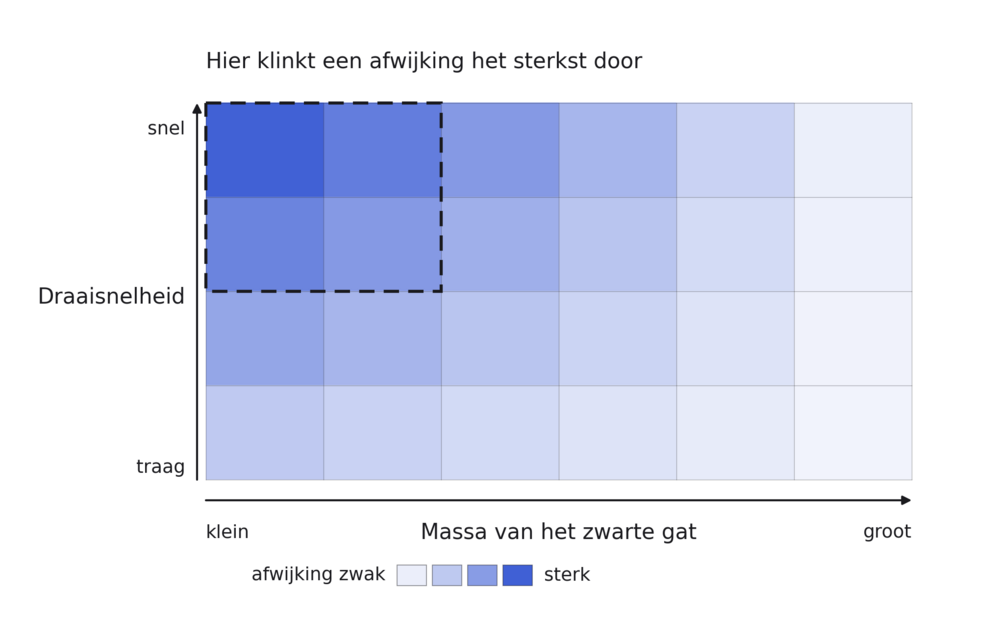
We hebben die voorspelling ook getoetst aan metingen van detectoren. Voorlopig doorstaat Einsteins theorie ook deze extra test. Dat betekent echter niet dat de zoektocht voorbij is. Integendeel, dankzij dit onderzoek weten we nu exact waar we moeten zoeken naar barstjes in Einsteins theorie, en hoe die barstjes eruit zouden zien.
Die kennis is exact wat de volgende generatie detectoren nodig heeft. Die nieuwe zwaartekrachtsgolfdetectoren zouden wel eens gevoelig genoeg kunnen zijn om zo een afwijking voor het eerst écht te ontdekken. Dan kunnen we gericht zoeken en met veel grotere precisie dan de huidige generatie kan.
Zwarte gaten in onze eigen achtertuin
Een van die nieuwe instrumenten, de Einstein Telescope, ET voor de vrienden, zou weleens vlak bij ons kunnen verrijzen: in de grensstreek tussen België, Nederland en Duitsland. Zeker is het nog niet, maar de kans is reëel.

Schematische voorstelling van de Einstein Telescope. Credits: NIKHEF/Marco Kraan
Tien jaar geleden hoorden we voor het eerst dat Einstein gelijk had. Voorlopig klinkt het heelal nog steeds zoals Einstein het berekende. Maar we zijn nog lang niet klaar met luisteren. Misschien staat met ET de volgende test wel letterlijk in onze achtertuin, en horen we dan eindelijk iets dat Einstein nooit voorspeld heeft.
Bibliografie
[1] F. S. Miguel. EFT corrections to scalar and vector quasinormal modes of rapidly
rotating black holes. Physical Review D, 109(10):104016, May 2024.
[2] S. J.B. Husken, T. van der Steen, S. Maenaut, K. K.H. Lam, et al. Quadratic
gravity corrections to scalar QNMs of rapidly rotating black holes, April 2026.
[3] T. van der Steen, S. Maenaut, S. J.B. Husken, P. G.S. Fernandes, et al. Ringing of
rapidly rotating black holes in effective field theory, April 2026.
[4] P. A. Cano, M. David, and G. van der Velde. Amplification of new physics in the
quasinormal mode spectrum of highly-rotating black holes, October 2025.
[5] S. Maenaut, G. Carullo, P. A. Cano, A. Liu, et al. Ringdown analysis of rotating
black holes in effective field theory extensions of general relativity. Physical Review
D: Particles and Fields, 113(4):044039, February 2026.
[6] A. K.W. Chung and N. Yunes. Probing quadratic gravity with black-hole ringdown
gravitational waves measured by LIGO-Virgo-KAGRA detectors, June 2025.
[7] G. Carullo, W. Del Pozzo, and J. Veitch. pyRing: a time-domain ringdown analysis
python package, 2023.
[8] P. Pani and A. P. Sanna. Scalar shortcut to beyond-Kerr ringdown tests and their
complementarity with black-hole shadow observations, March 2026.
[9] B.P. Abbott, R. Abbott, T. D. Abbott, M.R. Abernathy, et al. Observation of
Gravitational Waves from a Binary Black Hole Merger. Physical Review Letters,
116, February 2016.
[10] A.G. Abac, I. Abouelfettouh, F. Acernese, et al. GWTC-4.0: Updating the
Gravitational-Wave Transient Catalog with Observations from the First Part of
the Fourth LIGO-Virgo-KAGRA Observing Run, August 2025.
[11] A.G. Abac, I. Abouelfettouh, F. Acernese, et al. Black Hole Spectroscopy and Tests
of General Relativity with GW250114. Physical Review Letters, 136(4):041403,
January 2026.
[12] A.G. Abac, I. Abouelfettouh, F. Acernese, et al. GW250114: Testing Hawk-
ing’s Area Law and the Kerr Nature of Black Holes. Physical Review Letters,
135(11):111403, September 2025.
[13] R. Abbott, H. Abe, F. Acernese, et al. Tests of General Relativity with GWTC-3,
October 2025.
[14] A.G. Abac, I. Abouelfettouh, F. Acernese, et al. GWTC-4.0: Tests of General
Relativity. I. Overview and General Tests, March 2026.
[15] A.G. Abac, I. Abouelfettouh, F. Acernese, et al. GWTC-4.0: Tests of General
Relativity. II. Parameterized Tests, March 2026.
[16] A.G. Abac, I. Abouelfettouh, F. Acernese, et al. GWTC-4.0: Tests of General
Relativity. III. Tests of the Remnants, March 2026.
[17] N. Yunes, X. Siemens, and K. Yagi. Gravitational-wave tests of general relativity
with ground-based detectors and pulsar-timing arrays. Living Reviews in Relativity,
28(1):3, March 2025.
[18] G. Carullo, L. Van Der Schaaf, L. London, et al. Empirical tests of the black
hole no-hair conjecture using gravitational-wave observations. Physical Review D,
98(10):104020, November 2018.
[19] E. Berti, K. Yagi, H. Yang, and N. Yunes. Extreme Gravity Tests with Gravitational
Waves from Compact Binary Coalescences: (II) Ringdown. General Relativity and
Gravitation, 50(5):49, April 2018.
[20] O. Dreyer, B. J. Kelly, B. Krishnan, L. S. Finn, et al. Black hole spectroscopy:
Testing general relativity through gravitational wave observations. Classical and
Quantum Gravity, 21(4):787–804, 2004.
[21] E. Berti, V. Cardoso, and C. M. Will. On gravitational-wave spectroscopy of massive
black holes with the space interferometer LISA. Physical Review D, 73(6):064030,
2006.
[22] E. Berti, V. Cardoso, and A. O. Starinets. Quasinormal modes of black holes and
black branes. Class. Quant. Grav., 26:163001, 2009.
[23] H.P. Nollert. Quasinormal modes: the characteristic ‘sound’ of black holes and
neutron stars. Classical and Quantum Gravity, 16(12):R159, dec 1999.
[24] K. D. Kokkotas and B. G. Schmidt. Quasi-normal modes of stars and black holes.
Living Reviews in Relativity, 2(1), September 1999.
[25] E. Berti, V. Cardoso, G. Carullo, et al. Black hole spectroscopy: from theory to
experiment. Classical and Quantum Gravity, 2026.
[26] N. Franchini and S. H. V¨olkel. Testing General Relativity with Black Hole Quasi-
normal Modes. In Recent Progress on Gravity Tests: Challenges and Future Per-
spectives, pages 361–416. Springer Nature Singapore, Singapore, 2024.
[27] C.V. Vishveshwara. Stability of the Schwarzschild Metric. Physical Review D,
1(10):2870–2879, 1970.
[28] V. Cardoso and L. Gualtieri. Perturbations of Schwarzschild black holes in Dy-
namical Chern-Simons modified gravity. Physical Review D: Particles and Fields,
80:064008, 2009.
[29] C. Molina, P. Pani, V. Cardoso, and L. Gualtieri. Gravitational signature of
Schwarzschild black holes in dynamical Chern-Simons gravity. Physical Review D:
Particles and Fields, 81:124021, 2010.
[30] J. L. Bl´azquez-Salcedo, C. F. B. Macedo, V. Cardoso, V. Ferrari, et al. Per-
turbed black holes in Einstein-dilaton-Gauss-Bonnet gravity: Stability, ring-
down, and gravitational-wave emission. Physical Review D: Particles and Fields,
94(10):104024, November 2016.
[31] J. L. Bl´azquez-Salcedo, F. S. Khoo, and J. Kunz. Quasinormal modes of
Einstein-Gauss-Bonnet-dilaton black holes. Physical Review D: Particles and Fields,
96(6):064008, September 2017.
[32] O. J. Tattersall and P. G. Ferreira. Quasinormal modes of black holes in Horndeski
gravity. Physical Review D: Particles and Fields, 97(10):104047, May 2018.
[33] V. Cardoso, M. Kimura, A. Maselli, and L. Senatore. Black Holes in an Ef-
fective Field Theory Extension of General Relativity. Physical Review Letters,
121(25):251105, December 2018.
[34] V. Cardoso, M. Kimura, A. Maselli, E. Berti, et al. Parametrized black hole quasi-
normal ringdown: Decoupled equations for nonrotating black holes. Physical Review
D: Particles and Fields, 99(10):104077, May 2019.
[35] R. McManus, E. Berti, C. F.B. Macedo, M. Kimura, et al. Parametrized black
hole quasinormal ringdown. II. Coupled equations and quadratic corrections for
nonrotating black holes. Physical Review D: Particles and Fields, 100(4):044061,
August 2019.
[36] R.A. Konoplya and A.F. Zinhailo. Quasinormal modes, stability and shadows of
a black hole in the 4D Einstein–Gauss–Bonnet gravity. The European Physical
Journal C: Particles and Fields, 80(11):1049, November 2020.
[37] C. de Rham, J. Francfort, and J. Zhang. Black Hole Gravitational Waves in
the Effective Field Theory of Gravity. Physical Review D: Particles and Fields,
102(2):024079, July 2020.
[38] H. O. Silva, G. Tambalo, K. Glampedakis, K. Yagi, and J. Steinhoff. Quasinormal
modes and their excitation beyond general relativity. Physical Review D: Particles
and Fields, 110(2):024042, July 2024.
[39] L. Pierini and L. Gualtieri. Quasi-normal modes of rotating black holes in Einstein-
dilaton Gauss-Bonnet gravity: The first order in rotation. Physical Review D:
Particles and Fields, 103(12):124017, June 2021.
[40] M. Srivastava, Y. Chen, and S. Shankaranarayanan. Analytical computation of
quasinormal modes of slowly rotating black holes in dynamical Chern-Simons grav-
ity. Physical Review D: Particles and Fields, 104(6):064034, September 2021.
[41] P. A. Cano, K. Fransen, T. Hertog, and S. Maenaut. Gravitational ringing of
rotating black holes in higher-derivative gravity. Physical Review D: Particles and
Fields, 105(2):024064, January 2022.
[42] P. Wagle, N. Yunes, and H. O. Silva. Quasinormal modes of slowly-rotating black
holes in dynamical Chern-Simons gravity. Physical Review D: Particles and Fields,
105(12):124003, June 2022.
[43] L. Pierini and L. Gualtieri. Quasinormal modes of rotating black holes in Einstein-
dilaton Gauss-Bonnet gravity: The second order in rotation. Physical Review D:
Particles and Fields, 106(10):104009, November 2022.
[44] T. Alapati and S. Shankaranarayanan. Axial quasinormal modes of slowly rotating
black holes in dynamical Chern-Simons gravity to second order in spin and coupling.
Physical Review D, 112(2):024053, July 2025.
[45] A. K.W. Chung and N. Yunes. Quasinormal mode frequencies and gravita-
tional perturbations of black holes with any subextremal spin in modified grav-
ity through METRICS: The scalar-Gauss-Bonnet gravity case. Physical Review D,
110(6):064019, September 2024.
[46] A. K.W. Chung, K. K.H. Lam, and N. Yunes. Quasinormal mode frequen-
cies and gravitational perturbations of spinning black holes in modified gravity
through METRICS: The dynamical Chern-Simons gravity case. Physical Review D,
111(12):124052, June 2025.
[47] P. A. Cano, K. Fransen, and T. Hertog. Ringing of rotating black holes in higher-
derivative gravity. Physical Review D, 102(4):044047, August 2020.
[48] P. A. Cano, K. Fransen, T. Hertog, and S. Maenaut. Universal Teukolsky equa-
tions and black hole perturbations in higher-derivative gravity. Physical Review D,
108(2):024040, July 2023.
[49] P. A. Cano, K. Fransen, T. Hertog, and S. Maenaut. Quasinormal modes of rotating
black holes in higher-derivative gravity. Physical Review D: Particles and Fields,
108(12):124032, December 2023.
[50] P. A. Cano, L. Capuano, N. Franchini, S. Maenaut, and S. H. V¨olkel. Parametrized
quasinormal mode framework for modified Teukolsky equations. Physical Review
D, 110(10):104007, November 2024.
[51] P. A. Cano, L. Capuano, N. Franchini, S. Maenaut, and S. H. V¨olkel. Higher-
derivative corrections to the Kerr quasinormal mode spectrum. Physical Review D:
Particles and Fields, 110(12):124057, December 2024.
[52] J. L. Bl´azquez-Salcedo, F. S. Khoo, B. Kleihaus, and J. Kunz. Quasinormal mode
spectrum of rotating black holes in Einstein-Gauss-Bonnet-dilaton theory. Physical
Review D, 111(6):064015, March 2025.
[53] J. L. Bl´azquez-Salcedo, F. S. Khoo, B. Kleihaus, and J. Kunz. Quasinormal modes
of rapidly rotating Einstein-Gauss-Bonnet-dilaton black holes. Physical Review D,
111(2):L021505, January 2025.
[54] F. S. Khoo, J. L. Bl´azquez-Salcedo, B. Kleihaus, and J. Kunz. Quasinormal modes
of rotating black holes in shift-symmetric Einstein-scalar-Gauss–Bonnet theory. The
European Physical Journal C, 85(11):1366, November 2025.
[55] N. Yunes and F. Pretorius. Dynamical Chern-Simons Modified Gravity. I. Spinning
Black Holes in the Slow-Rotation Approximation. Physical Review D, 79(8):084043,
2009.
[56] K. Yagi, N. Yunes, and T. Tanaka. Slowly rotating black holes in dynamical
Chern-Simons gravity: Deformation quadratic in the spin. Physical Review D,
86(4):044037, August 2012.
[57] D. Ayzenberg and N. Yunes. Slowly rotating black holes in Einstein-Dilaton-Gauss-
Bonnet gravity: Quadratic order in spin solutions. Physical Review D, 90(4):044066,
August 2014.
[58] A. Maselli, P. Pani, L. Gualtieri, and V. Ferrari. Rotating black holes in
Einstein-Dilaton-Gauss-Bonnet gravity with finite coupling. Physical Review D,
92(8):083014, October 2015.
[59] P. A. Cano and A. Ruip´erez. Leading higher-derivative corrections to Kerr geometry.
Journal of High Energy Physics, 2019(5):189, May 2019.
[60] P. A. Cano, A. Deich, and N. Yunes. Accuracy of the slow-rotation approximation
for black holes in modified gravity in light of astrophysical observables. Physical
Review D: Particles and Fields, 109(2):024048, January 2024.
[61] K. K.H. Lam, A. K.W. Chung, and N. Yunes. Spinning Black Holes in Modified
Gravity via Spectral Methods. Physical Review Letters, 136(2):021401, January
2026.
[62] K. K.H. Lam, A. K.W. Chung, and N. Yunes. Analytic and accurate approximate
metrics for black holes with arbitrary rotation in beyond-Einstein gravity using
spectral methods. Physical Review D, 113(2):024030, January 2026.
[63] P. G.S. Fernandes. Leading effective field theory corrections to the Kerr metric at
all spins, December 2025.
[64] P. A. Cano, M. David, and G. van der Velde. Eikonal quasinormal modes of
highly-spinning black holes in higher-curvature gravity: A window into extremality,
September 2025.
[65] C. O. Lousto, M. Campanelli, Y. Zlochower, and H. Nakano. Remnant Masses,
Spins and Recoils from the Merger of Generic Black-Hole Binaries. Classical and
Quantum Gravity, 27(11):114006, 2010.
[66] G. T. Horowitz, M. Kolanowski, G. N. Remmen, and J. E. Santos. Extremal Kerr
Black Holes as Amplifiers of New Physics. Physical Review Letters, 131(9):091402,
August 2023.
[67] P. A. Cano and M. David. Teukolsky equation for near-extremal black holes beyond
general relativity: Near-horizon analysis. Physical Review D: Particles and Fields,
110(6):064067, September 2024.
[68] P. Grandcl´ement and J. Novak. Spectral methods for numerical relativity. Living
Reviews in Relativity, 12(1):1, 2009.
[69] O. J.C. Dias, J. E. Santos, and B. Way. Numerical Methods for Finding Stationary
Gravitational Solutions. Classical and Quantum Gravity, 33(13):133001, June 2016.
[70] C. Canuto, M. Y. Hussaini, A. Quarteroni, and T. A. Zang. Spectral Methods: Fun-
damentals in Single Domains. Scientific Computation. Springer, Berlin, Heidelberg,
2006.
[71] J. P. Boyd. Chebyshev and Fourier Spectral Methods. Dover Books on Mathematics.
Dover Publ, Mineola, NY, 1. publ., rev. and enlarged 2. ed. of the work by springer,
berlin, 1969 edition, 2001.
[72] R. Abbott, T.D. Abbott, F. Acernese, et al. GWTC-3: Compact Binary Coales-
cences Observed by LIGO and Virgo during the Second Part of the Third Observing
Run. Physical Review X, 13(4):041039, October 2023.
[73] R. Abbott, T.D. Abbott, S. Abraham, F. Acernese, et al. Tests of general relativity
with binary black holes from the second LIGO-Virgo gravitational-wave transient
catalog. Phys. Rev. D, 103:122002, Jun 2021.
[74] G. Carullo. Enhancing modified gravity detection from gravitational-wave observa-
tions using the parametrized ringdown spin expansion coeffcients formalism. Phys-
ical Review D: Particles and Fields, 103(12):124043, June 2021.
[75] H. O. Silva, A. Ghosh, and A. Buonanno. Black-hole ringdown as a probe of higher-
curvature gravity theories. Physical Review D: Particles and Fields, 107(4):044030,
February 2023.
[76] F.L. Juli´e, L. Pompili, and A. Buonanno. Inspiral-merger-ringdown waveforms
in Einstein-scalar-Gauss-Bonnet gravity within the effective-one-body formalism.
Physical Review D: Particles and Fields, 111(2):024016, January 2025.
[77] H. Liu and N. Yunes. Robust and improved constraints on higher-curvature gravita-
tional effective-field-theory with the GW170608 event. Physical Review D: Particles
and Fields, 111(8):084049, April 2025.
[78] C. Sagan. Cosmos. Random House, New York, NY, 1980.
[79] I. Newton. Philosophiae Naturalis Principia Mathematica. Royal Society, London,
UK, 1687.
[80] J. Evans. Relativity, britannica, May 2026.
[81] S. M. Carroll. Spacetime and Geometry. Addison-Wesley, Boston, MA, 2003.
[82] A. Einstein. Die feldgleichungen der gravitation. Sitzung der physikalisch-
mathematischen Klasse, November 1915.
[83] C.W. Misner, K.S. Thorne, and J.A. Wheeler. Gravitation. W. H. Freeman, San
Francisco, CA, 1973.
[84] R. Wald. General Relativity. The University of Chicago Press, Chicago, IL, 1984.
[85] J. F. Donoghue. General relativity as an effective field theory: The leading quantum
corrections. Physical Review D, 50(6):3874–3888, 1994.
[86] S. Endlich, V. Gorbenko, J. Huang, and L. Senatore. An effective formalism for
testing extensions to General Relativity with gravitational waves. Journal of High
Energy Physics, 09(9):122, September 2017.
[87] K. S. Stelle. Classical Gravity with Higher Derivatives. General Relativity and
Gravitation, 9(4):353–371, 1978.
[88] K.S. Stelle. Renormalization of Higher Derivative Quantum Gravity. Physical Re-
view D, 16(4):953–969, 1977.
[89] J. M. Lee. Introduction to Smooth Manifolds. Springer, New York, NY, 2000.
[90] O. Alexandrov. Tangent bundle, 2007. Wikimedia Commons.
[91] The Event Horizon Telescope Collaboration. First M87 Event Horizon Telescope
Results. I. The Shadow of the Supermassive Black Hole. The American Astronomical
Society, 875, 2019.
[92] R. Penrose. Gravitational collapse and space-time singularities. Physical Review
Letters, 14(57), January 1965.
[93] S.W. Hawking and R. Penrose. The singularities of gravitational collapse and cos-
mology. Proceedings of the Royal Society of London A., 314(1519), January 1970.
[94] A. Strominger and C. Vafa. Microscopic Origin of the Bekenstein-Hawking Entropy.
Physics Letters B, 379(1-4), 1996.
[95] H. Yang, F. Zhang, A. Zimmerman, D. A. Nichols, et al. Branching of quasinor-
mal modes for nearly extremal Kerr black holes. Physical Review D, 87(4):041502,
February 2013.
[96] H. Yang, A. Zimmerman, A. Zengino˘glu, F. Zhang, et al. Quasinormal modes of
nearly extremal Kerr spacetimes: Spectrum bifurcation and power-law ringdown.
Physical Review D, 88(4):044047, August 2013.
[97] K.S. Thorne. Disk-accretion onto a black hole. ii. evolution of the hole. The Astro-
physical Journal, 191:507–519, 1974.
[98] W. Israel. Event horizons in static vacuum space-times. Physical Review,
164(5):1776–1779, 1967.
[99] W. Israel. Event horizons in static electrovac space-times. Communications in
Mathematical Physics, 8(3):245–260, 1968.
[100] B. Carter. Axisymmetric Black Hole Has Only Two Degrees of Freedom. Physical
Review Letters, 26(6):331–333, 1971.
[101] M. Zajaˇcek and A. Tursunov. Electric charge of black holes: Is it really always
negligible?, April 2019.
[102] J. R. Oppenheimer and H. Snyder. On continued gravitational contraction. Phys.
Rev., 56:455–459, Sep 1939.
[103] T. M. Heckman and P. N. Best. The Coevolution of Galaxies and Supermassive
Black Holes: Insights from Surveys of the Contemporary Universe. Annual Review
of Astronomy and Astrophysics, 52:589–660, August 2014.
[104] E. Berti, E. Barausse, V. Cardoso, L. Gualtieri, et al. Testing general relativity
with present and future astrophysical observations. Classical and Quantum Gravity,
32(24):243001, December 2015.
[105] D. Tong. Lectures on string theory, 2012.
[106] S.W. Hawking. Particle creation by black holes. Communications in Mathematical
Physics, 43:199–220, 1975.
[107] S. Hadar, M. D. Johnson, A. Lupsasca, and G. N. Wong. Photon ring autocorrela-
tions. Phys. Rev. D, 103:104038, May 2021.
[108] S. E. Gralla, A. Lupsasca, and D. P. Marrone. The shape of the black hole photon
ring: A precise test of strong-field general relativity. Phys. Rev. D, 102:124004, Dec
2020.
[109] M. D. Johnson, A. Lupsasca, A. Strominger, G. N. Wong, et al. Universal interfer-
ometric signatures of a black hole’s photon ring. Science Advances, 6(12), March
2020.
[110] V. Cardoso, A. S. Miranda, E. Berti, H. Witek, and V. T. Zanchin. Geodesic
stability, Lyapunov exponents, and quasinormal modes. Phys. Rev. D, 79:064016,
Mar 2009.
[111] M. Maggiore. Gravitational Waves: Volume 1: Theory and Experiments. Oxford
University Press, Oxford, UK, 2007.
[112] S.A. Teukolsky. Perturbations of a rotating black hole. I. Fundamental equations for
gravitational, electromagnetic, and neutrino-field perturbations. The Astrophysical
Journal, 185:635–647, October 1973.
[113] T.G.F. Li. Testing the strong-field dynamics of general relativity, 2014. http:
//www.2physics.com/2014/10/testing-strong-field-dynamics-of.html.
[114] M. Maggiore. Gravitational Waves: Volume 2: Astrophysics and Cosmology. Oxford
University Press, Oxford, UK, 2018.
[115] T. W. Baumgarte and S. L. Shapiro. Numerical Relativity: Solving Einstein’s Equa-
tions on the Computer. Cambridge University Press, Cambridge, UK, 2010.
[116] F. Ohme. Analytical meets numerical relativity - status of complete gravita-
tional waveform models for binary black holes. Classical and Quantum Gravity,
29(12):124002, 2012.
[117] B.P. Abbott, R. Abbott, T. D. Abbott, F. Acernese, et al. GW170817: Observa-
tion of Gravitational Waves from a Binary Neutron Star Inspiral. Physical Review
Letters, 119(161101), October 2017.
[118] J. M. Lattimer. The nuclear equation of state and neutron star masses. Annual
Review of Nuclear and Particle Science, 62(1):485–515, November 2012.
[119] B.P. Abbott, R. Abbott, T. D. Abbott, F. Acernese, et al. A gravitational-wave
standard siren measurement of the Hubble constant. Nature, 511:85–88, October
2017.
[120] X.T. Zhang, J. Gair, C. Messenger, N. Korsakova, et al. Pre-localization of massive
black hole binaries in the millihertz band, 2026.
[121] P. Brax, A.C. Davis, Md R. Haque, C. Jockel, et al. Illuminating the dark universe
in the multi-messenger era, 2026.
[122] The LIGO Scientific Collaboration, the Virgo Collaboration, and the KAGRA Col-
laboration. GWTC-5.0: Observations from the Second Part of the Fourth LIGO-
Virgo-KAGRA Observing Run and Updates to the Gravitational-Wave Transient
Catalog, 2026.
[123] J. Aasi, B. P. Abbott, R. Abbott, T. Abbott, et al. Advanced LIGO. Classical and
Quantum Gravity, 32(7):074001, March 2015.
[124] M. Born and E. Wolf. Principles of Optics. Cambridge University Press, Cambridge,
UK, 1959.
[125] Stannered. Interferometer, 2007. Wikimedia Commons.
[126] B.P. Abbott, R. Abbott, T. D. Abbott, S. Abraham, et al. A guide to LIGO-Virgo
detector noise and extraction of transient gravitational-wave signals. Classical and
Quantum Gravity, 37(055002), February 2020.
[127] W. G. Anderson, P. R. Brady, J. D. E. Creighton, and ´E. ´E. Flanagan. Excess
power statistic for detection of burst sources of gravitational radiation. Physical
Review D, 63(4), January 2001.
[128] S. L. Danilishin, F. Y. Khalili, and H. Miao. Advanced quantum techniques for
future gravitational-wave detectors. Living Reviews in Relativity, 22(1), April 2019.
[129] G. Agazie, A. Anumarlapudi, A.M. Archibald, Z. Arzoumanian, et al. The
NANOGrav 15-year Data Set: Evidence for a Gravitational-Wave Background. The
Astrophysical Journal Letters, 951(1), June 2023.
[130] J. Antoniadis, P. Arumugam, S. Arumugam, S. Babak, et al. The second data
release from the European Pulsar Timing Array III. Search for gravitational wave
signals. Astronomy & Astrophysics, 678(A50), October 2023.
[131] H. Xu, S. Chen, Y. Guo, J. Jiang, et al. Searching for the nano-Hertz stochastic
gravitational wave background with the Chinese Pulsar Timing Array Data Release
I. Research in Astronomy and Astrophysics, 23(7), June 2023.
[132] F. Acernese, M. Agathos, K. Agatsuma, D. Aisa, et al. Advanced Virgo: a second-
generation interferometric gravitational wave detector. Classical and Quantum
Gravity, 32(2):024001, December 2014.
[133] T. Akutsu, M. Ando, K. Arai, Y. Arai, et al. KAGRA: 2.5 generation interferometric
gravitational wave detector. Nature Astronomy, 3(1):35–40, January 2019.
[134] M. Colpi, K. Danzmann, M. Hewitson, K. Holley-Bockelmann, et al. LISA Definition
Study Report, 2024.
[135] Z. Luo, Y. Wang, Y. Wu, W. Hu, and G. Jin. The Taiji program: A concise overview.
Progress of Theoretical and Experimental Physics, 2021(5):05A108, 05 2021.
[136] M. Branchesi, M. Maggiore, D. Alonso, C. Badger, et al. Science with the Einstein
Telescope: a comparison of different designs. Journal of Cosmology and Astroparticle
Physics, 2023(07):068, 2023.
[137] M. Evans, R.X. Adhikari, C. Afle, S.W. Ballmer, et al. A Horizon Study for Cosmic
Explorer: Science, Observatories, and Community, 2021.
[138] A. Pound and B. Wardell. Black Hole Perturbation Theory and Gravitational Self-
Force, page 1–119. Springer Singapore, 2021.
[139] I. Gupta, P. Narayan, L. London, S. Tiwari, and B. Sathyaprakash. Testing general
relativity with amplitudes of subdominant gravitational-wave modes, 2025.
[140] S. Chandrasekhar. The Mathematical Theory of Black Holes. Oxford University
Press, Oxford, UK, 1998.
[141] M. Foucoin and L. London. Properties of natural polynomials for Schwarzschild
and Kerr black holes, 2026.
[142] L. London and M. Foucoin. Natural polynomials for Kerr quasinormal modes. Phys.
Rev. D, 113:044009, Feb 2026.
[143] L. T. London. Radial scalar product for Kerr quasinormal modes. Phys. Rev. D,
113:044008, Feb 2026.
[144] L. London, S.J.B. Husken, M. Ferrus, and M. Foucoin. Spatial projection of kerr
quasinormal modes, 2026. In preparation.
[145] M. Minucci, R.P. Macedo, C. Pantelidou, and L. Sberna. Bilinear products and the
orthogonality of quasinormal modes on hyperboloidal foliations, 2026.
[146] S. R. Green, S. Hollands, L. Sberna, V. Toomani, and P. Zimmerman. Conserved
currents for a Kerr black hole and orthogonality of quasinormal modes. Physical
Review D, 107(6), March 2023.
[147] J. Besson and J. L. Jaramillo. Quasi-normal mode expansions of black hole pertur-
bations: a hyperboloidal Keldysh’s approach. General Relativity and Gravitation,
57(7), 2025.
[148] S. Ma and H. Yang. Excitation of quadratic quasinormal modes for Kerr black
holes. Physical Review D, 109(10), May 2024.
[149] E. Cannizzaro, M. Palleschi, L. Sberna, R. Brito, and S. Green. Excitation of scalar
quasi-normal modes from boson clouds, 2025.
[150] E. Newman and R. Penrose. An Approach to Gravitational Radiation by a Method
of Spin Coefficients. Journal of Mathematical Physics, 3(3), May 1962.
[151] V. Re, M. Bruni, D. R. Matravers, and F. T. White. Transverse Frames for Petrov
Type I Spacetimes: A General Algebraic Procedure. General Relativity and Gravi-
tation, 35(8):1351–1363, August 2003.
[152] N. T. Bishop and L. Rezzolla. Extraction of gravitational waves in numerical rela-
tivity. Living Reviews in Relativity, 19(1), October 2016.
[153] W.H. Press and S.A. Teukolsky. Perturbations of a rotating black hole. II. Dynam-
ical stability of the Kerr metric. The Astrophysical Journal, 185:649–673, October
1973.
[154] S.A. Teukolsky and W.H. Press. Perturbations of a rotating black hole. III. Interac-
tion of the hole with gravitational and electromagnetic radiation. The Astrophysical
Journal, 193:443–461, October 1974.
[155] L. Barack. Gravitational self-force in extreme mass-ratio inspirals. Classical and
Quantum Gravity, 26(21):213001, October 2009.
[156] I. Bah, E. Berti, V. De Luca, B. Ganchev, and D. Pere˜niguez. Gravitational electric-
magnetic duality at the light ring and quasinormal mode isospectrality in effective
field theories, 2026.
[157] L. T. London. Biorthogonal harmonics for the decomposition of gravitational radi-
ation. I. Angular modes, completeness, and the introduction of adjoint-spheroidal
harmonics. Phys. Rev. D, 107:044056, Feb 2023.
[158] G. B. Cook and M. Zalutskiy. Gravitational perturbations of the Kerr geometry:
High-accuracy study. Physical Review D, 90(12):124021, December 2014.
[159] C. Chen, J. Jing, Z. Cao, and M. Wang. Complete quasinormal modes of type-D
black holes. Physical Review D, 112(10), November 2025.
[160] E.W. Leaver. An Analytic representation for the quasi normal modes of Kerr black
holes. Proceedings of the Royal Society of London. A. Mathematical and Physical
Sciences, 402(1823):285–298, 1985.
[161] A. K.W. Chung, P. Wagle, and N. Yunes. Spectral method for the gravitational
perturbations of black holes: Schwarzschild background case. Physical Review D,
107(12):124032, June 2023.
[162] S. Iyer and C. M. Will. Black-hole normal modes: A WKB approach. I. Founda-
tions and application of a higher-order WKB analysis of potential-barrier scattering.
Phys. Rev. D, 35:3621–3631, Jun 1987.
[163] A. Zenginoglu. A geometric framework for black hole perturbations. Phys. Rev. D,
83:127502, Jun 2011.
[164] K. Glampedakis and H. O. Silva. Eikonal quasinormal modes of black holes beyond
general relativity. Phys. Rev. D, 100:044040, Aug 2019.
[165] S. R. Dolan. Quasinormal mode spectrum of a Kerr black hole in the eikonal limit.
Physical Review D, 82(10), November 2010.
[166] K.I. Kubota and H. Motohashi. Pole Skipping, Avoided Crossing, and Resonant
Excitation in Kerr Quasinormal Modes near Algebraically Special Frequencies, 2026.
[167] L. Ahlfors. Complex Analysis. McGraw-Hill Education, Columbus, OH, 1979.
[168] R. Dyer and C. J. Moore. Quasinormal mode content of binary black hole ringdowns.
Phys. Rev. Lett., 136:191403, May 2026.
[169] L. London, D. Shoemaker, and J. Healy. Modeling ringdown: Beyond the funda-
mental quasinormal modes. Phys. Rev. D, 90:124032, Dec 2014.
[170] M. De Amicis, E. Cannizzaro, G. Carullo, and L. Sberna. Dynamical quasinormal
mode excitation. Phys. Rev. D, 113:024048, Jan 2026.
[171] C. Kiefer. Quantum Gravity. Oxford University Press, Oxford, UK, 2012.
[172] R.P. Feynman. The role of gravitation in physics, 1957. Report from the 1957
Chapel Hill Conference.
[173] G. ’t Hooft and M. Veltman. One-loop divergencies in the theory of gravitation.
Ann. Inst. H. Poincare Phys. Theor. A, 20:69–94, 1974.
[174] X. Ruiz. Els castells, 2026.
[175] C. P. Burgess. Quantum gravity in everyday life: General relativity as an effective
field theory. Living Reviews in Relativity, 7(1), April 2004.
[176] P. Bueno and P. A. Cano. Einsteinian cubic gravity. Physical Review D,
94(10):104005, November 2016.
[177] W. L. Boyce and J. E. Santos. Kerr Black Hole Ringdown in Effective Field Theory,
March 2026.
[178] L. Arest´e Sal´o, K. Clough, and P. Figueras. Puncture gauge formulation for Einstein-
Gauss-Bonnet gravity and four-derivative scalar-tensor theories in d + 1 spacetime
dimensions. Phys. Rev. D, 108:084018, Oct 2023.
[179] S. Alexander and N. Yunes. Chern-Simons Modified General Relativity. Physics
Reports, 480(1):1–55, 2009.
[180] E. Bergshoeff, M. de Roo, B. de Wit, and P. van Nieuwenhuizen. Ten-Dimensional
Maxwell-Einstein Supergravity, Its Currents, and the Issue of Its Auxiliary Fields.
Nuclear Physics B, 195(1):97–136, 1982.
[181] M. B. Green and J. H. Schwarz. Anomaly Cancellation in Supersymmetric D=10
Gauge Theory and Superstring Theory. Physics Letters B, 149(1):117–122, 1984.
[182] K.I. Maeda, N. Ohta, and Y. Sasagawa. Black Hole Solutions in String Theory with
Gauss-Bonnet Curvature Correction. Physical Review D, 80(10):104032, 2009.
[183] F. Moura and R. Schiappa. Higher-derivative corrected black holes: Perturbative
stability and absorption cross-section in heterotic string theory. Classical and Quan-
tum Gravity, 24(2):361–386, 2007.
[184] D.J. Gross and J.H. Sloan. The quartic effective action for the heterotic string.
Nuclear Physics B, 291:41–89, 1987.
[185] D.J. Gross and E. Witten. Superstring modifications of Einstein’s equations. Nuclear
Physics B, 277:1–10, 1986.
[186] P. A. Cano and M. David. Isospectrality in effective field theory extensions of
general relativity. Phys. Rev. Lett., 134:191401, May 2025.
[187] A. Gelman, J.B. Carlin, H.S. Stern, D.B. Dunson, et al. Bayesian Data Analysis.
Chapman and Hall/CRC Press, New York, NY, 2013.
[188] J. D. Romano and N. J. Cornish. Detection methods for stochastic gravitational-
wave backgrounds: a unified treatment. Living Reviews in Relativity, 20(1), April
2017.
[189] G. Ashton, M. H¨ubner, P. D. Lasky, C. Talbot, et al. Bilby: A User-friendly
Bayesian Inference Library for Gravitational-wave Astronomy. The Astrophysical
Journal Supplement Series, 241(2):27, April 2019.
[190] J. Veitch, V. Raymond, B. Farr, W. Farr, et al. Parameter estimation for compact
binaries with ground-based gravitational-wave observations using the LALInference
software library. Phys. Rev. D, 91:042003, Feb 2015.
[191] M. Isi, M. Giesler, W. M. Farr, M. A. Scheel, and S. A. Teukolsky. Testing the
no-hair theorem with GW150914. Physical Review Letters, 123(11), 2019.
[192] M. Isi, W. M. Farr, M. Giesler, M. A. Scheel, and S. A. Teukolsky. Testing the
black-hole area law with GW150914. Physical Review Letters, 127(1), 2021.
[193] G. Carullo, W. Del Pozzo, and J. Veitch. Observational black hole spectroscopy: A
time-domain multimode analysis of GW150914. Physical Review D, 99(12), 2019.
[194] W. Del Pozzo and J. Veitch. CPNest: An efficient python parallelizable nested
samplng algorithm.
[195] B. P. Abbott, R. Abbott, T. D. Abbott, M. R. Abernathy, et al. Tests of general
relativity with GW150914. Phys. Rev. Lett., 116:221101, May 2016.
[196] G. Ashton, N. Bernstein, J. Buchner, X. Chen, et al. Nested sampling for physical
scientists. Nature Reviews Methods Primers, 2(1), May 2022.
[197] J. Buchner. Nested sampling methods. Statistics Surveys, 17, January 2023.
[198] J.S. Speagle. A Conceptual Introduction to Markov Chain Monte Carlo Methods,
2020.
[199] M. E. Peskin and D.V. Schroeder. An Introduction To Quantum Field Theory.
Addison-Wesley, Boston, MA, 1995.
[200] J. Derezi´nski and C. Gaß. Propagators in Curved Spacetimes from Operator Theory.
Annales Henri Poincar´e, December 2025.
[201] R. S. Borissov and P. P. Fiziev. Exact Solutions of Teukolsky Master Equation with
Continuous Spectrum. Bulgarian Journal of Physics, 37(2):065–089, 2010.
[202] A. Zimmerman, H. Yang, Z. Mark, Y. Chen, and L. Lehner. Quasinormal Modes
Beyond Kerr. In Gravitational Wave Astrophysics, pages 217–223, Cham, 2015.
Springer International Publishing.
[203] A. Hussain and A. Zimmerman. Approach to computing spectral shifts for black
holes beyond Kerr. Physical Review D, 106(10):104018, November 2022.
[204] T.H. Cormen, C.E. Leiserson, R.L. Rivest, and C. Stein. Introduction to algorithms.
MIT Press, Cambridge, MA, 1990.
[205] E. M. S¨anger, S. Roy, M. Agathos, et al. Tests of General Relativity with GW230529:
A neutron star merging with a lower mass-gap compact object, June 2024.
[206] H. O. Silva, A. M. Holgado, A. C´ardenas-Avenda˜no, and N. Yunes. Astrophysical
and theoretical physics implications from multimessenger neutron star observations.
Physical Review Letters, 126(18):181101, May 2021.
[207] B. Carr, K. Kohri, Y. Sendouda, and J. Yokoyama. Constraints on primordial black
holes. Reports on Progress in Physics, 84(116902), December 2021.
[208] J. Bardeen and G. T. Horowitz. Extreme Kerr throat geometry: A vacuum analog
of AdS2 × S2. Physical Review D, 60(10), October 1999.
[209] S.D. Mathur. The fuzzball proposal for black holes: an elementary review.
Fortschritte der Physik, 53(7-8):793–827, 2005.
[210] S.D. Mathur. Black hole size and phase space volumes, 2007.
[211] S.D. Mathur. Fuzzballs and the information paradox: a summary and conjectures,
2008.
[212] H. O. Silva, G. Tambalo, K. Glampedakis, and K. Yagi. Quasinormal modes and
their excitation beyond general relativity. II. Isospectrality loss in gravitational
waveforms. Physical Review D, 113(8), April 2026.
[213] W.H. Press, S.A. Teukolsky, W.T. Vetterling, and B.P. Flannery. Numerical Recipes.
The Art of Scientific Computing. Cambridge University Press, Cambridge,UK, 1986.
[214] A. G. Abac, I. Abouelfettouh, F. Acernese, K. Ackley, et al. GW231123: A Binary
Black Hole Merger with Total Mass 190–265 M⊙. The Astrophysical Journal Letters,
993(1):L25, October 2025.
[215] S. Bini, K. Kr´ol, K. Chatziioannou, and M. Isi. Impact of waveform systematics
and Gaussian noise on the interpretation of GW231123. Physical Review D, 113(8),
April 2026.
[216] F. Angeloni, K. Kritos, R. Schneider, E. Berti, et al. Investigating the formation
channel of GW231123: Population III stars or hierarchical mergers?, 2026.
[217] H. Siegel, N.M. Khusid, M. Isi, and W.M. Farr. GW231123 ringdown: interpretation
as multimodal kerr signal, 2025.
[218] A. Ray, S. Banagiri, E. Thrane, and P.D. Lasky. GW231123: extreme spins or
microglitches?, 2025.
[219] I. Cuceu, M.A. Bizouard, N. Christensen, and M. Sakellariadou. GW231123: binary
black hole merger or cosmic string? Physical Review D, 113(2), January 2026.
[220] R. Cotesta, G. Carullo, E. Berti, and V. Cardoso. Analysis of Ringdown Overtones
in GW150914. Phys. Rev. Lett., 129:111102, Sep 2022.
[221] D. Foreman-Mackey. corner.py: Scatterplot matrices in python. Journal of Open
Source Software, 1(2), 2016.
[222] L. Smulders. GW250114 cubic even gravity constraints with spin expansion. per-
sonal communication 24/04/2026.