Een auditorium voor verschillende gebruikers en gebruik
- KasperBruggeman
Een auditorium voor verschillende gebruikers en gebruik
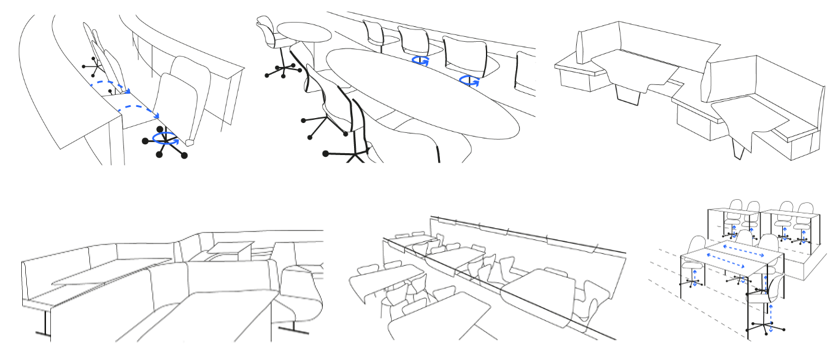
Wie ooit in een vol auditorium heeft gezeten, kent de zoektocht naar een geschikte plaats: voldoende afstand tot de buren, genoeg ruimte voor een laptop, en een zitje dat bereikbaar is zonder over medestudenten te moeten kruipen. Maar niet iedereen heeft dezelfde noden of keuzevrijheid. Een masterproef ingenieurswetenschappen: architectuur aan de KU Leuven onderzocht daarom zes alternatieve auditoriumindelingen. De conclusie: geen enkele vaste indeling werkt voor iedereen, maar een auditorium kan er wel voor zorgen dat gebruikers keuze hebben over hun plaats, ruimte en contact met anderen.
Er bestaat geen auditorium voor de gemiddelde student
Het klassieke auditorium is vooral ontworpen voor de traditionele manier van lesgeven waarbij studenten naar voren kijken terwijl een docent lesgeeft. Ondertussen evolueert het hoger onderwijs naar activerende lesvormen zoals groepswerk en discussie. Die vormen, waarbij een student actief wordt betrokken, leiden volgens onderzoek tot een beter begrip en betere leerresultaten. Een vaste, frontale opstelling met rijen stoelen en tafels maakt die onderwijsvormen moeilijker.
Ook studenten zelf verschillen. De ene heeft graag wat meer ruimte rond zich, de andere zit liever dicht bij medestudenten. Sommigen raken sneller afgeleid door geluiden of bewegingen, terwijl anderen net nood hebben aan sociaal contact. Daarnaast spelen lichamelijke verschillen een rol. Bestaand onderzoek laat bijvoorbeeld zien dat het auditoriummeubilair bij minder dan 20 procent van de studenten goed aansluit bij hun lichaamsmaten.
Die verschillen werden in de interviews vertaald naar de praktijk. Eén student beschreef het als volgt: "Je zit in een volle aula precies op de schoot van een ander… En dan met uw spullen, en uw jas, en uw rugzak en al die dingen…"
Daarnaast spelen ook zintuiglijke prikkels en mobiliteit mee. Een student met autisme vertelde hoe moeilijk het is om een les te verlaten bij overprikkeling: "Stel, je bent tijdens een les overprikkeld en je wilt even naar buiten gaan. Moet je dan echt iedereen gaan passeren? Dat is wel onhandig." Ook studenten met verminderde mobiliteit kunnen door de klassieke niveauverschillen niet zomaar overal zitten. Sommige studenten zoeken dan weer net bewust een rustige plek met minder medestudenten. Eenzelfde auditorium wordt dus door elke gebruiker anders ervaren.
De diversiteit centraal
Om te onderzoeken hoe een auditorium beter kan omgaan met die verschillen, werden zes verschillende indelingen voorgesteld. Ze varieerden van vaste geclusterde tafels tot draaibare stoelen en verplaatsbare tafels. De ontwerpen werden beoordeeld door twaalf deelnemers: zes studenten en zes docenten. Zij werden bewust geselecteerd om verschillende vormen van mobiliteit, zintuiglijke ervaringen en neurodiversiteit te vertegenwoordigen. Ook de docenten verschilden in hun manier van lesgeven. Het doel was dus niet om te zoeken naar de noden van de ‘gemiddelde student’, maar juist naar verschillen tussen gebruikers.
Uit de gesprekken en vergelijkingen kwamen twee spanningen naar voren. De eerste is die tussen ruimte en capaciteit. Meer stoelen betekent niet automatisch dat een aula ook meer bruikbare plaatsen heeft. Studenten gaven bijvoorbeeld aan dat ze soms bewust een extra bank vrijhouden om te zorgen voor voldoende werkruimte of afstand.
“Ik neem sowieso liefst twee banken. Ook om niet constant ge-sandwich te zitten tussen mensen,” vertelde een student.
Een aula met een hoge capaciteit maar krappe plaatsen kan daardoor minder bruikbaar zijn dan een minder compacte variant.
De tweede spanning gaat over samenwerken en individuele vrijheid. Samenwerken kan pedagogisch voordelig zijn doordat studenten actief leren redeneren en uitleggen. Maar niet iedereen ervaart groepswerk op dezelfde manier. Voor sommige studenten kan het stress geven wanneer ze zelf een groep moeten zoeken of met onbekenden moeten samenwerken. Voor anderen kan diezelfde situatie net een kans zijn om nieuwe mensen te leren kennen. Een goed auditorium moet samenwerking daarom mogelijk maken zonder het op te leggen.
Draaien in plaats van verhuizen
Van de zes onderzochte indelingen bood de Turn & Learn-variant met ovale groepstafels het beste antwoord op die spanningen. Studenten zitten er in paren van rijen op hetzelfde niveau. De ene helft heeft een rechte tafel, de andere een ovale groepstafel. Tijdens een hoorcollege kunnen studenten naar voren blijven kijken. Voor groepswerk kunnen ze eenvoudig hun stoel draaien zonder grote ruimtelijke aanpassingen.
“Hier moet je niks meer doen. Dan moet je enkel je stoel draaien,” zei een student over deze opstelling.
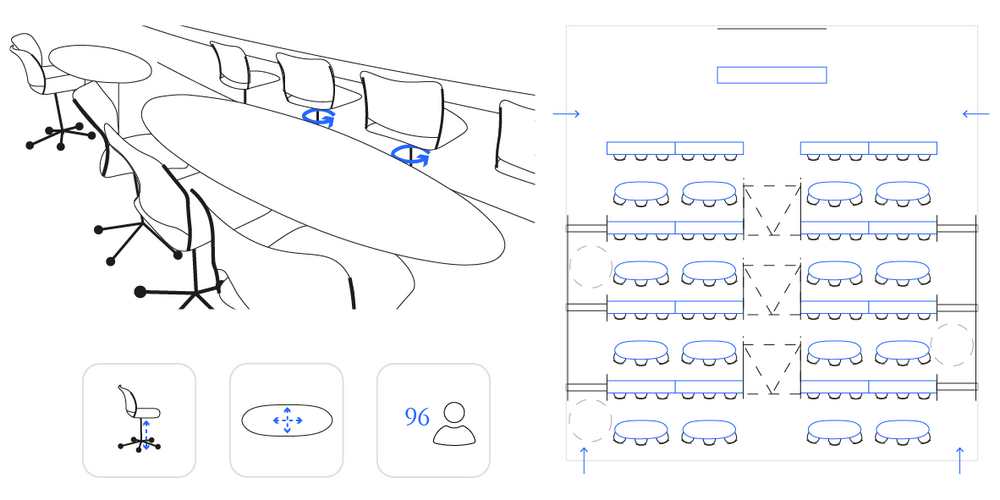
Hoewel het maar een kleine ingreep lijkt, is dit een belangrijke opmerking. De ruimte maakt samenwerking mogelijk zonder dat de student voortdurend verplicht aan een groepstafel moet zitten. Tegelijk blijft de opstelling duidelijk en voorspelbaar.
De brede, hellende gang door het midden van het auditorium is nog een troef. Die werd in de eerste plaats voorzien om te zorgen voor rolstoeltoegankelijke circulatie, maar bleek tijdens de interviews ook uitnodigend voor docenten om zich te verplaatsen doorheen de ruimte. Op die manier kunnen ze tussen de studenten gaan staan, wat drempelverlagend werkt voor de student-docentrelatie. Zo is een ingreep voor toegankelijkheid ook voordelig voor inclusiviteit en pedagogie.
Geen perfect auditorium, wel betere keuzes
Geen enkele vaste indeling kan tegelijk aan alle noden van alle gebruikers voldoen. De bevindingen werden daarom vertaald naar acht ontwerpprincipes voor inclusieve en activerende auditoria. Die gaan onder meer over voldoende werkruimte, toegankelijke circulatie, discrete vluchtwegen, keuze in sociale nabijheid, docentmobiliteit en de mogelijkheid om verschillende lesvormen te ondersteunen. De belangrijkste conclusie is dat een aula niet hetzelfde moet zijn voor iedereen.
De Turn & Learn-variant met ovale tafels is een mogelijke referentie die verschillende noden kan samenbrengen, maar de ontwerpen moeten worden afgestemd op de specifieke context van het auditorium. Bij het ontwerpen van een auditorium gaat het dus niet enkel om capaciteit en functionaliteit. Er moet aandacht zijn voor de toekomstige leervormen, studenten en docenten in al hun diversiteit.

Bibliografie
Abouelsaad, A. S., & Shafik, Z. Y. (2017). Architectural Design Criteria for Inclusive Education Schools. SSRN Electronic Journal. https://doi.org/10.2139/ssrn.3164208
Ahmad Najmee, N. A., Mohammed, Z., Rahman, M. H. A., Fadzil, N. M., Ludin, A. F. M., & Hassan, R. (2025). Classroom settings for visually impaired schoolchildren: A scoping review. PLOS ONE, 20(2), e0318871. https://doi.org/10.1371/journal.pone.0318871
Amer Alqahtani, L. (2015). Furnishing and Indoor Environment for Hyperactivity and Distracted Attention (in the Context of Sustainable Design). International Journal of Contemporary Architecture The New ARCH, (Vol.2, No. 1), 1-10. https://doi.org/10.14621/tna.20150201
Amor, M. C., & Elsotouhy, A. (2016). Neuroscience and Interior Architecture: Impact on Autism. Qatar Foundation Annual Research Conference Proceedings Volume 2016 Issue 1. Qatar Foundation Annual Research Conference Proceedings. https://doi.org/10.5339/qfarc.2016.SSHAPP1744
Ansari, S., Nikpay, A., & Varmazyar, S. (2018). Design and Development of an Ergonomic Chair for Students in Educational Settings. Health Scope, In Press(In Press). https://doi.org/10.5812/jhealthscope.60531
Audience Systems. (z.d.). [Lecture hall seating—Leeds University Business School] [Foto]. https://www.audiencesystems.com/case-studies/leeds-university-business-school/
Baarda, B., & Hulst, M. van der. (2017). Basisboek Interviewen: Handleiding voor het voorbereiden en afnemen van interviews (Vierde druk). Noordhoff Uitgevers.
Baepler, P. (2023). Orientation and Social Inclusion: Supporting Students with Visual Impairments in Active Learning Classrooms. https://www.semanticscholar.org/paper/Orientation-and-Social-Inclusion%3A-Supporting-with-Baepler/abfd8b4cc754ed972666065b4927a45f239953bc
Basister, M. P., Petersson, J., & Baconguis, R. D. T. (2025). Educational innovations for an inclusive learning environment: Insights from the teachers’ collaboration through lesson study. Frontiers in Education, 10, 1610749. https://doi.org/10.3389/feduc.2025.1610749
Becher, R., Øvrevik, J., Schwarze, P., Nilsen, S., Hongslo, J., & Bakke, J. (2018). Do Carpets Impair Indoor Air Quality and Cause Adverse Health Outcomes: A Review. International Journal of Environmental Research and Public Health, 15(2), 184. https://doi.org/10.3390/ijerph15020184
Beckers, R., Van Der Voordt, T., & Dewulf, G. (2016). Why do they study there? Diary research into students’ learning space choices in higher education. Higher Education Research & Development, 35(1), 142-157. https://doi.org/10.1080/07294360.2015.1123230
Bhuiyan, T. H., & Hossain, Md. S. J. (2015). University hall furniture design based on anthropometry: An artificial neural network approach. International Journal of Industrial and Systems Engineering, 20(4), 469. https://doi.org/10.1504/IJISE.2015.070184
Buildings Forum. (z.d.). [Foto van auditoriuminterieur] [Foto]. https://buildings-forum.com/nl/projects/detail/3238
Burwell Architects. (z.d.-a). [The Exchange Falmouth auditorium] [Foto]. Geraadpleegd https://www.burwellarchitects.com/content-item/the-exchange-falmouth
Burwell Architects. (z.d.b). [Auditorium—University of Leeds] [Foto]. https://www.burwellarchitects.com/content-item/auditoria-university-of-leeds
Cameron, H. E. (2016). Beyond cognitive deficit: The everyday lived experience of dyslexic students at university. Disability & Society, 1-18. https://doi.org/10.1080/09687599.2016.1152951
Casanova, D., Huet, I., & Garcia, F. (2023). The Experience of Co-Designing a Learning Space with Teachers and Students. Education Sciences, 13(2), 103. https://doi.org/10.3390/educsci13020103
Ceresnova, Z., Rollova, L., & Koncekova, D. (2018). Inclusive Design of Educational Environment for Diverse People. In G. Di Bucchianico & P. F. Kercher (Red.), Advances in Design for Inclusion (Vol. 587, pp. 431-440). Springer International Publishing. https://doi.org/10.1007/978-3-319-60597-5_41
Chalise, K. (2024). Models of Disability and Inclusive Education. Tele-Education.
Clement, N. M. (2018). The Use and Impact of the Collaborative Lecture Theatres: Digging Up the Foundations of the Lecture Theatre. University of Leeds. https://r.search.yahoo.com/_ylt=Awr.ioXaSh1qSQIAsN6PAwx.;_ylu=Y29sbwNpcjIEcG9zAzEEdnRpZAMEc2VjA3Ny/RV=2/RE=1781514203/RO=10/RU=https%3a%2f%2fteachingexcellence.leeds.ac.uk%2fwp-content%2fuploads%2fsites%2f89%2f2019%2f01%2fMartin-Clement-Final-Report-1.pdf/RK=2/RS=gOzrafrJGdKu1JOIYRbh75DNjAc-
Cloete, M., & Rout, M. (2025). ‘DeafSpace’ in the built school environment: A scoping review. Acta Structilia, 32(2), 238-263. https://doi.org/10.38140/as.v32i2.9146
Clouder, L., Karakus, M., Cinotti, A., Ferreyra, M. V., Fierros, G. A., & Rojo, P. (2020). Neurodiversity in higher education: A narrative synthesis. Higher Education, 80(4), 757-778. https://doi.org/10.1007/s10734-020-00513-6
Cort, C., Cort, G., & Williams, R. (2017). The Challenge of Making Buildings Flexible: How to Create Campuses That Adapt to Changing Needs. Planning for Higher Education, 45(4), 96-104. ProQuest Central (1991593447).
de Smet, M., Theelen, H., Vanhees, C., & van Breukelen, D. (2024). Briljant Blenden.
Denys, H., Heylighen, A., Jelic, A., & KU Leuven. Faculteit Ingenieurswetenschappen. Opleiding Master in de ingenieurswetenschappen. Architectuur (Leuven) degree granting institution. (2024). The role of the built workplace in well-being: Learning from experiences of teachers on the autism spectrum. In De rol van de gebouwde werkplek in welzijn: Leren van de ervaringen van leerkrachten op het autismespectrum. KU Leuven. Faculteit Ingenieurswetenschappen.
Diamond, A. (2005). Attention-deficit disorder (attention-deficit/ hyperactivity disorder without hyperactivity): A neurobiologically and behaviorally distinct disorder from attention-deficit/hyperactivity disorder (with hyperactivity). Development and Psychopathology, 17(3), 807-825. https://doi.org/10.1017/S0954579405050388
Edwards, M. R., & Clinton, M. E. (2019). A study exploring the impact of lecture capture availability and lecture capture usage on student attendance and attainment. Higher Education, 77(3), 403-421. https://doi.org/10.1007/s10734-018-0275-9
Elkington, S., & Bligh, B. (2019). Future Learning Spaces: Space, Technology and Pedagogy.
Ellis, R. A., & Goodyear, P. (2016). Models of learning space: Integrating research on space, place and learning in higher education. Review of Education, 4(2), 149-191. https://doi.org/10.1002/rev3.3056
Espada-Chavarria, R., González-Montesino, R. H., López-Bastías, J. L., & Díaz-Vega, M. (2023). Universal Design for Learning and Instruction: Effective Strategies for Inclusive Higher Education. Education Sciences, 13(6), 620. https://doi.org/10.3390/educsci13060620
Fabri, M., & Andrews, P. C. S. (2016). Human-Centered Design with Autistic University Students: Interface, Interaction and Information Preferences. In A. Marcus (Red.), Design, User Experience, and Usability: Novel User Experiences (Vol. 9747, pp. 157-166). Springer International Publishing. https://doi.org/10.1007/978-3-319-40355-7_15
Ferco Seating. (z.d.). [Foto van inclusief auditoriumontwerp] [Foto]. https://fercoseating.com/news/education/design-planning-creating-inclusive-environment-universities
Fernández Batanero, J. M., Rueda Montenegro, M., Cerero Fernández, J., & García Alonso, S. (2022). Challenges and trends in the use of technology by hearing impaired students in higher education. Technology and Disability, 34(2), 101-111. https://doi.org/10.3233/TAD-220372
Finkelstein, A., Ferris, J., Weston, C., & Winer, L. (2016). Research-Informed Principles for (Re)Designing Teaching and Learning Spaces. Journal of Learning Spaces, 5(1), 26-40.
Fisher, K., & Newton, C. (2014). Transforming the twenty-first-century campus to enhance the net-generation student learning experience: Using evidence-based design to determine what works and why in virtual/physical teaching spaces. Higher Education Research & Development, 33(5), 903-920. https://doi.org/10.1080/07294360.2014.890566
Frayling, C. (1993). Research in Art and Design (No. 1874175551; Royal College of Art Research Papers, p. 5). Royal College of Art. https://antle.iat.sfu.ca/wp-content/uploads/2018/08/Frayling.pdf
Gallaudet University. (z.d.). DeafSpace—Campus Design and Planning. Gallaudet University. Geraadpleegd 23 mei 2026, van https://gallaudet.edu/campus-design-facilities/campus-design-and-planning/deafspace/
Gin, L. E., Guerrero, F. A., Cooper, K. M., & Brownell, S. E. (2020). Is Active Learning Accessible? Exploring the Process of Providing Accommodations to Students with Disabilities. CBE—Life Sciences Education, 19(4), es12. https://doi.org/10.1187/cbe.20-03-0049
Good Tape. (z.d.). Privacy policy. Good Tape. Geraadpleegd 30 mei 2026, van https://goodtape.io/privacy-policy/
Hallahan, H., Kauffman, J. M., & Pullen, P. C. (2014). Exceptional Learners: An Introduction to Special Education (12de dr.). Pearson.
Healey, M. (2022). The Design of Physical Learning Spaces in Supporting Learning and Engaging Students on Campus.
Hockings, C., Brett, P., & Terentjevs, M. (2012). Making a difference—Inclusive learning and teaching in higher education through open educational resources. Distance Education, 33(2), 237-252. https://doi.org/10.1080/01587919.2012.692066
HOLT Architects. (z.d.). [Foto van Illick Lecture Hall] [Foto]. https://holt.com/esf-illick-lecture-hall
Hui, A. Y. C., & Mahmood, S. (2020). DESIGN IMPROVEMENT OF AUDITORIUM SEATING: A CASE STUDY AT PAGOH EDUCATION HUB. 5.
IndiaMART. (z.d.). [Foto van auditoriuminterieur] [Foto]. https://www.indiamart.com/proddetail/lecture-hall-designing-15180430355.html
Jansen, D., Petry, K., Ceulemans, E., Van Der Oord, S., Noens, I., & Baeyens, D. (2017). Functioning and participation problems of students with ADHD in higher education: Which reasonable accommodations are effective? European Journal of Special Needs Education, 32(1), 35-53. https://doi.org/10.1080/08856257.2016.1254965
Kattari, S. K., & Erickson, D. (2025). “If you’re asking for my diversity, you’re asking for all of me”: Challenging experiences of neurodivergent higher education faculty in the United States. Journal of Diversity in Higher Education, 19(2), 109-119. https://doi.org/10.1037/dhe0000639
Korthals Altes, T., Willemse, M., Goei, S. L., & Ehren, M. (2024). Higher education teachers’ understandings of and challenges for inclusion and inclusive learning environments: A systematic literature review. Educational Research Review, 43, 100605. https://doi.org/10.1016/j.edurev.2024.100605
Kraushaar, J. M., & Novak, D. (2010). Examining the Effects of Student Multitasking with Laptops during the Lecture. Journal of Information Systems Education, 21, 241-251.
KU Leuven. (2024). Jaarverslag KU Leuven 2024. KU Leuven. https://www.kuleuven.be/over-kuleuven/pdf/jaarverslag-ku-leuven-2024-met-uv.pdf
KU Leuven. (z.d.a). [Foto van auditorium 00.07] [Foto]. https://www.kuleuven.be/kulag/nl/lokaal/490-14-000007/onderwijs
KU Leuven. (z.d.b). [Foto van auditorium 01.12] [Foto]. https://www.kuleuven.be/kulag/nl/lokaal/122-20-010012/onderwijs
KU Leuven. (z.d.c). [Foto van auditorium 02.28] [Foto]. https://www.kuleuven.be/kulag/nl/lokaal/118-01-020028/onderwijs
KU Leuven. (z.d.d). [Foto van Aula Vesalius 91.30] [Foto]. https://www.kuleuven.be/kulag/nl/lokaal/111-01-910030/onderwijs
KU Leuven Stuvo. (z.d.). ListenWIFI: Beluister de les via je smartphone [Nieuwsbericht]. KU Leuven onderwijs. Geraadpleegd 23 mei 2026, van https://www.kuleuven.be/stuvo/functiebeperking/listenwifi-luister-de-les-via-je-smartphone
Leijon, M., Nordmo, I., Tieva, Å., & Troelsen, R. (2022). Formal learning spaces in Higher Education – a systematic review. Teaching in Higher Education, 29(6), 1460-1481. https://doi.org/10.1080/13562517.2022.2066469
Levy, L. G. G., Ferreira, L., Pinto, J. D., Nascimento, G. B., Biaggio, E. P. V., & Kessler, T. M. (2020). Hearing impairment and higher education: Perceptions of students and employees in a Brazilian Public Institution. Research, Society and Development, 9(1), e95911603. https://doi.org/10.33448/rsd-v9i1.1603
Mace, R., Connell, B. R., Jones, M., Mueller, J., Ostroff, E., Sanford, J., Steinfeld, E., Story, M., & Vanderheiden, G. (1997). Universal Design Principles. The Center for Universal Design, NC State University. https://www.udinstitute.org/_files/ugd/634d48_7a1b48c7879247a59ba059fa0c38dc14.pdf
Malik, Ayesha. M., Assistant Professor, School of Architecture and Planning, UMT, Lahore, Pakistan, Rashid, M., Assistant Professor, School of Architecture and Planning, UMT, Lahore, Pakistan, Awan, M. Y., Dean, School of Architecture and Planning, UMT, Lahore, Pakistan, Alvi, I. B., & 4 Ph. D. Student, Special Education, University of Management and Technology, Lahore, Pakistan. (2018). The Role of Architecture in the Identification of Obstacles and Spatial Solutions to Inclusive Education. UMT Education Review, 01(02), 39-58. https://doi.org/10.32350/uer.12.03
Marginson, S. (2016). The worldwide trend to high participation higher education: Dynamics of social stratification in inclusive systems. Higher Education, 72(4), 413-434. https://doi.org/10.1007/s10734-016-0016-x
Moriña, A. (2017). Inclusive education in higher education: Challenges and opportunities. European Journal of Special Needs Education, 32(1), 3-17. https://doi.org/10.1080/08856257.2016.1254964
Moriña, A., & Morgado, B. (2018). University surroundings and infrastructures that are accessible and inclusive for all: Listening to students with disabilities. Journal of Further and Higher Education, 42(1), 13-23. https://doi.org/10.1080/0309877X.2016.1188900
Moriña Díez, A., López, R. G., & Molina, V. M. (2015). Students with disabilities in higher education: A biographical-narrative approach to the role of lecturers. Higher Education Research & Development, 34(1), 147-159. https://doi.org/10.1080/07294360.2014.934329
Oblinger, D. (Red.). (2006). Learning spaces. Educause.
Odunaiya, N., Oguntibeju, O., & Owonuwa. (2014). Ergonomic suitability of educational furniture and possible health implications in a university setting. Advances in Medical Education and Practice, 1. https://doi.org/10.2147/AMEP.S38336
Ogaro, T. (2026). Disability Models and Inclusive Education: A Critical Review. Indonesian Journal of Teaching and Learning (INTEL), 5(1), 1-16. https://doi.org/10.56855/intel.v5i1.1664
Orr, D. W. (1993). Architecture as Pedagogy. Conservation Biology, 7(2), 226-228. https://doi.org/10.1046/j.1523-1739.1993.07020226.x
Ostroff, E. (1997). Mining our natural resources: The user as expert. Innovation, 16(1), 33-35.
Osuna-Juárez, A., & González-Castellano, N. (2024). Understanding professors’ and students with disabilities’ perceptions of inclusive higher education: A systematic literature review. European Journal of Special Needs Education, 39(5), 774-788. https://doi.org/10.1080/08856257.2023.2294238
Papaioannou, G., Volakaki, M.-G., Kokolakis, S., & Vouyioukas, D. (2023). Learning Spaces in Higher Education: A State-of-the-Art Review. Trends in Higher Education, 2(3), 526-545. https://doi.org/10.3390/higheredu2030032
Parcells, C., Stommel, M., & Hubbard, R. P. (1999). Mismatch of classroom furniture and student body dimensions. Journal of Adolescent Health, 24(4), 265-273. https://doi.org/10.1016/S1054-139X(98)00113-X
Park, E. L., & Choi, B. K. (2014). Transformation of classroom spaces: Traditional versus active learning classroom in colleges. Higher Education, 68(5), 749-771. https://doi.org/10.1007/s10734-014-9742-0
Parvez, M. S., Rahman, A., & Tasnim, N. (2019). Ergonomic mismatch between students anthropometry and university classroom furniture. Theoretical Issues in Ergonomics Science, 20(5), 603-631. https://doi.org/10.1080/1463922X.2019.1617909
Pasenidou, F. (2024). The emerging intersection: The role of architecture in promoting inclusive education. Oxford Review of Education, 52(1), 79-95. https://doi.org/10.1080/03054985.2024.2427041
Patil, A., & Raghani, S. (2025). Designing accessible and independent living spaces for visually impaired individuals: A barrier-free approach to interior design. International Journal for Equity in Health, 24(1), 137. https://doi.org/10.1186/s12939-025-02503-5
Pino, M., & Mortari, L. (2014). The Inclusion of Students with Dyslexia in Higher Education: A Systematic Review Using Narrative Synthesis. Dyslexia, 20(4), 346-369. https://doi.org/10.1002/dys.1484
Pinterest. (2018). [Foto van auditoriuminterieur] [Foto]. https://br.pinterest.com/pin/536772849332133986/
Powell, J. (2012). From Ableism to Accessibility in the Universal Design University.
Power, K., O’Flynn, F., Murphy, T., & O’Mahony, M. J. (2024). The Development of an Inclusive Higher Education Framework for Learning Spaces. International Journal of Technology and Inclusive Education, 13(1), 1948-1958. https://doi.org/10.20533/ijtie.2047.0533.2024.0242
Radcliffe, D. (2008). Learning spaces in higher education: Positive outcomes by design. University of Queensland.
Rossi, V. (2023). Inclusive Learning Design in Higher Education: A Practical Guide to Creating Equitable Learning Experiences (1ste dr.). Routledge. https://doi.org/10.4324/9781003230144
Safder, M., Muhammad, M., Akhtar, S., Fatima, G., & Malik, M. (2012). Problems Faced by Students with Hearing Impairment in Inclusive Education at the University Level.
Saltes, N. (2022). ‘It’s all about student accessibility. No one ever talks about teacher accessibility’: Examining ableist expectations in academia. International Journal of Inclusive Education, 26(7), 674-700. https://doi.org/10.1080/13603116.2020.1712483
Sedia Systems. (z.d.). [Texas A&M lecture hall seating] [Foto]. https://www.sediasystems.com/texas-a&m
Shahir, Y. M., & Nang Marfara Idayu, M. Y. (2024). Redesign and Development of a Student’s Chair Parameter at Lecture Hall for Malaysian University. Malaysian Journal of Ergonomics (MJEr), MJEr, 1, 31-45.
Sheffield Hallam University. (2016). Using the “Turn and Learn” lecture theatre. Learning Enhancement & Academic Development (LEAD). https://blogs.shu.ac.uk/learningspaces/files/2015/05/Using-the-turn-and-learn-lecture-theatre.pdf
Shuayb, I. (2020). Inclusive University Built Environments: The Impact of Approved Document M for Architects, Designers, and Engineers. Springer International Publishing. https://doi.org/10.1007/978-3-030-35861-7
Singh, V., & Saxena, S. (2023). Designing for Accessibility: Creating Inclusive Spaces in Architecture. International Journal of Science and Research (IJSR), 12(5), 1255-1271. https://doi.org/10.21275/SR23515094417
SIS Global Seating. (2024a). [Foto van auditorium University of Bristol] [Foto]. https://sisglobalseating.com/project/university-of-bristol/
SIS Global Seating. (2024b). [Foto van auditorium University of Liverpool] [Foto]. https://sisglobalseating.com/project/university-of-liverpool/
Smith, D. H., & Andrews, J. F. (2015). Deaf and hard of hearing faculty in higher education: Enhancing access, equity, policy, and practice. Disability & Society, 30(10), 1521-1536. https://doi.org/10.1080/09687599.2015.1113160
Smith, D. P., Hoare, A., & Lacey, M. M. (2018). Who goes where? The importance of peer groups on attainment and the student use of the lecture theatre teaching space. FEBS Open Bio, 8(9), 1368-1378. https://doi.org/10.1002/2211-5463.12494
StEvens, C. (2022). The lived experience of autistic teachers: A review of the literature. International Journal of Inclusive Education, 28(9), 1871-1885. https://doi.org/10.1080/13603116.2022.2041738
Stone, S.-D., Crooks, V. A., & Owen, M. (2013). Going through the back door: Chronically ill academics’ experiences as ‘unexpected workers’. Social Theory & Health, 11(2), 151-174. https://doi.org/10.1057/sth.2013.1
Swinnerton B. (2021). Collaborative lecture theatres: Does redesign of teaching space impact on pedagogy? Journal of Learning Spaces, 3(10), 1-12.
Tavassoli, T., Marcham, H., & Harvey, K. (2024). How does the built environment affect you? Autistic students’ experiences of University lecture theatres and teaching spaces. PsyArXiv. https://doi.org/10.31234/osf.io/uwrn5
Taylor, I. (Red.). (2016). Future campus: Design quality in university buildings. RIBA Publications.
Temple, P. (2008). Learning spaces in higher education: An under-researched topic. London Review of Education, 6(3). https://doi.org/10.1080/14748460802489363
Tinto, V. (1975). Dropout from Higher Education: A Theoretical Synthesis of Recent Research. Review of educational research, 45(1), 89-125. https://doi.org/10.3102/00346543045001089
Tsou, Y.-T., Kovács, L. V., Louloumari, A., Stockmann, L., Blijd-Hoogewys, E. M. A., Koutamanis, A., & Rieffe, C. (2026). School-Based Interventions for Increasing Autistic Pupils’ Social Inclusion in Mainstream Schools: A Systematic Review. Review Journal of Autism and Developmental Disorders, 13(1), 45-68. https://doi.org/10.1007/s40489-024-00429-2
Valtonen, T., Leppänen, U., Hyypiä, M., Kokko, A., Manninen, J., Vartiainen, H., Sointu, E., & Hirsto, L. (2021). Learning environments preferred by university students: A shift toward informal and flexible learning environments. Learning Environments Research, 24(3), 371-388. https://doi.org/10.1007/s10984-020-09339-6
Van Hees, V., Stokx, R., & Mertens, V. (2024). Lesopnames inclusief inzetten: Van beleid naar praktijk. Steunpunt Inclusief Hoger Onderwijs.
Van Note Chism, N. (2006). Challenging traditional assumptions and rethinking learning spaces. In D. G. Oblinger (Red.), Learning spaces (p. 2.1-2.12). EDUCAUSE. https://www.educause.edu/learningspaces
Vanhees, C., Milou de Smet, Laura Eeckhoudt, Karolien Adriaens, & Dinska Van Gucht. (2023). Hoe geef je effectief blended hoger onderwijs vorm? Praktijkaanbevelingen voor docenten. Thomas More Hogeschool. https://thomasmore.be/sites/default/files/2023-03/Leidraad%20EHBO%20docenten.pdf
Veiga, A., Gomes, A. M., & Remião, F. (2025). More than tools: “Video lecture capture” as a step towards pedagogic differentiation. Journal of Applied Research in Higher Education, 17(7), 61-75. https://doi.org/10.1108/JARHE-04-2024-0185
VRT NWS. (2024). [Campus Opera in Antwerpen] [Foto]. https://images.vrt.be/vrtnws_web/2024/02/01/0102cd7a-c11c-11ee-b483-02b7b76bf47f.jpg
Wang, Q., & Chen, Y. (2024). Applying a Kano-FAST integration approach to design requirements for auditorium chairs. BioResources, 19(3), 5825-5838. https://doi.org/10.15376/biores.19.3.5825-5838
Winterhalter, E. (z.d.). Physical learning spaces and college students with ADHD. California State University, Northridge.
Wood, R., & Happé, F. (2023). What are the views and experiences of autistic teachers? Findings from an online survey in the UK. Disability & Society, 38(1), 47-72. https://doi.org/10.1080/09687599.2021.1916888
Yadav, P., Udaya Kumar, D., & Karmakar, S. (2021). Inclusive Design in Higher Educational Institutes for People with Disability. In A. Chakrabarti, R. Poovaiah, P. Bokil, & V. Kant (Red.), Design for Tomorrow—Volume 2 (Vol. 222, pp. 165-176). Springer Singapore. https://doi.org/10.1007/978-981-16-0119-4_14
Yan, S., Wai, C. Y., Zhang, J., Geng, S., Wei, J., Chau, H.-W., & Jamei, E. (2025). Designing for Inclusion: A Comparative Analysis of Inclusive Campus Planning Across Australian Universities. Architecture, 5(3), 43. https://doi.org/10.3390/architecture5030043