Wat we (niet) weten over de honderden camera's in de stad
Aan de palen in het stadspark, tegen de gevels in de winkelstraat en op de grote kruispunten: in de binnenstad van Hasselt hangen maar liefst 492 actieve bewakingscamera's. Als voetganger of fietser lopen we er dagelijks straal voorbij. Maar wat gebeurt er als je voorbijgangers dwingt om wel naar boven te kijken? Dan blijken we massaal verhalen te verzinnen over wie er aan de andere kant van de lens zit.
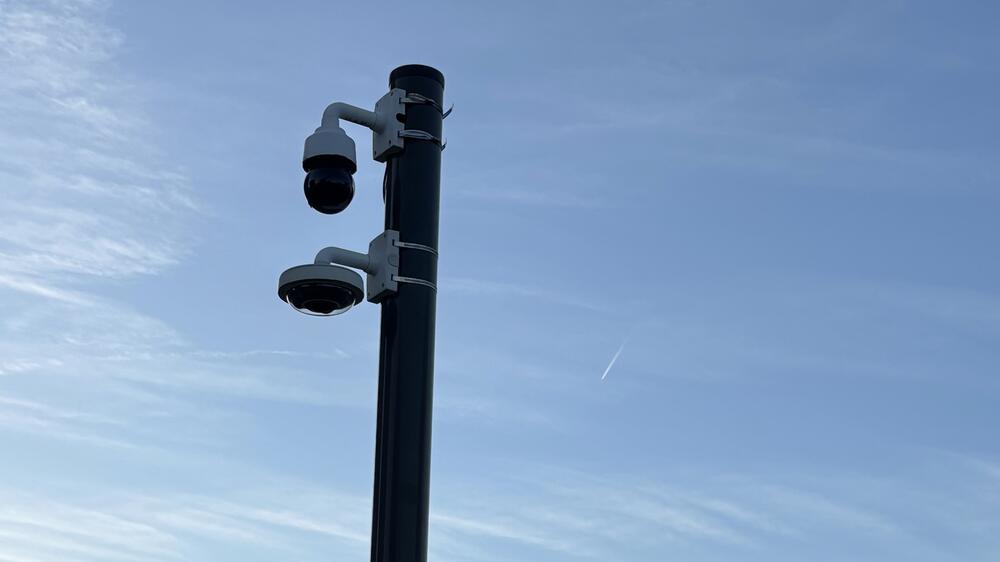
Voor mijn masterproef Communicatiewetenschappen wilde ik weten wat de gemiddelde burger eigenlijk weet over het cameranetwerk in zijn of haar stad. Om dat te achterhalen, organiseerde ik een tiental data walks. Ik nam 22 deelnemers uit verschillende demografische groepen mee op wandeling langs acht camerapunten: van het drukke stadspark en het skatepark tot een rustige woonwijk en de winkelstraat. Onderweg dachten ze hardop na bij elke camera die we tegenkwamen. Waarom hangt die daar? En vooral: wie kijkt er mee? Het antwoord op die laatste vraag bleek een vat vol mythes en misverstanden.
Mythes en mayonaisevlekken
Wanneer mensen niet weten hoe een systeem werkt, vullen ze de leegtes zelf in. Sommige wandelaars waren ervan overtuigd dat de camera's je automatisch van straat tot straat volgen zodra je in beeld komt. Anderen zagen de bekende nummerplaatcamera’s (ANPR) als een verborgen manier om de stadskas te spijzen.
"Trajectcontroles hebben niks met veiligheid te maken, het is puur een verdienmodel van de staat" - deelnemer
Maar de meest tot de verbeelding sprekende theorie was ongetwijfeld die over de controlekamer. Meerdere deelnemers beeldden zich in dat er 24 uur per dag, 7 dagen per week een agent naar de schermen staart. Eén wandelaar omschreef het als "een dikke man met mayonaisevlekken op zijn hemd" die achter de schermen elke beweging in de stad nauwlettend in de gaten houdt.
De realiteit achter de lens
Tijd voor een realitycheck bij de politiezone Limburg Regio Hoofdstad (LRH). Daar blijkt de praktijk een pak minder spectaculair dan de theorieën.
"Met duizend camera's in de hele politiezone is het een utopie om te zeggen dat we alles live volgen. Het gaat meestal om retroactief kijken na een incident" - Bart Reekmans, manager van het cameranetwerk (Politie LRH)
Van de man met mayonaisevlekken klopt dus niets. Camerabewaking is streng geregeld door de Camerawet (2007). Bovendien verwijdert het systeem de beelden na dertig dagen automatisch, tenzij ze nodig zijn voor een lopend onderzoek. En hoewel de software wel specifieke objecten kan zoeken, zoals een verdachte met een opvallend logo op de jas of een gedumpte vuilniszak, is er van gezichtsherkenning in de publieke ruimte absoluut geen sprake. Ook de mythe van het ANPR-verdienmodel sneuvelt: in Hasselt is er beleidsmatig voor gekozen om dit cameranetwerk bewust niet in te zetten voor gsm-boetes of trajectcontroles.

Locatie is alles
Toch mag het wantrouwen van de burgers niet zomaar als pure onwetendheid worden weggewuifd. Eén van de belangrijkste vaststellingen uit mijn onderzoek is dat we een bewakingscamera niet overal hetzelfde beoordelen. De context is cruciaal.
Dezelfde camera, beheerd door dezelfde instantie, krijgt een compleet andere betekenis afhankelijk van de locatie. In een drukke winkelstraat vonden de wandelaars het toezicht vanzelfsprekend. Maar exact dezelfde camera in een rustige woonwijk? Dan rezen daar plots wel vragen en voelden mensen zich bespied.
Zelfs goedbedoelde communicatie mist soms haar doel. Bepaalde informatieborden met geruststellende boodschappen zoals 'Wees gerust, onze camera's registreren alles' hadden op de wandelaars een averechts effect. Het toont aan hoe subtiel en complex de relatie tussen burger, overheid en privacy is.
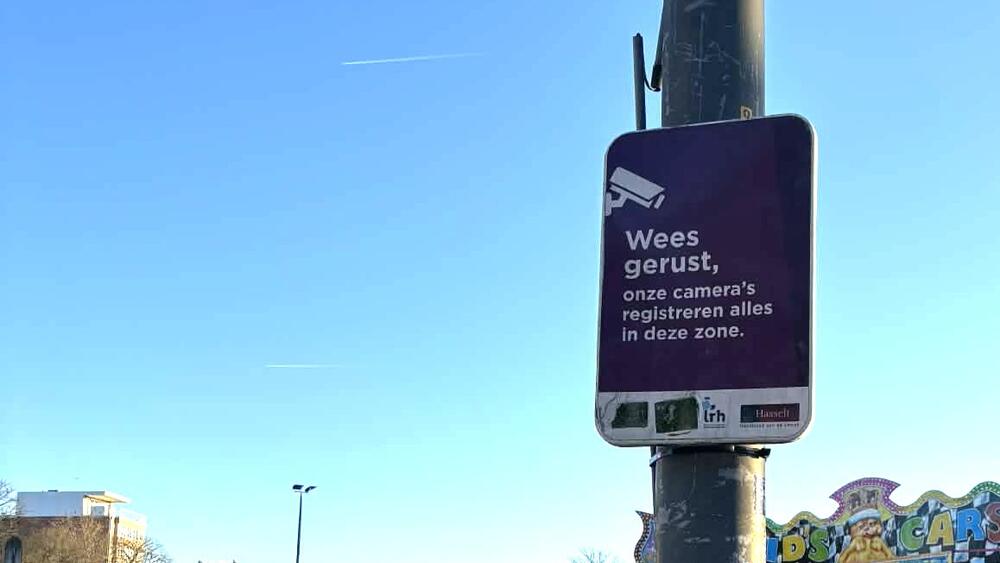
"Dat gaf mij juist een beetje het gevoel van: oei, hier wil iemand wel heel graag met mij meekijken" - deelnemer
Van wantrouwen naar dialoog
Cameratoezicht is een krachtig hulpmiddel, maar zolang het voor de burger een ondoorzichtige black box blijft, zullen de mythes blijven groeien. De oplossing ligt in proactieve communicatie. Politiezones zetten daar al stappen in, bijvoorbeeld door opendeurdagen te organiseren of buurtbewoners actief te informeren wanneer er plots extra camera's bijkomen.
Wist je trouwens dat je als inwoner zelf de regie in handen kan nemen? Bij aanhoudende overlast zoals sluikstorten kan je in Hasselt een tijdelijke 'mobicamera' aanvragen. En als je zelf een camera aan je voordeur hangt, ben je wettelijk verplicht die gratis te registreren via aangiftecamera.be. Die beelden zijn achteraf trouwens cruciaal om misdrijven op te lossen.
De 492 camera’s in de Hasseltse straten zullen niet snel verdwijnen; ze maken deel uit van de moderne stad. Maar pas wanneer we de kloof tussen burger en politie dichten, en duidelijk uitleggen waarom die lenzen precies op dat ene kruispunt hangen, verdwijnt het idee van Big Brother (of een man met mayonaisevlekken) dat meekijkt.
Bibliografie
Amnesty International (z.d.). Surveillance en mensenrechten. Amnesty International. Geraadpleegd op 20 mei 2026, van https://www.amnesty.nl/encyclopedie/surveillance-en-mensenrechten
Armstrong, G., & Norris, C. (1999). The Maximum Surveillance Society: The Rise of CCTV. Routledge. https://doi.org/10.4324/9781003136439
Barnard-Wills, D. (2011). UK News Media Discourses of Surveillance. The Sociological Quarterly, 52(4), 548-567. https://doi.org/10.1111/j.1533-8525.2011.01219.x
Bennett, T., & Gelsthorpe, L. (1996). Public Attitudes Towards CCTV (Closed Circuit Television) in Public Places. Studies on Crime and Crime Prevention, 5(1), 72-90.
Bischoff, P. (2025, juni 25). Surveillance camera statistics: Which are the most surveilled cities? Comparitech. https://www.comparitech.com/vpn-privacy/the-worlds-most-surveilled-citi…
Bolin, G., & Jerslev, A. (2018). Surveillance through media, by media, in media. Northern Lights: Film & Media Studies Yearbook, 16(1), 3-21. https://doi.org/10.1386/nl.16.1.3_2
Brands, J., Schwanen, T., & Van Aalst, I. (2016). What are you looking at? Visitors' perspectives on CCTV in the night-time economy. European Urban and Regional Studies, 23(1), 23-39. https://doi.org/10.1177/0969776413481369
Braun, V., & Clarke, V. (2013). Successful qualitative research: A practical guide for beginners. SAGE.
Bree, R. T., & Gallagher, G. (2016). Using Microsoft Excel to code and thematically analyse qualitative data: A simple, cost-effective approach. All Ireland Journal of Higher Education, 8(2). https://doi.org/10.62707/aishej.v8i2.281
Brockdorff, N., & Appleby-Arnold, S. (2015). The Citizens' Perspective: Awareness, Feelings and Acceptance of Surveillance and Surveillance Systems for Fighting Crime in Europe: A Quantitative Study. European Union. https://www.um.edu.mt/library/oar/handle/123456789/39555
Butot, V., Jacobs, G., Bayerl, P. S., Amador, J., & Nabipour, P. (2023). Making Smart Things Strange Again: Using Walking as a Method for Studying Subjective Experiences of Smart City Surveillance. Surveillance & Society, 21(1), 61-82. https://doi.org/10.24908/ss.v21i1.15665
Byman, D. (2024). Writing Policy Recommendations for Academic Journals: A Guide for the Perplexed. International Security, 48(4), 137-166. https://doi.org/10.1162/isec_a_00485
Cole, M. (2002). Signage and Surveillance: Interrogating the Textual Context of CCTV in the UK. Surveillance & Society, 2(2/3). https://doi.org/10.24908/ss.v2i2/3.3387
Conrad, K. (2009). 'Nothing to Hide … Nothing to Fear': Discriminatory Surveillance and Queer Visibility in Great Britain and Northern Ireland. In The Ashgate Research Companion to Queer Theory (pp. 329–346). Routledge. https://doi.org/10.4324/9781315613482-23
D'Cruz, H., Gillingham, P., & Melendez, S. (2007). Reflexivity: A concept and its meanings for practitioners working with children and families. Critical Social Work, 8(1). https://doi.org/10.22329/csw.v8i1.5744
DeVito, M. A., Birnholtz, J., Hancock, J. T., French, M., & Liu, S. (2018). How People Form Folk Theories of Social Media Feeds and What it Means for How We Study Self-Presentation. Proceedings of the 2018 CHI Conference on Human Factors in Computing Systems, 1-12. https://doi.org/10.1145/3173574.3173694
DeVito, M. A., Gergle, D., & Birnholtz, J. (2017). "Algorithms ruin everything": #RIPTwitter, Folk Theories, and Resistance to Algorithmic Change in Social Media. Proceedings of the 2017 CHI Conference on Human Factors in Computing Systems, 3163-3174. https://doi.org/10.1145/3025453.3025659
Dutta, M. J., Kaur, S., & Elers, P. (2020). Validity in interpretive methods: Frameworks and innovations. Annals of the International Communication Association, 44(3), 185-200. https://doi.org/10.1080/23808985.2020.1792795
England, K. V. L. (1994). Getting Personal: Reflexivity, Positionality, and Feminist Research. The Professional Geographer, 46(1), 80-89. https://doi.org/10.1111/j.0033-0124.1994.00080.x
Entman, R. M. (1993). Framing: Toward Clarification of a Fractured Paradigm. Journal of Communication, 43(4), 51-58. https://doi.org/10.1111/j.1460-2466.1993.tb01304.x
Finlay, L. (2002). Negotiating the swamp: The opportunity and challenge of reflexivity in research practice. Qualitative Research, 2(2), 209-230. https://doi.org/10.1177/146879410200200205
Forlano, L. (2010). Flash Mob Ethnography Workshop. Ethnographic Praxis in Industry Conference Proceedings, 2010, 307-307. https://doi.org/10.1111/j.1559-8918.2010.00030.x
Foucault, M. (1995). Discipline and punish: The birth of the prison (A. Sheridan, Vert.; 2e Vintage Books ed.). Vintage Books. (Origineel werk gepubliceerd in 1975)
Geertz, C. (2008). Thick description: Toward an interpretive theory of culture. In T. S. Oakes & P. L. Price (Eds.), The cultural geography reader (pp. 29–39). Routledge.
Gill, M., Bryan, J., & Allen, J. (2007). Public Perceptions of CCTV in Residential Areas: "It Is Not As Good As We Thought It Would Be." International Criminal Justice Review, 17(4), 304-324. https://doi.org/10.1177/1057567707311584
Gill, M., & Spriggs, A. (2005). Assessing the impact of CCTV (Home Office Research Study No. 292). Home Office Research, Development and Statistics Directorate.
Glaser, B. G., & Strauss, A. L. (2017). The Discovery of Grounded Theory: Strategies for Qualitative Research. Routledge. https://doi.org/10.4324/9780203793206
Goundar, P. R. (2025). Researcher Positionality: Ways to Include it in a Qualitative Research Design. International Journal of Qualitative Methods, 24. https://doi.org/10.1177/16094069251321251
Gras, M. L. (2002). The Legal Regulation of CCTV in Europe. Surveillance & Society, 2(2/3). https://doi.org/10.24908/ss.v2i2/3.3375
Greenberg, J., & Hier, S. (2009). CCTV Surveillance and the Poverty of Media Discourse: A Content Analysis of Canadian Newspaper Coverage. Canadian Journal of Communication, 34(3), 461-486. https://doi.org/10.22230/cjc.2009v34n3a2200
Kim, N., & Greenfield, A. (2011). Systems/Layers: How to run a walkshop on networked urbanism. Diffusion Library. http://diffusion.org.uk/?p=2364
Haggerty, K. D., & Ericson, R. V. (2000). The surveillant assemblage. The British Journal of Sociology, 51(4), 605–622. https://doi.org/10.1080/00071310020015280
Hino, K. (2022). Changes in public attitudes toward CCTV installations in residential areas between 2008 and 2019. Cities, 128, 103810. https://doi.org/10.1016/j.cities.2022.103810
Janssens, J., & Herkes, G. (2016). Smart city en camerabeleid in de stad Genk: Naar een doordachte en gedragen visie (Vol. 52). Maklu.
Kroener, I. (2014). CCTV: A technology under the radar? Routledge.
Latour, B. (2005). Reassembling the Social: An Introduction to Actor-Network-Theory. Oxford University Press. https://doi.org/10.1093/oso/9780199256044.001.0001
Lippert, R. (2009). Signs of the Surveillant Assemblage: Privacy Regulation, Urban CCTV, and Governmentality. Social & Legal Studies, 18(4), 505-522. https://doi.org/10.1177/0964663909345096
Long, A. F., & Godfrey, M. (2004). An evaluation tool to assess the quality of qualitative research studies. International Journal of Social Research Methodology, 7(2), 181-196. https://doi.org/10.1080/1364557032000045302
Lyon, D. (Ed.). (2003). Surveillance as social sorting: Privacy, risk, and digital discrimination. Routledge.
Lyon, D. (2022). Surveillance. Internet Policy Review, 11(4). https://doi.org/10.14763/2022.4.1673
Kenniscentrum Data & Maatschappij. (z.d.). Maak je eigen datawalk! Geraadpleegd op 4 november 2025, van https://data-en-maatschappij.ai/tools/datawalk-handleiding
Meyer, D. Z., & Avery, L. M. (2009). Excel as a Qualitative Data Analysis Tool. Field Methods, 21(1), 91-112. https://doi.org/10.1177/1525822X08323985
Mittelstadt, B. D., Allo, P., Taddeo, M., Wachter, S., & Floridi, L. (2016). The ethics of algorithms: Mapping the debate. Big Data & Society, 3(2), 2053951716679679. https://doi.org/10.1177/2053951716679679
Pillow, W. (2003). Confession, catharsis, or cure? Rethinking the uses of reflexivity as methodological power in qualitative research. International Journal of Qualitative Studies in Education, 16(2), 175-196. https://doi.org/10.1080/0951839032000060635
Piza, E. L., Welsh, B. C., Farrington, D. P., & Thomas, A. L. (2019). CCTV surveillance for crime prevention: A 40‐year systematic review with meta‐analysis. Criminology & Public Policy, 18(1), 135-159. https://doi.org/10.1111/1745-9133.12419
Powell, A. (2018). The data walkshop and radical bottom-up data knowledge. In H. Knox & D. Nafus (Eds.), Ethnography for a data-saturated world (pp. 212–232). Manchester University Press. https://doi.org/10.7765/9781526127600.00018
Schreurs, L. (2025). Research Designs for Communication Science [Powerpoint-slides]. Faculteit voor sociale wetenschappen, Katholieke Universiteit Leuven.
Shaffer, G. (2025). Close Encounters: Gauging Residents' Comfort and Trust Levels with Smart Technologies During "Data Walks". Surveillance & Society, 23(2), 244-264. https://doi.org/10.24908/ss.v23i2.16560
Van Es, K., & De Lange, M. (2020). Data with its boots on the ground: Datawalking as research method. European Journal of Communication, 35(3), 278-289. https://doi.org/10.1177/0267323120922087
Van Zeeland, I., Breuer, J., & Pierson, J. (2021). Walkshops for Citizen Involvement: Walk the Talk with Smart City Citizens. In 2021 IEEE International Smart Cities Conference (ISC2) (pp. 1–4). IEEE. https://doi.org/10.1109/ISC253183.2021.9562922
Verheyden, T. (2024, november 9). Meer dan een half miljoen camera's houden ons in de gaten op straat: "Nationaal cameraregister is dringend nodig". https://www.vrt.be/vrtnws/nl/2024/11/07/halfmiljoencamera-shoudtonsinde…
Wet van 21 maart 2007 tot regeling van de plaatsing en het gebruik van bewakingscamera's, Belgisch Staatsblad, 31 mei 2007, 29529. Justel. https://www.ejustice.just.fgov.be/cgi_loi/change_lg.pl?language=nl&la=N…
Wilson, C., Janes, G., & Williams, J. (2022). Identity, positionality and reflexivity: Relevance and application to research paramedics. British Paramedic Journal, 7(2), 43-49. https://doi.org/10.29045/14784726.2022.09.7.2.43
Zhang, D., Boerman, S. C., Hendriks, H., van der Goot, M. J., Araujo, T. B., & Voorveld, H. A. M. (2024). "They Know Everything": Folk Theories, Thoughts, and Feelings About Dataveillance in Media Technologies. International Journal of Communication, 18, 2710–2730. https://ijoc.org/index.php/ijoc/article/view/21495
Zurawski, N. (2010). 'It is all about perceptions': Closed-circuit television, feelings of safety and perceptions of space – What the people say. Security Journal, 23(4), 259-275. https://doi.org/10.1057/sj.2008.20